케나프 신육성 및 수집 품종의 생육과 사료적 특성 조사
이지연* ・ 벨루사미 비제야난드* ・ 구자룡** ・ 하보근* ・ 김동섭* ・ 김진백* ・ 김상훈* ・ 강시용*†
*한국원자력연구원 첨단방사선연구소, **충남대학교 농업과학연구소
Comparison of Growth Characteristics and Chemical Composition of Kenaf ( Hibiscus cannabinus L.) Varieties as a Potential Forage Crop
Ji Yeon Lee*, Vijayanand Velusamy*, Ja-Yong Koo**, Bo-Keun Ha*, Dong Sub Kim*, Jin-Baek Kim*, Sang Hoon Kim*, and Si-Yong Kang*†
*Advanced Radiation Technology Institute, Korea Atomic Energy Research Institute, 1266 Sinjeong, Jeongeup 580-185, Rep. of Korea.
**Institute of Agricultural Science, Chungnam National University, 99 Daehak-no, Yuseong-gu, Daejeon 305-764, Rep. of Korea.
132
†
Corresponding author: (Phone) +82-63-570-3310 (E-mail) [email protected]
<Received 19 April, 2012; Revised 1 June, 2012; Accepted 7 June, 2012>
ABSTRACT Kenaf (Hibiscus cannabinus) is an annual
herbaceous plant of the family Malvacease that has been planted in tropical Africa and Asia region for more than 4000 years and use as source of fiber, energy and feed stock. In this study, the physiological characters and chemical compositions of kenaf mutant variety “Jangdae” developed using gamma irradiation at the Korea Atomic Energy Research Institute (KAERI) were compared with three genetic resources (Auxu, C12, and C14-DRS). Jangdae showed the highest productivity growth rates in fresh yield, dry weight (DW) yield (leaf and stem), node number, and stem thickness. Especially, leaf DW yield of Jangdae was 1.6-3.1 times higher than that of three genetic resources. Also, stem DW yield of Jangdae was 1.6-2.1 times higher than that of three genetic resources. In the analysis of chemical composition, Jangdae showed 16.9% of crude protein content that was 0.86-0.94 times lower than three cultivars. However, Jangdae showed the highest neutral detergent fiber (NDF) contents in leaf (32.5%) and stem (75.2%). Also, acid detergent fiber (ADF) contents of stem and leaf in Jangdae were 64.4% and 33.9%, respectively. Total polyphenol and total flavonoid contents were 22.1 mg/g and 7.4 mg/g in Jangdae. Based on these results, Jangdae would have the potential to become a successful forage crop.Keywords : Hibiscus cannabinus, Kenaf, Bio-mass, Chemical
composition, Mutant케나프(영명: Kenaf, 학명: Hibiscus cannabinus L.)는 양 마(洋麻)라고도 불리며 서부 아프리카 원산의 무궁화과에 속하는 1년생 초본식물이다. 다양한 토질에서 생육이 가능 하며, 특히 건조에 강한 특성을 보이며 아시아와 아프리카 의 열대 및 아열대 지역에서 오래 전부터 주로 밧줄 및 포 장 재료와 민간 의약품, 사료 및 종자유 등으로 사용되어 왔 다. 최근에는 인도, 중국, 동남아시아, 미국 등에서 주로 재 배되고 있으며, 펄프 및 바이오 플라스틱 용품, 비목재 섬유 작물로써 국제적으로 관심을 받고 있다.
우리나라에서는 가마니 대체용 포대 생산을 위해 1960년 대에 처음으로 케나프를 도입하여 재배 실험을 진행하였으 나(Park and Kim, 1965), 1970년대 초에 화학소재 포대의 등장으로 연구가 중단되었다. 최근 국내에서 친환경적인 산 업용 신소재 개발에 관심이 고조되면서 케나프를 이용하여 목재대체 펄프, 사료용, 바이오 플라스틱 및 바이오 섬유 제 조 등 다양한 연구가 진행되고 있다(Song et al., 1995;
Miyazaki et al., 1995; Cho et al., 2001b; Han et al., 2004).
그리고 생육이 빠른 특성을 이용하여 대기중의 이산화탄소 저장이나 질소, 인산 등 집적 토양에서의 환경 정화용 식물 로도 주목을 받고 있다. 특히 케나프 줄기에 10%, 잎에 40%
내외의 단백질이 다량 함유되어 있어 가축의 조사료로 이용 가치가 매우 높은 것으로 보고 되어있다(Bhardivig et al, 1995; Hollowel et al, 1996). 그리고 최근 관심이 고조되고 있는 항산화 물질인 Flavonoid와 Polyphenol이 케나프 잎에
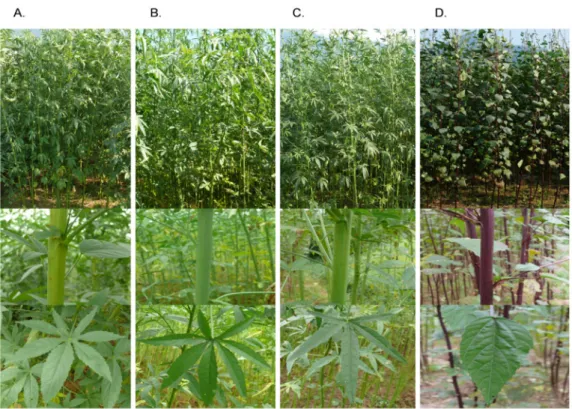
Fig. 1. Growth of leaf and stem at 100 days after seedling (DAP) in four different kenaf (Hibiscus cannabinus L.) varieties.
(A: Jangdae, B: Auxu, C: C-12, D: C14-DRS)
다량 함유되어 있음이 보고되었다(Kim et al., 2009; Ryu etal., 2006). 또한 잎에는 비타민 C 및 철분 함량이 높아 기능
성 식품 및 화장품 소재로 이용도 가능한 작물이다(Bledsoe, 1999; Killinger, 1969).국·내외 수집종 케나프의 대부분은 크게 조생, 중생, 만생 형의 3가지 생육형으로 나뉘는데, 조생종은 국내에서 채종 은 가능하지만 바이오매스 생산성이 크게 떨어지는 단점이 있다. 만생종의 경우 우리나라에서는 일장 감응성이 낮아 종자를 얻는 것이 불가능해 연속 재배에 어려움이 있다. 최 근 미국 및 중국에서 육종된 품종들은 중일성(day-neutral) 인 만생종이 대부분으로 온대 지역에서는 바이오매스 생산 성은 높은 반면, 개화가 늦거나 안되어 채종이 불가능 하다.
그러므로 케나프를 국내에서 대량 재배하기 위해서는 해외 종자 로열티 지불을 줄이고 농가 소득 증대에 기여할 수 있 도록 국내에서 채종이 가능하며 바이오매스 생산량이 높은 신품종 개발이 시급한 실정이다.
본 연구는 가축 사료용으로의 이용 가능성을 검증하기 위 해서 한국원자력연구원에서 방사선 육종기술을 이용하여 개발한 케나프 돌연변이 품종의 생육특성과 유용물질 함량 을 분석하고자 실시하였다.
재료 및 방법
실험 재료
본 실험에서는 4개의 케나프 품종 및 계통(장대, 옥수, C12, 및 C14-DRS)을 대상으로 하였다. 케나프 신품종 장대 는 수집종 ‘진주’ 계통에 감마선 300 Gy를 조사하여 선발 한 돌연변이 품종으로 만생종이며 국내에서 채종이 가능하 다. 옥수는 중국 도입종으로 만생종, C12와 C14-DRS는 이 탈리아 도입계통으로 조숙성이다. 특히 C14-DRS는 줄기 색이 적색을 띈다(Fig. 1).
종자는 2011년 5월 19일 전라북도 정읍시에 있는 한국원 자력연구원 첨단방사선연구소 실험포장에서 파종하였다. 파 종 30일 이후에 재식거리 60 × 20 cm 로 하여 주당묘수를 1개로 솎아주었다. 시비량은 ha당 질소 100 kg, 인산 90 kg 및 칼리 70 kg을 기비로 시용하였다.
생육특성
종자 파종후 생육 100일째에 각 시험구 중간지점에서 품 종별 5본씩을 선정하여 초장, 마디수, 줄기직경을 조사하였 다. 줄기와 잎을 분리하여 채취한 후 생체중을 측정하고, 60℃
에서 7일간 건조시켜 건물중을 측정하였다.
Table 1. Growth characters of four different kenaf (Hibiscus cannabinus L.) varieties.
Varieties
Plant height
(cm)
Number of node
Stem diameter
(mm)
Fresh weight yield/plant (g) Dry weight yield/plant (g)
Leaves Stems Total Leaves Stems Total
Jangdae 243
b64.8
a28.1
a280
a440
a720
a52
a111
a163
aAuxu 226
c46.8
c24.0
b186
b294
b480
b33
b69
b102
bC12 252
ab54.0
b22.5
c156
bc286
b442
b23
bc60
b83
bcC14-DRS 263
a58.8
b20.2
d108
c252
b360
b17
c52
b69
ca-d
Means with different superscripts within a colum are significantly different(P<0.05).
화학적 성분 조사
화학적 성분 조사는 건물중을 측정한 시료를 대상으로 케 나프의 줄기와 잎에서 조단백질, 조지방, 조섬유, 조회분, acid detergent fiber (ADF), neutral detergent fiber (NDF), 총 폴리페놀, 총 플라보노이드를 분석하였다. 일반성분 및 섬유소 분석은 농림수산식품부에서 고시한 사료표준분석방 법(제 2009-372호)을 적용하였으며, 총 플라보노이드 분석 은 식품 의약품안전청에서 고시한 건강기능식품시험법(제 2011-68호)에 준하여 분석하였다. 총 폴리페놀 분석은 시료 2 g을 70% 에탄올 50 ml에 환류 추출후 여과하고, 희석 한 후 Folin 시약 2 ml을 첨가하여 3분 후에 Na2CO3 5 ml을 가하고 혼합하여 발색시켰다. 발색 1시간후 시약을 분광광 도계 725 nm에서 흡광도를 측정하였으며 gallic acid를 표 준물질로 사용하였다.
통계분석
본 실험 결과의 통계분석은 SPSS package를 이용하여 one-way ANOVA 및 Duncan’s multiple range test를 통하 여 p<0.05 수준에서 그룹의 평균치 간의 유의성 차이를 검 정하였다.
결과 및 고찰
생육특성
케나프 품종들의 파종 후 100일째에 생육 정도는 Fig. 1 과 같다. 장대, 옥수, C12는 줄기와 잎이 녹색이며 잎모양이 손바닥 모양(장상)을 나타냈다.
그러나 C14-DRS는 적색의 줄기색을 띄며 완전형의 잎 모양을 나타냈다.
초장은 C14-DRS계통이 263 cm로 가장 컸으며 장대는 그 에 비에 20 cm정도 더 작은(243 cm) 생육을 보였다(Table
1). 그러나 마디수와 경직경에서는 장대가 각각 64.8개, 28.1 mm로 다른 계통들보다 1.1~1.4배 정도 우세를 보였다. 잎 의 생체중은 장대가 주당 280 g로 가장 낮은 C14-DRS보다 2.6배 무거웠으며, 줄기도 또한 주당 440 g으로 가장 무거 웠다. 그러나 옥수, C12, C14-DRS에서의 줄기 무게는 유의 적인 차이를 보이지 않았지만, C14-DRS에서 잎과 줄기의 생체중이 가장 가벼웠다. 건물중에서도 생체중과 유사한 품 종간 차이를 보였으며, 장대는 다른 품종보다 1.6~2.4배가 더 무거웠다. Cho (2001b)등은 제주지역에서 도입품종인 Evergradies 71로 실험한 결과, 생육 100일경 후 수확 시 230 cm 초장에 잎과 줄기의 생체중이 각각 362 g, 512 g으 로 나타났다고 보고하였다. Kim (2007) 등은 강원도 철원 에서 외국 도입품종인 Dowling, Everglade-41, Tainung-2를 가지고 재배 실험한 결과, 잎과 줄기의 생체중은 각각 125~155 g, 346~380 g의 범위를 나타냈다고 보고하였다. 이와 같은 결과로 신품종 장대는 제주도에서 재배한 Evergradies-71 보다는 약간 생육량이 낮지만, 철원지역에서 재배한 다른 도입품종보다 잎과 줄기의 생육이 우세한 것으로 나타났으 며, 앞으로 국내육성 품종으로써의 바이오 매스 생산성의 가치가 높다고 사료된다.
화학적 성분 조사
케나프 품종들 간의 화학적 특성을 조사한 결과는 Table 2와 같다. 식물의 사료 가치 차원에서 중요한 항목인 조단 백질 함량은 줄기에서 3.44%로 장대와 C12에서 가장 높은 함량을 보였으며, 잎에서는 C12에서 19.4%로써 가장 높은 함량을 나타냈다. 장대는 줄기에서와는 달리 조단백질 함량 이 잎에서 16.9%로써 가장 작은 수치를 보였다. 조지방 함 량은 장대의 줄기에서 가장 높았지만 다른 품종들과의 유의 적 차이는 나타나지 않았다. 잎의 조지방 함량은 C14-DRS, 옥수, C12, 그리고 장대 순이었다. 줄기의 조섬유와 조회분 함량은 품종들간의 유의적인 차이를 나타나지 않았다. 잎의
Table 2. Chemical composition of four different kenaf (Hibiscus cannabinus L.) varieties.
Varieties
Crude protein
(%) Crude fat (%) Crude fiber (%) Crude ash (%) ADF (%) NDF (%)
Stem Leaf Stem Leaf Stem Leaf Stem Leaf Stem Leaf Stem Leaf
Jangdae 3.44
a16.9
c0.88
a2.78
c52.0
a16.8
a4.09
a9.12
c64.4
b33.9
b75.2
a32.5
aAuxu 2.24
b17.7
b0.76
a4.81
a53.1
a14.9
b5.26
a8.93
d68.3
a45.9
a72.6
a31.5
aC12 3.44
a19.4
a0.46
a3.85
b52.4
a14.6
b5.53
a9.70
a61.0
b20.7
c74.3
a23.9
bC14-DRS 3.29
a18.9
a0.67
a4.91
a52.6
a17.3
a5.07
a9.55
b64.1
b24.4
c73.7
a28.6
aa-d
Means with different superscripts within a colum are significantly different at P<0.05
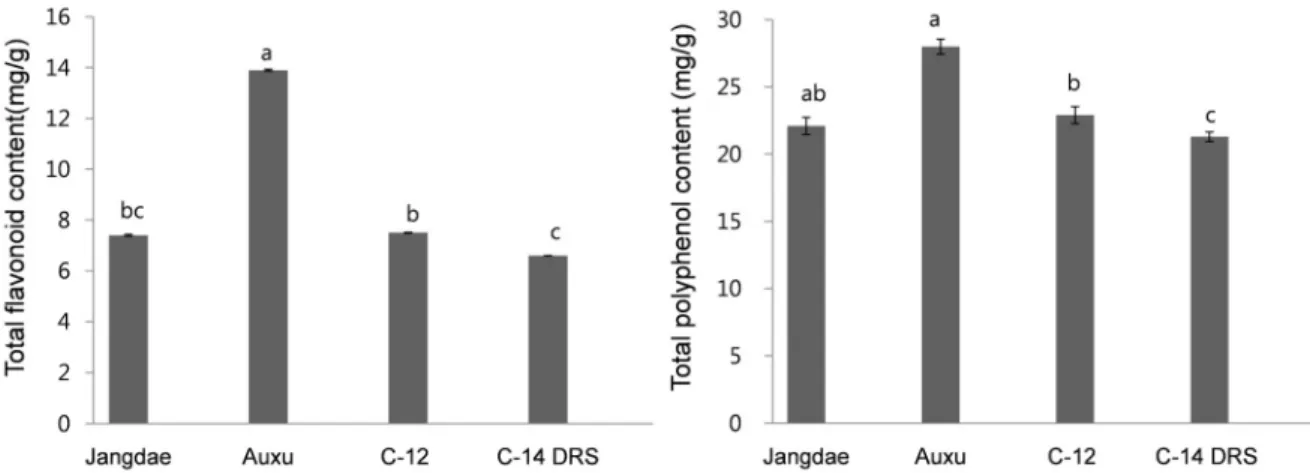
Fig. 2. Total flavonoid and polyphenol content of leaves in four different kenaf (Hibiscus cannabinus L.) varieties.
a-c values with different superscripts are significantly different at p<0.05.
조섬유 함량은 C14-DRS와 장대에서 17.3%와 16.8%로 높 게 나타났으며, 조회분 함량은 C12에서 9.7%로 가장 높게 나타났다. ADF함량은 옥수가 줄기와 잎에서 각각 68.3%와 45.9%로 가장 높았으며, 장대는 그 다음으로 높았다. 그러 나 NDF에서는 장대가 줄기와 잎 모두에서 각각 75.2%와 32.5%로 가장 높은 함량을 보였다. 전체적으로 장대의 잎 은 다른 품종들과 비교하여 조단백질, 조지방 함량이 낮게 나타났고, 조섬유와 조회분은 중간 정도의 함량을 보였으 며, ADF와 NDF함량은 높은 것으로 나타났다. 이 실험에서 와 대조적으로 제주지역에서 재배한 Evergradies 71 품종은 120일경의 잎에서 질소 시비량에 따라 20.1% ~ 25.8%의 범위로 더 높은 조단백질 함량을 나타냈으나(Cho et al., 2001a), 강원도 춘천지역에서 파종후 50일경에 수확한 4개 케나프 품종에서의 잎의 조단백질 함량(18.5% ~ 22.5%)과 는 비슷한 경향을 보였다(Han et al., 2004). 또한 춘천에서 재배한 4개 케나프 품종들의 ADF와 NDF함량은 잎에서 28.4%~32.7%와 47.2%~56.7%이고 줄기에서 54.1%~55.7%
와 71.6%~73.1%로 이 실험에서와 비슷한 경향을 보였다 (Han et al., 2004).
특히, 케나프 잎의 단백질 함량은 청보리의 13%보다 높 게 나타났으며, 두과 사료작물인 alfalfa의 18.8%와 유사한 경향을 보였다(Yoon et al., 2009; Yun et al., 2009). 이 결 과로 볼 때 케나프 잎이 반추가축에 중요한 단백질 공급원 으로 이용가치가 높다고 사료된다.
항산화 물질의 하나인 폴리페놀 함량은 옥수에서 28.0 mg/g으로 가장 높았으며, C12, 장대, C14-DRS순으로 각각 22.9 mg/g, 22.1 mg/g, 21.3 mg/g으로 나타났다(Fig. 2). 총 플라보이드 함량도 폴리페놀 함량과 같은 경향으로, 옥수 C12, 장대, C14-DRS순으로 각각 13.9 mg/g, 7.5 mg/g, 7.4 mg/g, 6.6 mg/g을 보였다. Kim 등(2009)은 파종후 생육 98 일 후의 케나프 도입품종에서 총폴리페놀과 플라보노이드 함량이 각각 22.6~27.1 mg/g과 48.1~55.4 mg/g 범위에서 나타난다고 보고하였다. 본 실험에서 총폴리페놀 함량은 Kim 등(2009)의 결과와 비슷한 경향을 보이지만, 총플라보노이 드 함량은 전체적으로 적게 나타났다. 이는 항산화 물질들 의 함량이 재배환경, 생육 및 수확 시기, 분석방법 등의 영 향에 따라 많은 차이를 보이기 때문인 것으로 사료된다.
적 요
본 연구에서는 대표적인 섬유작물인 케나프의 가축 사료 용으로 이용 가능성을 검증하기 위해서 한국원자력연구원 에서 개발한 신품종 장대와 다른 품종들(옥수, C12, C14-DRS)에 서 생육특성과 유용물질 함량을 비교 분석하였다. 전체적으 로 돌연변이 신품종 장대가 다른 대조품종들보다는 생육이 좋았는데 특히 생체중, 건물중, 줄기직경, 마디 수에서 대조 품종들보다 1.6~3.1배 가량 높은 생육 특성을 보였다. 조단 백질과 조지방 함량은 장대의 줄기에서 가장 높았으며, 잎 에서는 가장 적게 나타났다. 줄기의 조섬유와 조회분 함량 은 계통들간의 유의적인 차이를 보이지 않았다. 잎의 조섬 유 함량은 C14-DRS가 가장 높았으며 그 다음으로 장대가 높았다. ADF함량은 옥수의 줄기와 잎에서 가장 많이 나타 났으며 NDF는 장대의 줄기와 잎에서 가장 높게 나타났다.
총폴리페놀과 총플라보노이드 함량은 옥수, C12, 장대, C14-DRS순으로 나타났다.
사 사
본 연구는 농림수산식품부 생명산업기술개발사업 및 한 국원자력연구원 주요 사업 연구과제의 지원으로 이루어졌 으며, 연구비 지원에 감사 드립니다.
인용문헌