J. Korea Inst. Build. Const., Vol. 15, No. 4
http://dx.doi.org/10.5345/JKIBC.2015.15.4.425
www.jkibc.org
계층 분석 방법을 이용한 원자로 격납 건물 시공의 리스크 요인 분석
Analysis on Risk Factors of Reactor Containment Building
Construction using Analytic Hierarchy Process
신 대 웅
13)신 윤 석
2*김 광 희
2Shin, Dae-Woong
1Shin, Yoonseok
2*Kim, Gwang-Hee
2Department of Architectural Engineering, Kyonggi University, Yeongtong-Gu, Suwon-Si, 443-760, Korea
1Department of Plant Architectural Engineering, Kyonggi University, Yeongtong-Gu, Suwon-Si, 443-760, Korea
2Abstract
Since the construction of Kori 1 was completed in 1978, the construction projects for nuclear power plant are increasingly expanded into domestic and foreign sites. However, some of construction sites of nuclear power plant have the problems of process delay and cost loss due to lack of ability of risk management. The construction of reactor containment building in nuclear power plant is especially dotted with many risk factors because it needs professional skills and large-scale resources due to long duration compared with different construction phase. Therefore, it needs the study that analyzes risk factors expected in construction of reactor containment building and suggests way of stable performance of projects. So, this study assesses risk factors of construction of reactor containment building. For the objectives, this study uses survey for group of minority specialists of 36 experts. The risks of 24 factors is classified by criterions of process, cost, safety, and quality and the results of assessment is analyzed by analytic hierarchy process. As the results, the importance and priority of risk factors classified by each criterion were calculated and the applicability of analytic hierarchy process was identified to analyze risk factors of nuclear power plant construction. These will be baseline data for risk management in construction phase of reactor containment building.
Keywords : analytic hierarchy process, reactor containment building, risk analysis
1. 서 론
1.1 연구의 배경 및 목적
국내의 원자력 발전 플랜트는 1978년 고리 1호기의 운전 을 시작으로 현재 영광(6기), 울진(6기), 월성(5기) 등 총 23기의 원전을 가동하고 있다[1]. 원자력 발전 플랜트는 전 체 전력량의 31%를 공급하고 있으며, 2030년에는 전체의 약 59%를 차지할 전망이다[2]. 또한, 원자력 발전 플랜트의 건설은 2009년부터 아랍에미레이트에 신형경수로 4기를 수
Received : June 1, 2015
Revision received : June 15, 2015 Accepted : June 22, 2015
* Corresponding author : Shin, Yoonseok
[Tel: 82-31-249-9721, E-mail: [email protected]]
ⓒ2015 The Korea Institute of Building Construction, All rights reserved.
출하며 해외에까지 영역이 넓어지고 있다[2].
원자력 발전 플랜트의 건설이 국내·외로 확대되고 있는 반면에 일부 현장에서는 프로젝트 수행에서 공기 지연과 공 사비 손실 등의 문제가 발생하고 있는 실정이다. 이러한 문 제점은 원자력 발전소의 건설 프로젝트에서 관리와 수행 경 험의 부족이 원인이 될 수 있다. 특히, 원자력 발전 플랜트와 같은 특수 플랜트 건설을 위한 프로젝트는 천문학적인 금액 이 투입되므로 보다 체계적인 공정 및 원가 관리가 필수적이 라고 할 수 있다[3].
그러나 원자력 발전 플랜트의 건설 프로젝트에서 발생할 수 있는 리스크의 분석에 관한 연구는 아직까지 미흡하다.
Lee[1]는 계층적 분석방법을 활용하여 안전 측면에서 원자 력 발전 플랜트 건설공사의 공종별로 위험도를 정량적으로 산출하였다. 그 외 본 연구와 관련한 선행연구는 계층 분석
Analysis on Risk Factors of Reactor Containment Building Construction using Analytic Hierarchy Process
방법을 이용한 중국 건설사업관리 시장에서의 프로젝트 리 스크 분석[4], 퍼지 계층 분석 방법을 활용한 건설 프로젝트 의 코스트 관리에서 발생할 수 있는 리스크 요인의 평가[5]
등이 수행되었다. 그러나 기존의 연구들은 거시적인 관점에 서 건설 프로젝트의 리스크 요인을 도출하여 세부적인 공정 에서의 리스크를 파악하기 어렵다는 한계가 있다.
원자력 발전 플랜트 내의 원자로격납건물 시공은 기초 굴 착부터 포스트 텐셔닝 작업까지 주요 공정이 약 50개월 정도 의 긴 공사기간이 소요되는 단계이다[6]. 이러한 원자로격납 건물의 시공은 타 시공 단계에서보다 전문기술과 대규모 자 원이 요구된다. 이에 따라 공정관리, 재정, 안전 등에서 많은 리스크 요인이 산재될 수 있다. 그러므로 원자력 발전 플랜 트의 원자로격납건물 시공에서 발생할 수 있는 리스크 요인 들을 파악하여 전체 프로젝트의 안정적인 수행을 모색하는 것이 필요하다.
따라서 본 연구는 원자력 발전 플랜트 내 원자로격납건물 시공의 리스크 요인들을 분석하고자 한다. 리스크 요인의 평가를 위하여 의사결정기법 중 계층 분석 방법을 활용할 것이다. 본 연구의 결과는 원자력 발전 플랜트의 원자로격납 건물 시공 단계에서 리스크 관리를 위한 기초 자료로 활용될 수 있을 것이다.
1.2 연구의 방법 및 범위
본 연구의 범위는 원자력 발전 플랜트에서 원자로격납건 물 시공에서 발생할 수 있는 리스크 요인들을 대상으로 계층 분석 방법을 통하여 분석하는 것으로 한정한다. 분석을 위한 리스크 요인들은 24개 항목을 선정하였다. 각각의 항목들은 원자로격납건물 시공의 공정, 원가, 안전, 품질 관리에 영향 을 미칠 수 있는 요소들로써 이를 기준으로 분류되었다.
도출된 리스크 요인들을 바탕으로 본 연구는 설문조사방 법을 활용하였다. 설문조사를 수행하기 위하여 원자력 발전 플랜트 건설의 전문가 및 실무자 3명에 의한 피드백과 문헌 고찰을 통하여 리스크 요인들을 선정하고 분석모델을 수립 하였다. 선정된 항목들을 바탕으로 원자력 발전 플랜트의 시공 실무자 및 전문가들을 대상으로 각각 요인들간 쌍대 비교하는 방식의 설문조사를 수행하였다. 설문조사의 결과 는 Microsoft Excel 2010을 활용하여 계층 분석 방법을 적용하였다.
본 연구의 절차는 Figure 1과 같다.
Figure 1. Research flow
2. 이론적 고찰
2.1 리스크 분석에 관한 기존 연구 고찰
리스크의 개념은 손실과 피해에서부터 획득 및 기회의 상 실까지 포함한다[7]. 이러한 리스크는 건설 프로젝트의 목표 달성에 악영향을 초래할 수 있다. 따라서 리스크의 분석과 관리는 건설 프로젝트에서 발생하는 리스크를 최적 조건 또 는 수용 가능한 정도로 조정하는 접근방식이다[8].
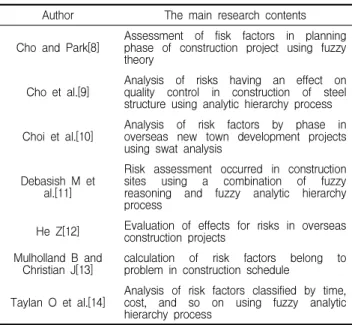
리스크 분석에 관한 건축공학분야에서 국내·외의 기존 연구는 다수 수행되었다.(Table 1 참조)
Author The main research contents Cho and Park[8] Assessment of fisk factors in planning
phase of construction project using fuzzy theory
Cho et al.[9] Analysis of risks having an effect on quality control in construction of steel structure using analytic hierarchy process Choi et al.[10] Analysis of risk factors by phase in
overseas new town development projects using swat analysis
Debasish M et al.[11]
Risk assessment occurred in construction sites using a combination of fuzzy reasoning and fuzzy analytic hierarchy process
He Z[12] Evaluation of effects for risks in overseas construction projects
Mulholland B and
Christian J[13] calculation of risk factors belong to problem in construction schedule
Taylan O et al.[14] Analysis of risk factors classified by time, cost, and so on using fuzzy analytic hierarchy process
Table 1. Summary of literature review
Objective Criterion Alternative
Reference
Lee[1] Hyundai E&C and Samsung
C&T[15]
Kang et
al.[17] Yi et al.[18] This study
An analysis of risk factors
for the construction
of reactor containment
buildign
Process
Interruption of sub-operation due to curing water for concrete O
Delay in the process due to a failure of crane O
Delay in the process due to delay in payment for purchased
materials O
Rush construction for process retrieving O
Delay in the duration due to the design change O
Acceleration claim by a owner O
Deterioration in workability with the increase of the lateral pressure
when concrete is placed O
Cost
Additional work due to lack of clarity in drawings O
Error in the material amount calculated O
Lack of temporary electricity and water supply O
Delay in progress payment by a owner O
Technologies cannot meet required performance O
Safety
Damage to the sling belt and wire due to the salvage of
excessive weight O
Drop of salvaged object due to faulty shackle fastening O Falling accident related to work in high places with form or reber O
Accident due to insufficient preparation in advance O
Occurrence of thermal stress in the work inside of the reactor
containment building O
Lack of safety of the piping withing the reactor containment
building for the earthquake load O
Quality
Coating of inappropriate coating curing compound due to the
coarse surface of concrete O
Breakage of the piping when concrete was placed on a high step O
Defect of containment liner plate O
Inappropriate quality assurance procedure O
Inappropriate curing of a part requiring curing O
Placement height limit of the form O
국내·외의 기존 문헌들은 퍼지이론 또는 계층 분석 방법 등을 활용하여 건설공사에서 발생할 수 있는 리스크를 광범 위한 측면에서 분석하였다. 그러나 건설 공사의 전체적인 관점에서의 리스크 분석은 건설 프로젝트 내의 각 시공 단계 에서 발생할 수 있는 개별적인 리스크 요인들을 소홀히 할 우려가 있다. 특히, 선행 연구들은 건설공사의 세부적인 공 정에서 발생할 수 있는 리스크를 파악하지 못하였다는 한계 가 있다.
그러므로 본 연구는 세부적으로 원자력 발전 플랜트 건설 의 주공정에 포함되는 원자로격납건물 시공 과정에서 발생 할 수 있는 리스크를 도출한다는 차별성을 가지고 있다. 원 자력 발전 플랜트 건설은 토목, 건축, 시운전 등 총 6개의 대공종, 20개의 단위공사, 91개의 세부공종으로 구성되어 있으며, 약 120개월이 소요되는 장기간의 건설 프로젝트이 다[1,15]. 이러한 건설 프로젝트는 평균적으로 15개월이 소 요되는 아파트 등의 일반 건설공사보다 많은 자원이 소요된
다[16]. 따라서 원자력 발전 플랜트 건설은 타 건설 프로젝트 와는 달리 개별적인 측면에서 리스크 요인의 세부적인 분석 이 필요하다.
2.2 원자로격납건물 시공의 리스크 요인
평가기준과 그에 대한 대안들을 설정하여 계층화하는 단 계로써 원자로격납건물의 시공에서 발생할 수 있는 리스크 의 요인을 분류한 표는 Table 2와 같다. 리스크 요인들은 해당 대안의 발생확률과 상위계층에 있는 기준에 영향을 미 칠 가능성 측면에서 선정 기준으로 정하였다. 이를 기본으로 하여 공정, 원가, 안전, 품질을 2번째 계층의 기준으로 결정 하였다. 이 기준들에 대해서 분류될 하위 대안들은 기존의 문헌들과 원자력 발전 플랜트의 시공계획보고서를 통하여 도출하고, 그 내용은 경력 10년 이상의 원자력 발전 플랜트 시공 전문가 및 실무자 2명과 2년 이상의 관련 실무자 1명에 의하여 검증되었다. 검증된 내용들은 국내·외의 원자력 발
Analysis on Risk Factors of Reactor Containment Building Construction using Analytic Hierarchy Process
Objective Criterion Alternative Improtance Priority Consistency
rate
An analysis of risk factors
for the construction
of reactor containment
buildign
Process
Interruption of sub-operation due to curing water for concrete 0.207 2
0.115
Delay in the process due to a failure of crane 0.074 5
Delay in the process due to delay in payment for purchased materials 0.042 7
Rush construction for process retrieving 0.103 3
Delay in the duration due to the design change 0.069 6
Acceleration claim by a owner 0.095 4
Deterioration in workability with the increase of the lateral pressure when
concrete is placed 0.409 1
Cost
Additional work due to lack of clarity in drawings 0.054 5
0.010
Error in the material amount calculated 0.106 4
Lack of temporary electricity and water supply 0.153 3
Delay in progress payment by a owner 0.234 2
Technologies cannot meet required performance 0.452 1
Safety
Damage to the sling belt and wire due to the salvage of excessive weight 0.079 4
0.079
Drop of salvaged object due to faulty shackle fastening 0.048 5
Falling accident related to work in high places with form or reber 0.048 5
Accident due to insufficient preparation in advance 0.143 3
Occurrence of thermal stress in the work inside of the reactor containment
building 0.312 2
Lack of safety of the piping withing the reactor containment building for the
earthquake load 0.370 1
Quality
Coating of inappropriate coating curing compound due to the coarse surface
of concrete 0.185 4
0.083 Breakage of the piping when concrete was placed on a high step 0.111 5
Defect of containment liner plate 0.052 6
Inappropriate quality assurance procedure 0.217 2
Inappropriate curing of a part requiring curing 0.224 1
Placement height limit of the form 0.211 3
Table 4. Assessment of risk factors in construction of reactor containment building by analytic hierarchy process
전 플랜트에 5년 이상 종사한 실무자 3명을 대상으로 예비 설문을 실시하여 적정성을 평가하였으며, 이를 최종적으로 리스크 요인으로 선정하였다.
3. 리스크 요인의 중요도 비교 분석
3.1 설문조사 개요
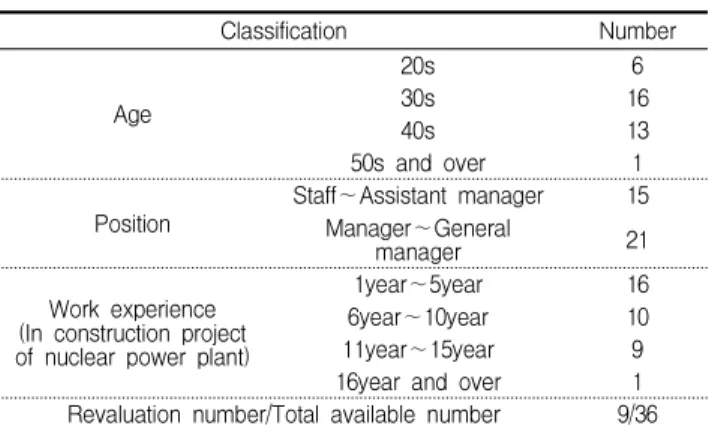
본 연구에서는 쌍대비교를 통해 하위계층으로 구성된 원 자로격납건물의 시공에서 발생할 수 있는 리스크 요인들의 중요도를 평가하고자 전문가 집단에 의하여 9점 척도의 쌍대 비교로 구성된 설문조사를 수행하였다. 설문조사는 2015년 1월 5일부터 동월 28일까지 실시하였다. 대상은 국내에서 원자력 발전 플랜트의 건설 프로젝트를 수행하는 S사, H사, G사 소속의 전문가 및 실무자들이다. 이들 중 각각 S사 23 명, H사 8명, G사 5명으로 총 36명이 응답하였다. 설문 대상들의 인구 통계적 특성은 Table 3과 같다.
쌍대비교의 신뢰도를 평가하고자 본 설문조사에 응답한 의사결정자들의 일관성을 일관성비율(Consistency Ratio, CR)을 척도로 하여 검증하였다. 일관성비율이 0.1 이하라면
합리적인 평가라고 규정하고, 0.2 이하라면 허용할 수 있는 평가라고 결정한다[19]. 반면에, 일관성비율이 0.2를 초과 할 경우에 해당 의사결정자의 설문은 재평가 또는 제외해야 한다[19]. 따라서 전체 36개의 설문지들 중 일관성비율이 0.2를 초과하는 설문지 9개는 설문을 다시 수행하여 수정 및 보완하였다.
Classification Number
Age
20s 6
30s 16
40s 13
50s and over 1
Position Staff∼Assistant manager 15 Manager∼General
manager 21
Work experience (In construction project of nuclear power plant)
1year∼5year 16
6year∼10year 10
11year∼15year 9
16year and over 1
Revaluation number/Total available number 9/36
Table 3. Summary of characteristics about research targets
3.2 중요도 산정
설문조사의 결과를 바탕으로 원자로격납건물에서 각 기준 별로 리스크 관리가 필요한 최적의 대안을 결정하고자 계층
하였다. 중요도는 전체 36명의 평가자들이 기준 내에서 해당 대안이 중요한 정도를 평가한 각각의 수치들을 종합하여 기 하 평균한 결과이다. 이에 대하여 일관성비율을 바탕으로 평가 결과의 일관성을 검증하였다. 원자로격납건물 시공의 리스크 요인에 대한 평가 결과는 Table 4와 같다.
3.3 결과 분석
원자로격납건물 시공의 리스크 요인 평가에 대한 일관성 비율은 수정 또는 보완된 설문지들을 포함하여 기준이 되는 공정, 원가, 품질, 안전에서 모두 0.2 이하이므로 합리적인 평가 또는 허용할 수 있는 평가로 결정하였다. 따라서 각 기준별로 산정된 대안들의 중요도와 우선순위는 모두 유효 하다고 할 수 있다.
공정 기준에서는 “콘크리트의 타설 측압에 따른 시공성 저하”이 0.409로 가장 중요도가 높게 나타났다. 차우선순위 는 “콘크리트의 양생수로 인한 하부작업간섭”, “공정만회를 위한 돌관작업수행” 순으로 나타났다. 공정 부분의 리스크 요인은 콘크리트 작업으로 인하여 발생되는 문제점들이 높 은 중요도를 보여 주었다.
원가 기준에서는 “요구 성능을 충족할 수 없는 기술력”
대안이 0.452로 가장 높은 중요도를 보였다. 다음으로는
“발주자의 기성금 지급 지연”, “가설 전력 및 용수 공급 부 족” 순으로 나타났다. 발주자의 무리한 성능 요구와 기성금 체불의 우선순위가 높다는 결과를 통하여 원가 부분에서는 발주자의 책임 및 역할로 인한 문제점들이 중요도가 높은 리스크 요인들로 나타났다.
안전 기준에서 우선순위가 가장 높은 대안은 “지진하중에 대한 원자로격납건물 내 배관 계통의 안전성 미확보”로 중요 도는 0.370이다. 차순위 대안으로는 “원자로격납건물 내부 작업으로 인한 열 스트레스 발생”, “사전준비 미흡으로 인한 안전사고” 순이다. 평가자들은 원자로격납건물의 구조적인 안전성을 가장 우선시하는 것으로 나타났다.
품질 기준에서는 “양생취약부위의 부적합한 양생” 대안의 중요도가 0.224로 우선순위가 가장 높다. 다음 순위로는
“부적합한 품질보증업무절차”, “거푸집의 타설높이 한계”,
“콘크리트의 거친 표면으로 인한 부적합한 피막양생재 도 포” 순으로 중요도가 높은 것으로 나타났다. 또한, 품질 기준 에서 각 리스크 요인들의 중요도는 1, 2, 3, 4순위의 요인들 이 큰 차이가 없는 것으로 나타났다.
로 분류된 리스크 요인들의 중요도와 우선순위가 명확하게 도출되었음을 보여 주었다. 각 기준들에 속한 리스크 요인들 의 중요도 결과를 바탕으로 원자력 발전 플랜트 건설현장에 서는 순위가 높은 요인을 우선적으로 관리하는 것이 필요하 다. 특히, 공정, 원가, 안전, 품질 부분에서는 각각 콘크리트 작업, 발주자와 관계, 원자로격납건물의 구조적인 안전성, 양생취약부위의 콘크리트 타설 등에 대한 문제점들의 개선 이 요구된다.
4. 결 론
본 연구는 소수 전문가 집단에 의한 설문조사를 통하여 원자로격납건물의 시공 리스크 요인을 분석하였다. 각각 24 개의 리스크 요인들은 공정, 원가, 안전, 품질을 기준으로 분류하여 중요도와 우선순위를 도출하였다. 도출된 결과를 바탕으로 공정, 원가, 안전, 품질 부분에서는 각각 콘크리트 작업에서의 문제점, 발주자와 관계에서의 문제점, 원자로격 납건물의 구조적인 안전성에 대한 문제점, 양생취약부위의 콘크리트 타설에 대한 문제점들이 개선되는 것이 필요하며, 사용자들은 이를 착안하여 관리하는 것이 요구된다. 기존 아파트 건설공사에서의 리스크 요인들은 소비자 만족과 수 익사업의 요소가 개입되어 있는 반면에, 원자로격납건물 시 공에서의 리스크 요인들은 내부 원자로의 안전성, 주변 지역 에 대한 영향, 공공사업의 요소와 관계되어 있다. 본 논문은 리스크 요인들을 분석하기 위하여 계층 분석 방법을 활용하 였다. 이 의사결정방법은 중요도를 명확하게 산출하여 우선 순위를 쉽게 결정할 수 있었으며, 다른 의사결정기법에 비해 이론과 절차가 단순하여 적용성이 용이하였다.
그러나 본 연구에서는 한 가지의 의사결정기법만을 활용 하여 원자로격납건물의 시공 리스크 요인을 분석하였다. 그 러므로 계층 분석 방법이 원자로격납건물의 시공 리스크를 분석하기 위해서 타 의사결정기법보다 적합하다는 결론을 제시할 수 없는 한계가 있다. 향후 연구에서는 계층 분석 방법과 퍼지 계층 분석 방법 또는 네트워크 분석 방법 (Analytic Network Process, ANP)을 비교 적용하여 원자 로격납건물 시공의 리스크 분석에 적합한 의사결정기법을 제시할 것이다.
Analysis on Risk Factors of Reactor Containment Building Construction using Analytic Hierarchy Process
요 약
1978년에 고리 1호기의 건설이 완공된 이래로 원자력 발전 플랜트의 건설 프로젝트는 국내·외로 점차 확대되고 있다. 그러나 일부 원자력 발전 플랜트의 건설 현장에서는 리스크 관리 능력의 부족으로 인하여 공기 지연과 공사비 손실의 문제점들을 가지고 있다. 특히, 원자력 발전 플랜트 내 원자로격납건물의 시공은 타 시공 단계에 비해 긴 공정기 간으로 인하여 전문기술과 대규모 자원이 요구됨에 따라 많은 리스크 요인들이 산재될 수 있다. 따라서 원자로격납 건물의 시공에서 예상되는 리스크 요인들을 분석하여 전체 프로젝트의 안정적인 수행 방향을 제시하는 연구가 필요하 다. 그러므로 본 연구는 원자로격납건물 시공의 리스크 요 인들을 평가하고자 한다. 이를 위하여 본 연구는 36명의 소수 전문가 집단을 대상으로 하는 설문조사방법을 활용하 였다. 24개의 리스크 요인들은 공정, 원가, 안전, 품질을 기준으로 분류되었으며, 이에 대한 평가 결과는 계층 분석 방법을 활용하여 분석하였다. 이를 바탕으로 각 기준별로 분류된 리스크 요인들은 중요도와 우선순위를 산정하고 원 자력 발전 플랜트의 시공 리스크 요인을 분석하는데 계층 분석 방법의 적용성을 확인하였다. 본 연구의 결과는 원자 로격납건물의 시공 단계에서 리스크 관리를 위한 기초 자료 로 활용될 수 있을 것이다.
키워드 : 계층 분석 방법, 원자로격납건물, 리스크 분석
Acknowledgement
This work was supported by the Nuclear Power Core Technology Development Program of the Korea Institute of Energy Technology Evaluation and Planning(KETEP), granted financial resource from the Ministry of Trade, Industry & Energy, Republic of Korea.(No.20131520100750)