I. 서 론
유산의 사전적 의미는 ‘계승되는 모든 것’, 한 세대에 서 다른 세대로 전해 내려오는 것으로써, 이는 한 사회 의 문화적 전통의 일부를 의미하며, 문화는 ‘공유’를 강 조하는 반면 유산은 그러한 것의 ‘전승’을 의미한다. 다 시 말해 문화와 유산의 개념은 서로 독립된 개념이 아닌 연속선상에 있는 개념으로써 ‘문화의 계승’이 곧 문화유 산이라고 할 수 있으며, 유산은 역사성, 장소성을 포함한
Corresponding Author : Min, Byoung-wook
Tel : 010-9293-4865
E-mail : [email protected]
자원으로써, 유산과 문화유산은 유기적인 관계라고 할 수 있다(손호기 등, 2012: Poria et al., 2003).
2002년 FAO 주관의 세계중요농업유산제도(GIAHS : Globally Important Agricultural Heritage Systems)가 도입되 어 이슈화됨으로써 농업·농촌의 다원적 가치에 대한 관 심이 증대되었다. 우리나라 농림축산식품부에서는 2012 년 국가중요농어업유산제도(NIAHS : National Important Agricultural Heritage System)를 도입하고, 2013년 1월 완 도 청산도 구들장 논과 제주도 흑룡만리 돌담밭을 국가 중요농업유산 제1호, 제2호로 각각 지정하였으며, 2014 년 구례 산수유시목지와 담양 대나무밭을 추가 지정하였 다. 청산도 구들장논과 제주도 돌담밭은 세계중요농업유
농어업유산의 경관가치를 측정하기 위한 평가항목 분석
최우영 ∙ 민병욱*
경희대학교 일반대학원 환경조경학과 ∙*계명대학교 생태조경학과
An Analysis on the Measurement Items to Assess the Landscape Value of Agriculture and Fisheries Heritage
Choi, Woo-Young ∙ Min, Byoung-wook*
Dept. of Landscape Architecture, Kyung Hee University
*
Dept. of Landscape Architecture, Keimyung University
ABSTRACT : The purpose of this research is first, to define what measurement items in terms of subjective consideration and preference can be used to assess the landscape values of agriculture and fisheries heritage, and second, to understand the perceptive patterns particularly how landscape experts weigh up the importance of the each measurement item. In order to extract the measurement items, extensive literature review was performed including research documents as well as domestic and international policy reports. A survey targeting the experts was conducted to ask their opinions on the importance of the selected items. For the analysis, SPSS 20.0 for Windows was used to carry out reliability analysis, descriptive statistics such as arithmetic mean and frequency distribution, factor analysis, and multiple linear regression modeling. The results are: the importance value of the landscape values in agriculture and fisheries heritage was 4.1494; the ratio value that the experts perceived the importance was 87.2%; and the average of the importance value of the analyzed items was 3.71. All the items have more than 3.00. Ten factor groups were summarized and defined whose total explanation power was 67.86%. The factor groups were named as l yricism , authenticity, environmentally-friendliness, durability, recognizability, regionality, visibility, value of sightseeing, social image, and universality. The factors influencing the landscape values are, in order of importance, recognizability, authenticity, visibility, universality, durability, and nativeness. According to the analysis, however, environmentally-friendliness, regionality, value of sightseeing, and social image were not as important.
Key words : Agriculture and Fisheries Heritage, Landscape Value, Measurement Items, Factor Analysis, Relation Analysis
1)산으로 지정되기도 하였다. 이러한 농어업유산제도의 목 적은 농어업인이 지역사회의 환경에 적응하면서 오랜 기 간 동안 형성·진화해 온 보전·유지 및 전승할 만한 가치 가 있는 전통적 농어업활동시스템과 이의 결과로서 나타 난 농어촌의 경관 등 모든 산물을 농어업 유산으로 지정 하여 보전하고 관광자원으로 활용하는 것이다(김경두, 2012). 특히 청산도 구들장논과 제주도 밭담이 GIAHS 및 NIAHS로 지정되는데 결정적 역할을 한 것은 주변의 독특하고 뛰어난 경관이라고 하는 만큼(http://news.mk.
co.kr/newsRead.php?year=2014&no=634797), 경관은 국가중 요농어업유산에서 중요한 요소임에도 불구하고 농어업유 산의 경관가치를 평가하는 지표가 객관화되어 있지 못하 고, 경관 관점에서 농어업유산을 분석한 연구 또한 미흡 한 실정이다(김동찬과 최우영, 2014).
따라서 본 연구는 GIAHS 및 NIAHS의 사례인 청산도 구들장논과 제주 밭담이 포함된 농어업유산에 대한 주관 적 범주의 경관가치 측정항목을 도출하고, 전문가들이 각 항목들에 대하여 경관가치에 미치는 영향정도를 어떻 게 인식하고 있는지 파악하고자 한다.
II. 이론적 고찰
1. 농어업유산과 경관
농어업유산에 관한 연구는 최근에 시작되었고 각국마 다 이에 대한 정의가 합의된 용어는 아니며 유사한 의미 를 가진 다양한 용어들이 사용되고 있다(윤원근과 최식 인, 2012). 본 연구는 세계중요농업유산(GIAHS)과 국가 중요농어업유산(NIAHS)으로 한정하여 고찰하였으며, 두 개의 정책에 대하여 개념과 지정기준이라는 두 가지 측 면에서 경관과 연계하여 검토하였다.
우선 개념적 측면에서 살펴보면, FAO의 GIAHS 개념 의 세 가지 핵심 요소는 1)생물다양성, 2)토지이용체계, 3)경관이고(손호기 등, 2012: Parviz Koohafan, 2011), 한 국의 NIAHS의 핵심 요소는 1)농어업적 토지이용, 2)농어 업활동, 3)농어촌경관이다. 특히, 한국의 국가중요농어업 유산의 개념은 다시 소프트웨적 요소와 하드웨어적 요소 라는 두 가지 개념요소가 복합되어 구성되는데, 소프트 웨어적 요소는 농어업활동이 이루어지는 전통적 농어업 시스템으로서 생물다양성, 생태시스템, 토지 및 수자원 관리체계, 공동체의 지식 및 기술체계 등을 포함하고, 하 드웨어적 요소는 시스템에 의해 형성된 경관으로서 농림 어업, 축산활동 및 물이용과 관련된 경관을 포함한다(박 윤호, 2012).
지정기준 측면에서는 GIAHS 지정기준은 1)식량・생 계수단의 확보, 2)생물다양성, 3)전통적 농업기술의 계승, 4)농업문화와 사회제도, 5)수려한 경관 등 5개 항목인데, 이때 경관은 환경적・사회적 한계를 극복하기 위한 인 간의 관리로 형성된 경관을 일컫는다(www.fao.com/
GIAHS). NIAHS 지정기준은 GIAHS의 것을 준용하여 1) 유산의 가치성, 2)파트너십, 3)효과성의 3개 항목으로 구 성되고, 가치성의 항목 중 세부항목으로서 독특하고 현 저한 경관적 특성을 내포한다.
이처럼 국내외 정책에서 농어업유산의 두 가지 키워 드가 ‘제도’와 ‘경관’ 임에도 불구하고(손호기 등, 2012:
Koohafkan and Altieri, 2011a: 2011b: Ramakrishnan, 2007), 김동찬과 최우영(2014)의 지적처럼 제도 관점의 연구는 지속적으로 진행 중에 있으나 경관 관점의 연구가 미흡 하며, 농어업유산 자체의 특성 즉 경관보다는 경제적・
제도적 측면이 강조되고 있는 한계점이 있다(박종준과 김상범, 2013).
2. 경관가치 측정척도
경관가치의 측정척도는 객관적인 평가가 가능한 물리 적(객관적) 측정척도와 주관적인 평가가 가능한 비물리 적(주관적) 측정척도가 있다. 반영운 등(2008)은 경관을 평가함에 있어 평가자의 객관적인 평가와 주관적인 평가 가 모두 필요하다고 강조하며, 농촌경관을 대상으로 물 리적·비물리적 경관으로 유형을 분류하여 평가지표를 개 발한 바 있는데, 비물리적(주관적) 경관 평가지표의 경우 지표 자체를 평가하기에는 체계적이며 개관적인 평가의 한계를 보이고 있다고 한계점을 제시한바 있다.
따라서 본 연구는 체계적이며 객관적인 절차를 통한 주관적 경관가치 측정척도를 개발하여 선행연구들의 한 계점을 보완하고자 한다.
3 선행연구 고찰
농어업유산의 경관가치 평가에 대한 선행연구가 미흡 하며, 이를 평가하기 위한 척도 또한 부재하여 유산 및 농어업 경관에 대한 연구를 고찰하였다. 유산과 관련된 선행연구에서는 주관적·심리적 즉 정성적 범주의 측정척 도가 존재하였으나(Garrod and Fyall, 2000: Frochot and Hughes, 2000: 전명숙, 2005: 장경수, 2000: 유수현과 진 병렬. 2002: 김계섭과 안윤지, 2004: 유수현, 2006), 농어 업 경관과 관련된 선행연구는 물리적 환경에 대한 객관 적 평가 연구(채혜성과 김혜민, 2005: 김혜민과 강방훈, 2006: 윤희정과 김혜민, 2006)에 집중되는 경향으로 나타 났다. 반영운 등(2008)이 농촌경관 평가지표는 물리적(객
관적) 경관과 비물리적(주관적) 경관으로 분류되어 객관 적 평가와 주관적 평가가 이루어져야한다고 강조하며, 주관적 경관지표로서 스카이라인, 색채경관, 경관형용사 를 활용한 어의척도를 포함하였으나, 주관적·심리적 즉 정성적 범주의 농어업 경관가치 측정척도는 부재하였다.
III. 연구범위 및 방법
1. 연구방법
본 연구는 1) 농어업유산의 경관과 관련된 선행연구가 미흡한 관계로 유산 및 농어업 경관과 관련된 국내외 정 책과 문헌을 고찰하였다. 2) 이를 통하여 1차적으로 추 출된 농어업유산의 경관가치 측정 항목에 대해 문항의 적절성을 확인하기 위하여 예비조사를 실시하였다. 이는 비확률추출방법 중 판단표본추출방법에 의해 선정된 경 관 관련 전문가 10명을 대상으로 하였고, 5점 리커트 척 도를 사용하였다. 3) 예비조사를 통해 2차로 선정된 항 목에 대해 중요도 본조사를 시행하였다. 이는 2014년 6 월 10일부터 20일까지 비확률추출방식 중 판단표본추출 방법에 의해 선정된 경희대학교와 계명대학교 조경전공 학생 130명과 경관과 관련된 실무에 종사하거나 대학원 이상 재학 중인 전문가 120명으로 총 250명을 대상으로 실시하였다.
2. 설문지 구성
설문지의 구성은 설문 작성을 위한 안내면, 농어업유 산 경관가치 측정 척도개발을 위한 설문면으로 구분하였 다. 안내문은 국가중요농어업유산 및 세계중요농업유산 에 대한 간략한 설명과 그 사례로서 청산도 구들장논 및 제주 돌담밭의 내용과 이미지를 수록하여 응답자가 인 지하도록 유도하였다. 설문면은 농어업유산의 경관가치 측정 항목의 중요도에 대한 문항 43개와 농어업유산에서 경관의 가치에 대한 문항 1개로 구성하였다.
3. 분석방법
조사 결과 총 250부의 표본이 추출되었고 이 중 불성 실하게 응답한 표본 9개를 제외시켜 유효표본 241매를 최종 분석에 활용하였다. 자료의 분석은 SPSS 20.0 for Windows 통계프로그램을 이용하였으며, 조사의 일관된 신뢰도를 확인하는 알파계수법(Chronbach’s alpha)에 의한 신뢰도 분석, 전체적인 응답경향과 분포를 살펴보기 위 한 산술평균, 측정 항목간의 공통요인 추출을 위한 요인 분석, 경관의 전체 중요도와 경관가치 측정 항목 요인과
의 관계성 파악을 위한 다중선형회귀분석을 실시하였다.
IV. 결과 및 고찰
1.농어업유산의 경관가치 측정 항목 추출
농어업유산의 경관가치 측정 항목 추출을 위한 자료 수집은 우선적으로 농어업유산의 경관에 대한 개념 정립 이 명확히 설정되어 있지 않았기 때문에 접근하는 과정 에서 정확한 이해가 어려웠다. 또한 농어업유산의 경관 을 정면으로 다루고 있는 연구나 측정하고 있는 국내외 의 선행연구가 상당히 부족한 실정으로 인한 한계점도 있었다.
이에 본 연구는 국내·외 문헌연구를 바탕으로 정책, 유산관련 연구, 농어업경관 관련연구를 토대로 농어업유 산의 경관가치와 관련된 측정항목을 추출하였다. 그러나 문항의 안면타당도 분석 결과 농업유산의 경관가치를 측 정함에 있어 모든 문항을 그대로 적용함에 있어 한계가 따랐다. 따라서 연구자가 중복되거나 유사한 의미로 사 용되는 문항을 통합하거나 재설정하여 농어업유산의 경 관가치를 측정할 수 있는 항목으로 판단되는 58개 항목 을 1차적으로 선정하였다. 정책 관련 항목은 세계유산 지정기준, GIAHS 선정기준, NIAHS 지정기준을 검토하 였고, 유산 관련 연구로서 유산관광・유산자원・에코뮤 지엄의 계획지표 및 평가지표에 대한 연구 15편, 농어 업경관 관련 연구로서 농산어촌어메니티, 농어업경관, 농 어촌경관, 경관농업, 농어촌성의 계획지표 및 평가지표에 대한 연구 11편을 분석하였다(Table1 참조).
이렇게 선정된 1차 항목에 대해 문항의 적절성 및 추 상성의 여부를 확인하기 위하여 예비조사를 실시하였다. 이는 비확률추출방법 중 판단표본추출방법에 의해 선정 된 경관 관련 전문가 10명을 대상으로 실시하였는데, 5 점 리커트 척도를 사용하여 3점 미만의 항목은 중요성이 적다고 판단되어 항목에서 삭제하였으며, 통합이 가능한 항목은 통합하여 총 43개 문항을 최종 선정하였다(Table 2 참조).
2. 응답자특성 분석
응답자의 일반적 특성분석 결과, 성별은 남성46.9%, 여성 53.1%였고, 연령은 20대 56.0%, 30대 31.1%, 40대 12.4%, 50대 이상 0.4%였으며, 종사분야는 조경 전공 학 생 53.9%, 조경・경관 24.9%, 건축・도시 12.4%, 농어촌 개발 7.5, 교수 1.2%였다(Table 4참조).
Items 정책 Research on Heritage Research on Agricultural and Fisheries Landscapes 1 2 3 4 5 6 7 8 9 10 11 12 13 14 15 A B C D E F G H I J K -generated by human creativity
-constructed for a long time -contains representative quality -contains unrivaled quality -contains distinctive feature(s) -innovative and original
-represents historically significant process -has enough elements to represent the quality of place
-has uniqueness -has regionality -has identity -has traditionality
-closely related with traditional agriculture, forestry and fishery
-has authenticity -has universality
-durable based on reasonable value -has many things to see
-contains educational values
-well conserves and maintains resources -clean and pleasant
-maintained and passed down by the inhabitants
-sublated improvement according to contemporary needs
-able to inspire the residents’ pride -able to inspire a racial boast -contains a sense of amusement -worth entrance fee
-harmony with local scenary/ image
-contributes to improving local scenary/ image -the degree of visual complexity is bearable -visually beautiful and attractive
-the natural landscape is beautiful -contributes to biological diversity -environmentally friendly
-has restorative capacity against environmental deterioration and contamination
-environmentally friendly agriculture is practiced
-productive activities are currently taking place -has noticeable philosophical background about the cultural heritage
-adjacent to nature and feels healthy -has harmony between village and nature -has religious values
-has artistic excellence
Table 1. Measurement Items to Assess the Landscape Value of Agriculture and Fisheries Heritage
내용
1 This landscape has been constructed for a long time.
2 This landscape contains representative quality.
3 This landscape contains unrivaled quality.
4 This landscape contains distinctive feature(s).
5 This landscape has enough elements to represent the quality of place.
6 This landscape has uniqueness.
7 This landscape has regionality.
8 This landscape has identity.
9 This landscape has traditionality.
10 This landscape is closely related with traditional agriculture, forestry and fishery.
11 This landscape includes environmentally friendly agriculture.
12 This landscape contains productive activities currently taking place.
13 This landscape has authenticity.
14 This landscape has universality.
15 This landscape is durable based on reasonable value.
16 This landscape has many things to see.
17 This landscape contains educational values.
18 This landscape well conserves and maintains natural resources.
19 This landscape is clean and pleasant.
Table 2. Selection of the Measurement Items to Assess the Landscape Value of Agriculture and Fisheries Heritage
20 This landscape is voluntarily maintained and passed down by the inhabitants.
21 This landscape sublates improvement according to contemporary needs
22 This landscape is able to inspire the residents’ pride.
23 This landscape strengthens local attachment and sense of belonging.
24 This landscape is worth entrance fee.
25 This landscape matches well with and improves local image and scenery.
26 This landscape’s visual complexity is bearable.
27 This landscape is visually beautiful and attractive.
28 This landscape contributes to biological diversity.
29 This landscape feels natural and healthy.
30 This landscape has harmony between nature and village.
31 This landscape has artistic excellence.
32 This landscape has potentials for tourism.
33 This landscape has a sense of safety.
34 This landscape feels historically and culturally valuable.
35 This landscape is able to provoke a desire to experience.
36 This landscape is related with well-known local products and good resources.
37 This landscape has rurality provoking nostalgia.
38 This landscape has a sense of being relaxed and rested.
39 This landscape is peaceful and calm.
40 This landscape is related with adjacent tourist attractions.
41 This landscape recalls childhood memories.
42 This landscape has sounds of nature.
43 This landscape has a sense of season.
-has potentials for tourism -has a sense of safety -historical values are tangible -cultural values are tangible -contemporary values are tangible -provokes a desire to experience -contributes to the current amenity -produces well-known local products and good resources
-rurality is tangible
-feels relaxed and being rested -peaceful and calm
-related with adjacent tourist attractions -recalls childhood memories
-strengthens local attachment and sense of belonging
-has sounds of nature -has a sense of season -provokes nostalgia to the past
세계유산등재기준, GIAHS 지정기준, NIAHS 지정기준, 1.양봉석(2006), 2.전명숙(2005), 3.장경수(2001), 4.Frochot &
Hughes,(2000), 5.Garrod.B. & Fyall. A.(2000), 6.한미영(2010), 7.유춘방(1995), 8.조장현과 권종현(2005), 9.김지선과 이훈(2009), 10.박진
영과 장경수(2000), 11.신지은(2005), 12.유수현(2006), 13.유수현과 진병렬(2002), 14.이승용과 김석출(2008), 15.장세길(2013), A.농촌진흥
청(2009), B.김은자(2007), C.농촌자원개발연구소(2005), D.한국정책평가연구원(2005), E.김상범(2006), F.농촌진흥청(1998),
G.OECD(2004), H.강영은(2008), I.Willits, Bealer & Timbers(1990), J.이동기와 윤상헌(2002), K.이민수와 박덩벽(2007)
Character Frequency(pers
on) Ratio(%)
Gender Male 113 46.9
Female 128 53.1
Age
20s 135 56.0
30s 75 31.1
40s 30 12.4
over 50 1 0.4
Occupation
Student 130 53.9
Landscape architect·Landscape
Planner
60 24.9
Architect·Urban
Planner 30 12.4
Rural Planning 18 7.5
Professor 3 1.2
Sum 241 100.0
Table 3. Demographic Information
3. 신뢰도 분석
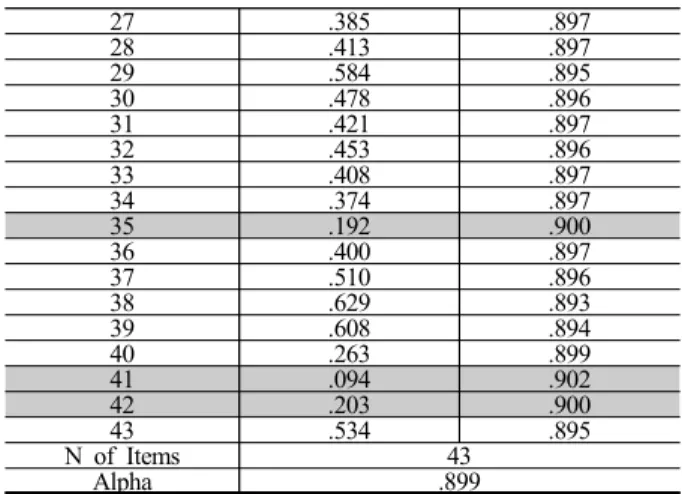
최종 선정된 농어업유산의 경관가치 측정 항목 43개 에 대한 신뢰성 및 타당성 검증을 위하여 실시한 신뢰도 분석 결과 Cronbach의 a는 .899로 나타나 내적 신뢰성을 가지는 것으로 판명되었고, 항목이 삭제된 경우 Cronbach의 a가 .899보다 큰 18(이 경관의 보존과 관리가 양호하다), 35(이 경관은 체험의사가 생길만 하다), 41(이 경관은 어린시절 추억을 떠올리게 한다), 42(이 경관은 자연의 소리가 들린다)를 제외한 39개 항목을 최종 측정 항목으로 선정하였다(Table 5참조).
4. 농어업유산의 경관가치 측정항목의 중요도 분석
가. 농어업유산에서 경관가치의 중요도 측정치 분석 농어업유산에서 경관가치의 중요도는 4.1494로 매우 높은 중요도를 나타냈고, ‘전혀 중요하지 않음’, ‘중요하 지 않음’, ‘보통’을 포함하여 그 중요성을 불인식한 비율 은 12.8%(31명)에 그쳤고, ‘중요함’, ‘매우 중요함’ 등 그 중요성을 인식한 비율은 87.2%(210명)으로 현저하게 차 이가 났다(Table 6, 7참조). 이로서 김동찬과 최우영 (2014)이 강조한 바와 같이 전문가들은 농어업유산에서 경관을 매우 중요한 가치로 인식하고 있음을 다시 한 번 확인하였다.
Revised Items- Correlation
When Item Removed- Cronbach Alpha
1 .299 .898
2 .330 .898
3 .503 .896
4 .338 .898
5 .335 .898
6 .270 .899
7 .491 .896
8 .410 .897
9 .526 .896
10 .331 .898
11 .464 .896
12 .392 .897
13 .419 .897
14 .433 .897
15 .370 .897
16 .344 .898
17 .369 .898
18 .174 .900
19 .340 .898
20 .321 .898
21 .415 .897
22 .437 .897
23 .453 .896
24 .393 .897
25 .526 .895
26 .328 .898
Table 4. Reliability Analysis
27 .385 .897
28 .413 .897
29 .584 .895
30 .478 .896
31 .421 .897
32 .453 .896
33 .408 .897
34 .374 .897
35 .192 .900
36 .400 .897
37 .510 .896
38 .629 .893
39 .608 .894
40 .263 .899
41 .094 .902
42 .203 .900
43 .534 .895
N of Items 43
Alpha .899
Average Standard Error Standard Deviation
Importance 4.1494 .04860 .75449
Table 5. Measured Importance of Landscape Value
Frequency Percent Valid Percent
Cumulative Percent Never
Important 2 .8 .8 .8
Not Important 6 2.5 2.5 3.3
Moderate 23 9.5 9.5 12.9
Important 133 55.2 55.2 68.0
Very Important 77 32.0 32.0 100.0
Sum 241 100.0 100.0
Table 6. Frequency of the Measured Importance of Landscape Value
나. 경관가치의 측정항목별 중요도 측정치 분석 농어업유산의 경관가치 측정항목의 중요도 분석 결과 전체 평균은 3.71로 나타났으며, 중요도가 고평가된 항목 은 이 경관은 지속성이 있고 그럴만한 가치가 있다, 이 경관은 고유성이 있다, 이 경관은 전통성이 있다, 이 경 관의 보존과 관리가 양호하다, 이 경관은 오랜 세월에 걸쳐 만들어졌다 순이었고, 이 경관은 보편성이 있다, 이 경관을 보기 위하여 입장료를 기꺼이 낼만하다, 이 경관은 예술적 탁월성이 있다, 이 경관은 어린 시절 추 억을 떠올리게 한다, 이 경관은 교육적 효과가 있다 순 으로 저평가 된 항목이었다(Table 8참조). 그러나 중요도 가 저평가된 항목도 모두 3점 이상으로 나타남으로써 모 든 항목의 중요도가 비교적 높은 점수로 나타나 농어업 유산의 경관가치의 평가항목으로서의 타당성이 입증된 것으로 판단된다.
다. 측정항목별 중요도 인자분석
최종적으로 선정된 농어업유산의 경관가치 측정항목 39개에 대한 요인분석을 실시하여 특성을 도출하였다.
요인추출 방법으로는 주성분추출법으로 분석하고, 베리 맥스 방식으로 회전시켰으며, 11번의 반복계산에 의해 인자회전이 수렴되었다. 본 연구에서는 요인부하량이 0.4 이하인 변수가 없기 때문에 39개 항목 전체를 활용하였 다. 또한 요인분석의 적합성을 나타내는 KMO(Kaiser- Meyer-Olkin)값은 .780으로 나타났고, Bartlett의 구형성 검정치의 유의확률이 0.000으로 나타나 요인분석의 사용 이 적합하며, 공통요인이 존재한다고 할 수 있다. 요인분 석 결과 초기 고유값(아이겐 값)이 1보다 크게 나타난 요인은 10개의 인자군으로 요약되었고, 전체 요인에 대 한 설명력은 67.86%였다. 각각의 인자명은 ‘서정성’, ‘고 유성’, ‘환경성’ ‘지속성’, ‘구별성’, ‘지역성’, ‘시각성’,
‘관광가치’, ‘사회적 이미지’, ‘보편성’으로 정의하였다 (Table9, 10 참조).
KMO’s Measure of Sampling Adequacy .780
Bartlett’s Sphericity Test
χ2 test 4969.110 Degree of Freedom 741 Significance Probability .000
Table 8. KMO and Bartlett’s Test Result4. 농어업유산의 경관가치와 측정항목의 관계성 분석 농어업유산의 경관가치와 측정항목의 영향관계 파악 을 위하여 경관가치의 전체중요도를 종속변수로 하고, 측정항목의 인자점수를 독립변수로 하여 다중선형회귀분 석을 실시하였다. 회귀분석 결과, 모형의 적합성은 F값 이 5.360(p<0.001)로 나타나 유의성이 매우 높은 것으로 판명되었고, 결정계수(R2) 값이 0.489로 전체변량의
Average Standard Error Standard
Deviation
1 4.0830 .05265 .81736
2 3.6639 .06275 .97420
3 3.7220 .05459 .84748
4 4.0041 .04972 .77189
5 3.8921 .05279 .81954
6 4.1452 .05091 .79035
7 3.9627 .05558 .86281
8 4.0290 .04934 .76593
9 4.1452 .05023 .77974
10 3.2863 .06350 .98583
11 3.3195 .06787 1.05356
12 3.5560 .06216 .96500
13 3.7344 .04972 .77191
14 3.0041 .07678 1.19198
15 4.2822 .04864 .75502
16 3.4191 .06006 .93245
17 3.1328 .06597 1.02419
18 4.1328 .04809 .74652
19 3.9295 .05877 .91242
20 3.9378 .05641 .87575
21 3.7220 .06658 1.03355
22 3.7884 .05230 .81191
23 3.8008 .05460 .84764
24 3.0249 .05576 .86567
25 3.6680 .07219 1.12072
26 3.9087 .05453 .84654
27 3.8921 .05010 .77780
28 3.7012 .05975 .92756
29 4.0415 .05253 .81544
30 4.0373 .05238 .81308
31 3.0415 .05991 .93002
32 3.6598 .05580 .86626
Table 7. Results of Measured Importance
33 3.2448 .06502 1.00945
34 4.0415 .05286 .82053
35 4.0452 .05159 .80083
36 3.6349 .06304 .97866
37 3.8299 .05968 .92652
38 3.5353 .07249 1.12537
39 3.4481 .07316 1.13578
40 3.4274 .06401 .99369
41 3.0705 .07620 1.18287
42 3.8340 .05752 .89294
43 3.5685 .08053 1.25020
평균 3.7080 .05905 .91667
48.9% 정도를 설명하고 있는 것으로 분석되었다. 이로서 농어업유산의 경관가치에 영향을 미치는 변수는 구별성, 고유성, 시각성, 보편성, 지속성, 서정성 순이었고, 환경 성, 지역성, 관광가치, 사회적 이미지는 영향을 미치지 않은 것으로 나타났다(Table 11참조). 즉, 경관 전문가 집 단은 농어업유산의 경관가치에서 구별성, 고유성, 시각 성, 보편성, 지속성, 서정성은 중요한 요인이며, 환경성, 지역성, 관광가치, 사회적 이미지는 상대적으로 덜 중요 한 요인인 것으로 인식하고 있는 것으로 판단된다.
본 연구에서 최종적으로 도출된 결과는 기존의 농어 촌경관・농어업경관의 평가지표와 상당부분 일치하는
가운데 ‘고유성’과 ‘보편성’이 추가로 포함되어 다른 연 구와 차별된다. 또한 ‘구별성’과 ‘보편성’이 동시에 강조 된 것도 주목할 만한데 대부분의 사람들이 가치를 인정 하는 가운데 특별함을 가져야하는 유산의 관점이 도입되 었다고 할 수 있다. 그런데 박종준 등(2013)은 세계중요 농업유산의 ‘살아있는 유산(living heritage)’을 위한 ‘역동 적인 보전(dynamic conservation)’이라며 두 개념을 강조 하였고, 장세길(2013)은 농어업유산을 통한 지역 활성화 를 위해 관광의 중요성을 주장하였으며, 농림축산식품부 도 2012년 보도자료를 통해 농어업유산제도의 기대효과 는 관광자원의 활용을 통한 지역별 브랜드화 및 국가이
1 2 3 4 5 성분 6 7 8 9 10
Lyricism
This landscape is peaceful and calm. .849 .110 .180 .045 .063 .117 -.041 .112 .016 .015 This landscape has a sense of season. .841 .018 .077 .006 .094 -.027 .174 .024 .014 .090 This landscape has a sense of being relaxed and rested. .821 .028 .167 .042 .109 .214 .090 .038 .091 .047 This landscape’s visual complexity is bearable. .813 -.010 .162 -.093 .083 .133 -.023 .044 .081 .123 This landscape has rurality provoking nostalgia. .694 -.130 .110 .184 -.099 .149 -.159 .343 .030 -.008
Authenticity
This landscape is voluntarily maintained and passed down by the
inhabitants. -.058 .786 .000 .119 -.076 .049 .126 -.031 .172 -.058
This landscape has uniqueness. -.018 .714 .101 -.254 .083 .052 -.016 .057 -.046 .228 This landscape has authenticity. -.062 .690 .004 .108 -.130 .084 .228 .165 .144 .008 This landscape has identity. .047 .685 .117 -.127 .275 .069 -.134 .200 .089 .031 This landscape has traditionality. .212 .535 .201 .081 .362 .073 -.060 -.045 -.138 .133 This landscape is closely related with traditional agriculture. -.032 .490 -.067 .402 .197 -.076 .069 -.316 .302 -.153 Environment
ally-friendli ness
This landscape contributes to biological diversity. .216 .071 .805 .028 -.028 .079 .068 -.028 .013 .140 This landscape feels natural and healthy. .349 .153 .647 .241 .248 -.072 .164 .105 -.008 -.093 This landscape has harmony between nature and village. .304 .082 .564 .208 .305 .052 .073 -.082 .092 -.203 This landscape includes environmentally friendly agriculture. .140 .310 .541 -.180 .200 -.064 -.058 .323 .019 .278 This landscape has a sense of safety. .370 -.139 .460 .003 -.017 .167 .227 .296 .111 .005
Durability
This landscape is durable based on reasonable value. .056 -.098 -.084 .683 .087 .243 -.001 .179 .051 -.156 This landscape sublates improvement according to contemporary
needs .037 .062 .121 .675 .023 .226 -.035 .027 -.310 .349
This landscape contains productive activities currently taking place. .023 .019 .215 .664 .099 -.096 .244 .038 .018 .115 This landscape has been constructed for a long time. .001 .397 .307 .418 .168 .125 -.098 -.136 .012 -.055
Recognizabi lity
This landscape contains distinctive feature(s). .471 .057 .102 .086 .645 .103 .042 -.041 -.024 -.001 This landscape has enough elements to represent the quality of
place. -.171 .151 .042 .249 .631 .193 .060 .031 .141 .052
This landscape contains unrivaled quality. .204 -.086 .031 .492 .583 .074 -.216 .111 .030 .102 This landscape contains representative quality. .167 .462 .208 -.061 .548 .077 .165 .043 .013 .130 This landscape has many things to see. .092 .382 -.097 .297 -.444 .259 .263 .140 .199 .329 Regionality This landscape is able to inspire the residents’ pride. .166 .126 .086 .111 .158 .749 .108 -.089 .191 -.145 This landscape strengthens local attachment and sense of belonging. .335 .141 -.032 .150 .172 .737 .000 -.071 -.106 -.070 This landscape has regionality. .431 .013 .137 .106 -.034 .524 .306 .099 -.024 .195 Visibility This landscape is visually beautiful and attractive. .066 .208 .132 .092 .086 .178 .772 .017 .034 -.064 This landscape has artistic excellence. .490 -.037 .146 .048 -.054 -.014 .513 .063 .119 .126 Sightseeing
value
This landscape is worth entrance fee. .338 .068 .134 .207 -.056 -.242 .018 .671 .169 .002 This landscape is related with adjacent tourist attractions. .282 .399 -.055 .207 .090 -.051 .023 .558 -.240 .035 This landscape is related with well-known local products and good
resources. -.170 .251 .207 -.146 .375 .330 .224 .431 .201 .175
This landscape has potentials for tourism. .388 .249 -.283 -.043 .116 .157 .229 .393 .387 .010 Social
Image
This landscape matches well with and improves local image and
scenery. .295 .222 .047 -.169 .070 .028 .162 .079 .624 .095
This landscape feels historically and culturally valuable. -.122 .115 .479 .157 -.069 .345 -.080 -.020 .534 .209
This landscape contains educational values. .286 .153 .350 .205 .226 -.097 -.401 .036 .458 .244
Universality This landscape has universality. .183 .227 .287 .032 .203 -.121 -.153 .015 .140 .669
This landscape is clean and pleasant. .391 -.022 -.241 .202 -.018 -.093 .330 .071 .163 .561
Eigenvalue EV 5.367 3.852 2.995 2.699 2.544 2.194 1.865 1.749 1.640 1.562
Index of Dispersion CV ( 13.762 9.877 7.679 6.921 6.522 5.626 4.781 4.485 4.205 4.006
Cumulative Index of Dispersion TV (%) 13.76223.64031.31938.24044.76250.38855.16959.65463.85967.864
Table 9. Factor Analysis on Importance미지 제고라고 언급함으로써 관광가치와 지역이미지 등 을 매우 중요한 요소로 강조하고 있다. 이러한 관점에서 농어업유산의 경관가치는 기존의 농어업경관의 평가지표 에 ‘살아있는 유산(living heritage)’적 측면은 강조하며, 상대적으로 ‘역동적인 보전(dynamic conservation)’적 측면 은 덜 강조하고 있음을 파악하였다.
Model
Unstandardized Regression Coefficients
Standardized Regression
Coefficients t P- value
Sig (f) R
2B standard
error ß
Coefficient 4.149 .045 92.808 .000
5.360 (.000) .489 Lyricism -.060 .045 -.080 -1.348 .042
Authenticity .156 .045 .206 3.474 .001 Environmen
tally-friendli
ness .041 .045 .055 .924 .356
Durability .096 .045 .127 2.142 .033 Recognizabi
lity .172 .045 .228 3.838 .000
Regionality .047 .045 .063 1.059 .291 Visibility .126 .045 .167 2.807 .005 Social
Image .064 .045 .084 1.422 .156 Sightseeing
Value -.045 .045 -.060 -1.005 .316 Universality -.123 .045 -.163 -2.740 .007
Table 10. Regression Analysis on the Tested FactorsIV. 결 론
본 연구의 목적은 농어업유산에 대한 주관적 범주의 경관가치 측정항목을 도출하고, 전문가들이 각 항목들에 대하여 경관가치에 미치는 영향정도를 어떻게 인식하고 있는지 파악하는 것이다. 이를 위하여 국내외 정책과 문헌 고찰을 통하여 농어업유산의 경관가치 측정항목을 추출하고, 예비조사를 거쳐 선정된 항목에 대하여 전문 가를 대상으로 중요도 설문조사를 시행하였다. 자료의 분석은 SPSS 20.0 for Windows 통계프로그램을 이용하 였으며, 신뢰도분석, 산술평균, 빈도분석, 요인분석, 다중 선형회귀분석 등을 실시하였고, 그 결과는 다음과 같다.
첫째, 국내외 정책 및 문헌 고찰을 통하여 추출된 57 개 항목에 대하여 예비조사를 실시한 결과 43개 항목이 도출되었다. 이의 중요도에 대한 신뢰도 분석을 시행한 결과, 항목이 삭제된 경우 신뢰도가 향상되는 항목은 4
개로 나타나 이를 제외하여 39개 항목을 최종 측정 항목 으로 선정하였다.
둘째, 농어업유산에서 경관가치의 중요도는 4.1494로 매우 높은 중요도를 나타냈고, 그 중요성을 인식한 비율 은 87.2%로 농어업유산에서 경관은 중요한 가치임을 확인하였다.
셋째, 농어업유산의 경관가치 측정항목의 중요도 전체 평균은 3.71로 나타났으며, 중요도가 고평가된 항목은 이 경관은 지속성이 있고 그럴만한 가치가 있다, 이 경관은 고유성이 있다, 이 경관은 전통성이 있다, 이 경관의 보 존과 관리가 양호하다, 이 경관은 오랜 세월에 걸쳐 만 들어졌다 순이었고, 이 경관은 보편성이 있다, 이 경관을 보기 위하여 입장료를 기꺼이 낼만하다, 이 경관은 예술 적 탁월성이 있다, 이 경관은 어린 시절 추억을 떠올리 게 한다, 이 경관은 교육적 효과가 있다 순으로 저평가 된 항목이었다.
넷째, 농어업유산의 경관가치 측정항목에 있어 그 특 성을 도출하기 위하여 요인분석을 실시하였다. 그 결과
‘서정성’, ‘고유성’, ‘환경성’, ‘지속성’, ‘구별성’, ‘지역성’,
‘시각성’, ‘관광가치’, ‘사회적 이미지’, ‘보편성’ 등 10개 요인으로 축약되었고, 전체 요인에 대한 설명력은 67.86%였다.
다섯째, 농어업유산의 경관가치와 측정항목의 영향관 계 파악을 위하여 경관가치의 전체중요도를 종속변수로 하고, 측정항목의 인자점수를 독립변수로 하여 다중선형 회귀분석을 실시하였다. 농어업유산의 경관가치에 영향 을 미치는 변수는 구별성, 고유성, 시각성, 보편성, 지속 성, 서정성 순이었고, 환경성, 지역성, 관광가치, 사회적 이미지는 영향을 미치지 않은 것으로 나타났다.
이를 종합하면 농어업유산의 경관가치는 기존의 농어 업경관의 평가지표에 ‘살아있는 유산(living heritage)’적 측면 즉, 고유성과 보편성은 강조하며, 상대적으로 ‘역동 적인 보전(dynamic conservation)’적 측면 즉, 관광가치와 지역이미지는 덜 강조하고 있는 것으로 판단된다.
본 연구는 농어업유산의 평가지표를 위해 경관적 측 면의 측정항목을 도출하고, 농어업유산의 전체 경관가치 에 영향을 미치는 중요한 요인을 파악하였다. 그 결과를 통해 기존의 농어촌경관・농어업경관의 평가지표들과의 차별성이 도출되고, 농어업유산의 두 갈래의 개념 중 한 측면이 특히 강조되어 농어업유산의 전체적인 평가지표 와도 차이점을 드러냈다. 이로서 농어업유산에서 경관가 치 평가지표는 농어촌・농어업경관 또는 농어업유산의 평가지표와 차별화되어야한다는 필요성을 개진하였다는 것에 의의가 있다.
그러나 농어업유산의 경관가치에 대한 연구가 미흡
하여 유사 분야의 문헌을 고찰함에 따라 누락된 항목이 존재할 수 있고, 통계적인 처리를 바탕으로 분석하다 보 니 요인의 수가 10개로 적절한 요인수의 범위를 초과하 여 나타났다는 한계점이 있다. 따라서 전문가들의 고견 을 조사하여 요인을 통합하거나 삭제하여 적절한 요인수 를 조절하고 가중치를 부여하는 등 누락된 척도를 보완 함으로써 완결된 농어업유산의 완결된 경관평가지표를 도출하는 연구가 필요할 것이다. 뿐만 아니라 농어업유 산의 주요한 핵심요소에 관광이 포함되고 있으나 설문의 대상을 전문가에 국한하였다는 한계점이 있으므로, 잠재 관광객 즉 일반인들의 인식을 조사하여 전문가와 일반인 의 인식을 비교하는 연구도 후행되어야 할 것이다. 이러 한 관점에서 추후 본 연구는 농어업유산의 경관평가 및 관리를 위한 정책 또는 연구에 필요한 기초자료로 활용 될 것으로 기대된다.
Reference
1. Ban, Y. U., J. I. Baek, M. A. Kim, and J. O. Yoon, 2008, Classifying Rural Landscape Types and Developing Rural Landscape Evaluation Indicators Using Expert Delphi Survey Method. Rural Planning 14(3): 53-61.
2. Chae, H. S. and H. M. Kim, 2005, A Study on the Classification of Landscape Elements for Effective Management of Agricultural Landscape. Rural Planning 11(3): 1-9.
3. Cho, J. H. and J. H. Kwon, 2005, The Evaluation of Expectation Level/Actual Satisfaction Level of European Attraction Attribute and its Relationship to Re-visitation/Recommendation. Tourism Research 19(2): 19-34.
4. Chun, M. S. , 2006, A Study on the Characteristic Points of the Tourism Resources on the Historical Sites. Journal of the Korea Contents Association 6(1):
93-101.
5. Frochot and Hughes, 2000, HISTOQUAL: The Development of a Historic Houses Assessment Scale.
Tourism Management 21: 161.
6. Han, M. Y., 2010, A Comparative Study on the Attributes of Cultural Heritage for Tourism between Korea and China: Focused on Korean and Chinese Tourists of Gyeong-bokgung and the Palace Museum.
Hanyang University, Seoul.
7. Jang, K. S., 2002, A study on the assessment scale of service quality in cultural and heritage tourist destination. Ph.D. Dissertation. Daegu University, Daegu.
8. Jang, S. G., 2013, The Agricluture Heritage, Heritage Tourism, and Ecomuseum: A Study on Application of Ecomuseum for Linking Agriculture Heritage to Regional Revitalization. Journal of Agricultural Extension and Community Development 20(4):
989-1021.
9. Kang, Y. E., 2008, A Study on the Indicators for Visual Landscape Planning of Landscape Agricultural Region, MS Thesis. Seoul University, Seoul.
10. Kim, D. C. and W. Y. Choi, 2014, IPA study of landscape potentiality of agricultural and fishery heritages. Journal of the Korean Institute of Landscape Architecture 42(4): 76-88.
11. Kim, E. J., 2007, A Study on the Development of Evaluation Criteria for Rural Amenity. Ph. D.
Dissertation. Seoul University, Seoul.
12. Kim, H. M. and B. H. Kang, 2006, An Analysis of the Landscape Character in Environment Friendly Cultivated Land based on Rural Amenity. Korean J.
Community Living Science 17(1): 11-21.
13. Kim, J. S. and H. Lee, 2009, An Evaluation of the Quality and Level of Satisfaction on Royal Palace Tourism: Focusing on Authentic Experience and HISTOQUAL. Journal of Tourism Science 33(6):
33-54.
14. Kim, K. Y., Y. H. Park, J. Y. Choi, J. G. Park and S. H. Park, 2005, Estimation of Agricultural Landscape Value and Management Policy: Esthetic- Economic Value and Environmental Policy. Research Report to Korean Environment Institute.
15. Kim, S. B., 2009, A Study on the Rural Landscape Evaluation Indicators for Preservation and Management. Research Report to Rural Development Administration.
16. Kim, S. B., B. H. Kang and H. M. Kim, 2006, Analysis of rural landscape's characteristics by using OECD agriculture landscape indicator. Research Report to Rural Development Administration.
17. Koohafkan, Parviz, 2011, Conservation and adaptive management of GIAHS. Journal of Resources and Ecology 2(1): 22-28.
18. Koohafkan, Parviz and Miguel Altieri, 2011a, GIAHS-A Legacy for the Future. Research Report to FAO.
19. Koohafkan, Parviz and Miguel Altieri, 2011b, A methodological framewok for the dynamic conservation of GIAHS. Research Report to FAO.
20. Lee, D. G. and S. H. Yun, 2002, Meanings and Measurement Scale Development on Rurality.
Proceedings of the 51th Symposium on The Tourism Sciences Society of Korea.
21. Lee, M. S. and D. B. Park, 2007, Typology of Urban People by Rurality Perception and Its Socio-demographic Characteristics. Rural Economic 30(3) 27-50.
22. Lee, S. Y. and S. C. Kim, 2008, The Effects Relationships of Educational Factors between Festival Satisfaction and Behavioral Intentions on Culture Tourism Festival: The Case of Iksan Seodong Festival 2006. Journal of Tourism Science 32(1):
119-139.
23. Park, M. E., 1998, A Study on the agri-environmental indicators. Research Report to Rural Development Administration.
24. Park, J. Y. and K. S. Jang, 2000, The study in Buddhist temple visitor’s satisfaction and revisit intention. Journal of Tourism & Hotel Management 2(1): 126-147.
25. Shin, J. E., 2005, Educational effect on visitors of Heritage site: In case of Changduk Palace. Kyonggi University, Suwon.
26. Park, J. J., S. B. Kim, and E. C. Lee, 2013, Adoption and Future Tasks of Nationally Important Agricultural Heritage System for Agricultural and Rural Resources Conservation. Rural Planning 19(4):
161-175.
27. Park, Y. H., 2012, A Study on the Establishment of Designation Criteria for Agricultural Heritage and
Management System. Research Report to EKR.
28. Poria, Y., R. Butler and D. Airey, 2003, The core of heritage tourism. Annuals of Tourism Research 30(1):
238-254.
29. Ramakrishnan, P. S., 2007, GIAHS: An Eco-Cultural Landscape Perspective.
30. Ruy, C. B., 1995,. A Study on the Attitude in Relation to Choice Behavior of Travel Destination.
MS Thesis. Sejong University, Seoul.
31. Son, H. G., S. B. Kim, and Y. G. Shin, 2012, A overseas case study for institutionalization of the agricultural and rural heritage in Korea. Korean Journal of Agricultural Management and Policy 39(4):841-869.
32. Willits, Fern K., Bealer, Robert C. and Timbers, Vincent L., 1990, Popular Images of Rurality. Rural Sociology 55(4): 559-578.
33. Yang, B. S., 2006,. Relations of Tourist Experience, Authenticity and Tourist Satisfaction towards Cultural Tourism Sites. Ph. D. Dissertation. Donga University, Busan.
34. Yoon, W. K. and S. I. Choi, 2012, Establishment of the agriculture and fisheries heritage system in Korea.
Journal of Korean Society of Agricultural Extension 19(2): 465-495.
35. http://news.mk.co.kr/newsRead.php?year=2014&no=6347 97.
36. http://www.fao.com/GIAHS.
37. http://www.unesco.or.kr/heritage/.