• 검색 결과가 없습니다.

The Case Study of Customer Delight Index Contents Model through Cater ing Service Industry

N/A
N/A
Protected

Academic year: 2021

Share "The Case Study of Customer Delight Index Contents Model through Cater ing Service Industry"

Copied!
13
0
0

로드 중.... (전체 텍스트 보기)

전체 글

(1)

The Case Study of Customer Delight Index Contents Model through Catering Service Industry

Yang, Ya-Yun

, Lee, Sung-Pil

††

ABSTRACT

The aims of this research is to build Customer Delight index contents model for measuring the influential factors - Customer Delight and identify the relationship among Customer Delight, Customer Satisfaction and Customer Loyalty. Customer Delight hypothesis model was proposed by Catering Service Industry of Starbucks and validate the final questionnaire; 7 point Likert scale was used in the questionnaire, Exploratory Factor Analysis (EFA) and Confirmatory Factor Analysis (CFA) are used to analyze the reliability. And path analysis was used to evaluating the final hypothesis model. The results of this research was that the customer Self-involvement can lead to high awakening level and it also bring positive emotion to the customer. Awakening Level and positive emotion were the key factors for the Customer Delight. Instead of customer expectation, Customer Delight is based on customer awakening level and positive emotion which is different from Customer Satisfaction model. It is clearly to see the discrepancies between Customer Delight and Customer Satisfaction.

Key words: Customer Delight Index Contents Model, Catering Brand, Starbucks

※ Corresponding Author : Lee, Sung-Pil, Address: Dong- seo University, College of Design, (47011) Jurye-Ro 47, Sasang-Gu, Busan, R.O.Korea, TEL : +82-51-320-1846, +82-10-9104-0963, E-mail : [email protected]

Receipt date : Jul. 27, 2016, Approval date : Aug. 1, 2016

††

Graduate School, Design Major, Dongseo University,

††
School of Design, Dongseo University, E-mail :[email protected]

1. Research Background and Purpose

1.1 Research Background

As [1] demonstrated, a basic conclusion of aca- demic research and enterprise practice: Customer Loyalty refers to the decisive factors of enterprise competitiveness and the significant source of en- terprise interest for long time as well as the sig- nificant property of the enterprise. Customer Satisfaction has become a typical business goal.

However, as [4,8] demonstrated, Customer Satis- faction cannot lead to Customer Loyalty and it breaks the whole economic success chain.(As show in Fig. 1)

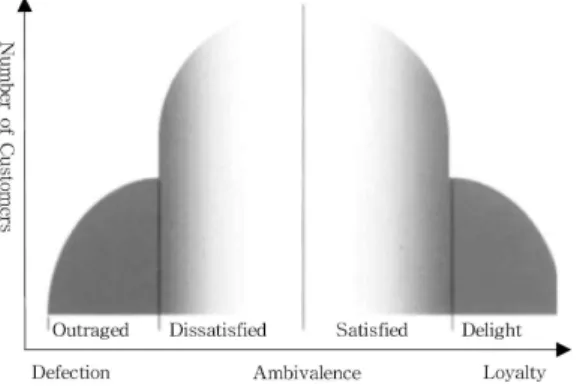
Some literature researches show that Customer Delight is more effective than Customer Satisfac- tion to drive Customer Loyalty, customer retention, positive word-of-mouth and recommendation in- tention. Just as show in Fig. 2, a delighted custom-

er may become a loyal customer, try to recommend the service of the enterprise to others and willing to pay high price for the recommended service.

Thus, the real way to increase Customer Loyalty and improve customer intention refers to not only Customer Satisfaction, but also Customer Delight.

Milliken is adamant that the real secret of quality is that it is a means as much as an end: the most likely route, as Jeanes says, 'to achieve improved results, deliver total Customer Satisfaction or even better, Customer Delight, thus ensuring not just survival, but sustainable profitable growth'. In a published statement[2], Perez said, ‘Guided by the insights of diverse customers and employees, Kodak is transforming itself to serve new markets.

Through diversity of thought and innovation, we

will continue to deliver breakthrough products that

delight customers. And our journey of diversity

and inclusion-while never complete—will help us

(2)

Fig. 1. Cause-Effect-Chain of Customer Satisfaction.

Fig. 2. Distribution of Customer Loyalty.

Fig. 3. Level of Customer Satisfaction.

better serve those who have come to trust Kodak.’

1.2 Research Purpose

The purpose of this research is to build Customer Delight index contents model for meas- uring the influential factors - Customer Delight and identify the relationship among Customer Delight, Customer Satisfaction and Customer Loyalty.

2. Literature Review

2.1 Theoretical study 2.1.1 Customer Delight

The construct of Customer Delight originates in the research of psychology on emotion. With the basis of emotion intensity, similarity and bipolarity, Plutchik suggested 8 kinds of basic emotions, in- cluding fear, anger, pleasure, sorrow, disgust, ac- ceptance, expectation and surprise. Delight refers

to the composite emotion that consists of pleasure and surprise. Customer Delight refers the compo- site emotion that consists of the two basic emo- tions of pleasure and awaken.

2.1.2 Customer Delight and Customer Satisfaction

Delight as extreme satisfaction that Customer

Satisfaction is customer’s perception of the degree

to which the customer’s requirements have been

fulfilled and also delight is a positive emotion that

customers' experience in response to having their

expectations exceeded to an unexpected and sur-

prising degree. Customer Delight refers to the ex-

treme level of Customer Satisfaction. In the early

stage, enterprise practitioner argues that Customer

Satisfaction is the basis of Customer Delight, but

as the inadequate condition. As show in figure 3,

the view of enterprise practitioner reaches the sup-

port from many scholars, such as Jones and Sasser

argued that only extremely satisfied customers

demonstrate loyal behavior. Kumar and Iyer also

argued that Customer Delight as the indicator of

satisfaction. Meanwhile, they argued that the in-

teractive behavior (employee attitude, employee

assistance and interpretation provided) and service

characteristics (For instance cleaning service, the

exact time to complete the service process and the

stated time to complete the service process) from

the service provider can classify the factors lead

to Customer Satisfaction and Customer Delight,

thus service features lead to Customer Satisfaction

(3)

and the interactive behavior from the service pro- vider could lead to Customer Delight. Ngobo also argues that Customer Delight refers to 100% of Customer Satisfaction and has obviously influence on Customer Loyalty. Anderson and Vikas also supported on this point of view as demonstrated in [3]. From this point of view, Customer Satisfac- tion is the basis of Customer Delight and Customer Delight is the extension of Customer Satisfaction that which lead to Customer Loyalty as well.

2.1.3 Effect Factors of Customer Delight (1) Awakening level and positive emotion.

Flourier & Kastenholz (2011)[6] finds that awak- ening and positive emotion refer to the key factors that cause Customer Delight. In other words, Customer Delight is actually based on customer awakening level and positive emotion instead of customer expectation, which is different from the Customer Satisfaction model.

(2) Esteem Require. Based on the perspective of require to investigate the influential factors of Customer Delight, Schneide & Bowen (1999)[13], Tores & Kline (2006, 2013)[16] and Tores et al.

(2014) argued that customer's Esteem Require needed to be fulfil in order to win Customer Delight. However, it does not proved by the em- pirical test.

(3) Customer self-involvement. Early in 1948, Barnard had noticed that customers would make a contribution to the service provider. As the pio- neers who make research on customer self-in- volvement, Lovelock & Young (1979)[7] are the earliest researchers to submit that improve pro- ductivity through customer self-involvement in the service. With the rise of self-service technologies and e-commerce, the amount of customer partic- ipation in service emerging and transferring proc- ess rapidly increasing. Customer have become the active players now instead of passive audience in the past (Prahalad & Ramaswamy, 2000). Song &

Adams (1993)[14] proposed that the level of partic-

ipation from the customer in the service provided could be classify the evaluation standard of the market. In the perspective of customer, customer self-involvement creates the unique consumption experience for themselves. Customers self-in- volvement in the service could deliver an emotional involvement; it is much more easily for customers to be delighted in the friendly interaction between customers and the staffs. In addition, the research shows that customers who finish part of their tasks will be more easily to be delighted.

3. Customer Delight Hypothesis

According to the previous research, Esteem Require, customer self-Involvement may lead to positive awakening and positive emotion. Custo- mer positive emotion effect could arise Customer Delight. The higher the positive effect of customer is, the more obvious Customer Delight will be.

Customer Delight may extend Customer Satisfac- tion to a higher level. On the other hand, Customer Satisfaction that causes Customer Delight may lead to Customer Loyalty to a higher level. Hence, it proved the hypothesis of Customer Delight model.

3.1 Esteem Require, Positive emotion and Awak- ening level

In the service experience, customers assumed

that they should treated as first and wish to receive

the support, attention and respect from the service

staffs; and also argued that it is necessary provided

from the service staff and place. With the emer-

gence of Esteem Require, customer psychology

will be in defected or unbalanced state that forms

psychological tension, calls up psychological en-

ergy and makes the psychology be in the ready or

stress state; when his respect demands are not

satisfied, the psychology will be in the awakening

state; once his Esteem Require are satisfied, it will

awakening various physiological response of cus-

(4)

tomers (Li Rui, 1999). Specifically speaking, in the service process, if the service staffs sincerely re- spond to customers' call and opinion, give care and attention to customers, treat he/she in the per- spectives of valuable customers and enable cus- tomers to have their own freedom instead of forc- ing customers on individual profit; and besides that, give positive evaluation and appropriate be- havior (such as smile service) for customers, in this way, customers will have a feeling of proud and feel that they get attention; and then, it will awakening customers' passion for service con- sumption and express strongly positive emotion actions. Otherwise, if service staffs disregard, show prejudice and discrimination on customers, their self-esteem will be heavily damaged and have senses of inferiority and weakness; therefore, cus- tomer psychology will be strongly stimulated and customers will be unhappy or angry in emotional state. Thus, it can be assumed that if the Esteem Require of customers are weak, it shows that cus- tomer Esteem Require are greatly satisfied, show high respect level and it will awakening positive emotion reaction of customers; if the Esteem Require of customers are strong, it shows that customer Esteem Require are not satisfied as well as the low respect level, in this way, it will awak- ening the passive emotion reaction of customers.

Therefore, hypothesis as follows are proposed:

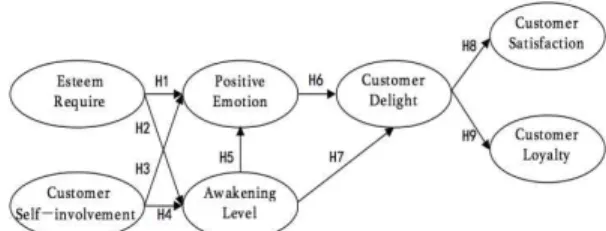
H1 Esteem Require has significant impact on Positive emotion.

H2 Esteem Require has significant impact on Awakening level.

3.2 Customer self-involvement, positive emotion and Awakening Level

Emotion refers to the self affection of customers for their real experience (Van Maanen and Kunda, 1989) and it can be regarded as the index of psy- chological healthy and comfort and pleasant state (Rafaeli and Sutoon, 1987).[12] Emotional experi- ence refers to the emotional state that people feel

and realize subjectively (Strongman, 1987)[15].

Westbrook et al.,(1991)[17] argues that there will be direct influence of emotion on the satisfaction evaluation of the entire service. In the process of customer self-involvement, positive emotion and awakening will bring positive Customer Delight feelings after customers accepting various stim- ulations of external service environment, such as pleasure, excitement and so on (Yoo, Park and Maclnnis, 1998)[18]. Strongman (1987)[14] defines emotional experience as the emotional state that the individuals feel and realize subjectively.

Schmitt argued that experience refers to the sepa- rate event that the individuals react to some stim- ulations, and it is usually caused by the direct in- vestigation or participation of the event no matter the event is real or virtual. In the process of serv- ice, customers are willing to interact with staffs or even provide assistance, it shows their active and positive state as well as the acceptance of product or service; thereby, it is easy to cause pos- itive emotion and awakening.

H3 Customer Self-involvement has significant impact on Positive emotion.

H4 Customer Self-involvement has significant impact on Awakening level.

3.3 Positive emotion, Awakening Level and Cus- tomer Delight

Positive emotion, awakening emotion and Cus- tomer Delight all refer to a kind of emotional states.

However, they have different formation mecha- nisms. Positive emotion refers to the emotion of positive valence that "the emotional state with pleasant feeling emerges for inside and outside stimulation, event satisfies individual demands"

(Guo Xiaoyan and Wang Zhenyu, 2007). Positive

emotion refers to positive inner experience that re-

lated to the satisfaction of demands and pleasant

feelings. Different from positive emotion, awaken-

ing emotion refers to activated state of body en-

ergy that related to the emotional state, and awak-

(5)

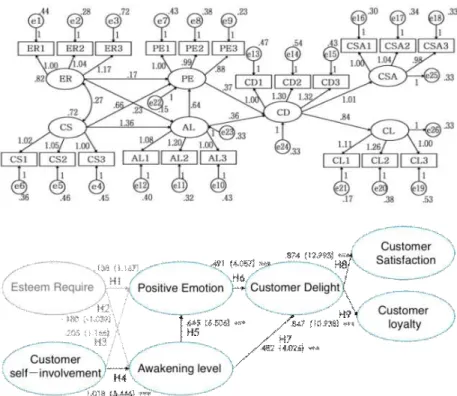
Fig. 4. Customer Delight Index Contents Hypothesis Model.

ening emotion plays the role to stimulate energy and prepare for action (Luo Yuejia and Wu Jianhui, 2005). Physiological awakening refers to a kind of psychological stimulated states and different emo- tions relate to different physiological reaction modes, such as stimulated, excited and passionate state etc. In the service experience, customers' dif- ferent emotional reactions on the environmental stimulation are caused by positive emotion and awakening emotion. Ekman (1984) also argues that every emotion does not refer to a single emotional state, it is a emotional group of related emotion.

Each emotional group has a common topic and dif- ferent variation; the common topic refers to the characteristics that all members of a emotional group have; however, the variation refers to the products of individual emotional difference, e.g. the common topic of delighted and relaxed emotion re- fer to positive topic, and they are different for the awakening state. Delight refers to a kind of strong positive emotional state. Chen Shugong (2004) thinks that Customer Delight refers to the strong positive emotional state and recalled by the sat- isfaction of customer demands. In this way, if it satisfies customer Esteem Require, it may build strong positive emotional reaction of customer and Customer Delight will arise. Therefore, the below hypothesis were proposed:

H5 Awakening level has significant impact on Positive emotion.

H6 Positive emotion has significant impact on Customer Delight.

H7 Awakening level has significant impact on Customer Delight.

3.4 Customer Delight, Customer Satisfaction and Customer Loyalty

In the early stage, Parasuraman, Zeithamland Berry(1994),Voss, Parasuraman and Grewal(1998), Zhang Shuqing(2000)[11]; the enterprise practi- tioners argued that Customer Satisfaction is the basis of Customer Delight, but as the inadequate

condition. it was supported by Anderson and Vikas as well. In this point of view, Customer Satisfaction is the basis of Customer Delight and Customer Delight is the extension of Customer Satisfaction that leads to Customer Loyalty. From the point of view from the enterprise practitioner reaches the support from many scholars, such as Jones and Sasser argued that only extremely satisfied cus- tomers demonstrate loyal behavior. Kumar and Iyer also argued that Customer Delight as the in- dicator of satisfaction. Meanwhile, they argued that the interactive behavior (employee attitude, em- ployee assistance and interpretation provided) and service characteristics (For instance cleaning serv- ice, the exact time to complete the service process and the stated time to complete the service proc- ess) from the service provider can classify the fac- tors lead to Customer Satisfaction and Customer Delight, thus service features lead to Customer Satisfaction and the interactive behavior from the service provider could lead to Customer Delight.

Ngobo also argues that Customer Delight refers to 100% of Customer Satisfaction and has obviously influence on Customer Loyalty.

H8 Customer Delight has significant impact on Customer Satisfaction.

H9 Customer Delight has significant impact on Customer Loyalty.

Based on above analysis, hypothesis model will be drawn as figure 4:

The Esteem Require from the Customer Delight

model was based on the Customer Delight model

suggested by Kline (20), and Kline revealed that

(6)

Table 1. Customer Ethnography Analysis

Customer Ethnography Items Frequency Percent Valid

percent Cumulative Percent

Gender Male 94 39.0 39.0 39.0

Female 147 61.0 61.0 100.0

Marital Status Married 104 43.2 43.2 43.2

Unmarried 7 56.8 56.8 100.0

Age

Less than 20 12 5.0 5.0 5.0

20~30 161 66.8 66.8 71.8

30~40 47 19.5 19.5 91.3

More than 40 21 8.7 8.7 100.0

Education Background

Below Bachelor Degree 36 14.9 14.9 14.9

Bachelor Degree 91 37.8 37.8 52.7

Master Degree 41 17.0 17.0 69.7

Doctor Degree 10 4.1 4.1 73.9

Others 63 26.1 26.1 100.0

Occupation

Student 43 17.8 17.8 17.8

Business 18 7.5 7.5 25.3

Services

(including arts workers) 27 11.2 11.2 36.5

Teacher 31 12.9 12.9 49.4

Management Personnel 17 7.1 7.1 56.4

Company Employees 62 25.7 25.7 82.2

Retired 1 0.4 0.4 82.6

Others 42 17.4 17.4 100.0

Income (monthly)

Less than ¥10,000 39 16.2 16.2 16.2

¥10,000~¥30,000 62 25.7 25.7 41.9

¥30,000~¥50,000 84 34.9 34.9 76.8

More than ¥50,000 56 23.2 23.2 100.0

Consumption frequency of any coffee brand

(Cups/Year)

Less than 10 110 45.6 45.6 45.6

10~20 64 26.6 26.6 72.2

20~50 39 16.2 16.2 88.4

More than 50 28 11.6 11.6 100.0

Consumption times of Starbucks (Times/Yea)

1~3 93 38.6 38.6 38.6

3~10 67 27.8 27.8 66.4

10~50 59 24.5 24.5 90.9

More than 50 22 9.1 9.1 100.0

Customer Delight can be led from the satisfaction of Esteem Require of customer. The self-involve- ment of customers from the observation variable referred to the Consumer Involvement Profiles (CIP) theory suggested by Laurent and Kapferer (1985). Also, as the endogenous potential variable, this research set the awakening level and Positive Emotion suggested from the research of Finn

(2005). The Customer Delight model was sug-

gested based on the research of Li Rui, Van

Maanen, Kunda, and Rafaeli A. In the Customer

Delight model, the endogenous variables were set

to Customer Loyalty, Customer Satisfaction, cog-

nitive level, and static variable.

(7)

Table 2. Exploratory Factor Analysis (EFA)

Variables and measuring items Factor

Loading Cronbach’s Alpha

Esteem Require

ER1: Staffs of Starbucks comply with my own choice and preference.

ER2: Staffs of Starbucks pay individualized attention on me.

ER3: Staffs of Starbucks can make objective evaluation on my taste and behavior instead of just courting.

ER4: Staffs of Starbucks serve for me patiently.

ER5: Staffs of Starbucks will consider for me in perspective of my interests.

.840 .672 .522 .778 .659

.858

Delight CD1: Service of Starbucks makes me gleeful.

CD2: Service of Starbucks makes me elated.

CD3: Service of Starbucks makes me delighted.

.208 .271

.383 .920

Awakening Level

AL1: Service of Starbucks makes me feel stimulated emotion.

AL2: Service of Starbucks makes me feel excited emotion.

AL3: Service of Starbucks makes me feel enthused emotion.

.824 .869

.774 .878

Customer Self- involvement

CS2: I am able to get along with staffs of Starbucks freely.

CS3: Staffs of Starbucks provide guiding service for me.

CS4: I am able to participate in the service of Starbucks diligently.

CS5: I am willing to participate in the service process of Starbucks actively.

CS6: I am willing to spend plenty time to experience service in Starbucks.

CS7: I have the financial and material capabilities to enjoy the service of Starbucks

CS8: I am able to order service of Starbucks through mobile terminals such as App of phone, laptop and so on.

.635 .614 .786 .788 .691 .733 .552

.870

Positive Emotion

PE1: Service of Starbucks makes me feel happy emotion.

PE2: Service of Starbucks makes me feel contented emotion.

PE3: Service of Starbucks makes me feel pleased emotion.

.712 .852

.796 .899

Customer Satisfaction

CSA1: It is very wise to choose Starbucks.

CSA2: There are many advantages of Starbucks.

CSA3: The experience in Starbucks is very pleasant.

CSA4: The product and service provided by Starbucks reach to my expectation.

.803 .794 .696

.577 .912

Customer Loyalty

CL1: Starbucks makes me feel homey.

CL3: Under the situation of the same price, I trend to choose Starbucks.

CL4: I will recommend Starbucks to my friends.

CL5: I will go to Starbucks in future.

.614 .605 .660 .839

.882 4. Starbucks Case Study

4.1 Starbucks Background

Case studies were performed based on Star- bucks, and this study identified how customer self- involvement and customer's Esteem Require affect the Positive Emotion and awakening level through the Customer Delight model. In modern large and middle-sized cities, Starbucks has become the sign of status and taste for young and a trend for

white-collar, the new generation with strong or

potential consumption ability has natural accept-

ance for new things. It means special opportunity

for the development of Starbucks. For white-collar

who pursue and fancy on Starbucks, Starbucks de-

velops rapidly in China. Starbucks lies in that the

center of customer requirement transfers from

product to service, and the service transfers to ex-

perience; Starbucks creates a "coffee religion" with

characteristics of "Starbucks experience".

(8)

Table 3. Confirmatory factor Analysis(CFA)

Confirmatory factor Factor Loading (λ)a C.Rb

Esteem Require →Esteem Require 1

→Esteem Require 2

→Esteem Require 3

.808c .873***

.781***

- .062 .162 Customer

Self-involvement

→Customer Self-involvement1

→Customer Self-involvement2

→Customer Self-involvement3

.822***

.795***

.784c

.803 .241 -

Customer Delight →Customer Delight 1

→Customer Delight 2

→Customer Delight 3

.778c .834***

.862***

- 14.327 14.963

Awakening Level →Awakening Level 1

→Awakening Level 2

→Awakening Level 3

.890***

.923***

.868c

19.340 20.879

-

Positive Emotion →Positive Emotion 1

→Positive Emotion 2

→Positive Emotion 3

.908c .831***

.839***

- 8.160 18.531

Customer Satisfaction →Customer Satisfaction1

→Customer Satisfaction2

→Customer Satisfaction3

.874c .867***

.858***

- 17.793 17.451

Customer Loyalty →Customer Loyalty 1

→Customer Loyalty 2

→Customer Loyalty 3

.9***

.865***

.757c

14.718 .985 - 4.2 Analysis Method

The Customer Delight model was suggested based on the research of Li Rui, Van Maanen, Kunda, and Rafaeli A. In the Customer Delight model, the endogenous variables were set to Customer Loyalty, Customer Satisfaction, cogni- tive level, and static variable.

In order to reach the aim of the research, it makes statistics and analysis of the collected ques- tionnaire as follows:

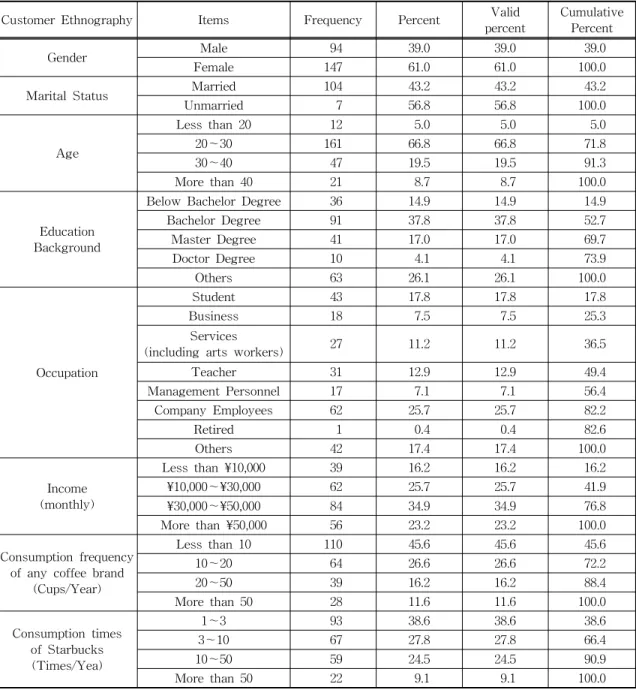
(1) It uses frequency analysis to make pop- ulation statistics and analysis

(2) It uses EFA and CFA to make analysis on the validity of analyzed content in the ques- tionnaire.

(3) It uses Cronbach α to calculate the reliability of analyzed content in the questionnaire.

(4) It uses Pearson correlation analysis of the inter relationship among all variables.

(5) In order to know about the relationship among all variables, it uses path analysis to ana-

lyze the hypothesis. 

For the statistics above, SPSS 18.0 and AMOS 20.0 are used to make analysis. P-values of the used statistics and analysis are all below 0.05.

4.2.1 Collecting Methods of Materials and Charac- teristics of Sample

4.2.2 Validity and Credibility Analysis

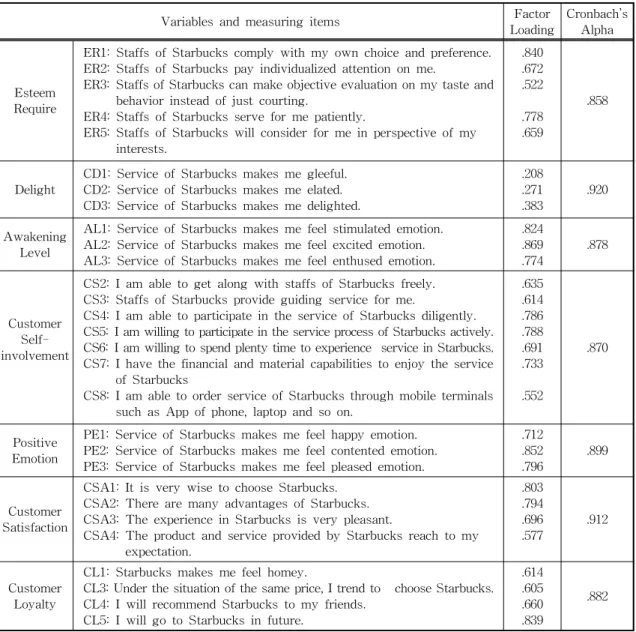
In order to detect the factor of construct validity, it makes elemental analysis. According to the rules that when Factor loading is more than 0.4, it is effi- cient, when Factor loading is more than 0.5, it is obviously efficient. It eliminates the injurious fac- tor with varinax. Finally, all the Factor loadings in the thesis are more than 0.6. As shows in Table 2 through factor analysis, all the factor values of EFA are bigger than 0.6 and all the reliabilities are bigger than 0.7; in aspect of statistics, the result is effective. As show as Table 2.

Through the test of reliability, values of every

(9)

Table 4. Configuration evaluation

Model CMIN df CMIN/F (X

2

/df) RMR IFI TLI CFI

Theoretical

Model 514.6 179 2.875 .069 .929 .916 .928

Table 5. Model path coefficients

Hypothesis Path

Theoretical Model

Hypothesis reject/accept Standardized Regression

Coefficient C.R.

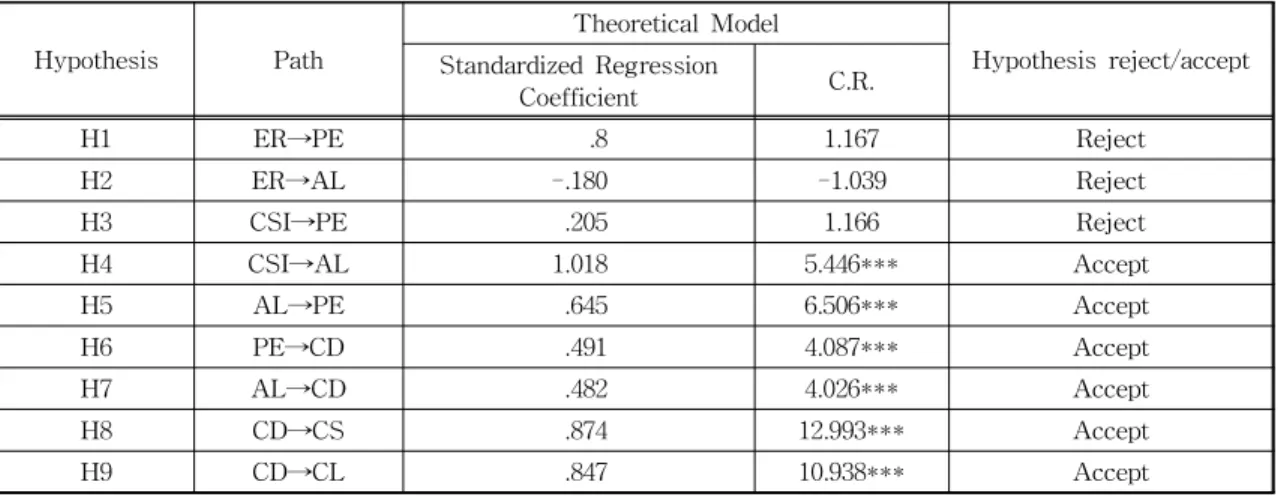
H1 ER→PE .8 1.167 Reject

H2 ER→AL -.180 -1.039 Reject

H3 CSI→PE .205 1.166 Reject

H4 CSI→AL 1.018 5.446*** Accept

H5 AL→PE .645 6.506*** Accept

H6 PE→CD .491 4.087*** Accept

H7 AL→CD .482 4.026*** Accept

H8 CD→CS .874 12.993*** Accept

H9 CD→CL .847 10.938*** Accept

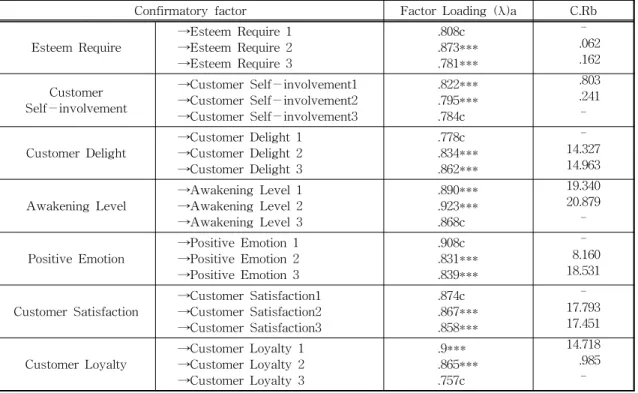
factor are all more than 0.7, and some of them even are more than 0.9 that prove the reliable and effi- cient reliability of the factor. The measurement in- dex of the measurement model in the research is of high fitness and the result of CFA can be seen from Table 3; every measurement value is ob- viously connected with the corresponding potential factor. So each result of CFA is effective as well in aspect of statistics. As show as Table 3.

As show in table 4,X2/df should be less than 3,RMR should be less than 0.08 and IFI, TLI, CFI should be bigger than 0.9. As shows in Table 6, the value of X2/df=2.875(less than 3)IFI, TLI, CFI is more than 0.9 that is obvious in statistics.

4.2.3 The path analysis on hypothesis test.

As shows in Table 5, H1, H2, H3 is false and others are true. Among them, H1, H2, H3 is neg- ative correlation and others are positive correlation.

The obvious influential relationship of Esteem Require and positive emotion, Esteem Require and awakening level, customer self-involvement and awakening level is false. The final model path as

show in figure 4 :

5. Conclusion and Implication

5.1 Conclusion

In order to build Customer Delight Index Con-

tents Model to measure the influential factors of

Customer Delight index and identify the relation-

ship among Customer Delight, Customer Satisfac-

tion and Customer Loyalty. H1 Esteem Require has

no significant impact on Positive emotion. H2

Esteem Require has no significant impact on

Awakening level. H3 Customer Self-involvement

has no significant impact on Positive emotion. H4

Customer Self-involvement has significant im-

pact on Awakening level. H5 Awakening level has

significant impact on Positive emotion. H6 Positive

emotion has significant impact on Customer

Delight. H7 Awakening level has significant impact

on Customer Delight. H8 Customer Delight has

significant impact on Customer Satisfaction. H9

Customer Delight has significant impact on Custo-

mer Loyalty. It builds measurement model with the

(10)

Standardized Regression Coefficient(C.R.)

Ÿ Remarks: * * * refers to p < 0. 01; * * refers to p < 0. 05; * refers top < 0. 10.

Ÿ H1、H2、H3 are Rejected.

Ÿ H4、H5、H6、H7、H8、H9 are Accepted.

Fig. 5. Model path.

previous research. In the empirical analysis, it takes advantages of questionnaire survey and takes the most popular catering service industry -Starbucks as an example. The questions used in the research are consist of high reliability and val- idity in this research. Questionnaires were col- lected and population statistics has been analysed.

EFA and CFA are used to make analysis on the validity of analyzed content in the questionnaire and it guarantees the reliability and validity of the questionnaire. In order to identify the relationship among all variables, it uses path analysis to ana- lyze the hypothesis. H1, H2 and H3 were all rejected. The obvious influential relationship of Esteem Require and positive emotion, Esteem Require and awakening level, customer self-in- volvement and awakening level were rejected.

Through the hypothesis of H1 and H2, meeting

Esteem Require is not the necessary and sufficient condition to win Customer Delight.

In the previous research, Yoo, Park and Macln-

nis (1998) say "in the process of customer self-in-

volvement, positive emotion and awakening will

bring positive Customer Delighted feelings after

customers accepting various stimulations of ex-

ternal service environment, such as pleasure, ex-

citement and so on." Through the test of H3 and

H4, there is obvious influence of customer self-in-

volvement on awakening level, however, there is

no obvious influence of customer self-involvement

on positive emotion. Through the test of H5, cus-

tomer self-involvement indirectly influence pos-

itive emotion through the obvious influence on

awakening level. All of H5, H6 and H7 were veri-

fied and accepted. The relationship among positive

emotion, awakening level and Customer Delight is

(11)

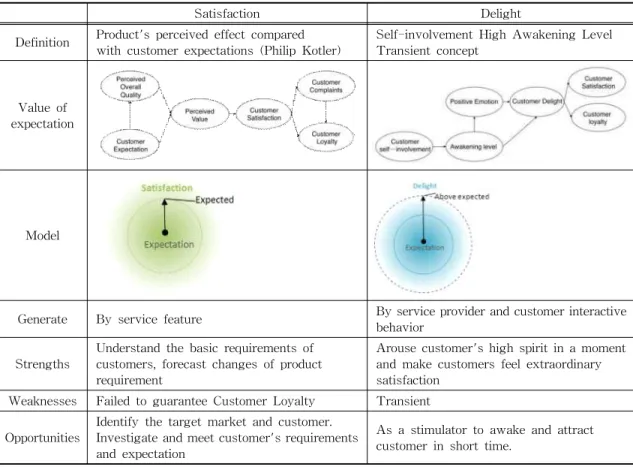
Table 6. Comparison between Customer Satisfaction and Customer Delight

Satisfaction Delight

Definition Product's perceived effect compared

with customer expectations (Philip Kotler) Self-involvement High Awakening Level Transient concept

Value of expectation

Model

Generate By service feature By service provider and customer interactive behavior

Strengths Understand the basic requirements of customers, forecast changes of product requirement

Arouse customer's high spirit in a moment and make customers feel extraordinary satisfaction

Weaknesses Failed to guarantee Customer Loyalty Transient

Opportunities Identify the target market and customer.

Investigate and meet customer's requirements and expectation

As a stimulator to awake and attract customer in short time.

verified as well. There is obvious influence of awakening level on positive emotion, there is ob- vious influence of positive emotion on Customer Delight and there is obvious influence of awaken- ing level on Customer Delight.

All of H8, H9 were verified and accepted. The relationship among Customer Delight, Customer Satisfaction and Customer Loyalty is verified as well. There is obvious influence of Customer Delight on Customer Satisfaction, there is obvious influence of Customer Delight on Customer Loyal- ty and there is obvious influence of Customer Satisfaction on Customer Loyalty.

In conclusion, Customer Self-involvement can lead to high awakening level and customer Awak- ening level can bring positive emotion to the cus- tomer. Awakening Level and positive emotion refer to the key factors that cause Customer Delight, in-

stead of customer expectation, Customer Delight is actually based on customer awakening level and positive emotion, which is different from the Cus- tomer Satisfaction model. There is obvious influ- ence of Customer Delight on Customer Satisfaction and Customer Loyalty.

5.2 Implication

As show in the table 6, Customer Delight comes from the positive emotion awaked by customers' self-involvement in the service process. The serv- ice that delighted customer will lead to Customer Satisfaction and Customer Loyalty. The research measures the formation mechanism of Customer Delight and submits some new academic opinions;

besides that, empirical research and analysis on the

formation mechanism of Customer Delight could

generate certain reference values for the academic

(12)

research on Customer Delight in future.

REFERENCE

[ 1 ] Aaker, and Daker A, Strategic Market Mana- gement, John Wily and Sons, New York, 1988.

[ 2 ] Winters, Mary Frances, CEOs Who Get It, Leadership Excellence, 2007.

[ 3 ] Anderson, Eugene W., and Vikas Mittal,

"Strengthening the Satisfaction-Profit Chain,"

Journal of Service Research, Vol. 3, No. 2, pp.

107-120, 2000.

[ 4 ] Jana L. H. Bowden, and Tracey S. Dagger,

"To Delight or Not to Delight? An Investiga- tion of Formation in the Restaurant Industry,"

Journal of Hospitality Marketing and Mana- gement, Vol. 20, No. 20, pp.501-524, 2011.

[ 5 ] Lee, Eunkoung, Myoungsik Choi, and Cheeyong Kim, "Study on Laughter-arousing Factors of Character Designs of Kakaotalk Emoticons,"

Journal of Korea Multimedia Society, Vol. 18, No. 2, pp. 253-259, 2015.

[ 6 ] Loureiro, Sandra Maria Correia, and Elisabeth Kastenholz, "Corporate Reputation, Satisfac- tion, Delight, and Loyalty towards Rural Lodging Units in Portugal," International Journal of Hospitality Management, Vol. 30, No. 3, pp. 575-583. 2011.

[ 7 ] Lovelock, Christopher Hood, "Classifying Services to Gain Strategic Marketing Insights," J ournal of Marketing, Vol. 47, No.

3, pp. 9-20, 1983.

[ 8 ] Mittal Vikas, and Wagner A Kamakura,

"Satisfaction Repurchase Intention and Repurchase Behavior, Investigating the Mod- erating Effects of Customer Characteristics,"

Journal of Social Science Electronic Publish- ing, Vol. 38, No. 1, pp. 131-142, 2001.

[ 9 ] Torres E. N., and S Kline, "From Customer Satisfaction to Customer Delight: Creating a New Standard of Service of the Hotel Indus- try," International Journal of Contemporary

Hospitality Management, Vol. 25, No. 5, pp.

642-659, 2013.

[10] Oliver, R. L., Rust, R. T., and S. Varki,

"Customer Delight: Foundations, Findings, and Managerial Insight," Journal of Retailing, Vol. 73, No. 3, pp. 311-336, 1997.

[11] Parasuraman A, and Berry L. L, "Reassess- ment of Expectations as a Comparison Standard in Measuring Service Quality:

Implications for Further Research," Journal of Marketing, 1994, Vol. 58, No. 1, pp.111-124.

[12] Rafaeli, Anat, and Sutton R I, "Expression of Emotion as Part of the Work Role," Academy of management review, Vol. 12, No. 1, pp.

23-37, 1987.

[13] Schneider Benjamin, and Bowen DE, "Under- standing Customer Delight and Outrage,"

Sloan Management Review, Vol. 41, No. 1, pp.

35-45, 1999.

[14] Song J. H. and Adams C. R., "Differentiation through Customer Involvement in Production or Delivery," Journal of Consumer Market- ing, Vol. 10, No. 2, pp. 4-12, 2013.

[15] Strongman D B, Miller J D, Calhoun L, et al,

"The Biochemical Basis for Interference Competition among Some Lignicolous Marine Fungi," Botanica Marina, Vol. 30, No. 1, pp.

21-26, 1987.

[16] Torres E N., and S Kline, "From Satisfaction to Delight: A Model for the Hotel Industry,"

International J ournal of Contemporary Ho- spitality Management, Vol. 18, No. 4, pp. 290- 301, 2006.

[17] Westbrook R A, Oliver R L, "The Dimension- ality of Consumption Emotion Patterns and Consumer Satisfaction," Journal of Consumer Research, Vol. 18, No. 1, pp. 84-91, 1991.

[18] Yoo C, Park J, MacInnis D J, "Effects of Store

Characteristics and In-store Emotional

Experiences on Store Attitude," J ournal of

Business Research, Vol. 42, No. 3, pp. 253-

263, 1998.

(13)

Yang, Ya-yun

She received a Master degree in Graduate School of design, Dong- seo University, Korea in 2014 and Ph.D. candidate research on Service Design from 2014. Her research fields focus on Custo- mer relationship management.

Lee, Sung-Pil

Lee Sung Pil is the professor of

Service Design at Dongseo Uni-

versity. He received a B.S. of

Industrial design and an M.S. of

Mechanical Engineering from

University of Bridgeport, Con-

necticut, US. He received his

Ph.D. in System Design from Chiba University, Japan

and Ph.D. course completion from Cheonbuk National

University in the major of Design Manufacture Engin-

eering.

수치

Fig. 2. Distribution of Customer Loyalty.
Fig. 4. Customer Delight Index Contents Hypothesis  Model.
Table 1. Customer Ethnography Analysis
Table 2. Exploratory Factor Analysis (EFA)
+5

참조

관련 문서

Through the results of the first study, if you manage dancers considering the positive motivation for perfectionism in consideration of the

As the results, the preparations of financial and customer/marketing perspectives have significant relationships between operational performances in total

The purpose of this study is to identify how the Customer Satisfaction (CS) policy affects the employees'level of stress and satisfaction, and to minimize the

The purpose of this study is to analyze the effects of service quality on customer satisfaction and revisit intention perceived by Chinese golf range

The study conducted a study of literature and research, and in literature, the study of cosmetic behavior, nail behavior, self esteem, and

Second, in the job performance competency group, 'Customer Management', 'Facility Management', 'Document Management', 'Promotion and Marketing', 'External

 waiting time for service, customer complaints, waiting time for service, customer complaints, cleanliness, food quality, order accuracy,. cleanliness, food quality,

As shown in the results of this study through research methods and data processing described above, since customer service is increasingly important, dance