1. INTRODUCTION
With the flourishing availability of text docu- ments on the World Wide Web (WWW), it has be- come very difficult for an average reader to gather information on individual issues, events, or topics by reading each and every document with an aim to find out the useful information. Therefore, the smart crawling system able to play a major role to overcome this problem. Because the crawler is a program that retrieves and stores pages from the web, commonly for a web search engine [2]. In this research, we have discussed how web crawling is highlighted in an efficient way. We preferred un- structured data in this article and the data was col-
lected from the web page using a specific keyword.
The unstructured data is a data or information that do not have any predefined data model or not or- ganized pre-defined model. Earlier, in the research on unstructured data [1], [8] in web pages sim- ilarity but was very condensed. For this reason, their accuracy rate is not up to the satisfaction levels. Therefore, to solve this phenomenon, on this paper effective method of collecting unstructured data is demonstrated. First of all, we have collected automatically keywords related urls. Then created the data tree using the Breadth First Search (BFS) method from the all collected urls. Unstructured data was accounted and collected from the web page. We have collected multitudes unstructured
Design and Implementation of Web Crawler utilizing Unstructured data
Ahmed Md. Tanvir
†, Mokdong Chung
††ABSTRACT
A Web Crawler is a program, which is commonly used by search engines to find the new brainchild on the internet. The use of crawlers has made the web easier for users. In this paper, we have used unstructured data by structuralization to collect data from the web pages. Our system is able to choose the word near our keyword in more than one document using unstructured way. Neighbor data were collected on the keyword through word2vec. The system goal is filtered at the data acquisition level and for a large taxonomy. The main problem in text taxonomy is how to improve the classification accuracy. In order to improve the accuracy, we propose a new weighting method of TF-IDF. In this paper, we modified TF-algorithm to calculate the accuracy of unstructured data. Finally, our system proposes a competent web pages search crawling algorithm, which is derived from TF-IDF and RL Web search algorithm to enhance the searching efficiency of the relevant information. In this paper, an attempt has been made to research and examine the work nature of crawlers and crawling algorithms in search engines for efficient information retrieval.
Key words: Web Crawling, TF-IDF, Unstructured data, Hyperlink.
※ Corresponding Author : Mokdong Chung, Address:
(48513) Yongso-ro 45, Nam-gu, Busan, Korea, TEL : +82-10-2858-6883, FAX : +82-51-629-6264, E-mail : [email protected]
Receipt date : Nov. 12, 2018, Revision date : Jan. 10, 2019 Approval date : Jan. 21, 2019
†
Dept. of Computer Engineering, Pukyong National Uni- versity, Busan, South Korea (E-mail : [email protected])
††
Dept. of Computer Engineering, Pukyong National University, Busan, South Korea
※ This research was supported by Basic Science
Research Program through the National Research
Foundation of Korea (NRF) funded by the Ministry of
Education (NRF2017R1D1A1B03030033).
data. Therefore, we used word2vec to identify key- word related data from the multiple data pool. In this paper, filtration of the data acquisition level was performed for a large taxonomy.
The web crawler algorithm is used to traverse a web pages by extracting inter links and out links.
The extracted links were seeded in URL list for future use. The web document are linked by multi- ple hypertext links with connecting diverse re- sources. The web crawler implements various web search algorithm for retrieving and locating web documents, such as BFS, Term Frequency-Inverse Document Frequency (TF-TDF) and Reinforce- ment Learning (RL). The implementation of differ- ent web search crawling algorithms provides search efficiencies. By analyzing various web search al- gorithms, this paper proposes a new method to use the TF-IDF algorithm by improving the equation.
The rest of the paper has been constructed in this manner. The next section presents the related work, where we will describe our algorithms. In section 3 the design of web crawler. In section 4 out implementation and evaluation of the system.
Finally, section 5 discusses the conclusion and fu- ture work.
2. RELATED WORK
2.1 Unstructured data
Unstructured data, in contrast, refers to data that does not fit neatly into the traditional row and column structure of relational databases. In web
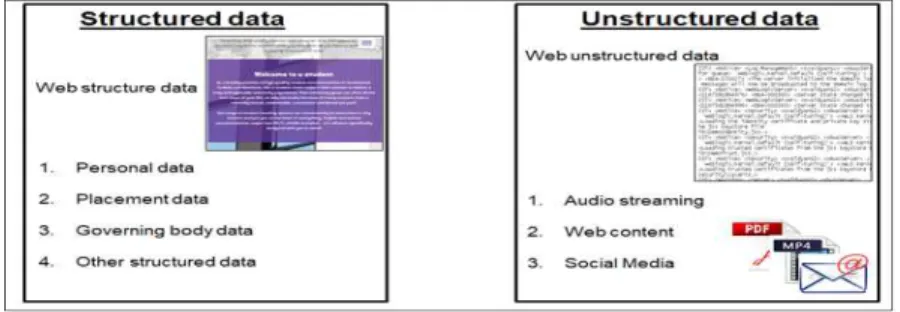
pages, it often includes text and multimedia content. Examples of text files like data processor, spreadsheets, presentations, webpages and many other kinds of business documents. While these sorts of files may have an internal structure, they are still considered unstructured because the data they contain does not fit neatly in a relational database. The learning resources and social net- working sites are examples of unstructured data [3]. The video and audio streaming of classroom is also unstructured data. Our paper focuses on learning resources and web pages multimedia data for unstructured data [12]. The education system generates, maintains and analyzes large amount of data through various sources. This data is related to academic, non-academic, learning, examination, admiration, training and placement. The nature of such data as shown in figure 1, is varied in nature as given.
2.2 An overview of TF-IDF
We will first introduce the mathematical back- ground of the algorithm and also describe the TF-IDF algorithm working process.
2.2.1. Mathematical Framework
Basically, TF-IDF works by determining the relative frequency of words in a specific document compared to the inverse ratio of that word over the entire document corpus. Intuitively, this calculation determines how relevant a given word is in a spe- cial document. Words that are common in a single
Fig. 1. Type of data and its application area.
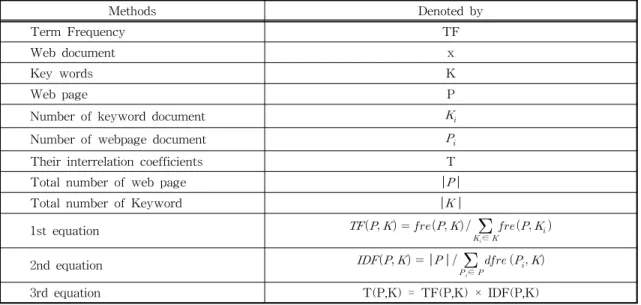
or a small group of documents tend to have higher TF-IDF numbers than common words such as ar- ticles and prepositions. The formal procedure for implementing TF-IDF has some minor differences over all its applications, but the overall approach works as follows in table 1. Their paper first de- fines a topic keyword dictionary, at the same time the web document is represented by x heft words, and then use TF-IDF method to calculate key- words (K), webpage, (P) and Term Frequency (TF) as shown in equation (1).
∈
(1) Here, P, K indicate the number of things of the keyword K in the web document P. As shown in equation (2) Inverse Document Frequency (IDF).
∈
(2) For the keyword, K with the webpages, P. Their interrelation coefficients are calculated as shown in equation (3).
T(P, K) = TF(P, K) × IDF(P, K) (3) TF-IDF is the multiple of the value of TF and IDF for a particular word. The value of TF-IDF increases with the number of occurrences within
a document and with rarity of the term across the corps. Finally T has been used to establish a con- nection between TF and IDF [6].
2.3 Reinforcement Learning Framework
In this section, we propose a formal framework for the deep web crawling based on RL and for- malize the crawling problem under the framework.
First of all we give an overview of the RL frame- work. The relation between a crawler and a deep web database is illustrated in figure 2.
From the figure, one can conclude that at any given step, an agent (crawler) perceives its state and selects an action (query). The environment Table 1. TF-IDF algorithm tools
Methods Denoted by
Term Frequency TF
Web document x
Key words K
Web page P
Number of keyword document
Number of webpage document
Their interrelation coefficients T
Total number of web page
Total number of Keyword
1st equation
∈
2nd equation
∈
3rd equation T(P,K) = TF(P,K) × IDF(P,K)
Fig. 2. Overview of the reinforcement learning frame
work.
responds by giving the agent some (possibly zero) reward (new records) and changing the agent into the successor state [11]. In the total procedure of RL-algorithm in the proposed method is described by the figure 3.
1. Link queue: Current set of links that have to be visited. Fetch link with highest score on queue.
2. Evaluate page this link points to: Based on set of text/content attributes. If relevant, store on Good Pages.
3. Get links from page
4. Evaluate links, add to link queue.
5. In the RL link scorer evaluate the links.
2.4 Word2vec
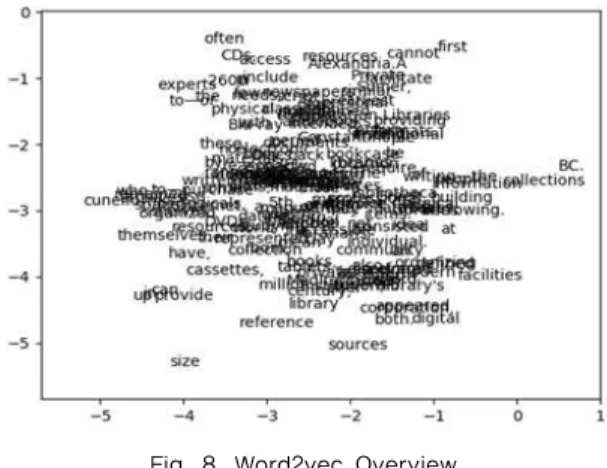
Word2vec is an algorithm for learning embed- ding’s using a neural language model. It also an open source tool released by Google in around 2013 [12]. It is based on deep learning and can learn the vector representations of words. Our first chal- lenge in the proposed method is to collect data from the web. For this reason, we have used specific keywords. We have selected specific four key- words (library, degree, student, university) and automatically collected hyperlink to the web ac- cording to the keywords described in figure 4. We have preferred web pages unstructured data. We have collected web hyperlinks in accordance with BFS method and selected unstructured related data. Therefore, we have selected keyword related web pages data using word2vec. We used
word2vec to divide the closer neighboring words in our used keywords. The dense vector repre- sentations of words learned by word2vec can cap- ture the semantic meanings, the logical relation- ships between words, where words that we know to be synonyms are more likely to have very closed vectors and antonyms tend to have dissimilar vectors. Because these vectors of words adhere surprisingly well to our friend word intuition and obey the laws of analogy.
3. DESIGN AND IMPLEMENTATION OF WEB CRAWLER
3.1 Web crawler architecture
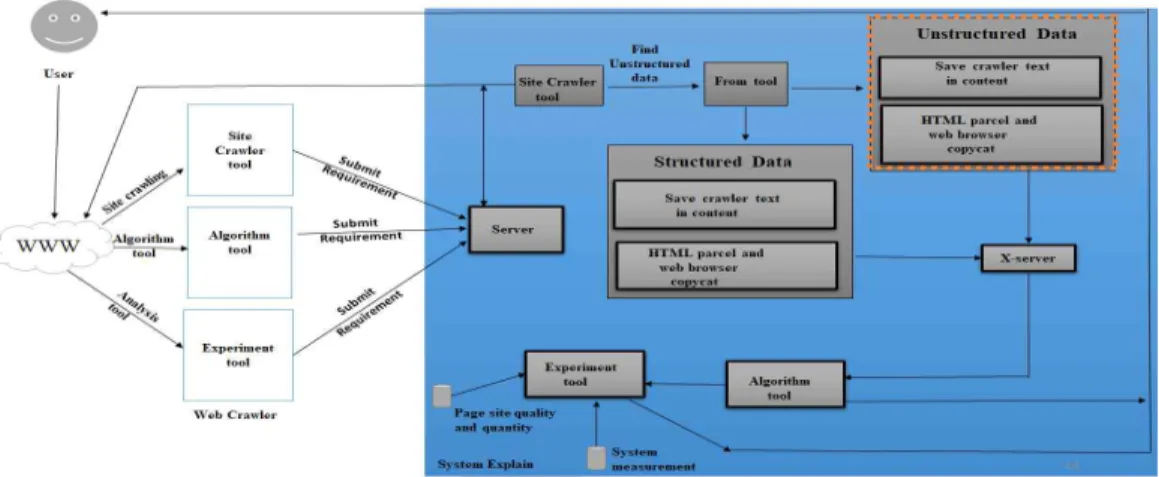
Web data acquisition is the foundation of web data mining. The web crawler is an important tool for web data acquisition. A web crawler is a pro- gram that is an essential web search engine to find the URL to the web page then save and download it. Web crawlers are an important component of web search engine, where they are used to collect the corpus of web pages index by the search engine as shown in figure 5 [4].
The web crawler's work methods are described.
The web page has different types of data. It is not possible to separate, when we are collecting this data, such as structured data or unstructured data in figure 1. Therefore, we created the architecture to separate these data. According to this archi- tecture, we collect data from the web page and it is divided into structured and unstructured ways.
Actually structure data is a data which is stored Fig 3 . Reinforcement Learning working Overview.
Fig. 4. Data gathering method according to the keyword.
in row and column format using traditional data- base management system. It follows all relational database management system properties like ACID, Normalization and etc. examples are Oracle, MySQL, ms-access, and so on. On the other hand, un- structured data is a data which is not stored in a table format. Which has no structure. It does not have a specific pattern like column or row. It in- cludes audio, video, pdf file etc. Therefore, we pre- ferred web pages unstructured data. Firstly, we have chosen a web page, after which we have sep- arated all the unstructured data associated with that web page, which we saved on our server. The biggest advantage of this architecture is that the collected data will not be lost, all data can be stored separately on the server. In this step of the algo- rithm tool, we will design how to use the algorithm.
Finally, the data reaches the experimental tool. The experimental tool uses the metrics computation tool’s output to show how a given design differ from highly rated designs with a similar purpose.
It uses several statistical models which derived from an analysis, that were rated according to their quality and usability and finally, it sends the result to the user.
3.2 Proposed Approach TF-Algorithm
The flow of measurement of the TF-algorithm
of the syndrome is shown by the pseudocode as follows.
1. START 2. P = 0; x = 0 3. While (True) do
4. While(Keyword queue is not empty) do 5. Pop from the Keyword queue 6. for(k = 1..n) do
7. if (P [k] = 0 and [k] < 0) or ( [k] <
0 and t < x[k] + x) then
8. if (p[
] > 0 and t > x[
]+x) then 9. p [
] =
10. x [
] = t 11. if (k == n) then 12. Reject task
13. else
14. if ( [ ] < T and [ ] > 0 and t > x [ ] + x) then
15. [ ] = [ ] -1
16. x = t
17. is a controller by P
18. else
19. if ( [ ] > + T and p [ ] < fre p and k / (get_total (p and
)) then 20. p = p +1
21. x[
] =t
22. push in the internal keyword queue value
Fig. 5. Web crawler architecture.
23. break 24. while (True) do
25. if (Keyword queue is empty for initial next state s’ and a’) then
26. for (k=1..n) do
27. if( p[
] < fre.P and ) then 28. p[
]=p[
]+1
29. x[k] = t
30. END
Step-1: Invocation and initialization (line 2 to 23). The block functionality is executed in an in- finite loop (line 3) activated every time interval (line 23). The current P state is set to the lowest value,
and the vector of time of the previous p state change, x, is set to 0 (line 2).
Step-2: Task fetching (line 4 to 5), the tasks external queue is checked if empty end, if not a task total keyword value is fetched (line 5).
Step-3: The conditional rejection (line 7 to 13), The code related to this step is executed inside a loop whose iterator k ranges from 1 to n, which is the number of cores in the processor (line 6).
If the output value of the
is controller ( ) is negative and the corresponding
core operates with highest performance and the interval between the previous p state switching time and current time (t) is long enough this value is assumed to have no capacity to execute task ki. Consequently, if all the cores in the analyzed processor have no capacity (line 11), task is rejected (line 13).
Moreover, if P state of the
core is different from p and its
state has not been switched for at least time web document x (line 8), p state in the
core is decreased (line 9) and the
element of vector x, storing the previous time of the
state alter- ation of the value
, is updated (line 10). As the previous errors in the k controller have been ob- served in a different P state (line 11). Hence, these obsolete values do not influence future admittance decisions.
Step-4: Task conditional admittance (lines 14 to 23), If the output value controller is lower then threshold +T, state in the core is long enough (line 14), the state is lower (line 15), and x is updated accordingly (line 16). In case the
dependent controller output value is above threshold +T, P state of the
core is different from the highest p state available in the processor (frequency p) and the previous switching of p state in the core is increased (line 19), and x is updated (line 20 to 21). Finally is sent to the every state queue (line 22).
The second part of the algorithm is located be- tween lines 24-30 and contains two steps only, as described below.
Step-1: Invocation (line 24 to 30), the block functionality is executed in an infinite loop (line 24), activated every time interval (line 29).
Step-2: p state conditional increase (line 25 to 29), the functionality of this next state step is acti- vated a’ and s’ (line 25). Under such condition, p state of all n cores are analyzed in a loop (line 26).
If the core performance is not the lowest possible then the core’s p state is increased (line 28), the web document value continues updated (line 29).
3.2.1 Proposed Approach RL-Algorithm
Reinforcement Learning or Q-Learning is learn- ing method, which renews each synapse weights according to output signals. The learning rule can be applied to feed forward networks and recurrent networks. The flow of measurement of the renewal of the syndrome is shown by the pseudocode as follows.
1. Initialize state (
)
2. calculate the reward of action an 3. for each document
∈
4. for each keyword k in
do
5. if action a(k) ≠A then
6. else then restart Reinforcement-Learning
(RL) of action a(k)
7. end for 8. end for
9. change the current state to
10.
restart candidate set S; S = S / [
] 11. for each
∈ update its reward
12. for each
∈ update its each value
13. for each
∈ calculated its RL-value 14. return argmax
′
15. End
Specifically, the surfacing algorithm first calcu- lates the reward of the last executed action and then updates the action set through step 3 to Step 8, which motive the agent to transit from its state
‘
’ to the successor state ‘
’. Then the training and candidate set are restart in accord with the new action set in step 10. After that, the algorithm catalog the reward and RL-value for each action in candidate set in step 11, step 12 and step 13 respectively. The action that maximizes RL-value will be returned as the next to be executed action.
3.3 Experimental Overview
In a good segmentation, sentences among differ- ent segments should belong to different subtopics.
Hence, the goal is to find the segmentation with the maximum external (two consecutive segments) dissimilarity. There are two types of segmentation in the field of the web such as structured and un- structured data. Web researchers usually use these two types of data to complete their web research.
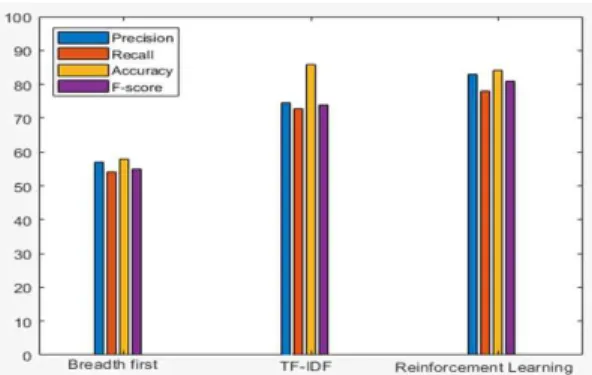
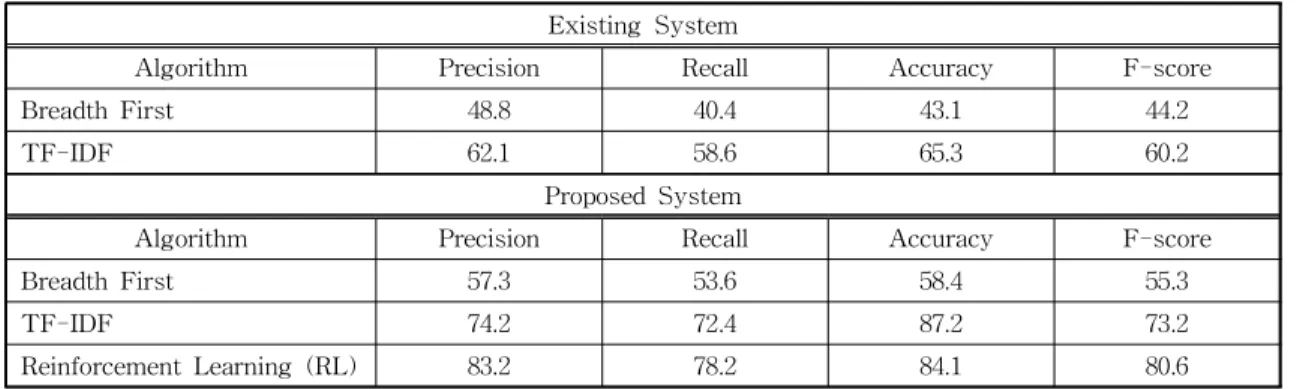
In this paper, we have preferred only web pages unstructured data. In the proposed method, we have used unstructured data in the form of structuralization. In the existing method, they have preferred both types of data. As a result, they are not able to find their keyword data equally. The equation (1) used in the existing method, in the pri- mary stage if the Web page (P), Keywords (K) and Number of keyword document (
) any value are
"0" so, the result of the total TF value is zero, it
means that the keyword is unable to choose a sim- ilar or closer word from the same document, which is not a good result. In this reason, the accuracy rate is not up to the satisfaction levels.
Therefore, to solve this problem we have used the total number of keyword document “|K|” in equation (4). In previous research, the total number of words has not been calculated. In this paper, we have calculated the total word value. This means that in the same document, the keyword can be correctly selected as a similar word. Therefore, if the more documents a term appears, the less im- portant that term will be, and the weighting will be less. So the user can find their information easi- ly and within in a short time.
∈