Article https://doi.org/10.14478/ace.2021.1030
1. Introduction
1)As the demand for dyestuffs increases in various industries, the dis- charge of dye wastewater is also increasing. The amount of dyes pro- duced globally to exceed about 700 million tons as of 2018, and there are more than 100,000 types of commercial dyes used[1]. As dyes use a large amount of water during the dyeing process, the amount of wastewater generated in the dyeing process is enormous[2]. Therefore, since the problem of environmental pollution caused by dyeing waste- water adversely affects aquatic ecosystems and has a potential negative effect on human health, research on various methods to eliminate them is ongoing[3].
In order to remove dye from wastewater, a number of technologies such as aggregation, flotation, precipitation, membrane process, chem- ical oxidation, biological oxidation and adsorption, etc. have been de- veloped and studied, and each method has advantages and disadvantages.
Among them, the adsorption method is the most studied and consid- ered because the removal efficiency is high, and the operation is sim- ple[4]. However, widely used for removing organic pollutants by using an existing adsorbent such as activated carbon is inefficient in terms of cost and is not feasible due to its low economic efficiency[5].
† Corresponding Author: Catholic Kwandong University,
Department of Biosystems and Convergence Engineering, Gangneung 25495, Republic of Korea
Tel: +82-33-649-7297 e-mail: [email protected]
pISSN: 1225-0112eISSN: 2288-4505 @ 2021 The Korean Society of Industrial and Engineering Chemistry. All rights reserved.
Therefore, bioadsorbents made from inexpensive agricultural waste are becoming the focus on many researchers. In particular, lignocellulose, composed of three major components of cellulose, hemicellulose and lignin, is rapidly emerging as a new eco-friendly adsorbent that can mainly replace the existing adsorbent[1,6]. Lignocellulosic-based water- melon can be an alternative to new adsorbents.
One of the fruits that is loved by many the summer, the flesh of watermelon is used for food. However, watermelon rind (WR), which accounts for 30% of all fruit, is disposed of as garbage without useful recycling[7]. WR is composed of pectin, citrulline, cellulose, protein and carotenoids[7,8]. These polymers are rich in functional groups such as hydroxyl (cellulose), amine (protein) and carboxylic acid (pectin), and have proven to have a great ability to easily bind cationic dyes in aqueous solutions[1,8]. In particular, WR contains the most cellu- lose, the most abundant organic compound on the earth. Due to these characteristics, WR can be regarded as a potential bioadsorbent, and many researchers conducted dye removal experiments using unmodified natural biomaterials, and reported many positive results[1,6]. However, the application of unmodified biomaterials has significant drawbacks such as low adsorption capacity in aqueous solutions and high release of soluble organic compounds[1,9]. Accordingly, in recent years, there is an increasing tendency to modify biosorbent materials to improve adsorption efficiency and remove soluble organic compounds. Methods of modifying bioadsorbents include physical, chemical, and other methods. Physical modification is generally simple and inexpensive, but due to its low efficiency, it is not widely used. On the other hand, chemical modification has the advantage of being simple and highly
Efficient Adsorption of Methylene Blue from Aqueous Solution by Sulfuric Acid Activated Watermelone Rind (Citrullus lanatus)
Seo-Yun Lee and Hee-Jeong Choi*,†
Department of Seed Biotechnology, Graduate School of International Agricultural Technology, Seoul National University, Pyeongchang 25354, Republic of Korea
*Department of Biosystems and Convergence Engineering, Catholic Kwandong University, Gangneung 25495, Republic of Korea (Received April 8, 2021; Revised May 21, 2021; Accepted May 21, 2021)
Abstract
The lignocellulose-based dried watermelon rind (WR) was modified with sulfuric acid, namely SWR for enhancement of meth- ylene blue (MB) adsorption from the aqueous solution. According to FT-IR analysis, after the modification of WR with sulfuric acid, the functional groups of R-SO3H, COOH and -OH groups was formated or enhanced on the surface of the WR. Moreover, the point of zero charge (pHpzc) was changed from 6.3 to 4.1 after modification, which widened the range for adsorbing of cationic dye MB. The adsorption process of MB onto the SWR was suitable for pseudo-2nd-order and Langmuir model and the maximum adsorption capacity of Langmuir was found to be 334.45 mg/g at pH 7. In adition, the adsorption process occurs through the electrostatic interaction, hydrogen bridge formation, electron donor-acceptor relationship, and π-π electron dis- persing force between functional groups on the carbon surface with MB molecules. Depending on functional groups available on the SWR surface, the MB adsorption mechanism can occur in combination with various interactions.
Keywords: Adsorption, Cationic dye, Kinetic, Lignocellulose, Sulfonation, Watermelone rind
efficient, and mainly uses acids and bases to modify biomaterials. In particular, several researchers reported that sulfuric acid increases the adsorption efficiency of cationic ions the most among various chemical substances that can modify biomaterials[1,10]. The reason is that the pretreatment of biomaterials using sulfuric acid increases the negative charge and surface area of the adsorbent surface, which leads to an in- crease in adsorption efficiency[11,12]. Therefore, in this study the sur- face of lignocellulosic-based WR was modified using sulfuric acid, and the removal efficiency of methylene blue (MB) from aqueous solution was analyzed using modified adsorbent. The experimental results were used to for adsorption isotherms and thermodynamic interpretation, and adsorption mechanism analyzed.
2. Materials and Methods
2.1. Materials
2.1.1. Preparation of SWR (sulfonated watermelon rind)
Watermelon was purchased at a local market, and the collected wa- termelon rinds were washed with tap water and then rinsed with dis- tilled water. The washed watermelon rind was cut into small pieces and dried in a drying oven at 85 ℃ for 24 hours to completely evapo- rate the moisture. The dried WR was pulverized in a ball mill at 120 rpm for 5 hours, separated into 40~60 mesh (0.25~0.4 mm) using an automatic sieve, and stored in a desiccator for use in the experiment.
A 20 g of dried watermelon rind powder was added to ethyl alcohol (60 mL) cooled to -10 ℃ and mixed completely for 1 hour. After that, it was added to 300 mL of cooled sulfuric acid, and a sulfonating re- action was carried out while stirring at 100 to 150 rpm for 12 hours so as not to exceed 10 ℃ using a reaction device [Yhana (Model SS-200, 50W)]. Thereafter, it was left at room temperature for 2 to 3 hours to induce the reaction to occur completely, and then washed sev- eral times with distilled water until neutral, put in a dryer, and dried for 48 hours at 85 ℃. The sulfonated watermelon rinds (SWR) were stored in a desiccator for use in experiments.
2.1.2. Methylene blue (MB)
Methylene blue (C16H18N3SCl) is a hetero cyclic aromatic compound and is a basic dye. Hydrate is blue and exists in the form of three mol- ecules of water per molecule of methylene blue. MB (C16H18ClN3S⋅
3H2O, molar mass: 319.85 g/mole, Sigma-Aldrich, USA) was used in powder form. MBs of various concentrations were prepared at a con- centration of 1000 mg/L, and then diluted with distilled water to pre- pare a solution of the required concentration
2.2. Experimental design and analytical methods 2.2.1. Batch test
Various parameter experiments to find optimal conditions were per- formed in the form of batch-test. The SWR was added in 1 L of aque- ous solution containing various concentrations of MB according to the experimental plan, and the experiment was conducted while controlling various parameters, such as pH (3~10), amount of adsorbent (0.5~5 g/L), initial concentration of MB (20~500 mg/L), contact time (0~240
minutes), and temperature (25~40 ℃). Sampling was performed at a predetermined time while stirring at 120 rpm in a Shaking Incubator.
The pH was adjusted using NaOH and HCl, and all experiments were repeated five times, and the average value was used as the experimental result, and the other parameters were fixed in order to experiment with one parameter.
2.2.2. Analytical methods
The chemical composition of SWR and WR was analyzed using an X-ray fluorescence spectrometer (XRF, ZEISS Xradia 520, Germany) spectrometer, and FT-IR was analyzed using Perkins Elmer (FT-IR 1760X, USA). The surface analysis of the adsorbent was performed us- ing Scanning Electron Microscopy (SEM; SEM-EDX, Hitachi, TM3030Plus, Japan), and the pHpzc was analyzed according to the pre- vious method[13]. The specific surface area, pore size, and distribution analysis of SWR and WR were analyzed from nitrogen adsorption and desorption isotherms using an adsorption analyzer (BELSORP-max, Bel Inc., Japan). The specific surface area was analyzed by Brunauer, Emmett and Teller (BET) analysis, pore distribution by Barrett, Joyner, and Halenda (BJH) analysis, and micropore distribution by t-plot analysis. MB concentration of the collected sample was measured us- ing a spectrometer (HACH DR2800, USA). The amount of SWR was measured using an electronic balance (XP26, Mettler Toledo, Swiss), and the pH was measured using a pH meter (SevenGO pro, Mettler Toledo). Adsorption kinetics were analyzed using Pseudo-1st-order and Pseudo-2nd-order, adsorption isotherms were analyzed using Langmuir, Freundlich and Temkin models, and thermodynamics were analyzed using Gibb’s free energy equation.
3. Results and Discussion
3.1. Characterization of WR and SWR 3.1.1. Physical properties
The results of component analysis of WR and SWR are summarized in Table 1. The major constituents of WR and SWR were carbon and oxygen, and in addition, small amounts of hydrogen and nitrogen were also contained. After sulfonation of WR, the content of oxygen in- creased and the content of carbon decreased. This may be due to the release of volatile during the sulfonating process, and the relatively high oxygen content is due to the high level of chemical active agent used (H2SO4; 95~98%). The ratio of H/C and O/C in the bioadsorbent affects the removal of contaminants because it is related to the increase and decrease of the aromatic and carbonyl groups[5,13]. According to previous studies, the aromaticity of the bio-adsorbent increases as the H/C ratio approaches 1, and when the O/C ratio is high, the anionic properties of the bio-adsorbent are strengthened due to the increase of the carboxylate group in the bio-adsorbent, thereby increasing the abil- ity to adsorb cationic substances[2,14]. The H/C ratio improved from 0.045 to 0.13 after sulfonating WR, and the O/C ratio increased from 0.72 to 1.17, and the carboxyl group inside the SWR adsorbent in- creased after sulfonating WR.
In general, the adsorption capacity is correlated with surface area of
Component (mass %) WR SWR
O 36.16 49.32
C 50.32 42.16
H 2.26 5.38
N 1.32 1.72
S - 1.32
Mg 0.08 0.09
Surface property
Pore volume (cm3/g) 0.019 0.153
Pore diameter (nm) 1.056 4.52
BET surface area (m2/g) 2.164 163.26 Table 1. Properties of Dried Watermelon Rind and Sulfonated Water- melon Rind (unit: %)
adsorbent[1,15]. However, this characteristic does not apply to all ad- sorbents, and if the surface area of the adsorbent is too large compared to the material to be adsorbed, the adsorption capacity is rather low[1,4]. Therefore, the increasing in the pore diameter of the adsorb- ent is not necessarily proportional to the improvement in adsorption capacity. According to previous studies, the pore size of the adsorbent of more 6 nm does not seem to have an advantage in increasing the adsorption efficiency of MB[9,11]. However, the adsorbent with a large surface area but a medium pore diameter showed a high level of MB adsorption capacity exceeding 800 mg/g[1,16]. This is because the size of MB in aqueous solution has dimensions of 0.400 × 0.793 × 1.634 nm, so the pore size of the adsorbent plays an important role in allowing the diffusion of MB in the pores[11,16]. According to pre- vious studies, MB molecules could not pass through pores of less than 1.0 nm (super-micropores), and adsorbents having a pore structure of at least more 1.33 nm in diameter had higher MB adsorption capacity than activated carbon having a meso-marco (> 30 nm) size[8,11]. The pore size of SWR increased from 1.056 nm of WR to 4.52 nm, which is within the range of micro-meso (2~30 nm) pore structure, and has a size suitable for adsorbing MB in aqueous solution.
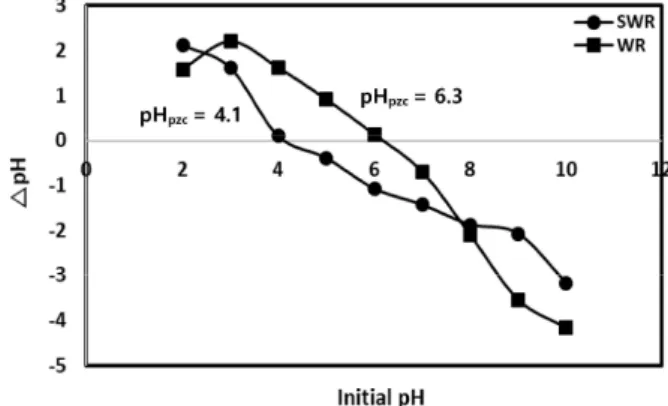
3.1.2. pHpzc
The pHpzc (point of zero charge) represents the pH value when the zeta potential of the adsorbent reaches zero[2]. If the pH value is lower than the pHpzc value, more hydrogen ions can be exchanged for heavy metal cations, but the high concentration of hydrogen ions protonates the surface functional groups (e.g. -OH) of the lignocellulose-based ad- sorbent, increasing the number of surface positive charges[4,17]. Then, the adsorption of cationic ions in the aqueous solution is reduced due to electrostatic repulsion, and the adsorption efficiency of anions is im- proved[1,18]. Conversely, when the pH value is higher than pHpzc, de- protonation returns the surface of the functional group to a negative charge, resulting in the opposite effect of cations and anions[19,20].
Therefore, in the adsorption of cationic substances, the pHpzc of the lignocellulose-based adsorbent should be more acidic for a wider range of pH action, whereas for the adsorption of anionic substances, pHpzc
Figure 1. pHpzc of WR and SWR in aqueous solution.
should be more alkaline. The adsorption efficiency of ionic cationic dyes is linked to the concentration of hydrogen ions in the aqueous solution, and since these various types of ions have different affinity for functional groups on the surface of the adsorbent, it ultimately af- fects the adsorption capacity.
In order to find the pHpzc of SWR, the experiment was performed by controlling the pH from 2 to 10, and the results are shown in Figure 1. The ΔpH is the value obtained by subtracting the initial pH from the final pH. The pHpzc of SWR was found to be 4.1, and it was confirmed that there is an acidic functional group on the surface of the SWR. The negative surface charge of SWR can be found in a pH envi- ronment above pHpzc, which favors adsorption of MB. In general, MB adsorption may be due to the presence of OH, COO-, and SO3- groups on the SWR surface. According to previous studies, the pHpzc values of coconut leave and mango peels were 3.2 and 4.6, respectively, after sulfonation[1,21]. When sulfonating a lignocellulose-based biomaterial, pHpzc decreases by increasing anionic functional groups on the surface of the adsorbent, and low pHpzc is thought to have a favorable effect on the adsorption efficiency of MB.
3.1.3. FT-IR spectra
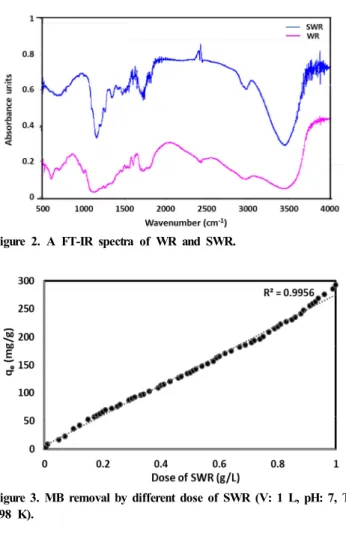
The FT-IR of WR and SWR provides important information to un- derstand the adsorption mechanism. WR showed very broad cellulose ester peak (1067 cm-1), aliphatic CH-stretching characteristic peak (2917 cm-1), and bonded OH peak (3392 cm-1) (Figure 2). It should be noted that both WR and SWR showed severe vibrations between 1300~1740 cm-1, which correspond to C=O carbonyl groups, carboxylic groups and C-O stretches. In addition, at 650 cm-1, it is not as strong as the bonded OH peak, but a peak of N-containing ligands also appears. SWR was bonded OH-group (3000~3500 cm-1), CH stretching (2900~2800 cm-1), C=O carbonyl groups (1740~1680 cm-1), carboxylic groups (1670~1640 cm-1) and CO stretch (1450~1300 cm-1) peak appeared. In addition, it was confirmed that the ether of 1109 cm-1, the absorption peak of R-SO3H of 1232 cm-1, and ketone peaks of 1642 and 1477 cm-1 were sulfonated. In particular, the peaks of N-containing ligands (650 cm-1), R-SO3H absorption peak (1232 cm-1), carboxylic groups (1642 cm-1) and bonded OH-group (3458 cm-1) of SWR are appeared lager than that of WR. This indicates that SWR has more functional
Figure 2. A FT-IR spectra of WR and SWR.
Figure 3. MB removal by different dose of SWR (V: 1 L, pH: 7, T:
298 K).
groups than WR and has a structure that is easier to adsorb MB ions.
Osman et al.[22] reported that the adsorption capacity is proportional to the number of functional groups in the adsorbent. The formation and enhanced change of -R-SO3H, -COOH, and -OH functional groups through sulfonation are thought to have a favorable effect on the ad- sorption efficiency of MB in aqueous solution.
3.2. Effect of various parameters 3.2.1. Amount of adsorbent
Optimizing the amount of adsorbent is one of the major items in the economic evaluation of adsorbents, such as adsorption efficiency. This is because if a large amount of harmful substances can be adsorbed and removed from a small amount of adsorbent, it is possible to be more free from environmental problems and to save materials and energy. In order to find out the effect of the amount of SWR on the adsorption efficiency of MB, experiments were performed with the concentration of MB at 1~300 mg/L, pH 7 and 25 ℃ and the results of removal efficiency of more than 90% are shown in Figure 3. The correlation between the amount of adsorbent and the amount of adsorp- tion was 0.9956, and as a result of calculating the relationship between the amount of MB adsorption and the amount of SWR adsorbent, about 32.5~36.7 mg of MB per 1 g of SWR could be adsorbed. As the concentration of MB increased, a more amount of SWR was required, which is a phenomenon caused by a decrease in the active point that
Figure 4. Effect of pH on MB removal (V: 1 L, MB: 10 mg/L, SWR dosage: 1 g/L, T: 298 K).
can be adsorbed on the adsorbent. According to previous studies, 0.8~
1.8 g/L was required when MB was removed using SWR, and about 27.96~44.14% MB removal efficiency was improved compared to when using non-sulfonated WR[8]. This is consistent with the research results of many researchers that adsorbed MB and heavy metals in aqueous solutions by sulfonating agricultural waste[1,2,9].
3.2.2. pH
In order to find out the effect of pH change in aqueous solution to the adsorption efficiency of MB onto SWR, the pH was adjusted to 3~10, and the experiment was performed using 1 g/L SWR, and the results are shown in Figure 4. The adsorption efficiency of MB onto SWR increased as the pH increased. In particular, the adsorption effi- ciency at pH 6 increased by 3.42 times for pH 3. As the pH increases, the sulfuric acid, carboxyl and phenolic hydroxyl groups of the SWR adsorbent are deprotonated to form R-SO32-, R-COO- and R-O- groups [11,16]. This is because the electrostatic attraction between the SWR adsorbent and the MB cations in the aqueous solution was improved as the surface of the SWR adsorbent became negatively charged. Note that there was no significant change in the adsorption efficiency up to pH 4, but the adsorption amount increased sharply above pH 5. This is related to the value of pHpzc mentioned above. The pHpzc of SWR is 4.1, and if the pH is higher than the pHpzc value, the surface charge of the adsorbent becomes negative, and cations may be adsorbed.
Another reason is that MB exists in aqueous solutions as cationic spe- cies and undissociated molecules depending on the pH.
3.3. Adsorption kinetics and adsorption isotherm modeling 3.3.1. Adsorption kinetics
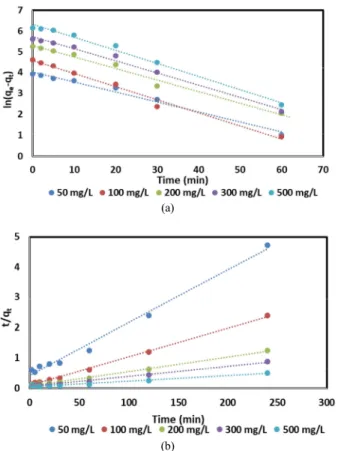
To compare the adsorption rate of MB to SWR, a kinetics experi- ment was conducted, and the results were analyzed as pseudo-1st-order and pseudo-2nd-order. The main parameters of adsorption kinetics are shown in Table 2 and Figure 5.
As a result of the analysis of the kinetics experiment, the reaction of MB was almost completed within 60 minutes using SWR (Figure S1). The values of k1 in pseudo-1st-order and k2 in pseudo-2nd-order decreased as the concentration of MB increased, indicating that the ad- sorption rate of MB to SWR decreased as the initial concentration of
(a)
(b)
Figure 5. A plots of (a) pseudo-first-order kinetics and (b) pseudo-se- cond-order kinetics.
MB increased. The relationship (R2) of the kinetic model was meas- ured higher in pseudo-2nd-order (0.9906~0.9977) than that of pseu- do-1st-order (0.9834~0.9901). Also, the qcal calculated in the pseu- do-2nd-order model was closer to the measured qe,exp compared to the value calculated in the pseudo-1st-order model. Therefore, MB adsorp- tion kinetics by SWR was more suitable for the pseudo-2nd-order model than the pseudo-1st-order model.
Figure S1. Influence of initial MB concentration (V: 1L, T: 298 K, pH: 7, SWR dosage: 5 g/L).
3.3.2. Adsorption isotherm
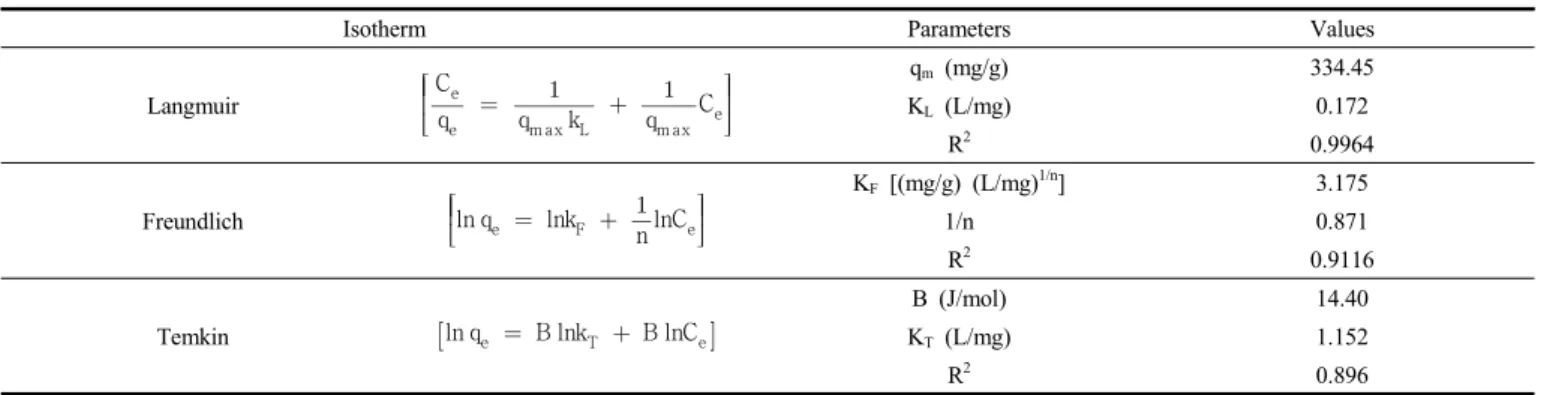
The adsorption isotherm is the equilibrium relationship between the concentration of the adsorption layer in the fluid phase and the concen- tration of the adsorbate in the adsorbent particles of a given temper- ature[5,9]. An isotherm adsorption experiment was performed to obtain information on the adsorption characteristics of MB onto SWR, and the obtained results were analyzed using models of Langmuir, Freundlich and Temkin, and summarized in Table 3. In the Langmuir isotherm model, one molecule is adsorbed and fixed at each adsorption point, and the adsorption energy at all adsorption points are uniform and there is no mutual attraction between the adsorbed molecules[2,13].
And it is assumed that adsorption is achieved by collisions between each empty adsorption point and molecules[14].
The value of the dimensionless separation constant RL [= 1/(1 + KLCo)] derived from Langmuir was calculated as 0.012, and it was eval- uated that the adsorption process of MB using SWR was favorable. In addition, the maximum adsorption capacity of Langmuir was 334.45 mg/g, which was higher than that of coconut (26.14 mg/g) and banana peels (50.51 mg/g) modified with acid, and hazelnut peels (109.90 mg/g) and persimmon leaves (256.0 mg/g) modified with alkali (Table 4).
Concentration, C0 (mg/L)
50 100 200 300 500
qe,exp (mg/g) 50.83 100.31 191.51 272.17 469.43
Pseudo-first-order [ln(qe - qt) = ln qe - k1t]
qe,cal (mg/g) 56.35 97.38 202.07 309.42 559.59
k1 0.0478 0.0624 0.056 0.0582 0.063
R2 0.9857 0.9872 0.9834 0.9901 0.9894
Pseudo-second-order
qt
t kqe
qe t
qe,cal (mg/g) 51.55 101.01 202.02 285.71 476.19
k2 7.30 × 10⁻⁶ 9.703 × 10⁻⁷ 1.21 × 10⁻⁷ 4.287 × 10⁻⁸ 9.26 × 10⁻⁹
h 2.33 10.11 11.64 14.62 18.76
R2 0.9911 0.9977 0.9924 0.9906 0.9973
qe: amount of MB adsorbed by SWR at equilibrium (mg/g), qt: amounts of MB adsorbed by SWR at equilibrium time t (mg/g), k1: Pseudo-1st-order constant (1/min), k2: Pseudo-2nd-order constant (g/mg·min), t: time (min)
Table 2. Kinetics Parameters for the Adsorption of MB onto SWR
The Temkin isotherm indicates that the heat of adsorption of MB ions decreases linearly rather than logarithmically with coverage[30].
The Tempkin constant B was measured to be 14.40 (J/mol), corre- sponding to the physical adsorption area (B < 20 J/mol). Therefore, ad- sorption of MB onto SWR is considered to be closer to physical ad- sorption caused by the action of Van der Waals force consisting of dis- persing force and electrostatic force rather than chemical adsorption of changing chemical form.
The Freundlich isotherm is suitable for adsorption where the Langmuir isotherm does not fit well. In addition, it can be derived the- oretically by assuming that the heat of adsorption decreases exponen- tially according to the degree of covering, assuming that all adsorption points have uniform adsorption strength among the assumptions of ob- taining the Langmuir isotherm by statistical method[4,19]. The constant c represents the number of adsorption points and n represents the de- gree of interaction between the adsorbed molecules[13]. If n > 1, the adsorption isotherm becomes convex due to the small increase in the adsorption amount even when the pressure increases because a re- pulsive force exists between the adsorbed molecules[15]. The larger the value of KF, which represents a measure of the adsorption capacity cal- culated from the Freundlich equation, indicates that the higher the val-
ue, the better the adsorption capacity, and the 1/n value representing the adsorption strength was generally between 0~1, the adsorption easi- ly occurs[2]. However, if it is larger than 2, it is interpreted that ad- sorption is difficult[4]. In this experiment, 1/n was analyzed as 0.871, so adsorption of MB onto SWR in aqueous solution was easy and the adsorption strength was appropriate. In addition, it can be seen that the value of KF is very high, so the adsorption ability is excellent. The ap- plicability of the adsorption model is that Langmuir’s R2 (0.9964) is higher than Freundlich’s R2 (0.9116) or Temkin’s R2 (0.896), so the adsorption of MB onto SWR is considered to be the most suitable for the Langmuir model.
3.4. Adsorption mechanism
The adsorption capacity was affected by the surface area and poros- ity of the adsorbent, but the aromatic rings and functional groups pres- ent on the surface of the adsorbent such as -C=O, -C-O-C-, -OH, -NH2, -C=S, -C=N and -S=O etc. plays an important role in increasing the adsorption capacity of MB in aqueous solution[6,10]. The molecular structure of MB that influences the interaction with the adsorbent car- bon surface was a 6 carbon aromatic ring, a cation containing nitrogen and sulfur[19]. The process of adsorption of methylene blue to carbon
Isotherm Parameters Values
Langmuir
qe Ce
qm axkL
qm ax
Ce
KqmL (mg/g) (L/mg) 334.450.172R2 0.9964
Freundlich
ln qe lnkF n lnCe
KF [(mg/g) (L/mg)1/n] 3.175
1/n 0.871
R2 0.9116
Temkin
ln qe B lnkT B lnCe
B (J/mol) 14.40
KT (L/mg) 1.152
R2 0.896
qe: adsorbed amount of Pb(II) at equilibrium (mg/g), Ce: Pb(II) concentration at equilibrium (mg/L), qmax: Langmuir maximum adsorption capacity (mg/g), KL: Langmuir constant (L/mg), KF: adsorption capacity (mg/g)(L/mg)1/n, 1/n: adsorption intensity of the system, kT: Temkin isotherm constant (L/mg), B: correlated to ad- sorption heat.
Table 4. Comparison of Adsorption Capacities for MB on Various Biomass Materials
Materials Adsorbent dose (g/L) pH qmax (mg/g) References
Watermelon rind 0.6 11 131.48 [23]
H2SO4 treated biomass
Watermelon rind 1 6 334.45 This study
Pine-fruit shell 3 8.5 529.0 [24]
Mango peels 1.4 5-6 277.8 [21]
Corn cob 1.2 5.6 216.6 [25]
Bagasse 4 9 56.5 [11]
KOH treated biomass Hazelnut peels 1.5 9 109.90 [26]
Persimmon leaf 1.5 9 256.0 [26]
Carbonated cellulose/microfibrillated cellulose spheres 0.8 7 303.0 [27]
APTES-reinforced lignocellulose hydrogel 1.5 6 191.9 [28]
Acetic acid lignin 1 6 63.3 [20]
Lignin-derived sulfonated porous carbon 0.8 6 420.40 [29]
sulfonated lignin-based hydrogel 1 6 495.0 [10]
Table 3. Adsorption Isotherms for MB onto SWR (500 mg/L, pH: 7)
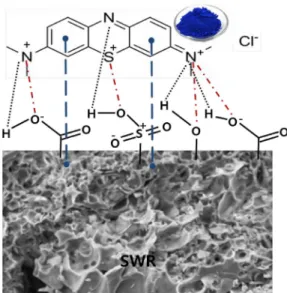
Figure 6. A possible interactions between SWR and MB in aqueous solution: electrostatic attraction ( ), hydrogen bonding interac- tion ( ) and π-π stacking interactions ( ).
occurs through electrostatic interactions, formation of hydrogen bridges, electron donor acceptor relationships, and the π-π electron dispersing force between functional groups on the carbon surface with MB mole- cules[1,11].
WR are made of carbonaceous substances such as polysaccharides.
It consists of low molecular weight compounds such as cellulose, pec- tin, carotenoids and amino acids, and citrulline and other phytochem- icals[8]. The presence of these compounds makes the WR an advanta- geous platform for the synthesis of activated carbon materials. WR can prove to be a suitable binder for MB adsorption due to the presence of hydroxyl (cellulose) and carboxyl (pectin) groups[8]. According to previous studies, watermelon peels contain a significant amount of phe- nolic compounds and have a high radical scavenging ability[1,6].
Adsorption of MB in aqueous solution is highly dependent on the various polar functional groups of the surface. According to the results of the FT-IR spectrum, the ratio of peaks of hydroxyl, carboxyl and carbonyl groups on the SWR surface was larger than that of WR, and various polar functional groups were enhanced. In particular, the for- mation of -SO3 groups on the surface of the adsorbent through the sul- fonating process is expected to play an important role in the adsorption process of MB. Depending on the functional groups available on the SWR surface, the MB adsorption mechanism can occur by various interactions. The various interactions between MB and SWR in aqueous solution can be broadly divided into three categories[8,28]; first, the electrostatic attraction between the positively charged MB cations in the aqueous solution and the negatively charged functional groups of the SWR surface. Second, it is the hydrogen bonding interaction be- tween the surface hydrogen bonds between the functional groups avail- able on the SWR surface and the nitrogen atom of MB, and the third, the π-π stacking interaction between the aromatic ring of MB and the graphene framework of SWR (Figure 6).
Based on the above-mentioned FT-IR analysis results, it can be con-
Temperature (K)
Thermodynamic [ΔG0 = ΔH0 - TΔS0]
△G0 (kJ/mol) △H (kJ/mol) △S (J/molㆍK)
298 -2.20
46.72 164.15
303 -3.02
313 -4.63
323 -6.30
qe: amount of MB adsorbed on SWR at equilibrium (mg/g), Ce: MB concentration at equilibrium (mg/L), R: universal gas constant (8.314 J/molK), T: absolute tem- perature (K), ΔH0: adsorption enthalpy change, ΔS0: adsorption entropy change, Δ G0: Gibbs free energy.
Table 5. Thermodynamic Parameters for Adsorption of MB onto SWR
cluded that various types of interactions contribute to the enhancement of MB adsorption on the SWR surface. These views are also consistent with reports by Jawad et al.[8] and Surip et al.[31]. In addition, similar observations have been reported by other researchers for adsorption to MB on the surface of chemically treated carbon microspheres, mul- ti-walled carbon nanotubes, wrapped carbon nanotubes and graphene-chi- tosan complexes[1,32]. The mechanism of adsorption of SWR and MB ions in aqueous solution can be explained by the following equation.
SWR-OH + C16H18ClN3S⋅3H2O →
SWR-O-C16H18N3S + HCl + 3H2O (1)
SWR-NH2 + C16H18ClN3S⋅3H2O →
SWR-NH-C16H18N3S + HCl + 3H2O (2)
SWR-COOH + C16H18ClN3S⋅3H2O →
SWR-COO-C16H18N3S + HCl + 3H2O (3)
SWR-SO3H + C16H18ClN3S⋅3H2O →
SWR-SO3-C16H18N3S + HCl + 3H2O (4)
In conclusion, sulfonation grafted the -SO3 group on the surface of the adsorbent, and strengthened the carboxyl group (-COOH) and the hydroxyl group. As a result, the adsorption efficiency of MB onto SWR was improved. However, if the degree of sulfonation is too high, the hydration shell induced by the sulfuric acid group acts as a barrier, preventing the sulfonated adsorbent and the cationic group of accessing each other[10,17]. This can reduce the adsorption efficiency. Therefore, it is necessary to optimize the degree of sulfonation for adsorbent.
Adsorption of MB onto SWR is a complex phenomenon due to various interactions.
3.5. Thermodynamic interpretation
In the adsorption process, the reaction temperature affects the sol- ubility of MB, which can determine the rate of adsorption as well as all potential ion exchangers[2,11]. The effect of temperature on adsorp- tion efficiency in aqueous solution was investigated, and the results are presented in Table 5.
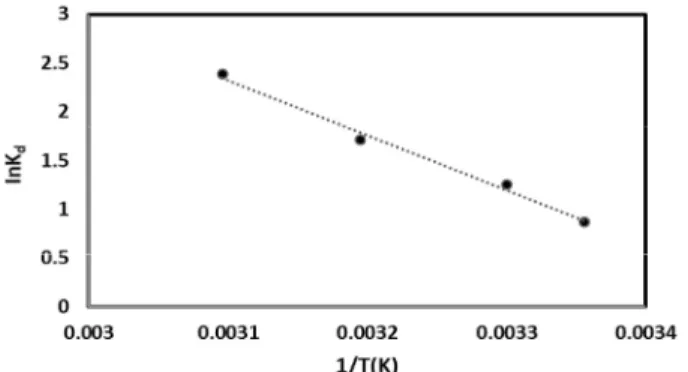
The values of ΔH and ΔS were calculated from the slope and in-
Figure 7. Plot of lnkd vs 1/T for determining of thermodynamic para- meters for the adsorption of MB onto SWR.
tercept of the van't Hoff plot (lnkd vs 1/T) as shown in Figure 7. As a result of the experiment, a negative value of ΔG indicates that ad- sorption of MB to SWR is spontaneous. In addition, the positive value of the enthalpy change (ΔH) indicates that the adsorption process is an endothermic reaction, and the positive entropy change (ΔS) in- dicates that the randomness of the SWR surface increases in the ad- sorption process. Moreover, the value of ΔG falls within the range of 0 to -20, so the MB adsorption process using SWR is a physical process. This is consistent with the analysis of the Temkin constant an- alyzed above.
Many researchers have reported that the biomaterial-based MB ad- sorption process is a spontaneous process and an endothermic reaction, and the adsorption efficiency increases with increasing temperature [1,6]. In addition, according to the values of Gibbs free energy and en- thalpy change, MB was adsorbed onto the biomaterial-based adsorbent through the physical adsorption process. The cause of this increase in adsorption efficiency was explained by the tendency of the activation of the active adsorption site of the adsorbent or the increase in the number of MB ions discharged from the adsorbent surface to the aque- ous solution. On the contrary, there are reports of several researchers that the adsorption efficiency decreased due to the decrease in the thickness of the boundary layer surrounding the adsorbent as the tem- perature increased. Li et al.[27] reported that as a result of removing MB from an aqueous solution by sulfonating a lignin-based material, the removal rate decreased by 18.13% as the temperature increased from 20 to 60 ℃. However, many researchers agree that temperatures as high as 50 ℃ can cause physical damage to bioadsorbents. Therefore, when using a bio-adsorbent to adsorb hazardous substances in an aque- ous solution, it is necessary to maintain an appropriate tem- perature.
4. Conclusions
This study attempted to adsorb MB in aqueous solution by sulfonat- ing a cellulose-based dried watermelon peel bio-adsorbent. The H/C ra- tio and O/C ratio was increased from 0.045 to 0.13 and from 0.72 to 1.17, respectively, after sulfonating of WR. The pHpzc of SWR was measured to be 4.1, so that the range to adsorb MB was wide, which had a favorable effect on adsorbing the cationic dye MB. The main functional groups of SWR were bonded OH-group, CH stretching, C=O
carbonyl groups, carboxylic groups and C-O stretch peaks, and R-SO3H peak. In various parameter experiments, 1 g/L of adsorbent and pH 6 were optimal conditions for adsorption of MB onto SWR.
The maximum adsorption capacity of Langmuir was found to be 334.45 mg/g. The adsorption process of MB using SWR was endother- mic and corresponds to a physical process according to the thermody- namic analysis. Sulfonating grafted the -SO3 group on the surface of the adsorbent and strengthened the carboxyl group (-COOH) and hy- droxyl group. As a result, the adsorption efficiency of MB onto SWR was improved.
Acknowledgement
This study was supported by the National Research Foundation of Korea (NRF) grant funded by the Korea government (MSIT) (No.
2021R111A3059243).
Declaration of Competing Interest
The authors declare that they have no known competing financial in- terests or personal relationships that could have appeared to influence the work reported in this paper.
References
1. E. Santoso, R. Ediati, Y. Kusumawati, H. Bahruji, D. O. Sulistiono, and D. Prasetyoko, Review on recent advances of carbon based adsorbent for methylene blue removal from waste water, Mater.
Today Chem., 16, 100233 (2020).
2. H. J. Choi and S. W. Yu, Biosorption of methylene blue from aqueous solution by agricultural bioadsorbent corncob, Environ.
Eng. Res., 24(1), 99-106 (2019).
3. Aruna, N. Bagotia, A. K. Sharma, and S. Kumar, A review on modi- fied sugarcane bagasse biosorbent for removal of dyes, Chemo- sphere, 268, 129309 (2021).
4. H. J. Choi, S. W. Yu, and K. H. Kim, Efficient use of Mg-modi- fied zeolite in the treatment of aqueous solution contaminated with heavy metal toxic ions, J. Taiwan Inst. Chem. Eng., 63, 482-489 (2016).
5. H. J. Choi, Assessment of the adsorption kinetics, equilibrium and thermodynamic for Pb(II) removal using a hybrid adsorbent, egg- shell and sericite, in aqueous solution, Water Sci. Technol., 79(10), 1922-1933 (2019).
6. N. Supanchaiyamat, K. Jetsrisuparb, J. T. N. Knijneburg, D. C. W.
Tsang, and A. J. Hunt, Lignin materials for adsorption: Current trend, perspectives and opportunities, Bioresour. Technol., 272, 570-581 (2019).
7. M. S. Hasanin and A. H. Hashem, Eco-friendly, economic fungal universal medium from watermelon peel waste, J. Microbiol. Me- thods, 168, 105802 (2020).
8. A. H. Jawad, R. Razuan, J. N. Appaturi, and L. D. Wilson, Ad- sorption and mechanism study for methylene blue dye removal with carbonized watermelon (Citrullus lanatus) rind prepared via one-step liquid phase H2SO4 activation, Surf. Interfaces, 16, 76-84 (2019).
9. Y. Dai, Q. Sun, W. Wang, L. Lu, M. Liu, J. Li, S. Yang, Y. Sun, K. Zhang, J. Xu, W. Zheng, Z. Hu, Y. Yang, Y. Gao, Y. Chen, X. Zhang, F. Gao, and Y. Zhang, Utilization of agricultural waste as adsorbent for the removal of contminants: A review, Chemo- sphere, 211, 235-253 (2018).
10. J. Li, H. Li, Z. Yuan, J. Fang, L. Chang, H. Zhang, and C. Li, Role of sulfonation in lignin-based material for adsorption removal of cationic dyes, Int. J. Biol. Macromol., 135, 1171-1181 (2019).
11. A. H. Jawad, R. A. Rashid, M. A. M. Ishak, and L. D. Wilson, Adsorption of methylene blue onto activated carbon developed from biomass waste by H2SO4 activation: kinetic, equilibrium and ther- modynamic studies, Desalin. Water Treat., 57, 25194-25206 (2016).
12. G. A. O. Weijue, J. P. W. Inwood, and P. Fatehi, Sulfonation of hydroxy methylated lignin and its application, J. Bioresour. Bioprod., 4(2), 80-88 (2019).
13. S. Y. Lee and H. J. Choi, Persimmon leaf bio-waste for adsorptive removal of heavy metals from aqueous solution, J. Environ. Manag., 209, 382-392 (2018).
14. S. W. Yu and H. J. Choi, Application of hybrid bead, persimmon leaf and chitosan for the treatment of aqueous solution contaminated with toxic heavy metal ions, Water Sci. Technol., 78(4), 837-847 (2018).
15. S. Manna, D. Roy, P. Saha, D. Gopakumar, and S. Thomas, Rapid methylene blue adsorption using modified lignocellulosic materials, Process Saf. Environ. Process, 107, 346-356 (2017).
16. S. Sabar, H. Abdul Aziz, N. H. Yusof, S. Subramaniam, K. Y. Food, L. D. Wilsone, and H. K. Lee, Preparation of sulfonated chitosan for enhanced adsorption of methylene blue from aqueous solution, React. Funct. Polym., 151, 104584 (2020).
17. M. Furtmair, J. Timm, and R. Marschall, Sulfonation of porous materials and their proton conductivity, Microporous Mesoporous Mater., 312, 110745 (2021).
18. K. F. L. Hagesteijn, S. Jiang, and B. P. Ladewig, A review of the synthesis and characterization of anion exchange membranes, J.
Mater. Sci., 53, 11131-11150 (2018).
19. H. J. Choi, Removal of Pb(II) from aqueous solution using hybrid adsorbent of sericite and spent coffee grounds, Appl. Chem. Eng., 29(5), 571-580 (2018).
20. Q. Feng, H. Cheng, F. Chen, X. Zhou, P. Wang, and Y. Xie, Investi- gation of cationic dye adsorption from water onto acetic acid lignin, J. Wood Chem. Technol., 36, 173-181 (2015).
21. A. H. Jawad, N. F. H. Mamat, M. F. Abdullah, and K. Ismail, Ad- sorption of methylene blue onto acid-treated mango peels: kinetic, equilibrium and thermodynamic, Desalin. Water Treat., 59, 210-219 (2017).
22. H. E. Osman, R. K. Badwy, and H. K. Ahmad, Usage of some agricultural by-products in the removal of some heavy metals from industrial wastewater, J. Phytol. Res., 2, 51-62 (2010).
23. O. Üner, Ü. Geçgel, and Y. Bayrak, Adsorption of methylene blue
by an efficient activated carbon prepared from Citrullus lanatus rind: Kinetic, isotherm, thermodynamic, and mechanism analysis, Water Air Soil Pollut., 227(7), 247 (2016).
24. R. Roy, M. D. Sajjadur Rahman, and D. E. Raynie, Recent advances of greener pretreatment technologies of lignocellulose, Curr. Res.
Green Sustain. Chem., 3, 100035 (2020).
25. A. H. Jawad, S. Mohammed, M. S. Mastuli, and M. F. B. Abdullah, Carbonization of corn (Zea mays) cob agricultural residue by one-step activation with sulfuric acid for methylene blue adsorp- tion, Desalin. Water Treat., 118, 342-351 (2018).
26. R. A. Rashid, A. H. Jawad, M. A. M. Ishak, and N. N. Kasim, KOH-activated carbon developed from biomass waste: Adsorption equilibrium, kinetic and thermodynamic studies for Methylene blue uptake, Desalin. Water Treat., 57(56), 1-11 (2016).
27. Y. Li, H. Xiao, Y. Pan, and L. Wang, Novel composite adsorbent consisting of dissolved cellulose fiber/microfibrillated cellulose for dyr removal from aqueous solution, ACS Sustain. Chem. Eng., 6, 6994-7002 (2018).
28. L. Zhang, H. Lu, J. Yu, E. McSporran, A. Khan, Y. Fan, Y. Yang, Z. Wang, and Y. Ni, Preparation of high-strength sustainable lignocellulose gels and their applications for antiultraviolet weath- ering and dye removal, ACS Sustain. Chem. Eng., 7(3), 2998-3009 (2019).
29. S. Zhu, J. Xu, Y. Kuang, Z. Cheng, Q. Wu, J. Xie, B. Wang, W.
Gao, J. Zeng, J. Li, and K. Chen, Lignin-derived sulfonated porous carbon from cornstalk for efficient and selective removal of cati- onic dyes, Ind. Crops Prod., 159, 113071 (2021).
30. H. J. Choi, Applicability of composite beads, spent coffee grounds/
chitosan, for the adsorptive removal of Pb(II) from aqueous sol- utions, Appl. Chem. Eng., 30(5), 536-545 (2019).
31. S. N. Surip, A. S. Abdulhameed, Z. N. Garba, S. S. A. Syed-Hassan, K. Ismail, and A. H. Jawa, H2SO4-treated Malaysian low rank coal for methylene blue dye decolourization and cod reduction: Opti- mization of adsorption and mechanism study, Surf. Interfaces, 21, 100641 (2020).
32. C. Bhattacharjee, S. Dutta, and V. K. Saxena, A review on bio- sorptive removal of dyes and heavy metals from wastewater using watermelon rind as biosorbent, Environ. Adv., 2, 100007 (2020).
Authors
Seo-Yun Lee; B.Sc., Student, Department of Seed Biotechnology, Graduate School of International Agricultural Technology, Seoul National University, Pyeongchang 25354, Republic of Korea;
seoyun0610 @snu.ac.kr
Hee-Jeong Choi; Ph.D., Professeur, Department of Biosystems and Convergence Engineering, Catholic Kwandong University, Gangneung 25495, Republic of Korea; [email protected]