오미자 리그난 화합물의 베타-아밀로이드간 결합 억제 및 해리 효과
유호진·윤미소·김도윤·원경종*·김보경*·장상희**·이환명#
호서대학교 한방화장품과학과 기초과학연구소, *건국대학교 의학전문대학원 생리학교실, **구미대학교 웰빙식품과 (Received August 3, 2012; Revised October 23, 2012; Accepted October 26, 2012)
Effect of Lignan Components from Schizandra chinensis on Beta-amyloid Aggregation Inhibition and Dissociation
Ho Jin Yu, Mi So Yoon, Do Yoon Kim, Kyung-Jong Won*, Bokyung Kim*, Sang-Hee Jang** and Hwan Myung Lee# Institute of Basic Science and Department of Cosmetic Science, College of Natural Sciences, Hoseo University, Asan 336-795, Korea
*Departments of Physiology, School of Medicine, Konkuk University, Chungju 380-701, Korea
**Departments of Wellbeing Food, Gumi University, Chungju 730-711, Korea
Abstract — The present study tested the effect of Schizandra chinensis lignan compounds, Gomisin A and Schizandrin, on the aggregation and dissociation of beta-amyloid (Aβ)1-42 to explore a possible therapeutic target for Alzheimer's disease.
Gomisin A significantly inhibited the Aβ1-42 aggregation in a dose dependent manner, but did not induced the dissociation of aggregated Aβ1-42. On the other hand, Schizandrin significantly suppressed the aggregation and dissociation of Aβ1-42.
These results suggest that Gomisin A and Schizandrin, which are known as biologically active ingredients from Schizandra chinensis, may be potentially useful target molecules to develop a drug for the prevention or treatment of Alzheimer's dis- ease.
Keywords □ Schizandra chinensis, Alzheimer's disease, beta-amyloid, Schizandrin, Gomisin
출생과 함께 비정상적인 지적 능력을 나타내는 경우 '정신 지 체'라고 하며, 정상적인 지적능력을 가진 사람이 다양한 원인에 의해 뇌기능이 손상되면서 인지 기능이 지속적이고 전반적으로 저하되는 현상을 치매(dementia)라고 한다. 의학의 발달로 인한 인간의 수명 연장과 함께 치매(dementia) 환자의 발생률은 점차 증가하고 있으며, 세계적으로 약 2억 5천만 명의 치매 환자가 추 정되고 있어, 암, 심장질환, 뇌졸중에 이어 네 번째 사망원인으 로 보고되고 있다.1,2)
치매는 Alzheimer's disease와 혈관성 치매가 가장 많은 부분 을 차지하며, 파킨슨병, 뇌졸중, 대사성 질환, 감염성 질환 등의 다양한 원인 질환으로부터 발병될 수 있다.3)그러나 이와 관련 된 명확한 발병기전은 밝혀지지 않았으며, beta-amyloid(Aβ)가 신경세포와 결합(neurotic plaques)하여 독성을 일으키는 것으로 알려진 amyloid cascade설,4,5) Tau 단백질에 의한 신경섬유농축 제(neurofibrillary tangle)가 신경세포에 독성을 나타내는 Tau 단
백질 과인산화설,6,7) free radical에 의한 지질과산화가 세포의 노 화 및 변형을 유발시켜 퇴행성 신경질환을 일으키는 oxidative stress설8)과 신경전달물질인 아세틸콜린의 합성이 줄어들어 신 경전달의 장애를 일으키는 콜린성 가설(cholineric hypothesis)9,10) 등이 치매의 원인 가설로 제시되고 있다. 다양한 원인 가설들 중 amyloid cascade설은 Alzheimer's disease의 가장 핵심적인 원인 가설이며, 42개의 아미노산으로 구성된 beta-amyloid(Aβ1-42) 응 집체(plaque)에 의한 신경세포독성 및 신경섬유종의 유발이 가장 중요한 원인이다.11) Aβ1-42는 Amyloid precursor protein(APP) 가 β-secretase와 γ-secretase의 작용에 의해 생성되고,12)세포막 으로부터 유리되어 Aβ간의 결합을 유도하게 된다.13) Aβ는 일반 적으로 독성이 없는 가용성(soluble)의 펩타이드 상태로 생산되 지만 뇌에서 결합하여 축척되면 노인성반(senile plaques)을 생 성하여 신경세포에 독성을 나타낸다.14)따라서 Aβ간의 응집을 억제하거나 응집된 Aβ간의 해리를 유도하게 되면 신경세포의 독 성을 일으키는 노인성반과 신경섬유종의 생성을 억제하여 Alzheimer's disease의 예방 및 치료를 기대할 수 있을 것이다.
Alzheimer's disease의 치료를 위한 합성약물에는 아세틸콜린 분해 억제제들이 주를 이루고 있지만, 구토, 설사, 식욕감퇴, 근
#본 논문에 관한 문의는 저자에게로 (전화) 041-540-9551 (팩스) 041-540-9538 (E-mail) [email protected]
종설
육 경련 및 수면장애 등의 부작용과 투여를 중단할 경우 급격한 인지 기능 약화와 재 투여시 이전과 같은 효과를 기대하기 어렵 다.15)또한 합성 Aβ1-42를 이용한 능동면역 시험약제는 임상실험 사용 중 무균성 뇌염이 발견되어 사후 부검에서 자가면역성 뇌 염이 원인 것으로 나타났다.16,17)이러한 Alzheimer's disease 치 료제의 부작용을 감소시키기 위해 최근 천연물에서 추출 또는 분 리를 통한 치료제 개발이 활발히 이루어지고 있으며, 선진국에 서는 이미 천연물을 이용한 신약개발에 연구와 투자가 1900년대 부터 증대되고 있다.18)
오미자(Schizandra chinensis)의 약리효과는 간보호 및 해독작
용,19,20)항생작용 및 항산화작용,21-23)혈당 강하작용,24)신경보
호 효과25)등이 알려져 있으며, Schizandrin, Schizandrol, Gomisin A-H, Angeloylgomisin Q, Pregomisin 등의 lignan 화합물26)과 palmitic acid와 stearic acid 등의 지방산과 유기산 등이 주요성 분을 이루고 있다.27) Gomisin A는 간독성의 개선28-30)과 기억력 장애를 회복시켰으며,31) Gomisin N은 항산화작용을 통해 지질 과산화를 억제하고,32,33)간암발생을 억제하며34,35)간 재생을 촉 진시킨다고 보고되어 있다.36)또한 Schizandrin은 혈당강하, 항 궤양작용, 만성간염치료효과, 중추신경흥분작용 등의 효능이 있 는 것으로 알려져 있다.37)이상의 보고들은 오미자의 주요 lignan 화합물인 Gomisin A, Gomsin N, Schizandrin이 중추신경보호 및 기억력개선 등과 관련이 있음을 시사하여 주고 있다.
본 연구는 오미자의 주요 lignan 화합물인 Gomisin A 및 Schizandrin을 이용하여 Alzheimer's disease의 원인가설 중 뇌 세포에 독성을 나타내는 Aβ1-42간의 응집 억제 활성을 통한 예방 및 진행저해 효과와 응집 해리 활성을 통한 치료효과를 확인하 고자 하였으며, 이를 위해 Aβ1-42의 biotinylation을 활용한 효율 적인 ELISA법을 확립하고, Aβ1-42간의 결합 억제와 해리 활성을 보았기에 보고 하고자 한다.
재료 및 방법
시약 및 기기
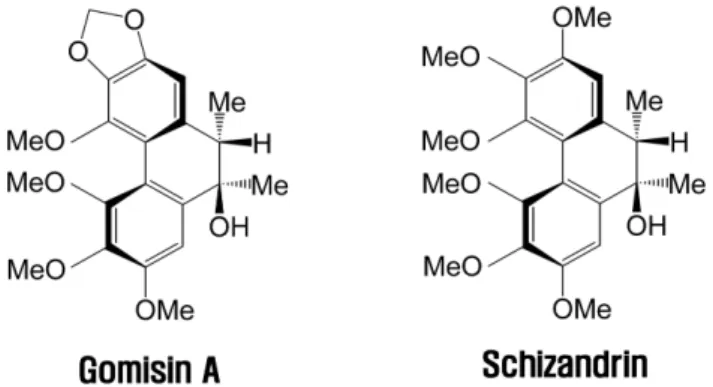
오미자(Schizandra chinensis)로부터 분리된 Gomisin A 및 Schizandrin(Fig. 1)은 식품의약품안전청(Korea Food and Drug Administration)으로부터 분양 받아서 사용하였다. Aβ1-42는 Bachem(bubendorf, Switzerland)과 streptavidin은 Roche (Rotkreuz, Switzerland)로부터 각각 구입 하였으며, NHS-biotin 과 Turbo-TMB(tetramethyl benzidine) solution은 Thermo scientific(Rockford, IL, USA)으로부터 구입하여 사용하였다.
Beta-amyloid biotinylation
Aβ1-42간의 응집 및 해리 반응을 측정하기 위해 biotin과 streptavidin의 강한 결합을 이용하였으며, 이를 위해 NHS-biotin
을 사용하여 Aβ1-42를 biotinylation 하였다. Aβ1-42와 NHS-biotin 을 1 : 5의 비율(W/W)로 상온에서 1시간 반응시킨 후 반응하지 않은 NHS-biotin을 제거하기 위해 1 M ethanolamine(pH 8.0)을 첨가하고, 다시 상온에서 30분 동안 반응시킨 후 분주하여 -80oC 에 보관하며 실험에 사용하였다.
Beta-amyloid간의 응집력 측정
Aβ1-42를 농도 변화(0.0001~1 g/well)를 주어 96 well plate에 처리 후, 4oC에서 overnight하여 coating하고 비특이적인 결합을 방지하기 위해 1% BSA/Phosphate buffered saline(0.05%
Tween 20, PBST)를 이용하여 2시간 동안 blocking 하였다.
Biotin을 결합시킨 Aβ1-42(Biotin-Aβ1-42)를 1 µg/well로 처리하여 2시간 반응시킨 후, Horseradish peroxidase(HRP)로 표지된 streptavidin을 처리하고 Turbo-TMB solution을 사용하여 HRP 에 의한 발색양을 450 nm에서 측정하였다.
Beta-amyloid간 응집 억제활성 측정
Aβ1-42간의 응집을 억제하는 물질탐색을 위한 screening method 로 변형된 Enzyme-linked Immunosorbent assay(ELISA) 방법을 사용하였다. Aβ1-42(0.1µg/well)를 96 well plate에 처리 후, 4oC 에서 overnight하여 coating하고, 2시간 동안 1% BSA/PBST로 blocking 하였다. 오미자 lignan 화합물(0.01~100 µg/ml)과 Biotin-Aβ1-42(1µg/ml)를 각 well에 100 ml씩 처리하고, 2시간 후 HRP로 표지된 streptavidin을 처리한 후, Turbo-TMB solution 을 사용하여 HRP에 의한 발색양을 450 nm에서 측정하였다.
Beta-amyloid간 응집 해리활성 측정
Aβ1-42간의 응집 해리활성의 물질탐색을 위해 Aβ1-42(0.1µg/
well)를 96 well plate에 넣은 후, 4oC에서 overnight하여 coating하고 1% BSA/PBST로 2시간 동안 blocking하였다.
Aβ1-42로 coating된 well에 Biotin-Aβ1-42를 넣은 후 2시간 동 안 결합시키고, 오미자의 lignan 화합물의 농도 변화(0.01~
Fig. 1− The chemical structures of the tested Schizandra chinensis lignans.
100µg/ml)에 따라 처리한 후 4시간 동안 해리반응을 유도하였 다. HRP로 표지된 streptavidin을 처리하고 Turbo-TMB solution을 사용하여 HRP에 의한 발색양을 450 nm에서 흡광 도를 측정하였다.
결과 및 고찰
Beta-Amyloid간의 응집 screening system 확립
지금까지 Alzheimer's disease의 예방 및 치료제 개발에 대한 효율적인 screening system의 개발은 매우 부족한 현실이다. 본 연구에서는 Alzheimer's disease의 원인 가설 중 amyloid
Fig. 2− Aβ1-42 evaluate of aggregation. Aβ1-42 (0~1µg/well) was coated in 96 well plate for overnight at 4oC. After treated with 1% BSA/PBST, each well of the plate was loaded with biotinylated Aβ1-42 (1µg/well), treated with streptavidin- HRP and then incubated with Turbo-TMB solution. AΒ1-42 aggregation was evaluated by the absorbance using ELISA reader. Each value represents the mean±SEM. *Denotes a significant difference from the Aβ1-42 aggregation state, with P<0.05.
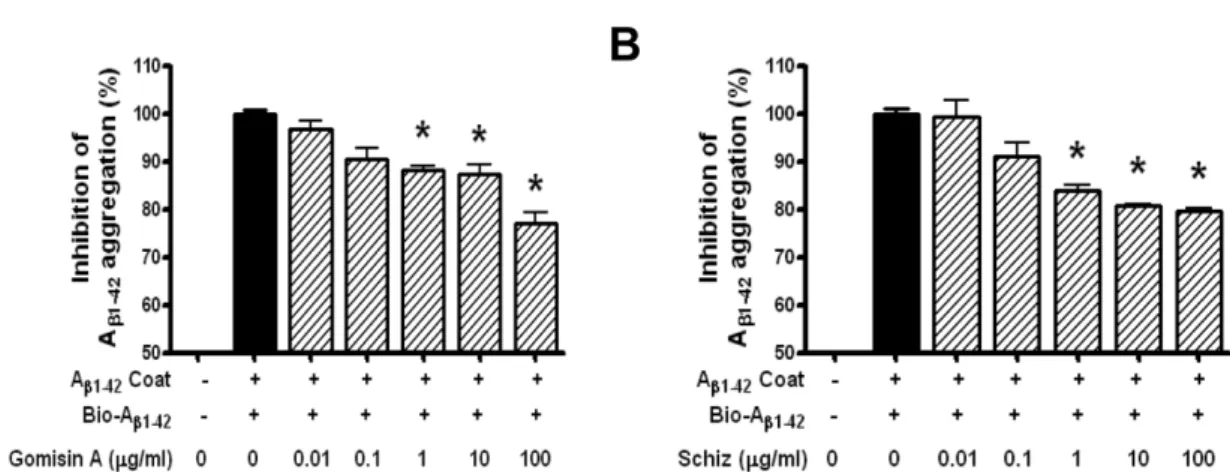
Fig. 3− Aβ1-42 aggregation inhibited by lignan compounds from Schizandra chinensis. Aβ1-42 was coated at concentration of 100 ng/well in 96 well plate for overnight at 4oC. Each well was loaded with 1% BSA/PBST and then treated with (A) Gomisin A and (B) Schizandrin.
After added with Biotinylated Aβ1-42, each well was treated with streptavidin-HRP and incubated with turbo-TMB solution. Effect of Aβ1-42 aggregation was tested by measuring the absorbance with ELISA reader. Each value represents the mean±SEM. *Denotes a significant difference from the beta-amyloid and beta-amyloid aggregation state, with P<0.05.
cascade설4,5)의 원인물질인 Aβ1-42간의 응집 및 해리의 효율적인 screening system의 확립과 이를 이용해 Gomisin A 및 Schizandrin의 Aβ1-42간의 응집억제 및 해리 활성을 확인하고자 하였다. 먼저, Aβ1-42를 plate 바닥에 coating하고, 이와 결합하는 Biotin-Aβ1-42을 streptavidin-HRP를 활용해 확인함으로서 Aβ1-42 간의 응집을 측정하고자 하였다. Aβ1-42간의 응집은 plate 바닥에 coating된 Aβ1-42의 농도 의존적으로 증가하였으며, Aβ1-42를 0.01~1µg이 coating된 well에서 통계적으로 유의한 응집현상이 관찰되었다(Fig. 2). 그러나 Aβ1-42의 농도 0.5~1 µg/well로 coating된 plate에서는 Aβ1-42와 Biotin-Aβ1-42간의 응집이 포화상 태(saturation)가 되어, Aβ1-42간의 응집억제와 해리 현상의 관찰 에는 적절하지 않은 농도로 사료된다. 따라서 Gomisin A 및 Schizandrin의 Aβ1-42간의 응집억제 및 해리 현상의 검색에는 Aβ1-42를 0.1 µg/well로 coating하고 Biotin-Aβ1-42가 1 µg/well이 되도록 하여 활용하였다.
Gomisin A 및 Schizandrin의 Aβ1-42간 응집 억제활성 Aβ1-42간의 응집으로 인한 노인성반의 형성이 독성을 매개함으 로서 신경세포를 사멸에 이르게 하며, Alzheimer's disease의 원 인으로 알려져 있다.4,5) Aβ1-42간의 응집 억제물질의 검색은 Alzheimer's disease의 예방과 진행억제에 있어서 매우 중요한 부분을 차지할 수 있을 것이다. 따라서, 오미자의 주요 lignan 화 합물인 Gomisin A 및 Shizandrin을 활용하여, Aβ1-42간의 응집 억제활성을 검색하고자 하였으며, 이들은 0.1~100 µg/ml의 농도 에서 각각 Aβ1-42간의 응집을 농도 의존적으로 억제하였다(Fig.
3A and B). Gomisin A는 1 µg/ml(11.7±0.7%)에서부터 유의한 억제활성이 관찰되었으며, 100 µg/ml에서 22.8±2.26%의 Aβ1-42 간의 응집 억제활성을 나타내었다(Fig. 3A). Schizandrin의 Aβ1-42간의 응집 억제활성은 1 µg/ml(16.1±1.2%)에서부터 억제
활성을 나타내어, 100 µg/ml(20.3±1.33%)에서 최대 억제활성을 나타내었다(Fig. 3B). 이러한 결과는 오미자의 lignan 화합물인 Gomisin A 및 Schizandrin이 Aβ1-42간의 응집을 억제함으로서 Alzheimer's disease의 예방제로서의 활용가능성을 시사하여 주 고 있다.
최근 Alzheimer's disease로 사망한 환자의 뇌조직에서 Aβ1-42 와 Vascular Endothelial Growth Factor(VEGF)가 노쇠반점에 같이 침착되어 있고, 이들이 특이적인 결합을 한다고 보고되었 다.38) 또한 Alzheimer's disease 환자의 뇌조직 노쇠반점에 VEGF가 침착되어 뇌혈관조직의 VEGF 결핍을 유도하고, 이로 인해 뇌혈관세포와 신경세포의 보호 및 활성을 저하시킴으로서 Alzheimer's disease의 진전과 악화로 이어질 수 있음을 제시하 고 있다.38,39) Gomisin A 및 Schizandrin에 의한 Aβ1-42간의 응 집 저해활성은 뇌조직 내 노쇠반점 형성의 직접적인 저해를 통 해 Alzheimer's disease의 초기 진행을 억제할 뿐만 아니라, VEGF의 노쇠반점 내 침착방지에 의해, VEGF의 결핍을 방지하 고 뇌 혈관조직의 보호 및 활성저하를 억제함으로서 Alzheimer's disease의 진전과 악화를 방지할 수 있음을 나타내고 있다.
Gomisin A 및 Schizandrin의 Aβ1-42간의 응집 해리활성 Aβ1-42간의 응집으로 인한 뇌 조직 내 노쇠반점의 형성은 뇌 신경세포의 기능저하 및 사멸의 원인을 제공하고 있으나, 이들 의 해리과정은 Aβ1-42에 의한 독성을 완화시킴으로서 Alzheimer's disease의 치료효과를 예상할 수 있다. 따라서 본 연구에서는 Aβ1-42간의 응집을 유도한 후, Gomisin A 및 Schizandrin에 의한 Aβ1-42간의 응집 해리활성을 검색하고자 하였다. Gomisin A는 100µg/ml에서 3.3±3.93%(Fig. 4A)의 Aβ1-42간의 응집 해리활성 을 나타내었으나, 통계적 유의성은 관찰되지 않았다. 그러나
Schizandrin은 농도의존적인 Aβ1-42간의 응집 해리활성을 나타내 었으며, 100 µg/ml에서 15±3.12%의 유의한 해리활성이 확인되 었다(Fig. 4B). 이상의 결과는 Gomsin A는 Aβ1-42간의 응집 억 제활성을 나타냄으로서 Alzheimer's disease의 예방 효과는 예상 되지만, 응집된 Aβ1-42간의 해리활성은 관찰되지 않음으로서 치 료 효과는 기대하기 어려울 것으로 판단된다. 반면 Schizandrin 은 Aβ1-42간의 응집 억제 및 해리활성이 유의하게 확인 되므로, 앞으로 더 체계적인 활성 연구를 통해 효과적인 Alzheimer's disease의 예방 및 치료제 개발의 선도물질로서 활용할 수 있을 것이다.
결 론
본 연구는 오미자의 lignan 화합물 중 Gomisin A 및 Schizandrin 의 Aβ1-42간의 응집억제(예방효과) 및 해리활성(치료효과) 검색을 통해 Alzheimer's disease의 예방 및 치료제 개발의 선도물질로 서 활용 가능성을 확인하고자 하였다. Gomisin A는 Aβ1-42간의 응집 억제활성이 유의하게 확인 되었으나, 응집된 Aβ1-42간의 해 리활성은 관찰되지 않았다. 반면 Schizandrin은 Aβ1-42간의 응집 억제 및 해리활성이 유의하게 확인되었다. 이러한 결과는 오미 자의 생리활성성분인 Gomisin A 및 Schizandrin을 단독 또는 복 합제제로 Alzheimer's disease의 예방 및 치료제로의 활용 가능 성을 암시하여 주고 있다.
감사의 말씀
본 연구는 2008~2009년 농촌신활력사업의 일환으로 문경시 로부터 연구비를 지원받아 수행하였으며, 이에 감사드립니다.
Fig. 4− Effect of lignan compounds from Schizandra chinensis of Aβ1-42 dissociation. Aβ1-42 was coated at concentration of 100 ng/well in 96 well plate for overnight at 4oC. Each well was loaded with 1% BSA/PBST and then treated with biotinylated Aβ1-42 (1µg/ml). After treated with (A) Gomisin A and (B) Schizandrin, each well was loaded with streptavidin-HRP and then incubated with turbo-TMB solution. Dissociative effect of Aβ1-42 aggregation was tested by measuring the absorbance with ELISA reader. Each value represents the mean±SEM. *Denotes a significant difference from the Aβ1-42 aggregation state, with P<0.05.
참고문헌
1) Parnetti, L., Senin, U. and Mecocci, P. : Cognitive enhancement therapy for Alzheimer's disease : The way forward. Drugs 53, 752 (1997).
2) Brinton, R. D. and Yamazaki, R. S. : Advances and challenges in the prevention and treatment of Alzheimer's disease.
Pharm. Res. 15, 386 (1998).
3) Park, Y. M., Jeon, Y. M., Kwon, G. C., Koo, S. H. and Park, J. W. : Analysis of apolipoprotein E genotypes in several demential diseases. Korean J. Clin. Pathol. 19, 642 (1999).
4) Karran, E., Mercken, M. and Strooper, B. D. : The amyloid cascade hypothesis for Alzheimer's disease: an appraisal for the development of therapeutics. Nat. Rev. Drug. Discov. 10, 698 (2011).
5) Hardy, J. A. and Higgins, G. A. : Alzheimer's disease: the amyloid cascade hypothesis. Science 256, 184 (1992).
6) Alonso, A. C., Grundke-lqbal, I. and Iqbal, K. : Alzheimer's disease hyperphosphorylated Tau sequesters normal Tau into tangles of filaments and disassembles microtubules. Nature Med. 2, 783 (1996).
7) Alonso, A. C., Grundke-lqbal, I. and Iqbal, K. : Abnormally phosphorylated Tau from Alzheimer's dosease brain depolymerizes microtubules. Neurobiol. Aging 15, s37 (1994).
8) Behl, C. : Alzheimer's disease and oxidative stress : implications for novel therapeutic approaches. Prog. Neurobiol.
57, 301 (1999).
9) Whitehouse, P. J., Price, D. J., Struble, R. G., Clark, A. W., Coyle, T. J. and Detol, M. R. : Alzheimer's disease and senile dementia : loss of neuros in the basal forebrain. Science 215, 1237 (1982).
10) Roberson, M. R., Kolasa, K., Parsons, D. S. and Harrell, L. E. : Cholinergic denevation and sympathetic ingrowth result in presistent changes in hippocampal muscarinic receptor.
Neurosecience 80, 413 (1997).
11) Barril, X., Orozco, M. and Luque, F. J. : Towards improved acetylcholinesterase inhibitor : a structural and computational approach. Mini. Rev. Med. Chem. 1, 255 (2001).
12) Selkoe, D. J. : Translating cell biology into therapeutic advances in Alzheimer's disease. Nature 399, 23 (1999).
13) Han, S. H. : Novel pharmacotherapies for Alzheimer's disease.
J. Korean Med. Assoc. 52, 1059 (2009).
14) Lorenzo, A. and Yankner, B. A. : β-Amyloid neurotoxicity requires fibril formation and is inhibited by Congo red. Proc.
Nati. Acad. Sci. 91, 12243 (1994).
15) Lee, D. W., Huh, Y. S. and Kim, K. W. : Evidence-based treatment of Alzheimer's disease. J. Korean Med. Assoc. 52, 417 (2009).
16) Nicoll, J. A., Wilkinson, D., Holmes, C., Steart, P., Markham, H.
and Weller, R. O. : Neuropathology of human alzheimer disease after immunization with amyloid-beta peptide: A case report.
Nat. Med. 9, 448 (2003).
17) Orgogozo, J. M., Gilman, S., Dartigues, J. F., Laurent, B., Puel, M., Kirby, L. C., Jouanny, P., Dubois, B., Eisner, L., Flitman, S., Michel, B. F., Boada, M., Frank, A. and Hock, C. : Subacute meningoencephalitis in a subset of patients with AD after Aβ42 immunization. Neurology 61, 46 (2003).
18) Min, S. K. and Hong, C. H. : Korean traditional medicines as novel drugs for neuropsychiatric disorders. Korean J.
Psychopharmacol. 18, 5 (2007).
19) Heo, J. H., Park, J. G., Cheon, H. J., Kim, Y. S., Kang, S. S., Hung, T. M., Bea, K. H. and Lee, S. M. : Hepatoprotective activities of gomisin A and gomisin N. Kor. J. Phamacogn. 37, 294 (2006).
20) Lee, J. S. and Lee, S. W. : Effects of water extracts in fruits of omija (Schizandra chinensis Baillon) on alchol metabolism.
Korean J. Dietary Culture 5, 259 (1990).
21) Jang, E. H., Pyo, Y. H. and Ahn, M. S. : Antioxidant effect of omija (Schizandra chinensis Baillon) extracts. Korean J. Soc.
Food Sci. 12, 372 (1996).
22) Kim, H. K., Na, G. M., Ye, S. H. and Han, H. S. : Extraction characteristics and antioxidative activity of Schizandra chinensis extracts. Korean J. Food Culture 19, 484 (2004).
23) Hong, K. H., Nam, E. S. and Park, S. I. : Effect of Omija (Schizandra chinensis) extract on the growth inhibition of food borne pathogens in yoghurt. Korean J. Food Sci. Ani. Resour.
23, 342 (2003).
24) Ko, B. S., Park, S. K., Choi, S. B., Jun, D. W., Choi, M. K. and Park, S. M. : A study on hypoglycemic effects of crude extracts of Schizandrae fructus. J. Korean Soc. Appl. Biol. Chem. 47, 258 (2004).
25) Kim, H. C. : Neuroprotective herbs for stroke therapy in traditional eastern medicine. Neurol. Res. 27, 287 (2005).
26) Hancke, J. L., Burgos, R. A. and Ahumada, F. : Schisandra chinensis (Turcz.) Baill. Fitoterapia. 70, 451 (1999).
27) Kim, M. J. and Park, E. J. Antioxidative and antigenotoxic effect of Omija (Schizandra chinensis B.) extracted with various solvent. J. Korean Soc. Food Sci. Nutr. 39, 487 (2010).
28) Ohkura, Y., Mizoguchi, Y., Yamamoto, S. and Morisawara, S. : Inhibitory effect of TJN-101 ((+)-(6S,7S,R-biar)-5,6,7,8-tetrahydro- 1,2,3,12-tetramethoxy-6,7-dimethyl-10,11-methylenedioxy-6- dibenzo[a,c]cyclooctenol) on immunologically induced liver injuries. Jpn. J. Pharmacol. 44, 179 (1987).
29) Yamamda, S., Murawaki, Y. and Kawasaki, H. : preventive effect of gomisin A, a lignan component of schizandra fruits, on acetaminophen-induced hepatotoxicity in rats. Biochem.
Pharmacol. 46, 1081 (1993).
30) Maeda S., Takeda, S., Miyamoto, Y., Aburada, M. and Harada,
M. : Effect of gomisin A on liver functions in hepatotoxic chemicals-treated rats. Jpn. J. Phamacol. 38, 347 (1985).
31) Kim, D. H., Hung, T. M., Bae, K. H., Jung, J. W., Lee, S. J., Yoon, B. H., Cheong, J. H., Ko, K. H. and Ryu, J. H. : Gomisin A improves scopolamine-induced memory impairment in mice. Eur. J. Pharmacol. 542, 129 (2006).
32) Liu, G. T. : Pharmacological actions and clinical use of Fructus schizandrea. Chin. Med. J. 102, 740 (1989).
33) Lu, H. and Liu, G. T. : Effect of dibenzo[a, c]cyclooctene lignans isolation from Fructus schizandrea on lipid peroxidation and antioxidative enzyme activity. Chem. Biol. Interact. 78, 77 (1991).
34) Liu, K. T. and Lesca, P. : Pharmacological properties of dibenzo[a, c]cyclooctene derivatives isolation from Fructus schizandrae chinensis. I. Interaction with rat liver cytochrome P-450 and inhibition of xenobiotic metabolism and mutagenicity.
Chem. Biol. Interact. 3, 301 (1982).
35) Ohtaki, Y., Nomura, M., Hida, T., Miyamoto, K., Kanitani, M., Aizawa, T. and Aburada M. : Inhibition by gomisin A, a lignan
compound, of hepatocarcinogenesis by 3'-methyl-4-dimethyl- aminoazobenzene in rat. Biol. Pharm. Bull. 6, 808 (1994).
36) Mak, D. H., Ip, S. P., Li, P. C., Poon, M. K. and Ko, K. M. : Effects of schisandrin B and alpha-tocopherol on lipid peroxidation, in vitro and in vivo. Mol. Cell. Biochem. 2, 161 (1996).
37) Choi, E. O., Lee, B. S., Park, Y. S., Seo, E. O. and Chung, B. W. : Extraction condition from Schizandra chinensis Baillon for beverage development of high Schizandrin concentration.
Korean J. Biotechnol. Bioeng. 23, 271 (2008).
38) Yang, S. P., Bae, D. G., Kang, H. J., Gwag, B. J., Gho, Y. S. and Chae, C. B. : Co-accumulation of vascular endothelial growth factor with β-amyloid in the brain of patients with Alzheimer's disease. Neurobiol. Aging 25, 283 (2004).
39) Sondell, M., Lundborg, G. and Kanje, M. : Vascular endothelial growth factor has neurotrophic activity and stimulates axonal outgrowth, enhancing cell survival and schwann cell proliferation in the peripheral nervous system. J. Neurosci. 19, 5731 (1999).