DOI 10.17480/psk.2018.62.6.374
디아족사이드에 의한 멜라닌 합성 촉진 효과에 미치는 TRPM 통로의 역할
이 용 수# 덕성여자대학교 약학대학
(Received September 27, 2018; Revised November 5, 2018; Accepted November 6, 2018)
Role of Transient Receptor Potential Melastatin (TRPM) Channels in the Stimulation of Melanin Synthesis by Diazoxide
Yong Soo Lee#
College of Pharmacy, Duksung Women’s University, Seoul 01369, Korea
Abstract — The known inhibitors of Ca2+-permeable transient receptor potential melastatin (TRPM) channels, flufenamic acid (FFA) and clotrimazole significantly blocked the diazoxide-induced increase in intracellular Ca2+ concentration ([Ca2+]i) and melanin synthesis in B16 melanoma cells. H2O2 which has been shown to stimulate the activity of the TRPM channels, increased [Ca2+]i and melanin synthesis, which was significantly inhibited by FFA. These results suggest that TRPM chan- nels may play an essential role in the diazoxide-induced melanogenesis through [Ca2+]i increase.
Keywords diazoxide, melanogenesis, TRPM channel, Ca2+ signal, B16 melanoma cell
서 론 (Introduction)
디아족사이드는 주로 신경내분비 세포에 존재하는 ATP-민감 성 칼륨 통로에 작용하여 통로를 열게 하며,1) 임상적으로는 응급 고혈압의 치료2)및 췌장 베타세포에서 인슐린의 과다분비를 억 제할 목적3)으로 사용되고 있다. 또한, 디아족사이드는 미토콘드 리아에 존재하는 ATP-민감성 칼륨 통로의 개방제(opener)로 작 용하여 허혈에 의한 세포손상에 대해 보호 효과를 나타낸다는 사 실이 입증되었다.4)디아족사이드는 여러 퇴행성 신경질환모델, 즉 알츠하이머병,5)뇌졸중,6)뇌전증7), 다발성 경화증8)등에서 신 경보호작용을 나타낸다는 연구 결과도 발표되었다.
칼륨 통로는 거의 모든 세포에 존재하며 세포의 분열,9)분화10) 및 세포 사멸11)의 조절 등에 깊이 관여하고 있고 멜라닌세포에 서도 다양한 칼륨 통로가 발현되고 있다.12)이와 같은 사실에 착 안하여 본 연구실에서는 멜라닌 합성에 연관된 칼륨 통로의 역
할을 알아 볼 목적으로 칼륨 통로의 개방제로 알려진 디아족사 이드를 이용한 실험을 수행한 바 있다. 연구 결과에서, 디아족사 이드는 멜라닌 합성을 촉진시켰는데 이 작용은 칼륨 통로와는 상 관없이 일어나며, 오히려 세포내 칼슘 유입에 의해 매개된다는 사실이 밝혀졌다.13)
본 연구에서는 이전 연구의 후속으로 디아족사이드에 의한 멜 라닌 합성 촉진작용을 매개하는 세포내 칼슘 유입이 어떤 경로 로 일어나는 지를 규명하고자 하였다.
실험 방법 (Experimental Methods)
시약
Diazoxide, verapamil (Vera), nifedipine (Nife), bepridil (Bep), benzamil (Benz), flufenamic acid (FFA), clotrimazole (CLT), hydrogen peroxide (H2O2) 및 각종 용매와 염류는 Sigma-Aldrich (미국)에서, fetal bovine serum (FBS)와 penicillin-streptomycin 혼합액은 GIBCO (미국)에서, 1-(2,5-carboxyoxazol-2-yl-6- aminobenzfuran-5-oxyl)-2-(2'-amino-methylphenoxy)-ethane- N,N,N'N'-tetraacetoxylmethyl ester (Fura-2/AM)은 Molecular Probes (미국)에서 구입하였다. Fura-2/AM은 dimethyl sulfoxide (DMSO)에 녹여 농축액으로 만든 후 물로 희석하여 사용하였다.
#
Corresponding Author Yong Soo Lee
College of Pharmacy, Duksung Women’s University, Seoul 01369, Korea
Tel.: +82-2-901-8396 Fax.: +82-2-901-8386 E-mail: [email protected]
Short Report
종설세포 배양
B16 흑색종 세포는 서울대학교 한국세포주은행에서 구입하였다.
구입한 세포는 10% FBS와 penicillin 100 IU/mL와 streptomycin 50μg/mL을 함유한 DMEM 용액으로 37oC로 유지되는 5% CO2 배양기(Forma, 미국)에서 배양하였다.
멜라닌 정량
멜라닌 정량은 이전 본 연구실에서 발표한 논문에서와 동일한 방법으로 시행하였다.13)간단히 설명하면, B16 세포에서 phenol red가 없는 DMEM을 사용하여 24 well plate에 세포를 plate에 부착시킨 후 디아족사이드 등 약물을 처리하고 48시간 뒤 세포 를 균질완충액으로 용해시킨 후, 세포 pellet을 1 N NaOH, 10%
DMSO 용액으로 멜라닌을 녹인 다음 96 well plate에 옮겨 ELISA reader (Molecular Device, 미국)를 사용하여 405 nm에 서 흡광도를 측정하였다. 멜라닌 생성량은 멜라닌 표준품을 이 용한 표준 검량선을 이용하여 산출하였고 약물을 처리하지 않은 대조군과 비교하여 백분율로 나타내었다.
세포내 칼슘 이온 농도 측정
세포내 칼슘 이온 농도는 이전 본 연구실에서 발표한 논문에 서와 동일한 방법인 형광 침탐법을 이용하여 측정하였다.13)간 단히 설명하면, B16 세포에 Fura-2/AM을 가해 배양한 후 세포 를 수집하여 Krebs-Ringer 완충액에 현탁시키고 quartz cuvette 에 세포 현탁액을 주입하여 Hitachi F-4500 형광 분석기(Hitachi Inc, 일본)를 사용하여 340 및 380 nm에서 여기 시킨 후 발광하 는 형광을 510 nm에서 측정하였다. 세포내 칼슘 농도는 340:380 nm 형광비 값을 구한 후 약물을 처리하지 않은 대조군과 비교 하여 백분율로 나타내었다.
자료 분석 및 통계적 검정
모든 실험은 네 번 반복해서 실시하고 실험 결과는 대조군의 조건에 대한 백분율로 나타내었다. 실험 결과는 평균값±SEM으 로 표시하고 two-way ANOVA로 분석하며 각각의 유의성 비교 는 Student-Newman-Keul’s test를 이용하여 실시하였다. P값이 0.05 이하인 경우에만 통계학적 유의성이 있는 것으로 간주하였다.
결과 및 고찰 (Results and Discussion)
디아족사이드에 의한 멜라닌 합성을 매개하는 칼슘 유입 경로 의 탐색
본 연구실의 이전 연구13)에서 칼륨 통로의 개방제로 알려진 디아족사이드1)가 멜라닌 합성을 촉진시킨다는 사실을 확인하였 다. 또한, 이 작용은 예상과는 달리 칼륨 통로와는 무관하게 일 어나며 세포내 칼슘 유입과 인과관계가 있음을 밝힌 바 있다. 세
포의 분열, 분화 및 사멸은 물론 근육 수축과 호르몬 및 신경전 달물질의 외포 작용 등 세포 기능에 중요한 역할을 담당하고 있 다고 잘 알려져 있는 세포내 칼슘 신호14)는 최근 몇 연구에서 멜 라닌 합성 기전에도 관여하고 있음이 밝혀지고 있다.15,16)본 연 구에서는 디아족사이드에 의한 멜라닌 합성 촉진 작용을 매개하 는 세포내 칼슘 유입이 어떤 경로로 일어나는 지를 알아보고자 하였다.
세포내로 칼슘 유입은 세포막에 존재하는 칼슘 통로나 Na+/ Ca2+ exchanger의 역방향 방식(reverse mode)의 활성화에 의해 일어날 수 있으며, 지금까지 세포막 칼슘 통로는 전압-작동성 (voltage-operated) 통로, 수용체-작동성(receptor-operated) 통로, 기계적-활성화(mechanically-activated) 통로, 비축-작동성(store- activated) 통로 및 신호-작동성(messenger-operated) 통로가 있 다고 알려져 있다.14)이 중 멜라닌 세포에는 전압-작동성 칼슘 통로와 비축-작동성 칼슘 통로 및 신호-작동성 칼슘 통로의 일종 인 TRPM 통로가 존재한다고 알려져 있으며,17)또한 Na+/Ca2+
exchanger가 역방향 방식으로 활성화될 때 일어나는 칼슘 유입 이 멜라닌 암세포의 전이에 영향을 미친다는 사실이 보고되었 다.18)이 중에서 비축-작동성 통로는 세포내 칼슘 저장고에서 칼 슘의 유리 후에 이것을 다시 채우기 위해 작동하는 것으로14)세 포내 칼슘 유리를 억제하는 약물인 dantrolene의 전처리에 의해 활성이 억제될 수 있다.19)이 전 연구의 결과에서 dantrolene은 디아족사이드에 의한 세포 내 칼슘 유입과 멜라닌 합성에 영향 을 미치지 못하였으므로13)이 과정에 비축-작동성 칼슘 통로가 연루되어 있을 가능성은 희박할 것으로 판단되므로 본 연구에서 는 제외하기로 하였다.
따라서, 다이족사이드에 의한 칼슘 유입을 매개하는 기전을 규 명하기 위하여 본 실험에서는 칼슘 통로와 Na+/Ca2+ exchanger 에 작용하여 그 활성을 억제한다고 알려진 다양한 약물을 이용 하여 세포내 칼슘 유입 및 멜라닌 합성에 미치는 영향을 관찰하 였다. 전압-작동성 칼슘 통로에 대한 억제제로는 verapamil (Vera) 과 nifedipine (Nife)20)을 Na+/Ca2+ exchanger 억제제로는 bepridil (Bep)과 benzamil(Benz)21)을 사용하였다. 이 전 연구의 결과에 서 디아족사이드는 100 μM 이상의 농도에서는 세포 생존율을 유의성 있게 저하시키지만, 70 μM 이하의 농도에서는 유의성 있 는 변화를 보이지 않았으므로,13) 본 연구에서는 디아족사이드의 농도를 50 μM으로 하여 실험을 실시하였다. 실험 결과, Fig. 1에 서 보듯이 Bep (50 μM), Benz (50 μM), Vera (100 μM) 및 Nife (100μM)을 처리할 때 디아족사이드(50 μM)에 의한 칼슘 유입(Fig. 1A)과 멜라닌 합성 촉진 작용(Fig. 1B)은 모두 통계적 으로 유의한 수준에서 변화를 가져오지 않았다. 이 결과는 전압 -작동성 칼슘 통로나 Na+/Ca2+ exchanger는 디아족사이드에 의 한 칼슘 유입에 중요한 역할을 하고 있지 않다는 사실을 시사한다.
디아족사이드의 작용에 미치는 TRPM 통로의 역할
멜라닌 합성 세포에는 신호-작동성 칼슘 통로의 일종인 TRPM 통로가 존재하며,22)또한 이 통로의 활성 변화는 멜라닌 합성의 증감과 관계가 있다는 사실이 밝혀졌다.23)따라서 다음 실험에 서는 TRPM 통로가 디아족사이드의 작용을 매개하는 지를 확인 하였고 이를 위해 이 통로의 활성을 억제한다고 알려진 flufenamic
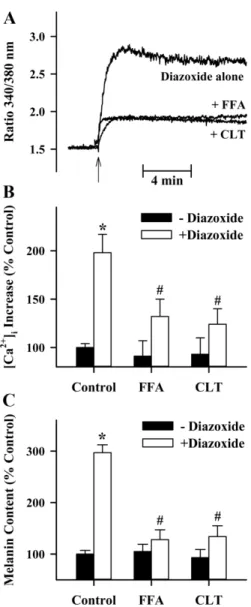
acid (FFA)24)와 clotrimazole (CLT)25)을 사용하였다. 실험 결과 에서, Fig. 2A에서 보듯이 디아족사이드(50 μM)에 의한 세포내 칼슘 증가는 FFA (50 μM) 및 CLT (10 μM)의 처리에 의해 효 과적으로 억제되었으며 Fig. 2B에서 보듯이 이 억제 작용은 통 계적으로 유의한 것으로 밝혀졌다. 또한, Fig. 2C에 보듯이 디아
Fig. 2 – Role of TRPM channels in the diazoxide-induced increased intracellular Ca
2+concentration and stimulation of melanin synthesis in B16 melanoma cells. The methods employed in these experiments are the same as those used in Fig. 1.
The data (A) represent intracellular Ca
2+changes with time. The arrow shows the time point for addition of diazoxide (50 µM). In these experiments FFA (50 µM) and CLT (10 µM), TRPM channel inhibitors, were used. In the Fig. 2B and 2C, the data were presented by the same ways as those used in Fig. 1A and 1B, respectively. Each column represents the mean value of four replications with bars indicating SEM. *p<0.05 compared to control.
#p<0.05 compared to diazoxide alone. Abbreviations: FFA, flufenamic acid; CLT, clotrimazole.
Fig. 1 – No involvement of voltage-operated Ca
2+channels and reverse mode of Na
+-Ca
2+-exchanger in the diazoxide- induced intracellular Ca
2+increase and stimulation of melanin synthesis in B16 melanoma cells. Intracellular Ca
2+concentration and melanin synthesis was assessed by the technique as described in the Method section. In these experiments Vera (100 µM) and Nife (100 µM), inhibitors of voltage-operated Ca
2+channels, and Bep (50 µM) and Benz (50 µM), inhibitors of Na
+-Ca
2+-exchanger, were added 5 and 30 min before treatment with diazoxide (50 µM), in the measurement of intracellular Ca
2+concentration (A) and melanin content (B), respectively. The data are expressed as a percentage of control condition in which the cells were incubated with diazoxide-free medium. Each column represents the mean value of four replications with bars indicating SEM. *p<0.05 compared to control. Abbreviations:
Ctrl, control; Vera, verapamil; Nife, nifedipine, Bep, bepridil;
Benz, benzamil.
족사이드(50 μM)에 의한 멜라닌 합성 촉진 작용도 FFA (50 μM) 및 CLT (10 μM)의 처리에 의해 통계적으로 유의한 수준에서 억 제되었다. 이 결과는 디아족사이드는 TRPM 통로의 활성화에 의 해 칼슘을 세포내로 유입시키고 이로 인해 멜라닌 합성이 촉진 된다는 사실을 시사한다.
한편, 과산화수소(H2O2)가 TRPM 통로에 작용하여 그 활성을 증가시킨다는 사실이 보고된 바 있으므로,26) 다음 실험에서는 과
산화수소를 처리한 후 세포내 칼슘 농도 및 멜라닌 합성의 변화 를 유도하는 지를 관찰하였다. 실험 결과에서, Fig. 3A에서 보듯 이 과산화수소는 세포내 칼슘 농도를 증가시켰으며, 이 작용은 통계적으로 유의성이 있는 것으로 나타났고(Fig. 3B), 또한 멜라 닌 합성 촉진 작용도 통계적으로 유의성이 있었다(Fig. 3C). 이 러한 과산화수소의 작용이 TRPM 통로의 활성화에 기인하는 지 를 검증하기 위하여 TRPM 억제제인 FFA를 이용한 실험에서 과산화수소(300 μM)에 의한 칼슘이온 농도 증가(Fig. 3A 및 3B) 및 멜라닌 합성(Fig. 3C)이 FFA (50 μM)에 의해 통계적으로 유 의한 수준에서 억제 효과를 보였다. 이 결과로써 TRPM 통로는 과산화수소에 의해 활성화되며 이로부터 유도된 칼슘 유입이 멜 라닌 합성의 촉진을 매개한다는 사실을 알 수 있다. 또한, 앞서 디아족사이드의 실험 결과와 종합해 보면 TRPM 통로는 여러 약물에 의한 칼슘 유입을 매개하는 표적분자로서의 역할을 수행 하고 있으며 나아가 멜라닌 합성 과정에 깊이 연루되어 있다는 사실을 알 수 있다.
본 연구의 결과만 가지고 어떻게 디아족사이드가 TRPM 통로 의 활성을 촉진하는지는 알 수 없다. TRPM 통로의 활성 기전 에 활성산소종이 연루되어 있다는 사실이 신장세포,26)혈관내피 세포,27)수정체상피세포,28)등 다양한 세포에서 알려지고 있음을 고려해 보면, 본 연구의 결과에서 나타난 디아족사이드에 의한 TRPM 통로의 활성 증가 작용도 활성산소종과 관련이 있을 가 능성이 존재한다. 하지만, 디아족사이드는 신경,29)심장30)등의 조직에서는 활성산소종의 발생을 오히려 억제하는 효과를 나타 내는 것으로 보고된 바 있다. 따라서, 본 연구에서 사용한 멜라 닌 합성 세포에서 디아족사이드의 작용 기전에 연루된 활성산소 종의 역할에 대해서는 이를 확인하는 추가 연구가 필요할 것이다.
디아족사이드는 서론에서도 언급했듯이 Kir6.2 칼륨 통로와
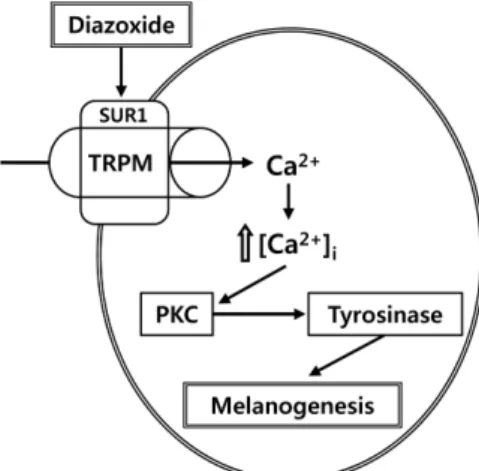
Fig. 4 − Proposed mechanism of action of diazoxide in the stimulation of melanogenesis. Abbreviations: SUR1, sulfonylurea receptor- 1; TRPM, transient receptor potential melastatin channel;
[Ca
2+]
i, intracellular Ca
2+concentration; PKC, protein kinase C.
Fig. 3 – Role of TRPM channels in the H
2O
2-induced increased intracellular Ca
2+concentration and stimulation of melanin synthesis in B16 melanoma cells. The experimental techniques and the way of data presentation are the same as those used in Fig. 2. In these experiments the effects of FFA (50 µM), as an inhibitor of the TRPM channels, on the H
2O
2-induced actions were investigated. In the data (A) the arrow shows the time point for addition of H
2O
2(300 µM).
In the data (B) and (C), each column represents the mean value of four replications with bars indicating SEM.
*p<0.05 compared to control.
#p<0.05 compared to H
2O
2alone. Abbreviations: FFA, flufenamic acid.
heteromer를 형성하고 있는 sulfonylurea receptor-1 (Sur1)에 결 합하여 이 칼륨 통로를 열게 한다.1)이와는 다르게, Woo 등의 연구에서 Sur1이 TRPM4 통로와 heteromer를 형성하여 발현한 다는 사실이 밝혀졌고,31)미세아교세포에서는 Sur1-Trpm4 통로 를 통한 칼슘 유입이 산화질소(NO)를 생성하는 효소인 NOS2를 활성화시킨다는 것이 확인되었다.32)이러한 사실을 바탕으로 추 론해보면, 디아족사이드가 직접적으로 TRPM 통로에 결합하여 작용을 나타낼 가능성도 존재하지만, 아직까지 본 연구에서 사 용한 세포에서 Sur1과 heteromer를 형성하고 있는 TRPM 통로 의 존재에 대한 보고가 없으므로 확실한 결론은 유보적이며 향 후 이에 대한 연구가 필요하다고 하겠다.
또한, 세포내 칼슘이온의 증가가 멜라닌 합성을 촉진시키는 기 전에 대해서도 아직까지 분명하게 알려지고 있지 않다. 하지만, 이전 연구 결과들을 근거로 추측해 본다면, 하나의 가능성은 증 가된 칼슘이온이 protein kinase C-β를 활성화시키면,33)이 효소 는 멜라닌 합성에 관여하는 율속단계 효소인 티로시나제를 인산 화하여 그 활성을 증가시키므로,34)멜라닌 합성을 유도할 수 있 게 된다. 또 다른 가능성은 유입된 칼슘이온이 멜라닌 합성이 일 어나는 멜라노좀의 막에 존재하는 칼슘 펌프를 통해 멜라노좀 내 로 수송되면, 멜라노좀 막전압과 내강 pH의 변화를 유발하게 되 며,35)이 변화로 인해 멜라닌 합성을 유도하는 효소들이 활성화 됨으로써 멜라닌 합성을 촉진할 수 있을 것이다.36)이처럼, 멜라 닌 합성 과정에 세포내 칼슘 신호가 중요할 역할을 하고 있다는 사실은 분명해 보이지만, 좀 더 자세한 기전을 설명하기 위해서 는 앞으로 많은 연구가 필요할 것이다.
결 론 (Conclusion)
본 연구에서는 디아족사이드에 의한 세포내 칼슘 유입과 멜라 닌 합성 촉진 작용에 미치는 TRPM 통로의 역할을 밝히고자 하 였다. 실험 결과에서 디아족사이드에 의한 세포내 칼슘 유입과 멜라닌 합성 촉진 작용은 전압-작동성 칼슘 통로 억제제인 Vera 및 Nife과 Na+-Ca2+-exchanger 억제제인 Bep 및 Benz에 의해 통계적으로 유의한 수준에서 변화를 보이지 않았다(Fig. 1). 하지 만, TRPM 통로 억제제인 FFA 및 CLT의 투여로 디아족사이드 의 작용은 통계적으로 유의한 수준에서 감소되었다(Fig. 2). 뿐만 아니라, TRPM 통로 활성을 촉진한다고 알려진 과산화수소를 투 여했을 때 세포내 칼슘 농도와 멜라닌 합성의 증가가 뚜렷하게 관찰되었으며 이러한 과산화수소의 작용은 TRPM 억제제인 FFA 의 전처리에 의해 통계적으로 유의한 수준에서 감소를 나타내었 다(Fig. 3). 본 연구의 결과들과 이미 보고된 연구 결과들을 기초 로 디아족사이드의 작용기전을 유추해 보면, Fig. 4에 나타내었 듯이, 디아족사이드는 TRPM 통로와 heteromer를 형성하고 있 는 sulfonylurea receptor-1 (Sur1)에 결합함으로써 TRPM 통로
를 열게 하여 세포내 칼슘 농도를 증가시키며 증가된 칼슘이온 은 protein kinase C (PKC)의 활성화를 통해 멜라닌 합성에 중 요한 효소인 티로시나제의 활성을 증가시킴으로써 멜라닌 합성 을 촉진할 것으로 생각된다. 본 연구의 결과는 디아족사이드와 같은 TRPM 통로의 활성을 조절하는 약물이 멜라닌 합성 이상 으로 인한 피부 색소 질환의 치료제 개발 연구에 활용될 가치가 있음을 시사한다.
감사의 말씀 (Acknowledgment)
본 연구는 덕성여자대학교 2018년도 교내연구비 지원에 의해 수행되었음.
References
1) Hansen, J. B. : Towards selective Kir6.2/SUR1 potassium channel openers, medicinal chemistry and therapeutic perspectives. Curr. Med. Chem. 13, 361 (2006).
2) Hennessy, A., Thornton, C. E., Makris, A., Ogle, R. F., Henderson-Smart, D. J., Gillin, A. G. and Child, A. : A randomised comparison of hydralazine and mini-bolus diazoxide for hypertensive emergencies in pregnancy : the PIVOT trial. Aust. N. Z. J. Obstet. Gynaecol. 47, 279 (2007).
3) Kane, C., Lindley, K. J., Johnson, P. R., James, R. F., Milla, P. J., Aynsley-Green, A. and Dunne, M. J. : Therapy for persistent hyperinsulinemic hypoglycemia of infancy. Understanding the responsiveness of beta cells to diazoxide and somatostatin. J.
Clin. Invest. 100, 1888 (1997).
4) Wang, Y., Wang, S., Harvat, T., Kinzer, K., Zhang, L., Feng, F., Qi, M. and Oberholzer, J. : Diazoxide, a KATP channel opener, prevents ischemia-reperfusion injury in rodent pancreatic islets. Cell. Transplant. 24, 25 (2015).
5) Zhu, J., Fu, Q., Xia, C. and Ma, G. : Effects of diazoxide on A?1- 42-induced expression of the NR2B subunit in cultured cholinergic neurons. Mol. Med. Rep. 12, 8301(2015).
6) Liu, R., Wang, H., Xu, B., Chen, W., Turlova, E., Dong, N., Sun, C. L., Lu, Y., Fu, H., Shi, R., Barszczyk, A., Yang, D., Jin, T., Mannucci, E., Feng, Z. P. and Sun, H. S. : Cerebrovascular safety of sulfonylureas : the role of KATP channels in neuroprotection and the risk of stroke in patients with type 2 diabetes. Diabetes 65, 2795 (2016).
7) DFu, Q., Sun, Z., Zhang, J., Gao, N., Qi, F., Che, F. and Ma, G.
: Diazoxide preconditioning antagonizes cytotoxicity induced by epileptic seizures. Neural Regen. Res. 15, 1000 (2013).
8) Virgili, N., Espinosa-Parrilla, J. F., Mancera, P., Pasten- Zamorano, A., Gimeno-Bayon, J., Rodriguez, M. J., Mahy, N.
and Pugliese, M. : Oral administration of the KATP channel opener diazoxide ameliorates disease progression in a murine
model of multiple sclerosis. J. Neuroinflammation 2, 149 (2011).
9) Urrego, D., Tomczak, A. P., Zahed, F., Stuhmer, W., Pardo, L. A.
: Potassium channels in cell cycle and cell proliferation. Philos.
Trans. R. Soc. Lond. B. Biol. Sci. 369, 20130094 (2014).
10) Song, M. S., Choi, S. Y., Ryu, P. D. and Lee, S. Y. : Voltage- gated K+ channel, Kv3.3 is involved in hemin-induced K562 differentiation. PLoS One 11, e0148633 (2016).
11) Demidchik, V., Straltsova, D., Medvedev, S. S., Pozhvanov, G.
A., Sokolik, A. and Yurin, V. : Stress-induced electrolyte leakage : the role of K+-permeable channels and involvement in programmed cell death and metabolic adjustment. J. Exp.
Bot. 65, 1259 (2014).
12) Allen, D. H., Lepple-Wienhues, A. and Cahalan, M. D. : Ion channel phenotype of melanoma cell lines. J. Membr. Biol. 155, 27 (1997).
13) Lee, Y. S. : Role of intracellular Ca2+ in the diazoxide-induced stimulation of melanin synthesis in B16 melanoma cells.
Yakhak Hoeji 60, 243 (2016).
14) Bootman, M. D., Rietdorf, K., Hardy, H., Dautova, Y., Corps, E., Pierro, C., Stapleton, E., Kang, E. and Proudfoot, D. : Calcium signalling and regulation of cell function. In : eLS.
John Wiley & Sons, Ltd : Chichester (2012).
15) Carsberg, C. J., Jones, K. T., Sharpe, G. R. and Friedmann, P.
S. : Intracellular calcium modulates the responses of human melanocytes to melanogenic stimuli. J. Dermatol. Sci. 9, 157 (1995).
16) Lee, Y. S. : Role of intracellular Ca2+ in the lovastatin-induced stimulation of melanin synthesis in B16 melanoma cells.
Yakhak Hoeji 57, 24 (2013).
17) Macia, A., Herreros, J., Marti, R. M. and Canti, C. : Calcium channel expression and applicability as targeted therapies in melanoma. Biomed. Res. Int. 2015, 587135 (2015).
18) Sennoune, S. R., Santos, J. M., Hussain, F. and Martinez- Zaguilan, R. : Sodium calcium exchanger operates in the reverse mode in metastatic human melanoma cells. Cell. Mol.
Biol. (Noisy-le-grand) 61, 40 (2015).
19) Zhao, X., Weisleder, N., Han, X., Pan, Z., Parness, J., Brotto, M.
and Ma, J. : Azumolene inhibits a component of store-operated calcium entry coupled to the skeletal muscle ryanodine receptor. J. Biol. Chem. 281, 33477 (2006).
20) Jung, H., Best, M. and Akkus, O. : Microdamage induced calcium efflux from bone matrix activates intracellular calcium signaling in osteoblasts via L-type and T-type voltage-gated calcium channels. Bone 76, 88 (2015).
21) Kim, J. A., Kang, Y. S., Lee, S. H. and Lee, Y. S. : Inhibitors of Na+/Ca2+ exchanger prevent oxidant-induced intracellular Ca2+ increase and apoptosis in a human hepatoma cell line.
Free Radic. Res. 33, 267 (2000).
22) Duncan, L. M., Deeds, J., Hunter, J., Shao, J., Holmgren, L. M., Woolf, E. A., Tepper, R. I. and Shyjan, A. W. : Down-regulation of the novel gene melastatin correlates with potential for melanoma metastasis. Cancer Res. 58, 1515 (1998).
23) Oancea, E., Vriens, J., Brauchi, S., Jun, J., Splawski, I. and Clapham, D. E. : TRPM1 forms ion channels associated with melanin content in melanocytes. Sci. Signal. 2, ra21 (2009).
24) Chen, G. L., Zeng, B., Eastmond, S., Elsenussi, S. E., Boa, A.
N. and Xu, S. Z. : Pharmacological comparison of novel synthetic fenamate analogues with econazole and 2-APB on the inhibition of TRPM2 channels. Br. J. Pharmacol. 167, 1232 (2012).
25) Valero, M., Morenilla-Palao, C., Belmonte, C. and Viana, F. : Pharmacological and functional properties of TRPM8 channels in prostate tumor cells. Pflugers Arch. 461, 99 (2011).
26) Shimizu, S., Yonezawa, R., Hagiwara, T., Yoshida, T., Takahashi, N., Hamano, S., Negoro, T., Toda, T., Wakamori, M., Mori, Y.
and Ishii, M. : Inhibitory effects of AG490 on H2O2-induced TRPM2-mediated Ca2+ entry. Eur. J. Pharmacol. 5, 22 (2014).
27) Sarmiento, D., Montorfano, I., Cerda, O., Caceres, M., Becerra, A., Cabello-Verrugio, C., Elorza, A. A., Riedel, C., Tapia, P., Velasquez, L. A., Varela, D. and Simon, F. : Increases in reactive oxygen species enhance vascular endothelial cell migration through a mechanism dependent on the transient receptor potential melastatin 4 ion channel. Microvasc. Res. 98, 187 (2015).
28) Keckeis, S., Wernecke, L., Salchow, D. J., Reichhart, N. and Strauß, O. : Activation of a Ca2+-dependent cation conductance with properties of TRPM2 by reactive oxygen species in lens epithelial cells. Exp. Eye Res. 161, 61 (2017).
29) Fu, Q., Gao, N., Yu, J., Ma, G., Du, Y., Wang, F., Su, Q. and Che, F. : Diazoxide pretreatment prevents A?1-42 induced oxidative stress in cholinergic neurons via alleviating NOX2 expression.
Neurochem. Res. 39, 1313 (2014).
30) Lucas, A. M., Caldas, F. R., da Silva, A. P., Ventura, M. M., Leite, I. M., Filgueiras, A. B., Silva, C. G., Kowaltowski, A. J.
and Facundo, H. T. : Diazoxide prevents reactive oxygen species and mitochondrial damage, leading to anti- hypertrophic effects. Chem. Biol. Interact. 261, 50 (2017).
31) Woo, S. K., Kwon, M. S., Ivanov, A., Gerzanich, V. and Simard, J. M. : The sulfonylurea receptor 1 (Sur1)-transient receptor potential melastatin 4 (Trpm4) channel. J. Biol. Chem. 288, 3655 (2013).
32) Kurland, D. B., Gerzanich, V., Karimy, J. K., Woo, S. K., Vennekens, R., Freichel, M., Nilius, B., Bryan, J. and Simard, J. M. : The Sur1-Trpm4 channel regulates NOS2 transcription in TLR4-activated microglia. J. Neuroinflammation 13, 130 (2016).
33) Park, H. Y., Wu, C., Yonemoto, L., Murphy-Smith, M., Wu, H.,
Stachur, C. M. and Gilchrest, B. A. : MITF mediates cAMP- induced protein kinase C-β expression in human melanocytes.
Biochem. J. 395, 571 (2006).
34) Park, H. Y., Perez, J. M., Laursen, R., Hara, M. and Gilchrest, B. A. : Protein kinase C-β activates tyrosinase by phosphorylating serine residues in its cytoplasmic domain. J.
Biol. Chem. 274, 16470 (1999).
35) Bellono, N. W., Kammel, L. G., Zimmerman, A. L. and Oancea, E. : UV light phototransduction activates transient receptor potential A1 ion channels in human melanocytes. Proc. Natl.
Acad. Sci. U. S. A. 110, 2383 (2013).
36) Bellono, N. W. and Oancea, E. V. : Ion transport in pigmentation. Arch. Biochem. Biophys. 563, 35 (2014).