Human Rights Damage and Self-esteem of University Students: The Mediating Effect of Hope and Grit
Chang-Seek Lee
1, Ji-Young Park
2, Padhaya Pushpa Raj
3, Umakanta Gautam
3, Ndam Mbah Denis
3, Sunit Adhikari
3*1Professor, Dept. of Health, Counseling and Welfare, Hanseo University
2Professor, Dept. of Child and Rearing, Hanseo University
3Doctoral Student, Dept. of Lifelong Education, Hanseo University
대학생의 인권침해경험과 자아존중감: 희망과 그릿의 매개효과
이창식
1, 박지영
2, 빳다여 뿌스뻐 라즈
3, 우마칸다 거우텀
3, 엔담바 데니스
3, 수닡 아디카리
3*1한서대학교 보건상담복지학과 교수, 2고구려대학교 아동보육학과 교수, 3한서대학교 평생교육학과 박사과정
Abstract The objective of the study was to determine the mediation effects of hope and grit in the relationship between human rights damage and self-esteem. A sample of students was recruited from two universities in Korea. For data analysis, SPSS PC+ and SPSS PROCESS macro were used. Frequency, reliability, correlation and mediating effect analysis were performed. Bootstrap technique was done to verify the mediating effect. Results showed as follows. First, grit, self-esteem and hope were negatively correlated with human rights damage, but grit, self-esteem and hope were positively correlated with each other. Second, hope and grit mediated in the relationship between human rights damage and self-esteem. For further research, it was discussed how university students who experienced human rights abuses could use grit and hope to maintain their lowered self-esteem.
Key Words : Human rights damage, Hope, Grit, Self-esteem, Mediating effect, University student
요 약 이 연구는 대학생을 대상으로 인권침해경험과 자아존중감 간의 관계에서 희망과 그릿의 매개효과를 분석하는데 목적을 두었다. 자료는 설문조사를 통하여 수집하였고, 자료수집을 위해 한국의 2개 대학을 선정하였다. 자료는 SPSS PC+ 및 SPSS PROCESS macro를 활용하여 분석하였고, 자료분석을 위하여 빈도분석, 신뢰도분석, 상관분석 및 매개 효과분석이 적용되었다. 매개효과를 검증하기 위하여 Bootstrap방법이 활용되었다. 연구의 결과는 다음과 같다. 첫째, 인권침해경험은 희망, 그릿, 자아존중감과 부적 상관관계가 있었다. 그러나 희망, 그릿, 자아존중감은 서로 정적 상관관 계가 있었다. 둘째, 희망과 그릿은 인권침해경험과 자아존중감과의 관계에서 매개역할을 하였다. 인권침해경험을 한 대학생들의 자아존중감을 높이기 위해 희망과 그릿을 활용하여 높일 수 있는 방안을 논의하였다.
주제어 : 인권침해경험, 희망, 그릿, 자아존중감, 매개효과, 대학생
*Corresponding Author : Sunit Adhikari([email protected])
Received May 2, 2019 Revised May 28, 2019
Accepted June 20, 2019 Published June 28, 2019
1. Introduction
Human rights damage definition has attracted both research and media attention since a report has indicated that it is a common phenomenon among children and women[1], with a devastated effect on these individuals in more than eighty-one countries across the globe[2]. While some achievements have been made over the period of the last six decades[3], human rights violations still plague the world today.
Victims of human rights violation suffer from torture or abuse, unfair trials freedom of expression[2] as well as psychosocial illnesses through their preschool through their normal or working life[4]. In effect, this limits their self-esteem, hope and grit and above all, their ability to achieve their life time goals[5,6].
The relationship between human rights damage and self-esteem has been examined by several research studies. Low self-esteem being a psychological impact of damaged individuals is made up of the thoughts, feelings, and opinions about one's self[7,8]. As a result, previous studies have stressed that victimized individuals have demonstrated a remarkably lower level of self-esteem in comparison to those who have never been victimized[9,10]. Similar studies also revealed that with respect to students, victims of human rights violation suffer from psychological and emotional disorder such as depression, loneliness and a lower self-esteem[11] which in effect has a detrimental effect on their academic performance[12]. Based on this literature, it is therefore expected that human rights damage is linked with lower levels of self-esteem among Korean University Students.
Hope may also help explain in part the consistent findings between human rights damage and self-esteem. Hope is defined as the developmental step of thinking about one's goal, along with the motivation towards those goals (agency), and the way to achieve those goals
(pathways)[13]. Furthermore, hope is defined as an optimistic belief that consists of two intuitive components, pathway and agency[14]. Based on the above definition, hopeful students demonstrate and set clear objectives as well as the desire and intention to accomplish them (agency) and strategies on how these objectives can be achieved (pathway). In relation to human rights damage, researchers have demonstrated that victimized students feel hopeless, with little or no control over each violent situation[15].
Further research indicates that if human right violation is common in schools, it could diminish hope, and in effect affect self-esteem and life satisfaction. For example, You et al.[16] pointed out that hopelessness is two significant outcomes experienced by victims of human rights violation.
Thus, human rights violation may have a devastating impact on both the agency and pathway aspects of hope.
In compliance to the above, grit are a variable with a positive relationship with self-esteem.
Angela Duckworth, one of the leading researchers of grit defines grit as passion and perseverance for achieving long term objectives[17,18]. Several studies have shown that human rights damage is closely connected with negative school attitudes, class avoidance and alternatively a lower academic performance[19].
In effect, students of damage are likely less passionate and less motivated to pursue their academic goals.
On the other hand, according to the previous
study, hope and grit were verified as mediating
roles. In a study of college students, hopes
mediated in the relationship between experience
of human rights damage and self-esteem[20]. In a
study of institutionalized adolescents, hope
mediated in the relationship between
ego-resilience and self-reliance[21]. In addition,
hope in the study of adults mediated in the
relationship authentic leadership and
organizational effectiveness[22].
In a study of college students, grit mediated in the relationship between job stress and well-being [22], and in a study of the workers, grit mediated in the relationship between growth mindset and organizational effectiveness[23]. In this study, hope and grit are expected to play a mediation role in the relationship between the experience of human rights damage and self-esteem.
Therefore, the current study was designed to investigate the mediating effect of grit and hope on human rights damage and self-esteem. In order to attain the objective of the study, we set up the research questions. Firstly, what are the correlations among human rights damage, hope, grit and self-esteem? Secondly, does hope and grit mediate between human rights damage and self-esteem?
2. Methods
2.1 Research model
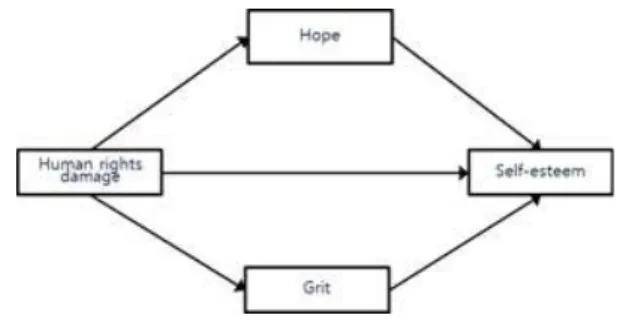
The research model for this study is like one shown in Fig.. 1. Based on previous studies, the following research model was proposed: human rights damage would negatively affect self-esteem, hope, and grit while hope and grit would mediate between human rights damage and self-esteem.
Fig. 1. Research model
2.2 Participants
A total of 233 4-year university students took
part in this survey. Data for the study were collected through purposive sampling. Detailed survey universities were in Seosan-Si, Chungcheeongnam-Do and in Mokpo-Si, Jeonranam-Do in the Korea. Data collection was conducted by visiting the university, requesting questionnaires to lecturers, and distributing and immediately collecting questionnaires from students. Of these students, 63.9% were females and 36.1% were males. Their average age was 22.6 years (range, 19 to 30 years). 45.5% of these students lived in metropolitan city, 37.8% lived in urban city, and the rest of 16.7% lived in rural area.
2.3 Research tools
2.3.1 Human rights damage
We used the scale used by National Human Rights Commission[24]. Its original scale had 25 questions about human rights damage and discrimination. 15 items suitable for university students were used in this study among a total of 25 questions. Each question was measured on a 5-point Likert scale. Higher scores of human rights damage indicate higher damage. In this study, the reliability of human rights damage scale was high with Cronbach's α value of 0.935.
2.3.2 Hope
In order to measure hope, we used the Korean version of the hope scale (K-DHS), which was adapted and validated by Choi et al[25]. from the original form developed by Snyder et al.[26].
Hope is composed of four items of agency thinking that measure goal setting and four items on pathways that measure thinking on how to reach those goals. Measurements were done on a 5-point Likert scale. The higher the score of hope, the higher the hope level. Cronbach's α value for hope reliability was 0.878.
2.3.3 Grit
We used the grit scale developed by
Duckworth & Quinn[27] in this study. The sub-areas for this scale include the interest consistency and effort persistence. The scale is composed of 12 questions in total. The measurements are made on a 5-point Likert scale, and the higher the grit score, the higher the level of grit.
Cronbach's value for grit reliability was α=0.835.
2.3.4 Self-esteem
The self-esteem scale developed by Rosenberg[28]
was used in this study. The scale consisted of 10 items. The measurement of each item was made on a 5-point Likert scale. Higher scores indicate greater self-esteem. The reliability of self-esteem scale used in this study was a little high with Cronbach's α value of 0.854.
2.3.5 Data analysis
SPSS PC + and SPSS macro PROCESS proposed by Hayes[29] were utilized for data analysis.
Frequency analysis, reliability analysis, and mediating effect analysis were performed. Bootstrap method was used to verify the mediating effect.
3. Results
3.1 Descriptive statistics
The statistical analysis results of the main variables are shown in Table 1. Grit, self-esteem, and hope were above normal, but human rights damage was lower than the median (M = 2.0616).
This meant that the human rights damage of college students was not very high.
Minimum Maximum M SD
Grit 2 4.83 3.1398 0.49678
Self-esteem 2.3 4.8 3.4773 0.57224
Hope 2.13 5 3.4319 0.54682
Human rights
damage 1 3.93 2.0616 0.73486
Table 1. Mean and Standard Deviations in all Studied Variables
3.2 Correlation Analysis
Pearson correlation analysis was used to identify correlations between variables as shown in Table 2. Human rights damage was negatively correlated with hopes, grit, and self-esteem. On the other hand, hope, grit, and self-esteem showed a positive correlation with each other.
Among them, the correlation coefficient of self-esteem and hope was the highest at r=.601 (p<.01), while the correlation coefficient of human rights damage and grit was lowest at r = -. 170 (p <.01).
1 2 3 4
1.Human rights
damage 1
2.Hope -.324** 1
3.Grit -.170** .436** 1
4.Self-esteem -.452** .601** .404** 1
**p˂ .01
Table 2. Relationship among all the Studied Variable
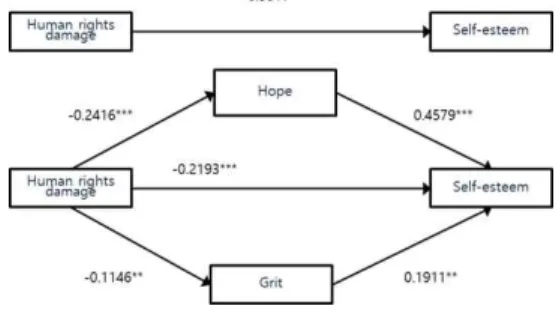
3.3 Mediating effects of hope and grit As a result of analysis of each path coefficient as shown Fig. 2, human rights damage had a significant negative impact on hope (-0.2416, p<.001), self-esteem (-0.2193, p<.001), and grit (-0.1146, p<.01). Hope (0.4579, p<.001) and grit (0.1911, p<.01) had a significant positive effect on self-esteem.
On the other hand, the total effect of human rights damage on self-esteem was -0.3517 (p<.001), but the direct effect of the human rights damage on the self-esteem decreased to -0.2193 (p<.001) when hope and grit were put into as mediating variables.
This indicates that hope and grit mediate in the relationship between human rights damage and self-esteem.
**p<.01, ***p.001
Fig. 2. Path analysis
3.4 Verification of mediating effect
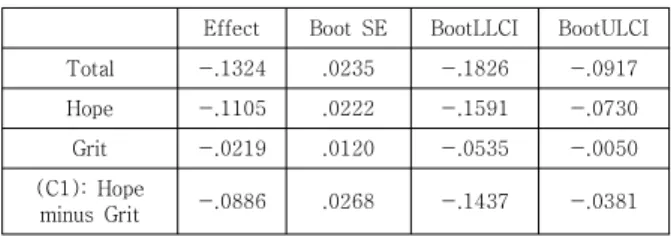
Table 3 shows the results of the bootstrap analysis. The indirect effect of hope, -0.1105, is within the interval from -0.1591 to -0.0730 under 95% confidence level in 5,000 corrected bootstrap samples and is significant because it does not include 0 within this interval. The indirect effect of grit, -0.0219, is within the interval from -0.0535 to -0.0050 under 95% confidence level in 5,000 corrected bootstrap samples and is significant because it does not include 0 within this interval.
Therefore, all indirect effects were significant.
On the other hand, the difference in indirect effect between self-esteem and grit was significant. Therefore, hope is higher in indirect effect than grit (hope-grit=-.0886, p<.05).
Effect Boot SE BootLLCI BootULCI
Total -.1324 .0235 -.1826 -.0917
Hope -.1105 .0222 -.1591 -.0730
Grit -.0219 .0120 -.0535 -.0050
(C1): Hope
minus Grit -.0886 .0268 -.1437 -.0381
Table 3. Indirect effect of human rights damage on self-esteem
4. Discussion and Conclusion
This study was to verify the mediating effects of hope and grit in the relationship between human rights damage and self-esteem of university students. Discussion focused on the results of the study are as follows.
First, as a result of correlations analysis, human rights damage was negatively correlated with hopes, grit, and self-esteem. On the other hand, hope, grit, and self-esteem showed a positive correlation with each other.
Second, as a result of path analysis, the human right damage had a direct effect on self-esteem.
This finding was in coherence with several research studies that indicate that victims of
human rights violation are more likely to demonstrate a low level of esteem[9,10].
Third, as a result of mediating effect analysis, the effects of human rights damage on self-esteem was mediated by hope and grit. This result is consistent with the previous results that hopes mediated in the relationship between experience of human rights damage and self-esteem[20], and in the relationship between ego-resilience and self-reliance[21]. For grit, this result is also consistent with the results that grit mediated in the relationship between job stress and well-being[22], and in the relationship between growth mindset and organizational effectiveness[23, 30]. Therefore, the experiences of human rights damage negatively affects self–
esteem. These negative influences were reduced by way of the hope and grit, which served as a protective factor of self-esteem. Therefore, university students who have experience of human rights damage have low self-esteem, so efforts to improve hope and grit are needed to restore self-esteem.
Limitations of this study and plans for future research are as follows.
First, this study was aimed at college students, so they had less experience of human rights damage than those who were socially marginalized.
Considering this point, it should be reasonable to interpret the damage of human rights in Korea.
Second, this study focused on the mediation effect analysis. Hope and Grit served as a protective factor for enhancing the self - esteem of college students who experienced human rights damage through mediation. Future research will need to develop programs to increase hope and grit.
REFERENCES
[1] V. Eva, H. N. Dorien, E. B. Hiske, Reinaud & M. D.
Peter. (2009). Baseline differences in clinical
symtomatology between ultra high risk subjects with and without a transition to psychosis. Schizophrenia Research, 109(1-3), 60-65.
[2] S. Hopgood. (2010). Amnesty International Report 2009: The State of the World's Human Rights, London:
Amnesty International Publications. Journal of Human Rights Practice, 2(1), 151-165.
[3] K. Francesca. (2003). Judicial deference under the human rights Act. European Human Rights Law Review, 65(6), 859-882.
[4] T. F. Smithyman & G. D. Fireman. (2014). Long-term psychosocial consequences of peer damage: from elementary to high school. School Psychology Quarterly, 29(1), 64-76.
[5] R. Seixas Sonia, P. Coelho Joaquim & N. Fisher Gustav. (2013). Bullies, Victim and bully -victims.
Impact on health profile. EducacaoSociedade &
Culturas, 38(1), 53-75.
[6] S. Woods, J. Done & H. Kalsi. (2009). Peer damage and internalizing difficulties: The moderating role of friendship quality. Journal of Adolescence, 32(2), 293-308, 2009.
[7] F. A. Kostas, C. Henrich, C. Christopher. (2014).
Effects of self esteem and narcissism on bullying and damage during early adolescence. Journal of Early Adolescence, 35(1), 5-29.
[8] H. Nader. (2014). Relationships between self-efficiency, self-esteem and procrastination in undergraduate psychology students.. Iran J Psychiatry Behavioral Science, 8(3), 42-49.
[9] D. S. J. Hawker & J. Boulton Michael. (2000). Twenty years' research on peer damage and psychosocial maladjustment: A meta-analytic review of cross-sectional studies. Journal of Child Psychology and Psychiatry, 41(4), 441-455.
[10] O'Moore Mona & C. Kirkham. (2001). Self-esteem and its relationship to bullying behavior. Journal of Aggressive Behavior, 27(4), 269-283,
[11] H. S. Lee. (2017). Convergent study of the effect of University Students’ Addiction to Smartphones on self-esteem and self-efficacy : stress level and mental health as mediating factors. Journal of Korea Convergence Society, 8(1), 139-148.
[12] S. K. Egan & D. G. Perry. (1998). Does low self-regard invite damage?. Developmental Psychology, 34(2), 299-309.
[13] C. R. Snyder. (1995). Conceptualizing, measuring, and nurturing hope. Journal of Counseling &
Development, 73(3), 84.
[14] C. R. Snyder, J. Cheavens & S. C. Syrupson. (1997).
Hope: An individual motive for social commerce. Group Dynamics: Theory, Research, and Practice, 1(2), 119.
[15] K. M. Radliff, C. Wang & S. M. Swearer. (2016).
Bullying and peer damage: An examination of
cognitive and psychological constructs. Journal of Medicinal Food, .31(11), 1983-2005.
[16] S. K. You, J. Michael, Furlong, Erika, Feleix, Jill D Sharkey, Diane Tanigawa. (2008). Relations among school connectedness, hope, life Satisfaction, and bullying damage. Psychology in the schools, 45(5), 446-460.
[17] A. L. Duckworth. (2011). Self-regulation strategies improve self-discipline in adolescents: Benefits of mental contrasting and implementation intentions.
Educational Psychology, 31(1), 17-26.
[18] A. L. Duckworth, C. Peterson, M. D. Matthews & D. R.
Kelly. (2007). grit: perseverance and passion for long-term goals. Journal of Personality and Social Psychology, 92(6), 1087-1101.
[19] G. W. Ladd, E. S. Buhs, W. Troop, P. K. Smith & C. H.
Hart. (2002). Children personal skills and relationships in school setting: Adaptive significance and implications for school-based prevention and intervention programs Blackwell. Handbook of children social development, Malden: Blackwell Publishing, pp.394-415,
[20] J. Y .Park & C. S. Lee. (2018). Human rights victimization and self-esteem of university students in Korea: The mediating effect of hope. Medico-Legal Update, 18(1), 260-264.
DOI: 10.5958/0974-1283.2018.00096.8
[21] M. S. Kim & C. S. Lee. (2012). Mediated effects of hope on the relationship between ego-resilience and independent will of adolescents in residential cares.
Journal of the Korea Academia-Industrial Cooperation Society, 13(2), 636-641.
[22] C. S. Lee. (2018). Authentic leadership and organizational effectiveness: The roles of hope, grit, and growth mindset. International Journal of Pure and Applied Mathematics, 118(19), 1439-1452.
[23] H. Y. Jang & C. S. Lee. (2018). Mediating effects of growth mindset and grit in relation to authentic leadership and organizational effectiveness. International Journal of Pure and Applied Mathematics, 118(24).
[24] Human rights statistics. (May 18, 2014).
http://library.humanrights.go.kr.
[25] Y. H. Choi, D. G. Lee & H. K. Lee. (2008). Validation of the Korean version of Snyder's dispositional hope scale. Korean Journal of Social and Personality Psychology, 22(2), 1-16.
DOI: 10.21193/kjspp.2008.22.2.001.
[26] C. R. Snyder, L. M. Irving, J. R. Anderson. (1991). Hope and health. Handbook of social and clinical psychology: The Health Perspective, New York:
Pergamon Pr., 285-305.
[27] A. L. Duckworth & P. D. Quinn. (2009). Development and validation of the Short Grit Scale (GRITS). Journal of Personality Assessment, 9(2), 166-174.
[28] M. Rosenberg. (1965). Rosenberg self-esteem scale (SES). Society and the adolescent self-image(pp.180), University of Princeton Press.
[29] A. F. Hayes. (2013). Introduction to mediation, moderation, and conditional process analysis: A regression-based approach(pp.507), New York: The Guilford Press.
[30] C. S. Lee & H. Y. Jang. (2018). The roles of growth minset and grit in relation to hope and self-directed learning.
Journal of Korea Convergence Society, 9(1), 95-102, 2018.
이 창 식(Lee, Chang Seek) [정회원]
· 1984년 2월 : 서울대학교(교육학석사)
· 1991년 4월 : University of the Philippines(Ph.D.)
· 1993년 2월 ~ 현재 : 한서대학교 아 동청소년복지학과 교수
· 관심분야 : 다문화교육, 평생교육
․ E-Mail : [email protected]
박 지 영(Ji Young, Park) [정회원]
․ 1992년 2월 : 전남대학교(문학사)
․ 2005년 2월 : 한서대학교(차학석사))
․ 2011년 2월 : 한서대학교(사회복지학 박사)
․ 2010년 3월 ~ 현재 : 고구려대학교 교수
․ 관심분야 : 다문화, 노인복지
․ E-Mail : [email protected]
빳다야 뿌스뻐 라즈(Padhaya Pushpa Raj) [정 회 원 ]
․ 2019년 5월 ~ 현재 : 한서대학교 박사 과정
․ 관심분야 : 평생교육
․ E-Mail : [email protected]
우마칸타 거우탐(Umakanta Gautam) [정회원]
․ 2019년 5월 ~ 현재 : 한서대학교 박사 과정
․ 관심분야 : 평생교육
․ E-Mail : [email protected]
엔담 바 데니스(Ndam Mbah Denis) [정회 원]
․ 2019년 5월 ~ 현재 : 한서대학교 박사 과정
․ 관심분야 : 평생교육
․ E-Mail : [email protected]
수닡 아디카리(Sunit Adhikari) [ 정 회 원 ]
․ 2019년 5월 ~현재 : 한서대학교 박사 과정
․ 관심분야 : 평생교육
․ E-Mail : [email protected]