Research on Influencing Factors of Consumer Behavior of Fresh Agricultural Products E-commerce in China
Ze Gao 1 , Hyung-Ho Kim 2 , Jae-yeon Sim 3*
1 Professor, College of Business Administration, Jilin Engineering Normal University,
2 Professor, Dept. of Air Transport & Logistics, Sehan University
3 Professor, Dept. of Business Management, Sehan University
중국 신선 농산품 전자상거래 소비자행동 영향요인에 관한 연구
고택 1 , 김형호 2 , 심재연 3*
1 길림공정사범학원 공상관리학원 교수
2 세한대학교 항공교통물류학과 교수, 3 세한대학교 경영학과 교수
Abstract The purpose of this paper is to provide directional and policy references to develop a higher level of service quality and consumer-oriented e-commerce platform. This paper has established a model of consumer behavior of Chinese fresh agricultural e-commerce using customer satisfaction theory and cognitive value theory, and used survey and SPS23.0 to verify hypothesis. Studies have shown that when consumers consume fresh agricultural products, product quality, logistics and distribution service quality, interactive quality of e-commerce platform, and product price and cognitive value have a positive effect on consumer behavior. This study is meaningful in the study of consumer behavior of fresh agricultural e-commerce, and in the case of fresh agricultural e-commerce companies, consumer behavior can be understood. In the model constructed in this paper, the relationship between each influencing factor and consumer behavior is considered comprehensively, but the possible relationship between fine molecular factors has not been studied and analyzed. In the future learning process, it is necessary to make clear the characteristics and particularity of the industry, think about its influencing factors comprehensively and make in-depth analysis.
Key Words : Fresh agricultural products, E-commerce, Consumer behavior, Perceived value, E-commerce platform
요 약 본 논문의 목적은 보다 높은 수준의 서비스 품질과 소비자 지향적인 전자상거래 플랫폼을 개발하기 위한 방향 제시 및 정책적 참조를 제공하는 것이다. 본 논문은 고객만족이론과 인지적 가치 이론을 이용하여 중국 신선 농산물 전자상거래의 소비자 행동 모형을 구축하고 설문조사 및 SPSS23.0을 이용하여 가설을 검증하였다. 연구결과 소비자들 은 신선 농산물을 소비할 때, 제품 품질, 물류 및 유통 서비스 품질, 전자상거래 플랫폼 상호작용 품질, 그리고 제품 가격과 인지 가치가 소비자 행동에 긍정적인 영향이 미치는 것으로 나타났다. 본 연구는 신선 농산물 전자상거래의 소비자 행동 연구에 의의가 있으며, 신선 농산물 전자상거래 기업에도 소비자 행동을 이해할 수 있다는데 의의가 있다.
본 논문에서 제시한 모델에서는 각 영향요인과 소비자 행동의 관계를 종합적으로 고려하지만 미세 요인의 가능한 관계 는 다루지 않았다. 향후 연구에서는 산업의 특성과 특수성을 명확히 하고, 그 영향 요인을 종합적으로 고려해 심층 분석할 필요가 있다.
주제어 : 신선 농산물, 전자 상거래, 소비자 행위, 인지 가치, 전자상거래 플랫폼
*This Paper was supported by the Sehan University Research Fund in 2020.
*Corresponding Author : Jae-yeon Sim([email protected])
Received March 27, 2020 Revised April 30, 2020
Accepted June 20, 2020 Published June 28, 2020
1. Introduction
In recent years, under the condition that network pays ceaseless popularity, Through the electronic commerce platform shopping has become an indispensable part of our residents' life. Fresh agricultural products are an important field closely related to people's life. X. H. Wang said that China's fresh agricultural products e-commerce market is gradually heating up, With the increasingly mature e-commerce technology, Fresh agricultural products e-commerce has become an important target of many e-commerce enterprises, logistics enterprises, retail enterprises and agricultural products enterprises planning[1].
But for these companies, the current strategy is usually to learn from or imitate the experience of shopping, However, fresh agricultural products e-commerce and other products of the common network shopping is actually very different[2].
For example, the wastage of fresh agricultural products makes the damage amount much higher than that of ordinary products, and there are differences between the consumer groups of fresh agricultural products in e-commerce and ordinary online shopping, and so on. Therefore, to promote the development of fresh agricultural products e-commerce, consumer behavior is one of the key points we must pay attention to. The results of empirical research and analysis in this paper can more clearly define consumer demand, It is of great practical significance for the development of fresh agricultural products e-commerce in China to provide directional Suggestions and policy references for the development of higher level, higher service quality and consumer-oriented fresh agricultural products e-commerce platform.
2. Theoretical basis and research hypothesis
2.1 Customer perceived value theory
Customer perceived value refers to the subjective evaluation of the benefits and effectiveness of products or services obtained by subtracting the total cost of time and energy spent in purchasing products or services[3]. It is a trade-off between perceived benefits and perceived costs. Scholars at home and abroad have conducted many researches on customer perceived value, including the following aspects:
Firstly, one of the determinants of perceived value is interest, including internal and external characteristics, perceived product quality;
Secondly, the total cost of customer perceived value can be divided into two parts: monetary cost and non-monetary cost composed of time, energy and other resources; Again, the product of external attributes, including packaging, colour, brand, etc., is a kind of intuitive value signal, usually consumers on product cognition is limited, all the elements of good external features can bring consumers product value higher, suggested to reduce consumers' benefits are obtained and paid too much balance between cost, so as to promote the purchase behavior decision-making[4]. In the study of e-commerce purchase intention, many scholars at home and abroad have analyzed perceived value. W. Q. Wu proves that customers' perceived value is one of the important factors affecting their purchasing behaviors through e-commerce[5]. Dabbenea F & Gay P & Sacco N also confirmed the important influence of perceived value by analyzing customers' purchasing behaviors of jewelry products[6].
Therefore, based on the theory of customer perceived value, this paper proposes the following hypotheses:
H1: fresh agricultural product quality has a
positive impact on fresh agricultural
product e-commerce consumer behavior
H2: logistics distribution service quality has a
positive impact on fresh agricultural products e-commerce consumer behavior H3: product price and perceived value have a
positive impact on fresh agricultural products e-commerce consumers
2.2 Technology Acceptance Model
The Technology Acceptance Model, or TAM, was proposed by Briz J in 1989[7]. To study a model of one's receptivity to information system based on rational behavior theory, This model has two decisive factors: one is perceived usefulness, the other is perceived ease of use.
Montanari R believes that customer perceived risk, system experience and perceived entertainment can also be used as external variables to analyze consumers' intentions through e-commerce platform shopping[8]. Ruiz.
Garcia. L believed that product quality, price and safety conditions were the most important variables, and established an extended technology acceptance model accordingly[9]. At present, promoting the addition and retention of consumers is the key to the successful development of e-commerce platforms.
Consumers interact with sellers through online e-commerce platforms. The perceived usefulness and ease of use of the system determine whether they use and continue to use the platform to purchase fresh agricultural products[10]. Based on the theory of technology acceptance model, this paper proposes the following hypotheses:
H4: the interactive design quality of e-commerce platform has a positive impact on the e-commerce consumer behavior of fresh agricultural products
Based on the research results at home and abroad, it can be seen that foreign scholars focus more on e-commerce or consumer satisfaction, pay more attention to the information technology of e-commerce platform for fresh agricultural products, and do less research on
influencing factors of consumer behavior.
However, the design quality of e-commerce platform is also one of the factors affecting consumer behavior, so the research results of foreign scholars still have great reference significance. Domestic scholars in recent years the problem of fresh agricultural products e-commerce research, mainly including fresh produce mode of e-commerce, logistics distribution system, etc., at the same time, fresh agricultural products e-commerce consumers will also gradually become a new hot spot of the scholars, but influence the consumers through factor analysis of e-commerce platform to buy fresh agricultural products is not comprehensive, on the basis of this article from the fresh agricultural product quality, logistics service quality and electric business platform for interaction design quality, product price and perceived value four aspects to understand the consumer satisfaction of fresh agricultural products e-commerce, This paper analyzes the important factors that influence the consumer behavior, and puts forward some countermeasures and Suggestions to promote the development of fresh agricultural products e-commerce in China.
2.3 Research model
This article selects the fresh agricultural
products e-commerce platform had purchase
experience of consumers as the research object,
based on the theory of customer satisfaction,
customer perceived value theory and the
technology acceptance model, identification may
affect consumers through consumer behavior of
e-commerce platform to buy fresh agricultural
products, including fresh produce quality (PQ),
logistics service quality (LQ), electric business
platform for interaction design quality (UIQ), and
product price and perceived value (PV), these
four factors interact, thus affect consumers'
buying behavior. Accordingly, this paper takes the quality of fresh agricultural products, the quality of logistics and distribution services, the quality of e-commerce platform interaction design and product price and perceived value as the key factors affecting consumer behavior in e-commerce of fresh agricultural products, and determines its sub-factors by combining the above theories and the research results of domestic and foreign scholars. Build the model for this article, as shown in Fig. 1.
PQ
LQ
PV
UIQ
PB H2
H3 H4 H1
Fig. 1. Theoretical model
3. Research design
3.1 Questionnaire and variable measurement This article adopts the way of questionnaire survey, the above theory model and research hypothesis, selection of fresh agricultural products Quality (PQ), Logistics service Quality (LQ), e-commerce platform interaction design Quality (UIQ), Product price and Perceived Value (PV) and consumer buying behavior (PB) as a variable, Based on the research and analysis results of domestic and foreign scholars[11].
According to the specific situation of this paper, using the Likert 5-point scale[12]. After the preliminary preparation of the scale, In order to improve its validity, experts and professors in related fields of this study were invited to provide Suggestions on the modification of specific contents of the measurement items. After revising the scale based on these Suggestions, 100 college students were selected for the test of the scale, and the scale was adjusted twice according to the feedback of the test, and 18 core questions were finally determined.
3.2 Data collection and description statistics 400 official questionnaires were distributed through the network, The questionnaire will be
category quantity % category quantity %
gender male 110 31.9
income
0-3000 41 11.8
female 235 68.1 3000-4999 112 32.4
professional
public institution 41 11.8 5000-6999 122 35.3
private enterprise 10 2.9 7000-9999 50 14.7
private enterprise 10 2.9 10000~~ 20 5.9
professionals 81 23.5
students 71 20.6
age
20-29 71 20.6
teacher 122 35.3 30-39 142 41.2
freelancer 10 2.9 40-49 112 32.4
50-69 20 5.9
Marital status
married 264 76.5
educational background
senior high school 35 10
unmarried 81 23.5 Bachelor's degree 193 55.9
Postgraduate
degree 117 34.1
345 100 345 100
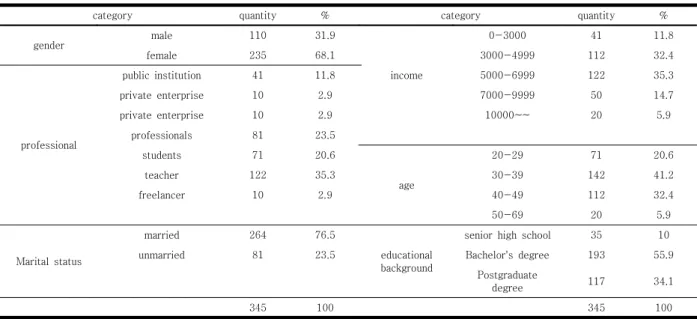
Table 1. Demographic characteristics
issued from December 2, 2019 to December 12, 2019. 373 questionnaires were collected, and 345 valid questionnaires were obtained by eliminating invalid questionnaires, with an effective rate of 86%. In this study, the sample size is 18, and the sample size (345), More than 10 times higher than the standard can be used to demonstrate the correlation between the scales.
Among the valid questionnaires, The results are shown in table 1, 110 were male samples and 235 were female samples, among which females accounted for 68.1%. The age distribution was 20.6% for those aged 20-29, 41.2% for those aged 30-39, 32.4% for those aged 40-49 and 5.9% for those aged 50-69. The sample aged between 30 and 39 years was the most represented, This group is also the main group of e-commerce consumption. In terms of marital status, the unmarried account for 23.5%, the married account for 76.5%, and the average monthly family income below 3,000 yuan accounts for 11.8%. 3000 to 4999 yuan accounts for 32.4%.
From 5000 to 6999 yuan accounts for 35.3%, from 7000 to 9999 yuan accounts for 14.7%, and from 10000 yuan to over 5.9%. In terms of education level, 10% of students have junior middle school, senior high school or below, 55.9% have bachelor's degree, and 34.1% have graduate degree. Respondents generally have a high level of education. In terms of occupational characteristics, public institutions accounted for 11.8%, private enterprises 2.9%, self-employed 2.9%, professional and technical personnel 23.5%, students 20.6%, teachers 35.3%, and freelancers 2.9%. The study covers a wide area. Relatively speaking, the sample data is reasonable.
4. Empirical analysis
4.1 Exploratory factor analysis
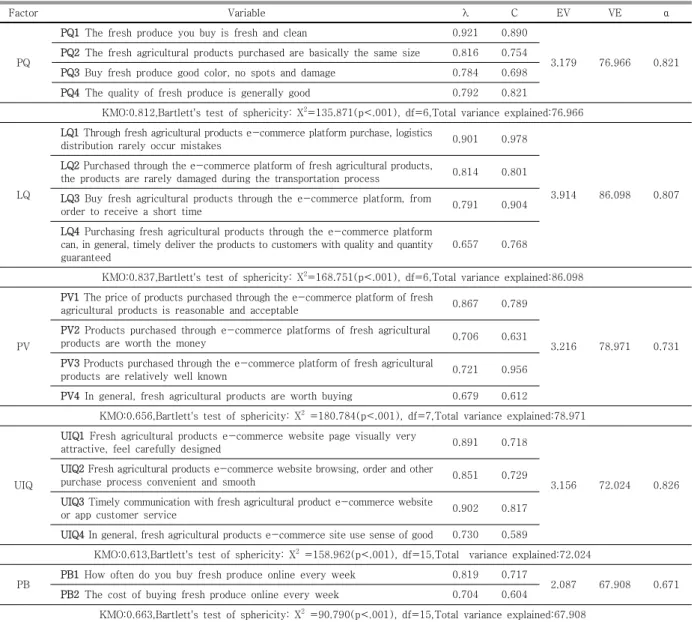
Based on the previous study of each factor, the measurement variables were extracted[13]. In
order to verify the rationality and credibility of the extracted variables, exploratory factor analysis and trust analysis were carried out. The results of the analysis are as shown in table 2.
Exploratory factor analysis in order to avoid
multiple commonalities, VARIMAX was used to
conduct major component analysis, the first
thing to product quality, according to the results
of exploratory factor analysis KMO is 0.812, This
is much higher than the 0.5 standard, By testing,
Bartlett ball test (Bartlett's test of sphericity X 2 =
135.871(p<0.001), The significance result is.000,
which can be used for factor analysis, factors of
load quantity for. 784 ~ 921(p≥.4), Convergence
value is. 698-890(p≥.4), the characteristic value
of 3.179 (1.0) or higher, credibility for the. 821,
by 76.966%. It conforms to the scale structure set
in this paper, so the product quality set in this
paper has a good structural validity. The result of
exploratory factor analysis on the quality of
logistics distribution service of the second factor
shows that KMO is 0.837, This is much higher
than the 0.5 standard, By testing, Bartlett's test of
sphericity X 2 =168.751(p<.001), and the
significance result reaches.000, which is suitable
for factor analysis. The reliability was.807 and
the explanatory power was 86.098%. It conforms
to the scale structure set in this paper, so the
structure validity of logistics service quality set in
this paper is good. The result of exploratory
factor analysis on the price and perceived value
of the third factor showed that KMO was 0.656,
This is much higher than the 0.5 standard, By testing,
Bartlett's test of sphericity X 2 =180.784(p<.001), and
the significance result reached.000, which was
suitable for factor analysis. The reliability was.731
and the explanatory power was 78.971%. It
conforms to the scale structure set in this paper,
so the price and perceived value variables set in
this paper have good structural validity. The
result of exploratory factor analysis on
e-commerce platform of the fourth factor shows
that KMO is 0.613, This is much higher than the
0.5 standard, By testing, Bartlett's test of sphericity: X 2 =158.962(p<.001), the significance result reached. 000, suitable for factor analysis, exploratory factor analysis results, factor load value of 0.730~0.902(≥0.4), common value of 0.589~0.817(≥0.4), characteristic value of 3.156 (≥1.0), reliability of 0.826, indicating force of 72.024%. It conforms to the scale structure set in this paper, so the interactive design variable of e-commerce platform set in this paper has a good structural validity. The result of exploratory factor analysis on the purchasing behavior of the fifth factor shows that KMO is 0.663, This is much higher than the 0.5 standard, By testing,
Bartlett's test of sphericity: X 2 =90.790(p<.001), the significance result reaches 0.000, suitable for factor analysis, exploratory factor analysis results, factor load value is 0.704~0.819(≥0.4), the commonality value is 0.604~0.717(≥0.4), the characteristic value is 2.087(≥1.0), the reliability is 0.671, indicating the force is 67.908%. It conforms to the scale structure set in this paper, so the purchasing behavior variable set in this paper has a good structural validity.
4.2 Regression analysis test hypothesis Based on the theory of customer perceived value, this study demonstrates the influencing
Factor Variable λ C EV VE α
PQ
PQ1 The fresh produce you buy is fresh and clean 0.921 0.890
3.179 76.966 0.821 PQ2 The fresh agricultural products purchased are basically the same size 0.816 0.754
PQ3 Buy fresh produce good color, no spots and damage 0.784 0.698 PQ4 The quality of fresh produce is generally good 0.792 0.821
KMO:0.812,Bartlett's test of sphericity: X
2=135.871(p<.001), df=6,Total variance explained:76.966
LQ
LQ1 Through fresh agricultural products e-commerce platform purchase, logistics
distribution rarely occur mistakes 0.901 0.978
3.914 86.098 0.807 LQ2 Purchased through the e-commerce platform of fresh agricultural products,
the products are rarely damaged during the transportation process 0.814 0.801 LQ3 Buy fresh agricultural products through the e-commerce platform, from
order to receive a short time 0.791 0.904
LQ4 Purchasing fresh agricultural products through the e-commerce platform can, in general, timely deliver the products to customers with quality and quantity guaranteed
0.657 0.768
KMO:0.837,Bartlett's test of sphericity: X
2=168.751(p<.001), df=6,Total variance explained:86.098
PV
PV1 The price of products purchased through the e-commerce platform of fresh
agricultural products is reasonable and acceptable 0.867 0.789
3.216 78.971 0.731 PV2 Products purchased through e-commerce platforms of fresh agricultural
products are worth the money 0.706 0.631
PV3 Products purchased through the e-commerce platform of fresh agricultural
products are relatively well known 0.721 0.956
PV4 In general, fresh agricultural products are worth buying 0.679 0.612
KMO:0.656,Bartlett's test of sphericity: X
2=180.784(p<.001), df=7,Total variance explained:78.971
UIQ
UIQ1 Fresh agricultural products e-commerce website page visually very
attractive, feel carefully designed 0.891 0.718
3.156 72.024 0.826 UIQ2 Fresh agricultural products e-commerce website browsing, order and other
purchase process convenient and smooth 0.851 0.729
UIQ3 Timely communication with fresh agricultural product e-commerce website
or app customer service 0.902 0.817
UIQ4 In general, fresh agricultural products e-commerce site use sense of good 0.730 0.589
KMO:0.613,Bartlett's test of sphericity: X
2=158.962(p<.001), df=15,Total variance explained:72.024
PB PB1 How often do you buy fresh produce online every week 0.819 0.717
2.087 67.908 0.671 PB2 The cost of buying fresh produce online every week 0.704 0.604
KMO:0.663,Bartlett's test of sphericity: X
2=90.790(p<.001), df=15,Total variance explained:67.908
Table 2. Results of exploratory factor analysis
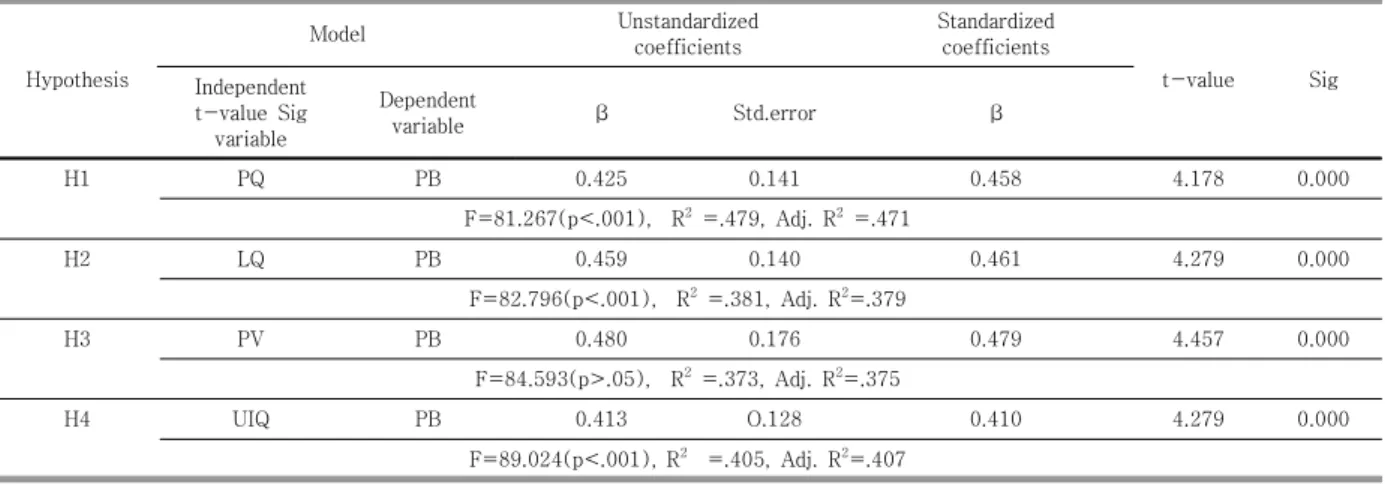
factors of consumer behavior in e-commerce of fresh agricultural products. The analysis results are shown in table 3. and Fig. 2. H1 hypothesis:
correlation analysis of the impact of fresh agricultural product quality on the e-commerce consumer behavior of fresh agricultural products shows that, F=81.267(p<0.001), which is very significant in terms of generalization, R 2 =0.479, Adj. R 2 =0.471. PQ has a significant effect on PB (β PQ→PB =0.458 , t=4.178, p<0.001), and H1 is verified, and the assumption is true. H2 hypothesis: The correlation analysis of the impact of logistics distribution service quality on the e-commerce consumer behavior of fresh agricultural products shows that, F=82.796 (p<0.001), statistically significant, R 2 =0.381, Adj.
R 2 =0.379. LQ has a significant impact on PB (β LQ→
PB =0.461, t=4.279, p<0.001), and H2 is validated, assuming that it is true. H3 The correlation
analysis of the impact of product price and perceived value on the e-commerce consumer behavior of fresh agricultural products shows that, F=84.593 (p<0.001), statistically significant, R 2 =0.373, Adj. R 2 =0.375. LQ has a significant impact on PB (β PV→PB =0.479, t=4.457, p<0.001) and H3 is validated, assuming that it is true. H4 hypothesis: The correlation analysis of the impact of the interactive design quality of e-commerce platform on the e-commerce consumer behavior of fresh agricultural products shows that, F=89.024(p<0.001), statistically very significant, R 2 =0.405, Adj. R 2 =0.407. FP4a, UIQ had an effective effect on PB (β UIQ→PB =0.410, t=4.279, p<0.001), and H3 is validated, assuming that it is true.
5. Conclusions and implications
5.1 Conclusion and revelation
By reference to a large number of domestic and foreign scholars research achievements, this pape analyzed the research status at home and abroad, according to the theory of customer perceived value and technology acceptance model as the theoretical basis[14], put forward the influence consumers through multiple factors of electric business platform to buy fresh agricultural products, through empirical analysis PQ
LQ
PV
UIQ
PB
0.461
***
0.479
***
0.410
***
0.458
***
4.178
Fig. 2. Model test results
* indicates P < 0.05; ** indicates P < 0.01; *** indicates P < 0.001.
Hypothesis
Model Unstandardized
coefficients
Standardized coefficients
t-value Sig
Independent t-value Sig
variable
Dependent
variable β Std.error β
H1 PQ PB 0.425 0.141 0.458 4.178 0.000
F=81.267(p<.001), R
2=.479, Adj. R
2=.471
H2 LQ PB 0.459 0.140 0.461 4.279 0.000
F=82.796(p<.001), R
2=.381, Adj. R
2=.379
H3 PV PB 0.480 0.176 0.479 4.457 0.000
F=84.593(p>.05), R
2=.373, Adj. R
2=.375
H4 UIQ PB 0.413 O.128 0.410 4.279 0.000
F=89.024(p<.001), R
2=.405, Adj. R
2=.407
Table 3. Results of regression analysis
it is concluded that the product price and perceived value, fresh agricultural products quality, logistics service quality and electric business platform interaction design quality of consumer behavior of the fresh produce electricity suppliers have positive significant impact, through the above analysis, for fresh agricultural products under the electricity, In the process of operation[15]. We should pay attention to improving the quality of fresh agricultural products, logistics and distribution service, and the interactive design quality of e-commerce websites and apps. To build a diversified e-commerce model ecosystem in the era of mobile Internet; We will give play to the innovative role of the new generation of information technology, such as the Internet of things and block chain, in the e-commerce of fresh agricultural products.
In the aspect of fresh agricultural products e-commerce consumer behavior influence factor, the research also has the very big development space in the future, such as the possible influencing factors on the characteristics of the industry, they require detailed analysis, not only need to analyze the impact of these independent variable factors on the consumer behavior, also need to analyze the potential relationship between independent variables and improve the model.
5.2 Deficiencies and prospects
Firstly, this paper focuses on the research of influencing factors of consumer behavior. Based on a large amount of literature at home and abroad, it puts forward the key influencing factors in four aspects, as well as the fine-molecule influencing factors, and makes assumptions about the relationship between these factors and consumer behavior. In the model constructed in this paper, the relationship between each influencing factor and consumer
behavior is considered comprehensively, but the possible relationship between subdivision factors is not studied and analyzed.
Second, a questionnaire survey was conducted in this study, the main measure to data processing and analysis as the core, to participate in the survey by consumer of electric business platform to buy fresh agricultural products are the basic information of the missing, not will base the information into the demonstration section, ignore the consumer's occupation, age and gender of the subjective influence on consumer behavior, so here there are some limitations in this paper.
Based on the shortcomings of the above research, in the future learning process, we will mainly focus on the following aspects of in-depth research:
First of all, when studying the influencing factors of consumer behavior, it is necessary to make clear the characteristics and particularity of the industry, comprehensively consider the influencing factors and conduct in-depth analysis. In addition to studying the influence of these factors on consumer behavior, it is also necessary to comprehensively consider whether the influencing factors interact with each other.
Secondly, a series of basic information and subjective factors, such as the occupation, education background, gender and age of the investigated subjects, should also be taken into consideration when conducting research and analysis by means of questionnaire survey. The influence of these factors on the studied issues cannot be ignored.
REFERENCES
[1] X. H. Wang. (2016). E-commerce cracked the internal mechanism of circulation dilemma of fresh agricultural products. Chinese soft science (52), 39-55.
DOI : 10.3969/j.issn.1002-9753.2016.02.004
[2] G. Chen. (2017). Based on online and offline fresh
agricultural products city distribution model and optimization strategy. Business economics, (06), 86-87.
DOI : 10.3969/j.issn.1002-5863.2017.06.033
[3] Z. Q. Du. (2016). European and American fresh agricultural products e-commerce operation mode innovation and enlightenment. Foreign economic and trade practice (07), 72-75.
DOI : 10.3969/j.issn.1003-5559.2016.07.018
[4] K. Liu. (2017). The innovative mechanism of e-commerce circulation of fresh agricultural products Reform and strategy (05), 94-97.
DOI : CNKI:SUN:SYJG.0.2017-03-002
[5] W. Q. Wu. (2017). Fuzzy comprehensive evaluation of consumer trust in online shopping of fresh agricultural products. Business economics research (01),52-54
DOI : 10.3969/j.issn.1002-5863.2017.01.020
[6] F. Dabbenea. (2008). Optimisation of fresh-food supply chains in uncertain environments .Biosystems Engineering, 99(3), 348-359.
DOI : 10.1016/j.biosystems eng.2007.11.011
[7] J. Briz. (2016). E-commerce and ICT adoption in the Spanish agro-food sector. Food supply networks: trust and e-business (07), 105-119.
DOI : 10.1079/9781845936396.0105
[8] R. Montanari. (2008). Cold chain tracking: a managerial perspective. Trends in Food Science and Technology 19 (8), 425-431.
DOI : 10.1016/j.tifs.2008.03.009
[9] Ruiz. Garcia. L. (2010). A model and prototype implementation for tracking and tracing agricultural batch products along the food chain. Food control, 21(2), 112-121.
DOI : 10.1016/j.foodcont.2008.12.003
[10] W. Chen. (2019). Intergenerational Transmission Effect of Chinese Filial Piety Concepts. Population and Economy, (02), 55-67.
DOI :13. 3969 / j. issn. 1000-4149. 2019. 02. 005 [11] J. Lao. (2017). Optimization of purchasing inventory
of fresh agricultural products in Internet sales based on scale effect Logistics technology (03), 123-127.
DOI : CNKI:SUN:WLJS.0.2017-03-029
[12] R. Li. (2016). Study on the profit model of fresh agricultural products e-commerce based on community The electronic commerce (10), 19-22.
DOI : 10.3969/j.issn.1005-5800.2016.29.010
[13] J. Jang & S. Kim. (2019). A Case Study on the Packaging Design to Maintain Food Freshness of E-Commerce - Focused on Domestic and International Cases Journal of The Korea Convergence Society, 10(07), 115-120.
DOI : 10.15207/JKCS.2019.10.7.115
[14] S. H. Park & C. S. Leem. (2019). Service model development and importance analysis using shared
economic service - As a specialization center for mail service Journal of The Korea Convergence Society, 10(05), 181-188.
DOI : 10.15207/JKCS.2019.10.5.181
[15] D. Y. Lee & J. C. Jo. (2017). User Sentiment Analysis on Amazon Fashion Product Review Using Word Embedding Journal of The Korea Convergence Society, 8(04), 1-8.
DOI : 10.15207/JKCS.2017.8.4.001
고 택(Ze Gao) [정회원]
․ 2000년 6월 : 길림농업대학교 경영학 과(이학사)
․ 2007년 12월 : 길림대학교 경영학과 (경영학 석사)
․ 2018년 5월∼ 현재 : 세한대학교 경 영학과(경영학 박사)
․ 2004년 8월 ∼ 현재 : 지린공정기술사 범학원 경영과 교수
․ 관심분야 : 통계, 마케팅
․ E-Mail : [email protected]
김 형 호(Hyung-Ho Kim) [정회원]
․ 1989년 2월 : 경희대학교 전자계산공 학과(공학사)
․ 1992년 8월 : 경희대학교 전자계산공 학과(공학석사)
․ 2018년 2월 : 인천대학교 동북아물류 대학원(물류학박사)
․ 1998년 3월 ∼ 현재 : 세한대학교 항 공교통물류학과 교수
․ 관심분야 : 신경회로망, 항공운송, System Dynamics
․ E-Mail : [email protected]
심 재 연(Jae-Yeon Sim) [정회원]