Vol. 25, No. 6 (2015)
274
업싸이클링된 암모늄 파라텡스텐의 열적 및 화학적 분해법 비교
정준기1·온진호1·김성진1·박상엽1,2†
1강릉원주대학교 파인세라믹기술혁신센터, 2강릉원주대학교 세라믹신소재공학과
Comparing Thermal and Chemical Decomposition of Up-Cycled Ammonium Paratungstate(APT)
Jun-Ki Chung1, Jin-Ho On1, Sung-Jin Kim1 and Sang-Yeup Park1,2†
1Technology Innovation Center for Fine Ceramics, Gangneung-Wonju National University, Gangnung 210-702, Korea
2Advanced Ceramic Materials Engineering, Gangneung-Wonju National University, Gangnung 210-702, Korea
(Received April 30, 2015 : Revised May 26, 2015 : Accepted May 27, 2015)
Abstract The possibility of using the chemical precipitation method of up-cycled ammonium paratungstate (APT) was studied and compared with the thermal decomposition method. WO3 particles were synthesized by chemical precipitation method using a 1: 2 weight ratio of APT: Di-water. For thermal decomposition, APT powder was heated for 4h at 600oC in air atmosphere.
The reaction products were characterized by X-ray diffraction (XRD), X-ray fluorescence spectrometer (XRF), particle size analyzer (PSA), and field emission-scanning electron microscopy (FE-SEM). Thermogravimetric analysis (TGA) of the up- cycled APT allowed for the identification of the sequence of decomposition and reduction reactions that occurred during the heat treatment. TGA data indicated a total weight loss of 10.78 % with the reactions completed in 658oC. The XRD results showed that APT completely decomposed to WO3 by thermal decomposition and chemical precipitation. The particle size of the synthesized WO3 powders by thermal decomposition with 2 h of planetary milling was around 2µm. During the chemical precipitation process, the particle size of the synthesized WO3 powders showed a round-shape with ~0.6µm size.
Key words WO3, APT, chemical precipitation, thermal decomposition.
1. 서 론
초경합금은 절삭, 절단용공구, 내마모용 부품 및 금형 소재로 이용되고 있으며, 국내 초경합금 시장규모는 약 7,500억원으로, 초경합금의 시장 규모는 꾸준히 증가하는 추세이다. 현재 사용되는 초경합금 W(텡스텐) 원료인 APT(Ammonium paratungstate, (NH4)10[H2W12O42]·4H2O) 는 중국에서 대량으로 생산되고 있다. 중국 정부의 원 료수출 통제 정책으로 W원료의 수급 및 확보에 어려움 이 예상되고 있으므로 국내 초경스크랩을 이용한 재활 용공정 기술개발이 필요한 실정이다. W 초경합금 스크 랩 활용을 위한 재활용 기술은 화학적 처리법(Chemical method), 전기분해법(Electrolysis method), 아연법(Zn
method) 및 습식제련법 등으로 알려져 있다.1-7)
초경스크랩의 W 재활용 공정에 있어서 최종 생산물 은 암모니아와 텡스텐으로 구성된 화합물인 APT이며, WC 제조는 APT의 암모니아, 결정수 분해를 통해 WO3
분말로 제조하여 환원 및 탄화 공정으로 이루어진다.
APT를 WO3로 제조함에 있어, 비교적 열분해법은 화학 공정에 비해 많은 연구가 이루어졌다.8-12) 그러나 많은 양 의 APT를 WO3로 제조함으로써 발생하는 다량의 암모 니아 가스 환경문제, 시설투자 등의 경제성으로 인해 국 내 기업들은 APT 분해 공정을 기피하고 WO3를 수입하 여 환원 및 탄화하는 공정만 선호하고 있다. 향후 폐초 경 스크랩의 재활용 활성화를 위해서는 친환경적이면서 부가가치가 높은 미분말화 공정의 APT 분해 기술개발
†Corresponding author
E-Mail : [email protected] (S.-Y. Park, Gangneung-Wonju Nat'l Univ.)
©Materials Research Society of Korea, All rights reserved.
This is an Open-Access article distributed under the terms of the Creative Commons Attribution Non-Commercial License (http://creative- commons.org/licenses/by-nc/3.0) which permits unrestricted non-commercial use, distribution, and reproduction in any medium, provided the original work is properly cited.
인 분쇄 공정만으로는 극미립자를 제조하는데 한계가 있 기에 나노급의 분말을 얻기 위해서는 화학적 반응이 수 반된 공정 도입이 필요하다.
본 연구에서는 폐초경 공구로부터 재활용 기술로 얻어 진 Up-cycled APT을 이용하여 열분해법과 화학침전법으 로 WO3 분말을 제조하고 제조공정에 따른 입도, 밀도, 순도 등의 물리적 특성 및 미세구조 형상을 비교하였다.
2. 실험 방법
Up-cycled APT 분말은 한국세라믹 기술원에서 초경합 금 스크랩을 고온산화법으로 분해하여 제조한 것을 사 용하였다. WO3 분말 제조는 열분해법과 화학침전법으로 하였으며, 전반적인 실험공정은 Fig. 1에 나타내었다.
열분해법은 APT를 600oC에서 4시간 유지하면서 WO3
결정상 분말을 제조한 후, 분쇄과정에서 발생할 수 있 는 오염원 최소화를 위해 Al2O3, ZrO2 같은 세라믹 소 재를 피하고 WC 용기와 볼을 이용하여 2시간 동안 밀 링을 하여 미립자화하였다.
화학침전법 공정에서는 APT 분말과 증류수를 1 : 2의 비율로 반응조에 투입하여 히팅멘틀에서 200oC를 유지 하면서 황산 30 ml를 넣고 완전히 혼합 반응되도록 저 어주면서, AMT(Ammonium Meta Tungstate) 결정상이 되면 황산(H2SO4)을 일정량 넣어주면서 pH = 1.5~2를 유 지하였다. 이러한 화학반응으로 제조된 WO3·xH2O가 침 전되도록 일정시간을 유지하며, 상단의 부유물은 버리고 2~3번의 수세 과정을 거친 분말을 건조시켜 최종적으로 500oC에서 4시간 하소처리 하였다.
APT의 열적특성 분석을 위해서 TG/DTA(Simutaneous TG System, STA409PC, Netzsch) 기기를 이용하여 상 온에서 1,000oC까지 10oC/min의 승온속도로 일반 대기 압 분위기에서 측정하였다. APT 및 WO3 분말의 결정 상 분석은 X-선 회절분석기(18 kW XRD, D/Max-2500, Rigaku)를 이용하여 4o/min의 스캔속도로 2θ = 15~70o범 위에서 측정하였고, 정량분석은 X-선 형광분석기(XRF, ZSX100e, Rigaku), 입자 크기는 입도분석기(Particle Size Analyzer, LS230, Beckman Coulter)를 이용하여 측정
평가하였다. APT 및 WO3 분말들의 미세구조는 전계방 출 주사전자현미경(FE-SEM, S-4700, Hitachi)으로 관찰 하였다.
3. 결과 및 고찰
3.1 Up-cycled APT의 분석
Fig. 2는 Up-cycled APT의 TG/DTA 열분석 결과이 다. TG데이터에서 10.78 %의 무게감량을 보여주었는데 이는 H2O 및 암모니아 가스의 휘발로 인한 것으로 판 단할 수 있으며, 500oC 이상에서는 무게감량 변화가 없 었다. 열분석 결과, 주요 흡열반응은 197oC, 265oC, 328
oC, 442oC, 555oC, 658oC에서 발열반응은 420oC, 519
oC에서 발생하였으며 662oC 이후에서 반응이 종결되었 다. 일반적으로 100~220oC에서는 (NH4)10(H2W12O42)가 (NH4)10(H2W12O40)·2H2O+4NH3로 즉, APT가 AMT 결 Fig. 1. Schematic diagram of the experimental method.
Fig. 2. TG/DTA patterns for Up-cycled APT without milling.
정상이 형성되는데, 이 화합물은 비정질상으로 APT에 비 하여 수용성이 강하다.13) 열분석 결과를 통해서도 197oC 온도구간에서 AMT 결정상이 형성되는 것으로 확인할 수 있었다. 220~450oC에서는 AMT가 분해되면서 ATB (Ammonium Tungsten Bronze)가 형성된다. 이보다 높은 온도에서는 암모니아 가스와 나머지 결정수가 휘발되면 서 WO3 결정상을 얻을 수 있다. 본 실험에서도 420~
422oC에서의 흡열반응 피크를 통해 ATB가 형성된다는 것을 확인할 수 있으며, TG/DTA 분석결과를 통해 APT 를 500oC 이상의 열분해법에 의해서 APT가 완전히 분 해됨을 확인할 수 있었다. 이러한 결과를 토대로 하소 및 열처리를 500oC, 600oC에서 각각 실시하였다.
Table 1과 2는 Up-cycled APT의 화학조성과 비표면 적, 밀도 입도 분석결과이다. WO3 화학조성은 99.6 %이 상의 순도를 나타내었으며, Co(코발트)가 약 0.3 wt% 함 유되어 있는데 이는 초기 초경공구에 함유된 것으로 사 료되며, 입자크기는 약 40 μm를 나타내었다. Fig. 3은
Up-cycled APT의 미세구조를 관찰한 것으로 입도 분석 결과와 유사한 입자 크기임을 확인하였고 입방정 형상 을 보여주었다.
3.2 WO3 결정상 및 정량 분석
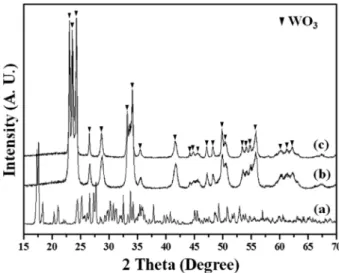
Fig. 4는 Up-cycled APT으로부터 열분해법과 화학침전 법으로 제조된 WO3분말의 XRD 결과를 나타낸다. XRD 분석결과 APT가 단사정(Monoclinic) 결정상을 지닌 것 으로 분석되었으며, 미세구조상에서도 찌그러진 입방정 형 태를 확인할 수 있었다. 한편 WO3 결정상은 제조공정 에 변화 없이 피크 각도와 강도가 유사함을 나타낸다.
Fig. 3. SEM micrographs of Up-cycled APT as starting materials: (a) low-magnification and (b) high-magnification.
Fig. 4. XRD patterns of WO3 were synthesized by thermal decom- position and chemical precipitation: (a) Up-cycling APT as starting material, (b) WO3 fabricatedby thermal decomposition and (c) WO3 fabricated by chemical precipitation.
Table 1. Chemical composition of Up-cycled APT (wt%).
Component
Specimen W O Ca Fe Co
Up-cycling
APT 74.1384 25.5017 0.0241 0.0273 0.3121 Table 2. Physical properties of Up-cycled APT.
Specimen Surface Area (m2/g)
Density (g/cm3)
Particle size (µm) mean median Up-cycling APT 0.6069 4.6274 40.30 48.01
Table 3. Chemical analysis of WO3 (wt%).
Component
Specimen W O Ca Fe Cu Co S
Thermal Decomposition 74.612 24.969 0.051 0.061 0.041 0.266 -
Chemical Precipitation 76.624 22.973 0.033 0.059 0.034 - 0.277
Table 3은 제조공정에 따른 WO3의 분말 조성을 나타 내었다. 열분해 공정에서는 초기에 함유된 Ca, Fe, Cu, Co 등의 불순물이 함유되었고 인체에 유해한 중금속은 검출되지 않았다. 화학침전법에서는 Co가 검출이 안 되 었지만 Sulfur가 0.277 wt% 함유되어 있음을 확인하였 다. 이는 화학처리공정에서 황산이 사용되면서 수세과정 에서 완전히 정제가 되지 못한 결과이다. 두 가지 공정 상에서 WO3의 순도는 약 99.6 wt%로 초기 Up-cycled
APT 분말과 비교하였을 때와 큰 차이를 보이지 않았다.
3.3. WO3 미세구조와 입도
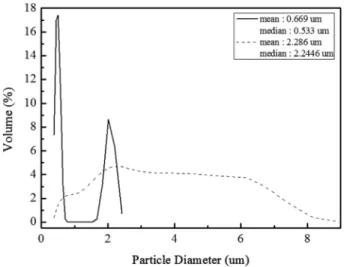
제조된 WO3 분말의 미세구조 형상을 Fig. 5에 나타 내었다. 분쇄공정을 동반한 열분해법으로 제조된 WO3에 서는 완전히 분쇄되지 않은 큰 입자들과 미립화된 입자 들이 불균일하게 존재하고 있었지만 화학침전법으로 제 조된 WO3 분말은 구형 형상을 지닌 입자들이 균일하게 분포되어 있음을 관찰할 수 있었다. Fig. 6의 입도분포 결과에서도 열분해법으로 제조된 WO3는 2 μm에서 6 μm 까지 구간에 입자가 분포되어 평균 입자크기로 ~2 μm 나 타내었지만, 화학침전법으로 제조된 WO3는 ~0.5 μm 이 하와 2 μm으로 입자가 분포되어 평균 입자크기로 ~0.6 μm 입자크기를 지니는 것으로 분석되었다. 화학침전법으로 제 조된 WO3에서 2 μm의 미세구조를 참고하였을 때 응집 된 입자들의 크기로 나타난 결과로 판단된다.
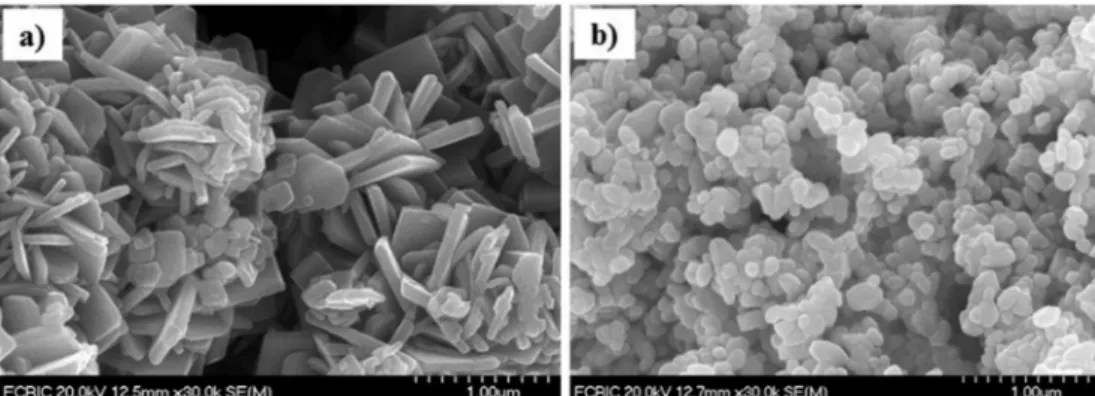
본 연구를 통해 제조된 WO3와 초경합금 제조에 이용 되는 중국산 WO3의 미세구조형상을 비교한 결과를 Fig.
7에 나타내었다. 상용화된 중국산 WO3는 판상 형태를 가 지며 화학침전법으로 제조된 입자보다 큰 입도를 나타 내었다. 구형의 입자가 균일하게 분포된 서브 마이크론 WO3 입자를 초경공구 제작 분말용으로 사용할 경우, WC/Co 초경의 소결성을 향상시킬 수 있을 것으로 판 단된다.
Fig. 5. FE-SEM micrographs of WO3 fabricated by thermal decomposition (a-1, a-2) and chemical precipitation (b-1, b-2).
Fig. 6. Particles size analysis of the WO3 fabricated by thermal decomposition (dot line) and chemical precipitation (solid line).
4. 결 론
본 연구에서는 초경스크랩의 재활용을 위해 입자크기 가 ~40 μm인 Up-cycling APT를 출발원료로 사용하여 열분해법과 화학침전법으로 WO3분말을 제조하고 이에 대 한 특성을 고찰하였다.
1) Up-cycling APT 분말은 열분해법 및 화학침전법으 로 각각 600oC/4h와 500oC/4h 열처리조건에서 제조하 였으며, 제조된 텡스텐 산화물 분말은 WO2.9의 블루텡 스텐이 아닌 노란색을 띠는 WO3임을 육안으로 확인하 였고 XRD분석에서는 공정법에 관계없이 WO3결정상이 형성됨을 확인하였다.
2) 열분해법 및 화학침전법으로 제조된 WO3의 순도는 대동소이하게 약 99.6 wt%임으로 분석되었으나, 열분해 법에서는 출발물질이 가진 불순물을 지속적으로 함유하 고 있는 반면, 화학침전법에서는 제조공정상 사용된 산 이 검출되어 수세조건의 필요성을 나타내었다.
3) 열분해법으로 제조된 WO3 분말의 입자크기는 ~2 μm임에 반하여 화학침전법으로 제조하였을 때는 ~0.6 μm 의 입자크기를 보였다. 이를 통해 분쇄공정에 의해서는 균일한 분말 미립화에 한계가 있으나, 화학침전법은 입 도 및 입자 형상 조절이 용이하였다. 따라서, 화학침전 법에 의한 WO3 합성은 대량 생산 공정과 미세가공용 초 경공구 제조 분말용에 매우 적합한 공정임을 확인할 수 있었다.
Acknowledgement
This work was supported by the grant No. R0002628 funded by the Korea government(Ministry of Trade, Industry & Energy).
References
1. B. F. Kieffer, Int. Tungsten Symposium Tungsten, 2d, San Francisco, June 1-5 (1982).
2. B. F. Kieffer, Int. J. Refract. Met. Hard Mater., 5, 65 (1986).
3. T. M. Latha and S. Venkatachalam, Hydrometallurgy, 22(3), 353 (1989).
4. E. Lassner, Int. J. Refract. Met. Hard Mater., 13(1-3), 35 (1995).
5. S. Venkateswaran, W-D. Schubert, B. Lux, M. Ostermann and B. Kieffer, Int J. Refract. Met. Hard Mater., 14(4), 263 (1996).
6. V. V. Malyshev and A. I. Gab, Theor. Found. Chem. Eng., 41(4), 436 (2007).
7. J. C. Lee, E. Y. Kim, J. H. Kim, W. B. Kim, B. S. Kim and B. D. Pandey, Int J. Refract. Met. Hard Mater., 29(3), 365 (2011).
8. A. K. Basu and F. R. Sale, J. Mater. Sci., 12(6), 1115 (1977).
9. S. A. A. Mansour, M. A. Mohamed and M. I. Zaki, Thermochim. Acta, 129(2), 187 (1988).
10. J. G. Lake and W. R. Ott, Thermochim. Acta, 32(1-2), 225 (1979).
11. M. S. Marashi, J. V. Khaki and S. M. Zebarjad, Int. J.
Refract. Met. Hard Mater., 30(1), 177 (2012).
12. A. O. Kalpakli, A. Arabaci, C. Kahruman and I.
Yusufoglu, Int. J. Refract. Met. Hard Mater., 37, 106 (2013).
13. T. M. Taylor, J. Am. Chem. Soc., 24(7), 629 (1902).
Fig. 7. FE-SEM micrographs of (a) commercial WO3 made in China and (b) WO3 by synthesized chemical precipitation.