제주도 단성화산의 분화량 계산과 화산재해 평가에 대한 예비연구
고보균1*·윤성효2
1고려대학교 이과대학 지구환경과학과, 2부산대학교 지구과학교육과
A Preliminary Study on Calculating Eruptive Volumes of Monogenetic Volcanoes and Volcanic Hazard Evaluation in Jeju Island
Bokyun Ko1* and Sung-Hyo Yun2
1Department of Earth and Environmental Sciences, Korea University, 145 Anam-ro, Seongbuk-gu, Seoul 02841, Korea
2Department of Earth Science Education, Pusan National University, 2, Busandaehak-ro 63beon-gil, Geumjeong-gu, Busan 46241, Korea
요 약: 제주도의 화산활동 규모를 파악하고 화산재해를 평가하기 위해 가장 최근에 분화한 단성화산 3개를 선택하여 화산 분화량을 계산하였다. 선택된 단성화산은 송악산 응회환, 비양도 분석구, 일출봉 응회구이며, 뉴질랜드의 오클랜드 화산지대에 적용된 모델을 사용하여 계산한 분화량은 각각 24,987,557 m
3, 9,652,025 m
3, 11,911,534 m
3이다. 이 분화량은 화구충진물, 응회환(응회구), 분석구, 그리고 용암류의 부피로 구성된다. 분화 량을 토대로 추정되는 화산폭발지수는 각각 3, 2, 3이며, 분화유형은 스트롬볼리식(Strombolian) 내지 써제이 식(Surtseyan)이고, 화산폭발지수와 화산이산화황지수의 상관관계를 이용한 이산화황 분출량은 2-8×10
3kt/y 로 추정된다. 제주도에 대한 최근 연대측정자료는 제주도에서 1만년 이내에 화산활동이 수차례 있었음을 보여주 며 앞으로의 화산활동 가능성을 지시하고 있다. 따라서 제주도의 분화 가능성을 고려한 연구가 충분히 수행 되어야 하고, 이를 토대로 화산재해를 평가하고 대비하는 시스템의 구축이 요구된다.
핵심어: 분화량, 오클랜드 화산지대 모델, 화산폭발지수, 화산이산화황지수, 화산재해, 제주도
Abstract:
Eruptive volumes of three monogenetic volcanoes (Songaksan tuff ring, Biyangdo scoria cone, and Ilchulbong tuff cone) with the youngest eruption age are calculated using the model, applied to Auckland Volcanic Field in New Zealand, to investigate the volcanic eruption scale and to evaluate volcanic hazard of Jeju Island. Calculated eruptive volumes of the volcanoes are 24,987,557 m3, 9,652,025 m3, and 11,911,534 m3, respectively, and the volumes include crater infill, tuff ring (tuff cone), scoria cone, and lava flow. Volcanic explosivity indices of Songaksan tuff ring, Biyangdo scoria cone, and Ilchulbong tuff cone are estimated based on the eruptive volumes to be 3, 2, and 3 respectively, and eruption type is Strombolian to Surtseyan. It is assumed that the amount of emitted sulfur dioxide gas is 2-8×10³kt/y according to the correlation between volcanic explosivity index and volcanic sulfur dioxide index. Recent age dating researches reveal evidences of several volcanic activities during the last 10,000 years indicating the possible volcanic eruption in Jeju Island in the near future. Therefore, it is necessary for appropriate researches regarding volcanic eruption of the island to be accomplished. In addition, establishment of the evaluation and preparation system for volcanic hazard based on the researches is required.Keywords:
Eruptive volumes, Auckland volcanic field model, volcanic explosivity index, volcanic sulfur dioxide index, volcanic hazard, Jeju Island*Corresponding author Tel: +82-2-887-6526
E-mail: [email protected]
144 고보균 · 윤성효
서 론
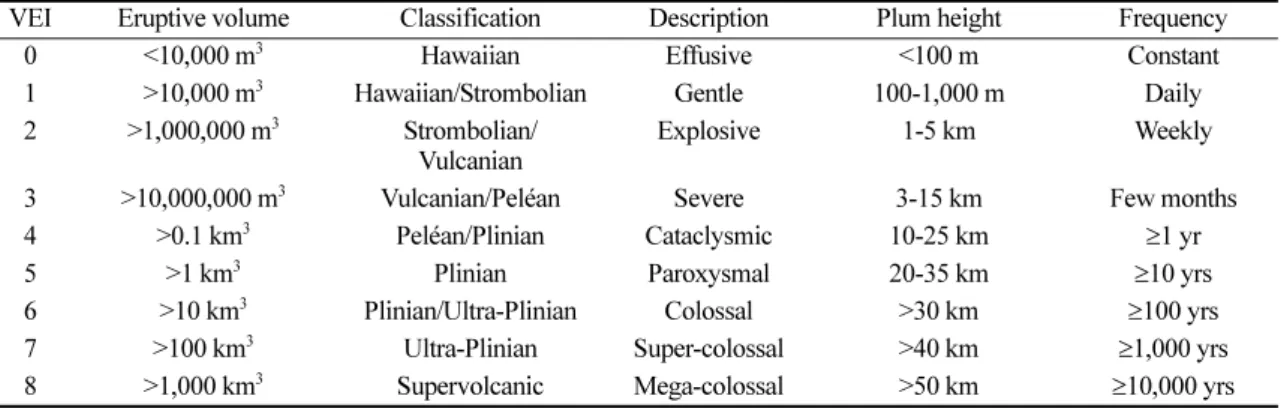
화산분화는 정확한 분화시기와 분화규모의 예측 및 대피시기와 피해범위 예보가 어렵기 때문에 위험도가 매우 높은 자연재해로 분류된다. 화산재해는 화산폭 발지수(volcanic explosivity index, VEI)로 표현되는 화산활동의 규모에 의해 평가되며, 화산폭발지수는 화 산 분화량과 분연주(eruption column)의 높이를 기준 으로 구분한다(Table 1, Newhall and Self, 1982).
그러므로 화산재해의 평가와 대응에 있어서 분화량 파악은 기본적이며 매우 중요한 요소이다.
현무암질 화산지대에는 흔히 다수의 단성화산 (monogenetic volcano)이 분포하며 시간과 공간적으로 분산된 화산활동 기록을 보인다(Walker, 1993). 단성 화산이 분포하는 현무암질 화산지대의 수명은 일반적 으로 매우 길어서(106-107 년, Kereszturi et al., 2013) 화산활동 이후의 침식 및 풍화작용 등에 의해 화산체 의 형태가 많이 파괴되므로 개개의 화산체 부피를 정 확히 측정하는 것은 어려운 작업이다. 따라서 화산체 의 형태를 정량화하고 분화량을 측정하기 위한 분화 량 계산 모델을 사용하는 것이 필수적인 조건이다.
제주도는 비교적 최근까지도 더 이상 화산활동을 하지 않는 지역으로 인식되어 화산재해의 가능성이 완전히 배재된 지역으로 간주되었었다. 그래서 제주 도에 대해 수행된 연구들은 주로 제주도의 형성사와 화산암의 지질학적 특징을 다루며, 제주도의 분화유 형이나 분화규모 및 화산재해에 대한 연구는 거의 이 루어지지 않았다. 하지만 최근 들어 연대측정기술의 발달과 심도 깊은 연구수행의 결과로 1만년 이내의 화산활동에 대한 증거가 다수 제시되었고(Sohn et al., 2002; Jeong et al., 2007; Kim et al., 2010;
Ahn, 2015), 이런 증거들은 앞으로 계속 발표될 것으 로 예상된다. 따라서 제주도는 더 이상 화산재해에 대해 안전하지 않은, 활동 가능성을 고려해야하는 화 산지역으로 분류되어야 하며, 이 지역에서의 화산재 해 평가 및 대책 수립을 위해 화산활동의 규모를 파 악하는 체계적인 연구 수행이 요구된다.
이 연구에서는 제주도 해안에 분포하며 야외지질조 사를 통해 최근에 분화한 것으로 추정되는 단성화산 3개(송악산 응회환, 비양도 분석구, 일출봉 응회구, Fig. 1)를 선정하여 뉴질랜드의 오클랜드 화산지대 (Auckland Volcanic Field, AVF) 분화량 계산 모델 (Kereszturi et al., 2013)을 적용시켜 분화량을 계산 하고, 이를 통해 화산폭발지수를 측정하여 이 단성화 산들의 화산활동 규모를 제시한다.
지질개요
제주도는 한반도에서 남쪽으로 약 90 km 떨어진 곳에 위치한 화산섬이며 해발 1950 m의 한라산을 중 심으로 남남서-북북동의 장축(약 70 km)과 약 35 km 의 폭을 지닌 타원형의 섬이다. 전체 면적이 1,848 km2이며, 본섬 외에도 10여개의 작은 부속 도서가 존 재한다. 제주도는 중생대 백악기의 화강암과 응회암 이 기반을 이루며 그 상부에 제3기의 퇴적층과 제4기 의 화산암이 분포하는 섬이다(Fig. 1). 화산암은 주로 용암류(lava flow)와 화성쇄설물(pyroclastic material) 로 구성되며, 이들의 재퇴적에 의해 형성된 퇴적물이 소규모 분포한다. 제주도에는 한라산 이외에도 ‘오름’
으로 명명된 작은 화산체들이 다수 분포한다. 지표에 서 관찰되는 오름은 약 450 개 정도이며, 이들 대부 분은 분석구(scoria cone 혹은 cinder cone), 응회환
Table 1. Volcanic explosivity index (Modified from Newhall and Self, 1982)
VEI Eruptive volume Classification Description Plum height Frequency
0 <10,000 m3 Hawaiian Effusive <100 m Constant
1 >10,000 m3 Hawaiian/Strombolian Gentle 100-1,000 m Daily
2 >1,000,000 m3 Strombolian/
Vulcanian
Explosive 1-5 km Weekly
3 >10,000,000 m3 Vulcanian/Peléan Severe 3-15 km Few months
4 >0.1 km3 Peléan/Plinian Cataclysmic 10-25 km ≥1 yr
5 >1 km3 Plinian Paroxysmal 20-35 km ≥10 yrs
6 >10 km3 Plinian/Ultra-Plinian Colossal >30 km ≥100 yrs
7 >100 km3 Ultra-Plinian Super-colossal >40 km ≥1,000 yrs
8 >1,000 km3 Supervolcanic Mega-colossal >50 km ≥10,000 yrs
(tuff ring), 응회구(tuff cone), 용암돔(lava dome), 소 순상화산(small shield volcano)으로 구성된다(Lee and Yun, 2012).
제주도의 화산활동은 약 1.8 Ma 전에 얕은 바다에 서 소규모의 수성화산분화(hydrovolcanic eruption)에 의해 시작되었으며 이와 동시에 서귀포층이 퇴적되었 다(Kim and Lee, 2000; Sohn and Park, 2004;
Sohn et al., 2008; Sohn and Yoon, 2010; Brenna et al., 2012a, 2012b). 약 0.5 Ma 전에 본격적인 육 상화산활동으로 전환되었으며, 현재 지표에 분포하는 단성화산들은 대부분 0.1 Ma 이후에 형성되었고(Koh et al., 2013), 역사시대까지 분출된 기록이 있다 (Won, 1976; Ahn, 2015).
연구방법
분화량 계산 모델
오클랜드 화산지대 모델은 단성화산을 다음의 6개 부 분으로 구분하여 분화량을 계산한다(Fig. 2, Kereszturi et al., 2013); (1) 화도충전암(diatreme), (2) 화구충
진물(crater infill), (3) 응회환(tuff ring), (4) 분석구 (scoria cone), (5) 용암류(lava flow), (6) 말단부테프 라(distal tephra). 분화량 계산 시 응회환, 분석구, 용 암류의 부피는 지표자료로 수치표면모델(digital surface model, DSM)이나 수치지형모델(digital terrain model, DTM) 또는 수치고도모델(digital elevation model, DEM) 자료를 이용함으로써 계산의 정확도를 향상시킬 수 있다.
분화량 계산
화도충전암은 분화의 유형과 규모에 따라 형태가 다양하게 나타나는데, 시추나 지구물리탐사를 통해 그 형태를 파악할 수 있다. 하지만 이러한 자료가 없을 경우에는 유사한 다른 화산의 자료를 이용하며 일반 적으로 상하가 역전된 원뿔 형태를 가정하여 계산하 는 것이 적절한 방법이다(Kereszturi et al., 2013).
h
simple
= rtop
/tanθ (1)V
simple
= 1/3πrtop
2hsimple
(2)여기서, h
simple
은 화도충전암 깊이, rtop
은 최소 화구Fig. 1. Geological map of Jeju volcanic island (modified from Park et al., 2000). Red circles indicate monogenetic
volcanoes for eruptive volume calculation. Scale for monogenetic volcanoes is 500 m.
146 고보균 · 윤성효
반경, θ는 화도충전암과 기반암과의 접촉각(0~90o),
V
simple
은 화도충전암 부피이다.화구충진물은 화도충전암 상부에 위치하며 상하가 역전된 원뿔의 아래부분이 절단된 형태를 가진다.
V
infill
= 1/3πhinfill
(rtop
2+ rtop
rbottom
+ rbottom
2) (3)r
bottom
= rtop
− (2tanβhinfill
) (4)여기서, V
infill
은 화구충진물 부피, hinfill
은 화구충진물 높이, rbottom
은 화구 바닥 반경이며, β는 화구벽의 각 도(0~90o)이다(Fig. 2).응회환과 분석구 및 용암류의 부피는 전통적인 방 법, 즉 현장에서 두께와 면적을 측정하여 계산하지만, 분화 이전의 표면에 대한 정확한 고도 정보가 확보되 면 수치표면모델과 수치지형모델, 그리고 수치고도모 델을 이용하여 더 정확한 값을 구할 수 있다.
V = ΣΔZ
i
xy (5)여기서, ΔZ
i
는 수치고도모델의 특정 위치 i에서의 층 의 두께(분화이전 지표와의 고도 차이)이고, x와 y는 i 지점의 수평좌표이다.Fig. 2. (A) Diagram of the volcano-sedimentary parts of a conceptualized monogenetic volcano for volume
estimation. (B) Methods applied for volume estimation from the different volcano parts (modified from Kereszturi et
al., 2013).
현무암질 화산지역의 테프라는 풍화와 식생에 의해 쉽게 파괴되기 때문에 정확한 분화량 계산에 많은 어 려움이 있다. 따라서 Sato and Taniguchi (1997)가 제안한 분화구 직경과 분화량의 상관관계를 이용한 식을 토대로 부피를 계산한다.
d
magmatic
= 0.11Vejecta
0.42 (6)d
phreatomagmatic
= 0.97Vejecta 0
.36 (7)여기서, d
magmatic
와 dphreatomagmatic
는 마그마와 수성마그마 의 평균 화구 직경이며, Vejecta
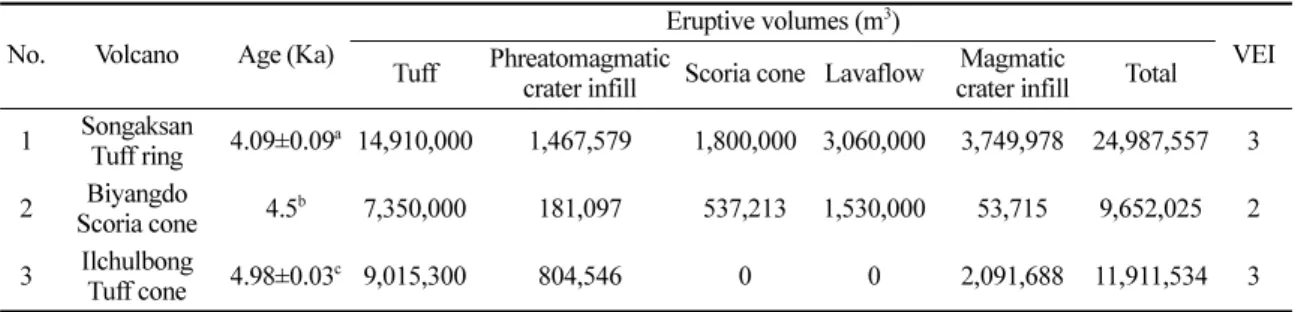
는 분화물의 부피이다.송악산응회환과 비양도분석구, 그리고 일출봉응회 구에 대한 분화량은 각각 24,987,557 m3, 9,652,025 m3, 11,911,534 m3이다(Table 2). 이 계산결과는 화구 충진물, 응회환(응회구), 분석구, 용암류의 분화량을 포함하며 화도충전암과 말단부테프라 값은 배제된다.
토 의
지하에 분포하는 화도충전암은 지표에 노출된 화산 체보다 더 큰 부피를 가지는 경우가 있기 때문에 (Lorenz, 1986; White and Ross, 2011) 화도충전암 의 부피에 대한 정확한 자료(시추자료나 지구물리탐 사자료 등)를 토대로 분화량을 계산하여야 한다. 하지 만 제주도의 화도충전암에 대한 연구는 Jeon et al.
(2013)가 유일하므로, 연구 대상 화산에 대한 분화량 계산에 화도충전암 자료를 포함시키는 것은 분화량에 대한 불확실성을 상당히 증가시킬 수 있다. 또한 말 단부테프라도 침식과 재퇴적으로 인해 신뢰할 만한 계산치를 얻기 어렵고 분석구 기저부(scoria cone base)도 지하에 분포하므로 이들에 대한 부피는 고려 하지 않았다. 따라서 이 계산치는 분화량에 대한 최
소치로 볼 수 있으며, 더 정확한 측정을 위해 추가적 인 조사가 요구된다.
일출봉응회구는 분화 당시에 생성된 분석구와 용암 류가 분포하지 않는 반면, 송악산응회환은 다양한 분 출유형 과정을 통해 복합적인 화산체를 형성하였기 때문에 응회암 외에도 분석구와 용암류가 분포하는 특징을 보인다(Hwang et al., 1992, 2001; Hwang, 2000; Sohn et al., 2002).
계산된 분화량을 토대로 추정되는 세 화산의 화산 폭발지수는 각각 3, 2, 3이다(Tables 1 and 2). 이들 의 분화유형은 스트롬볼리식(Strombolian) 내지 써제 이식(Surtseyan)에 해당되며(Fig. 3), 갈레라스(Galeras, 1993, 콜럼비아, VEI 2), 시나붕(Sinabung, 2010, 인 도네시아, VEI 2), 수프리에르힐스(Soufrière Hills, 1995, 카리브해 몬트세랫섬, VEI 3), 나브로(Nabro, 2011, 에티오피아와 에리트레아의 국경, VEI 3) 등과 동일한 화산폭발지수를 가진다. 분연주의 높이와 폭
Table 2. Calculated eruptive volumes of three monogenetic volcanoes in Jeju Island
No. Volcano Age (Ka)
Eruptive volumes (m3) Tuff Phreatomagmatic VEI
crater infill Scoria cone Lavaflow Magmatic
crater infill Total 1 Songaksan
Tuff ring 4.09±0.09a 14,910,000 1,467,579 1,800,000 3,060,000 3,749,978 24,987,557 3 2 Biyangdo
Scoria cone 4.5b 7,350,000 181,097 537,213 1,530,000 53,715 9,652,025 2 3 Ilchulbong
Tuff cone 4.98±0.03c 9,015,300 804,546 0 0 2,091,688 11,911,534 3
a
Sohn et al. (2002);
bAhn (2015);
cCheong et al. (2006).
Fig. 3. Eruption types of volcano (modified from Cas
and Wright, 1987). The area above the dashed line is
for hydrovolcanic eruptions.
148 고보균 · 윤성효
발력이 비교적 소규모인 것으로 보이지만, 아이슬란 드의 에이야피야들라이외퀴들(Eyjafjallajökull) 화산의 2010년 분화의 화산폭발지수가 4인 것을 감안할 때, 제주도에 화산폭발지수 3 정도의 화산분화가 발생하 면 화산재해에 대한 인식과 대비 부족으로 큰 피해가 초래될 수 있다.
화산재해 중에서 화산가스에 의한 재해가 있는데, 여러 종류의 화산가스 중에서 이산화황(sulfur dioxide, SO2)에 의한 피해가 가장 심각하다. 이산화황은 생물 체에 직접적인 피해를 줄 뿐만 아니라 대기환경의 변 화에 민감하게 작용하기 때문에 화산에서 분출된 이 산화황 가스에 대한 연구가 다수 수행되었다(Bluth et al., 1993; Pyle et al., 1996; Schnetzler et al., 1997;
Halmer et al., 2002). 화산폭발지수는 분화량과 분연 주의 높이만을 고려하기 때문에 화산폭발지수로 화산 활동의 규모는 파악할 수 있지만, 이산화황에 의한 화산재해의 정도를 직접 평가할 수 없다. 따라서 화산 폭발지수와 화산이산화황지수(volcanic sulfur dioxide index, VSI)의 상관관계에 대한 연구(Schnetzler et al., 1997; Halmer et al., 2002)를 통해 이산화황의 분출량을 파악할 수 있다. 이 연구에서는 화산을 지 구조 환경에 따라 섭입대에 분포하는 화산과 그 외 지역의 화산으로 구분하며, 판내부 환경에 해당되는 제주도에 화산폭발지수 3의 분화가 발생할 때 분출되 는 이산화황의 양은 2-8×10³kt/y로 추정할 수 있다.
미국의 스미소니언 연구소(Smithsonian Institution) 의 global volcanism program(GVP)은 과거 1만년 동안 분화의 기록이 있었던 화산을 활동성 화산으로 간주하고 이들의 화산활동 양상을 관측하고 있다. 제 주도에 대한 최근의 연구결과는 1만년 이내에 화산활 동이 있었음을 지시하고 있으며, 이는 제주도에서 화 산활동의 가능성이 있음을 시사한다. 따라서 제주도 는 더 이상 화산재해에 대해 안전하지 않은 곳으로 분류되어야 하며, 화산재해 평가 및 대책 수립을 위 한 기본적이고 필수적인 자료 수집 및 연구 수행이 요구된다.
결 론
제주도의 화산활동 규모를 파악하기 위해 가장 최 근에 분화한 3개의 단성화산(송악산 응회환, 비양도 분석구, 일출봉 응회구)을 선택하여 화산 분화량을 계산하였다. 오클랜드 화산지대 모델을 적용하여 계
산한 분화량은 각각 24,987,557 m3, 9,652,025 m3, 11,911,534 m3이고, 분화량을 토대로 추정되는 화산폭 발지수는 각각 3, 2, 3으로 계산되었으며, 이들의 분 화유형은 스트롬볼리식 내지 써제이식이다. 화산폭발 지수와 화산이산화황지수의 상관관계를 이용한 이산 화황 분출량은 2-8×10³kt/y로 추정된다. 최근의 연구 결과는 과거 1만년 이내에 제주도에서 화산활동이 수 차례 있었음 지시하며, 앞으로 더 많은 증거가 발표 될 가능성이 있다. 따라서 제주도는 사화산 지역이 아닌 활동 가능성이 있는 화산지대로 분류되어야 하 며, 제주도에 대한 화산재해 평가 및 대책 수립이 요 구된다.
사 사
본 연구는 정부(국민안전처)의 재원으로 자연재해 저감기술개발사업단의 지원을 받아 수행된 연구 [MPSS-자연-2015-81]이다. 본 논문의 심사를 위해 시 간과 노력을 할애해 주신 편집위원과, 본 논문을 읽 고 건설적인 비평을 해주신 심사위원 길영우 교수와 최은경 박사께 감사드린다.
References