https://doi.org/10.15204/jkobgy.2017.30.1.042
국내에서 수행된 난임 관련 한의학 치료 임상연구 경향 고찰
1 강남자생한방병원 한방부인과, 2 동국대학교 한의과대학 한방부인과학교실
3 경희대학교 한의과대학 한방부인과학교실 소민지 1 , 이윤재 1 , 김수현 2 , 장준복 3 , 황덕상 3 , 김동일 2
ABSTRACT
Trends Analysis of Clinical Studies on Korean Medicine for Infertility Min-Ji So 1 , Yoon-Jae Lee 1 , Su-Hyun Kim 2
Jun-Bock Jang 3 , Deok-Sang Hwang 3 , Dong-Il Kim 2
1 Dept. of Korean Obstetrics & Gynecology, Gangnam Ja-Seng Hospital of Oriental Medicine
2 Dept. of Korean Medicine Obstetrics and Gynecology, College of Korean Medicine, Dong-Guk University
3 Dept. of Korean Medicine Obstetrics and Gynecology, College of Korean Medicine, Kyung-Hee University
Objectives: This study were investigated clinical studies published in international and Korea’s journals to assess the effect of Korean Medicine for infertility.
Methods: PubMed and Oriental Medicine Advanced Searching Integrated System (OASIS) were searched for this review up to Nov 2016.: using terms of ‘infertility' and ‘subfertile’.
Results: Fifty clinical studies were finally selected. All studies were assessed as the noncomparative studies, and mainly case reports. The year of publication of literatures was the highest at from 2011 to 2015, accounted for 44%. Among 50 studies, there were 5 studies on males, 43 studies on females and 2 studies on both male and female.
The number of subjects varies from 1 to 1277. The number of studies with subjects less than 10 was the greatest. Of all the studies, only three were institutional review board (IRB) approved. There were 9 studies that indicated whether the grant was supported. The duration of treatment was between 30 and 360 days, and most cases were within 180 days. Intervention methods were 100% for herb medicine, 40% added on acupuncture, and 29% added on moxibustion.
Conclusions: Further clinical trials of well designed is needed to accumulate enough information to establish the evidence for Korean Medicine for infertility.
Key Words: Infertility, Clinical Study, Medicine, Korean Traditional
4)
“본 연구는 보건복지부의 재원으로 한국보건산업진흥원의 보건의료기술연구개발사업 지원에 의하여 이루어진 것임(과제고유번호 : HI15C0169).”
“This research was supported by a grant of the Korea Health Technology R&D Project through the Korea Health Industry Development Institute (KHIDI), funded by the Ministry of Health & Welfare, Republic of Korea (grant number : HI15C0169)”
Corresponding author(Deok-Sang Hwang) : Dept. of Korean Medicine Obstetrics and Gynecology, College of Korean Medicine, Kyung Hee University, 1 Hoegi-dong, Dongdaemun-gu, Seoul, Korea
Tel : 02-958-91601 E-mail : [email protected]
Corresponding author(Dong-Il Kim) : Dept. of Korean Medicine Obstetrics and Gynecology, Dongguk
Ⅰ. 서 론
한국은 2015년 기준 합계 출산율 1.239 명으로 OECD 회원국의 2012년 평균 합 계출산율 1.74명과 많은 차이를 보이는 저출산 국가이다 1) . 저출산과 고령화로 인해 한국은 빠르게 초고령 사회로 진입 하고 있다. 이러한 현상의 원인으로는 사회경제적인 상황으로 인한 결혼과 출 산 기피 현상 등도 있으나, 결혼 연령 및 임신 시도 연령이 높아지면서 이에 따른 난임의 증가도 또한 원인으로 지적되고 있다 2) .
대한민국에서는 2006년부터 난임부부 국가 지원사업이 시행되고 있으며 난임 국가 지원 사업에서는 시험관 아기와 인 공수정이 포함된다. 체외수정 시술비 지 원에 의한 출생아수는 2008년 4,535명에 서 2013년에는 14,346명으로 지속적으로 증가 추세를 보이고 있으며 우리나라 출 산율 증가에 기여한다고 볼 수 있다 3) .
그러나 난임 대상 한의학 치료는 국가 지원이 없는 상황으로, 한의학 치료에 대한 남임 부부들의 요구가 많아지면서 지역자체단체에서의 지원 사업들이 많아 지고 있다. 최근 들어 그러한 지원 사업 들의 결과 보고를 종합하여 조 등 4) 이 발 표된 바 있으며, 한의학 치료 난임 지원 사업도 좋은 결과를 보이고 있음을 알 수 있다.
난임 관련 국가 지원과 임상에서 난임 관련 진료가 좀 더 활발하게 이루어지기 위해서는 많은 근거가 확보되어야 하며 실제 임상에서 시행되고 있는 임상 자료 들이 체계적으로 분석되고 그 효과가 보 고되어야 한다. 하지만 관련된 근거들의
출판이 많지 않으며, 또한 증례 위주의 보고가 대부분이기 때문에 기존의 출판 된 연구들의 근거수준은 매우 낮은 결과 를 보이고 있다.
최근 난임 관련 임상연구 출판이 늘고 있는 만큼 최신 연구 동향에 대해 살펴 보고, 현재까지 국내 한의학에서 이루어 지고 있는 난임 관련 한의학 치료에 대 한 근거를 확립, 정리하고 그에 대한 향 후 임상연구에 대한 제언을 시행하고자 하였다.
2013년에 양 등 5) 이 불임 관련 국내 한 의학 임상연구 동향을 분석한 바 있으 나, 난임의 한의학 치료 관련 출판이 최 근에 더욱 많아지고 있으며, 국내 한의 학 관련 근거가 국제학술지에 발표되는 경우도 많아지고 있다. 그러므로 국내학 술지 뿐만 아니라 국외학술지에 출판된 임상 문헌들을 함께 검색 및 분석하여 난임 관련 한의학 치료에 대한 좀 더 많 은 근거에 대해 체계적으로 검토하고자 하였다.
Ⅱ. 방 법
1. 연구대상
국내외에 발표된 국내수행 한의 난임 치료 임상논문을 대상으로 하였다.
2. 검 색
국내 검색 데이터베이스로는 OASIS를
활용하였다. 민감도 높은 검색 수행을
위해서 “난임”, “불임”, “infertility" 등의
검색어를 주로 활용하였으며, 국외에 출
판된 한국의 한의학 난임 관련 임상연구
를 파악하기 위해서 PubMed 검색을 수
행하였다. 주요 검색어로는 MeSH term 으로 “infertility", “subfertile", “Medicine, Korean Traditional" 등을 활용하였다. 일 차검색은 2015년 11월 5일에 수행하였고, 최근 문헌을 확인하기 위해 2016년 11월 5일에 추가적인 검색을 실시하였다.
2. 선택배제
여성 난임 및 남성 난임 환자를 대상 으로 한의학 치료를 시행하여 임신 관련 결과를 보고한 모든 임상 문헌을 대상으 로 하였으며 발표년도에 제한을 두지 않 았다. 한의학 치료는 한약, 침, 뜸, 약침, 부항, 좌훈 등 한의학 치료로 볼 수 있는 것은 모두 포함하였고 복합치료도 포함 하였다. 단, 실험연구는 제외하였으며, 진 단이나 변증 관련 특성만 보고한 연구는 제외하였다. 또한 한의학 치료 중재로 인 한 효과 보고가 아닌, 난임 관련 결과가 없 고 특성 보고 및 설문조사 보고만 있는 문 헌은 제외하였다. 이 밖에도 peer review 를 받지 않은 컨퍼런스, 초록 등은 배제 하였으며, 영어나 한국어로 출판되지 않 은 문헌 및 한국에서 시행되지 않은 연 구는 배제하였다.
3. 추출 및 분석
상기 기준을 만족시키는 문헌들을 두 명의 연구자가 독립적으로 선택, 배제하
였으며 원문을 검토하여 최종적인 포함 여부를 결정하였다. 검토된 원문을 사전 에 정해진 추출형식에 맞춰 연구에서의 중재종류, 연구디자인, 치료지속기간, 추적 관찰기간, 대상 환자, 결과지표(outcomes), 연구에서의 결과, 연구 지원 기관 언급 여부 등에 대해 추출하였으며, 그 결과 를 분석하였다.
Ⅲ. 결 과
1. 검색된 문헌의 분류
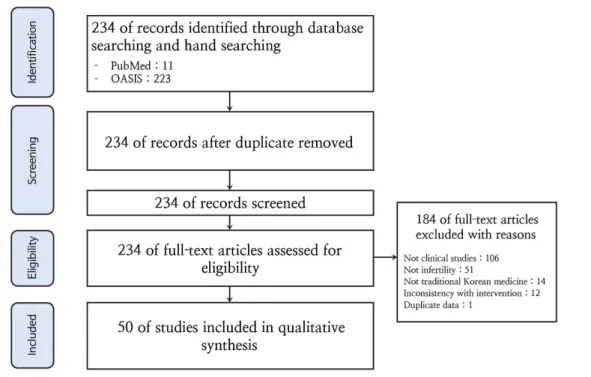
일차 검색 및 추가 검색에서 234개의 논문이 검색되었다. 정확한 분석을 위해 234개의 모든 원문을 보고 선택 배제를 시행하였다. 이 중 문헌연구 및 실험연 구 등을 제외하였고, 난임 환자가 아닌 연구를 제외하였다. 또한 중재방법으로 한의학 치료를 사용하지 않은 경우 등을 제외하였으며, 실태분석이나 문헌조사, 설문조사, 진단관련 연구는 제외하였다.
난임에 대한 한의학 치료 효과를 보고한 임상 문헌 50편이 최종 분석에 포함되었 다. 이 50편을 분석하여 한국에서의 난 임 연구동향을 파악하고자 하였다(Fig. 1).
2. 국내 난임 임상 연구 분석 결과
포함된 50편의 연구 특성은 Table 1에
제시되었다.
Fig. 1. Flowchart of searching and analysis.
Author, year Sex of
patients No*. of
patients Intervention Outcome
1 Gang, 1988 6) Female 1277 Herb medication Pregnancy
2 Yang et al, 1984 7) Female 98 Herb medication Pregnancy
3 Kim, 1991 8) Female 26 Herb medication Pregnancy
4 Kim et al, 1994 9) Female 140 Herb medication Pregnancy
5 Park, 1997 10) Female 5 Herb medication+moxibustion Pregnancy 6 Kim et al, 1998 11) Female 1 Herb medication+acupuncture Ectopic pregnancy 7 Kim et al, 2000 12) Female 1 Herb medication+electroacupuncture
+moxibustion Pregnancy
8 Choi et al, 2001 13) Female 29 Herb medication Pregnancy, birth 9 Moon et al, 2001 14) Female 56 Herb medication (with IVF † ) Clinical pregnancy 10 Go et al, 2001 15) Female 18 Herb medication (with IVF) Pregnancy, No. of oocystes,
No. of embryos 11 Song et al, 2002 16) Female 5 Herb medication+cupping+lipodren Pregnancy, birth 12 Kim et al, 2002 17) Female 21 Herb medication Pregnancy, ovulation (BBT ‡ )
13 Seo et al, 2003 18) Female 2 Herb medication Pregnancy
14 Hwang et al, 2004 19) Female 1 Herb medication Pregnancy, birth, hormone 15 Jung et al, 2004 20) Male 1 Herb medication+ear acupuncture
+lipodren Pregnancy, semen analysis 16 Kwon et al, 2005 21) Male 25 Herb medication Semen analysis 17 Lee, 2005 22) Female 1 Herb medication+acupuncture
+cuppping+lipodren Pregnancy, birth 18 Jo et al, 2005 23) Female 1 Herb medication Pregnancy, birth 19 Jung et al, 2005 24) Female 1 Herb medication+acupuncture
+moxibustion+pharmacopuncture Pregnancy 20 Jang, 2006 25) Female 56 Herb medication Pregnancy, birth
21 Son, 2006 26) Female 7 Herb medication Pregnancy
22 Jeong et al, 2007 27) Female 1 Herb medication+acupuncture
(with IVF) Pregnancy, birth
Table 1. Characteristics of Included Studies
23 Shin et al, 2008 28) Female 1 Herb medication+acupuncture
+moxibustion+cupping (with IVF) Pregnancy, birth 24 Lee et al, 2009 29) Female 28 Herb medication1 FSH, menstrual cycle
25 Lim, 2010 30) Female 1 Herb medication Pregnancy
26 Wee et al, 2010 31) Female 1 Herb medication+moxibustion
+pharmacopucnture+ear acupuncture Pregnancy, birth 27 Lee et al, 2010 32) Female 15 Herb medication Pregnancy, No. of oocytes,
No. of embryos, quality of embryos
28 Park et al, 2010 33) Female 104 Herb medication+acupuncture
+moxibustion Pregnancy, birth, adverse event
29 Park et al, 2011 34) Female 38 Herb medication+acupuncture +ear acupuncture (with IVF)
Pregnancy (biochemical, clinical), miscarriage, ectopic
pregnancy, satisfaction 30 Jang et al, 2011 35) Female 1 Herb medication (with IVF) Pregnancy, birth 31 Cho, 2012 36) Both 2 Herb medication+acupuncture
+moxibustion (with IVF) Pregnancy, birth, hormone 32 Ahn et al, 2013 37) Female 32 Herb medication+electroacupuncture
+moxibustion
Pregnancy, live birth, miscarriage, multiple
pregnancy 33 Kim et al, 2013 38) Female 171 Herb medication+acupuncture
+moxibustion Pregnancy, miscarriage, adverse events 34 Cho et al, 2014 39) (a) Female 6 Herb medication+acupuncture
(one with IVF) Pregnancy, satisfaction 35 Cho et al, 2014 40) (b) Female 1 Herb medication+acupuncture
+moxibustion Pregnancy
36 Lee et al, 2014 41) Female 975 Herb medication+acupuncture
+moxibustion+cupping Pregnancy, birth, miscarriage 37 Jang et al, 2014 42) Female 1 Herb medication+acupuncture
+moxibustion Clinical pregnancy, birth
38 Yun, 2014 43) Female 3 Herb medication Pregnancy
39 Koh et al, 2015 44) Female 2 Herb medication Pregnancy
40 Cho, 2015 45) Female 20 Herb medication+acupuncture
(one with IVF) Pregnancy, satisfaction 41 Lee et al, 2015 46) Female 1 Herb medication+acupuncture
+moxibustion Pregnancy
42 Kwon et al, 2015 47) Female 1 Herb medication+moxibustion
+acupuncture Pregnancy, birth 43 Nam et al, 2015 48) Both 40 Herb medication+acupuncture
+moxibustion Pregnancy, birth, satisfaction 44 Moon et al, 2015 49) Female 4 Herb medication+acupuncture
+moxibustion (with IVF) Clinical pregnancy, birth 45 Jo et al, 2015 50) Male 1 Herb medication+acupuncture
+bee venom Semen analysis
46 Jeong et al, 2015 51) Female 34 Herb medication+acupuncture
+moxibustion Pregnancy, live birth, AMH, hormone 47 Bae et al, 2015 52) Female 61 Herb medication+acupuncture
+moxibustion (with IVF) Pregnancy, live birth, miscarriage 48 Jo et al, 2016 53) (a) Male 2 Herb medication+acupuncture Semen analysis, pregnancy 49 Jo et al, 2016 54) (b) Female 22 Herb medication+acupuncture AMH
50 Jo et al, 2016 55) (c) Male 2 Herb medication+acupuncture
+bee venom Scrotal thermoregulation
*No : numbers