207
Journal of Food Hygiene and Safety
Available online at http://www.foodhygiene.or.kr
pISSN 1229-1153 J. Fd Hyg. Safety Vol. 29, No. 3, pp.207~210 (2014)
http://dx.doi.org/10.13103/JFHS.2014.29.3.207
영유아를 대상으로 한 유통식품 중 Bacillus cereus 오염실태 연구
박민정*·홍해근·손종성·권연옥·임영식·이현호·김구환 경기도보건환경연구원북부지원
A Study on the Contamination of Bacillus cereus in Baby Food on the Online Market
Park Min-jung*, Hong Hae-geun, Son Jong-seong, Kwon Yeon-ok, Lim Young-sik, Lee Hyun-ho, and Kim Gu-hwan Gyeonggi-do Institute of Health and Environment, North Branch
(Received May 24, 2014/Revised June 10, 2014/Accepted September 2, 2014)
ABSTRACT - Bacillus cereus is food poisoning bacteria frequently occured in starch food. Most of the delivery foods for infant is classified as ready-to-cook food. But unlike food for infant and young children, there are no stan- dards and specifications of Bacillus cereus in ready-to-cook food. The purpose of this study is to examine the presence of Bacillus cereus, aerobic bacteria and coliforms in the food for infant and young children sold through internet. B.
cereus was detected in 9 samples (8.3%), total aerobic bacteria was detected over 106CFU/g in 4 samples and coliforms were not detected in any samples. This will provide basic data for standards and specifications of Bacillus cereus in ready-to-cook food.
Key words : Bacillus cereus, Bacillus thuringiensis, Food for infant and young children, Ready-to-cook food
생활수준이 향상되고 맞벌이 가구가 증가하는 등 사회 구조 변화에 따른 식생활 양식의 변화로 간편하게 섭취할 수 있는 편의식품과 ready-to-eat-food의 개발과 소비가 증 가하고 있다1). 또한 영유아 자녀에게 이유식을 직접 만들 어 먹이기 어려운 여성을 위해 조리된 이유식을 집으로 배달해주는 이유식 판매업체가 다수 등장하고 있고, 시장 규모도 점차 확대되고 있다. 이러한 업체들은 홈메이드 방 식을 강조하며 영유아를 위한 위생과 안전성 등을 내세우 고 있다. 그러나 다양한 식재료를 사용하고 보존제 등을 첨가하지 않아 제조 또는 배달과정에서 미생물에 노출될 경우 쉽게 변질·부패될 수 있어 철저한 위생관리가 필수 적이다2).
Bacillus cereus는 토양 및 야채, 곡류, 우유 등 식품 원 료에서 흔히 발견되는 그람양성균으로 대부분의 식품 가 공처리 과정에서도 생존 가능한 포자 형성균이다3-4). B.
cereus는 사람에게 설사형 및 구토형의 두 가지 유형의 식 중독을 일으킨다5-6). 설사형 식중독은 B. cereus가 소장에 서 성장하는 동안에 생산되는 enterotoxin에 의해 발생하
며7)단백질이 포함된 식육 제품이나 채소스프, 소스, 푸딩 등의 식품에서 주로 발생한다. 또한 구토형 식중독의 원 인독소는 식품에서 B. cereus가 영양세포상태로 성장하거 나 발아하는 동안에 생산된 독소로 쌀, 파스타, 국수 등을 튀기거나 조리한 전분질 식품에 의해서 발생한다8).
배달 이유식과 어린이 반찬류의 대부분은 식품유형이 즉 석조리식품으로 되어 있으며 최근 기타 영·유아식으로 바뀌어가는 추세이다. 기타 영·유아식에는 B. cereus의 기준이 1 g 당 100 이하로 관리되고 있으나 즉석조리식품 에는 B. cereus의 기준이 없는 실정이다. 본 연구에서는 인 터넷에서 판매되는 배달이유식을 중심으로 일반세균, 대 장균군, B. cereus의 오염실태를 조사하였으며 B. cereus의 설사유발 독소 유전자 및 구토유발 독소유전자 분포를 파 악하였다.
재료 및 방법
재료
본 연구에 사용된 검체는 인터넷에서 판매되고 있는 배 달이유식 및 영유아용 반찬 106건을 구입하여 사용하였다.
식품유형별로 구분하면 기타 영·유아식 27건, 즉석조리 식품 79건이었다.
*Correspondence to: Park Min-jung, Gyeonggi-do Institute of Health and Environment, North branch, 1, Cheongsa-ro, Uijeongbu-si, Gyeonggi-do 480-764, Korea
Tel: 82-31-8030-5923, E-mail: [email protected]
208 Park Min-jung, Hong Hae-geun, Son Jong-seong, Kwon Yeon-ok, Lim Young-sik, Lee Hyun-ho, and Kim Gu-hwan
검체의 전처리
식품공전9)에 따라 검체 25 g을 무균적으로 취하여 멸균 인산완충액 225 mL를 가하여 stomacher (Bag Mixer 400, interscience, France)로 균질화한 후 시험용액으로 하였다.
대장균군 및 일반세균수 측정
일반 세균수는 시험용액 1 mL와 10배 단계 희석액 1 mL 씩을 멸균 페트리접시 2매에 무균적으로 취하여 Plate count agar (Difco, France)를 무균적으로 분주하고 검체와 배지 를 잘 혼합하여 응고시킨 후 배지를 중첩시켜 확산집락의 발생을 억제시킨 다음 35~37oC에서 24~48시간 배양하여 1개 평판 당 30~300개의 집락을 생성한 평판을 택하여 g 당 집락수를 계산하였다.
대장균군은 시험용액 1~0.1 mL를 2개씩 Brilliant Green Lactose Bile Broth (Oxoid, England)에 가하여 35~37oC에 서 48 ± 3시간 배양한 후 가스 발생여부를 확인하였다.
Bacillus cereus의 동정 및 정량
시험용액의 단계별 희석용액 0.2 mL씩 5장을 도말하여 총 접종액이 1 mL이 되게 한 후 30oC에서 24 ± 2시간 배 양한 후 집락 주변에 lecithinase를 생성하는 혼탁한 환이 있는 분홍색 집락을 계수하였다. 이 전형적인 집락을 선 별하여 Tryptic soy agar (Oxoid, England)에 도말하여 API 50CHB와 API 20E test kit (bioMerieux, France)를 이용한 생화학 시험을 하여 동정하였다. 또한 독소유전자를 확인하 기 위해 Bacillus cereus 6-toxin detection kit (Kogenebiotech, Korea)를 사용하여 PCR하였으며 B. cereus와 B. thurin- giensis를 구분하기 위해 Bacillus cereus detection (Bc/Bt distinguish) PCR kit (Jinsungunitech, Korea)를 사용하여 PCR하였고 0.5% basic fuchsin을 이용하여 현미경으로도 확인하였다.
결과 및 고찰
일반세균수 및 대장균군
이유식 106건의 세균수 검사결과 균이 검출되지 않은 것부터 최대 1.1 × 10⁶CFU/g까지 검출되었다. 기타 영·
유아식에서는 12건(44%)에서 최대 2.5 × 10³CFU/g, 즉석 조리식품에서는 46건(58%)에서 최대 1.1 × 10⁶CFU/g으로 대체적으로 즉석조리식품에서 세균수가 많이 검출되었다 (Table 1). 특히 즉석조리식품 중 4건에서는 세균수 기준 인 105CFU/g을 초과하였다.
대장균군은 106건 모두에서 검출되지 않았다.
B. cereus 분리 및 동정
106건의 검체 중 총 9건에서 B. cereus가 10~3.6 × 10³ CFU/g 범위로 검출되었다(Table 2).
B. cereus가 검출된 제품은 모두 즉석조리식품이었으며 이는 상대적으로 미생물기준이 엄격하지 않아서인 것으로 보인다. 기준이 100 CFU/g 이하로 설정되어 있는 기타 영·
유아식과 달리 즉석조리식품에서는 B. cereus의 기준이 설 정되어 있지 않아 잠재적 위험성이 큰 것으로 판단되며, 추가적인 조사 연구를 통해 B. cereus의 기준을 마련하여 야 할 것으로 판단된다. 배달 이유식은 면역력이 취약하 고 성장기 영양관리가 중요한 영유아가 주식으로 이용하 고 있는 식품인 만큼 기타·영유아식 등으로 허가하여 관 리하는 것도 좋은 방법이라고 하겠다.
B. cereus 독소유전자 분포
즉석조리식품으로부터 분리된 총 9주에 대한 B. cereus 의 독소유전자 분석결과는 Fig. 1에 나타내었다. Cytotoxin K (CytK)는 cytotoxin protein 생산 B. cereus로부터 분리 되었으며, S. aureus의 α-hemolysin과 C. perfringens의 β- toxin의 구조와 유사한 것으로 알려져 있다. cytK 독소유 전자에 대한 PCR 검출 결과 6주(66.6%)에서 585bp의 증 폭밴드를 확인할 수 있었다. Nonhemolytic enterotoxin 중 nheA의 PCR 실험결과 8주(88.9%)에서 475bp의 증폭밴드 를 확인할 수 있었다. 식중독과 관련해 어떠한 역할을 하 는지 아직 알려져 있지 않은 entFM은 8주(88.9%)에서 각 각 와 360~400bp의 밴드를 확인할 수 있었다. B. cereus가 생산하는 설사독소 중 가장 대표적인 독소유전자인 bceT 는 PCR 결과 7주(77.8%)에서 303bp의 증폭밴드가 나타났 으며 이러한 결과는 Kim 등10)이 김밥과 떡으로부터 분리 한 균주에서 62.5%의 검출빈도를 나타냈다고 보고한 것 보다 다소 높은 경향을 보였다. Hemolysine BL 유전자 중 hblC는 3주(33.3%)에서 195bp의 증폭밴드를 확인할 수 있 었다. 이 결과는 Kim 등10)의 결과보다 낮은 검출율을 보 였으나 Heinrichs 등11)이 분리균주 중 31%가 hbl을 보유 한다고 보고한 것과 유사하였다. 구토독소인 cer은 cereulide 를 생성하는 유전자 중 일부로 알려졌고 4개의 아미노산 Table 1. Detection rate of total aerobic bacteria and B. cereus in infant food
Food type Food for infant and young children
Ready-to- cook food No. of detected samples
/total samples 12/27 46/79
Detection rate (%) 44 58
Table 2. Detection rate of B. cereus in infant food Food type Food for infant and
young children
Ready-to- cook food No. of detected samples
/total samples 0/27 9/79
Detection rate (%) 0 11
A Study on the Contamination of Bacillus cereus in Baby Food on the Online Market 209
또는 oxy-acid의 삼반복 고리구조로 이루어져 있다. 구토 독소는 126oC로 90분간 가열하여도 파괴되지 않는 열저 항성과 산, 알칼리, 단백질 가수분해효소에도 저항성을 가 지고 항체를 형성하지 않아 쉽게 질병을 일으킨다. cer은 2주(22.2%)에서만 증폭밴드가 나타났다. 이는 Jeon 등12)이 쌀밥에서 분리한 B. cereus 균주에서 9개 중 7개가 구토 형 식중독 유발 유전자만을 가지고 있다고 보고한 것과는 상반되나 다른 연구자의 보고13-14)에 의하면 생쌀에서 분 리한 94개의 B. cereus에서 단 한 균주도 구토독소를 생 산하지 못했고, 즉석섭취식품에서 분리된 40개의 B. cereus 중에서 단 한 개 균주만 구토독소를 생산하고 있었다.
B. cereus 및 B. thuringiensis 선별 동정
B. thuringiensis는 식중독균으로 지정되어 있지 않으나 식중독균인 B. cereus와 생화학적 및 유전적으로 매우 유 사하여 구분이 쉽지 않다. 현재 두 균주를 구분하는 일반 적인 방법으로 B. thuringiensis에만 있는 결정체독소(Cry toxin, insecticidal toxin)15-16)의 존재 유무를 광학현미경이 나 전자현미경으로 관찰하는 방법이 주로 사용되고 있다.
B. thuringiensis에서 포자형성을 유도하여 결정체독소의 존
재를 광학현미경으로 관찰하는 방법은 배율이 낮아 정확 도가 떨어지며 전자현미경으로 관찰하더라도 많은 시간과 비용 및 숙련도를 필요로 하는 문제가 있다. 최근 cry 유 전자를 이용한 PCR로 구별하는 방법도 개발되었다. B.
thuringiensis의 경우 groEL 밴드와 cry1 밴드 두 개를 확 인할 수 있다.
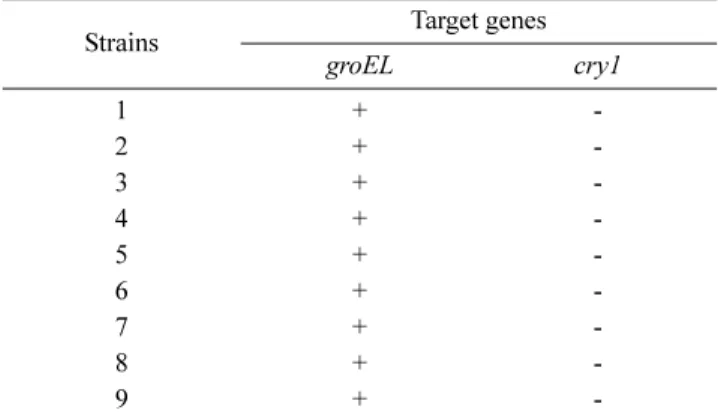
여기서는 먼저 B. cereus와 B. thuringiensis를 구분하기 위해 현미경으로 관찰한 결과 결정체독소가 발견되지 않 았으며(Fig. 2), PCR 시험법으로 확인한 결과 모두 B. cereus 임을 알 수 있었다(Table 3).
요 약
본 연구에서는 인터넷에서 판매되는 배달이유식의 위생 안전성을 평가하고, B. cereus의 독소유전자 분포를 파악 하여 즉석조리식품으로 구분되는 이유식의 B. cereus 기준 설정을 위한 기초자료를 제공하고자 하였다. 기타 영·유 아식 27건, 즉석조리식품 79건 등 총 106건에 대한 실험 결과는 다음과 같다.
1. 이유식 106건의 세균수 검사결과 기타 영·유아식에 서는 12건(44%)에서 최대 2.5 × 10³CFU/g, 즉석조리식품 에서는 46건(58%)에서 최대 1.1 × 10⁶CFU/g으로 대체적으 로 즉석조리식품에서 세균수가 많이 검출되었다.
2. 106건의 검체 중 총 9건에서 B. cereus가 10~3.6 × 10³ CFU/g 범위로 검출되었으며 모두 즉석조리식품이었다.
3. B. cereus의 독소유전자 중 cytK는 6주(66.6%), nheA 및 entFM은 8주(88.9%), bceT는 7주(77.8%), hblC는 3주 (33.3%)에서 검출되었으며 구토독소인 cer은 2주(22.2%)에 서만 증폭밴드가 나타났다.
4. 분리된 균주는 B. cereus와 B. thuringiensis를 구분하 기 위한 시험법에서 모두 B. cereus로 나타났다.
참고문헌
1. Choi S.K., Lee M.S., Lee K.H., Lim D.S., Lee K.H. and Kim Table 3. PCR result for distinguish B. cereus from B. thuringiensis
Strains Target genes
groEL cry1
1 + -
2 + -
3 + -
4 + -
5 + -
6 + -
7 + -
8 + -
9 + -
Fig. 1. PCR result of B. cereus 6 toxin genes.
Fig. 2. B. cereus isolated from ready-to-cook food.
210 Park Min-jung, Hong Hae-geun, Son Jong-seong, Kwon Yeon-ok, Lim Young-sik, Lee Hyun-ho, and Kim Gu-hwan
C.H.: Changes in quality of hamburger and sandwich during storage under simulated temperature and time. Korean J.
Food Sci. Ani. Resour, 18, 27~34 (1998).
2. 소비자안전센터 소비자안전국 식의약안전팀, 시험검사국
식품미생물팀 : 영유아식품 안 전실태 조사 (2011).
3. Kim S.J., Jung J.H., Tahk H.M., Baek S.Y., Lee S.Y.: Effect of factors on the sporulation of Bacillus cereus and their ther- mal resistance. J. Fd. Hyg. Safety, 24, 256~261 (2009).
4. Ankolekar, C., Rahmati, T., Labbe, R.G.: Detection of toxi- genic Bacillus cereus and Bacillus thuringiensis spore in U.S. rice. Int. J. Food Microbiol, 128, 460~466 (2008).
5. Kramer, J.M., Gilbert, R.J.: Bacillus cereus and other Bacil- lus species in foodborne bacterial pathogens. Doyle MP (ed).
Marcel Dekker Inc., London, UK, pp. 21-70 (1989) 6. David A. Rasko, Michael R. Altherr, Cliff S. Han, Jacques
Ravel : Genomics of the Bacillus cereus group of organisms.
FEMS Microbiology Reviews, 29, 303~329 (2005).
7. Anwarul, H., Nicholas, J.R.: Phenotypic and genotypic char- acterisation of Bacillus cereus isolates Bangladeshi rice. Int.
J. Food Microbiol, 98, 23~24 (2005).
8. Valero, M., Hernandez-Herrero, L.A., Fernandez, P.S. and Salmeron, M.C.: Characterization of Bacillus cereus isolates from fresh vegetables and refrigerated minimally processed foods by biochemical and physiological tests. Int. J. Food Microbiol., 19, 491~499 (2002).
9. 식품공전. 식품의약품안전처 (2013)
10. Kim J.B., Park Y.B., Park M.K., Shin S.W., Kwon Y.O.,
Ko H.U. and Kim J.C.: Distribution of toxin genes in Bacillus cereus isolated from cooked grains. 경기도 보 건환경연구원보, pp.155~164 (2006)
11. Heinrich, J.H., Beecher, D.J., MacMillan, J.D. and Zilinskas, B.A.: Molecular cloning and characterization of the hblA gene encoding the B component of hemolysin BL from Bacillus cereus. J. bacteriol., 17, 6760~6766 (1993).
12. Jeon J.H. and Park J.H.: Toxin gene analysis of Bacillus cereus and Bacillus thuringiensis isolated from cooked rice.
Korean J. Food Sci. Technol., 42(3), 361~367 (2010).
13. Ankolekar, C., Rahmati, T., Labbe’, R.G.: Detection of toxi- genic Bacillus cereus and Bacillus thuringiensis spores in U.S. rice. Int. J. Food Microbiol., 128, 460~466 (2009).
14. Rosenquist, H., Smidt, L., Anderson, S.R., Jensen, G.B., Wil- cks, A.: Occurence and significance of Bacillus cereus and Bacillus thuringiensis in ready-to-eat food. FEMS Microbiol.
Lett., 250, 129~136 (2005).
15. Maria, E. Vidal-Dominguez, Macarena Perez-Cenci, Gra- ciela, L. Salerno, Corina, M. Beron : Genetic diversity of cry gene sequences of Bacillus thuringiensis strains analyzed by denaturing gradient gel electrophoresis. Curr. Microbiol., 62, 866~870 (2011).
16. Alejandra Bravo, Sarjeet S. Gill and Mario Soberon : Mode of action of Bacillus thuringiensis Cry and Cyt toxins and their potential for insect control. Toxicon, 49(4), 423~435 (2007).