Effect of High Temperature, Daylength, and Reduced Solar Radiation on Potato Growth and Yield
Yean-Uk Kim and Byun-Woo Lee*
1)Department of Plant Science, College of Agriculture and Life Sciences, Seoul National University, Seoul 08826, Korea
(Received May 3, 2016; Revised June 29, 2016; Accepted June 30, 2016)
고온, 일장 및 저일사 조건이 감자 생육 및 수량에 미치는 영향
김연욱⋅이변우*
서울대학교 식물생산과학부
(2016년 5월 3일 접수; 2016년 6월 29일 수정; 2016년 6월 30일 수락)
ABSTRACT
Potato phenology, growth, and yield are projected to be highly affected by global warming in the future. The objective of this study was to examine the responses of potato growth and yield to environmental elements like temperature, solar radiation, and daylength. Planting date experiments under open field condition were conducted using three cultivars differing in maturity group (Irish Cobbler and Superior as early; Atlantic as mid-late maturing) at eight different planting dates. In addition, elevated temperature experiment was conducted in four plastic houses controlled to target temperatures of ambient temperature (AT), AT+1.5
oC, AT+3
oC, and AT+5
oC using cv. Superior.
Tuber initiation onset was found to be hastened curve-linearly with increasing temperature, showing optimum temperature around 22-24
oC, while delayed by longer photoperiod and lower solar radiation in Superior and Atlantic. In the planting date experiments where the average temperature is near optimal and solar radiation, rainfall, pest, and disease are not limiting factor for tuber yield, the most important determinant was growth duration, which is limited by the beginning of rainy season in summer and frost in the late fall. Yield tended to increase along with delayed tuber initiation. Within the optimum temperature range (17
o-22
oC), larger diurnal range of temperature increased the tuber yield. In an elevated temperature treatment of AT+5.0
oC, plants failed to form tubers as affected by high temperature, low irradiance, and long daylength. Tuber number at early growth stage was reduced by higher temperature, resulting in the decrease of assimilates allocated to tuber and the reduction of average tuber weight. Stem growth was enhanced by elevated temperature at the expense of tuber growth. Consequently, tuber yield decreased with elevated temperature above ambient and drop to almost nil at AT+5.0
oC.
Key words: Potato, Climate change, High temperature, Planting date, Tuber initiation, Tuber yield
* Corresponding Author : Byun-Woo Lee ([email protected])
DOI: 10.5532/KJAFM.2016.18.2.74
ⓒ Author(s) 2016. CC Attribution 3.0 License.
I. Introduction
Potato is a major crop ranking not only the fifth in worldwide production but also the third in human consumption. In Korea, potato is the 2nd major food crop after rice in terms of domestic production (FAOSTAT, 2015). Due to its yielding capacity and nutritious benefits (Salaman and Burton, 1985), cultivation acreage has expanded rapidly during the last few centuries. Also Potato is highly recommended crop for food security as food demands increase due to population growth (FAO, 2009). Global climate change as accompanied by warming is projected to exert adverse impact on production of potato, which is known as cool season crop.
Global mean surface temperature has increased by 0.85
oC (0.65-1.06
oC) during 1880-2012 period, and it is projected to increase by 0.3-4.8
oC for 2081-2100 relative to 1986-2005. South Korea experienced even faster warming, mean temperature increased by 1.87
oC during 1908-2009. Mean surface temperature for South Korea is projected to increase by 5.9
oC by the end of 21st century (IPCC, 2013 and 2014).
Even though, role of potato as a food security crop is expected to increase in the future, the climate change impacts on potato and adaptation strategies are not sufficiently established. Generally, temperature is the most important factor for potato growth and yield (Smith, 1968). Optimal temperature for net photosynthesis is lower than 25
oC, but due to the reduction of harvest index under higher temperature, optimal temperature of yield is even lower than that of net photosynthesis (Winkler, 1971; Ku et al., 1977; Dwelle et al., 1981).
Wheeler and Tibbitts(1986) showed optimal temperature for tuber yield are 20
oC and 16
oC for daylengths of 12 and 24hours, respectively. However, temperature responses vary among cultivars and development stages, and especially, heat tolerance varies widely (Reynolds et al., 1990). In Korea, low temperature during early stage and high temperature during tuber bulking stage reduce tuber yield and quality for the cultivation in spring (Choi et al., 2014).
Various environmental factors other than temperature affect potato phenology and growth. Photoperiod is one of the most important factors for potato growth and development. Lorenzen and Ewing(1990) showed higher photosynthesis efficiency in short days and Ewing and Wareing(1978) showed short days hastened tuber initiation onset. Low irradiance delays duration of tuber initiation and affects the number of tuber and tuber yield. However, interactions between environmental factors have not been well understood. For instance, many studies concluded irradiance effects on tuber initiation onset is negligible, but Demagante and Vander Zaag(1988) showed low irradiance delays tuber initiation onset under high temperature and the effect varied among cultivars. The objectives of this experiment are to examine the responses of potato growth and yield to the elevated temperature and the different daylength and solar radiation as changed by planting dates for different cultivars.
II. Materials and Methods
2.1. Planting date experiments 2.1.1. Experimental setup
This study was carried out at the experimental farm of Seoul National University (37.27
oN, 126.99
oE), Korea.
Three cultivars differing in maturity groups were
planted at three different planting dates during the
spring season of 2014 and 2015. Two cultivars were
planted at two different planting dates during the fall
season of 2014 (Table 1). Plants were grown under
non-water stress condition, irrigated by hose and
sprinkler in 2014 and 2015, respectively. Fertilizers
were applied by the rates of 100kg ha
-1of N, 100kg ha
-1of P and 120kg ha
-1of K at the planting dates in the
spring season of both years. For the fall season
experiments, nitrogen fertilization rate was 1.5 times of
the spring season fertilization. Seed tubers were
pre-germinated for two to three weeks and planted at a
spacing of 0.7m between rows and 0.25m between
plants within row.
2.1.2. Measurements 2.1.2.1. Plant growth
Emergence dates were recorded when 50% of the plants emerged from the soil surface. Tuber initiation onset date was considered to the date when 50% of sampled plants formed more than one tuber with at least 1cm diameter (Sands et al., 1979; Manrique and Hodges, 1989). Tuber initiation onsets were observed by destructive sampling of three to five plants for each treatment. Plant dry mass, tuber fresh weight, and leaf area were determined by harvesting five to six plants at an interval of one to three weeks. Vegetative organ was divided into leaf and stem and oven-dried at 80
oC.
Tubers were manually washed and sliced into 2cm before drying. Leaf area was measured with Li-3000 portable leaf area meter (Li-Cor, Lincoln, Nebraska, USA) after separated from stem. Measurements were carried out by bulk and individual in the spring season of 2014 and the rest, respectively. Tuber number per plant and fresh weight of each tuber were measured in 2015. Due to the beginning of rainy season and the frost, plants were harvested prior to the physiological maturity.
2.1.2.2. Meteorological data
Throughout the growing season, meteorological elements, such as air temperature and solar radiation were monitored at 5 minutes interval using data-logger
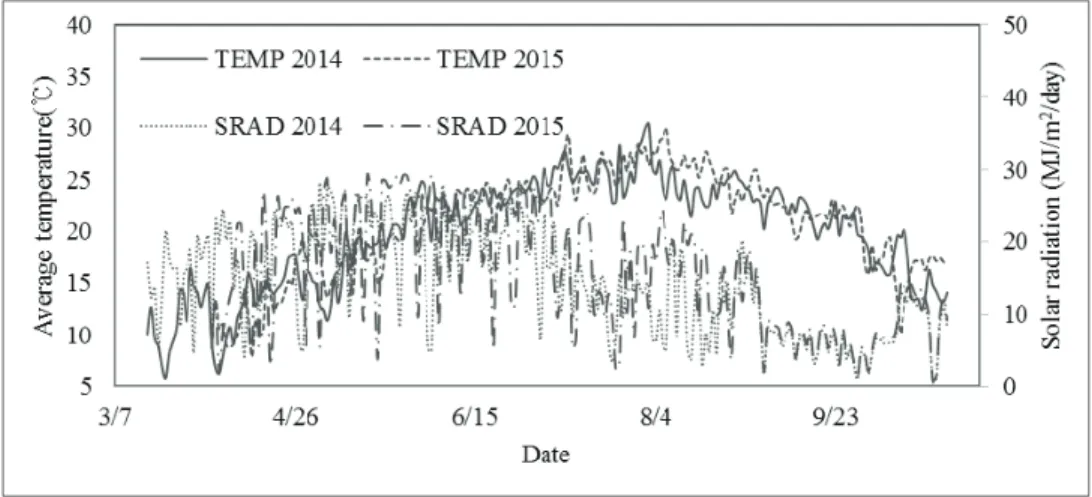
(CR1000, Campbell Scientific, USA) equipped with temperature sensor and pyranometer (Fig. 1).
Meteorological data from Suwon weather station, located next to the experimental farm, was used for the time when data-logger power was down. Average daily maximum temperature, minimum temperature and solar radiation throughout the growing season and period between emergence and tuber initiation onset (EM-TIO) were used for ridge regression.
2.2. Elevated temperature experiments 2.2.1. Experimental setup
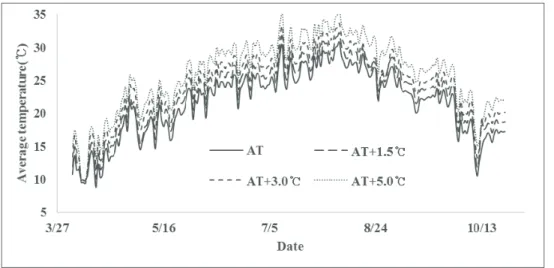
This study was conducted under four plastic houses controlled to target temperatures of ambient temperature (AT), AT+1.5
oC, AT+3.0
oC, and AT+5.0
oC (Fig. 2). An early maturing cultivar, Superior was used in 2015.
Pre-germinated seed tubers were planted at April 29 and September 17 with a row spacing of 0.7m and 0.2m within rows. Drip irrigation was implemented to prevent water stress. Fertilizer was applied at the rate of 1.5 times of the planting date experiments to compensate organic residues from previous cultivations.
2.2.2. Measurements 2.2.2.1. Plant growth
General methods for measuring plant growth were identical to the planting date experiments. After emergence, ten plants per treatments were sampled five
Fig. 1. Daily average air temperature and solar radiation during experimental season in 2014 and 2015.
times at an interval of two weeks and measurements were taken for each plant. Tuber was sorted into four groups, tuber weight of 1-49g, 50-99g, 100-149g and bigger than 150g.
2.2.2.2. Meteorological data
Air temperature and solar radiation were measured at 1 minute intervals with datalogger equipped with platinum resistor thermoprobe and pyranometer during the growth season.
2.2.3. Statistical analysis
Analysis of variance (ANOVA) was used to test the significance among temperature treatment means.
2.3. Effects of environmental factors on tuber growth Multiplicative models (1) and (2) for tuber initiation onset using average temperature, solar radiation, daylength, and diurnal temperature range were made by a global optimization by differential evolution (DE) introduced by Storn and Price(1997). To analyze the relationship between tuber yield and environmental factors, ridge regression was used to prevent multicollinearity problems among meteorological variables. Linear ridge regression contained in the R package ‘ridge’ was used. Quadratic regression was performed to analyze the relationship between yield and
average temperature for cultivar Superior.
(1)
for the planting date experiment
(2)
for the Superior data pooled across the planting date and the temperature elevation experiments
Where , , , , and are days from emergence to tuber initiation onset, average temperature (
oC), daylength (hour), daily solar radiation (MJ/m
2/day), and diurnal temperature range (
oC), respectively.
III. Results
3.1. Responses of potato development and growth to planting dates
Air temperature tends to increase until the beginning of August, reaching average temperature of 30
oC in Suwon (Fig. 1). The daylength is near 15 hours at summer solstice which falls on June 21. During the spring season, later planting caused higher temperature and longer days while opposite for the fall season.
Fig. 2. Daily average air temperature inside the plastic houses which were controlled to different target
temperatures in 2015.
Plantings in the fall season were delayed by the continuous rainfall, causing shorter daylength throughout the growing season compared to the spring season and the ordinary cultivation period in the fall season (Table 1, 2).
3.1.1. Tuber initiation onset
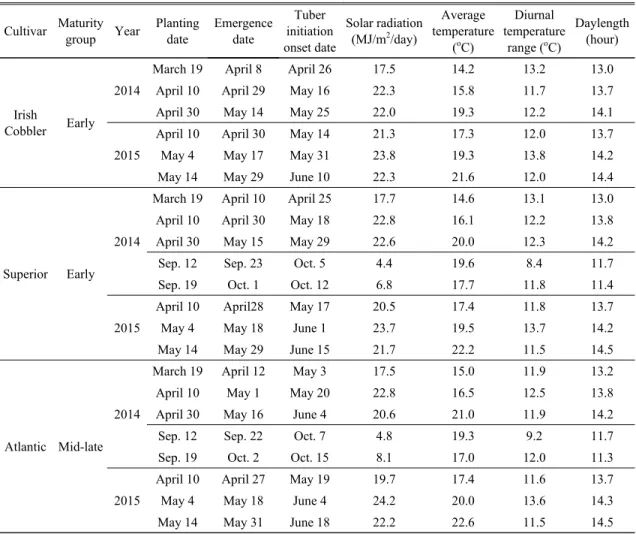
As shown in the Table 1, tuber initiation onset occurred from 11 to 22 days after emergence according to planting dates and cultivars. In the spring season, Irish Cobbler formed tuber about 1.8 and 5 days earlier than Superior and Atlantic on average. As the temperature increases with delayed planting in the spring, tuber initiations were hastened for Irish Cobbler and Atlantic,
except for the last planting of Atlantic. Irish Cobbler and Atlantic are known as non-photosensitive and highly thermo-sensitive cultivars, respectively (Miller and McGoldrick, 1941; Tibbitts et al., 1992). Thus, it could be interpreted as the temperature effects on tuber initiation overcompensated the delaying effect by the lengthened daylength in the later planting. However, Superior did not show consistent response to average temperature change and daylength, but as diurnal temperature range decreased, tuber initiation onset was delayed in the both year. In the fall season, tuber started to form earlier than the spring season, even though average temperature and diurnal temperature range were, respectively, similar and relatively smaller as
Cultivar Maturity
group Year Planting date
Emergence date
Tuber initiation onset date
Solar radiation (MJ/m
2/day)
Average temperature
(
oC)
Diurnal temperature
range (
oC)
Daylength (hour)
Irish
Cobbler Early 2014
March 19 April 8 April 26 17.5 14.2 13.2 13.0
April 10 April 29 May 16 22.3 15.8 11.7 13.7
April 30 May 14 May 25 22.0 19.3 12.2 14.1
2015
April 10 April 30 May 14 21.3 17.3 12.0 13.7
May 4 May 17 May 31 23.8 19.3 13.8 14.2
May 14 May 29 June 10 22.3 21.6 12.0 14.4
Superior Early 2014
March 19 April 10 April 25 17.7 14.6 13.1 13.0
April 10 April 30 May 18 22.8 16.1 12.2 13.8
April 30 May 15 May 29 22.6 20.0 12.3 14.2
Sep. 12 Sep. 23 Oct. 5 4.4 19.6 8.4 11.7
Sep. 19 Oct. 1 Oct. 12 6.8 17.7 11.8 11.4
2015
April 10 April28 May 17 20.5 17.4 11.8 13.7
May 4 May 18 June 1 23.7 19.5 13.7 14.2
May 14 May 29 June 15 21.7 22.2 11.5 14.5
Atlantic Mid-late 2014
March 19 April 12 May 3 17.5 15.0 11.9 13.2
April 10 May 1 May 20 22.8 16.5 12.5 13.8
April 30 May 16 June 4 20.6 21.0 11.9 14.2
Sep. 12 Sep. 22 Oct. 7 4.8 19.3 9.2 11.7
Sep. 19 Oct. 2 Oct. 15 8.1 17.0 12.0 11.3
2015
April 10 April 27 May 19 19.7 17.4 11.6 13.7
May 4 May 18 June 4 24.2 20.0 13.6 14.3
May 14 May 31 June 18 22.2 22.6 11.5 14.5
Table 1. Dates of planting, emergence, tuber initiation onset, and meteorological elements averaged during the period
from emergence to tuber initiation onset under different planting dates in 2014 and 2015
compared to those at the late planting in the spring season. This indicates that the main meteorological element affecting tuber initiation could be the daylength.
3.1.2. Yield
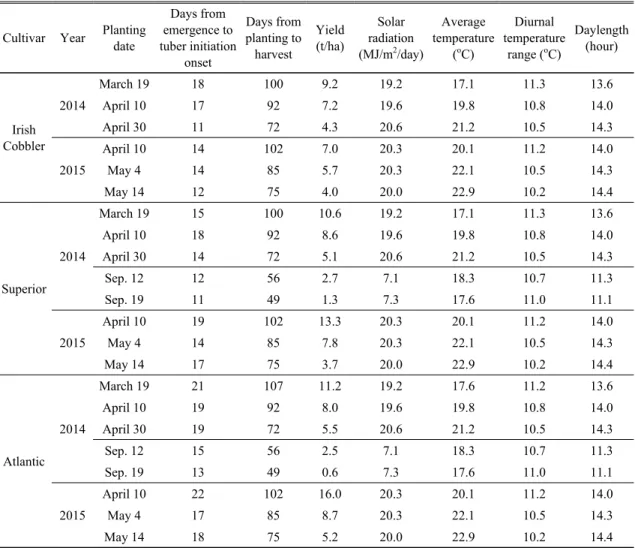
As presented in Table 2, cultivation periods were shortened by the beginning of rainy season and the frost at the later plantings in the spring and the fall season, respectively, resulting in the decreased yield. During the spring experiments, the mean daily average temperature increased from 17.1
oC to 22.9
oC with delayed planting and diurnal temperature range decreased with the delayed planting dates. Average daily solar radiation was not different among the spring plantings. However,
due to the difference of growth duration among the planting dates, meteorological effects on tuber yield are not clearly shown. Among cultivars, when the growth duration exceed 100 days, late-maturing cultivar tends to have higher yield, but no consistent trends were found in the shorter growth duration.
3.2. Responses of potato growth and yield to elevated temperature
3.2.1. Tuber initiation onset
As shown in Table 3, average temperatures of the spring season experiment were approximately 4
oC higher than those of the fall experiment, showing similar
Cultivar Year Planting date
Days from emergence to tuber initiation
onset
Days from planting to harvest
Yield (t/ha)
Solar radiation (MJ/m
2/day)
Average temperature
(
oC)
Diurnal temperature
range (
oC)
Daylength (hour)
Irish Cobbler
2014
March 19 18 100 9.2 19.2 17.1 11.3 13.6
April 10 17 92 7.2 19.6 19.8 10.8 14.0
April 30 11 72 4.3 20.6 21.2 10.5 14.3
2015
April 10 14 102 7.0 20.3 20.1 11.2 14.0
May 4 14 85 5.7 20.3 22.1 10.5 14.3
May 14 12 75 4.0 20.0 22.9 10.2 14.4
Superior 2014
March 19 15 100 10.6 19.2 17.1 11.3 13.6
April 10 18 92 8.6 19.6 19.8 10.8 14.0
April 30 14 72 5.1 20.6 21.2 10.5 14.3
Sep. 12 12 56 2.7 7.1 18.3 10.7 11.3
Sep. 19 11 49 1.3 7.3 17.6 11.0 11.1
2015
April 10 19 102 13.3 20.3 20.1 11.2 14.0
May 4 14 85 7.8 20.3 22.1 10.5 14.3
May 14 17 75 3.7 20.0 22.9 10.2 14.4
Atlantic 2014
March 19 21 107 11.2 19.2 17.6 11.2 13.6
April 10 19 92 8.0 19.6 19.8 10.8 14.0
April 30 19 72 5.5 20.6 21.2 10.5 14.3
Sep. 12 15 56 2.5 7.1 18.3 10.7 11.3
Sep. 19 13 49 0.6 7.3 17.6 11.0 11.1
2015
April 10 22 102 16.0 20.3 20.1 11.2 14.0
May 4 17 85 8.7 20.3 22.1 10.5 14.3
May 14 18 75 5.2 20.0 22.9 10.2 14.4
Table 2. Yield, growth duration, and meteorological elements averaged throughout the growth period under different
planting dates in 2014 and 2015
temperatures between AT of the spring experiment and AT+5.0
oC of the fall experiment. Solar radiation of the spring experiment was twice that of the fall experiment and daylength was 2.9 hours longer in the spring experiment.
Tuber initiation onsets were slightly delayed at AT+3.0
oC and inhibited at AT+5.0
oC in the spring season experiment. In the fall season experiment, there were no variations of EM-TIO among the temperature treatments. EM-TIO in the spring season experiment was twice as long as that of the fall season experiment due to the difference of daylength. Tuber initiation was delayed in plastic houses compared to the open field and the environmental differences between the two experiments were solar radiation and diurnal temperature range (Table 1 and 3).
3.2.2. Growth and yield
As presented in Table 5, total dry weight was reduced significantly with temperature elevation treatments above AT+3.0
oC and the total dry weight of AT+5.0
oC was lower than a half of that in the other treatments.
Tuber dry weight decreased significantly until harvest with temperature elevation. As presented in Table 4, final yield decreased substantially with temperature elevation above ambient, dropping to almost nil in AT+5
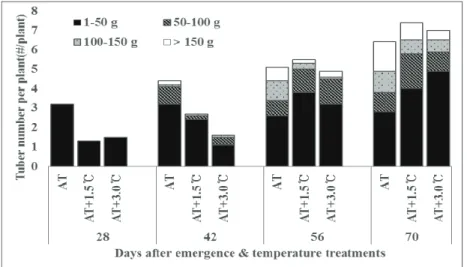
oC. As presented in Fig. 3, less tubers were formed during the early season of tuber initiation (28-42 days after planting; DAE) under elevated temperature treatments, while no statistical difference in tuber number were found thereafter among temperature treatments except AT+5.0
oC. Therefore, proportion of small tubers increased with temperature elevation above ambient. The proportion of assimilates partitioning to stem increased at the expense of tuber growth along with temperature elevation. Dry weight ratio of leaf to stem decreased along with elevated temperature.
3.3. Effects of environmental factors on tuber initiation and growth
3.3.1. Tuber initiation onset
The responses of tuber initiation onset to environments can be explained by the models presented in Table 6. In the open field condition, temperature was an important Planting
date
Temperature treatments
Emergence date
Tuber initiation onset date
Solar radiation (MJ/m
2/day)
Average temperature
(
oC)
Diurnal temperature
range (
oC)
Daylength (hour)
April 29
AT May 10 June 5(26) 16.2 20.0 17.4 14.2
AT+1.5
oC May 9 June 4(26) 16.6 21.4 18.9 14.1
AT+3.0
oC May 10 June 7(28) 16.3 23.1 18.1 14.2
AT+5.0
oC May 11 Failed 16.1 24.8 17.3 14.2
Sep. 17
AT Sep. 30 Oct. 14(14) 8.9 16.4 14.4 11.4
AT+1.5
oC Oct. 1 Oct. 15(14) 9.0 17.7 17.4 11.3
AT+3.0
oC Sep. 30 Oct. 14(14) 8.9 19.2 17.0 11.4
AT+5.0
oC Oct. 9 Oct. 23(14) 8.2 20.1 16.5 11.0
Table 3. Tuber initiation onset as affected by elevated temperature treatments and meteorological elements averaged over the period from emergence to tuber initiation onset in a potato cultivar Superior in 2015
Planting date
Temperature treatments
Yield (ton/ha)
Solar radiation (MJ/m
2/day)
Average temperature(
oC)
Diurnal temperature range (
oC)
Daylength (hour)
April 29
AT 6.4 14.8 22.4 15.2 14.3
AT+1.5
oC 4.5 14.8 23.8 16.1 14.3
AT+3.0
oC 2.7 14.8 25.3 15.7 14.3
AT+5.0
oC 0.0 14.7 27.1 15.9 14.3
Table 4. Tuber yield as affected by elevated temperature treatments and meteorological elements averaged throughout
the growth period
days after emergence
temperature treatments
dry weight(g/plant) dry weight ratio(g/g)
LAI tuber number
leaf stem tuber total leaf stem tuber
14
AT 2.41 1.70b 0.02 4.14 0.58a 0.41b 0.01 0.42 0.10
AT+1.5℃ 2.46 1.93ab 0.00 4.39 0.56ab 0.44ab 0.00 0.36 0.00
AT+3.0℃ 3.10 2.25ab 0.00 4.65 0.52b 0.48a 0.00 0.42 0.00
AT+5.0℃ 2.45 2.62a 0.00 5.72 0.54ab 0.46ab 0.00 0.36 0.00
F-value 1.777NS 2.93* 1NS 2.231NS 4.574** 4.781** 1NS 0.902NS 1NS
28
AT 9.57 7.46 6.48a 23.51 0.41 0.33c 0.26a 1.36 3.20a
AT+1.5℃ 9.23 9.85 1.96b 21.04 0.45 0.48b 0.08b 1.35 1.30ab
AT+3.0℃ 9.38 9.92 1.91b 21.21 0.44 0.46b 0.10b 1.14 1.50ab
AT+5.0℃ 8.40 11.28 0.00b 19.68 0.43 0.57a 0.00b 1.11 0.00b
F-value 0.175NS 1.352NS 7.123*** 0.311NS 0.647NS 21.27*** 8.313*** 0.58NS 6.742**
42
AT 21.30 21.00 25.15a 67.45 0.32 0.31c 0.37a 3.47 4.40a
AT+1.5℃ 20.13 28.87 9.43b 58.43 0.34 0.50b 0.16b 3.48 2.70b
AT+3.0℃ 17.50 24.57 7.27b 49.34 0.36 0.52b 0.12b 2.59 1.60b
AT+5.0℃ 14.70 23.01 0.00b 36.57 0.36 0.64a 0.00b 2.14 0.00c
F-value 1.465NS 0.765NS 13.18*** 2.75NS 1.442NS 24.96*** 13.36*** 1.889NS 23.34***
56
AT 23.87a 28.06 51.49a 103.43a 0.23bc 0.28c 0.48a 5.21a 4.70a AT+1.5℃ 30.16a 39.93 37.89ab 107.98a 0.27ab 0.35bc 0.38a 5.56a 5.50a AT+3.0℃ 18.23ab 36.96 29.81b 85.00a 0.21c 0.42b 0.38a 3.74ab 4.90a AT+5.0℃ 11.46b 24.76 0.26c 39.48b 0.31a 0.68a 0.01b 2.21b 0.20b F-value 6.187** 1.838NS 16.4*** 8.907*** 8.552*** 27.64*** 22.34*** 5.361** 12.83***
70
AT 16.84 23.15 90.07a 130.06a 0.12c 0.17c 0.70a 5.04 6.40a AT+1.5℃ 26.16 46.96 63.29b 136.40a 0.19b 0.34b 0.47b 6.50 7.40a AT+3.0℃ 19.58 42.78 38.41b 100.77ab 0.20b 0.43b 0.38b 5.20 7.00a AT+5.0℃ 17.17 39.64 0.31c 57.12b 0.30a 0.69a 0.00c 3.21 0.30b F-value 2.082NS 2.797NS 34.12*** 7.747*** 47.05*** 91.57*** 98.41*** 2.635NS 13.28***
NS, *, **, ***, not significant at the 0.05, 0.01, 0.001 significant levels, respectively.
Table 5. Growth characteristics of Superior as affected by different temperature regimes
Fig. 3. Temporal changes of tuber number and tuber weight distribution under
different elevated temperature treatments.
factor for tuber initiation onset commonly to all the cultivars tested, while daylength was another important factor only in two cultivars Superior and Atlantic except the Irish Cobbler. In Irish Cobbler temperature is the sole factor affecting tuber initiation onset. Tuber initiation onset response to temperature was very similar among cultivars, becoming earlier curve-linearly with increasing temperature up to optimum average temperature and showing similar optimum temperature
of around 22-24
oC. Tuber initiation onset tended to delay with the increasing daylength very similarly in the two cultivars Superior and Atlantic. In these cultivars temperature and daylength seemed to exert effects on tuber initiation onset interactively, exaggerating each other. Only daylength and average temperature were not sufficient for explaining tuber initiation onset variation of Superior at spring season in temperature controlled plastic houses with much larger diurnal ranges of
Cultivars Parameters r
2Planting date experiment
a
1a
2a
3b
1b
2-
Irish Cobbler 0.104 -4.63 63.2 - - - 0.85
Superior -0.18 8.38 -155.4 -0.03 0.17 - 0.63
Atlantic 0.23 -11.27 207 0.029 -0.15 - 0.75
Pooled with temperature experiment
c
1c
2d
1d
2e
1e
2Superior -0.28 12.81 3.74 -33.58 0.0062 0.054 0.90
a and b are the coefficients of temperature and daylength for the tuber initiation model of the planting date experiment.
c, d, and e are the coefficients of solar radiation, daylength, and diurnal temperature range for the tuber initiation model of Superior data pooled across the planting date and temperature experiments.
Table 6. Parameters of the tuber initiation models [equations (1), (2)] obtained by a global optimization by differential evolution (DE)
Fig. 4. Relationship of duration from emergence to tuber initiation onset with solar radiation, daylength, and diurnal temperature range in cultivar Superior. Data were pooled across the planting date and the temperature elevation experiments.
11.5/14.0/14.5h and 12/17
oC are daylength and daily mean temperature,
respectively.
temperature and lower solar radiation than in the open field. As in Fig. 4, the model using all the data pooled across planting date experiments in open field and elevated temperature experiments in plastic houses shows that the effect of solar radiation on tuber initiation onset of Superior varied with different daylength and diurnal temperature range. Solar radiation had relatively small effects on tuber initiation onset under short day in fall season. However, tuber initiation onset was highly affected by solar radiation in the spring season, especially under the plastic houses, where daylength and diurnal temperature range were long and large.
3.3.2. Yield
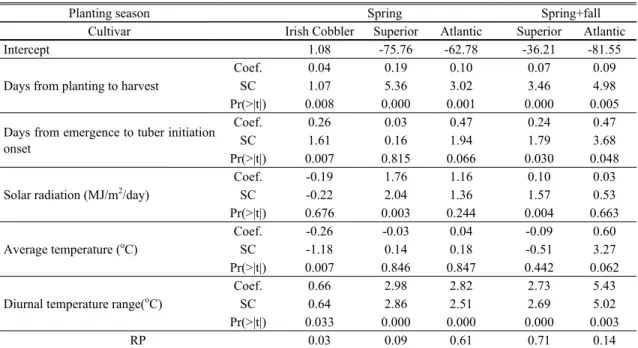
Relative importance of yield-related factors was analyzed using ridge regression for open field experimental data as shown in Table 7. Tuber yield tended to increase significantly with the increased growth duration and the delayed tuber initiation (longer EM-TIO) regardless of cultivars and planting seasons.
Solar radiation showed significantly positive
relationship with tuber yield only in cultivar Superior, while average temperature showed significantly negative relationship with tuber yield only in cultivar Irish Cobbler. However, diurnal temperature range showed highly significant positive relationship with tuber yield in all the cultivars tested.
The yield response to average temperature during growth period were analyzed for the data pooled across planting date experiments in the open field and temperature elevation experiments in plastic houses for cultivar Superior. As shown in Fig. 5, tuber yield showed quadratic response to average air temperature.
Tuber yield reached maximum at around 20
oC, decreased drastically above this temperature, and dropped to almost nil at 27
oC.
IV. Discussion
Future potato yield is projected to decrease in many regions because of temperature increase due to global warming (Hijmans, 2003). The yield decreases due to
Planting season Spring Spring+fall
Cultivar Irish Cobbler Superior Atlantic Superior Atlantic
Intercept 1.08 -75.76 -62.78 -36.21 -81.55
Days from planting to harvest
Coef. 0.04 0.19 0.10 0.07 0.09
SC 1.07 5.36 3.02 3.46 4.98
Pr(>|t|) 0.008 0.000 0.001 0.000 0.005
Days from emergence to tuber initiation onset
Coef. 0.26 0.03 0.47 0.24 0.47
SC 1.61 0.16 1.94 1.79 3.68
Pr(>|t|) 0.007 0.815 0.066 0.030 0.048
Solar radiation (MJ/m
2/day)
Coef. -0.19 1.76 1.16 0.10 0.03
SC -0.22 2.04 1.36 1.57 0.53
Pr(>|t|) 0.676 0.003 0.244 0.004 0.663
Average temperature (
oC)
Coef. -0.26 -0.03 0.04 -0.09 0.60
SC -1.18 0.14 0.18 -0.51 3.27
Pr(>|t|) 0.007 0.846 0.847 0.442 0.062
Diurnal temperature range(
oC)
Coef. 0.66 2.98 2.82 2.73 5.43
SC 0.64 2.86 2.51 2.69 5.02
Pr(>|t|) 0.033 0.000 0.000 0.000 0.003
RP 0.03 0.09 0.61 0.71 0.14
Coef., SC, Pr, and RP are represent ridge regression coefficient, scaled ridge regression coefficient, probability, and ridge parameter, respectively.
Table 7. Ridge regression analysis of the relationship of tuber yield with growth duration, tuber initiation duration, and
meteorological elements averaged over whole growth period
warming would be attributed to the reduced assimilates allocating to tuber, shift of tuber initiation onset and slower tuber formation during the initiation phase, decrease of growing season, etc.
Tuber initiation was hastened by higher temperature under the current climate in Suwon (Table 6). However, tuber initiation will be delayed by the temperature above 22-24
oC and Streck et al.(2007) suggest similar optimum temperature for tuber initiation of 15-21
oC.
Contrast to the common result, tuber initiation was delayed under the plastic house condition due to reduced solar radiation level (16MJ/m
2/day) which was relatively higher than the reported critical solar radiation level of 7MJ/m
2/day (O’brien et al., 1998) and larger diurnal range of temperature. Demagante and Vander Zaag(1988) also suggested that reduced solar radiation (thought to be above 10MJ/m
2/day) under high temperature delay tuber initiation. This result would be supported by the report of Jackson(1999) that high temperature, long day, and low solar radiation have similar mechanism of delaying tuber initiation by increasing gibberellin level which is known as an inhibitor of tuber formation. Low radiation seems to intensify the response of tuber initiation onset to
daylength and temperature. Also, according to our data, large diurnal temperature range is beneficial for tuber formation under open field condition, but the effect was opposite when the average temperature and fluctuation range exceed 22
oC and 17
oC, respectively (Table 1, 3).
There were studies suggesting diurnal fluctuations are beneficial to tuber initiation (Werner, 1935; Bennett et al., 1991), but not for the opposite. The previous studies were conducted under short days or daily maximum temperature of 22
oC. In our experiments in plastic houses, high diurnal temperature range would have caused daily maximum temperature above 30
oC, causing heat stress.
In the current climate in Suwon, where average temperature is around 20
oC during the potato growth season, tuber yield is not highly affected by slight temperature elevation, while decrease of diurnal temperature range could be more detrimental to tuber yield than the increase of average temperature (Table 7).
However, if average temperature increase more than 2-3
oC, tuber yield would decrease drastically and drop to almost nil at 27
oC as in Fig. 5. This coincides with the result of Wheeler(1986) that optimum temperature for tuber yield are 20
oC and 24
oC under daylength of 12 and Fig. 5. Quadratic regression of tuber yield divided by growth duration with daily mean
temperature averaged throughout the growth period in a cultivar Superior. Open and closed
circle represent the planting date experiments data in the open field and the elevated
temperature experiment data in the plastic houses, respectively.
16 hour, respectively. In our study and previous research (Timlin et al., 2006) yield reduction by elevated temperature was mainly due to reduced assimilates partitioning ratio to tuber and enhanced stem growth. Due to reduced sink strength of tuber by elevated temperature, tuber formation was delayed, which coincides with the study (Wardlaw, 1990) that organ initiation often decreases and abortion increases with decreased source strength. Delayed tuber formation leaded to large number of smaller tuber and great yield loss at harvest (Table 5 and Fig. 3). Also, tuber initiation makes diversion of assimilates to tuber, thus early tuber initiations cause small plants and leaf area leading to lower final yield (Ivins and Bremner, 1965; Bremner and Radley, 1966). Therefore, environmental conditions during the early growth (before tuber initiation and early tuber growth phase) may play crucial role for the late tuber growth. In conclusion, lengthened growth period, delayed tuber initiation onset, higher solar radiation, and current average temperature with large daily temperature fluctuation will increase tuber yield, but temperature above the current will cause yield loss.
적 요