• 검색 결과가 없습니다.

Surface Hardness Measurement of Anodic Oxide Films on AA2024 based an Ink-Impregnation Method

N/A
N/A
Protected

Academic year: 2021

Share "Surface Hardness Measurement of Anodic Oxide Films on AA2024 based an Ink-Impregnation Method"

Copied!
7
0
0

로드 중.... (전체 텍스트 보기)

전체 글

(1)

한국표면공학회지 J. Korean Inst. Surf. Eng.

Vol. 53, No. 2, 2020.

https://doi.org/10.5695/JKISE.2020.53.2.80

<연구논문>

ISSN 1225-8024(Print) ISSN 2288-8403(Online)

Surface Hardness Measurement of Anodic Oxide Films on AA2024 based an Ink-Impregnation Method

Sungmo Moon

1,2*

and Jong-joo Rha

1

1

Surface Technology Division, Korea Institute of Materials Science, Gyeongnam 51508, Korea

2
Advanced Materials Engineering, Korea University of Science and Technology, Daejeon 34113, Korea (Received 16 April, 2020 ; revised 22 April, 2020 ; accepted 28 April, 2020)

Abstract

This paper is concerned with type of imperfections present within the anodic oxide films on AA2024 and surface hardness of the anodic film measured after ink-impregnation. The anodic oxide films were formed for 25 min at 40 mA/cm

2

and 15±0.5

o

C and 300 rpm of magnet stirring rate in 20% sulfuric acid solution.

The ink-impregnation allows clear observations of not only the imperfections within the anodic oxide films but also an indentation mark on the oxide film surface made by a pyramidal-diamond penetrator for the hardness measurement. There were observed four different regions in the anodic oxide films on AA2024 and the surface hardness of the anodic oxide films appeared to be crucially dependent on the type of defects, showing 60~100 H

v

on the oxide surface region I with large size black defect, 100~140 H

v

on the oxide surface region II with large size grey defect, 140~170 H

v

on the oxide surface region III with mall size black and/or grey defects and 170~190 H

v

on the oxide surface region IV without defects. The pyramidal indentation marks were observed to be distorted in the regions with a large size black and grey defects, while no distortion of the indentation mark was observed in the regions with small size defects and without visible defects.

Keywords : Surface hardness, anodic oxide film, AA2024, ink-impregnation method

1. Introduction

Aluminum alloys have been widely used for automotive, aerospace and structural applications due to their high strength-to-weight ratio. However, their relatively low hardness together with their high friction coe-cients limit their further uses in engineering applications. To overcome these limitations, the surface of Al alloy is treated electrochemically to cover its surface with thick and hard oxide films by anodizing process [1-5]. The anodizing method is one of typical surface treatment methods of aluminum alloys used for improving resistances against corrosion and wear.

Formation of the anodizing films on aluminum alloys is critically influenced by the composition of alloy because alloying elements are oxidized at faster or slower rates than the surrounding aluminum matrix, resulting in the formation of flaws in the microstructure of the anodic oxide layer. It was reported that Cu-bearing particles remain in the anodic oxide films and peripheral dissolution occurs in the closest vicinity of these particles during the anodizing process [6]. In contrast, Mg-containing particles, such as Mg

2

Si and small MgZn

2

particles, are dissolved, resulting in the formation of pits or vacant spaces in the anodic oxide film [6]. Hardness of anodic oxide films are dependent on the flaws and imperfections like vacant spaces within them [6-8].

Microhardness and thickness of anodized AA2024 is known to decrease with increasing anodizing temperature due to an increased porosity [8,9].

Hardness of anodic oxide films was also reported to

* Corresponding Author: Sungmo Moon

Surface Technology Division, Korea Institute of Materials Science

Tel: +82-55-280-3549 ; Fax: +82-55-280-3570

E-mail: [email protected]

(2)

be increased by sealing treatments of the anodic oxide film in Ni-acetate solution, boiling water and NaAlO

2

solution [10]. Hard anodic alumina coatings with more than 600 Hv of Vickers hardness were obtained on pure aluminum by anodizing at low temperature in etidronic acid (C

2

H

8

O

7

P

2

) solution and hardness of the anodic coating was increased by heat treatment [11]. Although there are many investigations on the improvement of hardness of anodic oxide films, at present, little information on the surface hardness of anodic oxide films in the regions with different imperfections on AA2024 is available.

In the present work, an ink-impregnation method was employed for clear observation of imperfections present within the anodic oxide films and an indentation mark by a pyramidal-diamond penetrator to measure hardness of the anodic oxide films, and four different regions of the anodic films with different imperfections are reported.

2. Experimental

Al2024-T3 alloy samples (wt.%, Si 0.06, Fe 0.12, Cu 4.12, Mn 0.43, Zn 0.08, Ti 0.03 and Al balance) of 20 mm × 20 mm size were abraded by SiC papers successively up to # 2000 SiC paper and then they were covered with plasma electrolytic oxidation (PEO) films for improving the adhesion with an epoxy. The PEO-treated samples were mounted in an

epoxy block under vacuum to make sufficient infiltration of epoxy into the PEO film. One side of the epoxy-mounted sample was polished successively up to #4000 SiC paper and then used for anodizing experiment. The anodizing treatment was performed for 25 min at 40 mA/cm

2

, 15±0.5

o

C and 300 rpm of magnet stirring rate in 20% H

2

SO

4

solution.

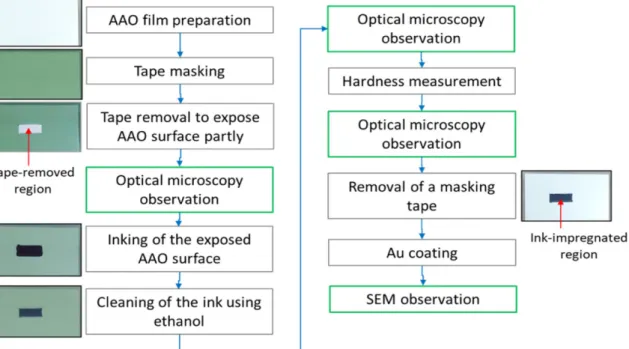
Thickness of the anodic oxide film was obtained to be about 32 µm. After the anodizing treatment, the samples are washed in a stream of tap water and dried with an air gun. The anodic oxide film was masked by a tape with an exposure area of about 2 mm × 5 mm area, as shown in Fig. 1, and then oxide film surface morphology was observed by an optical microscope equipped in a microhardness tester (V-Test II, Bareiss). After observation by optical microscopy, the exposed aluminum anodic oxide (AAO) surface was impregnated with an oil–

based ink using an oil pen. The inked AAO surface was dried and cleaned by a tissue with ethanol. The ink on the AAO surface was completely removed but the ink impregnated into the AAO film was remaining, as shown in Fig. 1. The inked AAO surface was observed again by an optical microscope and then indentation hardness was measured by the microhardness tester using a pyramidal-diamond penetrator under a load of 100g. After the hardness measurement and surface observation, the masking tape was removed from the surface, coated with Au

Fig. 1. Experimental procedure for the observation of surface morphology and hardness measurement of anodic

oxide films on AA2024, based on an ink-impregnation method.

(3)

by sputter coater (Cressington 108 auto) and then the same surface area was observed by SEM (Scanning Electron Microscopy, JSM-6610LV). Fig. 1 represent the detailed procedure used in this work for the observation of the surface morphologies and measurement of surface hardness of anodic oxide films.

3. Results and Discussion

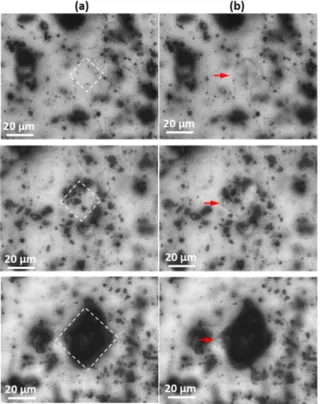
The surface morphologies of anodic oxide films formed on AA2024 are observed by an optical microscope before and after indentation hardness measurement and the results are exhibited in Fig. 2.

Dotted white diamond shape lines in Fig. 2(a) represent the regions to be indented for the hardness measurement, which is corresponding to the indented regions in Fig. 2(b), as indicated by red arrows. The pyramidal indentation mark was not clearly visible on the as-prepared surface of anodic oxide film (Fig.

2(b)). The size of pyramidal indentation marks is dependent on the region with and without dark imperfections. The smallest size of the indentation

mark was obtained from the regions with little imperfections. Larger size of the indentation mark was observed in the region with bigger size of dark defects. It is apparent that the size of indentation marks becomes larger with increasing portion of dark defects within the indented regions, indicating lowered hardness with increasing the portion of imperfections in the anodic oxide films.

In order to measure indentation hardness precisely on the surface of anodic oxide films on aluminum alloys, it is essential to distinguish an indentation mark. In a preceding paper [12], we presented two methods for the measurement of indentation hardness on the anodic oxide film surface. One is to coat the anodic oxide film surface with thin Au layer less than 0.1 µm. The other one is to impregnate oil- based ink into pores in the anodic oxide film and then to clean the ink on the surface using ethanol.

The ink-impregnation method is very cheap, simple and convenient, and allows clear observation of imperfections in the anodic oxide film, as can be seen in Fig. 3. The oxide surface is darkened and boundaries of imperfections become more clearly visible by the ink-impregnation. Observation of the ink-impregnated anodic oxide film using an optical microscope provides that a number of imperfections not only on the oxide surface but also within the anodic oxide film are distinguishable. Large size imperfections present within the anodic oxide films, not

Fig. 2. Optical microscope images of anodic oxide films on AA2024 (a) before and (b) after indentation using a pyramidal-diamond penetrator under a load of 100g for indentation hardness measurement. The anodic films were formed for 25 min at 40 mA/cm

2

, 15±0.5

o

C and 300 rpm of magnet stirring rate in 20%

H

2

SO

4

solution.

Fig. 3. (a, b, c) Optical microscope images and (d)

SEM image of the anodic oxide film on AA2024 (a)

before and (b, c) after ink-impregnation. The anodic

film was formed for 25 min at 40 mA/cm

2

, 15±0.5

o

C

and 300 rpm of magnet stirring rate in 20% H

2

SO

4

solution and indentation hardness was measured

using a pyramidal-diamond penetrator under a load of

100 g after an ink-impregnation.

(4)

exposed to the surface, are also detectable by the ink- impregnation method, as indicated by a, b and c in Fig.

3. However, observation of the ink-impregnated anodic

oxide film by SEM allows only to find surface imperfections like open pores, indicated by red arrows in Fig. 3(d). An indentation mark of pyramidal shape becomes clearly visible as black color on an optical image (Fig. 3(c)) because of the impregnated ink.

In this work, four different regions were found in the anodic oxide films on AA2024: region I with a large size black defect; region II with a large size grey defect; region III with small size black and grey defects; region IV with little defects, as exhibited in Fig. 4. Typical optical microscope images of the region I with a large size black defect are presented in Fig. 5 before and after indentation by pyramidal penetrator. The dashed white lines in Fig. 5 represent the regions to be indented. The size of the indentation mark appeared to be proportional to the size of the black defect, indicating lowered hardness by the black defect in the anodic oxide film. It is also noticed that the pyramidal shape of indentation marks was distorted in the region with a large size black defect, as can be seen in upper and lower samples in Fig. 5. The distortion of the indentation Fig. 4. Optical microscope images of four different

regions of anodic oxide films on AA2024 observed after an ink impregnation. The anodic films were formed for 25 min at 40 mA/cm

2

, 15±0.5

o

C and 300 rpm of magnet stirring rate in 20% H

2

SO

4

solution.

Fig. 5. Optical microscope images of large size black defects (a) before and (b) after indentation using a pyramidal-diamond penetrator under a load of 100 g after an ink-impregnation of anodic oxide films on AA2024. The anodic films were formed for 25 min at 40 mA/cm

2

, 15±0.5

o

C and 300 rpm of magnet stirring rate in 20% H

2

SO

4

solution.

Fig. 6. Optical microscope images of large size grey

defect (a) before and (b) after indentation by a

pyramidal-diamond penetrator under a load of 100 g

after an ink-impregnation of anodic oxide films on

AA2024. The anodic films were formed for 25 min at

40 mA/cm

2

, 15±0.5

o

C and 300 rpm of magnet stirring

rate in 20% H

2

SO

4

solution.

(5)

mark suggests uneven hardness values around a large size back defect in the anodic oxide films on AA2024.

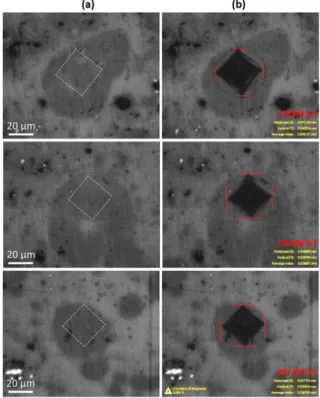
Fig. 6 depicts indentation marks in the region II with a large size grey defect in the anodic oxide film on AA2024. The shapes of pyramidal indentation marks are a little bit distorted and radial cracks were formed around the indentation mark. Radial crack formation upon Vickers indentation has been reported in silicon nitride ceramics [13]. On the other hand, crack formation at the tip of the pyramidal indentation marks were reported in anodic oxide films formed on aluminum alloy in sulfuric acid and oxalic acid solutions [14]. In this work, cracks at the indented edge on the AAO film were not found and only large size grey defects resulted in the formation of radial cracks. To understand the reasons why the redial crack is formed outside of the plastic zine of the large size grey defect and why cracks are not generated at the tip of the indentation marks, further studies are necessary based on the stress evolutions within the anodic oxide films during loading and unloading processes.

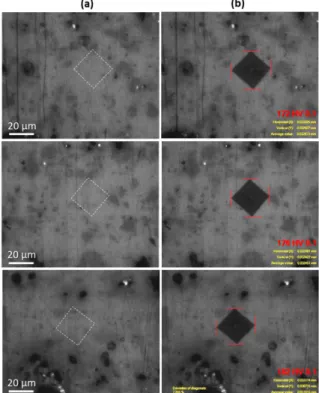
Fig. 7 displays indentation marks in the region III with small size grey/black defects less than 10 µm in the anodic oxide film. Surface hardness of the anodic oxide film increased with decreasing the portion of dark/grey defect in the area to be indented, as indicated by dashed white diamond in the images before the indentation. The region of the anodic oxide films without detectable defects showed the highest values of hardness, as shown in Fig. 8. No cracks were observed around the indented region III with small size grey/black defects and region IV without visible grey/black defects.

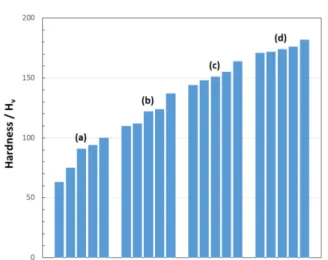
Indentation hardness of anodic oxide films was observed to crucially depend on the type of defects in the oxide film, as presented in Fig. 9. The hardness of anodic oxide film with a large size black defect was obtained to be the lowest values between 60 and 100 H

v

. The oxide film with large size grey defects showed a little bit higher surface hardness between 100 and 140 H

v

than those of large size black defects. The surface region in the anodic oxide film with mall size black and/or grey defects revealed much higher values of indentation hardness

Fig. 7. Optical microscope images of small size defects (a) before and (b) after indentation by a pyramidal-diamond penetrator under a load of 100 g after an ink-impregnation of anodic oxide films on AA2024. The anodic films were formed for 25 min at 40 mA/cm

2

, 15±0.5

o

C and 300 rpm of magnet stirring rate in 20% H

2

SO

4

solution.

Fig. 8 Optical microscope images of the region without

visible defects (a) before and (b) after indentation by a

pyramidal-diamond penetrator under a load of 100g

after an ink-impregnation of anodic oxide films on

AA2024. The anodic films were formed for 25 min at

40 mA/cm

2

, 15±0.5

o

C and 300 rpm of magnet stirring

rate in 20 % H

2

SO

4

solution.

(6)

than 140 up to 170 H

v

and the highest values of surface hardness were measured on the surface region without visible defects in the anodic oxide film, ranging from 170 to 190 H

v

. Considering that brightness of optical microscope images is determined by the reflected light intensity from the metal/oxide interface through the anodic films, it seems reasonable to conclude that darker region of the anodic oxide films arises from imperfections present within the anodic films, such as irregularly distorted structure of pores or more vacant spaces. Black and grey defects in the anodic oxide films on aluminum alloys may arise from irregular anodic dissolution of second- phase particles in the alloy. Detailed study on the formation of the black and grey defects in anodic oxide films will be investigated in the following research work.

4. Conclusions

The present work was performed to investigate type of defects present in anodic oxide films formed on AA2040 in 20% sulfuric acid solution and their effects on the hardness of the anodic films using an ink-impregnation method. The pyramidal indentation mark on the anodic oxide film surface was not clearly distinguishable on the as-prepared surface on optical microscope images. An ink-impregnation of the anodic films provides that boundaries of imperfections in the anodic films are clearly

distinguishable, and imperfections within the anodic oxide films, not exposed to the surface, are detectable in the optical microscope image. An indentation mark of pyramidal shape became clearly visible as black color in an optical image after the ink-impregnation. There were observed four different regions in the anodic oxide films on AA2024: region I with a large size black defect, showing the lowest hardness values between 60 and 100 H

v

; region II with a large size grey defect, showing the surface hardness values between 100 and 140 H

v

; region III with small size black and grey defects having relatively higher values of hardness than 140 up to 170 H

v

; region IV without defects, showing the highest values of surface hardness, ranging from 170 to 190 H

v

. The pyramidal indentation marks were observed to be distorted in the regions with a large size black and grey defects due to uneven porous structure around the imperfections, while no distortion of the indentation mark was observed on the regions with small size defects and without visible defects. Radial cracks around the indentation mark were only observed in the region II with large size grey defects.

Acknowledgement

We would like to acknowledge the financial support from the R&D Convergence Program of NST (National Research Council of Science &

Technology) of Republic of Korea.

References

[1] Sanghyuck Moon, Sungmo Moon and Sugun Lim, Formation Characteristics of Hard Anodizing Films on 6xxx Aluminum Alloys, J. Kor. Inst. Surf.

Eng. 52 (2019) 203-210.

[2] Sungmo Moon, Anodic Oxidation Treatment Methods of Metals, J. Kor. Inst. Surf. Eng. 51 (2018) 1-10.

[3] Sungmo Moon, Kihun Jeong, Sugun Lim.

Formation Behavior of Anodic Oxide Films on Al 6061 Alloy in Sulfuric Acid Solution, J. Kor.

Inst. Surf. Eng. 51 (2018) 393-399.

[4] Sungmo Moon, Cheolnam Yang and Sangjo Na, Formation Behavior of Anodic Oxide Films on Al7075 Alloy in Sulfuric Acid Solution, J. Kor.

Inst. Surf. Eng. 47 (2014) 155-161.

[5] S. Moon, Y. Nam, Anodic oxidation of Mg-Sn alloys in alkaline solutions, Corrosion Science 65 (2012) 494-501.

Fig. 9. Plot of indentation hardness (H

v

) of anodic

oxide films on AA2024 measured under a load of 100g

in different regions with (a) large size black defect, (b)

large size grey defect, (c) small size defects and (d)

without visible defects. The anodic films were formed

for 25 min at 40 mA/cm

2

, 15±0.5

o

C and 300 rpm of

magnet stirring rate in 20% H

2

SO

4

solution.

(7)

[6] Fan Zhang, Cem Ornek, Jan-Olov Nilsson, Jinshan Pan, Anodisation of aluminium alloy AA7075 – Influence of intermetallic particles on anodic oxide growth, Corrosion Science 164 (2020) 108319- 108322.

[7] Massimiliano Bononi, Roberto Giovanardi, Andrea Bozza, Paolo Mattioli, Pulsed current effect on hard anodizing process of 2024-T3 aluminium alloy, Surface and Coatings Technology 289 (2016) 110-117.

[8] Jieqin Lu, Guoying Wei, Yundan Yu, Changfa Guo, Li Jiang, Aluminum alloy AA2024 anodized from the mixed acid system with enhanced mechanical properties, Surfaces and Interfaces 13 (2018) 46-50.

[9] T. Aerts, Th. Dimogerontakis, I. De Graeve, J.

Fransaer, H. Terryn, Influence of the anodizing temperature on the porosity and the mechanical properties of the porous anodic oxide film, Surface

& Coatings Technology 201 (2007) 7310-7317.

[10] Moonsu Kim, Hyeonseok Yoo, Jinsub Choi, Non- nickel-based sealing of anodic porous aluminum

oxide in NaAlO

2

, Surface & Coatings Technology 310 (2017) 106-112.

[11] Tatsuya Kikuchi, Akimasa Takenaga, Shungo Natsui, Ryosuke O. Suzuki, Advanced hard anodic alumina coatings via etidronic acid anodizing, Surface and Coatings Technology 326 (2017) 72- 78.

[12] Sungmo Moon, Novel Methods for Measuring the Surface Hardness of Anodic Oxide Films on Aluminum Alloy, J. Kor. Inst. Surf. Eng. 53 (2020) 36-42.

[13] T. Vuherer, L. Milovic, V. Glih, Behaviour of small cracks during their propagation from Vickers indentations in coarse-grain steel: An experimental investigation, International Journal of Fatigue 33 (2011) 1505-1513.

[14] P. Ramana Reddy, K. M. Ajith, N. K.

Udayashankar, Micro and nano indentation analysis

of porous anodic alumina prepared in oxalic and

sulphuric acid, Ceramics International 42 (2016)

17806-17813.

수치

Fig. 1. Experimental procedure for the observation of surface morphology and hardness measurement of anodic oxide films on AA2024, based on an ink-impregnation method.
Fig. 2. Optical microscope images of anodic oxide films on AA2024 (a) before and (b) after indentation using a pyramidal-diamond penetrator under a load of 100g for indentation hardness measurement
Fig. 6. Optical microscope images of large size grey defect (a) before and (b) after indentation by a pyramidal-diamond penetrator under a load of 100 g after an ink-impregnation of anodic oxide films on AA2024
Fig. 6 depicts indentation marks in the region II with a large size grey defect in the anodic oxide film on AA2024
+2

참조

관련 문서