Kor. J. Hort. Sci. Technol. 31(2):231-238, 2013 DOI http://dx.doi.org/10.7235/hort.2013.12177
Characterization of Lipophilic Nutraceutical Compounds in Seeds and Leaves of Perilla frutescens
Seungduk Um
1,2,3†, Shiva Ram Bhandari
4,5†, Nam-Hoon Kim
1,2,3, Tae-Jin Yang
1,2,3, Ju Kyoung Lee
6,7, and Young-Sang Lee
4*1
Department of Plant Science, Seoul National University, Seoul 151-921, Korea
2
Plant Genomics and Breeding Institute, Seoul National University, Seoul 151-921, Korea
3
Research Institute for Agriculture and Life Sciences, Seoul National University, Seoul 151-921, Korea
4
Department of Medical Biotechnology, Soonchunhyang University, Asan 336-745, Korea
5
Department of Horticultural Crop Research, National Institute of Horticultural & Herbal Science, Rural Development Administration, Suwon 440-706, Korea
6
Department of Applied Plant Sciences, Kangwon National University, Chuncheon 200-701, Korea
7
College of Agriculture and Life Sciences, Kangwon National University, Chuncheon 200-701, Korea
Abstract. Perilla frutescens, which comprises var. frutescens and var. crispa, has been cultivated traditionally in Asian countries as an edible oil, leaf vegetable, and medicinal crop. To evaluate the lipophilic phytonutrient properties of P. frutescens, we selected 54 Perilla accessions [19 landraces of var. frutescens (FL), 22 weedy type var. frutescens (FW), 9 weedy type var. crispa (CW), 2 cultivars of var. frutescens widely cultivated for seed oil (FCS), and 2 cultivars of var. frutescens cultivated as a leaf vegetable (FCL)] and analyzed their seeds and leaves for vitamin E, squalene, and phytosterols. Among the four vitamin E isomers analyzed, γ-tocopherol was the major form of vitamin E in seeds, whereas α-tocopherol was the major form in leaves of all types of P. frutescens. The highest total vitamin E content in seeds was present in FL (170.0 mg・kg
-1), whereas that in leaves was highest in FCL (358.1 mg・kg
-1). The highest levels of squalene in seeds and leaves were in FL (65.5 mg・kg
-1) and CW (719.3 mg・kg
-1), respectively. Among the three phytosterols, β -sitosterol occurred in the highest amount in both leaves and seeds of all of the crop types. Phytonutrient contents were comparatively higher in leaves than in seeds of all crop types. All of these results suggest that the consumption of leaves and seeds of Perilla crops could be beneficial to human health, as Perilla possesses considerable amounts of various lipophilic compounds.
Additional key words: Perilla var. crispa, phytosterol, squalene, vitamin E
*Corresponding author: [email protected]
†
These authors contributed equally to this research work.
※ Received 13 September 2012; Revised 27 November 2012; Accepted 29 November 2012. This work was supported in part by the Soonchunhyang University Research Fund (20110694: Reveleris iES Flash Chromatography).
Introduction
Perilla frutescens (L.) Britt. (Labiatae) is a self-fertilizing annual plant that is widely cultivated and distributed in the Himalayan hills, Southeast Asia, and East Asia (Makino, 1961; Nitta, 2001). Recently, it has been also grown in various other countries, including the United States, European nations, and Russia (Nitta and Ohnishi, 1999; Nitta et al., 2003). The species includes two cultivated varieties of Perilla that are characterized on the basis of morphology and use. P.
frutescens var. frutescens is an oil crop, which is known as ren in Chinese, deulkkae in Korean, and egoma in Japanese, whereas P. frutescens var. crispa is a Chinese medicinal or vegetable crop called zisu in Chinese, cha-jo-ki in Korean, and shiso in Japanese (Lee et al., 2002). In addition to those two cultivated types of Perilla, weedy plants of both var.
frutescens and var. crispa (Lee and Ohnishi, 2001; Nitta and
Ohnishi, 1999) are commonly found in habitats such as
roadsides, wastelands, abandoned fields, and marginal lands
around farm fields in East Asia. The two cultivated types of
Perilla are distinguished by several morphological features. P.
frutescens var. frutescens is tall and has large seeds (> 2 mm), which are either soft or hard, green leaves and stems, unwrinkled leaves, and a fragrance specific to var. frutescens.
In contrast, P. frutescens var. crispa is short and has small seeds (< 2 mm), which are hard, either red or green leaves and stems, either wrinkly or non-wrinkly leaves, and a fragrance specific to var. crispa (Lee and Ohnishi, 2001). The plant is occasionally found in a relict form in Korea (Lee and Ohnishi, 2001). P. frutescens var. frutescens is widely cultivated and used in Korea (Lee et al., 2002; Nitta, 2001; Nitta et al., 2003) and believed to have originated in southern China, where a wild type of this plant is widely distributed (Lee and Ohnishi, 2003; Makino, 1960; Nitta et al., 2003). In Korea, var.
frutescens has been one of the most important oil crops since ancient times. Var. frutescens has been a vegetable crop, and its seed oil has been used as both edible and industrial oil, including for lamp oil, waterproofing umbrella paper and other rain gear, and as a lacquer for wooden furniture, wooden vessels, and other household items (Choi, 1984). The seeds of var. frutescens have also been used as a folk medicine for inveterate gastritis and cough and as a restorative (Choi, 1984). Recently, considerable attention has been given to the anti-inflammatory, anti-allergic, and anti-tumor promoting substances contained in beefsteak plants (Makino et al., 2003;
Ueda et al., 2002). With the increase of meat consumption and development of various methods for cooking the fresh leaves, var. frutescens is used not only as a seed oil crop but also as a leafy vegetable crop and has become one of the most important crops in Korea.
Vitamin E, phytosterols, and squalene are the chief phytonutrients found in the unsaponifiable lipid fraction of crop seeds. Vitamin E, which consists of the four isomers α-, β-, γ-, and δ- tocopherol, is a well-known natural antioxidant.
By inhibiting membrane lipid peroxidation and scavenging reactive oxygen species (Kruk et al., 2005; Munne-Bosch and Alegre, 2002; Trebst et al., 2002), vitamin E is believed to reduce the risk of cardiovascular diseases and certain types of cancers (Burton, 1994; Burton and Traber, 1990). Phytosterols, primarily β-sitosterol, campesterol, and stigmasterol, are integral components of plant cell membranes and are found abundantly in vegetable oils, nuts, seeds, and grains (Weihrauch and Gardner, 1978). Phytosterols are mainly known for lowering
serum cholesterol (Marangoni and Poli, 2010) and preventing the development of colon cancer (Awad and Fink, 2000) and for their atherosclerotic (Moghadasian et al., 1999), anti-inflammatory (Bouic, 2001), and anti-oxidative effects (van Rensburg et al., 2000). Squalene, a hydrocarbon, is a key intermediate in cholesterol biosynthesis (Moreda et al., 2001) and is abundant in shark liver oil (Squalus spp.) and olive oil.
It possesses antitumor, anti-proliferative, and serum-cholesterol- lowering effects (Khor and Chieng, 1997), along with chemopreventive activity against colon carcinogenesis (Rao et al., 1998).
In this study, we collected various germplasms of Perilla crops and weedy types from different places in Korea and evaluated vitamin E isomers, squalene, and phytosterols in seeds and leaves to develop a highly nutritive variety.
Materials and Methods
Plant Materials
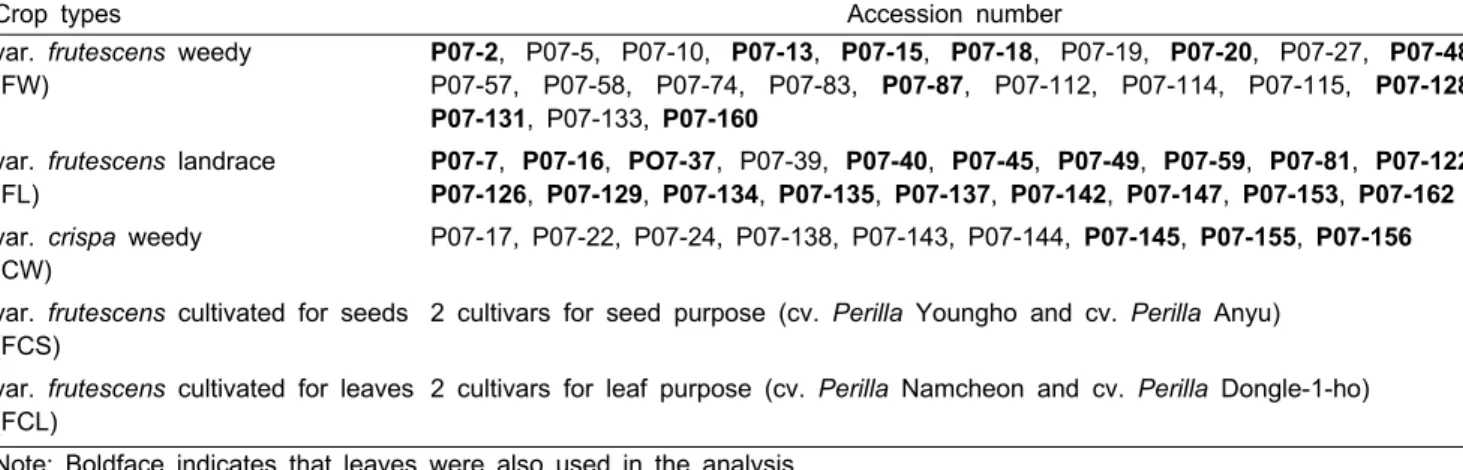
The materials used in this study consisted of 54 Perilla accessions, including 19 landrace accessions of var. frutescens (FL), 22 accessions of weedy type var. frutescens (FW), 9 accessions of weedy type var. crispa (CW), and 4 cultivars of var. frutescens, of which 2 were leafy vegetable crops (FCL) and 2 were seed oil crops (FCS). The 54 accessions of cultivated and weedy Perilla types (Table 1) were collected in Korea during October-November 2007 and 2008. We visited more than 30 villages and interviewed numerous farmers about the cultivation and utilization of Perilla crops. We also searched for natural distributions of weedy types of Perilla in farm fields, roadsides, wastelands, abandoned fields, and areas around farmhouses. The collected Perilla samples were classified into cultivated or weedy types based on morphological characters and cultivation conditions (cultivated or not). Four widely cultivated cultivars of var.
frutescens developed by the National Institute of Crop Science, Rural Development Administration of Korea, were used as references. To propagate the seeds of the 54 accessions of cultivated and weedy Perilla types, five individuals of each accession were grown in a field at the Faculty of Agriculture, Kangwon National University, Chuncheon, Gangwon Province.
For analysis in this study, 10 g of seeds harvested in 2007 from
each accession was used. To analyze the leaf constituents and
correlate these with their quantities in seeds, the same
Table 1. Seeds of Perilla frutescens used in this study.
Crop types Accession number
var. frutescens weedy (FW)
P07-2, P07-5, P07-10, P07-13, P07-15, P07-18, P07-19, P07-20, P07-27, P07-48, P07-57, P07-58, P07-74, P07-83, P07-87, P07-112, P07-114, P07-115, P07-128, P07-131, P07-133, P07-160
var. frutescens landrace (FL)
P07-7, P07-16, PO7-37, P07-39, P07-40, P07-45, P07-49, P07-59, P07-81, P07-122, P07-126, P07-129, P07-134, P07-135, P07-137, P07-142, P07-147, P07-153, P07-162 var. crispa weedy
(CW)
P07-17, P07-22, P07-24, P07-138, P07-143, P07-144, P07-145, P07-155, P07-156
var. frutescens cultivated for seeds (FCS)
2 cultivars for seed purpose (cv. Perilla Youngho and cv. Perilla Anyu)
var. frutescens cultivated for leaves (FCL)
2 cultivars for leaf purpose (cv. Perilla Namcheon and cv. Perilla Dongle-1-ho)
Note: Boldface indicates that leaves were also used in the analysis.
accessions were planted by direct seeding in June 2008 on the agricultural research farm of Seoul National University, Suwon, Korea. In September, 40 g of healthy leaves was harvested from 35 well-grown accessions and lyophilized using a freeze-dryer (IlShin BioBase, Korea). The seeds and leaves were then ground into fine powder and stored at -20°C for further analysis.
Sample Preparation for Analysis of Tocopherols, Phyto- sterols, and Squalene
Samples for the analysis of tocopherols, phytosterols, and squalene were prepared according to Bhandari et al. (2012) with some modifications. Dry powdered Perilla seeds and leaves (1.0 g) were placed in a 50 mL Falcon tube and extracted with 15 mL ethanol using 100 mg ascorbic acid as an antioxidant. The mixture was shaken in a hot-water bath at 80°C for 10 min. Then, for saponification, 300 µL 44%
potassium hydroxide was added, and the mixture was shaken for 18 min under the same conditions. After saponification, each tube was cooled in ice, and 10 mL of n-hexane and 10 mL of distilled water were added and mixed, and the mixture was centrifuged at 1900 × g for 10 min. The upper hexane layer was then collected, and 10 mL n-hexane was added to the remaining solution. This process was repeated three times, with the collected hexane solutions pooled and then washed three times with 10 mL distilled water. The solutions were passed through Na
2SO
4anhydrous to remove water, concentrated in a rotary evaporator, and redissolved in 1 mL isooctane.
Analysis of Tocopherols, Squalene, and Phytosterols Four vitamin E isomers (α-, β-, γ-, and δ- tocopherols),
squalene, and three phytosterols (campesterol, stigmasterol, and β-sitosterol) were quantified using a gas chromatograph (Varian 3800; Varian Inc., Palo Alto, CA, USA) according to Bhandari et al. (2012) The analysis was performed using a CP-SIL 8CB capillary column (25.0 m × 250 µm × 0.40 µm nominal) at a constant flow rate (1.0 mL・min
-1) of helium as a carrier gas. The injection volume was 1 µL, and the split ratio was 1:20. The temperature for the injector and flame ionization detector was set at 290°C. The column oven temperature was initially set at 220°C for 2 min, then raised to 290°C at a rate of 5ºC・min
-1and held for 14 min, after which the temperature was raised to 310°C. All of the vitamin E, squalene, and phytosterols peaks were identified by comparison to the retention time of authentic standard peaks.
Standard Solution Preparation
External standard solutions of the four vitamin E isomers were prepared by dissolving the authentic standards separately in isooctane to prepare 1,000 ppm stock solutions. Later, they were mixed and diluted to proper concentrations. Similarly, standard stock solutions of squalene and the phytosterols were separately dissolved in isooctane and chloroform, respectively, and further diluted to the desired concentrations.
Chemicals and Reagents
Vitamin E standards (α-, β-, γ-, and δ-tocopherol) were
purchased from Merck (Darmstadt, Germany). Squalene,
stigmasterol, β-sitosterol, and campesterol were obtained
from Sigma-Aldrich (St. Louis, MO, USA). Ascorbic acid,
chloroform, and anhydrous sodium sulfate were acquired
from Samchun (Seoul, Korea), potassium hydroxide was
Table 2. Descriptive statistics of vitamin E isomer contents (mg・kg
-1) in seeds and leaves of Perilla frutescens.
Crop Type Descrip- tives
Seeds Leaves
α-T
zβ-T γ-T δ-T Total -T α-T β-T γ-T Total-T
var.
frutescens
weedy type (FW)
Minimum 2.7 1.3 112.1 2.4 126.5 62.3 0.9 0.6 63.8
Maximum 12.1 10.7 187.5 6.1 204.9 364.2 2.4 4.1 368.1
Mean 6.8 5.7 135.4 4.6 150.1 244.6 1.6 1.4 247.7
SD
y3.1 2.5 18.7 1.0 18.8 98.9 0.6 1.0 100.0
CV (%)
x45.6 43.9 13.8 21.7 12.5 40.4 37.5 71.4 40.4
var.
frutescens
landrace (FL)
Minimum 8.5 1.4 124.5 2.5 140.5 172.0 0.9 0.8 173.6
Maximum 13.3 8.9 189.9 6.2 203.3 614.0 3.2 4.9 620.0
Mean 10.3 5.0 151.9 4.5 170.0 308.0 2.0 1.8 311.7
SD 1.4 3.1 21.7 1.1 21.0 113.3 0.5 0.9 114.2
CV (%) 13.6 62.0 14.3 24.4 12.4 36.8 25.0 50.0 36.6
var. crispa weedy type (CW)
Minimum 4.4 1.8 105.2 3.4 117.6 243.4 1.5 0.6 245.5
Maximum 6.9 10.1 137.9 6.7 161.0 318.6 2.1 1.8 322.5
Mean 6.0 4.1 120.9 4.7 135.7 274.9 1.7 1.4 278.1
SD 0.8 3.1 11.8 1.2 14.7 39.0 0.3 0.7 39.8
CV (%) 13.3 75.6 9.8 25.5 10.8 14.2 17.6 50.0 14.3
FCS Mean 5.7 1.2 134.6 3.7 145.2 291.2 2.0 2.2 295.3
SD 0.2 0.2 5.5 0.3 6.2 92.1 0.4 0.3 92.8
FCL Mean 11.1 1.3 144.8 2.3 159.4 354.0 2.1 2.1 358.1
SD 0.1 0.1 12.1 1.7 13.9 112.2 0.3 0.8 111.7
Mean 8.0 3.5 137.5 4.0 152.1 294.5 1.9 1.8 298.2
z
T: Tocopherol.
y
SD: Standard deviation.
x
CV: Coefficient of variation.
purchased from Daejung (Seoul, Korea), and ethanol was obtained from Duksan Chemicals (Seoul, Korea). Hexane (HPLC grade) and isooctane (2,2,4-trimethyl pentane; HPLC grade) were purchased from J.T. Baker (Phillipsburg, NJ, USA).
Statistical Analysis
For quantitative studies, at least three independent sample extraction replications were conducted. Descriptive statistical analyses were performed using SPSS (ver. 18; SPSS, Inc., Chicago, IL, USA) at a significance level of P = 0.05.
Results and Discussions
Vitamin E Content
Vitamin E analysis of all types of P. frutescens evaluated in this study showed that only tocopherols were present in both seeds and leaves (Table 2). Seeds of all types of P. frutescens exhibited the highest γ-tocopherol content among the four
tocopherol isomers (α-, β-, γ-, and δ-tocopherol). Similar results have previously been observed in Perilla seeds (Park et al., 2004; Shin and Kim, 1994), however, in these cases, only one variety was used, and the name was not clearly identified.
FL showed a higher level of seed vitamin E (170.1 mg・kg
-1) than FW, CW, or the two var. frutescens cultivars developed for seed (FCS) and leaf (FCL) purposes by the National Institute of Crop Science of the Rural Development Administration of Korea. Among accessions of the same type, highest total vitamin E content in seed was observed in accessions PO7-128 (204.9 mg・kg
-1), PO7-59 (203.3 mg・
kg
-1), PO7-24 (161.0 mg・kg
-1) in FW, FL, and CW types, respectively. The average seed vitamin E content in Perilla crops (152.1 mg・kg
-1) was higher than that in various other seed oil crops, such as linseed (83.0 mg・kg
-1), mustard (69.0 mg・kg
-1), and sesame (100.0 mg・kg
-1) (Ryan et al., 2007).
Similarly, Bhandari et al. (2011) reported 132.5 mg・kg
-1total
vitamin E content in seeds of 12 var. crispa landraces collected
in Korea and Japan. In contrast to the varying γ-tocopherol
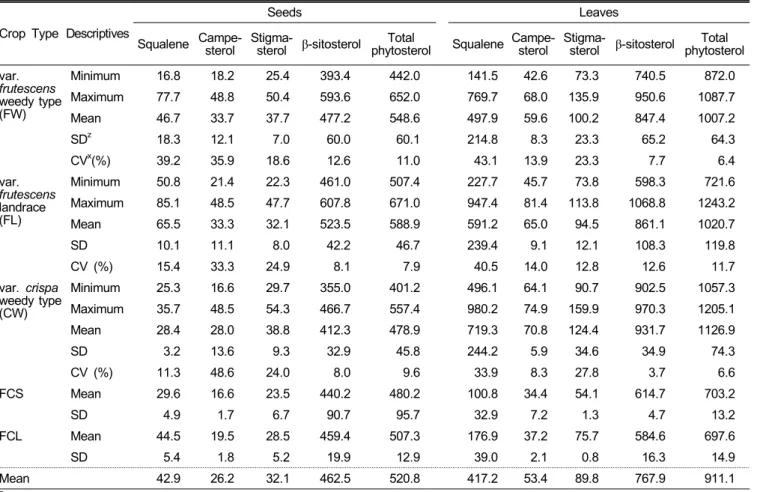
Table 3. Descriptive statistics of squalene and phytosterols (campesterol, stigmasterol, and β-sitosterol) contents (mg・kg
-1) in seeds and leaves of Perilla frutescens.
Crop Type Descriptives
Seeds Leaves
Squalene Campe- sterol Stigma-
sterol β-sitosterol Total
phytosterol Squalene Campe- sterol Stigma-
sterol β-sitosterol Total phytosterol var.
frutescens
weedy type (FW)
Minimum 16.8 18.2 25.4 393.4 442.0 141.5 42.6 73.3 740.5 872.0
Maximum 77.7 48.8 50.4 593.6 652.0 769.7 68.0 135.9 950.6 1087.7
Mean 46.7 33.7 37.7 477.2 548.6 497.9 59.6 100.2 847.4 1007.2
SD
z18.3 12.1 7.0 60.0 60.1 214.8 8.3 23.3 65.2 64.3
CV
x(%) 39.2 35.9 18.6 12.6 11.0 43.1 13.9 23.3 7.7 6.4
var.
frutescens
landrace (FL)
Minimum 50.8 21.4 22.3 461.0 507.4 227.7 45.7 73.8 598.3 721.6
Maximum 85.1 48.5 47.7 607.8 671.0 947.4 81.4 113.8 1068.8 1243.2
Mean 65.5 33.3 32.1 523.5 588.9 591.2 65.0 94.5 861.1 1020.7
SD 10.1 11.1 8.0 42.2 46.7 239.4 9.1 12.1 108.3 119.8
CV (%) 15.4 33.3 24.9 8.1 7.9 40.5 14.0 12.8 12.6 11.7
var. crispa weedy type (CW)
Minimum 25.3 16.6 29.7 355.0 401.2 496.1 64.1 90.7 902.5 1057.3
Maximum 35.7 48.5 54.3 466.7 557.4 980.2 74.9 159.9 970.3 1205.1
Mean 28.4 28.0 38.8 412.3 478.9 719.3 70.8 124.4 931.7 1126.9
SD 3.2 13.6 9.3 32.9 45.8 244.2 5.9 34.6 34.9 74.3
CV (%) 11.3 48.6 24.0 8.0 9.6 33.9 8.3 27.8 3.7 6.6
FCS Mean 29.6 16.6 23.5 440.2 480.2 100.8 34.4 54.1 614.7 703.2
SD 4.9 1.7 6.7 90.7 95.7 32.9 7.2 1.3 4.7 13.2
FCL Mean 44.5 19.5 28.5 459.4 507.3 176.9 37.2 75.7 584.6 697.6
SD 5.4 1.8 5.2 19.9 12.9 39.0 2.1 0.8 16.3 14.9
Mean 42.9 26.2 32.1 462.5 520.8 417.2 53.4 89.8 767.9 911.1
z
SD: Standard deviation.
x