Determination of Optimum Threshold for Accuracy of People-counting System Based on Motion Detection
Hanseul Ryu*, Junho Song*, Boram Lee**, and Kiyoung Lee**
,***
†*Intern program, Built Environment Science and Technology Laboratory, Graduate School of Public Health, Seoul National University
**Department of Environmental Health Graduate School of Public Health, Seoul National University
***Institute of Health and Environment, Seoul National University
ABSTRACT
Objectives: A people-counting system measures real-time occupancy through motion detection. Accurate people- counting can be used to calculate suitable ventilation demands. This study determined the optimum motion threshold for a people-counting system.
Methods: In a closed room with two occupants moving constantly, different thresholds were tested for the accu- racy of a people-counting system. The experiments were conducted at 150, 300, 450 and 600 lux. These levels of brightness included the illumination levels of most public indoor areas. The experiments were repeated with three types of clothing coloration.
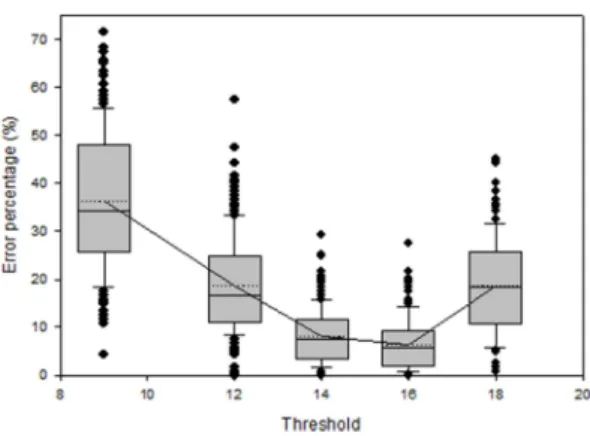
Results: Overall, a threshold of 16 provided the lowest mean error percentage for the people-counting system.
Brightness and clothing color did not have a significant impact on the results.
Conclusion: A people-counting system could be used with threshold of 16 for most indoor environments.
Keywords: Accuracy test, environmental health service, IAQ management, motion detection, people counting
I. Introduction
Maintenance of proper indoor environmental quality (IEQ) in buildings requires high efficiency of ventilation.
1,2)Various studies have shown that carbon dioxide concentration provides the most precise measure of IEQ, since CO
2is closely associated with occupant density.
3,4)Therefore, the most widely studied form of demand controlled ventilation (DCV) was based on CO
2.
5-9)DCV can conserve energy by adjusting the ventilation rate based on actual need. However, due to variables such as air circulation in multi-room buildings and gas dissipation rate, CO
2concentration was often not an exact indicator for ventilation demand in a specific area.
10-15)For better efficiency of DCV, a people-counting
system was proposed to determine the real-time ventilation rate. Appropriate ventilation rate could be calculated by CO2 emission rate per person, if number of resident can be measured. Therefore, a people-counting system can provide most efficient ventilation rate instantly. In addition, ventilation can be operated only when there are people in the space.
Such demand controlled ventilation system can provide clean air with less energy consumption.
However, there is no automatic people-counting system available.
For DCV, a people-counting system was developed to directly measure real-time occupancy in closed areas through motion detection. It provided a rapid calculation of ventilation demand in a certain location. Various factors, including brightness of the area and clothing color of occupants, could influence
†