대도시에 거주하는 여성의 모유 중 Indicator PCBs와 식이습성 및 인구통계학적 인자간의 관계
위성욱·김기호*·조봉희·조유진·윤조희·민병윤† 경남대학교 환경공학과, *경남대학교 공동기기원 (2010. 4. 21. 접수/2010. 5. 29. 수정/2010. 6. 18. 채택)
The Relationship among the Indicator PCBs in Breast Milk and Dietary Habits and Demographic Factors in Women
Living in Urban Areas
Sung-Ug We · Ki-Ho Kim* · Bong-Hui Cho · Yu-Jin Cho · Cho-Hee Yoon · Byung-Yoon Min† Department of Environmental Engineering, Kyungnam University, Masan, Korea
*Center for Instrumental Analysis, Kyungnam University, Masan, Korea (Received April 21, 2010/Revised May 29, 2010/Accepted June 18, 2010)
ABSTRACT
In this study, breast milk levels of indicator polychlorinated biphenyls (PCBs) were estimated, and statistics drawn, for 22 Koreans in the general population, aged 26-38, who had resided in metropolitan areas for more than 5 years without occupational exposure to organochlorine pollutants. Concentrations of indicator PCBs were measured using the isotope dilution method with a high resolution gas chromatograph/high resolution mass detector, which provided accurate and precise data for investigation of trends, and international comparisons. The geometric mean of total indicator PCB levels was 22.3 ng/g lipid, which is significantly lower than the level in individuals from European countries. Overall, the geometric mean and 95th percentile of the most abundant congener PCB 153 were 8.04 ng/g lipid and 16.4 ng/g lipid, respectively. PCB congeners 138, 153 and 180 together accounted for about 75% of the indicator congeners analyzed. Breast milk total indicator PCB concentrations were significantly associated with age and parity, but not with body mass index (BMI), rate of body weight increase, or smoking habits. The geometric mean level of PCB 153 in breast milk from mothers with a pre-pregnant BMI <21 kg/m2 was significantly higher than in pre-pregnant women with a BMI of 21 kg/m2 (p<0.05). Women who ate more fish, meat, and milk products did not have significantly higher total indicator PCB levels than those who ate less of these products, but a significant difference in PCB 153 levels was demonstrated between the subjects consuming higher (11.45 ng/g lipid) and lower (6.79 ng/g lipid) amounts of fish (p<0.05), after adjusting for confounders. These results suggest that age, parity and fish intake are the important factors affecting the concentrations of indicator PCBs in these subjects.
Keywords: indicator PCBs, breast milk, dietary habits, breast-feeding, urban areas
I. 서 론
PCBs(Polychlorinated biphenyls)는 환경 중에서 높은 잔류성과 친유성으로 먹이사슬을 통하여 생체의 지방 질 부분에 생물·농축된다. 이러한 측면에서 고지방 식
품을 많이 섭취하는 사람들은 PCBs에 노출되어 지방 에 축적되기 쉬우며,1) 축적된 PCBs는 면역독성, 갑상 선 호르몬 대사 방해, 신경독성과 같은 많은 생물학적 독성을 나타낸다.2)비직업적으로 노출된 여성의 모유에 대한 PCBs의 측정은 1960년대에 시작된 이래,3)오늘 날에는 먹이사슬의 모든 단계에서 검출되고 있으며, 대 기를 통하여 전 세계 지역, 심지어 북극지역까지 확산 되고 있는 실정이다.4)
PCBs에 대한 인체 독성은 이미 검증되어 많은 나라
†Corresponding author : Department of Environmental Engineering, Kyungnam University
Tel: 82-55-249-2245, Fax: 82-505-999-2166 E-mail: [email protected]
에서 PCBs의 생산 및 사용이 금지 또는 규제되고 있 기 때문에 환경 및 인체 시료에서 PCBs의 농도가 지 속적으로 낮아지는 경향을 보이고 있으나 과거에 생산 되었던 제품들이 아직까지 이용되고 있고 그 처리과정 에서 노출된 PCBs도 환경 중 여전히 존재하므로 지속 적인 인체노출의 원인이 되고 있는 실정이다.5)국내에 서도 지난 1947년에서 1984년까지 약 5,000톤 이상이 수입되었으며, 1996년 PCBs가 금지되기 이전까지 약 4,292톤의 PCBs가 사용6)되었기 때문에 환경 중에 노출 되어 있는 PCBs는 다양한 경로를 통해 혈액, 모유 등 유기체의 지방조직에 축적되었을 것으로 판단된다. 이 러한 측면에서 볼 때, 산모의 지방조직에 축적되어 있는 PCBs와 같은 잔류성유기오염물질(Persistent Organic Pollutants, POPs)은 모유 수유를 통해 유아에 게로 전달 될 수 있는 중요한 노출경로이기도 하다.7) 따라서, 산모의 연령, 출산경력, 비만지수(Body mass index, BMI), 식이습관, 흡연습관 등과 같은 다양한 노 출인자와 모유 내 PCBs의 축적수준에 미치는 영향과 의 정량적인 상관성 분석은 산모와 유아의 위해성 평 가에 대한 중요한 정보가 제공될 수 있을 것이다.
한편, PCBs의 체내 축적 및 인체노출 연구에 있어 비페닐기에 치환된 염소수가 적은 PCBs의 경우, 분해 속도가 빨라서 잔류량도 거의 없기 때문에 지표 (indicator)라는 개별 이성질체의 방법이 추천되고 있 다.8,9) 이 indicator PCB 이성질체는 PCB -28, -52, -101, -118, -138, -153 및 -180로서 환경 중에서의 안 전성으로 식품 소비를 통한 인체 노출의 좋은 지표로 인식되고 있으며, 특히, PCB-138, -153, -180 등 고염 소계 PCBs는 지방이 많은 어류를 포함한 모든 고유기 체에서 높은 농도로 검출된다.9) 이와 같이 7종의 indicator PCBs는 생체 내에 축적성이 상대적으로 높고 각종 모체의 시료에서 항상 고농도로 존재하기에 유럽 연합 식품안전국에 의해 가장 중요한 이성질체로 채택 되어 있다.10) 또한, WHO(World health organization) 의 모유 모니터링 관련 International Round Robin의 분석 항목으로 정해져 있다. 그러나 국외에서는 모유시 료에 대하여 PCBs의 독성 및 인체노출에 대하여 많은 연구가 진행되고 있지만 국내의 경우 인체시료의 확보 및 경제적인 고비용으로 인하여 인체 모유에 대한 이 들의 연구 자료는 거의 없다.
따라서 본 연구의 목적은 도시지역에 거주하고 있는 비직업적 일반인을 대상으로 초유 중 indicator PCBs의 농도를 측정하여 식이습성 및 산모의 노출인자와의 상 관관계를 통하여 영향 인자를 파악하고 국가간의 오염 수준을 비교하기 위한 정확한 정보를 제공함이다.
II. 재료 및 방법
1. 연구대상 및 시료채취
서울지역에서 2006년 4월부터 6월까지 인터넷과 전 단지 배부를 통하여 25명의 산모가 지원하였다. 연구대 상자는 대상지역에서 최소 5년 이상 거주한 건강한 산 모로 PCB 화합물에 대한 직업적 노출이 없고, 수유대 상 유아는 1인이며, 모유제공에 이상이 없는 건강한 산 모(모유제공, 동의서 작성)를 대상으로 하였다. 본 연구 계획은 한국소비생활연구원에서 구성한 기관생명윤리 심의위원회(Institutional review boards, IRB)에 의하여 승인된 방법으로 지원자의 동의를 얻고 윤리적으로 허 락된 범위 안에서 채취하였으며, 시료채취 전 1회, 완 료 후 1회 등 총 2회의 심사를 받았다. 모유 채취는 시료의 안전한 채취방법, 보관 및 운송방법 등에 관한 교육을 받은 모니터요원이 직접 병원과 가정을 방문하 여 100 ml 용량의 갈색 유리병을 이용하여 초유, 출산 후 30일째 모유, 출산 후 60일째 모유를 각각 50~
100 ml 채취하여 분석 전까지 −20oC 이하에서 냉동 보 관하였다. 또한, 모유 채취와 동시에 산모의 연령, 신 장, 체중, 출산경력, 출산방법, 거주환경, 식이습관 및 산모의 약물복용여부, 영유아의 성별, 체중, 수유량 등 에 관한 설문조사는 모니터요원에 의한 개별 면접조사 를 실시하여 확보하였다.
2. 분석방법
모유 중 indicator PCBs 분석은 25명의 연구대상자 중 모유 채취량이 충분한 22명의 시료를 선정하여 초 유를 분석 하였으며, 분석방법은 HRGC/HRMS(High resolution gas chromatography/High resolution mass detector)를 이용한 동위원소희석법으로 CDC11) (Centers for Disease Control)의 실험방법을 기초로 분석하였다.
요약하면, 모유 시료 50 g을 취하여 500 ml의 분액여두 에 넣고 농도보정 및 회수율 산정을 위하여 정제용 내 부표준물질(13C-labelled MBP-MXS, Wellington Labs., Canada; EC-4058, Cambridge Isotope Labs., USA)을 첨가한 후, 소량의 옥살산나트륨, 에탄올, 염화나트륨 (PCB analysis grade, Wako, Japan)을 가하여 분해시 켰다. 이후 n-헥산(Ultra residue analysis, J.T. Baker) 100 ml로 액-액 추출을 2회, 세정수 200 ml로 2회 수세 하였으며, 추출액은 무수황산나트륨(PCB analysis grade, Wako, Japan)을 통과시켜 수분을 제거하였다.
추출액은 회전증발농축기(EYELA N-1000)를 이용하여 2 ml까지 농축한 다음 지질 및 방해물질을 제거하기 위 하여 황산처리 하였다. 황산처리 후 잔존하는 산 성분
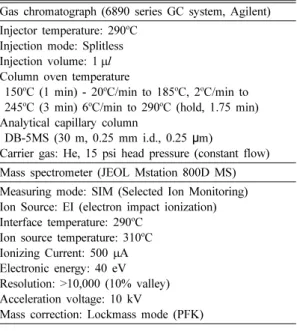
을 제거하기 위하여 헥산세정수로 2~3회 세정한 후 n- 헥산 층은 무수황산나트륨으로 탈수하고 회전증발농축 기를 이용하여 약 2 ml까지 농축한 다음 다층실리카겔 컬럼 크로마토그래피(70~230 mesh, Merck, Darmstadt, Germany), 활성 알루미나 컬럼 크로마토그래피(활성도 1, 염기성, Sigma Aldrich) 순으로 정제과정을 거친 후 에 활성탄(dioxin analysis grade, Wako, Japan) 1 g과 25% 디클로로메탄:n-헥산(v/v) 30 ml를 이용하여 indicator PCBs를 회수하였다. 회수된 용출액은 회전 증 발 농축기와 질소농축기를 이용해 50 µl로 농축한 후 회수율 측정용 내부표준물질(13C-labelled PCB IS-100, Wellington Labs., Canada) 첨가하고 최종적으로 25 µL로 농축하였다. 농축된 시료는 HRGC/HRMS로 분해 능 10,000이상(10% valley)에서 선택이온검출법 (Selected ion monitoring, SIM) 모드로 검출하였으며, HRGC/HRMS 기기분석 조건은 Table 1과 같다.
바탕시료(blank sample) 분석은 용매나 초자로부터 방해물질 또는 오염을 검토하기 위하여 5개 시료마다 1개씩 동시에 분석하였다. 첨가된 13C-labelled 이성질체 의 평균 회수율은 72~114%(평균=87%)의 범위로 나타 났으며, 검출한계(Limit of detection, LOD)는 0.1~0.5 ng/g의 범위였다.
3. 통계분석
모유 중 indicator PCBs 농도는 정규분포하지 않아 (Shapiro-Wilk test for normality, p<0.01), 로그 변환
후 indicator PCBs 농도 값을 기초 통계량으로 사용하 였다. 스피어만 상관관계(Spearmen’s rank correlation) 분석은 indicator PCB 이성질체 사이의 상관관계의 파 악하기 위하여 사용되었으며, 연령은 단순선형회귀분석 을 이용하였다. 모유 중 indicator PCBs의 농도분포는 Mann-Whitney U-test를 통하여 BMI, 출산경력, 흡 연습관, 식이습성 등에 따른 농도 차이를 검증하였고, 산모의 연령, BMI, 출산경력 등은 보정 후 그룹(예, 어 패류 섭취빈도, 육류 섭취빈도, 유제품 섭취빈도)내의 관련성을 파악하기 위하여 다중선형회귀분석(Multiple linear regression)을 적용하였다. 결과 해석을 위한 자료 의 통계분석은 Statistica(version 6.0, statsoft Inc., OK, USA) software system으로 수행되었으며, p<0.05는 통 계학적으로 유의하다고 간주하였다.
III. 결과 및 고찰
1. 산모의 일반적인 특성
본 연구 대상자에 대한 신장, 연령, 생활양식, 식이습 성 등의 일반적인 특징들에 대하여 Table 2에 나타내었 다. 본 연구에 참여한 수유부의 연령범위는 26~38세(평 균·표준편차 32±3.1세), 임신 전 BMI 16.1~28.4 kg/
m2, 임신기간 중 체지방 증가비율 0.02~0.23, 그리고 지방함량은 0.8~6.1%로 초산부와 경산부 그룹 사이에 유의한 차이는 나타나지 않았다(p>0.05). 모든 산모가 Table 1. HRGC/HRMS conditions for indicator PCBs
Gas chromatograph (6890 series GC system, Agilent) Injector temperature: 290oC
Injection mode: Splitless Injection volume: 1µl Column oven temperature
150oC (1 min) - 20oC/min to 185oC, 2oC/min to 245oC (3 min) 6oC/min to 290oC (hold, 1.75 min) Analytical capillary column
DB-5MS (30 m, 0.25 mm i.d., 0.25 µm)
Carrier gas: He, 15 psi head pressure (constant flow) Mass spectrometer (JEOL Mstation 800D MS) Measuring mode: SIM (Selected Ion Monitoring) Ion Source: EI (electron impact ionization) Interface temperature: 290oC
Ion source temperature: 310oC Ionizing Current: 500 µA Electronic energy: 40 eV Resolution: >10,000 (10% valley) Acceleration voltage: 10 kV
Mass correction: Lockmass mode (PFK)
Table 2. Maternal characteristics in this study
Subject characteristics Mean±SD (range) or n (percentage) Maternal age at delivery (years) 32±3.1 (26~38) Lipid contents (%) 2.7±1.4 (0.8~6.1) Maternal body height (cm) 160±5.9 (150~172) Parity (primipara/multipara) 13/9 (59/41) Pre-pregnancy BMI (kg/m2) 20.6±2.7 (16.1~28.4) Rate of body weight increasea 0.11±0.05 (0.02~0.23) Fish & Shellfish intake
(<2/ 2 times/week)
9/13 (41/59) Meat intake (<2/ 2 times/week) 16/6 (73/27) Milk products intake (<2/ 2 times/
week)
5/17 (23/77) Smoking habit (non-smoker/
ex-smoker/current smoker)
17/5/0 (77/23/0) Change of dietary habit after
pregnancy (yes/no)
6/16 (27/73)
aRate of body weight increase was calculated as follows:
(maternal weight before delivery)-(maternal weight before pregnancy)/(maternal weight before pregnancy).
비흡연자였으며, 직업적인 노출은 없었다. 임신 후 식 습관에 변화가 있다고 응답한 산모는 27%이며, 유아는 모두 초유를 섭취하였다.
2. PCBs 농도분포 및 기술통계량
일반 여성 모유 중 PCB-28, 52, 118, 138, 153 및 180 등 7종의 indicator PCBs(Indicator polychlorinated biphenyls)가 대부분의 모유 시료에서 검출되었으며, 기 술적 통계결과는 Table 3에 나타내었다. 7종의 indicator PCB 농도분포는 PCB-52를 제외하고 로그 정규 분포로 잘 나타났다(Shapiro-Wilk test for data in log-transformed variables, p>0.01).
모유 중 indicator PCBs 농도는 9.14~47.6 ng/g lipid 의 범위로 중앙값은 24.9 ng/g lipid(기하평균=22.3 ng/
g lipid), 상한치 95th percentile 값은 42.6 ng/g lipid이 었다. 이성질체 분포패턴은 PCB 101 < 52 < 28 < 118 <
180 < 138 < 153의 순으로 PCB-153이 38.1%로 가장 높
은 조성비를 보였으며, PCB-138, 153, 180의 합은 총 indicator PCBs의 약 75%를 차지하였다. 다른 이성질체 에 비하여 비교적 높은 조성비를 보인 PCB-138, 153, 180은 주로 4,4'- 위치에 염소가 치환된 이성질체들이 다. 이러한 특징은 4,4'- 치환 이성질체는 인체 내에서 대사되기 어렵다는 것을 의미할 수도 있다. 또한, PCB- 138, 153, 180은 Phenobarbital형으로 Cytochrom P-450 2B1(CYP2B1) 유도능력을 가지며, 현기증(phenobarbital), 진행성 종양(promote neoplasia), 간부종(hepatomegalien) 과 같은 증상을 일으키는 이성질체로 보고되고 있다.12) 일반적으로 이들 이성질체는 어류를 포함한 고유기체 에서 높은 농도로 축적되어 있으며, mono-에서 deca- CBs까지 총 PCBs 농도의 약 50~80%를 차지하는 것으 로 알려져 있다.8)본 연구에서도 PCB-138, 153, 180은 모든 모유시료에서 높은 농도로 검출되어 유사한 결과 를 얻었다. 또한, PCB-138, 153, 180은 서로간의 상관 성이 매우 높았다(Table 4). 가장 높은 상관관계는 PCB-
Table 3. Descriptive statistics of indicator PCB congeners in breast milk samples Congeners Arithmetic
meana
Standard deviation
Geometric
mean 95% CI Median 95th
percentile
Range (min-max)
PCB-28 1.24 0.53 1.13 1.01~1.47 1.19 2.19 0.43~2.29
PCB-52 1.16 3.33 0.46 −0.32~2.63 0.38 1.21 0.09~16.0
PCB-101 0.58 0.26 0.53 0.47~0.70 0.51 0.97 0.16~1.25
PCB-118 3.11 1.83 2.57 2.30~3.92 2.90 6.08 0.72~7.20
PCB-138 5.46 3.56 4.50 3.88~7.04 4.90 10.10 1.35~16.7
PCB-153 9.54 6.32 8.04 6.74~12.4 8.31 16.40 2.20~32.4
PCB-180 3.57 1.62 3.23 2.85~4.29 3.25 6.34 1.33~7.45
Sum PCBsb 18.60 8.77 16.60 14.7~22.5 18.40 36.50 6.13~39.9
ΣPCBsc 24.70 10.90 22.30 19.9~29.5 24.90 42.60 9.14~47.6
CI: Confidence interval.
aUnit: ng/g lipid weight basis.
bSum PCB=PCB 138+PCB 153+PCB 180.
cΣPCBs=PCB 28+PCB 52+PCB 101+PCB 118+PCB 138+PCB 153+PCB 180.
Table 4. Spearman rank correlation coefficients among lipid-adjusted breast milk concentrations of PCB congeners
Congener Indicator PCBs
PCB-28 PCB-52 PCB-101 PCB-118 PCB-138 PCB-153 PCB-180 Sum PCBs
PCB-28 1
PCB-52 0.536* 1
PCB-101 0.366 0.602** 1
PCB-118 0.252 0.449* 0.616** 1
PCB-138 0.351 0.441* 0.427* 0.579** 1
PCB-153 0.229 0.564** 0.159 0.672** 0.982*** 1
PCB-180 0.401 0.439* 0.581** 0.602** 0.835*** 0.903*** 1
Sum PCBs 0.275 0.569** 0.353 0.625** 0.897*** 0.942*** 0.885*** 1 ΣPCBs 0.467* 0.571** 0.572** 0.598** 0.947*** 0.959*** 0.873*** 0.967***
*p<0.05; **p<0.01; ***p<0.001.
138과 153사이에서 관찰되었으며(r=0.982, p<0.001), 이 어서 PCB-153과 180(r=0.903, p<0.001), PCB-138과 180(r=0.835, p<0.001) 순이었다. 특히, PCB-153은 총 indicator PCBs와의 사이에서도 가장 높은 상관관계 (r=0.959)를 보여 non-dioxin like PCBs 인체 배경노출 에 대한 좋은 생물지표가 될 수 있을 것으로 판단되었 다. 반면, 저염소계 PCBs인 PCB-28은 PCB-52와 유의 한 상관성을 보였을 뿐 다른 이성질체와의 상관관계는 나타나지 않았다. PCB-153과 PCB-180은 동물 지방조 직에서의 제거 반감기는 각각 453일과 6개월로 상당히 길기 때문에생체 내에서 분해가 용이하지 않아 제거속 도가 느리다.13)
한편, 본 연구에서 13.2%의 조성비를 보인 PCB-118 은 다이옥신과 유사한 독성을 나타내는 mono-ortho 치 환 PCBs로서 모유에서 총 dioxin-like PCBs(mono- ortho PCBs+non-ortho PCBs) 농도의 약 50% 이상을 차지한다.14) 따라서 PCB-118의 농도값을 통하여 dioxin-like PCBs와 독성등량치(Toxic equivalent quantity, TEQ)의 충분한 지표가 될 것으로 판단된다.
3. PCBs 농도와 노출인자와의 관계
PCBs의 노출과 체내 축적에 따른 영향은 많은 인자 가 관여할 수 있다. 또한, 많은 선행연구에서 유기오염 물질의 체내 이동과 산모의 노출 인자 사이에 유의한
관계5,15)를 보여줬고 이는 유기염소계화합물의 지용성과
생물·축적 가능성 때문이다.15)
Table 5의 선형회귀분석 결과는 연령이 indicator PCB 이성질체의 농도와 서로 관련되었음을 보여준다.
일반적으로 연령은 PCBs의 가장 중요한 예측인자로 특 히, 고염소계 PCBs인 PCB-153, 180 농도와 높은 상 관관계를 나타낸다.16,17) 본 연구에서도 모유 중 indicator PCBs 농도와 산모의 연령사이에서 유의한 양
의 상관관계가 나타났다(p<0.001). 더욱이 단순선형회 귀분석결과 총 indicator PCBs의 농도는 연령이 증가할 수록 2.56 ng/g lipid씩 증가하였으며(y=−56.53+2.56x, y: PCBs 농도, x: 산모 연령), PCB-138, 153, 180의 농도 수준도 연령이 1세 증가할수록 각각 0.61, 1.32, 0.22 ng/g lipid씩 증가하였다. 연령과 비례하여 모유 중 indicator PCBs의 농도 증가는 연령의 증가에 따른 PCBs의 노출시간증가, 긴 반감기에 따른 배출속도의 감 소 등에 의한 결과로 해석되어 진다.5)반면, PCB-28과 PCB-52는 연령과 아무런 상관관계가 나타나지 않았다.
체내 지방의 양은 유기염소계화합물 농도와 상관관계 가 있을지도 모른다. 일부 선행연구에서 잠재적 예측인 자 중 BMI를 포함하였다. Glynn 등18)은 BMI와 혈청 중 p,p'-DDE 농도간에 양의 상관관계를 가진다고 보고 하였으며, PCBs의 경우 BMI와 상관성이 없거나19) 또 는, 음의 상관관계18,20)를 가진다고 보고되고 있다. 이와 유사하게 본 연구에서도 PCB-153은 BMI가 높은 그룹 이 낮은 그룹에 비해 유의하게 농도가 낮았으며 (p<0.05), 연령, 출산경력에 대한 통계학적 차이가 나타 났다(p<0.05). 그러나 분석된 다른 indicator PCB 이성 질체에서는 유의한 차이는 나타나지 않았으며, 임신기 간 중의 체지방 증가 비율과도 유의한 차이는 보이지 않았다(Table 6). Wolff 등21)에 따르면 고염소계 PCBs 와 BMI 사이의 음의 상관관계는 PCBs 노출진행을 반 영할 수 있다. Collins 등22)은 BMI가 고염소계 다이옥 신의 배경농도를 평가하는데 특히, 중요하며, 연령을 함 께 연구에서 감안해야 한다는 점을 지적하고 있다. 하 지만 일반적으로 BMI 경향이 연령에 따라 증가하기 때문에 이것은 연령과 독립적으로 BMI의 영향을 평가 하는 것은 어려울 것으로 판단된다.
초산부의 모유 내 indicator PCBs 농도는 경산부보다 확연히 높았으며(p<0.01), 특히, 저염소계 PCBs보다 PCB-138, -153, -180 등 고염소계 이성질체의 농도가 높았다(p<0.01). 이와 같이 경산부 여성에게 PCBs의 농도가 낮게 나타나는 것은 다산에 의한 수유와 태반 을 통하여 산모로부터 유아에게 지용성 오염물질인 PCBs가 배출되기 때문으로 판단된다.23,24) 따라서 수 유기 유아들은 이들 유기염소계화합물에 노출 될 수 있다.
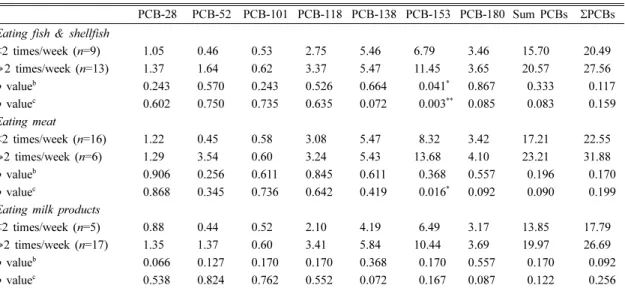
4. 식이습성과 PCBs 농도와의 상관성
Table 7은 산모의 식이습성과 indicator PCBs 농도와 의 상관성을 분석한 결과이다. 한국인에게 유기오염물 질의 체내 축적의 주요 기여 인자 중의 하나는 어패류 의 섭취로 알려져 있다.25,26) PCB-153의 농도는 어패류 Table 5. Regression coefficients for the levels of indicator
PCBs against ages of mothers Congener Regression
coefficients
Standard
error p-value
ln (PCB-28) 0.016 0.014 0.247
ln (PCB-52) 0.041 0.029 0.174
ln (PCB-101) 0.025 0.013 0.069
ln (PCB-118) 0.032 0.014 0.036
ln (PCB-138) 0.051 0.017 0.007
ln (PCB-153) 0.052 0.015 0.002
ln (PCB-180) 0.028 0.013 0.042
ln (Sum PCBs) 0.049 0.011 <0.001 ln (ΣPCBs) 0.046 0.011 <0.001
Table 6. Indicator PCB levelsa in the demographic parameters between two groups
PCB-28 PCB-52 PCB-101 PCB-118 PCB-138 PCB-153 PCB-180 Sum PCBs ΣPCBs Pre-pregnant BMI
<21 kg/m2 (n=8) 1.31 0.45 0.60 3.02 5.03 9.55 3.52 19.2 25.5
21 kg/m2 (n=14) 0.87 0.48 0.43 1.94 3.71 5.96 2.79 12.9 17.7
p valueb 0.076 0.195 0.195 0.116 0.413 0.039* 0.195 0.067 0.116
p valuec 0.113 0.406 0.253 0.282 0.317 0.012* 0.128 0.094 0.167
Rate of body weight increase
<0.1 (n=11) 1.14 0.40 0.51 2.59 5.53 8.88 3.43 18.8 24.2
0.1 (n=11) 1.12 0.54 0.55 2.54 3.67 7.29 3.05 14.7 20.6
p valueb 0.818 0.533 0.922 0.818 0.123 0.670 0.577 0.200 0.375
p valuec 0.641 0.636 0.598 0.334 0.066 0.132 0.658 0.091 0.149
Parity
Primipara (n=13) 1.15 0.50 0.52 2.76 5.83 10.5 3.98 21.7 28.1
Multipara (n=9) 1.10 0.41 0.54 2.31 3.10 5.44 2.40 11.3 16.0
p valueb 0.764 0.815 0.713 0.443 0.012* 0.007** 0.007** <0.001*** 0.004**
*p<0.05; **p<0.01; ***p<0.001.
aGeometric mean (unit: ng/g lipid).
bWithout any adjustment.
cMaternal age and parity were adjusted by multiple linear regression.
Table 7. The difference in indicator PCB levelsa between the different food consumption groups
PCB-28 PCB-52 PCB-101 PCB-118 PCB-138 PCB-153 PCB-180 Sum PCBs ΣPCBs Eating fish & shellfish
<2 times/week (n=9) 1.05 0.46 0.53 2.75 5.46 6.79 3.46 15.70 20.49
2 times/week (n=13) 1.37 1.64 0.62 3.37 5.47 11.45 3.65 20.57 27.56
p valueb 0.243 0.570 0.243 0.526 0.664 0.041* 0.867 0.333 0.117
p valuec 0.602 0.750 0.735 0.635 0.072 0.003** 0.085 0.083 0.159
Eating meat
<2 times/week (n=16) 1.22 0.45 0.58 3.08 5.47 8.32 3.42 17.21 22.55
2 times/week (n=6) 1.29 3.54 0.60 3.24 5.43 13.68 4.10 23.21 31.88
p valueb 0.906 0.256 0.611 0.845 0.611 0.368 0.557 0.196 0.170
p valuec 0.868 0.345 0.736 0.642 0.419 0.016* 0.092 0.090 0.199
Eating milk products
<2 times/week (n=5) 0.88 0.44 0.52 2.10 4.19 6.49 3.17 13.85 17.79
2 times/week (n=17) 1.35 1.37 0.60 3.41 5.84 10.44 3.69 19.97 26.69
p valueb 0.066 0.127 0.170 0.170 0.368 0.170 0.557 0.170 0.092
p valuec 0.538 0.824 0.762 0.552 0.072 0.167 0.087 0.122 0.256
*p<0.05; **p<0.01; ***p<0.001.
aGeometric mean (unit: ng/g lipid).
bWithout any adjustment.
cMaternal age, pre-pregnant BMI, and parity were adjusted by multiple linear regression.
를 많이 소비하는 여성이 적게 소비하는 여성보다 높 았으며(p<0.05), 산모의 연령, BMI, 출산경력에 대한 PCB-153의 농도는 높은 어패류 섭취그룹( 2 times/
week)에서 통계적으로 유의하게 증가되었다(p<0.01). 육 류 섭취빈도 또한, 연령, BMI, 출산경력에 대한 통계학
적 차이가 나타났다(p<0.05). 하지만 PCB-153을 제외 한 PCB-26, -52, -101, -118, -138 및 -180은 어패류, 육류 및 유제품 섭취빈도에 따른 유의성은 나타나지 않 았다. 이와 같이 인체 노출의 주요 기여인자와 상관성 이 결여된 원인 중의 하나는 임신기간 중 식이습관의
변화로 인한 지방대사가 변화하기 때문일 것으로 판단 되나 통계학적으로 많은 표본추출이 이루어지지 못한 것도 한 원인이라 사료된다.
일부 연구에서 PCBs의 체내 축적량은 어패류 또는 육류의 소비와 양의 상관성(p<0.05)을 갖는 것으로 보 고하고 있으나27) 본 연구 결과에서는 indicator PCBs 농도는 어패류, 육류, 유제품의 섭취 빈도 그룹간에 유 의한 상관성은 없었지만 섭취빈도가 높은 그룹에서 indicator PCBs 농도가 높게 검출되었다. 또한, PCB- 153은 어패류 섭취빈도와 유의한 상관성을 나타내었으 며, 산모의 연령, 출산 전 BMI, 출산경력은 어패류 섭 취빈도, 육류 섭취빈도에 영향을 주는 중요한 인자로 나타났다.
한 국가에서 전반적으로 어류 소비가 적을 때, 모유 에서 유기오염물질의 농도는 감소하는 것으로 보고되 었으나28) 지금까지 국내에서는 모유 중 PCBs 농도의 감소와 어류 소비 감소간의 정량적인 관계는 발표된 바 없다. 이와 같이 비록 현재 국내에서 생물과 인체시료 에서 indicator PCBs의 자료는 매우 부족하지만 PCB- 153의 노출경로는 어패류 소비와 관련될 것으로 생각 되며, 어패류 소비를 통한 PCB-153은 인체노출의 새로 운 지표가 될 것이다.
5. PCBs 배경노출 및 농도비교
WHO에서 수행한 26개국 공동조사 결과를 Fig. 1에 나타내었다.34) 국내 모유 중 indicator PCBs의 중앙값 은 남반구에 위치한 브라질, 피지, 필리핀, 호주, 뉴질 랜드와 유사하거나 높은 수준이며, 선진 공업국인 미 국, 유럽국가에 비해 낮은 수준이었다. 특히, 슬로바키 아, 체코 공화국 모유 중의 indicator PCBs 농도는 각 각 443 ng/g lipid, 502 ng/g lipid로 본 연구 결과보다 각각 18배, 20배 높은 수준이었다. 국가별 PCBs 소비 량은 미국이 전 세계소비량의 46%를 차지하였으며, 다 음으로 러시아(7.9%), 독일(7.1%), 일본(4.1%), 프랑스 (4.1%) 및 캐나다(3.0%) 순으로 북미를 포함한 유럽국 가에서 PCBs의 대부분이 사용하였다.6) 국내의 경우 1996년 PCBs 사용이 금지되기 이전까지 약 4,292톤의 PCBs가 사용되어 일본(16,000~31,000톤)의 약 1/4~1/7 배 수준이었다. 한편, 일본14)여성 모유 중의 총 PCBs 평균농도는 120 ng/g lipid로서 본 연구결과에 비하여 약 5배나 높은 수준이었는데 이는 한국인과 일본인의 식이습관의 유사성으로 인하여 인체 노출경로가 유사 하다 하더라도 결국 PCBs 사용량에 의해 체내 축적량 이 차이가 있음을 알 수 있다. 또한, 소각과정에서의 PCBs 생성에 관한 보고가 있지만 이농도 수준은 상업
적으로 대량으로 사용되었던 PCBs 제품(Aroclor, Kanechlor)에 의한 오염수준과 비교하면 매우 낮다. 이 와 같은 상황을 종합해 볼 때, 우리나라에서의 일반인 모유 중의 PCBs 오염은 배경노출에 기인한 수준으로 판단된다.
인체시료에서 잔류성유기오염물질을 연구하는데 있어 시간경과에 따른 이들 물질 농도변화의 비교·분석은 중요한 인자임에도 불구하고21) 시간경과에 따른 국내 모유 중 indicator PCBs 농도변화의 자료는 거의 없다.
따라서 본 연구에서는 서울지역 일반인 혈청시료 내 PCB-153 농도의 시간적 변화 경향을 분석하였다. 혈청 중 PCB-153의 평균농도는 2001년30) 62.5 ng/g lipid, 2003년31) 39.2 ng/g lipid, 2006년32) 20.7 ng/g lipid로 점차 감소하였다. 이러한 혈청 내의 PCBs 농도의 감소 경향은 1996년부터 시작된 한국의 PCBs 사용의 강력 한 규제 때문으로 판단되었다. 국외에서도 1970년대 후 반부터 PCBs의 생산 및 사용이 금지되어 있어 환경 중의 농도 수준은 점점 감소하는 추세로 특히, 일본33) Fig. 1. Concentrations of indicator PCBs in human milk of different countries.34) Vertical bars show the range and median contribution of total indicator PCBs concentration.
에서 dioxin-like PCBs의 농도 수준은 1998년부터 2002까지 뚜렷한 감소를 보이고 있다(p<0.01).
IV. 결 론
본 연구는 서울지역에 거주하고 있는 비직업적 일반 인을 대상으로 초유 중 indicator PCBs의 농도를 측정 하고 식이습성 및 산모의 노출인자간의 상관관계를 통 하여 영향 인자를 조사한 결과 얻어진 결론은 다음과 같다.
1. 모유 중 indicator PCBs의 중앙값은 남반구에 위 치한 브라질(16 ng/g lipid), 피지(17 ng/g lipid), 필리핀 (26 ng/g lipid), 호주(30 ng/g lipid), 뉴질랜드(37 ng/g lipid)와 유사하거나 높은 수준이며, 선진 공업국인 미국 (54 ng/g lipid), 유럽국가에 비해 매우 낮은 수준으로 일반 배경농도에 해당하였다. 특히, 식이습성이 유사한 일본인 모유 중의 총 PCBs 평균농도 120 ng/g lipid로 서 본 연구결과에 비하여 약 5배나 높은 수준이었다.
2. 이성질체 분포패턴은 PCB-101 < 52 < 28 < 118 <
180 < 138 <153의 순으로 평가되었고 PCB-138, -153, -180의 합은 총 indicator PCBs의 약 75%를 차지하였 다. 또한, 고염소계 PCBs는 서로 상관성이 매우 높은 반면, 저염소계인 PCB-28은 PCB-52와 유의한 상관성 이 관찰되었을 뿐 다른 고염소계 PCBs와의 상관관계 는 나타나지 않았다. 이는 연령에 따른 노출시간 증가 및 고염소계 PCBs의 느린 분해속도 때문으로 판단되 었다.
3. 산모의 노출인자와 indicator PCBs 농도 사이에서 연령(p<0.001), 출산경력(p<0.01)은 유의한 상관성이 나 타났으나 체중 증가비율, BMI, 흡연습관, 식이습성과는 유의한 상관성은 나타나지 않았다. 그러나 PCB-153은 어패류 섭취빈도에 따라 유의한 차이가 나타났으며, 산 모의 연령, 출산 전 BMI, 출산경력에 대해 유의한 차 이가 나타났다(p<0.01). 따라서 어패류 소비량은 indicator PCBs와의 높은 상관관계를 통하여 PCB-153 은 인체노출의 새로운 지표가 될 것으로 판단되었다.
본 연구에서 얻어진 모유 중의 indicator PCBs 오염 수준은 현재 한국인 산모 전체에 대한 PCBs 오염수준 을 대표하기에는 분석시료수가 적고 특히, 모유 중의 PCBs의 이전 자료가 충분하지 않아 전체 한국인의 노 출인자를 자세하게 평가하기에는 한계가 있을 것으로 판단된다. 그러나 본 연구 결과는 한국인의 indicator PCBs의 인체 노출평가에 대한 국제적 기초자료로 활 용할 수 있을 것이다. 이는 국제적 비교에 이용되는
오염물질의 정량 및 정성 분석으로 HRGC/HRMS를 이용한 동위원소희석법에 의해 측정되었기 때문이다.
이러한 측면에서 본 연구결과는 중요한 의미를 지니고 있다.
감사의 글
본 연구는 2006년도 식품의약품안전청 용역연구개발 사업의 연구비 지원(06132내분비436)에 의해 수행 된 연구결과의 일부이며, 이에 감사드립니다.
참고문헌
1. Ahlborg, U., Hanberg, A. and Kenne, K. : Risk assessment of polychlorinated biphenyls (PCBs).
Report NORD, Nordic Council of Ministers, Copen- hagen, 26, 1992.
2. Brouwer, A., Longnecker, M. P., Birnbaum, L. S., Cogliano, J., Kostyniak, P. and Moore, J. : Character- ization of potential endocrine-related health effects at low-dose levels of exposure to PCBs. Environmental Health Perspectives, 107, 639-649, 1999.
3. Jensen, S. : Report of a new chemical hazard. New Science, 32, 612, 1996.
4. Macdonald, R. W., Harner, T. and Fyfe, J. : Recent climate change in the Arctic and its impact on con- taminant pathways and interpretation of temporal trend data. Science of the Total Environment, 342, 75- 86, 2005.
5. erna, M., Malý, M., Grabic, R., Batáriová, A., Šmíd, J. and Beneš, B. : Serum concentrations of indicator PCB congeners in the Czech adult popula- tion. Chemosphere, 72, 1124-1131, 2008.
6. Breivik, K., Sweetman, A., Pacyna J. M., Jones, K.
C. : Towards a global historical emission inventory for selected PCB congeners - a mass balance approach. 1. Global production and consumption. Sci- ence of the Total Environment, 290, 181-198, 2002.
7. Szyrwinska, K. and Lulek, J. : Exposure to specific polychlorinated biphenyls and some chlorinated pes- ticides via breast milk in Poland. Chemosphere, 66, 1985-1903, 2007.
8. Glynn, A. W., Wolk, A., Aune, M., Atuma, S., Zet- termark, S., Maele-Schmid, M., Darnerud, P. O., Becker, W., Vessby, B. and Adami, H. : Serum con- centrations of organochlorines in men: a search for markers of exposure. Science of the Total Environ- ment, 263, 197-208, 2000.
9. Wingfors, H., Selden, A. I., Nilsson, C. and Haglund, P. : Identification of markers for PCB exposure in plasma from Swedish construction workers removing old elastic sealants. Annals of Occupational Hygiene Society, 50(1), 65-73, 2006.
10. EFSA (European Food Safety Authority) : Opinion of C
ê
the scientific panel on contaminants in the food chain on a request from the commission related to the pres- ence of non dioxin-like PCBs in feed and food. EFSA Journal, 284, 1-137, 2005.
11. CDC (Centers for Disease Control and Prevention) : Laboratory Procedure Manual Method 28 for Second National Report on Human Exposure to Environmen- tal Chemicals. 2003.
12. Vezina, C. M., Walker, N. J. and Olson, J. R. : Sub- chronic exposure to TCDD, PeCDF, PCB126, and PCB153: effect on hepatic gene expression. Environ- mental Health Perspectives, 112, 1636, 2004.
13. Phillips, D. L., Smith, A. B., Burse, W. W., Steele, G.
K. and Hannon, W. H. : Half-life of polychlorinated biphenyls in occupationally exposed workers. Arch.
Environmental Health, 44, 351-354, 1989.
14. Park, S. A., We, S. U., Cho, B. H., Kim, K. H., Baek, J. H., Han, S. Y. and Min, B. Y. : Levels of PCDDs/
DFs and dl-PCBs in breast milk from Korean women living in Seoul and Ansan: estimation of PCDDs/DFs and dl-PCBs intake for breastfed infants. Proceed- ings of Environmental Health in Asia-Pacific Region, Jeju, Korea, 164-168, 2008.
15. Smeds, A. and Saukko, P. : Identification and quan- tification of polychlorinated biphenyls and some endocrine disrupting pesticides in human adipose tis- sue from Finland. Chemosphere, 44, 1463-1471, 2001.
16. ATSDR : Toxicological Profile for Polychlorinated Biphenyls, Atlanta, <www.atsdr.cdc.gov>, 2002.
17. Schaeffer, D. J., Dellinger, J. A., Needham, L. L. and Hansen, L. G. : Serum PCB profiles in Native Amer- icans from Wisconsin based on region, diet, age and gender: implications for epidemiology studies. Sci- ence of the Total Environment, 357, 74-87, 2006.
18. Glynn, A. W., Granath, F., Aune, M., Atuma, S., Darnerud, P. O., Bjerlesius, R., Vainio, H. and Weiderpass, E. : Organochlorines in Swedish women:
determinants of serum concentrations. Environmental Health Perspectives, 111, 349-355, 2003.
19. Sandanger, T. M., Brustad, M., Sandau, C. D. and Lund, E. : Levels of persistent organic pollutants in a coastal northern Norwegian population with high fishliver intake. Journal of Environmental Monitor- ing, 8, 552-557, 2006.
20. Apostoli, P., Magoni, M., Bergonzi, R., Carasi, S., Indelicato, A., Scarcella, C. and Donato, F. : Assess- ment of reference values for polychlorinated biphe- nyl concentration in human blood. Chemosphere, 61, 413-421, 2005.
21. Wolff, M. S., Berkowitz, G. S., Brower, S., Senie, R., Bleiweiss, I. J., Tartter, P., Pace, B., Roy, N., Wallen- stein, S. and Weston, A. : Organochlorine exposures and breast cancer risk in New York City women.
Environmental Research, 84, 151-161, 2000.
22. Collins, J. J., Bodner, K., Burns, C. J., Budinsky, R.
A., Lamparski, L. L., Wilken, M., Martin, G. D. and Carson, M. I. : Body mass index and serum chlori-
nated dibenzo-p-dioxin and dibenzofuran levels.
Chemosphere 66, 1079-1085, 2007.
23. Schecter, A., Ryan, J. J. and Papke, O. : Decrease in levels and body burden of dioxins, dibenzofurans, PCBS, DDE, and HCB in blood and milk in a mother nursing twins over a thirty-eight month period.
Chemosphere, 37, 1807-1816, 1998.
24. Yua, Z., Palkovicovab, L., Drobnac, B., Petrikc, J., Kocanc, A., Trmovecc, T. and Picciottoa, I. H. : Comparison of organochlrine compound concentra- tions in colostrum and mature milk. Chemosphere, 66, 1012-1018, 2007.
25. Moon, C. H. and Paik, J. M. : Estimation of PCDDs/
PCDFs intake for Korean children and their mothers through daily foods. Journal of Environmental Health Sciences, 33(1), 11-15, 2007.
26. Moon, H. B. and Choi, H. G. : Human exposure to PCDDs, PCDFs and dioxin-like PCBs associated with seafood consumption in Korea from 2005 to 2007.
Environment International, 35, 279-284, 2009.
27. Tsukino, H., Hanaoka, T., Sasaki, H., Motoyama, H., Hiroshima, M. and Tanaka, T. : Fish intake and serum levels of organochlorines among Japanese women.
Science of the Total Environment, 359, 90-100, 2006.
28. Schuhmacher, M., Domingo, J. L., Kiviranta, H. and Vartiainen, T. : Monitoring dioxins and furans in a population living near a hazardous waste incinerator:
levels in breast milk. Chemosphere, 57, 43-49, 2004.
29. Kunisue, T., Muraoka, M., Ohtake, M., Sudaryanto, A., Minh, N. H., Ueno, D., Higaki, Y., Ochi, M., Tsy- denova, O., Kamikawa, S., Tonegi, T., Nakamura, Y., Shimomura, H., Nagayama, J. and Tanabe, S. : Con- tamination status of persistent organochlorines in human breast milk from Japan: recent levels and tem- poral trend. Chemosphere, 64, 1601-1608, 2006.
30. Kim, B. H., Ikonomou, M. G., Lee, S. J., Kim, H. S.
and Chang, Y. S. : Concentrations of polybrominated diphenyl ethers, polychlorinated dibenzo-p-dioxins and dibenzofurans, and polychlorinated biphenyls in human blood samples from Korea. Science of the Total Environment, 336, 45-56, 2005.
31. Park, H., Lee, S. J., Kang, J. H. and Chang, Y. S. : Congener-specific approach to human PCB concen- trations by serum analysis. Chemosphere, 68, 1699- 1706, 2007.
32. Kang, J. H., Park, H. K., Chang, Y. S. and Choi, J.
W. : Distribution of organochlorine pesticides (OCPs) and polychlorinated biphenyls (PCBs) in human serum from urban areas in Korea. Chemosphere, 332, 1124-1133, 2008.
33. Uehara, R., Peng, G., Nakamura, Y., Matsuura, N., Kondo, N. and Tada, H. : Human milk survey for dioxins in the general population in Japan. Chemo- sphere, 62, 1135-1141, 2006.
34. Malisch, R. and Van Leeuwen, R. : PCDD/F Results of the WHO coordinated exposure study on the lev- els of PCBs, PCDDs and PCDFs in human milk.
Organohalogen Compounds, 64, 140-143, 2003.