Estimation of Stocking Density using Habitat Suibility Index and Ecological Indicator for Oyster Farms in Geoje-Hansan Bay
Yoon-Sik Cho
*․Won-Chan Lee
**†․Sok-Jin Hong
**․Hyung-Chul Kim
**․ Jeong-Bae Kim
**․Jung-Hyun Park
***, ** Marine Environment Research Division, National Fisheries Research & Development Institute, Busan, 619-705, Korea
서식적합도와 생태지표를 이용한 거제한산만 굴양식장의 입식밀도 산정
조윤식
*․이원찬
**†․홍석진
**․김형철
**․김정배
**․박정현
***, ** 국립수산과학원 어장환경과
Abstract : Most of Korean farms have been developed in the semi-closed bay, and its position is very vulnerable to the coastal contamination due to the long term and the high density. So, mariculture management is very essential for the sustainable aquaculture.
Some of the specific ways would be the assessment of the optimal stocking density for mariculture management zone and this has to consider both the suitable site selection and the assessment of ecological carrying capacity. Habitat suitability index(0.0 totally unsuitable habitat, 1.0 optimum habitat) and ecological indicator(Filtration pressure indicator) was used to assess the stocking density for oyster farms in Geoje-Hansan Bay. Geoje Bay showed the higher habitat suitability index value 0.75 than Hansan Bay 0.53, indicating that Geoje Bay is more suitable for oyster farming. Ecological indicator showed different stocking density according to the coastal characteristics in Geoje-Hansan Bay. Consequently, it is desirable that the stocking density in Geoje Bay should reduce average 40 % and Hansan Bay, average 60 % than present, in order to meet the ecological carrying capacity. The assessment of the stocking density could solve various problems such as the coastal contamination, environmental aggravation and the productivity decrease and this study could be a scientific basis to establish the policies for mariculture management.
Key Words : Mariculture management, Site selection, Ecological carrying capacity, Habitat suitability index, Ecological indicator, Geoje-Hansan Bay, Oyster farms
요 약 : 대부분의 국내 어장들은 반폐쇄성 내만에 집중되어 있으며, 장기 양식과 높은 입식밀도에 의한 연안오염에 매우 취약한 위치를 점하 고 있기 때문에, 지속적인 양식을 위하여 어장관리가 매우 중요한 실정이다. 이를 위한 방안으로 적지선정과 생태학적 환경수용력을 함께 고려 한 최적 입식밀도 산정이 될 수 있다. 거제한산만 굴양식장의 입식밀도 산정을 위하여 0.0이 비적지, 1.0이 적지임을 나타내는 서식적합도 (Habitat suitability index)와 생태지표인 여과압 지표(Filtration pressure indicator)가 이용되었다. 거제만의 서식적합도는 0.75로서 한산만 0.53 보다 높았으며, 이는 거제만이 굴양식에 좀 더 적합함을 의미한다. 생태지표는 연안특성에 따라 다른 입식밀도를 나타내었으며, 결과적으로 거 제만의 굴양식장에 대하여 현 입식밀도와 비교하여 평균 40 %, 한산만은 평균 60 % 저감 입식하여야 생태학적 환경수용력을 만족하는 것으로 나타났다. 입식밀도의 산정은 현재 국내 양식업이 직면한 연안오염, 환경악화, 생산성 감소에 대한 해결책을 제공할 수 있으며, 이 연구는 어장 관리 정책 설립에 대한 과학적 근거로 활용될 수 있을 것이다.
핵심용어 : 어장관리, 적지선정, 생태학적 환경수용력, 서식적합도, 생태지표, 거제한산만, 굴양식장
1. Introduction
According to ‘the mariculture Management Act’, mariculture management zone can be designated when the appropriate measures are necessary to restore productivity of
* First author : [email protected], 051-720-2527
†Corresponding author : [email protected], 051-720-2520
fisheries. And it has to consider the mariculture circumstances and the coastal characteristics. The efficient mariculture management would be preserving mariculture environment, restructuring farm, improving productivity of fisheries, improving the efficiency of mariculture management, introducing cessation of fish farm, offering various political support and supporting fishermen, etc.. The
ultimate goal of mariculture management is to improve the productivity of fisheries by preserving and improving the environment(NFRDI, 2009).
Some of the specific ways to do this would be the assessment of the optimal stocking density for mariculture management zone. Farmers are interested as to how successful farming could be considering the environment of target seas, while environmental activists are interested in the amount of productivity with minimum environmental load and policy makers are interested in the amount of productivity that is in the middle of the two groups. This has to consider both the suitable site selection and the assessment of ecological carrying capacity. Many researchers have investigated weighted linear combination method using the pairwise comparison(Perez et al., 2005; Radiarta et al., 2008), parameter specific suitability functions(Longdill et al., 2008; Vincenzi et al., 2006), habitat suitability index(HSI)(Cho et al., 2012) for the suitable site selection in fish farm. HSI was developed by the U.S. Fish and Wildlife Service through studies on interaction with the environment to clarify the qualitative and quantitative characteristics of habitats a species can use(U. S. Fish and Wildlife Service, 1981). In case of the assessment of ecological carrying capacity, ecological indicator is an alternative to assess the ecological efficiency of bivalve farms to anticipate how bivalve farms can alter the functions of marine ecosystem(Gibbs, 2007).
However, no studies for the assessment of the stocking density using HSI and ecological indicator have researched.
As the surrounding environment of farms get aggravated with long-term farming, it is necessary to establish scientific basis to decide mariculture management zone. The aim of the present paper is to give the measures of mariculture management by assessing the stocking density using HSI and ecological indicator for oyster farms in Geoje-Hansan Bay.
2. Material and methods
2.1 Study area
The current study selected Geoje-Hansan Bay in the South Sea of Korea which spans 58.8 km2 in area. According to spatial analysis of Geological Information System(GIS), the size of oyster farms with fishery license was 6.0 km2 and took 10.2 % of the total area of zone. The oyster production in Geongnam region showed a sustained increasing, 151,621 M/T in 2000, 223,614 M/T in 2008(Statistics Korea, 2010).
Whereas, bottom COD ranged from 0.98 mg L-1(2000) to 1.76
mg L-1(2008) in Geoje-Hansan Bay(NFRDI, 2008b). In order to understand the environmental characteristics of Geoje- Hansan Bay, seasonal water quality and sediments in 2008 were surveyed at 15 sites(Fig. 1).
Fig. 1. Distribution of oyster farms, survey sites in Geoje-Hansan Bay(Cho et al., 2012).
2.2 Habitat Suitability Index for site selection
HSI indicates habitat suitability in terms of the growth or survival of species. 1.0 indicates suitable habitat and 0.0 indicates unsuitable habitat. It is considered that HSI is linearly related to habitat’s ecological carrying capacity based on the species’ use of the habitat and assumed that dependence on initial density is ignored(Brown, 1986). The growth and survival of oyster may be affected by other factors not considered here, but the most influential 6 factors were selected based on statistical analysis, field survey, experimental analysis, and literature. The interaction of complex variables is explained by three Life Requisite Suitability Index(LRSI). In terms of HSI calculation, the first LRSI-Growth considers the responsive change in the growth of oysters. As complementary relations among the variables would weaken, geometric mean was used to calculate the interaction of variables(U. S. Fish and Wildlife Service, 1981).
The second LRSI-Survival is related to the variables that
influence the survival of oysters. The third LRSI-Water Chemistry includes variables relating to water quality (Table 1).
Model level Equation Condition
LRSI-Growth (V1× V2)0.5 For oyster culture LRSI-Survival (V3× V4)0.5 No fouling, disease,
predator LRSI-Water
Cemistry (V5× V6)0.5
HSI
{(LRSI-Growth)
× (LRSI-Survival)}0.5 If(LRSI-Water Chemistry) ≥ 0.70 {((LRSI-Growth)
× (LRSI-Water Chemistry))0.5
× (LRSI-Survival)}0.5
If(LRSI-Water Chemistry) < 0.70 Table 1. Life Requisite Suitability Index(LRSI) and Habitat
Suitability Index(HSI) equations; V1= water temperature; V2= chlorophyll a; V3= suspended sediments; V4= hydrodynamics; V5= Salinity; V6= dissolved oxygen saturation(Brown, 1986)
2.3 Ecological indicator
In this study, filtration pressure indicator(FP) was used as an ecological indicator and considered the flow of resources based on the primary production and the filtering rate in bivalve farms. It ignores exchanges with outer seas(eq. 1).
(1)
Here Bf is the total carbon extracted from the water-column by the bivalve farm. Pp is the total carbon fixed by autotrophs, such as phytoplankton, in the Bay(Gibbs, 2007). Smaal and Prins(1993) suggested quantitative standards on a hypothesis that the bivalve farm play a key role in coupling the pelagic with the sediment. Gibbs(2007) referred to Smaal and Prins(1993) for the theoretical background of filtration pressure, which is an ecological indicator(Smaal and Prins, 1993; Gibbs, 2007), and suggests that theoretical production carrying capacity is when FP is 1.
The concept of ecological carrying capacity is satisfactory without leading to significant changes to ecological process, species, populations or communities, when FP is below 0.05.
This FP value, however, can always change according to the primary production of target seas and the actual size and filtering rate of bivalve farms. According to the recent
studies, the FP value in Geoje-Hansan Bay was 0.203(Cho et al., 2010), the FP value that satisfied the ecological carrying capacity in Geoje-Hansan Bay was 0.102. As a reference, the ecological FP value of Sylt in Germany was 0.12, Western Wadden Sea in Holland was 0.05, Marennes Oleron Bay in France was 0.24(Lee et al., 2011).
3. Results and discussion
3.1 Site selection for oyster farms
In order to calculate HSI of Geoje-Hansan Bay, after obtaining the geometric mean of Life Requisite Suitability Index, we overlapped it using GIS(Fig. 2). The score of each index referred to the research of Cho et al.(2012). HSI and LRSI classifications were based on literatures on the study area which is coast of British Columbia and Vancouver Islands(48° 30'N, 123° 13'W). Their locations are different from Geoje-Hansan Bay's(34° 46'N, 128° 28'E). According to Brown's study, there were highly significant between HSI values and oyster production(y = 2.032x - 0.158, R2= 0.77, p<
0.001). In case of the study area’s HSI and oyster production in this regression, the correlations had a similar result(Geoje Bay’s HSI = 0.75, oyster production = 1.148 g 100 oysters-1 day-1; Hansan Bay’s HSI = 0.53, oyster production = 0.756 g 100 oysters-1day-1, y = 1.943x - 0.153, R2= 0.73). Geoje Bay’s HSI was also higher than Hansan Bay’s and practically Geoje Bay showed the higher oyster production. Therefore, we concluded that it is applicable to adapt HSI to Geoje-Hansan Bay in Korea.
As a result it can be divided into 7 groups considering HSI and the density of farms. Geoje-Hansan Bay is divided into 39.3 % of zone with 0.5∼0.6 HSI, 12.8 % of zone with 0.6∼0.7 HSI. Of the entire 58.8 km2of zone, 30.6 km2had HSI equal to or greater than 0.5. In terms of HSI distribution in Geoje- Hansan Bay, it was found that Geoje Bay showed the higher HSI value(0.75) than Hansan Bay(0.53), indicating that Geoje Bay is more suitable for oyster farming. Hansan Bay showed low HSI not suitable for oyster farming in the southeast of Hwa, the right of Bongam and the intersection of two Bays.
HSI can be thought of a hypothesis on the relationship between oyster production and the environment, so it is definitely necessary to compare HSI with oyster production in the same site. The HSI of oyster farms in Geoje-Hansan Bay ranged from 0.40 to 0.65 and the oyster production were from 0.13 to 1.75 kg m-2yr-1(Average 0.84 kg m-2yr-1). When these values were compared to the oyster production in Geoje- Hansan Bay, it matched the standard regression line by 87
Fig. 2. Site selection for oyster farming in Geoje-Hansan Bay(①∼⑦ are group number according to the scores of habitat suitability index, adapted from Cho et al., 2012).
%(p< 0.01). Therefore, this method had a high correlation between the oyster production and the HSI of oyster farms(NFRDI, 2008a).
3.2 Ecological indicator
The primary productivity and filtration rates for the 270 days of oyster farming season in 2008 were average 580 mg C m-2day-1 and 1.84 L ind-1hr-1(Table 2).
2008 2009
Jun Jul. Aug. Sep. Oct. Nov. Dec. Jan. Feb.
Water temp.
(℃) 17.9 22.1 23.5 23.7 19.6 16.9 12.2 11.7 8.55 Dry tissue
weight
(g ind.-1) 0.01 0.16 0.47 0.81 0.81 2.04 2.42 2.80 3.09 Filtration rate
(L ind.-1hr-1) 0.16 0.62 1.48 2.19 1.99 2.81 2.51 2.56 2.26 Primary
productivity
(mg C m-2d-1) 973 936 825 556 206 161 475 502 590 Table 2. Filtration rate of oyster(Crassostrea gigas) and the
primary productivity in Geoje-Hansan Bay(adapted from Cho et al., 2010)
Wet tissue weight according to Geoje-Hansan Bay's oyster production in 2008(Hanging Oyster Farming Cooperative, 2008) was 4,935 tons and it converts to 987 ton․dry weight (wet weight : dry weight = 1 : 0.2; Kobayashi et al., 1997), 394
tonC(dry weight : Carbon = 1 : 0.4; Horiguchi et al., 1998).
The amount of carbon needed by oyster to produce this is 1,974 tonC(Ecological efficiency 20 %; Jordan and Valiela, 1982). Considering that the farming period spans 270 days, the total sum of primary production of all farms in Geoje-Hansan Bay is 9,703 tonC and the FP value becomes 1,974 / 9,703 = 0.203(Table 3). This means that a considerable amount of carbon resources generated in the region is transported to oyster farms.
Group Area Wet weight Dry
weight Carbon Carbon require- ment
Phytoplankton production FP (Km2) (ton) (ton) (tonC) (tonC) (gCm-2d-1) (tonC) 1 5.60 365 73 29 146 0.78 1,179 0.124 2 7.38 1041 208 83 417 0.75 1,494 0.279 3 13.30 2313 462 185 925 0.75 2,694 0.344 4 8.96 267 53 21 107 0.7 1,693 0.063 5 15.27 774 154 61 310 0.5 2,061 0.150
6 1.76 33 7 2 13 0.26 124 0.109
7 6.53 139 27 11 56 0.26 459 0.122
Total 58.80 4,935 987 394 1,974 0.58 9,703 0.203 Table 3. Assessment of filtration pressure according to
oyster farms group
If oyster farms consume phytoplankton within the scope of the primary production, it can be considered that the ecological carrying capacity is met with no load on the ecosystem. Theoretically, if it is assumed that the primary production of each unit of area equals the phytoplankton flux(Ingestion of oyster farms or phytoplankton consumption), it can be considered that ecological carrying capacity is satisfied. If this is converted to FP value considering the area and oyster farms, it is as shown in Table 4. As each marine environment has different primary production and phytoplankton flux, the FP value satisfying the ecological carrying capacity is also different. When Geoje-Hansan Bay’s FP value was reassessed based on the maritime characteristics and the existing farms, the FP value satisfying Geoje-Hansan Bay’s ecological carrying capacity was 0.102(Lee et al., 2011). Phytoplankton concentrations per group were 4.07 ug L-1, 3.70 ug L-1, 3.77 ug L-1, 3.62 ug L-1, 3.12 ug L-1, 2.87 ug L-1, 2.98 ug L-1(NFRDI, 2008a) and individual per unit volume were 66 ind. m-3, 51 ind. m-3, 48 ind. m-3, 40 ind. m-3, 64 ind. m-3, 24 ind. m-3, 52 ind. m-3(Hanging Oyster Farming Cooperative, 2008).
Group
Primary production Phytoplankton flux EcologicalFP (g C m-2d-1) (106g C d-1)
①
(g C m-2d-1) (106g C d-1)
② ②÷①
1 0.78 4.4 1.78 0.5 0.124
0.78 0.2 0.054
2 0.75 5.5 1.25 1.5 0.279
0.75 0.9 0.168
3 0.75 10.0 1.20 3.4 0.344
0.75 2.1 0.215
4 0.70 6.3 0.96 0.4 0.063
0.70 0.3 0.046
5 0.50 7.6 1.32 1.1 0.150
0.50 0.4 0.057
6 0.26 0.5 0.46 0.1 0.109
0.26 0.0 0.062
7 0.26 1.7 1.03 0.2 0.122
0.26 0.1 0.031
Total 0.58 34.1 1.15# 6.9 0.203
0.58 3.5 0.102
# Oyster Filtering Rate × Phytoplankton concentration × 30 × 24 hr × Individual per unit volume × average depth of farm × 1,000,000 Oyster Filtering Rate in Geoje-Hansan Bay = 1.84 L ind.-1hr-1
(NFRDI, 2008a)
Phytoplankton concentration in Geoje-Hansan Bay = 3.55 μg L-1 (NFRDI, 2008a)
C : Chlorophylla ratio = 30 : 1 (Smaal and Prins, 1993) Individual per unit volume =
(14 instruments × 235 hanging lines × 25 collectors × 30 entities)
÷ (10,000 m2 × 5m length of hanging lines)
= 49 ind. m-3
Table 4. Assessment of ecological carrying capacity’s filtration pressure according to oyster farms group
3.3 Stocking density
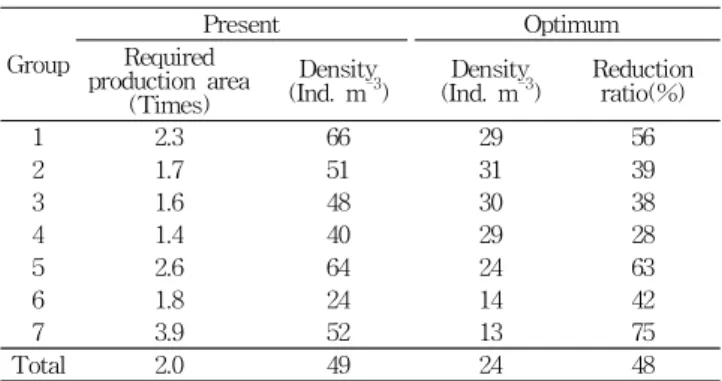
According to Hanging Oyster Farming Cooperative(2008), the stocking density in Geoje-Hansan Bay was average 49 ind. m-3. The productivity of Geoje-Hansan Bay exceeds its ecological carrying capacity and may cause certain load or change to the ecosystem. Therefore, the current productivity should be reduced by 48 % according to the ecological indicator and the stocking density for the bivalve farm should be reduced to the mean 24 ind. m-3. Besides, as each zone has different FP, it has different stocking density according to the group(Table 5). Group 1∼4(Geoje Bay) showed 29∼31 ind.
m-3 in the stocking density and Group 5∼7(Hansan Bay) showed 13∼24 ind. m-3. It is desirable that the stocking density for oyster culturing in Geoje Bay should reduce 28∼
56 %(Average 40 %) and Hansan Bay, 42∼75 %(Average 60
%) than present, in order to meet the ecological carrying capacity.
By attempting spatial analysis of this ecological indicator using the GIS, it would be possible to broaden its scope of application for the interested zone. In other words, it is
possible to select the suitable site of farms by applying HSI developed by the U.S. Fish & Wildlife Service. If HSI can be calculated for each species based on ecological and physiological studies, it will be possible to select the optimal site for each species for more efficient mariculture management. In this study, the most influential 6 variables (Water temperature, chlorophyll a, suspended sediments, hydrodynamics, dissolved oxygen and salinity) were selected.
If other factors are found to be more influential than these factors, they could be added or replaced for improvement. If the carrying capacity of farms is assessed by applying an ecological indicator based on the concept of ecological carrying capacity for sustainable productivity, these two factors could be combined to calculate the optimal stocking density.
Group
Present Optimum
Required production area
(Times)
Density
(Ind. m-3) Density
(Ind. m-3) Reduction ratio(%)
1 2.3 66 29 56
2 1.7 51 31 39
3 1.6 48 30 38
4 1.4 40 29 28
5 2.6 64 24 63
6 1.8 24 14 42
7 3.9 52 13 75
Total 2.0 49 24 48
Table 5. Assessment of optimal stocking density according to oyster farms group in Geoje-Hansan Bay
For the sustainable aquafarming, there is a requirement for a eco-friendly mariculture management by the estimation of ecological carrying capacity. The model development and application for the ecological carrying capacity is still in the initial step, because it has to consider the whole ecosystem and all culture activities. As an alternative, there is a requirement for ecological indicator for assessing the ecological performance of oyster cultures. This study used an ecological indicator for easier approach to assess oyster farms' ecological carrying capacity. It is assumed that the ecological indicator value is linearly related to the ecological carrying capacity. In the future, it would be essential to develop an ecosystem model for more accurate assessment of ecological carrying capacity.
4. Conclusion
By selecting the suitable site selection and assessing ecological carrying capacity, this study assessed the optimal
stocking density for oyster farming in Geoje-Hansan Bay.
The assessment of the stocking density can solve various problems, currently faced by culture in Korea, such as the coastal contamination, environmental aggravation and the productivity decrease. Therefore, this study could be a scientific basis to establish the policies for mariculture management.
Acknowledgments
This work was funded by a grant from the National Fisheries Research and Development Institute(Long term research planning on environmental best management for aquaculture, RP-2012-ME-030).
References
[1] Brown, J. R.(1986), The influence of environmental factors upon the growth and survival of the pacific oyster, Crassostrea gigas Thunberg, M. Sc. thesis, Simon Fraser University, Bernaby, B.C., p. 142.
[2] Cho, Y. S., S. J. Hong, S. E. Park, R. H. Jung, W. C. Lee and S. M. Lee(2010), Application of ecological indicator to sustainable use of oyster culture grounds in Geoje-Hansan Bay, Korea, Journal of the Korean society of marine environment & safety, Vol. 16, No. 1, pp.
21-29.
[3] Cho, Y. S., W. C. Lee, S. J. Hong, H. C. Kim and J. B.
Kim(2012), GIS-based suitable site selection using habitat suitability index for oyster farms in Geoje-Hansan Bay, Korea, Ocean & Coastal Management, Vol. 56, pp. 10-16.
[4] Gibbs, M. T.(2007), Sustainability performance indicators for suspended bivalve aquaculture activities, Ecological Indicators, Vol. 7, pp. 94-107.
[5] Hanging Oyster Farming Cooperative(2008), personal communication, p. 23.
[6] Horiguchi, F., K. Nakata, P. Y. Lee, W. J. Choi, C. K. Kim and T. Terasawa(1998), Mathematical eco-hydrodynamical model application in Chinhae Bay, J. Adv. Mar. Sci.
Tech. Soci., Vol. 4, No. 1, pp. 81-94.
[7] Jordan, T. E. and I. Valiela(1982), A nitrogen budget for the ribbed bivalve, Geukensia demissa, and its significance in nitrogen flow in a New England salt marsh, Limn. Oceanogr., Vol. 27, pp. 75-90.
[8] Kobayashi, M., E. E. Hofmann, E. N. Powell, J. M. Klink and K. Kusaka(1997), A population dynamics model for
the Japanese oyster, Crassostrea gigas, Aquaculture, Vol. 149, pp. 285-321.
[9] Lee, W. C., Y. S. Cho, S. J. Hong, H. C. Kim, J. B. Kim and S. M. Lee(2011), Estimation of ecological carrying capacity for oyster culture by ecological indicator in Geoje-Hansan Bay, Journal of the Korean society of marine environment & safety, Vol. 17, No. 4, pp.
315-322.
[10] Longdill, P. C., T. R. Healy and K. P. Black(2008), An integrated GIS approach for sustainable aquaculture management area site selection, Ocean & Coastal Management, Vol. 51, pp. 612-624.
[11] NFRDI(2008a), Environmental research of aquaculture farm in Korea, National Fisheries Research Development Institute, 1st(2008) Report, p. 243.
[12] NFRDI(2008b), Annual report of Korean marine environment monitoring, National Fisheries Research Development Institute, Vol. 13, p. 400.
[13] NFRDI(2009), Environmental research of aquaculture farm in Korea, National Fisheries Research Development Institute, 2nd(2009) Report, p. 443.
[14] Perez, O. M., T. C. Telfer and L. G. Ross(2005), Geographical information systems-based models for offshore floating marine fish cage aquaculture site selection in Tenerife, Canary Islands, Aquaculture Research, Vol. 36, pp. 946-961.
[15] Radiarta, I. N., S. Saitoh and A. Miyazono(2008), GIS-based multi-criteria evaluation models for identifying suitable sites for Japanese scallop (Mizuhopecten yessoensis) aquaculture in Funka Bay, southwestern Hokkaido, Japan, Aquaculture, Vol. 284, pp. 127-135.
[16] Smaal, A. C. and T. C. Prins(1993), The uptake of organic matter and the release of inorganic nutrients by bivalve suspension feeder beds, In: Dame, R.F. (Ed.), Bivalve Filter Feeders in Estuarine and Coastal Ecosystem Processes, Springer Verlag Heidelberg, pp.
273-298.
[17] Statistics Korea(2010), Fishery production survey, Retrieved from http://fs.fips.go.kr/main.jsp (accessed 08.
20. 11.).
[18] U. S. Fish and Wildlife Service(1981), Standards for the development of Habitat Suitability Index models, Ecological Services Manual, Vol. 103. Division of Ecological Services, USFWS, U. S. Dept. Int., Washington, D. C., p. 171.
[19] Vincenzi, S., G. Caramori, R. Rossi and G. A. De Leo(2006), A GIS based Habitat Suitability model for
commercial yield estimation ofTapes philippinarumin a Mediterranean coastal lagoon(Sacca diGoro, Italy), Ecological Modelling, Vol. 193, pp. 90-104.
Received : 2012. 05. 16.
Revised : 2012. 06. 13. (1st) 2012. 06. 22. (2nd) Accepted : 2012. 06. 25.