총 설
Tetramethylene-1,4-bis(p-oxybenzylidene p-substituted aniline) 의 합성과 액정성
최옥병·박주훈†·이용섭·이환명·김기환·이은경·고경곤·이은상·소봉근*·이창준*·이수민*
호서대학교자연과학대학
336-795 충남아산시배방면세출리 165
*한남대학교자연과학대학 306-791 대전시대덕구오정동 133 (2006년 8월 3일접수, 2006년 11월 8일채택)
Preparation and Mesomorphic Properties of tetramethylene-1,4-bis (p-oxybenzylidene p-substituted aniline)
Ok-Byung Choi, Joo-Hoon Park
†, Yong-Seop Lee, Whan-Myung Lee, Ki-Hwan Kim, Eun-Kyoung Lee, Kyung-Kon Ko, Eun-Sang Lee, Bong-Keun So*, Chang-Joon Lee* and Soo-Min Lee*
College of Natural Science, Hoseo University, 165, Sechul-ri, Baebang-myun, Asan, Chungnam 336-795, Korea
*College of Natural Science, Hannam University, 133, Ojeong-dong, Daedeok-gu, Daejeon 306-791, Korea
(Received 3 August 2006; accepted 8 November 2006)요 약
말단에두개의동일한 schiff base 메소젠과중앙에테트라메틸렌유연격자를갖는새로운이메소제닉화합물을합
성하였다. 이들의열적성질및액정성은시차주사열분석기와가열판이부착된편광현미경을사용하여조사하였다. X= -F, -Cl, -Br, -CN 및 -OCH3화합물은양방성네마틱액정이었으며, 이에반하여 X= -I와 -CF3화합물은액정상을 형성하지못하였다. 이화합물들의네마틱그룹효율은 -CN > -OCH3 > -Br > -Cl > -F 순서이었다.
Abstract −A series of new dimesogenic compounds having two identical, terminal Schiff base type mesogens and a central tetramethylene spacer were synthesized. Their thermotropic and mesomorphic properties of the compounds were investigated by differential scanning calorimetry and polarizing microscopy. The compounds with X= -F, -Cl, -Br, -CN and -OCH3 were enantiotropically nematic liquid crystal. In contrast, the compounds with X= -I and -CF3 were non-liq- uid crystal. The nematic forming efficiency of the groups was in the order of -CN > -OCH3 > -Br > -Cl > -F.
Key words: Liquid Crystalline Compounds, Dimesogenic Liquid Crystals, Non-Conventional Liquid Crystals
1. 서 론
물질의제4상태로알려진액정화합물은전자계기판, 계산기, 측 정기기의디지털표시장치, 원격조정교통신호판, 특수유리창, 광 학적기억장치, 노트북컴퓨터단말장치의표시장치와천연색 TV
스크린등에응용되는첨단소재로서주목을받고있다[1, 2]. 현재
까지여러가지분자구조를갖는액정화합물의합성및성질에대
하여연구보고되었으나[3, 4], 연구되어진대부분의액정화합물은
메소젠을단지하나만포함하는단일메소젠화합물이며, 하나이상
의메소젠기를포함하고있는액정화합물에대하여는최근에보고 되기시작하였다[5, 6]. 중앙에폴리메틸렌유연격자를가지며양말 단에메소젠기를가지는이메소제닉화합물은주사슬에동일한메 소젠과폴리메틸렌유연격자를교대로갖는액정중합체에대한좋
은모형화합물이될수있는가를연구하면서더욱관심을갖게되 었다. 왜냐하면, 중합체의특성은분자량과다분산도에크게영향을 받으며, 등방성액체화전이온도에도달하기전에분해되는등여 러가지문제가있으므로, 중합체와같은메소젠과유연격자를갖 는모형화합물을합성하여이들의액정성을조사함으로써중합체 동족계열에대한기본지침이될수있는가를살펴볼수있는것 이다. 그리하여진[7] 등은액정폴리에스터와모형화합물간의구조 와성질에관한상관관계를살펴보았고, 박[8] 등은폴리 schiff base와모형화합물간의상관관계를밝히기위하여이메소제닉화
합물을이용하였다. 이상과같은열방성액정화합물의구조-성질 관계를좀더밝히기위하여, 최근에박[5] 등은 Schiff base 메소젠 과유연격자를단일또는이중으로결합시킨액정화합물들을합성 하여이들의구조-성질간의상관관계를보고하였다. 여기에서, 이
메소제닉화합물의액정성과양말단에해당되는단일메소제닉화 합물이갖는액정성이비교연구되었는데, 이들이메소제닉화합물
†To whom correspondence should be addressed.
E-mail: [email protected]
이갖는액정성은단일메소제닉화합물이갖는액정성의단순한조 합만으로는나타나지않는다는것을알았다. 본연구에서는이메소 제닉화합물의좀더확고한구조-성질간의상관관계를밝혀내기 위한노력의일환으로중앙에테트라메틸렌기를고정시키고양말 단에치환된 schiff base 메소젠기를갖는아래와같은 Series I 화
합물을합성하여이들치환기에따른액정성을살펴보았고, 네마틱 그룹효율순서를결정하였다.
Series I
2. 실 험
Series I 화합물의합성은두단계로행하였다. 첫번째단계는
tetramethylene-1,4-bis-p-oxybenzaldehyde(1)을얻기위하여 sodium carbonate의존재하에N,N-dimethylformamide를용매로 1,4-dibromobutane과 p-hydroxybenzaldehyde를반응시켰다.
(1)
두번째단계는최종생성물인 Series I을얻기위하여에탄올에
서 p-substituted anilines와상기중간생성물(1)을반응시켰다.
Series Ⅰ
Series I
치환기를바꾼 Series I 화합물을얻기위하여는동일한합성법이
사용되었으며, 대표적으로, X= -OCH3의합성법만을아래에기술하 였다. 4-Hydroxybenzaldehyde(0.05 mol), 1,4-dibromobutane(0.025 mol)과 anhydrous sodium carbonate(0.066 mol)를삼구플라스크에 넣었다. 건조시킨N,N-dimethylformamide(14 ml)를넣고질소기류 하에서 4시간동안환류시켰다. 반응혼합물을식히고, 500 ml의증 류수에부었다. 침전물을 5% sodium bicarbonate로씻은다음다시
증류수로 3차례닦아준후말렸다. 말려서얻은화합물(1)을무수에 탄올로재결정하여옅은노란색결정을얻었다. 수득율은 61%였으 며, 녹는점은 103oC로문헌값[9]과잘일치하였다. 위에서얻은
tetramethylene-1,4-bis-p-oxybenzaldehyde(1)(0.01 mol)을 50 ml 에
탄올에녹이고, p-methoxyaniline(0.02 mol)을 50 ml 에탄올에녹여 서두혼합용액을 4시간이상환류시킨후 5oC까지식혀서걸렀다.
공기중에서말린후에탄올과 DMSO의혼합용매(1:1,v/v)로재결정 하였다. 수득률은 89%였으며, 녹는점은 231oC였다. 화합물의구조
확인은 IR 스펙트럼및원소분석에의하여행하였고, 화합물이용매
에잘녹지않으므로 NMR 스펙트럼은얻지못하였다. IR(KBr,cm-1);
-CH=N-신축진동; 1620, -C-O-신축진동; 1160, -CH3; 1380 cm-1. Anal. Calcd for C32H32O4N2:C,75.59; H, 6.30; N, 5.51. Found: C, 75.70; H, 6.48; N, 5.62. Series I 화합물의열적거동은질소기류
하에서시차주사열량분석기(DSC: differential scanning calorimetry, TA, DSC 910S)를사용하여가열및냉각속도 10oC/min로살펴보 았다. 온도보정과상전이에대한열역학적값을얻기위하여인듐 을기준물질로사용하였고, 화합물의광학구조는가열판(mettler hot stage FP-82HT)이부착된편광현미경(Leitz, Ortholux)을사용하여 관찰하였다.
3. 결과 및 고찰
3-1.화합물의합성 및구조확인최종생성물인 Series I 화합물의합성은두단계로행하여졌다. 1,4-Dibromobutane과 p-hydroxybenzaldehyde를반응시켜중간생성
물(1)을합성하였고, 여기에 p-치환된아닐린을넣고환류시켜서최 종생성물을얻었다. 화합물들의분자구조및순도는 TLC, IR, 1H-NMR
및원소분석에의하여이루어졌다.
3-2.화합물의열적거동과 액정성질
화합물의열전이행동은 differential scanning calorimetry (DSC)
와편광현미경을이용하여조사하였으며, 광학구조는가열판이부 착된편광현미경으로관찰하였다.
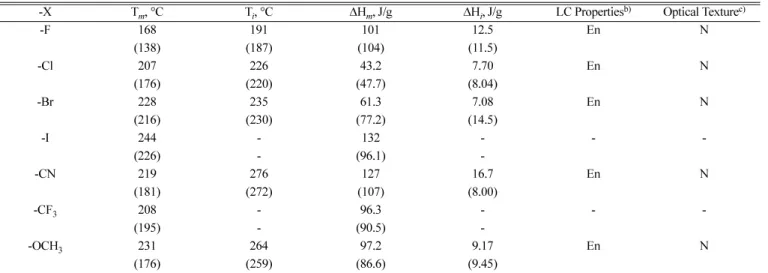
3-3. X=-F, -Cl, -Br, -I, -CN, -CF3 및 -OCH3화합물 양말단에치환기로 X= -F, -Cl, -Br, -I, -CN, -CF3및 -OCH3기를 갖는화합물의열역학적데이터와액정성질및광학구조를 Table 1
에나타내었고, 이들의 DSC thermograms와광학구조를 Fig.1,2 및 3에실었다. Fig. 1에서살펴보는바와같이 X=-F와 -Cl이비슷한열 거동을보였고, X= -Br, -CN 및 -OCH3가비슷한행동을나타내었
다. X=-F인화합물의경우가열시 168oC에서커다란흡열피이크
를보여주고있는데이는결정성고체 → 액정으로의변환에해당
하며, 191oC에서보여주는작은피이크는액정 → 등방성액체로의
전이에해당한다. 이러한현상은냉각시에도보여주었는데, 187oC
에서보여주는작은피이크는등방성액체 → 액정으로의전이이고, 138oC에서보여주는커다란피이크는액정 → 결정성고체로의변
환을보여준다. X=-F인경우, 168oC에서보여주는커다란흡열피 이크앞에작은피이크가 160oC에서보여지는데, 이는결정 → 결 정전이에해당하는피이크이다. 이를확인하기위하여 1st heating
후에 1st cooling한후다시 2nd heating을하였는데 160oC에서보여
지는피이크가약간작아질뿐또다시나타나는것을볼수있다. 이 러한현상은불완전한결정화나준안정화된결정상태의나타남에 기인하며, 비슷한거동이유기화합물에서자주보여진다[10, 11]. 여
기에 비하여, X= -Br, -CN 및 -OCH3화합물은 가열시 고체결
정 → 액정으로, 액정 → 등방성액체로의전환이보여졌고, 냉각시 등방성액체 → 액정으로, 액정 → 고체결정으로의피이크를보여주 고있다. 따라서, 상기화합물들은가열과냉각시모두액정상을형 성하는양방성액정임을알수있었고, 이러한현상은편광현미경
에의하여도가역적으로관찰되었다. 이들의편광현미경사진을
Fig. 2에보여주었다. Fig. 2의 (a)는 X=-F인경우가열시보여주는
광학적구조이고, (b)는냉각시에나타나는광학구조로서네마틱액
정특유의 2,4-brush 형태인 schlieren texture를보여주고있다[12].
그림(c)는가열시 X= -CN화합물의 241oC에서찍은광학구조이고, (d)는냉각시 265oC에서찍은광학구조로서네마틱액정특유의
대리석형태인 marble texture를형성하고있다[12]. Fig. 3에 X=-I와
-CF3화합물의 DSC thermograms를보여주었다. X=-I인경우가열시
Table 1. Thermal properties and thermodynamic data for the phase transitions of compoundsa)
-X Tm, °C Ti, °C ∆Hm, J/g ∆Hi, J/g LC Propertiesb) Optical Texturec)
-F 168 191 101 12.5 En N
(138) (187) (104) (11.5)
-Cl 207 226 43.2 7.70 En N
(176) (220) (47.7) (8.04)
-Br 228 235 61.3 7.08 En N
(216) (230) (77.2) (14.5)
-I 244 - 132 - - -
(226) - (96.1) -
-CN 219 276 127 16.7 En N
(181) (272) (107) (8.00)
-CF3 208 - 96.3 - - -
(195) - (90.5) -
-OCH3 231 264 97.2 9.17 En N
(176) (259) (86.6) (9.45)
a)Values in the parentheses are those obtained from the cooling differential scanning calorimeter thermograms.
b)En designates enantiotropic formation of liquid crystal phases.
c)N stands for nematic liquid crystal.
Fig. 1. DSC thermograms of Series I with X = -F, -Cl, -Br, -CN and -OCH3.
Fig. 2. Photomicrographs of Series I with (a) X=-F on heating (170°C), (b) X = -F on cooling (177°C), (c) X=-CN on heating (241°C), and (d) X = -CN on cooling (265 °C).
하나의커다란흡열피이크를보여주는데, 이는고체결정에서등방
성액체로의전이를나타낸다. 300oC가넘어서는화합물이분해되
기때문에냉각시에는어떠한발열피이크도보여주지않았다. 한 편 -CF3도가열시에 208oC에서결정 → 등방성액체로의전이를
보여주고, 냉각시에는 195oC에서등방성액체 → 고체결정으로의 전이를보여주므로액정상을형성하지못하는화합물로조사되었으 며, 편광현미경하에서도가역적으로같은현상이관찰되었다. X=-
I와 -CF3 화합물이다른치환기의화합물과달리액정상을형성하지
못하는이유는 Table 1에주어진열역학적값에의하여설명할수
있다. 즉, Table 1에주어진녹음열(△Hm)의값들을비교해보면, X= -I 및 -CF3의녹음열값이상당히높은것을볼수있다. △Hm
값이높은화합물들은액정을형성하지못하는경향이있는것으로 보고되었다[13, 14]. 즉, 가열시이들의△Hm 값이너무커서액정 상을형성하지못하고, 고체결정에서바로등방성액체로전이하는 것으로보인다. 또한일반적으로말단치환기가 -CF3인경우는액 정상의열안정성을감소시키므로 group efficiency가감소되는것
으로알려져있다[15]. 한편 X= -CN인경우는△Hm값이 127로상 당히높음에도불구하고액정상을형성하는까닭은 -C≡N기가선
형을페닐기에계속유지하고있어서 rigidity를좋게하여주기때
문에액정상을형성할수있는것이다. Table 1의등방성액체화
온도(Ti)로부터이화합물들의치환기 nematic group efficiency order
를보면 -CN > -OCH3> -Br > -Cl > -F순으로감소함을알수있다.
여기서 nematic group efficiency order는등방성액체화온도(Ti)를 비교해말하며, Ti가높을수록 group efficiency가크다고말한다. 이
nematic group efficiency는치환기가액정상을얼마나잘안정화시
킬수있느냐의척도로써이용되어왔는데[14-16], 본연구에서합성
한화합물들의치환기 nematic group efficiency order는단일메소 젠화합물이나선형이메소젠화합물[14-16]의경우와도동일한순 서를유지하였다.
4. 결 론
중앙에 oxytetramethyleneoxy 유연격자를 갖으며, 양말단에
schiff-base 형태의메소젠기를갖는새로운형태의액정화합물을합
성하였다. 화합물들의말단치환기효과를살펴보기위하여파라-위
치의치환기를 X= -F, -Cl, -Br, -I, -CN, -CF3및 -OCH3기로바꾸 었고, 이들의열역학적성질과액정성를구조와관련지어살펴보았 다. X= -F, -Cl, -Br, -CN 및 -OCH3는가열과냉각시모두액정상을 형성하는양방성네마틱액정이었고, X= -I 및 -CF3는액정상을형 성하지못하였다. 이화합물들의 nematic group efficiency order는
-CN > -OCH3> -Br > -Cl > -F순으로, 중앙에유연격자를갖으며양 말단에다른메소젠기를갖는화합물들과동일한 nematic group efficiency order를나타내었다.
감 사
본논문은 2003년도호서대학교특별학술연구비에의하여연구
되었으며, 이에깊은감사의말씀을드립니다.
참고문헌
1. Collings, P. J., Liquid Crystals, Princeton University Press, Prin- ceton and Oxford(2002).
2. Yoon, S. H., “Organic Material for LCD Components,”Poly.
Scie. Tech., 15(6), 674-682(2004).
3. Demus, D. and Zaschke, H., Flussige Kristalle in Tabellen II, VEB Deutscher Verlag fur Grundstoffindustire, Leipzig (1984).
4. Demus, D., Goodby, J., Gray, G. W., Spiess, H.-W. and vill, V., Handbook of Liquid Crystals, Wiley-VCH, Weinhem, Vol.1. (1998).
5. Park, J.-H., Choi, O.-B., Lee, J.-S., Kang, K.-M., Shin, J.-C., Kim, K.-H., Kim, H.-J., Lee, C. J., So, B.-K. and Lee, S.-M., “Liquid Cristalline Properties of Schiff Base Mono-and Dimesogenic Com- pounds,”Kor. Chem. Eng.Res., 43(1), 176-180(2005).
6. Park, J.-H., Lee, H.-M., Choi, O.-B., Lee, Y.-S., Ko, K.-K., Lee, E.-S., Song, J.-H., Kim, K.-W., Lee, E.-K., Lee, C.-J., So, B.-K.
and Lee, S.-M., “H-Shaped Dimesogenic Compounds; Synthe- sis and Thermotropic Properties of α,ω-Bis[2,5-bis(4-cyanophe- noxycarbonyl)phenoxy]alkanes,”J. Kor. Chem. Soc., 50(3), 263- 268(2006).
7. Jin, J.-I., “Liquid Crystalline Behavior of Novel Dimesogenic Compounds,”Mol. Cryst. Liq. Cryst., 267, 249-265(1995).
8. Jin, J.-I and Park, J.-H., “Main Chain Thermotropic Copolyes- ters Containing Imino Group Linked Mesogenic Units and Poly- methylene Spacers,”Eur. Polym. J.,23(12), 973-977(1987).
9. Donahoe, H. B., Benjamin, L. E., Fennoy, L. V. and Greiff, D.,
“Synthesis of Potential Rickettsiostatic Agents.I.4,4'-Dicarboxy-
α,ω-diphenoxyalkanes,”J. Org. Chem., 26, 474-475(1961).
10. Dehne, H., Roger, A., Demus, D., Diele, S., Kresse, H., Pelzl, G.
and Wedeler, W., “Sulphur Ligated Siamese Twin Mesogens,”
Liq. Cryst., 6, 47-62(1989).
11. Park, J.-H., Choi, O.-B., Shin, J.-C., Kang, K.-M., Kim, K.-H., Lee, C.-J., So, B.-K. and Lee, S.-M., “Effect of Molecular Struc- ture on Liquid Crystalline Properties(1); 1,10-Bis(p-2-,3-,4-halo- genophenoxycarbonyl)phenoxydecane,”J. Kor. Chem, Soc., 48(3), 322-326(2004).
12. Demus, D., Textures of Liquid Crystals, Verlag Chemie, N.Y.(1978).
13. Jin, J.-I., Kang, J.-S., Jo, B.-W. and Lenz, R.W., “Synthesis and Properties of Thermotropic Compounds with Two Terminal Mesogenic Units and a Central Spacer III. Homologous Series of Fig. 3. DSC thermograms of Series I with X = -I and -CF3.
α,ω-Bis[4-(p-nitrobenzoyloxy)phenoxy]alkanes,”Bull. Kor. Chem.
Soc., 4(4), 176-178(1983).
14. Jin, J.-I. and Park, J.-H., “Thermotropic Compounds with Two Terminal Mesogenic Units and a Central Spacer. 5. Homologous Series of Polymethylene-α,ω-Bis(p-oxybenzylidene Aniline),”
Mol. Cryst. Liq. Cryst., 110, 293-308(1984).
15. Gray, G. W., Winsor, P. A., Eds. Liquid Crystals and Plastic Crystals, John wiley and Sons Inc, London, Vol.1.1. 115-125(1974).
16. Jin, J.-I., “Liquid Crystalline Behavior of Novel Dimesogenic Compound,”Mol. Cryst. Liq. Cryst., 267, 249-269(1995).