고령의 대퇴 전자간 골절 환자에서 Polished 시멘트 대퇴 스템을 이용한 양극성 인공관절 치환술 후 임상적 및 방사선학적 결과
권석현ㆍ신창현ㆍ이영창ㆍ김민우*ㆍ김태호*
원광대학교 의과대학 정형외과학교실, 예수병원 정형외과*
Clinical and Radiological Outcomes of Polished Cemented Bipolar Hemiarthroplasty for Intertrochanteric Fractures in Elderly Patients
Suc-Hyun Kweon, M.D., Chang-Hyun Shin, M.D., Yeong-Chang Lee, M.D., Min-Woo Kim, M.D.*, Tae-Ho Kim, M.D.*
Department of Orthopedic Surgery, Wonkwang University School of Medicine, Iksan, Department of Orthopedic Surgery, Presbyterian Medical Center*, Jeonju, Korea
Received November 20, 2019 Revised December 20, 2019 Accepted April 13, 2020 Correspondence to:
Tae-Ho Kim, M.D.
Department of Orthopedic Surgery, Presbyterian Medical Center, 365 Seowon-ro, Wansan-gu, Jeonju 54987, Korea
Tel: +82-63-230-8114 Fax: +82-63-230-1439 E-mail: [email protected] Financial support: This study was supported by grant from Wonkwang University, 2019.
Conflict of interests: None.
Purpose: To evaluate the clinical and radiological outcomes of bipolar hemiarthroplasty using a polished cemented femoral stem for intertrochanteric fractures in elderly patients.
Materials and Methods: From July 2005 to May 2015, 48 patients diagnosed with intertrochanteric fractures underwent bipolar hemiarthroplasty. The mean age and follow-up period were 80.5 years and 30.5 months, respectively. The postoperative results were evaluated clinically and radiologically.
Results: The mean operation time was 100 minutes (range, 90-120 minutes), and the mean amount of blood loss was 334 ml (range, 170-500 ml). At the last follow-up, the mean Harris hip score (HHS), visual analogue scale (VAS), and Western Ontario and McMaster Universities Osteoarthritis Index (WOMAC) scores were 82.2 (range, 76-90), 0.8 (range, 1-3), and 36 (range, 30-40), respectively.
Walking was initiated using a walker for partial weight-bearing, and the mean walking time was 5.8 days (range, 3-14 days). Ambulatory ability was restored to a walking state before the injury in 36 cases (75.0%), and wheelchair ambulation was possible in 12 cases (25.0%). The instrumental activities of daily living (IADLs) were 17 patients (35.4%), and the basic activities of daily living (BADLs) were 31 patients (64.6%).
Conclusion: Polished cemented bipolar hemiarthroplasty can achieve secure fixation with no postop- erative thigh pain. Restoring the preoperative walking ability will be more helpful for intertrochanteric fractures in elderly patients.
Key Words: Femur, Intertrochanteric fracture, Hemiarthroplasty, Cemented femoral stem
Copyright © 2020 The Korean Fracture Society. All rights reserved.
This is an Open Access article distributed under the terms of the Creative Commons Attribution Non-Commercial License (http://creativecommons.org/licenses/by-nc/4.0) which permits unrestricted non-commercial use, distribution, and reproduction in any medium, provided the original work is properly cited.
Introduction
The goal of treatment of proximal hip fractures in elderly patients is to reduce complications that can occur in bed life
by relieving pain and restoring preoperative walking ability through early walking and rehabilitation. Elderly patients often have poor bone quality due to osteoporosis; therefore, a reduction can be difficult, and concomitant complica-
tions such as nonunion, metal fixation failure, and lag screw perforation of the femoral head occur frequently.1) Bipolar hemiarthroplasty has disadvantages such as longer opera- tion time and can result in more bleeding than internal fix- ation. However, there are limited implementations for early walking and return to daily life. Furthermore, there have been reports demonstrating the use of cementless femoral stems,2,3) but a firm fixation it is often difficult to obtain early, and many complications such as postoperative thigh pain or fractures around the stem are possible.4,5) The aim of this study was to evaluate the clinical and radiological results of bipolar hemiarthroplasty using polished cemented femoral stem in patients with intertrochanteric fractures.
Materials and Methods
1. Study subject
This study was approved by the local hospital ethics committee (No. 2019-08-008), and the informed consent was waived. From July 2005 to May 2015, Wonkwang University Hospital, among 238 patients with bipolar hemi- arthroplasty who aged 75 years old or older and were diag- nosed with intertrochanteric fracture of the femur classified by AO-Muller/Orthopaedic Trauma Association classifi- cation from 31-A2.1 to 31-A2.3, 52 patients were included who were able to walk outdoors without an assistive device.
According to the AO classification, 31-A3 type fracture has the fracture line extending from the medial cortex to the cortical bone below the Greater Trochater (GT). So these type fractures were excluded from this study because they were not suitable for making GT as the landmark for lat- eralization of femoral components. Among them, 1 patient died during the follow-up period and 3 patients were not
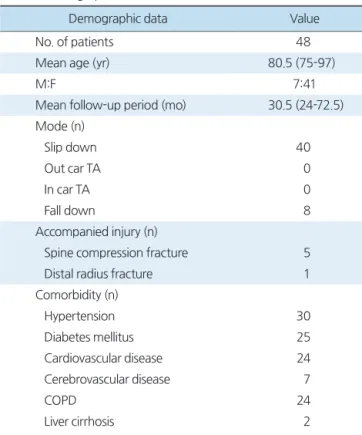
followed-up; therefore, a total of 48 cases were included who were followed-up for at least 2 years (Table 1). The study cohort included 41 females and 7 males with a mean age of 80.5 years (range, 75-97 years). The mean follow-up period was 30.5 months (range, 24-72.5 months). Of the 48 patients, 40 cases were occurred by slipping down and 8 cases by falling down, respectively. Concomitant injuries occurred in 5 cases of lumbar compression fracture and 1 case of distal radius fracture. Concomitant diseases included hypertension in 30 cases, diabetes in 25 cases, cardiovas- cular disease in 24 cases, cerebrovascular disease in 7 cases, chronic lung disease in 24 cases, liver cirrhosis in 2 cases, and chronic renal failure in 9 cases (Table 2).
2. Surgical method
In all cases, the anterolateral approach (the modified Hardinge approach) was used. The femoral head was re- moved after cutting by oscillating saw along the intertro-
Table 1. Classification of Intertrochanteric Fracture (n=48)
AO/OTA classification Value
31-A2.1 6 (12.5)
31-A2.2 28 (58.3)
31-A2.3 14 (29.2)
Values are presented as number (%). AO/OTA: AO-Muller/Orthopae- dic Trauma Association.
Table 2. Demographic Data
Demographic data Value
No. of patients 48
Mean age (yr) 80.5 (75-97)
M:F 7:41
Mean follow-up period (mo) 30.5 (24-72.5) Mode (n)
Slip down 40
Out car TA 0
In car TA 0
Fall down 8
Accompanied injury (n)
Spine compression fracture 5
Distal radius fracture 1
Comorbidity (n)
Hypertension 30
Diabetes mellitus 25
Cardiovascular disease 24
Cerebrovascular disease 7
COPD 24
Liver cirrhosis 2
Chronic kidney disease 9
Values are presented as number only or mean (range). M: male, F:
female, TA: traffic accident, COPD: chronic obstructive pulmonary dis- ease.
chanteric fracture while preserving the soft tissues around the exposed fracture area. Care was taken in the proximal femoral region, which is connected from the lesser trochan- ter to the greater trochanter, to avoid additional fractures because of the importance of maintaining the thickness of the proximal cement mantle. If the greater trochanteric
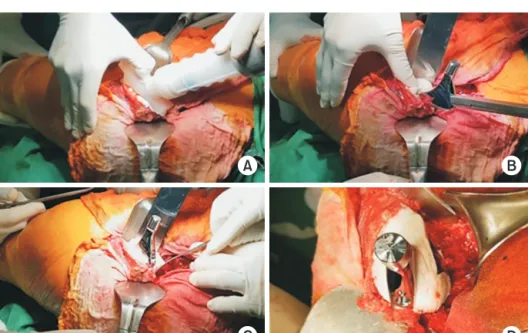
fragments were displaced or additional fractures were ex- isted, double loop wires were used to pass from the lesser trochanter to the greater trochanter to fix them firstly with figure eight shaped knot and then with an elliptical rein- forcement (Fig. 1). In all cases, Cement was injected using the third-generation cement technique. In case of proximal femoral bone loss, an osteotome was placed around the bone defect to obtain an appropriate cement mantle thick- ness while maintaining the form (Fig. 2). After the cement was injected, pressure was applied using a proximal femoral sealing to distribute the cement evenly. Cement that flowed out of the form after the femoral stem was inserted was re- moved before hardening using a rongeur or thin osteotome.
The degree of insertion of the femoral stem was determined by centering the three reference points on the femoral stem while maintaining a cement mantle thickness of at least 3 to 4 mm from the lesser trochanter up to 1 cm above. The femoral stem that extended with increased medial offset was used in all cases. Overall, 34 Exeter V40 (44 offset) ce- mented stems (Stryker, Mahwah, NJ, USA) and 14 collar- less polished tapered (CPT) extended offset cemented stems (Zimmer, Warsaw, IN, USA) were used. Simplex (Stryker- Howmedica-Osteonics, Mahwah, NJ, USA) bone cement was used for the Exeter stem and CMW3 (Depuy, Warsaw, IN, USA) bone cement was used for the CPT stem.
A B
Gluteus medius Gluteus
minimus
Fig. 1. The 18 gauze wiring technique was used above the soft tissue on the trochanteric area with an eight-shape and second oval-shape.
(A) Anteroposterior view. (B) Axial view.
A B
C D
Fig. 2. (A) Cement gun was used for retro grade insertion and pressurization.
(B) Osteotome was positioned around the bone defect. (C, D) An appropriate cement mantle thickness was obtained while maintaining the form.
3. Methodsunstab
We encouraged patients to start the knee joint and Q- setting exercise 1 day postoperatively. Wheelchair ambula- tion or bed side standing was done at 4 to 5 days and walker ambulation at 6 to 7 days postoperatively, respectively. Pa- tients with concomitant injuries and postoperative medical complications were treated with individualized rehabilitation method.
We used the Harris hip score (HHS), visual analogue scale (VAS), and Western Ontario and McMaster Universities Os- teoarthritis Index (WOMAC) score for clinical evaluation.
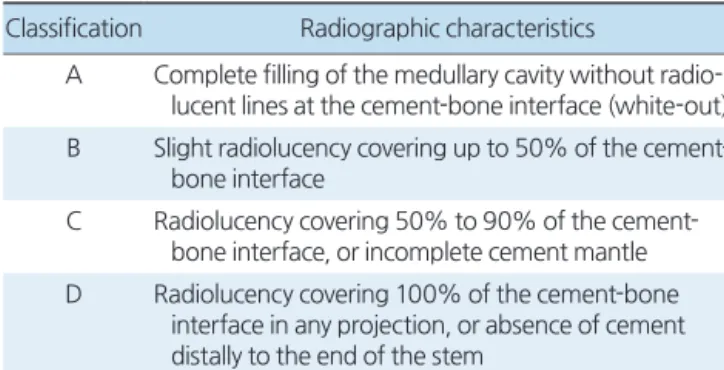
We assessed the degree of recovery to the ambulatory state before injury and postoperative total weight bearing time.6,7) We used anteroposterior and axial images for ra- diological evaluation of the hips at the time of operation and throughout the final follow-up (Fig. 3). Barrack classifica- tion was used for postoperative cementing technique evalu- ation to categorize the patients into four grades (Table 3).8)
We measured the vertical distance of the radiolucent line of the outer shoulder of the stem in zone 1 to assess subsid- ence of the femoral stem. When we could not measure this distance, the change in the distance between the end of the femoral stem and the lower part of the distal centralizer was assessed. As described previously by Gruen et al.,9) the femoral stem is divided into 7 zones for monitoring and a
radiolucent line can be identified if the demarcation line of the bone cement and femoral stem is thicker than 2 mm.
Results
The mean operative time was 100 minutes (range, 90- 120 minutes), and the mean blood loss was 334 ml (range, 170-500 ml). Systemic complications included pneumonia (3 cases), urinary tract infection (3 cases), and delirium (9 cases). There were no femoral pain or groin pain complaints and no postoperative dislocations in all cases. Superficial infection occurred in 3 patients; subsequently, 2 patients were treated with simple intravenous antibiotic therapy, and the remaining case was improved with marginal resection, implantation of antibiotic-embedded cement beads, and intravenous antibiotic therapy for 4 weeks. As a result of the
Table 3. Barrack Classification of Cement Mantle Quality Classification Radiographic characteristics
A Complete filling of the medullary cavity without radio- lucent lines at the cement-bone interface (white-out) B Slight radiolucency covering up to 50% of the cement-
bone interface
C Radiolucency covering 50% to 90% of the cement- bone interface, or incomplete cement mantle D Radiolucency covering 100% of the cement-bone
interface in any projection, or absence of cement distally to the end of the stem
A
C
B
Fig. 3. A 79-year-old female with an intertrochanteric fracture under- went bipolar hemiarthroplasty. (A) Preoperatively: anteroposterior and axial view. (B) Postoperatively: anteroposterior and axial view. (C) Two- year follow-up: anteroposterior and axial view.
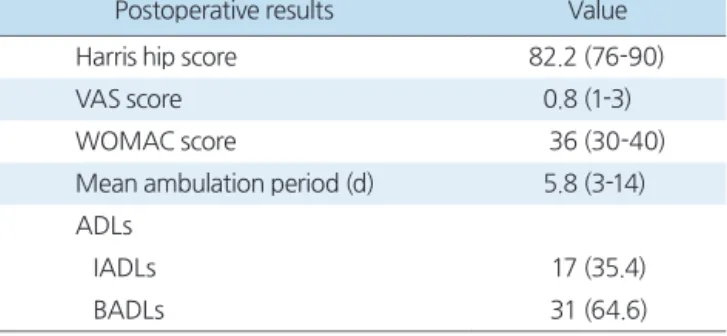
clinical evaluation, the mean HHS was 82.2 (range, 76- 90), the mean VAS was 0.8 (range, 1-3), and the WOMAC score was 36 (range, 30-40) at the last follow-up.
The gait was initiated using a walker to partially load weight, and the mean walking time was 5.8 days (range, 3-14 days). Walker ambulation was delayed in 2 patients with long-term pneumonia treatments and 6 patients with preoperative dementia. Walking ability recovered to pre- injury state in 36 cases (75.0%), and 12 cases (25.0%) were able to be ambulated with wheelchairs. Instrumental activi- ties of daily living (IADLs) were possible in 17 cases (35.4%), and basic activities of daily living (BADLs) were possible in 31 cases (64.6%) (Table 4).
In postoperative imaging, 30, 14, 4, and 0 patients were classified as grades A, B, C, and D, respectively, in a retro- spective manner according to the Barrack classification. The mean subsidence of the femoral stem was 2.3 mm (range, 1-5 mm) at the final follow-up with no subsidence of bone cement in any case.
We did not find osteolysis and loosening of the femoral stem in any patient. Postoperative complications included fracture of the proximal part of the femoral stem due to slip down (1 patient, Vancouver type B). Proximal femoral stem fracture was managed with internal fixation using a metal plate without changing the femoral stem while maintaining the cement.
Discussion
Proximal femoral fractures in the elderly include severe osteoporotic comminuted fractures therefore, internal fixa- tion can be difficult and complications such as nonunion and metal fixation failure can frequently occur.10) In ad- dition, when internal fixation fails, the long bed life delays the return to normal life due to deterioration of systemic condition and muscle weakness, overall resulting in an in- crease in mortality rate. Treatment options should be based on the patient’s general condition, the type of fracture, and the degree of osteoporosis. In elderly patients, bipolar hemi- arthroplasty may be selected as an appropriate treatment option because it can reduce the complications associated with fractures and reduce systemic complications by allow- ing early ambulation and functional recovery.11,12) However, there has been debate over whether cementless or cemented stems are more appropriate for elderly patients. Many au- thors have reported no difference in mortality, functional outcomes, and reoperation rates between patients with cementless and cemented stems over long-term follow- up.13,14) Furthermore, it has been reported that the use of a cemented femoral stem may lead to complications such as increased bleeding, longer operation time, embolization, and decreased cardiac output during cement insertion.13) In this study, the mean intraoperative and postoperative transfusion volumes were 400 ml and 600 ml, respectively, and ad- ditional transfusion was performed only if the hemoglobin level was less than 7 g/dl. The operation time was delayed when the greater trochanteric bone was severely displaced and the double loop wire technique was used. In order to prevent embolism, the femoral cancellous bone was kept at its maximum, and the adipose tissue and cancellous bone were removed. After washing with 2 to 3 L of normal saline, gauze packing with hydrogen peroxide was used to prevent blood clots from remaining in the femur, and then cement was injected. Anesthesiologists need to pay close attention to prevent significant lowering of blood pressure during joint reduction after cement compression and femoral stem insertion. Choy et al.15) reported that 40 cementless Bipolar hemiarthroplasties with AML 5/8 porous-coated femoral
Table 4. Postoperative Clinical Outcome (n=48)
Postoperative results Value
Harris hip score 82.2 (76-90)
VAS score 0.8 (1-3)
WOMAC score 36 (30-40)
Mean ambulation period (d) 5.8 (3-14) ADLs
IADLs 17 (35.4)
BADLs 31 (64.6)
Values are presented as mean (range) or number (%). VAS: visual analogue scale, WOMAC: Western Ontario and McMaster Universities Osteoarthritis Index, ADL: activities of daily living, IADL: instrumental activities of daily living, BADL: basic activities of daily living.
stem (Depuy) for intertrochanteric fractures (A2 according to the AO classification) in elderly patients showed reason- able outcomes for more than 2 years of follow-up. The author emphasized the osteointegration rate in the diaphysis can be increased in osteoporotic elderly patients with press- fit fixation of implants. In this study, even though there was no radiologic complication, 7 patients (14.5%) and 5 pa- tients (10.4%) complained of groin and thigh pain, respec- tively, requiring medication. Considering groin or thigh pain was not observed in our study, even if there is no particular problem in the surgical technique, the press-fit fixation of cementless arthroplasty itself can cause the pain.
Bipolar hemiarthroplasty in elderly patients has been performed for rapid recovery and functional needs.16,17) Firm fixation and less femoral pain are easy to obtain via cemented femoral stems, thus allowing for early wheelchair ambulation and standing after surgery while also being helpful for early rehabilitation treatment in elderly patients.18) Early treatment has also been reported to result in fewer complications and lower mortality.19) In this study, ambula- tion with a walker was performed on mean 4.5 days post- operatively. In cases of medical complications such as pneu- monia or dementia, ambulation with walker was delayed.
However, all patient began wheelchair ambulation three days after the operation.
In a proximal femoral fracture, a cemented femoral stem with a collar was used to distribute the pressure to the proximal bone and cement to prevent the femoral stem subsidence and to allow for the leg length to be set more easily.20) However, stress was applied to the proximal thigh, resulting in early dissociation of the femoral stem due to proximal femoral bone resorption and cement mantle frag- ment. Furthermore, when the varus position of the femoral stem is caused by a calcar pivot, the collar acts as a fulcrum, resulting in a femoral stem failure.9,21) However, this compli- cation was reduced in the case of a polished cemented stem without collar when the proximal cement mantle thickness (3-4 mm proximal, 2 mm distal) is retained because hoop stress occurred on the cement-bone surface while the stem interlock within the cement mantle.22,23) In this study, we used a polished cemented stem without a collar in all cases.
At the final follow-up, the mean femoral stem subsidence was 2.3 mm, and there was no osteolysis due to proximal femoral bone resorption and cement mantle fracture.
Because the gluteus medius and gluteus minimus, which are the abductors of the hip, are attached around the fe- mur greater trochanter, rehabilitation is often delayed due to postoperative pain and tingling if there is no firm fixa- tion. Various methods have been used to fix the greater trochanter. Grimsrud et al.24) reported that the standard ce- ment femoral stem and the new cerclage cable technique in premature intertrochanteric fractures allow for early weight bearing and result in fewer complications. The double- stranded 18-gauge wire was used to fix the fractured tro- chanteric site first with a figure eight knot, and then fas- tened firmly in an elliptical shape once more to enable early walking.
Conclusion
In elderly patients with intertrochanteric fractures, bipo- lar hemiarthroplasty can be performed as an alternative to internal fixation, which has a high failure rate. The bipolar hemiarthroplasty using a polished cemented femoral stem, which is a third-generation cement technique, can be useful for early walking and restoration of preoperative gait due to earlier firm fixation and no thigh pain.
요 약
목적: 고령의 대퇴 전자간 골절 환자에서 polished 시멘트 대
퇴 스템을 이용하여 양극성 인공관절 치환술을 시행하고 임 상적, 방사선학적 추시 결과를 알아보고자 하였다.대상 및 방법: 2005년 7월부터 2015년 5월까지 대퇴 전자간
골절로 진단 받은 환자에서 인공관절 치환술을 시행하였던 48예를 대상으로 하였다. 평균 연령은 80.5세였고 추시 평균 은 30.5개월이었으며, 결과는 임상적, 방사선학적으로 평가되 었다.결과: 평균 수술 시간은 100분(범위 90-120분), 평균 출혈량
은 334 ml (범위 170-500 ml)였다. 마지막 추시에서 HHS 점 수, VAS 및 WOMAC 지수는 각각 평균 82.2 (범위 76-90), 0.8 (범위 1-3), 36 (범위 30-40)이었다. 보행은 보행기를 이용하여 부분적 체중부하를 시작하였으며 평균 보행 시기는 5.8일(범위 3-14일)이었고, 보행 능력은 36예(75.0%)에서 수 상 전 보행 상태로 회복하였고, 12예(25.0%)에서 휠체어 보 행이 가능하였다.
결론: 고령의 대퇴 전자간 골절에서 polished 시멘트 대퇴 스
템을 이용한 양극성 인공관절 치환술은 고정이 견고하며 술 후 통증 완화로 인하여 조기 보행이 가능하고 수술 전 보행 정도 회복에 도움을 줄 수 있다.색인 단어: 대퇴골, 대퇴 전자간 골절, 양극성 인공관절 치환
술, 시멘트 대퇴 스템ORCID
권석현, https://orcid.org/0000-0003-1939-2676 신창현, https://orcid.org/0000-0001-7282-7902 이영창, https://orcid.org/0000-0002-7981-4300 김민우, https://orcid.org/0000-0003-0528-5730 김태호, https://orcid.org/0000-0002-2882-0372
References
1. Tasyıkan L, Ugutmen E, Sanel S, Soylemez MS, Ozkan K, So- lakoglu C: Short-term results of surgical treatment with cepha- lomedullary nails for basicervical proximal femoral fractures.
Acta Orthop Belg, 81: 427-434, 2015.
2. Chang JD, Yoo JH, Chang KY, Park BM: Cementless Zwey- muller stem for the treatment of the hip fracture in patients older than 80 with severe osteoporosis: case control study with ce- mented stem. J Korean Hip Soc, 18: 447-453, 2006.
3. Kim SY, Kim YG, Hwang JK: Cementless calcar-replacement hemiarthroplasty compared with intramedullary fixation of unstable intertrochanteric fractures. A prospective, randomized study. J Bone Joint Surg Am, 87: 2186-2192, 2005.
4. Leonardsson O, Kärrholm J, Åkesson K, Garellick G, Rogmark C: Higher risk of reoperation for bipolar and uncemented hemi- arthroplasty. Acta Orthop, 83: 459-466, 2012.
5. Viberg B, Overgaard S, Lauritsen J, Ovesen O: Lower reopera- tion rate for cemented hemiarthroplasty than for uncemented hemiarthroplasty and internal fixation following femoral neck fracture: 12- to 19-year follow-up of patients aged 75 years or more. Acta Orthop, 84: 254-259, 2013.
6. Hoffer MM, Feiwell E, Perry R, Perry J, Bonnett C: Functional ambulation in patients with myelomeningocele. J Bone Joint Surg Am, 55: 137-148, 1973.
7. Koval KJ, Skovron ML, Aharonoff GB, Meadows SE, Zucker-
man JD: Ambulatory ability after hip fracture. A prospective study in geriatric patients. Clin Orthop Relat Res, (310): 150- 159, 1995.
8. Barrack RL, Mulroy RD Jr, Harris WH: Improved cementing techniques and femoral component loosening in young patients with hip arthroplasty. A 12-year radiographic review. J Bone Joint Surg Br, 74: 385-389, 1992.
9. Gruen TA, McNeice GM, Amstutz HC: “Modes of failure” of cemented stem-type femoral components: a radiographic analy- sis of loosening. Clin Orthop Relat Res, (141): 17-27, 1979.
10. Watson ST, Schaller TM, Tanner SL, Adams JD, Jeray KJ: Out- comes of low-energy basicervical proximal femoral fractures treated with cephalomedullary fixation. J Bone Joint Surg Am, 98: 1097-1102, 2016.
11. Yurdakul E, Karaaslan F, Korkmaz M, Duygulu F, Baktır A: Is cemented bipolar hemiarthroplasty a safe treatment for femoral neck fracture in elderly patients? Clin Interv Aging, 10: 1063- 1067, 2015.
12. Lennox IA, McLauchlan J: Comparing the mortality and mor- bidity of cemented and uncemented hemiarthroplasties. Injury, 24: 185-186, 1993.
13. Parker MJ, Gurusamy KS, Azegami S: Arthroplasties (with and without bone cement) for proximal femoral fractures in adults.
Cochrane Database Syst Rev, 16: CD001706, 2010.
14. Luo X, He S, Li Z, Huang D: Systematic review of cemented versus uncemented hemiarthroplasty for displaced femoral neck fractures in older patients. Arch Orthop Trauma Surg, 132: 455- 463, 2012.
15. Choy WS, Ahn JH, Ko JH, Kam BS, Lee DH: Cementless bipo- lar hemiarthroplasty for unstable intertrochanteric fractures in elderly patients. Clin Orthop Surg, 2: 221-226, 2010.
16. Broos PL, Rommens PM, Deleyn PR, Geens VR, Stappaerts KH: Pertrochanteric fractures in the elderly: are there indications for primary prosthetic replacement? J Orthop Trauma, 5: 446- 451, 1991.
17. Harwin SF, Stern RE, Kulick RG: Primary Bateman-Leinbach bipolar prosthetic replacement of the hip in the treatment of un- stable intertrochanteric fractures in the elderly. Orthopedics, 13:
1131-1136, 1990.
18. Foss NB, Kehlet H: Mortality analysis in hip fracture patients:
implications for design of future outcome trials. Br J Anaesth, 94: 24-29, 2005.
19. Leighton RK, Schmidt AH, Collier P, Trask K: Advances in the treatment of intracapsular hip fractures in the elderly. Injury, 38 Suppl 3: S24-S34, 2007.
20. Haentjens P, Casteleyn PP, De Boeck H, Handelberg F, Opdecam P: Treatment of unstable intertrochanteric and subtrochanteric fractures in elderly patients. Primary bipolar arthroplasty com- pared with internal fixation. J Bone Joint Surg Am, 71: 1214- 1225, 1989.
21. Ling RS: The use of a collar and precoating on cemented femo- ral stems is unnecessary and detrimental. Clin Orthop Relat Res, (285): 73-83, 1992.
22. Hook S, Moulder E, Yates PJ, Burston BJ, Whitley E, Bannister GC: The Exeter Universal stem: a minimum ten-year review from an independent centre. J Bone Joint Surg Br, 88: 1584- 1590, 2006.
23. Lewthwaite SC, Squires B, Gie GA, Timperley AJ, Ling RS: The Exeter Universal hip in patients 50 years or younger at 10-17 years’ followup. Clin Orthop Relat Res, 466: 324-331, 2008.
24. Grimsrud C, Monzon RJ, Richman J, Ries MD: Cemented hip arthroplasty with a novel cerclage cable technique for unstable intertrochanteric hip fractures. J Arthroplasty, 20: 337-343, 2005.