Study for the Leadership Qualities of International WYP 2005 Young Physics Talent
Sung-Won Kim ∗
Department of Science Education, Ewha Womans University, Seoul 120-750
Wan-Seon Kim
Department of Science Education, Ewha Womans University, Seoul 120-750 Department of Physics, Incheon University, Incheon 406-772
(Received 24 May, 2010 : revised 25 August, 2010 : accepted 14 September, 2010)
This paper reports the leadership qualities of the International WYP2005 Young Physics Talent.
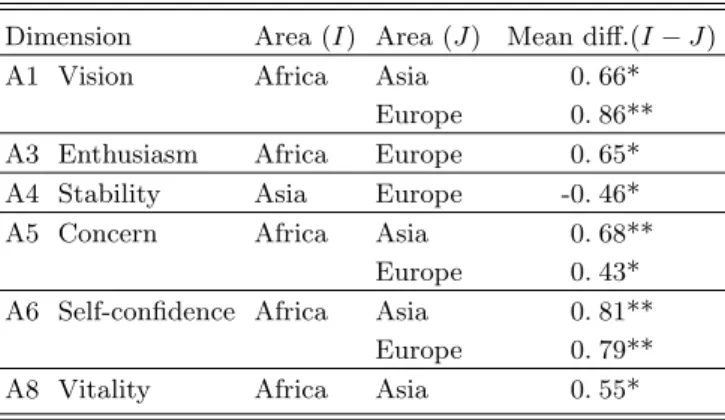
The scores on leadership qualities from the survey were obtained for 70 students from 19 coun- tries. The survey consisted of 10 dimensions of the leadership qualities. The data were compared between males’ and females’ scores by using the t-test. Also, the differences among students from several continents were studied by using ANOVA and a post-hoc analysis. For gender differences, females had significantly higher scores in ‘integrity’ and ‘concern for others’ than males. African students had significantly higher scores in five dimensions (vision, enthusiasm, concern for others, self-confidence, and vitality), and Asian students had lower scores in ‘stability’ than European stu- dents. However, no differences between Asian and European students were observed for the rest of the dimensions.
PACS numbers: 01, 01.40.-d
Keywords: leadership, young physics talented, physics young ambassador
I. Introduction
1. World of Year of Physics (WYP) and Physics Talent Search
To commemorate Einstein’s great works in 1905, such as papers on quantum theory, Brownian motion, and spe- cial relativity, the European Physical Society (EPS) and the International Union of Pure and Applied Physics (IUPAP) designated 2005 the “World Year of Physics (WYP)” [1]. On June 10, 2004, the United Nations (UN) declared 2005 as the “International Year of Physics.” A series of events were organized by different groups includ- ing science museums, physics departments at educational institutions, labs, community groups, and teachers. The program of “WYP 2005 Physics Talent Search” was one of those events. The purpose of that program was to
∗
E-mail: [email protected]
create enthusiasm, interest, and participation in physics among young people and their families. Participating countries selected physics-talented girls and boys, ages 10–18. Sub-ranges of 10–12, 13–15, and 16–18 were also used; thus, the students were in elementary, middle, or high school. They accomplished a series of assignments and activities proposed by the WYP 2005 Physics Tal- ent Search International Committee; then, excellent stu- dents were selected by assessments of those assignments and activities.
The assignments included various activities related
with physics. The categories were as follows: writ-
ing about physics, physics experiments, physics and art,
physics and photography, WYP 2005 activities, teaching
physics, physics competitions, physics literature search
and research paper, and other activities or tasks designed
by the National Committee. For each category, itemized
tasks and a number of points were given in detail. Stu-
dents were required to accumulate points from at least
-952-
three categories for National Recognition, as “[Country Name] WYP 2005 Physics Talent.” Also, each category was assigned limits on the number of points. To be cho- sen as “International WYP 2005 Physics Talent,” stu- dents had to acquire more than 1.5 times the minimum points for the National WYP 2005 Physics Talent in dif- ferent tasks in different categories or multiple tasks in one category. According to the criteria, 32 students was selected as International WYP 2005 Physics Talent.
2. Physics Young Ambassadors’ Symposium
The international festival of “Physics Young Ambas- sadors Symposium” was held in Taipei, Taiwan, from December 31, 2005 to January 4, 2006. Twenty coun- tries participated in this special symposium [2]. Stu- dents from Taipei were excepted because Taipei was the host country. One to six students from each country attended this symposium, and six students represented Korea as International WYP 2005 Physics Talents. Two students were in elementary, two in middle, and two in high school. Among them, three students were male and three students were female.
Students from each country attended a wide variety of events, including presentations by distinguished physi- cists, a ‘physics is fun’ session with hands-on activities, a poster session and an oral presentation session for the students to present their work, a cultural evening, sight- seeing tours in Taipei and the surrounding area, and an awards ceremony honoring the students’ achievements in physics. They had a scientific tour of Hsinchu Science- based Industrial Park in Taiwan as one of the scientific activities. In the poster session, exhibitions of the exper- iments by the participating countries were posted, and an oral presentation by a representative from each team was given.
3. Motivation and Research Goals
Leadership is important not only in governmental or political leaders, but also in others, such as parents, teachers, scientists, etc. If they have proper guidelines, young people, students, and researchers will procedure
the good results. Physics Young Ambassadors are lead- ers as young scientists. Based on the purpose of the
“WYP 2005 Physics Talent Search” program, they were assigned tasks on phenomena or knowledge relative to physics. Therefore, it was also desirable that they have some other traits, such as a vision of purpose, eagerness to achieve goals, or concern for others. These traits rep- resent some of the qualities of a leader.
In this research, we studied the leadership qualities of Physics Young Ambassadors and constructed a survey.
Also, we obtained scores on the five-point Likert scale, and present the level of leadership quality of the Inter- national WYP 2005 Physics Talents. The differences be- tween the genders were investigated and a comparison among the continents was made.
II. Theoretical Background
1. Definition and Importance of Leadership
The Physics Young Ambassadors (PYA) were selected based on various kinds of activities that were very closely related with leadership, such as vision, ability, concern for others, etc. Thus, we define PYA as physics talented students with leadership traits. Therefore, we studied general leadership dimensions to develop a tool for mea- suring their leadership qualities.
Leadership is one of the five U.S. Department of Ed-
ucation categories of giftedness [3] (general intellectual
ability, specific academic talent, creativity, leadership,
or talent in visual or performing arts). Renzulli (2003)
[4] tied leadership to affective learning: gifted education
should promote a strong concern for less fortunate indi-
viduals and a leadership capability. Also, Renzulli and
colleagues (2001) [5] defined leadership by using a lead-
ership rating scale, on which teachers evaluate student
leadership according to ten criteria. Plowman (1981)
[6] itemized the six aspects of leadership in the form of
adjectives: charismatic, intuitive, generative, analytic,
evaluative, and synergistic. Plowman (1981) also defined
16 traits of leadership at the ‘1980 California Association
for the Gifted Annual Conference’ in Los Angeles. Ac-
cording to “The Art of Leadership” by G. Manning and
K. Curtis (2003) [7], “Leadership is social influence. By
their ideas and deeds, leaders show the way and influ- ence the behavior of others. Leadership is important not only in government, but in other areas of life as well.
Social conscience and conduct have been influenced by reformers such as Martin Luther King.”
Leadership qualities early studies on the “what it takes to be a successful leader and what the most effective lead- ership style is” were based on two theories, trait theory and behavior theory. The former focused on qualities of the leader; the latter focused on leadership action.
Because the explanations for the ten qualities of leader- ship were very important in developing our survey, we excerpted them for Ref. 7:
Vision : The first requirement for a leader is a strong sense of purpose. A vision of what could and should be is a basic force that enables the leader to rec- ognize what must be done and to do it. Vision inspires others and causes the leader to accept the duties of leadership, whether pleasant or unpleas- ant.
Ability : The leader must know the job or invite loss of respect. Also, the leader must keep job knowledge current. Finally, a leader must have a keen mind to understand information, formulate strategies, and make correct decisions.
Enthusiasm : Genuine enthusiasm is an important trait of a good leader. Enthusiasm is a form of per- suasiveness that causes others to become interested and willing to accept what the leader is attempt- ing to accomplish. Enthusiasm shown by a leader generates enthusiasm in followers.
Stability : The leader must understand her or his own world and how it relates to the world of others.
Empathy for employees cannot be developed if the leader is emotionally involved with personal prob- lems.
Concern for others : At the heart of caring leader- ship is concern for others. The leader must not look down on others or treat them as machines re- placeable and interchangeable.
Self-confidence : Confidence in one’s ability gives the leader inner strength to overcome difficult tasks.
People quickly sense a leader’s self-confidence, and this quality results in increased commitment and performance.
Persistence : The leader must have drive and determi- nation to stick with difficult tasks until they are completed.
Vitality : Even if the spirit is willing, strength and stamina are needed to fulfill the tasks of leader- ship. Effective leaders are typically described as electric, vigorous, active, and full of life, no matter how old they are or if they are physically disabled.
Charisma : Charisma is a special personal quality that generates others’ interest and causes them to fol- low. Optimism, a sense of adventure, and com- mitment to a cause are traits found in charismatic leaders.
Integrity : The most important quality of leadership is integrity, understood as honesty, strength of char- acter, and courage. Without integrity there is no trust, the number one element in the leader- follower equation. Integrity leads to trust, and trust leads to respect, loyalty, and ultimately ac- tion.
Table 1 shows the brief descriptions used to evaluate the leadership qualities.
III. Method
1. Development of Measurement Tool
The dimensions of the measurement tool were based on
the conceptual framework printed in “The Art of Lead-
ership” by Manning and Curtis (2003) [7], in which a
ten-dimension framework of leadership was suggested. In
this study, we modified the items for each dimension to
obtain the responses of physics young talent. Initially,
40 items were developed. Among these items, 30 items
were chosen based on a contents validity test. A full list
of the finally selected for the survey is presented in Table
2.
Table 1. Ten dimensions of leadership [7].
Leadership dimension Brief Descriptions
Vision a sense of what could and should be done
Ability job knowledge and expertise to achieve results
Enthusiasm personal commitment that invigorates and motivates people
Stability emotional adjustment and objectivity
Concern for others service to followers and interest in their welfare
Self-confidence inner strength that comes from preparation and competence
Persistence determination to see tough tasks through to completion
Vitality strength and stamina
Charisma magnetic ability to attract people and cause them to follow
Integrity honesty, strength of character, and courage that generates trust
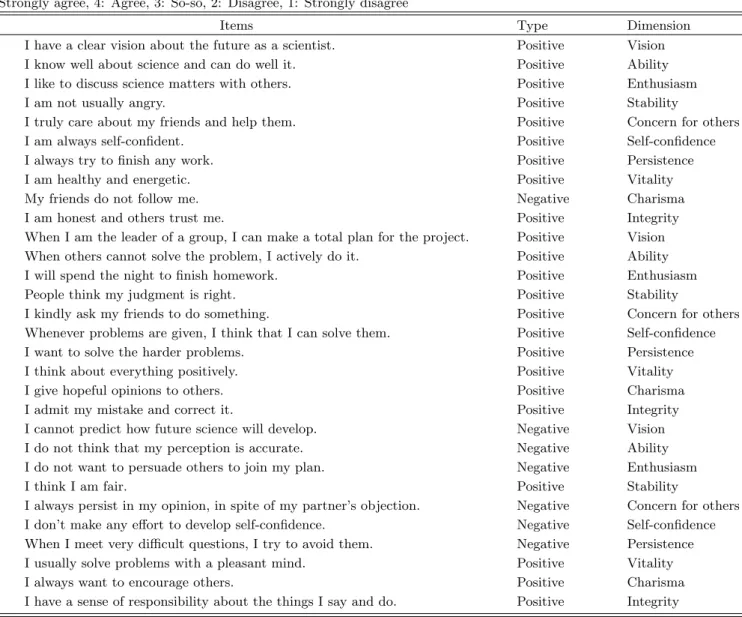
Table 2. Questionnaire developed for this study.
5: Strongly agree, 4: Agree, 3: So-so, 2: Disagree, 1: Strongly disagree
Items Type Dimension
1. I have a clear vision about the future as a scientist. Positive Vision
2. I know well about science and can do well it. Positive Ability
3. I like to discuss science matters with others. Positive Enthusiasm
4. I am not usually angry. Positive Stability
5. I truly care about my friends and help them. Positive Concern for others
6. I am always self-confident. Positive Self-confidence
7. I always try to finish any work. Positive Persistence
8. I am healthy and energetic. Positive Vitality
9. My friends do not follow me. Negative Charisma
10. I am honest and others trust me. Positive Integrity
11. When I am the leader of a group, I can make a total plan for the project. Positive Vision 12. When others cannot solve the problem, I actively do it. Positive Ability
13. I will spend the night to finish homework. Positive Enthusiasm
14. People think my judgment is right. Positive Stability
15. I kindly ask my friends to do something. Positive Concern for others
16. Whenever problems are given, I think that I can solve them. Positive Self-confidence
17. I want to solve the harder problems. Positive Persistence
18. I think about everything positively. Positive Vitality
19. I give hopeful opinions to others. Positive Charisma
20. I admit my mistake and correct it. Positive Integrity
21. I cannot predict how future science will develop. Negative Vision
22. I do not think that my perception is accurate. Negative Ability
23. I do not want to persuade others to join my plan. Negative Enthusiasm
24. I think I am fair. Positive Stability
25. I always persist in my opinion, in spite of my partner’s objection. Negative Concern for others 26. I don’t make any effort to develop self-confidence. Negative Self-confidence 27. When I meet very difficult questions, I try to avoid them. Negative Persistence
28. I usually solve problems with a pleasant mind. Positive Vitality
29. I always want to encourage others. Positive Charisma
30. I have a sense of responsibility about the things I say and do. Positive Integrity
Table 3. Cronbach’s α coefficient for all items.
Cronbach’s α Cronbach’s α N of Items
based on standardized items
.880 .889 30
2. Validity and Reliability of the Tool
An initial pool of items for each dimension included four items. Each item employed a five-point Likert re- sponse format with scores of 1 (strongly disagree) and 5 (strongly agree). Items stated in reverse of (negative) were scored in a reverse mode. Therefore, a high score indicated a positive view. A content validity analysis (or test) was performed. Finally, three items were se- lected for each dimension. Because the development of the survey was based on a theoretical background [7], we classified the items by using the meanings of the contents rather than by using a factor analysis. The reliability of our survey was also analyzed. Cronbach’s alpha coeffi- cient was obtained for all items and was 0.88, as shown in Table 3. Hatcher and Stepanski (1994) [8] have claimed that, for social science studies, even a Cronbach’s alpha coefficient low as 0.55 can be recognized and accepted for statistical consideration. Therefore, this result indicates a satisfactory level of internal consistency.
3. Sample
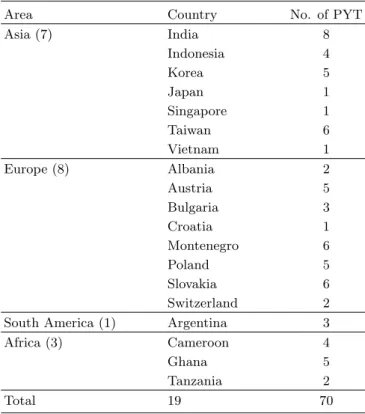
The participants in the present study were 70 WYP 2005 International Young Physics Talents from 19 coun- tries, aged 11–23, who participated in the International Symposium in Taipei from December 31, 2005 to January 4, 2006. Table 4 presents participating countries and the numbers of students. Though the survey was written in English, students did not experience any problems in responding because of their leaders’ help.
4. Data Analysis
We investigated the score on ten dimensions of lead- ership. Using the t-test, we studied the gender differ- ences for the leadership qualities. Analysis of variance
Table 4. Participating countries and number of students (PYT). The numbers in parentheses represent the num- bers of countries.
Area Country No. of PYT
Asia (7) India 8
Indonesia 4
Korea 5
Japan 1
Singapore 1
Taiwan 6
Vietnam 1
Europe (8) Albania 2
Austria 5
Bulgaria 3
Croatia 1
Montenegro 6
Poland 5
Slovakia 6
Switzerland 2
South America (1) Argentina 3
Africa (3) Cameroon 4
Ghana 5
Tanzania 2
Total 19 70
(ANOVA) was used to study the differences in the lead- ership qualities of the Physics Young Talents from each continent. For the purpose of studying the origin of dif- ferences in the scores of students from different conti- nents, a post-hoc analysis was performed. The data were analyzed using SPSS version 13.
IV. Results
1. Students’ Responses
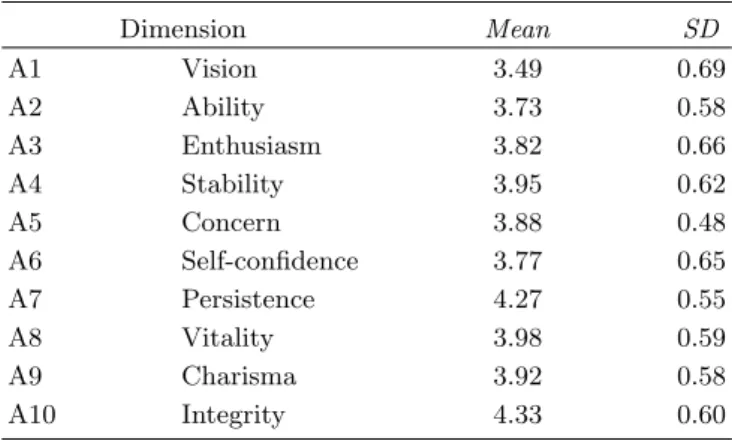
Table 5 shows the mean scores and standard deriva- tions of responses for the leadership qualities assessed by the survey. We note that the mean score for students’
responses in the ‘vision’ dimension was the lowest (3.49)
and the mean score in the ‘integrity’ dimension was the
highest (4.33). It shows that Young Physics Talents have
more honesty, strength of character, and courage that
generate trust than other leadership qualities. For all di-
mensions, the scores were higher than 3.0; that is, most
students demonstrated strong leadership.
Table 5. Average scores of the students for each dimen- sion.
Dimension Mean SD
A1 Vision 3.49 0.69
A2 Ability 3.73 0.58
A3 Enthusiasm 3.82 0.66
A4 Stability 3.95 0.62
A5 Concern 3.88 0.48
A6 Self-confidence 3.77 0.65
A7 Persistence 4.27 0.55
A8 Vitality 3.98 0.59
A9 Charisma 3.92 0.58
A10 Integrity 4.33 0.60
Note: N = 70
2. Gender Differences on the Leadership Quality
Gender differences on each dimension are presented in Table 6, where the mean scores, standard deviations, and t-test values are shown. The number of students is 34 for males and 34 for females, and 2 persons were excluded because of missing gender markings. In this result, the mean scores of male and female students were statisti- cally different on the dimensions of ‘concern for others’
and ‘integrity’ (p < .05). However, excluding these di- mensions, the t-test indicated no significant differences for the other dimensions. Thus, one can conclude female Physics Young Ambassadors have a little more service to followers and interest in their welfare, honesty, strength of character, and courage that generates trust than male PYAs. Nevertheless, for most dimensions except ‘enthu- siasm,’ the mean scores of female students tended to be higher than those of male students. Figure 1 visually shows the gender differences for the leadership qualities of physics talents.
3. Comparison of Leadership Among Continents
In this study, we investigated the scores for the lead- ership qualities of Physics Young Talents by continent.
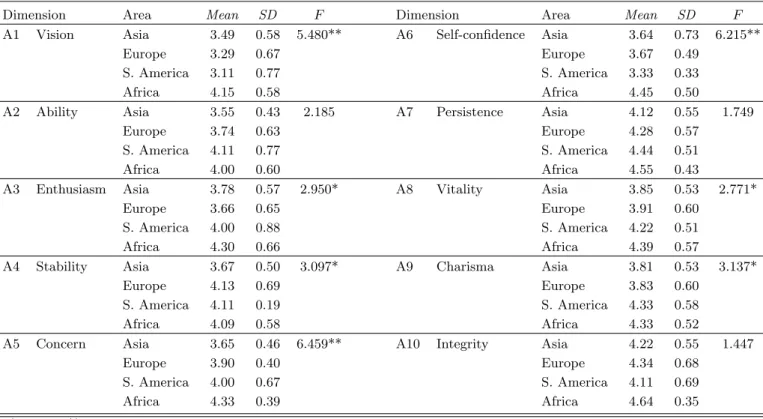
The results in Table 7 show statistical descriptions (mean score, standard deviation, and F value from ANOVA analysis) of the leadership qualities of Physics Young Tal- ents from each continent.
Fig. 1. Gender differences for the leadership of physics talented.
Fig. 2. Leadership qualities for International Young Physics Talented.
According to the results, the scores for the leadership qualities of students from several continents show statis- tically significant differences in seven dimensions: vision, enthusiasm, stability, concern for others, self-confidence, vitality, and charisma, but in three dimensions, ability, persistence, and integrity, no significant differences are shown. Visually, Figure 2 shows the scores for each di- mension for each continent. In most dimensions, African students had higher scores than others. This result shows that African Physics Talents are comparatively members of a select group with higher commitment to leadership.
They seem to highly proud of their title of Physics Young Ambassador even though they come from the weaker socio-economic background than those from other con- tinents.
To compare concretely, we performed a post analysis
of our ANOVA results, as shown in Table 8. Only the
results with significant differences are presented in Table
8 to avoid complexity. As shown, African students had
Table 6. Gender differences on each dimension of leadership.
Dimension Gender Mean SD t Dimension Gender Mean SD t
A1 Vision Male 3.47 0.70 -0.53 A6 Self-confidence Male 3.63 0.60 -1.98
Female 3.56 0.67 Female 3.93 0.67
A2 Ability Male 3.67 0.54 -0.90 A7 Persistence Male 4.17 0.56 -1.39
Female 3.79 0.62 Female 4.35 0.55
A3 Enthusiasm Male 3.88 0.67 0.85 A8 Vitality Male 3.94 0.66 -0.48
Female 3.75 0.67 Female 4.01 0.50
A4 Stability Male 3.84 0.65 -1.42 A9 Charisma Male 3.88 0.62 -0.61
Female 4.05 0.58 Female 3.97 0.57
A5 Concern Male 3.75 0.50 -2.12* A10 Integrity Male 4.18 0.59 -2.25*
Female 4.00 0.46 Female 4.49 0.56
Note: Male N = 34, Female N = 34,
∗p < .05
Table 7. Statistical descriptions of the leadership of Physics Young Talented on each continent.
Dimension Area Mean SD F Dimension Area Mean SD F
A1 Vision Asia 3.49 0.58 5.480** A6 Self-confidence Asia 3.64 0.73 6.215**
Europe 3.29 0.67 Europe 3.67 0.49
S. America 3.11 0.77 S. America 3.33 0.33
Africa 4.15 0.58 Africa 4.45 0.50
A2 Ability Asia 3.55 0.43 2.185 A7 Persistence Asia 4.12 0.55 1.749
Europe 3.74 0.63 Europe 4.28 0.57
S. America 4.11 0.77 S. America 4.44 0.51
Africa 4.00 0.60 Africa 4.55 0.43
A3 Enthusiasm Asia 3.78 0.57 2.950* A8 Vitality Asia 3.85 0.53 2.771*
Europe 3.66 0.65 Europe 3.91 0.60
S. America 4.00 0.88 S. America 4.22 0.51
Africa 4.30 0.66 Africa 4.39 0.57
A4 Stability Asia 3.67 0.50 3.097* A9 Charisma Asia 3.81 0.53 3.137*
Europe 4.13 0.69 Europe 3.83 0.60
S. America 4.11 0.19 S. America 4.33 0.58
Africa 4.09 0.58 Africa 4.33 0.52
A5 Concern Asia 3.65 0.46 6.459** A10 Integrity Asia 4.22 0.55 1.447
Europe 3.90 0.40 Europe 4.34 0.68
S. America 4.00 0.67 S. America 4.11 0.69
Africa 4.33 0.39 Africa 4.64 0.35
∗