271
©The Korean Society of Food Science and Technology
된장 가열조리 시 생성되는 향기성분 변화
이승주∗·안봄이
한국식품연구원 전통식품연구단
Thermal Changes of Aroma Components in Soybean Pastes (Doenjang)
Seung-Joo Lee∗ and Bomi Ahn
Traditional Foods Research Group, Korea Food Research Institute
Abstract In this study, volatile compounds were isolated from traditional and commercial fermented soybean pastes according to different heating temperatures (room temperature, 50oC, 100oC) using headspace-solid phase microextraction (HS-SPME). The compounds were then analyzed by gas chromatography-mass spectrometry (GC-MS). A total of 51 volatile components, including 18 esters, 3 alcohols, 6 acids, 8 pyrazines, 5 volatile phenols, 6 aldehydes, and 5 miscellaneous compounds, were identified. Esters and acids such as ethyl hexadecanoate, acetic acid, and 2/3-methyl butanoic acid were the largest groups among the quantified volatiles. By applying principal component analyses to the GC-MS data sets, differences were observed in the volatile components of the soybean pastes as to the different heating temperatures. A large variation was shown between the volatile components of the traditional and commercial soybean pastes by increasing the heating temperature. Commercial samples had significantly higher levels of longer chain ethyl esters, aldehydes, and thermal degradation products such as maltol and 2-acetyl pyrrole, while traditional samples showed higher concentrations of acids and pyrazines.
Keywords: soybean, volatile, HS-SPME, GC-MS
서
론
된장은 우리나라 고유의 발효식품으로 단백질과 아미노산 함 량이 높아 영양학적으로도 우수한 전통식품이다. 최근에는 재래 식 발효 된장에서 항산화능, 항돌연변이성, ACE 저해물질, 혈전 용해성 등 여러 가지 생리활성 물질의 기능성이 확인되면서 관 심이 증대되고 있다(1,2). 하지만 우리 고유 된장의 영양학적 및 기능성 측면에서의 우수성에도 불구하고 세계화 측면에서 일본 의 미소(Miso) 등과 경쟁력이 떨어지는 것이 현실이다. 이는 된 장의 고유한 풍미가 외국인의 기호도에 맞지 않아 된장에 대한 접근성을 떨어뜨리는 것이 한 원인으로 여겨진다. 따라서 우리 고유의 전통식품인 된장의 품질향상과 세계화를 위해서는 된장 의 풍미특성에 대한 체계적이고 정량적인 이해가 필수적이라 할 수 있다. 국내의 된장관련 연구를 살펴보면, 메주나 장류에서의 미생물 의 동정과 분리에 관한 연구가 다수 진행되었으며(3-5), 된장 제 조공정의 표준화(6)와 색도 및 유통 중의 품질 안정화 연구(7)가 진행되었다. 최근에는 기능성 물질인 isoflavone의 활성 측정 등 기능성 측면에 대한 연구가 활발히 이루어지고 있다(8). 특히 된 장 발효와 숙성에 관하여는 미생물과 각종 영양성분의 변화에 관 한 연구가 진행되어 된장의 풍미에 관여하는 주요 세균으로Bacillus subtilis, Bacillus licheniformis와 일부 Bacillus sp.와 Mucor sp. 및 Penicillium sp. 등이 분리되었다(9-11). 휘발성 향기성분 관 련 연구를 살펴보면 균주를 달리한 된장의 향기성분 분석(12,13), 추출 조건을 달리한 된장의 향기성분 분석(14,15), 제조방법과 숙 성기간에 따른 된장의 향기특성 분석(16) 연구가 진행되었으나 된장의 휘발성 향기성분의 실제 조리과정에서의 변화에 관한 연 구는 Joo와 Shin(17)의 된장찌개 조리시의 변화 고찰 연구를 제 외하고는 이루어지지 않고 있다. 식품의 향기성분 분석을 위한 추출 방법으로는 다양한 방법의 사용이 가능한데 동시증류추출(simultaneous distillation and extrac-tion, SDE)법, 감압증류법 등이 사용되나 열 변성 물질이 생성되 거나 시간이 오래 걸리고 용매를 사용해야 하는 단점이 있다. 따 라서 이를 극복하기 위한 방법으로 고체상마이크로추출(solid phase microextraction, SPME)이 이용되고 있다(18-20). SPME 방법은 휘 발성 화합물을 용매없이 fused-silica로 코팅된 fiber에 직접 추출, 농축하는 장점으로 널리 이용되고 있다(20). 본 연구에서는 전통 된장과 공장산 제품을 재료로 SPME 방법으로 가열 조리시의 향 기성분의 변화를 파악하고 이를 바탕으로 된장 관련 조리식품 개 발에서의 기초자료로 삼고자 한다.
재료
및
방법
재료 및 시약 본 연구에 사용한 된장 시료는 시판 된장 중에 시장 점유율이 높고 대형 할인점에서 유통되는 공장산 된장 1종(J)과 우체국 택 배를 통해 판매되는 전통 된장 1종(A)을 구입하여 4o C에 저장, 보관하며 사용하였다. 공장산 된장인 J는 밀 코지를 이용하여 *Corresponding author: Seung-Joo Lee, Korea Food ResearchInsti-tute, Seongnam, Gyeonggi-do 463-420, Korea. Tel : 82-31-780-9303
Fax: 82-31-709-9876 E-mail: [email protected]
Received April 18, 2008; revised May 20, 2008; accepted May 24, 2008
Aspergillus oryzae를 접종하여 제조한 제품으로 주요 원부재료로 콩 53.4%, 메주 16%, 소금, 코지가 사용되었다. 전통 된장인 A 는 전통 메주생산 방식으로 제조된 제품으로 전분 재료 없이 콩 만 사용되었다. 향기성분 화합물의 표준시약과 내부표준물질로 사용한 2-methyl-1-pentanol 및 NaCl은 Aldrich-Sigma(Milwaukee, WI, USA)에서 구입하였다.
HS-SPME 방법을 이용한 휘발성향기성분의 추출
향기성분 포집을 위해 30 mL의 headspace glass vial(Supelco, Bellafonte, PA, USA)에 10 g의 균질화된 된장 시료를 넣은 뒤 증 류수 7 mL과 내부표준 용액 1 mL(2-methyl-1-pentanol 10 µg/mL DW solution), NaCl 3 g을 넣고 silicon/teflon septum (Supelco, Bellafonte, PA, USA)으로 입구를 밀봉하였다. Vial은 각각의 가열 온도별(상온, 50o C, 100o C) 조건에서 30분 동안 magnetic bar를 이 용하여 교반하면서 평형상태를 만들었다. 유리병에 SPME fiber needle을 넣고 30분 동안 휘발성 성분을 흡착시키고, 220o C의 GC-MS injection port에서 5분간 탈착하여 분석하였다. 된장의 향기성 분 회수를 위해 적합한 SPME fiber(Supelco, Bellafonte, PA, USA) 선정을 위해 4종의 SPME fiber (polydimethylsiloxane/divinylben-zene(65 µm), polydimethylsiloxane/carboxen(75 µm), polydimethylsi-loxane(100 µm)와 divinylbenzene/carboxen/PDMS(50/30 µm))를 이용하여 1종의 된장시료에 대해 분석을 실시하였다. 휘발성 성 분의 포집, 농축의 재현성 및 peak 감도를 분석한 결과 divinyl-benzene/carboxen/PDMS(50/30 µm) 사용 시 가장 많은 성분의 휘 발성분이 포집 및 농축되어 이를 최종 분석 fiber로 선정하였다. GC/MS를 이용한 향기성분의 정성 및 정량분석 HS-SPME에 의해 얻어진 각각의 향기성분은 GC/MS(Agilent 6890 gas chromatography/5973 mass selective detector, Agilent Co., Palo Alto, CA, USA)로 분석하였다. 실험에 사용한 column은 DB-WAX(30 m length× 0.32 mm i.d. × 0.25 µm film thickness, J&W Scientific, Folsom, CA, USA)를 사용하였다. 이동상 기체는 helium으로 유속은 1.0 mL/min을 유지하였다. 오븐 온도는 40o
C 에서 5분간 유지한 후, 185oC까지 5oC/min의 속도로 상승시킨 후 20분간 유지하였다. 주입구 온도는 220oC였고 splitless mode에서 분석하였다. MS의 분석 조건으로 MS ionization voltage는 70 eV, source temperature는 200o
C, interface temperature는 280o C, mass spectrum scan range는 40~350 m/z로 하였다.
GC-MS에 의해 분리된 각각의 peak 성분은 mass spectra와 Wiley 275 mass spectral database (Hewlett-packard, Palo Alto, CA)의 mass spectra를 비교하고, C8-C24의 알칸(Aldrich, Milwau-kee, MN, USA)을 사용하여 각각 peak의 linear retention index를 구하여(Kovats) 이를 표준시료(또는 문헌)와의 비교를 통해 두 개 의 조건에 모두 맞는 경우 동정된 것으로 하였다. 휘발성 향기성 분의 정량은 내부표준물질(2-methyl-1-pentanol)의 peak area와 동 정된 휘발성 향기성분의 peak area의 비율로 나타내어 양을 비교 하였다(21).
통계분석
분석 결과는 Windows 7.2의 SAS (Statistical Analysis Systems Cary, NC, USA)를 이용하여 분산분석(ANOVA)을 실시하였고 시 료의 분포와 휘발성 향기성분간의 관계를 파악하기 위해 XLSTAT ver. 2007.1(Addinsoft, New York, NY, USA)을 이용하여 주성분 분석(principal component analysis, PCA)을 실시하였다.
결과
및
고찰
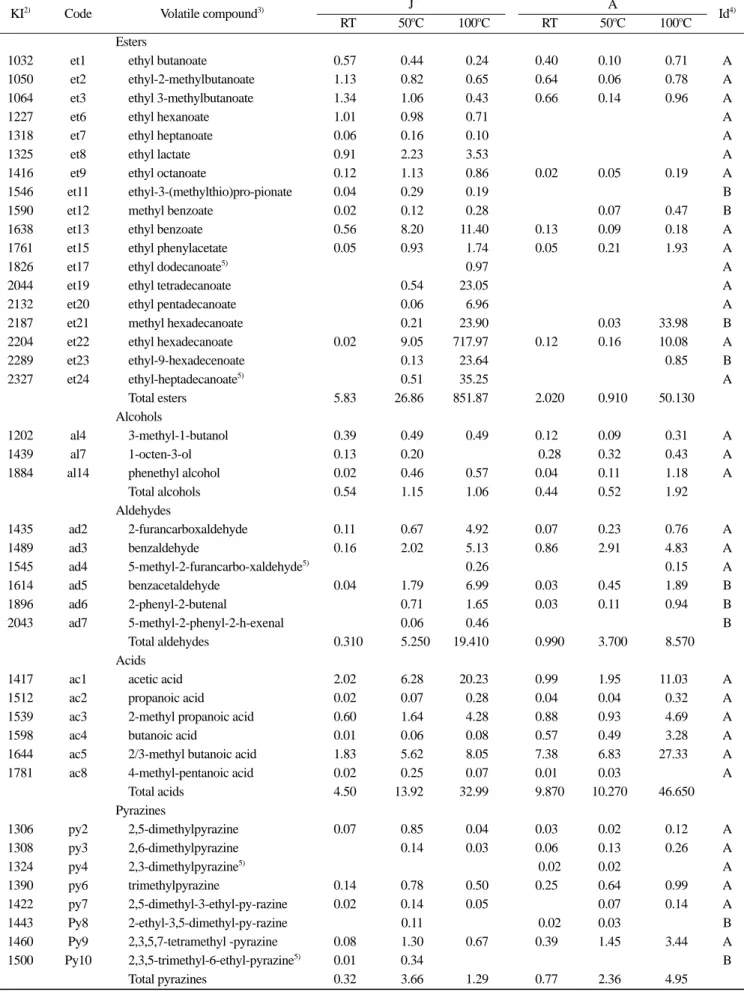
SPME 방법에 의한 된장의향기성분 된장 2종(J, A)의 가열조건(상온, 50o C, 100o C)을 달리한 향기 성분변화를 조사하기 위해 SPME법을 사용하여 향기성분을 포집 한 후 GC/MS로 분석한 결과는 Table 1과 같다. 정성된 화합물 은 2개의 시료에서 51개의 향기성분이 확인되었고 동정된 성분 을 화학적 특성에 따라 분류하면 18 esters, 3 alcohols, 6 acids, 8 pyrazines, 5 volatile phenols, 1 ketones, 6 aldehydes와 4개의 기 타성분이 동정되었다. 에스터 성분과 산 성분이 동정된 화합물 중 두 개 시료에서 모두 가장 높은 농도를 차지하였고 그 중 ethyl 2-methylbutanoate, ethyl 3-methylbutanoate, ethyl hexadecanoate, acetic acid, methyl-propanoic acid, 2/3-methyl butanoic acid, 2-pentyl-furan, tetramethyl-pyrazine과 benzaldehyde가 주요 성분으로 나타났다. 이는 전통된장 및 개량된장의 향기성분으로 보고한 연 구결과와 유사한 경향을 나타내었다(10-19). 본 연구에서 검출된 에스터류에 대해 살펴보면, 공장산 제품인 J에서는 상온에서는 12개, 가열에 따라 검출된 성분이 늘어나 100oC로 가열 시에는 18개의 성분이 검출되었다. 정량 분석된 총 에스터류의 함량도 상온에서는 5.83 ppm이었으나 가열에 따라 증가하여 100o C에서는 851.87 ppm이 검출되어 가열에 따라 에스 터성분의 증가하는 것으로 나타났다. 반면 전통된장 시료인 A에 서는 검출된 에스터류는 7개, 가열에 따라 각각 9개, 10개로 나 타나 공장산 제품에 비해 에스터류가 적게 검출되고 함량도 낮 게 나타났다. 과일향을 나타내는 적은 분자량의 에스터류인 ethyl butanoate, ethyl-2-methylbutanoate, ethyl-3-methylbutanoate 등은 공 장산 제품에서 높게 나타났고 가열에 따라 함량이 감소하였다. 반 면 ethyl tetradecanoate, ethyl pentandecanoate와 ethyl hexade-canoate와 같은 고분자량의 지방산과 결합된 에스터류는 가열함 에 따라 생성되고 그 함량도 매우 높게 나타났다. 이러한 고분량 의 에스터는 중국의 sufu(22), 일본 미소(23)와 한국의 된장 제품 (12,14-15,17)에서도 보고된 바 있다. 이러한 고분자량의 에스터류 는 일반적으로 발효된장 제품에서 대두의 지방산 성분에 곰팡이 의 작용에 의해 생성되는 것으로 보고된 바 있다(24). 본 연구에 서는 된장의 풍부한 지방산 성분과 전분의 분해로 생성된 당에서 효모에 의해 생성된 에탄올과 가열에 의해 반응하여 그 함량이 크게 증가된 것으로 여겨진다.알코올류로는 3-methyl-1-butanol, 1-octen-3-ol, phenethyl alco-hol이 검출되었다 이들 성분은 간장(25), 미소(23)와 한국 된장제 품(12,14,15)에서 풍미에 중요한 영향을 주요 성분으로 확인되었 다. 공장산 제품과 전통된장 제품간의 차이가 크게 나타나지 않 았고 가열에 따른 함량 변화도 에스터류에 비해 낮은 것으로 나 타났다. 알데히드류는 7개의 성분이(2-furancarboxaldehyde, benzal-dehyde, 5-methyl furfural, benzacetalbenzal-dehyde, 2-phenyl-2-butenal, 5-methyl-2-phenyl-2-hexenal) 확인되었고, 이들 성분은 주로 단향, 견과류, 카라멜관련 바람직한 풍미를 나타내는 것으로 알려졌다 (26). 퓨란 유도체는 된장 제조 과정 중 생성되는 당의 가열에 따 른 마이얄 반응으로 생성되는 것으로 알려졌고(12), 실제로 본 연 구에서 가열에 따라 함량이 증가됨을 확인할 수 있었다. 산 성분은 6개 성분이 검출되었고, 공장산 제품보다 전통 된장 에서 가열 50o C 조건을 제외하고는 많은 함량이 검출되었다. 공 장산 제품인 J의 경우 acetic acid가 가장 높은 함량을 나타내었으 나 전통 된장제품인 A에서는 2/3-methyl butanoic acid가 주요 성 분으로 나타났다. 2-methyl propanoic acid와 2/3-methyl butanoic acids는 효모의 단백질 대사 산물로 알려져 있고, 그 외 산은 지
Table 1. Changes of volatile compounds (ppm1), w/w) in soybean paste samples (J and A) under different heating temperature (RT;
room temperature, 50oC, and 100oC) (n=2)
KI2)
Code Volatile compound3) J A
Id4) RT 50o C 100o C RT 50o C 100o C Esters
1032 et1 ethyl butanoate 0.57 0.440 0.240 0.40 00.10 0.710 A
1050 et2 ethyl-2-methylbutanoate 1.13 0.820 0.650 0.64 00.06 0.780 A
1064 et3 ethyl 3-methylbutanoate 1.34 1.060 0.430 0.66 00.14 0.960 A
1227 et6 ethyl hexanoate 1.01 0.980 0.710 A
1318 et7 ethyl heptanoate 0.06 0.160 0.100 A
1325 et8 ethyl lactate 0.91 2.230 3.530 A
1416 et9 ethyl octanoate 0.12 1.130 0.860 0.02 00.05 0.190 A
1546 et11 ethyl-3-(methylthio)pro-pionate 0.04 0.290 0.190 B
1590 et12 methyl benzoate 0.02 0.120 0.280 00.07 0.470 B
1638 et13 ethyl benzoate 0.56 8.200 11.400 0.13 00.09 0.180 A
1761 et15 ethyl phenylacetate 0.05 0.930 1.740 0.05 00.21 1.930 A
1826 et17 ethyl dodecanoate5)
0.970 A
2044 et19 ethyl tetradecanoate 0.540 23.050 A
2132 et20 ethyl pentadecanoate 0.060 6.960 A
2187 et21 methyl hexadecanoate 0.210 23.900 00.03 33.980 B
2204 et22 ethyl hexadecanoate 0.02 9.050 717.970 0.12 00.16 10.080 A
2289 et23 ethyl-9-hexadecenoate 0.130 23.640 0.850 B 2327 et24 ethyl-heptadecanoate5) 0.510 35.250 A Total esters 5.83 26.860 851.870 2.020 00.910 50.130 Alcohols 1202 al4 3-methyl-1-butanol 0.39 0.490 0.490 0.12 00.09 0.310 A 1439 al7 1-octen-3-ol 0.13 0.200 0.28 00.32 0.430 A
1884 al14 phenethyl alcohol 0.02 0.460 0.570 0.04 00.11 1.180 A
Total alcohols 0.54 1.150 1.060 0.44 00.52 1.920 Aldehydes 1435 ad2 2-furancarboxaldehyde 0.11 0.670 4.920 0.07 00.23 0.760 A 1489 ad3 benzaldehyde 0.16 2.020 5.130 0.86 02.91 4.830 A 1545 ad4 5-methyl-2-furancarbo-xaldehyde5) 0.260 0.150 A 1614 ad5 benzacetaldehyde 0.04 1.790 6.990 0.03 00.45 1.890 B 1896 ad6 2-phenyl-2-butenal 0.710 1.650 0.03 00.11 0.940 B 2043 ad7 5-methyl-2-phenyl-2-h-exenal 0.060 0.460 B Total aldehydes 0.310 5.250 19.4100 0.990 03.700 8.570 Acids
1417 ac1 acetic acid 2.02 6.280 20.230 0.99 01.95 11.030 A
1512 ac2 propanoic acid 0.02 0.070 0.280 0.04 00.04 0.320 A
1539 ac3 2-methyl propanoic acid 0.60 1.640 4.280 0.88 00.93 4.690 A
1598 ac4 butanoic acid 0.01 0.060 0.080 0.57 00.49 3.280 A
1644 ac5 2/3-methyl butanoic acid 1.83 5.620 8.050 7.38 06.83 27.330 A
1781 ac8 4-methyl-pentanoic acid 0.02 0.250 0.070 0.01 00.03 A
Total acids 4.50 13.920 32.990 9.870 10.270 46.650 Pyrazines 1306 py2 2,5-dimethylpyrazine 0.07 0.850 0.040 0.03 00.02 0.120 A 1308 py3 2,6-dimethylpyrazine 0.140 0.030 0.06 00.13 0.260 A 1324 py4 2,3-dimethylpyrazine5) 0.02 00.02 A 1390 py6 trimethylpyrazine 0.14 0.780 0.500 0.25 00.64 0.990 A 1422 py7 2,5-dimethyl-3-ethyl-py-razine 0.02 0.140 0.050 00.07 0.140 A 1443 Py8 2-ethyl-3,5-dimethyl-py-razine 0.110 0.02 00.03 B
1460 Py9 2,3,5,7-tetramethyl -pyrazine 0.08 1.300 0.670 0.39 01.45 3.440 A
1500 Py10 2,3,5-trimethyl-6-ethyl-pyrazine5)
0.01 0.340 B
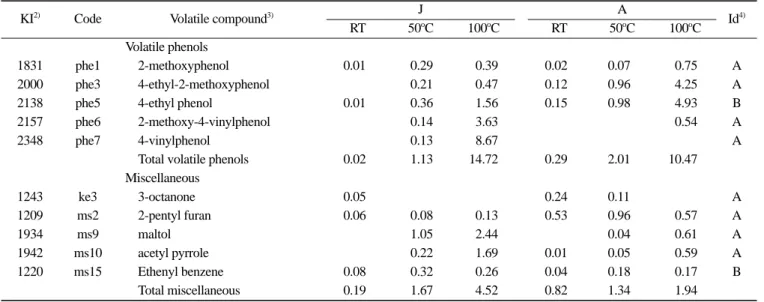
질분해효소에 의한 대두의 세포외 분해에 의해 지방산이 생성되 고 이의 분해에 따라 생성되는 것으로 보고되었다(24). 일반적으 로 acetic acid(식초향)을 제외하고 산류는 기호성에 좋지 않은 산 화되고 부패한 냄새를 내는데, 전통된장에서 된장 특유의 꼬린내 를 내는 2/3-methylbutanoic acid 성분이 7.38 ppm으로 공장산 제 품(1.83 ppm)에 비해 상온에서 4배 이상 높게 나타났다. 피라진류는 주로 식품이나 원료의 가열조작에 의해 생성되는 갈변 flavor의 대표적 물질로 가열식품의 향기에 중요한 역할을 하는 물질로 이 대부분은 단백질, 아미노산의 열분해, 당과 단백 질 혹은 아미노산과의 반응에서 생성되는 것으로 알려졌다(26). 전반적으로 전통된장에서 높은 함량이 검출되었고 가열에 따라 함량이 증가하였다. 피라진류는 대개 고소한 견과류의 향을 내는 것으로 된장의 풍미에 긍정적으로 작용하는 것으로 알려졌으며, 다른 대두 발효식품인 미소에서도 중요한 향기성분으로 확인된 바 있다(23). 휘발성 페놀류는 상온에서 2-methoxyphenol, 4-ethyl-2-methoxyphenol, 4-ethylphenol이 검출되었고 가열에 따라 2-meth-oxy-4-vinylphenol과 4-vinylphenol이 확인되었다. 이들 향기성분은 삶은 대두, 스모크 향을 나타내고, 대두의 lignin 유래의 phenolic carboxylic acid의 가열 분해 산물로 알려져 있다(27). 기타 휘발성 향기성분으로 대표적인 마이얄반응 분해산물인 2-Table 1. Continued KI2)
Code Volatile compound3) J A
Id4) RT 50o C 100o C RT 50o C 100o C Volatile phenols 1831 phe1 2-methoxyphenol 0.01 0.290 0.390 0.02 00.07 0.750 A 2000 phe3 4-ethyl-2-methoxyphenol 0.210 0.470 0.12 00.96 4.250 A
2138 phe5 4-ethyl phenol 0.01 0.360 1.560 0.15 00.98 4.930 B
2157 phe6 2-methoxy-4-vinylphenol 0.140 3.630 0.540 A
2348 phe7 4-vinylphenol 0.130 8.670 A
Total volatile phenols 0.02 1.130 14.720 0.29 02.01 10.470
Miscellaneous 1243 ke3 3-octanone 0.05 0.24 00.11 A 1209 ms2 2-pentyl furan 0.06 0.080 0.130 0.53 00.96 0.570 A 1934 ms9 maltol 1.050 2.440 00.04 0.610 A 1942 ms10 acetyl pyrrole 0.220 1.690 0.01 00.05 0.590 A 1220 ms15 Ethenyl benzene 0.08 0.320 0.260 0.04 00.18 0.170 B Total miscellaneous 0.19 1.670 4.520 0.82 01.34 1.940 1)Average of the ppm (n=2)
(ppm= Area of each compound × Amount of internal standard) Area of internal standard × Amount of sample/106
2)Kovats indices of unknown compounds on DB-WAX column.
3)Compounds by order of their Kovats indices in a chemical class.
4)Volatiles were identified based on the following criteria: A, mass spectrum and retention index consistent with those of an authentic standard;
B, mass spectrum consistent with that of the Wiley 275 mass spectrum database.
5)Volatiles were not used in Principal Component Analysis.
Fig. 1. PCA loadings for (a) 47 volatiles and scores for (b) six soybean paste samples under different heating temperature. The sample
codes are as follows: JRT, J under room temperature; J50, J under 50o
C; J100, J under 100o
C; ART, A under room temperature; A50, A under 50o
C; A100, A under 100o
pentylfuran, acetyl pyrrole과 maltol이 검출되었고 이들 성분의 함 량은 가열에 따라 증가하였으나 공장산 제품의 증가폭이 전통된 장에 비해 크게 높은 것으로 나타났다. 가열조건에 따른 된장의 향기성분 변화 분산분석 결과 동정된 모든 휘발성 향기성분에서 시료간의 유 의적 차이가 나타났다(p<0.05). 가열조건에 따른 휘발성 향기성분 의 변화와 된장 시료 간의 차이를 파악하고자 주성분분석을 실 시하였다. 동정된 51개 성분에서 한 시료에서만 검출된 4개 성분 을 제외하고 47개 성분을 이용하여 주성분 분석을 한 결과는 Fig. 1과 같다. 주성분(PC) 1과 2는 각각 전체 데이터변동의 45.36% 와 28.40%를 설명하는 2차원적인 모델을 나타냈다. 상온에서 분 석된 공장산 된장(JRT)과 전통된장(ART)은 3사분면에 분포하여 향기성분에서 큰 차이를 나타내지 않았으나 가열함에 따라 공장 산 제품은 4사분면 방향으로 이동하는 것으로 나타났고, 반면 전 통제품은 1사분면으로 변화하는 것으로 나타났다. 따라서 가열에 따라 전통과 공장산 제품의 풍미 특성의 차이가 증가하는 것으로 여겨진다. Fig. 1(a)의 향기성분 분포를 살펴보면, 공장산 가열시 료(J50, J100)가 분포한 4사분면에는 ethyl octanoate(et9), ethyl benzoate(et13), ethyl tetradecanoate (et19), ethyl hexadecanoate (et16), ethyl 9-hexadecenoate(et23), 3-methyl-1-butanol (al4), 2-furancarboxaldehyde (ad2), benzacetaldehyde(ad5), 5-methyl-2-phe-nyl-2-hexenal(ad7), 2-methoxy-4-vinylphenol(phe6), 4-vinylphenol (phe7), maltol(ms9), acetyl pyrrole(ms10)가 나타나 이들 시료와 높은 상관성을 나타냈고, 1사분면에는 2,6-dimethylpyrazine(py3), trimethylpyrazine(py6), 2,5-dimethyl-3-ethylpyrazine(py7), 2,3,5,7-tetramethylpyrazine(py9), 2-methoxyphenol(phe1), 4-ethyl-2-methox-yphenol(phe3), 4-ethyl phenol(phe5), butanoic acid(ac4), 2/3-methyl butanoic acid(ac5), phenethyl alcohol(al14)이 100o
C에서 가열한 전 통된장(A100)과 가깝게 분포함으로써 높은 상관관계를 보여주었 다. 실제로 Table 1에서 나타난 바와 같이 가열에 따라 공장산 제품(J)의 경우 에스터, 알데히드류의 함량이 크게 증가하였고, 전 통제품(A)의 경우 산, 피라진류의 증가를 확인할 수 있었다. 따 라서 이들 성분이 전통 및 공장산 된장 제품의 향기특성을 나타 내는 주요한 성분으로 여겨진다.
요
약
본 연구에서는 공장산 된장과 전통 된장 제품을 이용하여 가 열조건(상온, 50o C, 100o C)을 달리한 시료의 휘발성 향기성분을 HS-SPME법에 의해 추출한 후, GC-MSD를 이용하여 분석동정하 였고 이들 성분의 정량분석도 실시하였다. 정성된 화합물은 총 51개의 향기성분이 확인되었고 동정된 성분을 화학적 특성에 따 라 분류하면 18 esters, 3 alcohols, 6 acids, 8 pyrazines, 5 vola-tile phenols, 1 ketones, 6 aldehydes와 4개의 기타성분이 동정되었 다. 에스터 성분과 산 성분이 동정된 화합물 중 두 개 시료에서 모두 가장 높은 농도를 차지하였다. 전통된장 시료는 가열 온도 가 증가함에 따라 산, 피라진류의 증가가 두드러졌고, 공장산 제 품의 경우 에스터, 알데히드류 및 maltol과 acetyl pyrrole과 같은 일부 마이얄반응 부산물이 크게 증가하는 것으로 나타났다. 향 후, 관능검사 및 GC-Olfactometry 분석을 통한 전통 및 공장산 제품의 관능특성과 주요 휘발성 향기성분간의 상관관계분석이 필 요하리라 판단되고 이를 통해 다양한 관능특성의 맞춤형 제품 개 발에 기초자료로 활용할 수 있으리라 여겨진다.문
헌
1. Shin ZI, Yu R, Park SA, Chung DK, Ahn CW, Nam HS, Kim KS, Lee HJ. His-His-Leu, an angiotensin I converting enzyme inhibitory peptide derived from Korean soybean paste, exerts antihypertensive activity in vivo. J. Agr. Food Chem. 49: 3004-3009 (2001)
2. Yu R, Park SA, Chung DK, Nam HS, Shin ZI. Effect of soybean hydrolysate on hypertension in spontaneously hypertensive rats. J. Korean Soc. Food Sci. Nutr. 25: 1031-1036 (1996)
3. Lee WJ, Cho DH. Microbiological studies of Korean native soy-sauce fermentation- A study on the microflora changes during Korean native soy-sauce fermentation. J. Korean Agric. Chem. Soc. 13: 35-42 (1970)
4. Yoon IS, Kim HO, Yoon SE, Lee KS. Studies on the changes of N-compounds during the fermentation process of the Korean
deonjang. Korean J. Food Sci. Technol. 9: 131-137 (1997)
5. Park JS, Lee MY, Kim KS, Lee TS. Volatile flavor components of soybean paste (doenjang) prepared from different types of strains. Korean J. Food Sci. Technol. 26: 255-260 (1994)
6. Park KY, Hwang KM, Jung KO, Lee KB. Studies on the stan-dardization of doenjang (Korean soybean paste) 1. Stanstan-dardization of manufacturing method of doenjang by literatures. J. Korean Soc. Food Sci. Nutr. 31: 343-350 (2002)
7. Kwak EJ, Park WS, Lim SI. Color and quality properties of doenjang added with citric acid and phytic acid. Korean J. Food Sci. Technol. 35: 455-460 (2003)
8. Lee DH, Kim JH, Yoon BH, Lee GS, Choi SY, Lee JS. Changes of physiological functionalities during the fermentation of medici-nal herbs doenjang. Korean J. Food Preserv. 10: 213-218 (2003) 9. Shin SY, Kim YB, Yu TJ. Flavor improvement of soybean pastes
by the addition of Bacillus licheniformis and Saccharomyces rouxii. Korean J. Food Sci. Technol. 17: 14-18 (1985)
10. Song JY, Ahn CW, Kim JK. Flavor components produced by microorganism during fermentation of Korean ordinary soybean paste. Korean J. Appl. Microbiol. Bioeng. 12: 147-152 (1984) 11. Ki WK, Kim JK, Kang DH, Cho YU. Development of excellent
mutants for manufacture of ordinary Korean soy sauce and soy-bean paste. Korean J. Appl. Microbiol. Bioeng. 15: 21-28 (1987) 12. Park JS, Lee MY, Kim KS, Lee TS. Volatile flavor components of
soybean paste (doenjang) prepared from different types of strains. Korean J. Food Sci. Technol. 26: 255-260 (1994)
13. Seo JS, Chang HG, Ji WD, Lee EJ, Choi MR, Kim HJ, Kim JK. Aroma components of traditional Korean soy sauce and soybean paste fermented with the same meju. J. Microbiol. Biotechnol. 6: 275-285 (1996)
14. Park HK, Gil B, Park JK. Characteristic flavor compounds of commercial soybean paste. Food Sci. Biotechnol. 12: 607-377 (2003) 15. Shin MR, Joo KJ. Fractionated volatile flavor components of
soy-bean paste by dynamic headspace method. J. Korean Soc. Food Sci. Nutr. 28: 305-311 (1999)
16. Choi MK, Sohn KH, Jeon HJ. Changes in odor characteristics of
doenjang with different preparing methods and ripening periods.
Korean J. Diet. Culture 12: 265-274 (1997)
17. Joo KJ, Shin MR. Flavor components generated from thermally processed soybean paste (doenjang and soondoenjang) soups and characteristics of sensory evaluation. Korean J. Food Sci. Technol. 36: 202-210 (2004)
18. Arthur CL, Pawliszyn J. Solid-phase microextraction with thermal desorption using fused silica optical fibers. Anal. Chem. 62: 2145-2148 (1990)
19. Yang X, Peppard T. Solid-phase microextraction for flavor analy-sis. J. Agr. Food Chem. 42: 1925-1930 (1994)
20. Steffen A, Pawliszyn J. Analysis of flavor volatiles using head-space solid-phase microextraction. J. Agr. Food Chem. 44: 2187-2193 (1996)
21. Lee SY, Chung MS, Kim MK, Baek HH, Lee MS. Volatile com-pounds of Elsholtzia splenden. Korean J. Food Sci. Technol. 37: 339-344 (2005)
22. Chung HY. Volatile components in fermented soybean (Glycine
23. Ku KL, Chen TP, Chiou RY. Apparatus used for small-scale vola-tile extraction from ethanol-supplemented low-salt miso and GC-MS characterization of the extracted flavors. J. Agr. Food Chem. 48: 3507-3511 (2000)
24. Chou CC, Hwan CH. Effect of ethanol on the hydrolysis of pro-tein and lipid during the aging of a Chinese fermented soya bean curds, sufu. J. Sci. Food Agr. 66: 393-398 (1994)
25. Lee MH, Kwok KF. Studies on the flavor components of soy sauce. J. Chinese Agr. Chem. Soc. 25: 101-111 (1987)
26. Fors S. Sensory properties of volatile Maillard reaction products and related compounds: A literature review. pp. 185-286 In: The Maillard Reaction in Foods and Nutrition. Waller GR, Feather MS (eds). American Chemical Society, Washington DC, USA. (1983) 27. Van den Ouweland GA, Schutte L. Flavor problems in the
appli-cation of soy protein materials as meat substitutes. pp. 33-42 In: Flavor of Foods and Beverages. Charalambous GL, Inglett GE (eds). Academic, NY, USA. (1978)