D I A B E T E S & M E T A B O L I S M J O U R N A L
This is an Open Access article distributed under the terms of the Creative Commons At- tribution Non-Commercial License (http://creativecommons.org/licenses/by-nc/3.0/) which permits unrestricted non-commercial use, distribution, and reproduction in any medium, provided the original work is properly cited.
Effects of Exercise Alone on Insulin Sensitivity and Glucose Tolerance in Obese Youth
SoJung Lee1, YoonMyung Kim2
1Division of Weight Management and Wellness, Children’s Hospital of Pittsburgh of UPMC, University of Pittsburgh School of Medicine, Pittsburgh, PA, USA,
2University College, Yonsei University International Campus, Incheon, Korea
As with the dramatic increases in childhood obesity over the past decades, the incidence of type 2 diabetes has increased among children and adolescents in the United States. Insulin resistance is a common feature of childhood obesity and increases the risk of type 2 diabetes, metabolic syndrome, and atherogenic lipoprotein profile in obese youth. Although cross-sectional studies re- port beneficial effects of physical activity or cardiorespiratory fitness on insulin sensitivity, the role of regular exercise alone (e.g., no calorie restriction) as a strategy to reduce the risk of type 2 diabetes is unclear in obese children and adolescents. In this mini review, we examined the independent effects of various exercise on glucose tolerance and insulin sensitivity in obese youth.
Keywords: Abdominal fat; Childhood obesity; Exercise; Glucose tolerance; Insulin resistance; Resistance exercise
Corresponding author: SoJung Lee
Division of Weight Management and Wellness, Children’s Hospital of Pittsburgh of UPMC, University of Pittsburgh School of Medicine, Faculty Pavilion Sixth Floor (Office 6102), 4401 Penn Ave, Pittsburgh, PA 15224, USA
INTRODUCTION
Insulin resistance is defined as the decreased peripheral tissue response to insulin-mediated cellular actions and the term
“insulin resistance” refers to reduced whole-body glucose up- take in response to physiological levels of insulin [1]. Insulin resistance is a common feature of obesity and is strongly asso- ciated with the etiology of type 2 diabetes, hypertension and coronary heart disease [2]. Currently, the gold standard meth- od to evaluate insulin resistance is the hyperinsulinemic-eug- lycemic clamp technique [3].
As with the increasing epidemic of childhood obesity in re- cent years, the prevalence of type 2 diabetes has increased among obese youth, particularly in a racial/ethnic minority group [4]. Although transient insulin resistance can occur dur- ing puberty [5], obesity is the most prevalent pathophysiologi- cal cause of insulin resistance in children and adolescents [1].
Sinha et al. [6] reported that impaired glucose tolerance is present in 25% of prepubertal obese children and 21% of obese
adolescents based on a 2-hour oral glucose tolerance test (OGTT). A longitudinal study has shown that transition from normal to impaired glucose tolerance and from impaired glu- cose tolerance to type 2 diabetes is significantly associated with weight gain in children and adolescents [7]. Increased abdom- inal fat, particularly visceral fat is recognized as a strong pre- dictor of insulin resistance in obese youth independent of total adiposity [8].
In adults, epidemiologic studies suggest that regular physi- cal activity is protective against development of type 2 diabetes [9-11]. Intervention studies report that engaging in regular ex- ercise is associated with significant improvements in glycemic control [12] and insulin sensitivity [13,14] in nondieting men and women. Further, evidence from well-controlled random- ized studies suggests that a combination of aerobic (e.g., tread- mill walking, jogging) and resistance (e.g., weight lifting) exer- cise is more effective than either exercise modality alone to improve insulin sensitivity [15,16] and glycemic control [12, 17] in men and women. Although cross-sectional studies re- http://dx.doi.org/10.4093/dmj.2013.37.4.225
pISSN 2233-6079 · eISSN 2233-6087
port the beneficial effects of physical activity [18] or having a high cardiorespiratory fitness [19] on insulin sensitivity in children and adolescents, whether engaging in exercise alone is effective in improving insulin sensitivity is not firmly estab- lished.
The purpose of this mini review is to examine the effects of exercise alone (e.g., no calorie restriction) on glucose tolerance and insulin sensitivity in obese children and adolescents. Giv- en that fasting insulin alone or combined with fasting glucose is a poor surrogate measure of insulin resistance [1], this re- view will focus on the exercise intervention studies, in which insulin resistance was evaluated by the OGTT, intravenous glucose tolerance test (IVGTT) and hyperinsulinemic eugly- cemic clamp test in nondieting children and adolescents.
EFFECT OF AEROBIC EXERCISE ALONE ON INSULIN SENSITIVITY AND GLUCOSE TOLERANCE IN OBESE YOUTH
Skeletal muscle is the major site of insulin-mediated glucose uptake in the postprandial state as the majority (~85%) of glu- cose uptake by peripheral tissues occurs in muscle [20]. Exer- cise has an “insulin-like effect” to facilitate glucose transport from the circulation into the working muscles [21]. It has been suggested that the mechanism by which exercise increases glucose uptake may be via the translocation of glucose trans- porters (e.g., GLUT-4) from an intracellular pool to the sur- face of the cell, where glucose uptake takes place [21,22]. In- deed, studies demonstrated increased GLUT-4 concentrations with aerobic training, which is accompanied by increases in insulin-mediated glucose uptake in adults [23-25]. However, the exercise-induced increase in muscle GLUT-4 concentra- tion and the corresponding increase in insulin sensitivity de- creases rapidly after the cessation of exercise [24], which sug- gests that exercise should be performed on a regular basis to maintain enhanced insulin sensitivity.
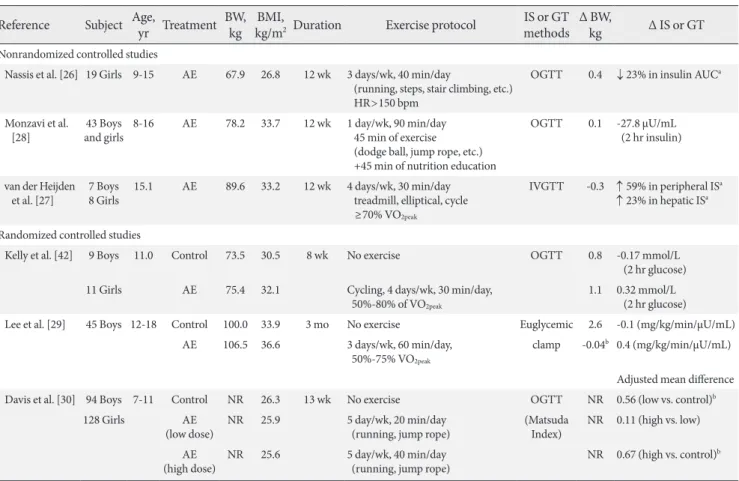
Currently, we are aware of six intervention studies, wherein the effects of aerobic exercise without calorie restriction on in- sulin sensitivity and glucose tolerance were examined in obese children and adolescents. Inspection of Table 1 reveals that the majority of studies have employed short duration of aerobic exercise (8 weeks to 3 months) and reported no significant weight loss after the training. For example, Nassis et al. [26]
have shown that in overweight and obese girls (n=19), 12 weeks of aerobic exercise (3 days/wk, 40 min/session, running,
stair climbing, and jump rope) resulted in a significant reduc- tion (-23.3%) in insulin area under the curve (AUC) and in- crease in cardiovascular fitness (18.8%) in the absence of changes in body weight and % body fat. A significant increase (6.2%) in lower limb fat free mass was observed after the train- ing, which was significantly correlated with a reduction in in- sulin AUC (r=-0.68). Similarly, van der Heijden et al. [27] per- formed a nonrandomized controlled study to examine the ef- fect of 12-week moderate intensity (≥70% VO2peak) aerobic ex- ercise (4 days/wk, 30 min/session, treadmill, elliptical, or a bike) on insulin action in obese Hispanic adolescents. In this study, the stable label IVGTT was employed to distinguish pe- ripheral and hepatic insulin sensitivity. Despite the absence of weight loss and calorie restriction, significant improvements in peripheral (50%) and hepatic insulin sensitivity (23%) were observed, which was also accompanied by reductions in total fat (-1.1%) and increases in lean body mass (1.1 kg). Con- versely, Monzavi et al. [28] observed no changes in oral glu- cose tolerance after a 12-week family-based lifestyle interven- tion program in overweight youth.
In adults, some studies suggest that the improvement in in- sulin sensitivity in response to aerobic exercise training is me- diated by reductions in adiposity [13,14]. Gan et al. [13] re- ported that in obese men, aerobic exercise alone is associated with significant improvements in insulin sensitivity as mea- sured by hyperinsulinemic-euglycemic clamp technique, and that the improvement in insulin sensitivity is associated with concomitant reductions in visceral fat and not by skeletal muscle characteristics such as intramyocellular lipid and long- chain acyl CoA levels. Currently, there has only been one ran- domized controlled study in obese youth that examined the effects of aerobic exercise on insulin action and secretion, and total and regional fat topography. We [29] have recently dem- onstrated that in obese adolescent boys, 3 months of aerobic exercise (3 times/wk, 60 min/session, 60% to 75% of VO2peak) without calorie restriction results in significant reductions in total (-2.6%) and visceral fat (-6.7%) and intrahepatic lipid content (-1.9%) by comparison to nonexercising controls.
However, despite significant improvement in body composi- tion, there were no improvements in oral glucose tolerance, and insulin sensitivity and secretion as accessed by the 3-hour hyperinsulinemic-euglycemic clamp test and the 2-hour hy- perglycemic clamp test, respectively. Further, no changes in skeletal muscle mass and intramyocellular lipid content were observed in response to aerobic training.
At present, we are aware of one randomized controlled trial that examined the effect of different doses of aerobic training on insulin resistance in the pediatric population. Davis et al.
[30] examined the effects of low-dose (5 days/wk, 20 min/ses- sion) versus high-dose (5 day/wk, 40 min/session) of aerobic exercise program (without dietary restrictions) on oral glucose tolerance in a large sample of overweight and obese children (n=222, 7 to 11 years). After 3 months of aerobic exercise, they observed a dose-response trend, such that the reductions in in- sulin AUC was larger in the high-dose exercise (adjusted mean difference, -3.56×10³ μU/mL) and the low-dose exercise groups (adjusted mean difference, -2.96×10³ μU/mL) than the control group. Dose-response associations were also observed for re- ductions in % body fat and visceral fat, independent of gender and race. Observation that the low- and high-dose of exercise groups showed similar improvements on insulin resistance, and that the increment of benefit between the control and low- dose exercise groups was larger than those observed between
the low- and high-dose exercise groups, suggest that greater health benefits can be obtained when obese youth move from being sedentary to becoming moderately active.
EFFECT OF RESISTANCE EXERCISE ALONE OR IN COMBINATION WITH AEROBIC EXERCISE ON INSULIN SENSITIVITY AND GLUCOSE TOLERANCE IN OBESE YOUTH
Although aerobic types of physical activities have been tradi- tionally recommended for children and adolescents, a recent guideline suggests that properly designed and supervised re- sistance training is beneficial to improve musculoskeletal strength, cardiovascular risk profiles, motor skills and psycho- social well-being of youth [31]. Currently, we are aware of five randomized controlled studies, in which the effects of resis- tance exercise without calorie restriction on insulin sensitivity and glucose tolerance were examined in obese youth (Table 2).
Table 1. Effect of aerobic exercise without calorie restriction alone on insulin sensitivity and glucose tolerance in obese youth Reference Subject Age, yr Treatment BW,
kg BMI,
kg/m2 Duration Exercise protocol IS or GT methods Δ BW,
kg Δ IS or GT
Nonrandomized controlled studies
Nassis et al. [26] 19 Girls 9-15 AE 67.9 26.8 12 wk 3 days/wk, 40 min/day
(running, steps, stair climbing, etc.) HR>150 bpm
OGTT 0.4 ↓ 23% in insulin AUCa
Monzavi et al.
[28] 43 Boys
and girls 8-16 AE 78.2 33.7 12 wk 1 day/wk, 90 min/day 45 min of exercise (dodge ball, jump rope, etc.) +45 min of nutrition education
OGTT 0.1 -27.8 µU/mL (2 hr insulin)
van der Heijden et al. [27] 7 Boys
8 Girls 15.1 AE 89.6 33.2 12 wk 4 days/wk, 30 min/day treadmill, elliptical, cycle ≥70% VO2peak
IVGTT -0.3 ↑ 59% in peripheral ISa
↑ 23% in hepatic ISa Randomized controlled studies
Kelly et al. [42] 9 Boys 11.0 Control 73.5 30.5 8 wk No exercise OGTT 0.8 -0.17 mmol/L (2 hr glucose) 11 Girls AE 75.4 32.1 Cycling, 4 days/wk, 30 min/day,
50%-80% of VO2peak
1.1 0.32 mmol/L (2 hr glucose) Lee et al. [29] 45 Boys 12-18 Control 100.0 33.9 3 mo No exercise Euglycemic 2.6 -0.1 (mg/kg/min/µU/mL)
AE 106.5 36.6 3 days/wk, 60 min/day, 50%-75% VO2peak
clamp -0.04b 0.4 (mg/kg/min/µU/mL) Adjusted mean difference Davis et al. [30] 94 Boys 7-11 Control NR 26.3 13 wk No exercise OGTT NR 0.56 (low vs. control)b
128 Girls AE
(low dose) NR 25.9 5 day/wk, 20 min/day
(running, jump rope) (Matsuda
Index) NR 0.11 (high vs. low) (high dose)AE NR 25.6 5 day/wk, 40 min/day
(running, jump rope) NR 0.67 (high vs. control)b BW, body weight; BMI, body mass index; IS, insulin sensitivity; GT, glucose tolerance; Δ, change score; AE, aerobic exercise; HR, heart rate;
OGTT, oral glucose tolerance test; AUC, area under the curve; IVGTT, intravenous glucose tolerance test; NR, not reported.
aSignificantly different from baseline within group, P<0.05, bSignificantly different from the control group, P<0.05.
Evidence from randomized controlled trials [29,32] suggests that progressive resistance training is effective in improving
insulin sensitivity in previously sedentary obese adolescent boys. Shaibi and colleagues [32] examined the effects of a 16- Table 2. Effect of resistance exercise alone or in combination with aerobic exercise on insulin sensitivity and glucose tolerance in obese youth
Reference Subject Age, yr Treatment BW, kg BMI,
kg/m2 Duration Exercise protocol IS or GT methods Δ BW,
kg Δ IS or GT
Non-randomized controlled studies Treuth et al.
[33] 12 Girls 7-10 RE 46.6 NR 5 mo 3 days/wk, 20 min/day, 50% of 1RM 7 whole-body exercises (2 sets, 12-15 reps)
OGTT 4.0a -26.0 pmol/L in insulin AUC van der
Heijden et al. [34]
6 Boys
6 Girls 15.5 RE 97.0 35.3 12 wk 2 day/wk, 60 min/day 10 whole-body exercises (2-3 sets, 8-20 reps)
IVGTT 2.6a ↑ 24% in hepatic ISa
Bell et al. [37] 8 Boys
6 Girls 12.7 Circuit training (AE+RE)
80.6 31.6 8 wk 3 day/wk, 60 min/day 10 sets of 1 min of cycling+
1 min of weight training (12 reps)
Euglycemic
clamp 0.6 ↑ 22% in ISa
Randomized controlled studies Davis et al.
[38] 41 Girls 15.2 Control 90.0 34.6 16 wk No exercise and nutrition
intervention IVGTT -0.3 -0.03 (×10-4min-1/µU/mL) N 85.9 33.8 Decreasing sugar+increasing fiber 0.3 0.3 (×10-4min-1/µU/mL) N+RE 84.5 32.8 2 days/wk, 60 min/day,
10 whole-body RE [1] 2.4 -0.4 (×10-4min-1/µU/mL) N+RE+AE 85.7 33.6 30 min AE (treadmill, elliptical) -0.8 0.1 (×10-4min-1/µU/mL) Hasson et al.
[35] 48 AA Control BMI percen-
tile=97.3 16 wk No exercise and nutrition education IVGTT NR -0.4 (×10-4min-1/µU/mL)
N Decreasing sugar+increasing fiber NR 0.1 (×10-4min-1/µU/mL)b
N+RE 2 days/wk, 60 min/day,
10 whole-body RE [1] NR 0.0 (×10-4min-1/µU/mL)
52 Latino Control No exercise and nutrition education NR -0.4 (×10-4min-1/µU/mL)
N Decreasing sugar+increasing fiber NR 0.3 (×10-4min-1/µU/mL)b
N+RE 2 days/wk, 60 min/day,
10 whole-body RE [1] NR -0.2 (×10-4min-1/µU/mL) Shaibi et al.
[32] 22 Boys 15.6 Control 98.3 34.6 16 wk No exercise intervention IVGTT 2.1 0.1 (×10-4min-1/µU/mL) 15.1 RE 90.0 32.5 2 days/wk, 60 min/day,
10 whole-body RE 1.9 0.9 (×10-4min-1/µU/mL)b (1-3 sets, 8-15 reps,
60%-97% of 1RM) Davis et al.
[36] 28 Boys
26 Girls 14-18 Control 93.0 33.7 16 wk No exercise and nutrition
intervention IVGTT 0.6 0.1 (×10-4min-1/µU/mL) N 87.9 32.3 Decreasing sugar+increasing fiber 0.1 0.2 (×10-4min-1/µU/mL) N+RE 95.3 34.9 2 days/wk, 60 min/day,
10 whole-body RE [1] -0.3 0.0 (×10-4min-1/µU/mL) Lee et al. [29] 45 Boys 12-18 Control 100.0 33.9 3 mo No exercise intervention Euglycemic 2.6 -0.1 (mg/kg/min/µU/mL)
RE 97.7 34.5 3 days/wk, 60 min/day,
10 whole-body exercise clamp -0.6b 0.8 (mg/kg/min/µU/mL)b (1-2 sets, 8-12 reps, >60% of 1RM)
BW, body weight; BMI, body mass index; IS, insulin sensitivity; GT, glucose tolerance; Δ, change score; RE, resistance exercise; NR, not reported;
RM, repetition maximum; OGTT, oral glucose tolerance test; AUC, area under the curve; IVGTT, intravenous glucose tolerance test; AE, aero- bic exercise; N, nutrition.
aSignificantly different from baseline within group, P<0.05, bSignificantly different from the control group, P<0.05.
week resistance training alone (2 days/wk, 60 min/session) on insulin sensitivity in overweight Hispanic adolescent boys.
The exercise program was progressive with respect to the number of sets (one to three sets), repetitions (three to 15 rep- etitions), and resistance used (62% to 97% of baseline 1 repeti- tion maximum) and each exercise session consisted of single and multiple-joint exercises using both free weights and weight stack equipment. After 16 weeks, insulin sensitivity measured by IVGTT significantly increased in the resistance exercise group (45%) compared with nonexercising controls (-0.9%) and the improvement in insulin sensitivity was independent of changes in total fat and lean body mass. Similarly, we conduct- ed a randomized controlled study in obese adolescent boys to examine the effects of resistance versus aerobic exercise train- ing, matched for exercise duration and frequency, on insulin sensitivity by a 3-hour hyperinsulinemic-euglycemic clamp technique [29]. We observed a significant increase in insulin sensitivity (28%) in the resistance exercise group alone, which was accompanied by significant increases in skeletal muscle mass (1.4 kg). We also found that compared with controls, re- sistance exercise was as effective as aerobic exercise in reduc- ing total (resistance, -2.5 kg vs. aerobic, -3.0 kg) and visceral fat (resistance, -0.2 kg vs. aerobic, -0.1 kg), and liver fat content (resistance, -2.0% vs. aerobic, -1.9%) as measured by whole- body magnetic resonance imaging and proton magnetic reso- nance spectroscopy. However, unlike the study of Shaibi et al.
[32], we observed that the changes in insulin sensitivity were significantly associated with reductions in total and visceral fat as quantified by whole-body MRI technique, which reinforces the importance of adiposity reduction in improving insulin sensitivity in obese adolescent boys.
Unlike favorable metabolic benefits observed in obese ado- lescent boys [29,32], others report no beneficial effects of resis- tance exercise on oral glucose tolerance and peripheral insulin sensitivity in obese girls [33] and a mixed sample of obese boys and girls [34-36]. Goran’s group [35,36] reported no improve- ments in insulin sensitivity in response to a 16-week resistance exercise (2 days/wk, 60 min/session) combined with healthy diet (decreasing sugar and increasing fiber intake) in obese Af- rican-American and Hispanic adolescent boys and girls. Simi- larly, Treuth et al. [33] demonstrated significant increases in total and abdominal subcutaneous fat after a 5-month resis- tance training, which resulted in no improvements in glucose and insulin AUC in obese prepubertal girls (7 to 10 years). Al- though the disparate findings are unclear in the current litera-
ture, inclusion of children of both sexes in the analyses [34- 36], significant weight gain [33] and increased energy com- pensation in response to exercise training [35,36] may in part explain no improvements in insulin sensitivity.
To date, we are aware of two studies [37,38] wherein the ef- fect of combined resistance and aerobic exercise on insulin sensitivity was examined in obese youth. In a nonrandomized controlled trial, Bell et al. [37] examined the effects of circuit training (3 times/wk, 60 min/session) on insulin sensitivity using the hyperinsulinemic euglycemic clamp technique in a mixed sample of obese boys and girls (n=14). In this study, each exercise session included 1 minute of cycle ergometry (65% to 85% of maximum heart rate) followed by a 1 minute of resistance training (12 repetitions/min, 55% to 65% of max- imum voluntary contraction) and two sets of 10 resistance ex- ercise stations. Significant increases in insulin sensitivity (22%) and reductions in submaximal heart rate responses (indicative of improvement in cardiorespiratory fitness) were observed independent of changes in body composition (e.g., total fat and lean body mass). Conversely, no significant effects of combi- nation of aerobic and resistance training on insulin sensitivity and glucose tolerance were reported in obese Hispanic girls [38].
CONCLUSIONS
Insulin resistant overweight/obese children and adolescents have a high prevalence of the metabolic syndrome [8] and an atherogenic lipoprotein profile of small dense low density li- poprotein, small high density lipoprotein, and large very low density lipoprotein [39]. Our group previously demonstrated that for a given body mass index or total fat, insulin resistance is higher in those with high visceral fat [40] and/or high waist circumference [41]. Although lifestyle intervention is the pri- mary intervention strategy to treat obese youth, the role of physical activity alone to reduce the risk of type 2 diabetes re- mains unclear.
Currently, few randomized controlled studies are available that examined the independent effect of aerobic exercise [29,30,42], resistance exercise [29,32,35,36] or combination of both exercises [38] on glucose tolerance or insulin sensitivity in overweight and obese youth and their findings are incon- clusive to date. Although there is evidence of dose-response relationships between aerobic exercise and oral glucose toler- ance in children [30], the effect of aerobic exercise alone on in
vivo insulin sensitivity has not been firmly established. Within the currently limited evidence, two randomized controlled tri- als suggest the beneficial effects of resistance exercise on insu- lin sensitivity and skeletal muscle mass in obese adolescent boys, independent of calorie restriction [29,32].
Given the variations in the study designs, the population studied (single gender vs. both gender combined; prepubertal vs. pubertal) and small sample size, intervention studies have failed to conclusively demonstrate the independent effects of exercise on insulin sensitivity and glucose tolerance in chil- dren and adolescents. As insulin resistance occurs with puber- ty [5], pubertal stage (e.g., Tanner stage) should be examined and considered during data analyses/interpretations. As many of the studies did not concurrently assess abdominal fat, a strong independent factor of insulin resistance in youth [40, 41], it is unclear whether the changes in insulin sensitivity and glucose tolerance are mediated by the changes in abdominal fat. Due to the lack of intervention studies comparing the ef- fects of different exercise modalities, the optimal mode of exer- cise to improve insulin sensitivity is currently unknown in children and adolescents.
CONFLICTS OF INTEREST
No potential conflict of interest relevant to this article was re- ported.
REFERENCES
1. Levy-Marchal C, Arslanian S, Cutfield W, Sinaiko A, Druet C, Marcovecchio ML, Chiarelli F; ESPE-LWPES-ISPAD-APPES- APEG-SLEP-JSPE; Insulin Resistance in Children Consensus Conference Group. Insulin resistance in children: consensus, perspective, and future directions. J Clin Endocrinol Metab 2010;95:5189-98.
2. Reaven GM. Banting lecture 1988. Role of insulin resistance in human disease. Diabetes 1988;37:1595-607.
3. DeFronzo RA, Tobin JD, Andres R. Glucose clamp technique:
a method for quantifying insulin secretion and resistance. Am J Physiol 1979;237:E214-23.
4. Writing Group for the SEARCH for Diabetes in Youth Study Group, Dabelea D, Bell RA, D’Agostino RB Jr, Imperatore G, Johansen JM, Linder B, Liu LL, Loots B, Marcovina S, Mayer- Davis EJ, Pettitt DJ, Waitzfelder B. Incidence of diabetes in youth in the United States. JAMA 2007;297:2716-24.
5. Goran MI, Gower BA. Longitudinal study on pubertal insulin resistance. Diabetes 2001;50:2444-50.
6. Sinha R, Fisch G, Teague B, Tamborlane WV, Banyas B, Allen K, Savoye M, Rieger V, Taksali S, Barbetta G, Sherwin RS, Caprio S. Prevalence of impaired glucose tolerance among children and adolescents with marked obesity. N Engl J Med 2002;346:802-10.
7. Weiss R, Taksali SE, Tamborlane WV, Burgert TS, Savoye M, Caprio S. Predictors of changes in glucose tolerance status in obese youth. Diabetes Care 2005;28:902-9.
8. Lee S, Gungor N, Bacha F, Arslanian S. Insulin resistance: link to the components of the metabolic syndrome and biomarkers of endothelial dysfunction in youth. Diabetes Care 2007;30:
2091-7.
9. Helmrich SP, Ragland DR, Leung RW, Paffenbarger RS Jr.
Physical activity and reduced occurrence of non-insulin-de- pendent diabetes mellitus. N Engl J Med 1991;325:147-52.
10. Lynch J, Helmrich SP, Lakka TA, Kaplan GA, Cohen RD, Sa- lonen R, Salonen JT. Moderately intense physical activities and high levels of cardiorespiratory fitness reduce the risk of non- insulin-dependent diabetes mellitus in middle-aged men.
Arch Intern Med 1996;156:1307-14.
11. Knowler WC, Barrett-Connor E, Fowler SE, Hamman RF, La- chin JM, Walker EA, Nathan DM; Diabetes Prevention Pro- gram Research Group. Reduction in the incidence of type 2 di- abetes with lifestyle intervention or metformin. N Engl J Med 2002;346:393-403.
12. Sigal RJ, Kenny GP, Boule NG, Wells GA, Prud’homme D, Fortier M, Reid RD, Tulloch H, Coyle D, Phillips P, Jennings A, Jaffey J. Effects of aerobic training, resistance training, or both on glycemic control in type 2 diabetes: a randomized trial.
Ann Intern Med 2007;147:357-69.
13. Gan SK, Kriketos AD, Ellis BA, Thompson CH, Kraegen EW, Chisholm DJ. Changes in aerobic capacity and visceral fat but not myocyte lipid levels predict increased insulin action after exercise in overweight and obese men. Diabetes Care 2003;26:
1706-13.
14. Duncan GE, Perri MG, Theriaque DW, Hutson AD, Eckel RH, Stacpoole PW. Exercise training, without weight loss, increases insulin sensitivity and postheparin plasma lipase activity in previously sedentary adults. Diabetes Care 2003;26:557-62.
15. Davidson LE, Hudson R, Kilpatrick K, Kuk JL, McMillan K, Janiszewski PM, Lee S, Lam M, Ross R. Effects of exercise mo- dality on insulin resistance and functional limitation in older adults: a randomized controlled trial. Arch Intern Med 2009;
169:122-31.
16. Cuff DJ, Meneilly GS, Martin A, Ignaszewski A, Tildesley HD, Frohlich JJ. Effective exercise modality to reduce insulin resis- tance in women with type 2 diabetes. Diabetes Care 2003;26:
2977-82.
17. Church TS, Blair SN, Cocreham S, Johannsen N, Johnson W, Kramer K, Mikus CR, Myers V, Nauta M, Rodarte RQ, Sparks L, Thompson A, Earnest CP. Effects of aerobic and resistance training on hemoglobin A1c levels in patients with type 2 dia- betes: a randomized controlled trial. JAMA 2010;304:2253-62.
18. Schmitz KH, Jacobs DR Jr, Hong CP, Steinberger J, Moran A, Sinaiko AR. Association of physical activity with insulin sensi- tivity in children. Int J Obes Relat Metab Disord 2002;26:1310- 6.
19. Lee S, Bacha F, Gungor N, Arslanian SA. Cardiorespiratory fit- ness in youth: relationship to insulin sensitivity and beta-cell function. Obesity (Silver Spring) 2006;14:1579-85.
20. DeFronzo RA, Gunnarsson R, Bjorkman O, Olsson M, Wahren J. Effects of insulin on peripheral and splanchnic glu- cose metabolism in noninsulin-dependent (type II) diabetes mellitus. J Clin Invest 1985;76:149-55.
21. Hayashi T, Wojtaszewski JF, Goodyear LJ. Exercise regulation of glucose transport in skeletal muscle. Am J Physiol 1997;273 (6 Pt 1):E1039-51.
22. Goodyear LJ, King PA, Hirshman MF, Thompson CM, Horton ED, Horton ES. Contractile activity increases plasma mem- brane glucose transporters in absence of insulin. Am J Physiol 1990;258(4 Pt 1):E667-72.
23. Christ-Roberts CY, Pratipanawatr T, Pratipanawatr W, Berria R, Belfort R, Kashyap S, Mandarino LJ. Exercise training in- creases glycogen synthase activity and GLUT4 expression but not insulin signaling in overweight nondiabetic and type 2 di- abetic subjects. Metabolism 2004;53:1233-42.
24. Houmard JA, Tyndall GL, Midyette JB, Hickey MS, Dolan PL, Gavigan KE, Weidner ML, Dohm GL. Effect of reduced train- ing and training cessation on insulin action and muscle GLUT- 4. J Appl Physiol 1996;81:1162-8.
25. Houmard JA, Shinebarger MH, Dolan PL, Leggett-Frazier N, Bruner RK, McCammon MR, Israel RG, Dohm GL. Exercise training increases GLUT-4 protein concentration in previously sedentary middle-aged men. Am J Physiol 1993;264(6 Pt 1):
E896-901.
26. Nassis GP, Papantakou K, Skenderi K, Triandafillopoulou M, Kavouras SA, Yannakoulia M, Chrousos GP, Sidossis LS. Aero- bic exercise training improves insulin sensitivity without
changes in body weight, body fat, adiponectin, and inflamma- tory markers in overweight and obese girls. Metabolism 2005;
54:1472-9.
27. van der Heijden GJ, Toffolo G, Manesso E, Sauer PJ, Sunehag AL. Aerobic exercise increases peripheral and hepatic insulin sensitivity in sedentary adolescents. J Clin Endocrinol Metab 2009;94:4292-9.
28. Monzavi R, Dreimane D, Geffner ME, Braun S, Conrad B, Kli- er M, Kaufman FR. Improvement in risk factors for metabolic syndrome and insulin resistance in overweight youth who are treated with lifestyle intervention. Pediatrics 2006;117:e1111-8.
29. Lee S, Bacha F, Hannon T, Kuk JL, Boesch C, Arslanian S. Ef- fects of aerobic versus resistance exercise without caloric re- striction on abdominal fat, intrahepatic lipid, and insulin sen- sitivity in obese adolescent boys: a randomized, controlled tri- al. Diabetes 2012;61:2787-95.
30. Davis CL, Pollock NK, Waller JL, Allison JD, Dennis BA, Bas- sali R, Melendez A, Boyle CA, Gower BA. Exercise dose and diabetes risk in overweight and obese children: a randomized controlled trial. JAMA 2012;308:1103-12.
31. Faigenbaum AD, Kraemer WJ, Blimkie CJ, Jeffreys I, Micheli LJ, Nitka M, Rowland TW. Youth resistance training: updated position statement paper from the national strength and con- ditioning association. J Strength Cond Res 2009;23(5 Suppl):
S60-79.
32. Shaibi GQ, Cruz ML, Ball GD, Weigensberg MJ, Salem GJ, Crespo NC, Goran MI. Effects of resistance training on insulin sensitivity in overweight Latino adolescent males. Med Sci Sports Exerc 2006;38:1208-15.
33. Treuth MS, Hunter GR, Figueroa-Colon R, Goran MI. Effects of strength training on intra-abdominal adipose tissue in obese prepubertal girls. Med Sci Sports Exerc 1998;30:1738-43.
34. Van Der Heijden GJ, Wang ZJ, Chu Z, Toffolo G, Manesso E, Sauer PJ, Sunehag AL. Strength exercise improves muscle mass and hepatic insulin sensitivity in obese youth. Med Sci Sports Exerc 2010;42:1973-80.
35. Hasson RE, Adam TC, Davis JN, Kelly LA, Ventura EE, Byrd- Williams CE, Toledo-Corral CM, Roberts CK, Lane CJ, Azen SP, Chou CP, Spruijt-Metz D, Weigensberg MJ, Berhane K, Goran MI. Randomized controlled trial to improve adiposity, inflammation, and insulin resistance in obese African-Ameri- can and Latino youth. Obesity (Silver Spring) 2012;20:811-8.
36. Davis JN, Kelly LA, Lane CJ, Ventura EE, Byrd-Williams CE, Alexandar KA, Azen SP, Chou CP, Spruijt-Metz D, Weigens- berg MJ, Berhane K, Goran MI. Randomized control trial to
improve adiposity and insulin resistance in overweight Latino adolescents. Obesity (Silver Spring) 2009;17:1542-8.
37. Bell LM, Watts K, Siafarikas A, Thompson A, Ratnam N, Bul- sara M, Finn J, O’Driscoll G, Green DJ, Jones TW, Davis EA.
Exercise alone reduces insulin resistance in obese children in- dependently of changes in body composition. J Clin Endocri- nol Metab 2007;92:4230-5.
38. Davis JN, Tung A, Chak SS, Ventura EE, Byrd-Williams CE, Alexander KE, Lane CJ, Weigensberg MJ, Spruijt-Metz D, Go- ran MI. Aerobic and strength training reduces adiposity in overweight Latina adolescents. Med Sci Sports Exerc 2009;41:
1494-503.
39. Burns SF, Lee S, Arslanian SA. In vivo insulin sensitivity and
lipoprotein particle size and concentration in black and white children. Diabetes Care 2009;32:2087-93.
40. Bacha F, Saad R, Gungor N, Arslanian SA. Are obesity-related metabolic risk factors modulated by the degree of insulin resis- tance in adolescents? Diabetes Care 2006;29:1599-604.
41. Lee S, Bacha F, Gungor N, Arslanian SA. Waist circumference is an independent predictor of insulin resistance in black and white youths. J Pediatr 2006;148:188-94.
42. Kelly AS, Wetzsteon RJ, Kaiser DR, Steinberger J, Bank AJ, Dengel DR. Inflammation, insulin, and endothelial function in overweight children and adolescents: the role of exercise. J Pediatr 2004;145:731-6.