Effects of Self-esteem and Academic Stress on Depression in Korean Students in Health Care Professions
Kang, Jaeku1 · Ko, Yu Kyung2 · Lee, Hye-Kyung3 · Kang, Kyung-hee4 · Hur, Yera5 · Lee, Keum-ho6
1Department of Pharmacology, College of Medicine, Konyang University, Daejeon
2Department of Nursing Science, College of Medicine, Wonkwang University, Iksan
3Department of Social Work, College of Rehabilitation, Social Welfare & Education, Konyang University, Daejeon
4Department of Dental Hygiene, College of Medical Science, Konyang University, Daejeon
5Department of Medical, College of Medicine, Konyang University, Daejeon, Korea
Purpose: The purposes of this study were to identify factors affecting depression in college students and the corre- lation of depression with self-esteem and academic stress, and to identify differences among student self-esteem, academic stress, and general characteristics and the relationship of these variables to depression. Methods: The study was done in April 2011 with 852 students in health-related majors (medicine, nursing science, and dental hygiene) of a medical college in Korea. A self-rating survey containing 10 items from the Rosenberg Self-esteem Scale, 20 items from the Self-rating Depression Scale, and 22 items on academic stress was used. Data were analyzed using descriptive statistics, t-tests, one-way ANOVA, and logistic regression. Results: Medical students’
scores for self-esteem were significantly higher than dental hygiene students, but for academic stress scores, the result was the opposite. Logistic regression showed that self-esteem, academic stress, academic major and satisfaction with it (positive affect), and home income level (negative affect) significantly affected the level of depression. Conclusion: Designing and implementing realistic programs tailored to students' academic majors to enhance their self-esteem and provide practical knowledge in dealing with academic stress will help these stu- dents obtain a healthier school life emotionally as well as academically.
Key Words: Depression, Self-esteem, Stress
주요어: 우울, 자존감, 스트레스
Corresponding author: Ko, Yu Kyung
Department of Nursing Science, College of Medicine, Wonkwang University, 460 Iksandae-ro, Iksan, Jeonbuk 570-749, Korea.
Tel: +82-63-850-6012, Fax: +82-63-850-6060, E-mail: [email protected]
- 이 논문은 2013학년도 원광대학교의 교비지원에 의해서 수행됨.- This paper was supported by Wonkwang University in 2013.
투고일 2013년 1월 24일 / 수정일 2013년 3월 18일 / 게재확정일 2013년 3월 19일
This is an open access article distributed under the terms of the Creative Commons Attribution Non-Commercial License (http://creativecommons.org/license/
by-nc/3.0), which permits unrestricted non-commercial use, distribution, and reproduction in any medium, provided the original work is properly cited.
INTRODUCTION
Going to college is a stressful event because it is a turning point in life, from adolescence to adulthood.
Cultural adjustments are an issue in this period, which is the preparation stage for being an adult as well as an ex- tension of the period of adolescence. In this period, people are easily exposed to depression because of the various stresses from life development tasks and psy-
chosocial changes (Dyson & Renk, 2006). Thus, pre- ventive interventions, which can help college students adjust early and maintain mental health, are important.
One survey of mental health in college students, whose intellectual talent means they will play an important role in society, showed that 23.2%(Park & Hah, 2007) of the students had depression. Although different methods were used in these surveys, participants, and results, and considering that depression rates in adults are
8~18%(Chon, Choi, & Yang, 2001), the depression rates for college students identified in these studies are rela- tively high.
In Korea, college students spend most of their time in job preparation rather than expanding their knowledge and discussing learning. In particular, academic stress for students in health care-related majors, who need to take a national board examination, would be expected to be higher. Therefore, this study explored depression, self-esteem, academic stress, and the factors affecting depression in college students.
Depression is a major disorder that affects the quality of life by causing physical., emotional., cognitive, and behavioral changes. It is one of the top disorders that threaten human life in the twenty-first century, along with cardiac disorders and traffic accidents. The in- cidence of depression is significantly different by gen- der. It is about 2 times higher in women than in men. It has been reported that the incidence of depression in women 18 to 44 years old is particularly high (Birmaher, Ryan, Williamson, Brent, & Kaufman, 1996). Depression in college students can continue into adulthood and if symptoms are aggravated, daily life can become difficult and suicide can even occur (Cho et al., 2002). In addi- tion, depression is connectedwith social issues includ- ing internet addiction (Lee, 2003), alcohol abuse, and smoking (Kim & Kim, 2001). The impact of depression indicates the importance and severity of depression in this period of life. The especially close connection be- tween depression and suicide has been reported in vari- ous studies. Mild depression is also a risk factor for se- vere depression (Wilson, Mottram, & Sixsmith, 2007).
Thus, if mild depression is neglected without treatment, the risk of suicide can increase.
Among depression-related factors, self-esteem is an important factor for psychosocial interventions (Choi, Kim, & Lee, 2005). Self-esteem is a subjective personal valuation. It shows a cognitive attitude and emotional feeling about one’s own ability, significance, and worth (Kwon, Kang, & Kim, 2008). It has been reported that rates of depression and self-esteem differ by gender.
Women were more susceptible to depression and their self-esteem was lower than male students (Jeon & Bae, 2007). For women, it has specifically been reported that low academic achievement, insufficient future plans, limited personal relationships, and low self-esteem were factors affecting depression, because women expended a great deal of energy deciding on a future career and performing expected roles in the period from the end of adolescence to early adulthood (Beeber, 1996).
Rapid changes in society affect adjustment to college life. In addition, Chon, Kim and Yi (2000) reported that Korean college students experience stress over econom- ic problems, employment, studies, personal relation- ships, and values. Stress and depression have been found to have a positive relationship. It has been re- ported that personal factors including personal charac- teristics (Kim & Lee, 2006), self-efficacy (Han, 2005), a dysfunctional attitude (Park, Son, & Oh, 1993), coping strategies (Gong & Lee, 2006), and environmental fac- tors like economic conditions and social support (Kim &
Kim, 2001) are mediators between stress and depression in college students. Grades, time management, various personal relationships, and concerns about careers and jobs could also be potential stress sources for college students. Kim (2003) reported that the greatest stressor for most students was their studies and career. Park, Bae and Jung (2002) reported that when self-esteem and self-efficacy were high, stress over studies and employ- ment was low. In Chung and Lee (2012)’s study on stress level and alcohol related behavior, the score for students concerned about academic achievement was 2.8±0.59 out of 4 indicating that academic stress was the highest among the subcategories of stress. Academic stress affected mental health conditions like depression and anxiety as well as physical health. In addition, aca- demic stress was associated with decreased self-con- fidence, lower grades, and slower adjustment to campus life (Kim, 2003). Therefore, the purpose of this study was to investigate the factors affecting depression. Spe- cific aims of the study were as follows;
1) Identification of general characteristics, self-esteem, academic stress, and depression of the students 2) Identification of depression levels according to the
students’ general characteristics
3) Identification of self-esteem, academic stress, and depression according to the students’ major 4) Identification of factors affecting depression The results can be used for promotion of satisfactory campus life and prevention of expected problems by understanding the causes of the depression. In addition, by creating conditions for increased academic achieve- ment, it would be possible for students to plan and pre- pare for the future.
METHODS 1. Research Design
This study was a descriptive survey that explored fac-
tors related to depression in students in the health pro- fessions of one university.
2. Sample
The participants included the entire student body in medical science, nursing science, and dental hygiene of K University in Daejeon. The survey was performed in April 2011. The initial number of participants was 872, and the data for 852 students were analyzed, all except 20 students with inadequate responses,
3. Instruments
1) Rosenberg Self-Esteem Scale (RSE)
The Rosenberg Self-Esteem Scale (RSE),which was developed by Rosenberg (1965), has 10 items. It has a Likert’s scale with 4 points and a Guttman Scale re- production coefficient of .92. Cronbach's ⍺ coefficients for the original study ranged from .78 to .82, which shows a high internal consistency. In this study, the Cronbach's ⍺ was .85. The RSE, which is the Guttman Scale with a single level, is an instrument for measuring self-esteem in adults who have various careers.
2) Self-rating Depression Scale (SDS)
The Self-rating Depression Scale (SDS),which was developed by Zung (1965), is designed to examine three aspects of depression including extended effects, phys- ical epiphenomena, and emotional epiphenomena. It has 10 items that show positive symptoms and 10 items that show negative symptoms. It has a 5-point Likert’s scale, and the total score range is from 20 to 80. The cut-off points are as follows: Normal range 20~49, range for mild depression 50~59, for moderate depression 60~
69, and for severe depression 70 and above. The spilt- half reliability is .73, which shows a relatively high in- ternal consistency and reliability. In this study, the Cron- bach's ⍺ coefficient was .76
3) Academic stress
The instrument for measuring academic stress was de- veloped by the authors of the present study by referring to previous studies and its validity was verified by five experts. The total number of items on the academic stress instrument is 22. These items were divided into 5 sub-categories by exploratory factor analysis. The cate- gories include personal relationships (5 items), studies and grades (7 items), English language (2 items), career (3 items), and university and major (4 items). The Cron-
bach's ⍺ was .83.
4. Data analysis
The collected data were analyzed using SPSS version 12.0 (SPSS Inc., Chicago, USA). Descriptive statistics such as mean, standard deviation, and frequency were used to analyze the general characteristics, academic stress, depression level, and self-esteem of the students.
The depression level was divided by the 4 cut-off points.
Frequency analysis was performed to investigate the distribution by major. ANOVA and t-tests were used to confirm depression by general characteristics. One-way ANOVA was used to analyze depression, self-esteem, and academic stress by major. After classifying the stu- dents into a non-depression group and a depression group, logistic regression analysis was performed to in- vestigate significant predictors and the predictive power for depression.
5. Ethical considerations
For ethical protection, the purpose and method of this study were explained to the dean of the students' university before beginning the study. A verbal explan- ation of the purpose of the study was provided to the students. Ethical protection of the students was obtained by collecting a written consent form which included the following: Guarantee of anonymity of collected data, as- surance that the data will only be used for the survey and will not cause any disadvantage to the participants.
RESULTS
1. Depression by Demographics and General Charac- teristics of Participants
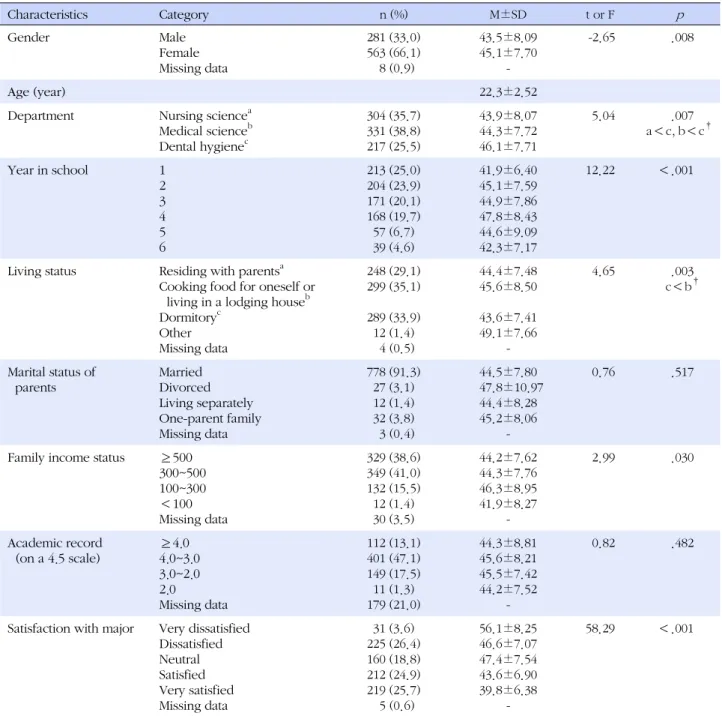
The general characteristics of the participants are shown in Table 1. Of the students, 66.1% were female.
Nursing science students comprised 35.7% of the partic- ipants, medical students, 38.8%, and dental hygiene stu- dents, 25.5%. The percentage of first-year students was the highest, at 25.0%. The mean age of the students was 22.3 years of age and the percentage of students living in boarding houses was the highest, at 35.1%. For mar- ital status of the students' parents, 3.1% were divorced and for monthly income of parents, almost half (41.0%) had a monthly income between three to five thousand Korean won (1,000,000 Korean won is approximately US$1,000). For satisfaction with major, 26.4% were dis-
Table 1. Depression by Demographics and General Characteristics of Participants (N=852)
Characteristics Category n (%) M±SD t or F p
Gender Male
Female Missing data
281 (33.0) 563 (66.1) 8 (0.9)
43.5±8.09 45.1±7.70
-
-2.65 .008
Age (year) 22.3±2.52
Department Nursing sciencea
Medical scienceb Dental hygienec
304 (35.7) 331 (38.8) 217 (25.5)
43.9±8.07 44.3±7.72 46.1±7.71
5.04 .007
a<c, b<c†
Year in school 1
2 3 4 5 6
213 (25.0) 204 (23.9) 171 (20.1) 168 (19.7) 57 (6.7) 39 (4.6)
41.9±6.40 45.1±7.59 44.9±7.86 47.8±8.43 44.6±9.09 42.3±7.17
12.22 <.001
Living status Residing with parentsa Cooking food for oneself or
living in a lodging houseb Dormitoryc
Other Missing data
248 (29.1) 299 (35.1) 289 (33.9) 12 (1.4) 4 (0.5)
44.4±7.48 45.6±8.50 43.6±7.41 49.1±7.66
-
4.65 .003
c<b†
Marital status of parents
Married Divorced Living separately One-parent family Missing data
778 (91.3) 27 (3.1) 12 (1.4) 32 (3.8) 3 (0.4)
44.5±7.80 47.8±10.97
44.4±8.28 45.2±8.06
-
0.76 .517
Family income status ≥500 300~500 100~300
<100 Missing data
329 (38.6) 349 (41.0) 132 (15.5) 12 (1.4) 30 (3.5)
44.2±7.62 44.3±7.76 46.3±8.95 41.9±8.27
-
2.99 .030
Academic record (on a 4.5 scale)
≥4.0 4.0~3.0 3.0~2.0 2.0
Missing data
112 (13.1) 401 (47.1) 149 (17.5) 11 (1.3) 179 (21.0)
44.3±8.81 45.6±8.21 45.5±7.42 44.2±7.52
-
0.82 .482
Satisfaction with major Very dissatisfied Dissatisfied Neutral Satisfied Very satisfied Missing data
31 (3.6) 225 (26.4) 160 (18.8) 212 (24.9) 219 (25.7) 5 (0.6)
56.1±8.25 46.6±7.07 47.4±7.54 43.6±6.90 39.8±6.38
-
58.29 <.001
†Scheffé́́́ method Post Hoc test.
satisfied, 25.7%, highly satisfied and 24.9%, satisfied.
When the level of depression was considered in light of general characteristics, differences were found by gen- der, major, year in school, parents' income status, and satisfaction with major.
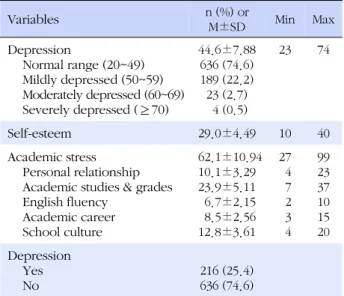
2. Mean and standard deviation of variables The students' depression levels are shown in Table 2.
The depression ranged from a minimum of 23 to a max-
imum of 74. The average score was 44.6. The percent- age for mild depression was 22.2% and 4 students (0.5%) had a depression level score of 70 or above. The self-esteem scores ranged from 10 to 40. The average score was 29.0. The range of academic stress was from 27 to 99. The average score was 62.1. Mildly depressed, moderately depressed, and severely depressed students were grouped in the depression group (216 students [25.4%]). Students within the normal range for depres- sion were included in the non-depression group.
Table 3. Differences in Depression, Self-esteem, and Academic Stress by Department (N=852)
Department Depression Self-esteem Academic stress
M±SD F p M±SD F p M±SD F p
Nursing sciencea Medical scienceb Dental hygienec
43.9±8.07 44.3±7.72 46.1±7.71
5.04 .007
a<c, b<c†
29.0±4.46 29.7±4.37 28.2±4.60
7.09 .001
c<b†
62.3±10.63 60.4±10.85 64.2±11.12
8.30 <.001 b<c†
Total 44.6±7.89 29.1±4.49 62.1±10.94
†Scheffé́́́ method Post Hoc test.
3. Differences in depression, self-esteem, and academic stress by department
Differences in the main variables by major are show- nin Table 3. The mean depression score for the dental hygiene students was highest, at 46.1. The self-esteem score for the medical science students was significantly higher, at 29.7, than that of the dental hygiene students.
The academic stress score for the dental hygiene stu- dents was significantly higher, at 64.2, than that of the medical science students.
4. Factors affecting depression
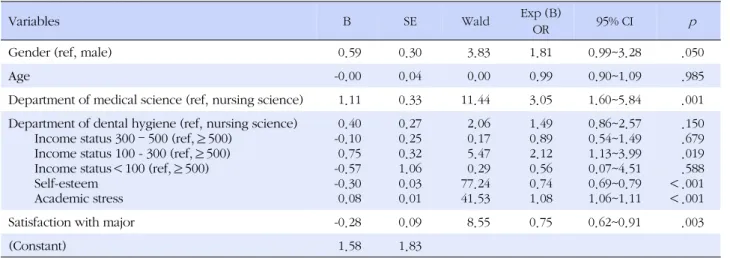
Depression, the dependent variable of the sample da- ta, was classified into 2 groups: The depression group with mild, moderate, and severe depression and the non-depression group within the normal range. To in- vestigate factors directly correlated with depression, a logistic regression analysis was performed with the in- dependent variables, which were self-esteem, academic stress, and general characteristics (Table 4).
General characteristics were converted with dummy variables. The standard variable was male for gender, nursing science for major, and 5,000,000 won and above for parents' monthly income.
The Hosmer-Lemeshowmodel was appropriate for depression (p =.461). A test of fitness was used to com- pare the observed probability and predictive probability using the model. An insignificant difference means that the model is appropriate. In this model, the significant variables were medical science department, parents' monthly income from 1,000,000 to 3,000,000 won, self- esteem, academic stress, and satisfaction with major.
The total model was also significant (p <.001). In this study, it was found that self-esteem, academic stress, satisfaction with major, choice of major, and parents' in- come were correlated with depression. When self-es- teem was high, the depression level was 0.74 times lower. When satisfaction with major was high, the de- pression level was 0.75 times lower. The depression level in students majoring in medical science was 3.05 times higher than that of students in nursing science. The de- pression level in the group with a household income of 1,000,000 to 3,000,000 won was 2.12 times higher than that of students with higher family income. When acad- emic stress was high, the depression level was 1.08 times higher.
DISCUSSION
Depression is a common mental health disorder today.
It has greatest major effect on individual emotional sta- bility. In this study the effects of factors affecting depres- sion including self-esteem and academic stress in stu- dents in health-related majors was explored.
To this end, the effects of students' general character- istics, self-esteem, and academic stress on depression for students in nursing science, medical science, and dental hygiene were examined. It was found that self- esteem, academic stress, and satisfaction with the major were factors significantly related to depression. Among Table 2. Mean and Standard Deviation of Variables (N=852)
Variables n (%) or
M±SD Min Max
Depression
Normal range (20~49) Mildly depressed (50~59) Moderately depressed (60~69) Severely depressed (≥70)
44.6±7.88 636 (74.6) 189 (22.2) 23 (2.7) 4 (0.5)
23 74
Self-esteem 29.0±4.49 10 40
Academic stress Personal relationship Academic studies & grades English fluency
Academic career School culture
62.1±10.94 10.1±3.29 23.9±5.11 6.7±2.15 8.5±2.56 12.8±3.61
27 4 7 2 3 4
99 23 37 10 15 20 Depression
Yes No
216 (25.4) 636 (74.6)
Table 4. Factors affecting Depression (N=852)
Variables B SE Wald Exp (B)
OR 95% CI p
Gender (ref, male) 0.59 0.30 3.83 1.81 0.99~3.28 .050
Age -0.00 0.04 0.00 0.99 0.90~1.09 .985
Department of medical science (ref, nursing science) 1.11 0.33 11.44 3.05 1.60~5.84 .001 Department of dental hygiene (ref, nursing science)
Income status 300 – 500 (ref,≥500) Income status 100 - 300 (ref,≥500) Income status<100 (ref,≥500) Self-esteem
Academic stress
0.40 -0.10 0.75 -0.57 -0.30 0.08
0.27 0.25 0.32 1.06 0.03 0.01
2.06 0.17 5.47 0.29 77.24 41.53
1.49 0.89 2.12 0.56 0.74 1.08
0.86~2.57 0.54~1.49 1.13~3.99 0.07~4.51 0.69~0.79 1.06~1.11
.150 .679 .019 .588
<.001
<.001
Satisfaction with major -0.28 0.09 8.55 0.75 0.62~0.91 .003
(Constant) 1.58 1.83
ref=reference variable; OR=odds ratio; CI=confidence interval.
the majors, the depression level in dental hygiene stu- dents was the highest. In addition, the depression level in medical science students was 3.05 times higher than that in nursing science students. Parents' economic con- dition was highly related to depression. The depression level in the group earning 1,000,000 to 3,000,000 won was 2.12 times higher than that of the group earning 5,000,000 won and above. These results mostly agreed with those of previous studies.
The effect of self-esteem on depression has been dis- cussed in many studies. When self-esteem was high, the depression level was low. Self-esteem decreased neg- ative mental conditions and protected the self from mental instability (Dixon & Kurpius, 2008). Self-esteem is general self-valuation. It means to accept oneself pos- itively and realize one’s worth.
In this study, self-esteem was found to be related to satisfaction with major and stress, which affect depres- sion. Self-esteem is an especially important factor for de- velopment and application of stress management strat- egies in first-year college students who face academic stress and must navigate social adjustment and prepara- tion for a career (Deniz, 2006). It can be concluded that self-esteem improves the mental health of college stu- dents at a key turning point in their development. Thus, the enhancement of self-esteem has the advantage of in- creasing satisfaction with campus life and decreasing depression in college students. For that reason, a pre- ventive approach to mental health through the improve- ment of self-esteem is necessary and a clinical approach could be used.
Stress is also an important factor to take into consid- eration during life turning points. Stress has a close con-
nection with mental health. Appropriate stress is essen- tial in maintaining physical and mental health as well as making positive academic achievements. However, se- vere and repetitive stress and passive management of stress have negative effects on mental health (Dixon &
Kurpius, 2008). Particularly, students in health-related majors have frequent tests and are overworked studying to prepare for their national board examinations. Thus, academic stress for students in health care professions would differ from that of students with other majors.
Students need to realize the importance of individual coping methods for stress and mental health related to study and career situations that can cause excessive stress. Maladjustment should be prevented by being concerned and training for healthy habits. In this study, stress was found to be the most important factor affect- ing depression and this result indicates a need for stress management strategies to decrease academic stress and improve mental health in college students. In addition, choice of major and satisfaction with major were highly correlated with depression in this study.
Studies on the mental health of college students have been performed frequently. However, most of them have included first-year students only. In addition, the analysis of mental health for students with different ma- jors has not been adequate.
In some studies, the main variables related to mental health like depression and stress management have been investigated for nursing science students (Han & Kim, 2007). According to these studies, nursing science stu- dents felt that clinical training and classes were a greater burden for them than studies for students in other majors.
They experienced various social tensions due the need
to prepare for the national board examination, being re- sponsible for patients, and the rapid developments in medical technology (Jung & Shin, 2006), and they were vulnerable to maladjustments such as depression.
This psychological weakness affects academic ach- ievement and satisfaction with major. Students with high satisfaction with campus life showed higher self-esteem than those with low satisfaction. Task performance and grades were high in students with high self-esteem be- cause they performed their tasks more actively (Park &
Hah, 2007).
Students in health-related majors concentrate on the national board examination. They experience a different situation than students in other majors because of the advantageous employment conditions generated by lim- ited competition and pre-job training through clinical experience.
In the present study, the relationship between satis- faction with major and depression in students with health-related majors was investigated. When satisfac- tion was high, the depression level was low.
This finding has not been reported in previous stu- dies. Considering academic satisfaction and counseling when choosing a major, proper advice according to per- sonal aptitude is an important factor for promoting stu- dents' mental health. In a previous study on satisfaction with the major, satisfaction was somewhat higher, at 77.9%, among health professions students than among students with other majors, at 70.1%. However, the dif- ference was not statistically significant (Yu, 2009).
Generally, the preference for health-related majors like medical science and nursing science is high in Korea, although satisfaction with major and academic perform- ance after admission are not higher than in other majors.
Thus, career exploration focusing on personal aptitude is necessary. Academic stress due to studying unfamiliar material in health-related majors affects satisfaction with the major. Improving mental health and preventing mal- adjustment in students with health-related majors should start with pre-college career exploration by aptitude.
In this study, the general characteristics of the students which affected depression were, gender, parents' eco- nomic status, and type of residence. It has been gen- erally known that the incidence of depression differs by gender. Thus, most studies find similar results for de- pression by gender. Specifically, in many studies, it has been reported that women were more susceptible to de- pression than men. The result of the present study con- firms these results. However, the results have not been the same in every study. For example, while it has been
reported that the predisposition to depression was high- er in women than men (Matud, 2004), another study found no difference by gender (Dyson & Renk, 2006).
This could be interpreted as showing that depression is not affected just by gender difference itself but the dif- ference in recognition and management of variables af- fecting depression by gender. Women are particularly sensitive to the stresses of campus life, and thus it has been found that these stressors are more likely to lead to depression in women.
There is also a difference in self-esteem between men and women. Men's self-esteem is higher than that of women. This could be a reason for the inconsistent re- sults of studies on the role of gender in depression (Dixon & Kurpius, 2008). Thus, strategies considering not just gender differences but various interactions among the factors affecting depression are necessary to prevent depression.
College students are in an achievement-oriented situ- ation and under stress from their studies, adjustment to social relationships, and career exploration. These stress- es at this life turning point are affected by environmental factors like economic conditions and type of residence.
Economic instability, in particular, increases academic stress and affects depression. When residence was sta- ble, the depression level was low. College students who are in life transition are preparing for a life independent from their families emotionally, economically, and so- cially. To cope with these stresses, economic stability and a social support system are important. Academic stress, the burden of career achievement, and anxiety were high in students with health-related majors including nursing science (Goff, 2011). Environmental stress would have a negative effect on these stressors. For instance, students in poor economic conditions have physical and time burdens due to maintaining part time jobs along with academic performance. These burdens affect aca- demic performance directly and indirectly and as a con- sequence of poorer academic performance, these stu- dents could be deprived of scholarship benefits and be restricted from admission to dormitories.
As a result, socioeconomic instability increases the risk of mental health problems in college students. This risk, in turn, increases rates of low academic achieve- ment and anxiety about the future. Therefore, pre- ventive approaches to improve the mental health of col- lege students, systemic support including the increase in the number of dormitory facilities, relaxation of the con- ditions for dormitory admission, and expansion of scholar- ship benefits are necessary.
The limitation of this study is that it is difficult to gen- eralize these results because the participants were only in one university. However, the strength of this study is that it compared depression levels among students ma- joring in medical science, nursing science, or dental hy- giene. In addition a significant contribution is the inclu- sion of general characteristics affecting depression, like satisfaction with major, not just psychosocial variables like self-esteem and academic stress related to academic performance. Suggestions for further studies include:
First, the results in this study should be verified by future studies including a broader range of college students.
Second, practical mental health promotion programs for college students could be developed by analyzing the relationship between the causes and variables of de- pression and comparing students in health-related and non-health-related majors. Third, comparative interna- tional studies of foreign and domestic health professions students would be valuable. Lastly, to apply the study results, institutional and system-wide programs should be developed to increase academic achievement and maintain the mental health of students.
CONCLUSION
This study was done to provide basic data for career counseling among those applying to college and im- provement of academic achievement by confirming fac- tors related to depression in students in the health care professions. Meanwhile, a variety of depression studies were conducted by the mono-disciplinary students in the medical and nursing departments. However in this study, the dental hygiene department was chosen amongst other comparable conventional medicine departments, such as the traditional medicine department and the de- partment of Health. There was a remarkable resemblance among the three departments such as practical training and entering the national board examination. For this reason, we selected the three departments altogether.
Through this study, it was confirmed that clinical strat- egies to support the improvement of self-esteem and cop- ing with academic stress are needed. To improve mental health, the choice of major by aptitude and the develop- ment of institutional support programs are important for college students whose socioeconomic support systems are insufficient. In this study, stress was found to be the most important factor affecting depression and this result indicates a need for stress management strategies to de- crease academic stress and improve mental health in col- lege students. Choice of major and satisfaction with ma-
jor were highly correlated with depression in this study.
REFERENCES
Beeber, L. S. (1996). Pattern integration in young depressed wo- men. Archives of Psychiatric Nursing, 10, 151-156.
Birmaher, B., Ryan, N. D., Williamson, D. E., Brent, D. A., & Kauf- man, J. (1996). Childhood and adolescent depression: A re- view of the past 10 years. Journal of the American Academ- ic Child Adolescent Psychiatry, 35, 1427-1439.
Cho, S. J., Jeon, H. J., Kim, J. K., Suh, T. W., Kim, S. U., Hahm, B.
J., et al. (2002). Prevalence of suicide behaviors (suicidal ideation and suicide attempts) and risk factors of suicide at- tempts in junior and high school adolescents. Journal of Korean Neuropsychiatric Association, 41, 1142-1155.
Choi, W. Y., Kim, C. K., & Lee, S. Y. (2005). Effectiveness of a cog- nitive-behavioral group counseling program for college stu- dents with depression and suicide thought. The Korean Journal of Counseling, 6, 75-91.
Chon, K. K., Choi, S. C., & Yang, B. C. (2001). Integrated adapta- tion of CES-D in Korea. The Korean Journal of Health Psy- chology, 6, 59-76.
Chon, K. K., Kim, K. H., & Yi, J. S. (2000). Development of the re- vised life stress scale for college students. The Korean Jour- nal of Health Psychology, 5, 316-335.
Deniz, M. E. (2006). The relationships among coping with stress, life satisfaction, decision-making styles and decision self-es- teem: An investigation with Turkish university students.
Social Behavior and Personality, 34, 1161-1170.
Dixon, S. K., & Kurpius, S. E. R. (2008). Depression and college stress among university undergraduates: Do mattering and self-esteem make a difference? Journal of College Student Development, 49, 412-424.
Dyson, R., & Renk, K. (2006). Freshmen adaptation to university life: Depressive symptoms, stress, and coping. Journal of Clinical Psychology, 62, 1231–1244.
Goff, A. M. (2011). Stressors, academic performance, and learned resourcefulness in baccalaureate nursing students. Interna- tional Journal of Nursing Education Scholarship, 8, 1-20.
Gong, S. J., & Lee, E. H. (2006). Medication effect of coping be- tween life stress and depression in female college students.
Korean Journal of Woman Psychology, 11, 21-40.
Han, K. S. (2005). Self-efficacy, health promoting behaviors, and symptoms of stress among university students. Journal of Korean Academy of Nursing, 35, 585-592.
Han, K. S., & Kim, M. G. (2007). Comparison to self-esteem, fam- ily adaptation, health promoting behaviors, and symptoms of stress between nursing and other major university wom- en student. Journal of Korean Academy of Psychiatric and Mental Health Nursing, 16, 78-84.
Jeon, J., & Bae, E. J. (2007). Difference between self-esteem and family cohesiveness by university students' demographical variances. The Korean Journal of Counseling, 8, 807-817.
Jung, M. H., & Shin, M. A. (2006). Correlations between self-es- teemand satisfaction in major in nursing college students.
The Journal of Korean Academic Society of Nursing Educa- tion, 12(2), 170-177.
Kim, C. H., & Lee, M. K. (2006). The effect of personality style and interpersonal problem solving ability on life stress, depres- sion. Korean Journal of Health Psychology, 11, 163-175.
Kim, O. S., & Kim, K. H. (2001). Social support, depression, drinking and smoking in college and working females.
Journal of Korean Academy of Adult Nursing, 13, 363-372.
Kim, S. K. (2003). Life stress in freshman and adjustment to college. Korean Journal of Youth Studies, 10 (2), 215-237.
Kwon, H. J., Kang, Y. S., & Kim, J. Y. (2008). Effects of cogni- tive-behavioral group counseling on the self-esteem and in- terpersonal skills of school bullying victims. Journal of Fi- sheries and Marine Sciences Education, 20 (10), 46-57.
Lee, D. S. (2003). A study on the relations of internet addiction, depression and ego identity of adolescents. Unpublished master's thesis, Chonnam National University, Gwangju.
Matud, M. P. (2004). Gender differences in stress and coping styles. Personality and Individual Differences, 37, 1401-1415.
Park, H. S., Bae, Y. J., & Jung, S. Y. (2002). A study on self-es- teem, self-efficacy, coping methods, and the academic and job-seeking stress of nursing students. Journal of Korean Academy of Psychiatric and Mental Health Nursing, 11, 621-631.
Park, H. S., Son, C. N., & Oh, S. W. (1993). The effects of stress, social support, dysfunctional attitude and coping style upon depression. Korean Journal of Clinical Psychology, 12, 179- 196.
Park, K. H., & Hah, Y. S. (2007). Depression, self-efficacy, life satis- faction and coping behaviors of university students. The Korean Journal of Stress Research, 15, 17-25.
Rosenberg, M. (1965). Society and the adolescent self-image.
Princeton, NJ: Princeton University Press.
Wilson, K., Mottram, P., & Sixsmith, A. (2007). Depressive symp- toms in the very old living alone: Prevalence, incidence and risk factors. International Journal of Geriatric Psychiatry, 22, 361-366.
Yu, E. Y. (2009). Self-esteem and stress-coping strategies of the college students in the department of public health. The Journal of the Korea Contents Association, 9(6), 225-236.
Zung, W. W. (1965). A self-rating depression scale. Archives of General Psychiatry, 12, 63-70.