Temporal and Spatial Variability of Heating and Cooling Degree- days in South Korea, 1973-2002*
Youngeun Choi**
한반도 난·냉방도일의 시공간 분포 특성 변화에 관한 연구*
최영은**
Abstract:The spatial and temporal variations of heating degree-days (HDDs) and cooling degree-days (CDDs) are closely related with the temperature field. The spatial distribution of 30-year mean HDDs shows that the higher values locates in the northern part of South Korea while the lower values locates in the southern part. The 30-year mean CDDs shows a more randomized distribution than the HDDs. The changing trends of HDDs and CDDs show a different feature: HDDs have a distinct decreasing trend while CDDs have an insignificant change. The decreasing trends of HDDs are consistent over South Korea and most of stations have experienced the statistically significant change. As significant changing areas of HDDs are much broader than those of annual mean temperature, HDDs can be more useful than annual mean temperature to detect the climate change impact on a regional level. In other words, an insignificant change on the mean temperature field can induce the significant change of thermal climatology in a region. The temporal pattern of climatic departure index (CDI) for South Korea HDDs series shows a general decreasing, but a sharp increase during recent years. The drastic decrease of HDDs induces higher CDI indicating larger variability among stations. However, the decrease of South Korea HDDs series cannot totally attribute to the global warming due to urban effects. By the early 1980s, there were no big differences of HDDs between urban and rural series, but later the differences are getting larger. This was expected to be with the intensification of urbanization in South Korea. However, still there is a decreasing trend of HDDs for rural stations.
Key Words : Heating degree-day, cooling degree-day, climatic departure index, thermal climatology
요약:난방도일과 냉방도일은 에너지 사용량 예측에 사용되는 개념으로 특정 지역의 열기후적 특성을 이해하는 데 유용하게 사용되 어 왔다. 난방도일과 냉방도일의 공간 분포는 반대로 나타난다. 난방도일의 경우 남부에서 최소가 나타나고 북쪽으로 올수록 그 값 이 증가하고 강원도를 포함한 북동쪽에서 최대가 나타났다. 냉방도일은 제주도와 남부에서 최대가 나타나고 북쪽으로 올수록 그 값 이 감소한다. 냉방도일에는 최근 30년간 뚜렷한 변화 경향이 나타나지 않지만 난방도일의 경우는 모든 지점에서 뚜렷한 감소 경향이 나타났다. 난방도일의 감소는 최저기온의 급격한 상승에 기인한 것으로 판단된다. 또한 난방도일의 감소는 연 평균기온의 증가보다 뚜렷한 변화 경향을 나타냈다. 평균기온에서 뚜렷한 변화 경향이 탐지되지 않더라도 기후변화의 영향이 존재할 수 있음을 나타낸다.
또한 최근 급격한 난방도일의 감소는 기후편차지수의 증가를 초래하여 한반도 내 난방도일의 변동이 커지고 있음을 보여주고 있다.
주요어 : 난방도일, 냉방도일, 기후편차지수, 열기후학
* This work was supported by the Korea Research Foundation Grant (KRF-2004-003-B00336).
** Assistant professor, Department. of Geography, College of Science, Konkuk University, [email protected]
1. Introduction
The examination of extreme climate events is essential to understand the process of climate change (Chessa and Delitala, 1997; Frich et al., 2002; Jung et al., 2002; Choi, 2004) and the practical importance of extreme climate conditions can be explained through the use of heating and cooling degree-days (Soulé and Suckling, 1995). Heating degree-days (HDDs) and cooling degree-days (CDDs) have been frequently applied in estimation of energy consumption rates and patterns in many countries (Quayle and Diaz, 1980; Lamb and Changnon, 1981; Sanderson, 1983; Downton et al., 1988; Soulé and Suckling, 1995; Hargy, 1997;
Hartley and Robinson, 2000). The theory is very simple. Heating or cooling degree-days are based on the assumption that people will begin to use the heating or cooling systems when daily mean temperature drops below or rise above a critical level of human comfort, a base comfortable temperature (Thompson and Perry, 1997).
Heating degree-days are determined by summing the deviations of daily mean temperature from the base temperature. Hence, the lower daily mean temperature is, the more heating degree- days and the greater predicted consumption of fuel are. The higher daily mean temperature is, the more cooling are needed. It is easily predicted that if the global warming is intensified, HDDs will be decreased while CDDs will be increased. Also, there are some possibilities that the more extreme climate conditions will induce the higher degree-days.
There has been a consensus about the global warming, but there have been controversies about regional climate change due to different directions and magnitude of changes over the
different regions (Houghton et al., 2001). People are more interested in and easily understand the change of the climate change indicators such as frost days or ice days rather than the change of climate elements such as temperature or rainfall.
Also, some climate change indicators show more distinct and consistent changes over regions, so they are sometime more useful than temperature or rainfall itself. The annual number of frost days shows more near-uniform decreases than annual temperature over the second part of the 20th century over Korea and other countries (Frich et al., 2002; Choi, 2004).
Cumulative degree-days can be a direct and simple indicator of the overall thermal climate for a given heating and cooling season at a given location. Because heating and cooling requirements are directly related to temperature, they should have changed during same period (Ministry of Water, Land and Air protection, 2002). When the time series of them are compared, HDDs and CDDs can provide a useful measure of climate variability (Soulé and Suckling, 1995). The purpose of this study is to examine the characteristics of thermal climate over South Korea using heating degree-days and cooling degree-days. This study also assesses the climatic normals, temporal trends and spatial variability of degree-days over shorter intervals (10-year and 15-year) within the recent 30-year period (1973-2002).
2. Data and Methodology
The climate records of daily mean temperature were examined for 60 stations during the period of 1973-2002. The station observation histories such as large locational moves, elevation changes
or changes in the time of observation were examined, but the primary concern in selecting stations was data completeness and spatial coverage. As the global warming has the same increasing signal with an urban effect and the urban effect is one of crucial noises to estimate the magnitude of global warming. However, in order to have adequate spatial resolution, both urban and rural stations were used. As Soulé and Suckling (1995)’s work, urban warming bias was controlled by performing statistical analyses with and without the inclusion of major urban centers.
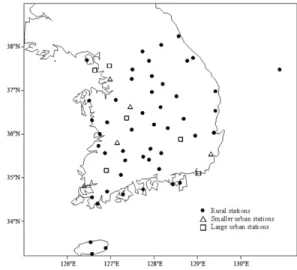
Although an urban heat island effect can be evident in small cities and towns, eleven stations were classified as major urban centers. The stations with population density more than one thousand persons per km2 in 2000 were categorized as urban stations and others were rural stations. Again, urban stations with more than one million population totals were defined as large urban stations and others are smaller urban stations. As there are a few true rural stations in South Korea, it might be appropriate to be referred as relatively less urbanized stations. Figure 1 shows the location of stations used for this study (squares, triangles and dots represent six large urban stations, five smaller urban stations and 49 rural stations, respectively).
When dealing with comparative analyses of cumulative heating degree-days over a heating season or year, it needs to have the same number of observations for each station in each year. To maintain the same number of days in each year, data for 29 February were eliminated from analyses. Traditionally, degree-days have computed as deviation from a base comfortable temperature, 18℃ and 26℃ for HDDs and CDDs, respectively (Lee, 1980). Using daily data from 1973 to 2002, a 29-year time series of HDDs and
a 30-year time series of CDDs are calculated for each station.
Climatic variability of heating and cooling degree-days within and among the group of 60 stations is examined using a climatic departure index (CDI) developed by Soulé and Suckling (1995). The CDI for a given year j is calculated using formula:
where xi is the value of HDDs or CDDs averaged for location i for the study period, Xij is the values of HDDs or CDDs during year j at location i, ∆i is the standard deviation of HDDs or CDDs at location i, and n is the number of stations. CDI can provide a standardized quantitative measure of regional climate variability. When calculated yearly, it serves as a measure of climatic normality for the region.
Years with large positive or negative deviations from the long-term mean will produce comparatively large CDI values, and years with
Figure 1. The location of stations (squares: six large urban stations, triangles: five smaller urban stations and dots: 49 rural stations)
stations ‘near-normal’ produce comparatively lower CDI values.
A 30-year mean period has been used to represent the climatic normals, but the use of 30- year normals may not provide the best results for applied situations. Shorter period normals such as 5-year, 10-year and 15-year period may be more appropriate when considering the near- future state of the climate (Soulé and Suckling, 1995). Here, 10-year and 15-year heating and cooling degree-days were calculated and compared. For HDDs, as actually 29-year series were constructed, the first 15-year period is 15 years from 1973-1987, but the second 15-year period is 14 years from 1988-2001. The last 10- year period is 9 years from 1993-2001.
3. Results and Discussion
1) The spatial distribution of heating and cooling degree-days
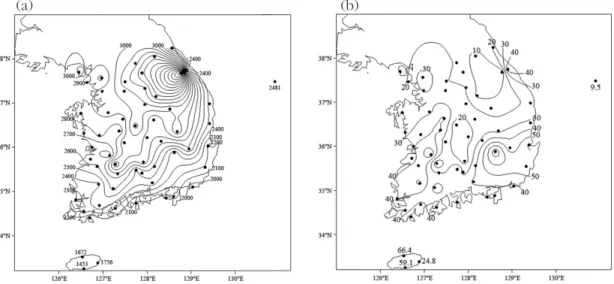
The spatial and temporal variations of HDDs and CDDs are closely related with the temperature field. The spatial distribution of 30- year mean HDDs shows a pretty similar pattern to that of annual mean temperature with the opposite direction of higher or lower value areas (Figure 2a, Figure 3). The higher values of HDDs locate in the northern part of the country while the lower values locate in the southern part due to temperature differences between those areas.
The HDDs minimum locates over Jeju island and southern parts with below 2000 degree-days (DDs) while the maximum locates over Daegwallyeong and northeastern parts of the country with higher than 3,000 DDs. The higher values of HDDs over the area are caused by both higher latitudes and higher elevations of stations.
The 30-year mean CDDs show a more randomized distribution than the HDDs, but it still reflects the distribution of annual mean temperature indicating that southern stations have higher CDDs than northern stations. The maximum locates over southeastern parts of the
Figure 2. The spatial distribution of 30-year mean of heating degree-days (a) and cooling degree-days (b) over South Korea, 1973-2002, DDs.
(a) (b)
country with higher than 50 DDs while the minimum locates over northeastern parts of the country with below 10 DDs. It means that stations over the southern parts will need more energy for cooling systems than those over the northern parts (Figure 2b).
2) The changing trends of heating and cooling degree-days
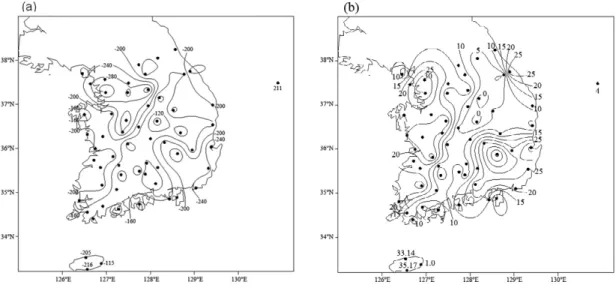
As the long-term annual mean temperature indicated a distinct increasing trend over South Korea due to the apparent increase of minimum temperature during winter (Jung et al., 2002), it can be expected that HDDs would be decreased in South Korea. However, CDDs would not have a distinct change due to no significant change of maximum temperature. The changing trends of HDDs and CDDs show a different feature: HDDs have a distinct decreasing trend while CDDs have an insignificant change. The decreasing trends of HDDs are consistent over South Korea and most of stations have experienced the statistically significant change (Figure 4a). The changing trend of HDDs and annual mean temperature shows a very similar pattern with different directions (Figure 4a, 4b). Also, Areas showing significant change of HDDs are much broader than those of annual mean temperature.
When correlation coefficient(r) is higher than Figure 3. The spatial distribution of 30-year annual
mean temperature (℃) over South Korea, 1973-2002.
Figure 4. The changing trends of heating degree-days (a) and annual mean temperature (b) over South Korea, 1973-2002, DDs.
0.27, trends are statistically significant at 95%
level. Therefore it might be said that HDDs is more useful than annual mean temperature to detect the climate change impact on a regional level. Although there is an insignificant change on the mean temperature field the significant change of thermal climate in a region can be detected when considering the accumulation of thermal surplus. The changing trends of CDDs show more complex and insignificant as some areas were experiencing an increase while other areas are a decrease. The changing trends of HDDs and CDDs indicate that lower temperatures during cooler seasons show more significant changes than higher temperature during warmer seasons (Jung et al., 2002).
However, this does not guarantee that extreme hot-day events will be remained unchanged.
The shorter periods of HDDs and CDDs normals were constructed as the most significant aspect of the temporal distribution of temperature field was the sustained upward trend during the recent years. The two 15-year
and three 10-year HDDs and CDDs normals were compared. Two 15 years, 1973-1987 and 1988- 2002 mean HDDs show the same pattern, but magnitudes are different. The most distinct feature in these two periods is the reduction of higher HDDs areas during the recent years. The higher HDDs area with higher than 3,000 DDs is getting much smaller during the latter 15 years and most of areas experience a decrease. As the mean HDDs are 2754 DDs for the first 15-year period and 2564 DDs for the latter 15-year period, there is a decrease of 7%. If there is an abrupt climate change, shorter periods of normal will be more useful for the near future climate prediction. Figure 5a shows the difference of HDDs between 1973-1987 and 1988-2002. Two 15 years, 1973-1987 and 1988-2002 mean CDDs also show a similar pattern, but CDDs increase, especially over southeastern and western parts of the country. The changing trend of CDDs is insignificant at most of stations, but the second 15-year period clearly has higher mean CDDs than first 15-year periods (Figure 5b).
Figure 5. The difference of 1973-1987 and 1988-2002 mean heating degree-days (a) and cooling degree- days (b) over South Korea, DDs.
Even ten years periods, there is a pretty big difference of HDDs when considering the higher HDDs area. There is drastic reductions of areas with higher than 3,000 DDs and the decreasing magnitude is getting larger indicating the possibility of the warming is accelerating over South Korea. The three 10-year mean HDDs are 2736.4, 2677.8, and 2562.5, respectively indicating an increase of 58.6 DDs and 115.3 DDs comparing with the first 10-year mean. The three 10-year mean CDDs are 25.0, 36.7 and 27.1 DDs, respectively indicating no significant change.
3) The temporal variation of heating and cooling degree-days
Figure 6 shows the time series of South Korea HDDs series and climatic departure index (CDI).
South Korea HDDs series was constructed by arithmetically averaging 60 stations and shows a statistically significant change. The temporal pattern of CDI for South Korea HDDs series have shown a general decreasing, but a sharp increase since the early 1990s. The drastic decrease of HDDs induce higher CDI indicating larger variability among stations. In the period of higher variability, the electrical generating capacities can
be underutilized or overtaxed. However, the decrease of South Korea HDDs series cannot totally attribute to the global warming due to a strong urban effect. The situation is the almost same for the CDI for South Korea CDDs series (Figure 7). The temporal variation of South Korea CDDs series is pretty consistent by the early 1990s, but after that, an abrupt increase. It induces a sharp increasing of CDI during the recent years.
Urban and rural HDDs and CDDs series were constructed. Figure 8 shows the annual variation of urban HDDs series constructed with averaging HDDs from 11 urban stations. The rest 49 stations were used for rural HDDs series. By the Figure 6. The annual variation of South Korea
heating degree-days series (DDs) and climatic departure index, 1973-2002.
Figure 8. The annual variation of urban and rural heating degree-days series, 1973-2002, DDs.
Figure 7. The annual variation of South Korea cooling degree-days series (DDs) and climatic departure index, 1973-2002.
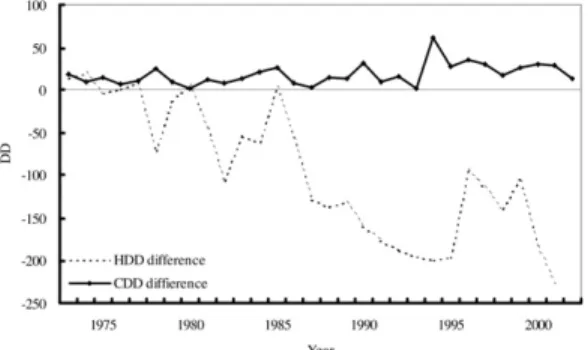
early 1980s, there are no big differences of HDDs between two series, but later the differences are getting larger. This was partly expected to be with the intensification of urbanization in South Korea. During the first 15-year period, the difference between urban and rural HDDs series is just 32.8 DDs, but the difference is getting 160.7 DDs during the latter 15-year period indicating that urban effects influence in a decrease of HDDs. However, still there is a statistically significant decreasing trend of HDDs for rural stations. The differences of CDDs between rural and urban series have no distinct trends (Figure 9). The first 15-year and the second 15-year mean CDDs for rural series are 26.1 and 28.5, respectively, indicating there are no distinct increases. However, those for urban
series are 38.5 and 52.8, respectively with significant increases. Although no distinct trends are not detected in urban and rural CDDs series, there are some possibilities on change of CDD in urban areas showing that the difference of urban and rural series for CDDs is getting larger between two 15-year periods. Figure 10 shows the difference of HDDs and CDDs between urban and rural series.
Table 1 shows the changing rate of annual mean temperature, HDDs and CDDs. The more urbanized, the higher changing rate for annual mean temperature and HDDs. Rural series do not show statistically significant trends for annual mean temperature but for HDDs. Without the distinct change of mean temperature, there is a distinct decrease of HDDs and is a distinct change of thermal climate over South Korea during heating seasons. There is an increase of CDDs, but not significant.
4. Summary and Conclusions
The spatial and temporal variations of HDDs and CDDs are closely related with the temperature field. The spatial distribution of 30- Figure 9. The annual variation of urban and rural
cooling degree-days series, 1973-2002, DDs. Figure 10. The difference of heating and cooling degree-days between urban and rural series, 1973- 2002, DDs.
Table 1. Trends of annual mean temperature (AMT), heating(HDDs) and cooling degree-days(CDDs) series by various series.
AMT HDDs CDDs
South Korea series 0.026* -10.5** + Large urban series 0.047** -15.3** + Smaller urban series 0.045** -15.1** +
Rural series 0.21 -7.6* +
*: significant at 95% level, **: significant at 99% level +: insignificant increase
year mean HDDs shows a very similar pattern to that of annual mean temperature with the opposite direction of higher or lower value areas.
The higher values of HDDs locate in the northern part of the country while the lower values locate in the southern part. The 30-year mean CDDs show a more randomized distribution than the HDDs, but it still reflects the distribution of annual mean temperature indicating that southern stations have higher CDDs than northern stations.
The changing trends of HDDs and CDDs show a different feature: HDDs have a distinct decreasing trend while CDDs have an insignificant change. The decreasing trends of HDDs are consistent and most of stations have experienced the statistically significant change.
Also, areas showing significant changes of HDDs are much broader than those of annual mean temperature. Therefore, it might be said that HDDs are more useful than annual mean temperature to detect the climate change impact on a regional level. Although there is an insignificant change on the mean temperature field, the significant change of thermal climatology in a region can be detected when considering the accumulation of thermal surplus.
The temporal pattern of CDI for South Korea HDDs series shows a general decreasing, but a sharp increase during recent years. The drastic decrease of HDDs induced higher CDI indicating larger variability among stations. In the period of higher variability, the electrical generating capacities can be underutilized or overtaxed.
However, the decrease of South Korea HDDs series cannot totally attribute to the global warming due to a strong urban effect.
By the early 1980s, there are no big differences of HDDs between urban and rural series, but
later the differences are getting larger. This is expected to be with the intensification of urbanization in South Korea. During the first 15- year period, the difference between urban and rural HDDs series is just 32.8 DDs, but the difference is getting 160.7 DDs during the latter 15-year period indicating that urban effects influenced in a decrease of HDDs. However, still there is a decreasing trend of HDDs for rural stations. Therefore, rather than just temperature or rainfall, the development and analyses of appropriate climate change indicator can produce better detection of climate change and their impacts over the regional climate.
References
Chessa, P. O. and A. M. S. Delitala, 1997, Objective analysis of daily extreme temperatures of Sardina(Italy) using distance from the sea as independent variable, International Journal of Climatology, 17, 1467-1485.
Choi, Y., 2004, Trends on temperature and precipitation extreme events in Korea, Journal of the Korean Geographical Society, 39, 711-721.
Choi, Y., H-S. Jung, K. Y. Nam, and W. T. Kwon, 2003, Adjusting urban bias in the regional mean surface temperature series of South Korea, 1968- 1999, International Journal of Climatology, 23, 577-591.
Downton, M. W., T. R. Stewart and K. A. Miller, 1988, Estimating historical heating and cooling needs:
per capita degree days, Journal of Applied Meteorology, 27, 84-90.
Frich, P., L. V. Alexander, P. Della-Marta, B. Bleason, M.
Haylock, A. M. G. Klein Tank, and T. Peterson, 2002, Observed coherent changes in climatic extremes during the second half of the twentieth century, Climate Research, 19, 193- 212.
Hargy, V. T., 1997, Objectively mapping accumulated
temperature for Ireland, International Journal of Climatology, 17, 909-927.
Hartley, S. and D. Robinson, 2000, A shift in winter season timing in the northern plain of the USA as indicated by temporal analysis of heating degree days, International Journal of Climatology, 20, 365-379.
Houghton, J. T., Y. Ding, D. T. Griggs, M. Noguer, P. J.
van der Linden, X. Dai, K. Maskell, and C. A.
Johnson, 2001, Climate Change 2001: The Scientific Basis, Cambridge University Press.
Jung, H. S., Y. Choi, J. H. Oh, and G. H. Lim, 2002, Recent trends in temperature and precipitation over South Korea, International Journal of Climatology, 22, 1327-1337.
Lamb, P. R. and S. A. Changnon, 1981, On the best temperature and precipitation normals: the Illinois situation, Journal of Applied Meteorology, 20, 1383-1390.
Lee, H., 1980, Heating degree-day in major cities of Korea, Geography, 22, 10-22.
Ministry of Water, Land and Air protection, 2002, Indicators of Climate Change for British Columbia 2002, British Columbia, Canada.
Quayle, R. and H. Diaz, 1980, Heating degree day data applied to residential heating energy consumption, Journal of Applied Meteorology, 19, 241-246.
Sanderson, M., 1983, Heating degree day research in Alberta: residents conserve natural gas, Professional Geographers, 35, 437-440.
Soulé, R. T. and P. H. Suckling, 1995, Variations in heating and cooling degree-days in the southern-eastern USA, 1960-1989, International Journal of Climatology, 15, 355-367.
Thompson, R. D. and A. Perry, 1997, Applied Climatology: Principles and Practice, Routledge.
Correspondence: Youngeun Choi, Assistant professor, Dept. of Geography, College of Science, Konkuk University 143-701 Korea (e-mail:
yechoi@ konkuk.ac.kr, phone : 02-450-3447)
교신:최영은, 143-701 서울시 광진구 화양동 1번지 건국 대학교 지리학과 (이메일: [email protected], 전화:02-450-3447)
Received December 6, 2005 Accepted December 26, 2005