• 검색 결과가 없습니다.

Primary Chest Wall Sarcoma: Surgical Outcomes and Prognostic Factors

N/A
N/A
Protected

Academic year: 2021

Share "Primary Chest Wall Sarcoma: Surgical Outcomes and Prognostic Factors"

Copied!
8
0
0

로드 중.... (전체 텍스트 보기)

전체 글

(1)

ISSN: 2233-601X (Print) ISSN: 2093-6516 (Online)

This study was presented at the 2018 Fall Conference of the Korean Society of Thoracic and Cardiovascular Surgery (English Competition Forum 10th).

Received: December 26, 2018, Revised: April 22, 2019, Accepted: May 6, 2019, Published online: October 5, 2019

Corresponding author: Jong Ho Cho, Department of Thoracic and Cardiovascular Surgery, Samsung Medical Center, Sungkyunkwan University School of Medicine, 81 Irwon-ro, Gangnam-gu, Seoul 06351, Korea

(Tel) 82-2-3410-0289 (Fax) 82-2-3410-0089 (E-mail) [email protected]

© The Korean Society for Thoracic and Cardiovascular Surgery. 2019. All right reserved.

This is an open access article distributed under the terms of the Creative Commons Attribution Non-Commercial License (http://creativecommons.org/

licenses/by-nc/4.0) which permits unrestricted non-commercial use, distribution, and reproduction in any medium, provided the original work is properly cited.

Primary Chest Wall Sarcoma: Surgical Outcomes and Prognostic Factors

Ilkun Park, M.D., Sumin Shin, M.D., Ph.D., Hong Kwan Kim, M.D., Ph.D., Yong Soo Choi, M.D., Ph.D., Jhingook Kim, M.D., Ph.D., Jae Ill Zo, M.D., Ph.D.,

Young Mog Shim, M.D., Ph.D., Jong Ho Cho, M.D., Ph.D.

Department of Thoracic and Cardiovascular Surgery, Samsung Medical Center, Sungkyunkwan University School of Medicine, Seoul, Korea

Background: Primary chest wall sarcoma is a rare disease with limited reports of surgical resection. Methods:

This retrospective review included 41 patients with primary chest wall sarcoma who underwent chest wall resection and reconstruction from 2001 to 2015. The clinical, histologic, and surgical variables were collected and analyzed by univariate and multivariate Cox regression analyses for overall survival (OS) and re- currence-free survival (RFS). Results: The OS rates at 5 and 10 years were 73% and 61%, respectively. The RFS rate at 10 years was 57.1%. Multivariate Cox regression analysis revealed old age (hazard ratio [HR], 5.16; 95% confidence interval [CI], 1.71–15.48) as a significant risk factor for death. A surgical resection margin distance of less than 1.5 cm (HR, 15.759; 95% CI, 1.78–139.46) and histologic grade III (HR, 28.36;

95% CI, 2.76–290.87) were independent risk factors for recurrence. Conclusion: Long-term OS and RFS after the surgical resection of primary chest wall sarcoma were clinically acceptable.

Key words: 1. Sarcoma 2. Chest wall

3. Undifferentiated pleomorphic sarcoma

Introduction

Primary chest wall sarcoma is a rare disease for which surgical resection is the treatment of choice.

The 5-year overall survival (OS) rates reported by previous reviews are acceptable [1-9], ranging from 59% to 68%. Many risk factors are known to affect OS, including tumor histology, sex, resection margin status, and histologic grade [1-9]. However, only a few reports are available on cases of primary chest wall sarcoma followed up for >10 years.

In Korea, there are limited reports of surgical re- section for primary chest wall sarcoma [10-16].

Because relatively few patients have primary chest wall sarcoma, survival analyses and risk factor analy- ses have been rarely conducted.

This study aimed to report the long-term outcomes of surgical resection for primary chest wall sarcoma and to analyze the prognostic factors for long-term OS and recurrence-free survival (RFS).

https://doi.org/10.5090/kjtcs.2019.52.5.360

(2)

Methods

1) Participants

We reviewed the cases of 42 patients who under- went surgical resection of primary chest wall sarco- mas from January 2001 to December 2015. All pa- tients were followed up until September 2018.

All patients included in this study had histologi- cally confirmed primary chest wall sarcomas other than metastatic chest wall sarcomas or benign chest wall tumors. Because only cases of sarcoma treated by curative resection were included for analysis in this study, we excluded 1 patient who underwent palliative resection for primary chest wall sarcoma with pleural seeding.

This study was approved by the Institutional Ethics Committee/Review Board of Samsung Medical Center, which waived the requirement for informed patient consent due to its retrospective nature (IRB approval no., SMC 2018-12-032-001).

2) Variables

We reviewed the following clinical, histological, and surgical variables that were analyzed and sug- gested as prognostic values in previous studies [1-9]:

age, sex, symptoms at presentation, tumor maximal diameter, tumor histologic grade following the Fédération Nationale des Centres de Lutte Contre le Cancer (FNCLCC) grade, specific anatomic structures resected, materials used for the chest wall re- construction, neoadjuvant or adjuvant treatment, and resection margin status.

Two different methods can be used to describe the resection margin status, as reported in other reviews [1,2,5,6,8]: residual tumor (R) classification and measurement of the nearest distance of the resected specimen margin to the tumor. However, our data on the distance between the resection margin and the tumor were based on pathologic data, not surgical records, because some data about resection margin distance in the surgical records were missing or incorrect.

3) Surgical technique

Surgical resection of chest wall sarcoma included resection of the affected rib with at least a 4-cm margin, unaffected ribs above and below the tumor, adjacent muscles, and underlying pleura, and any

other tissues adherent to the tumor. Pathologically negative margins were identified in all 4 directions from the tumor via frozen biopsy. When vital struc- tures such as the spinal cord or vascular structures were present near the tumor, a 2-cm margin was permitted for surgical resection.

4) Statistical analysis

The descriptive statistics for categorical variables are reported as frequency and percentage, whereas continuous variables are reported as mean±standard deviation or median (range). Categorical variables were compared between the groups using the chi-square test or the Fisher exact test, while con- tinuous variables were compared using the 2-sample t-test or the Wilcoxon rank-sum test. All statistical tests were 2-sided, with an alpha level of 0.05. OS and RFS curves were constructed using Kaplan-Meier estimates and compared using the log-rank test. The relationship between maximal diameter of the tumor and resection margin distance was studied by calcu- lating the Pearson correlation coefficient (r). Statistical significance was inferred for p-values <0.05. The op- timal resection margin distance cutoff was evaluated using the Youden index; receiver operating character- istic (ROC) curve analyses for OS and RFS were per- formed, and the area under the curve (AUC) for each analysis was calculated. Using this criterion, a test with no better accuracy than chance has an AUC of 0.5, whereas a test with perfect accuracy has an AUC of 1. Cox proportional hazard regression was used to identify predictors of OS and RFS. Variables with p-values <0.1 in the univariate analysis were consid- ered for the multivariate analysis. The backward elimination method was used for model selection in the multivariate analysis. The results are reported as hazard ratio (HRs) and 95% confidence interval (CIs). The statistical analysis was performed using IBM SPSS ver. 25.0 (IBM Corp., Armonk, NY, USA).

Results

The baseline characteristics of the patients are list-

ed in Table 1. Their mean age was 47.5 years, and

23 patients (56%) were male. Eighteen patients

(44%) presented with a palpable mass. Twelve pa-

tients (29%) had a previous history of breast or thy-

roid cancer. The mean maximal diameter of the tu-

(3)

Table 1. Clinical, histological, and surgical characteristics of all patients (N=41)

Characteristic Value

Age (yr) 47.51±19

Male sex 23 (56)

Previous cancer history 12 (29)

Symptom at presentation

Mass 18 (44)

Pain 11 (27)

None 11 (27)

Tumor maximal diameter (cm) 6.19±3.5 Tumor histology

Chondrosarcoma 8 (20)

Undifferentiated pleomorphic sarcoma 7 (17)

Liposarcoma 6 (15)

Fibrosarcoma 5 (12)

Ewing’s sarcoma 5 (12)

Osteosarcoma 3 (7)

Leiomyosarcoma 2 (5)

Others 5 (12)

Histologic grade (FNCLCC)

Grade I 8 (20)

Grade II 15 (37)

Grade III 9 (22)

Resection

No. of resected ribs 3 (1–3)

Sternum 3 (7)

Vertebra 4 (10)

Reconstruction

Gore-Tex 11 (27)

Muscle flap 5 (12)

Mesh 2 (5)

Neoadjuvant or adjuvant therapy 20 (49) Values are presented as mean±standard deviation, number (%), or median (range).

FNCLCC, Fédération Nationale des Centres de Lutte Contre le Cancer.

Fig. 1. Overall survival time of 41 patients who underwent surgi- cal resection of primary chest wall sarcoma.

Fig. 2. Recurrence-free survival time of 41 patients who under- went surgical resection of primary chest wall sarcomas.

mor was 6.19 cm, with a standard deviation of 3.5 cm. Eight patients (20%) had the cellular type of chondrosarcoma, and 7 (17%) had the cellular type of undifferentiated pleomorphic sarcoma. Fifteen pa- tients (37%) had FNCLCC histologic grade II tumors, while 9 (22%) had FNCLCC histologic grade III tumors. The median number of ribs resected per pa- tient was 3; there were 3 cases of partial resection of the sternum and 4 of partial resection of the vertebrae. Gore-Tex was used for reconstructing the chest wall in 11 patients (27%), and 20 patients (49%) were treated using neoadjuvant or adjuvant treatment with surgery.

Fig. 1 shows the OS curve: 30 patients (73%) sur- vived for >5 years after surgical resection of the primary chest wall sarcoma, while 25 patients (61%) survived for >10 years. Fig. 2 shows the RFS curve.

The 10-year RFS was 57.1%.

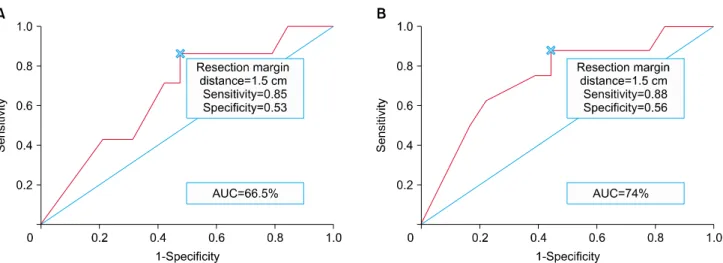
The AUC of the ROC curve for OS was 66.5% (Fig.

3A) and the AUC of the ROC curve for RFS was 74%

(Fig. 3B). The cutoff value in both ROC curves was a resection margin distance of 1.5 cm, which corre- sponded to the maximum Youden index (in the ROC curve for OS, the cutoff value of 1.5 cm had a sensi- tivity of 0.85 and a specificity of 0.53; in the ROC curve for RFS, the cutoff value of 1.5 cm had a sensi- tivity of 0.88 and a specificity of 0.56.

The relationship between the maximal diameter of

the tumor and the resection margin distance was

(4)

Fig. 3. ROC curve and cutoff analysis with the Youden index for determination of the optimal resection margin distance. (A) ROC curve and cutoff analysis for overall survival. (B) ROC curve and cutoff analysis for recurrence-free survival. ROC, receiver operating character- istic; AUC, area under the curve.

Table 2. Clinical, histological, and surgical characteristics by recurrence

Variable No recurrence (n=23) Recurred (n=18) p-value

Age (yr) 37.20±3.75 57.33±3.52 <0.001

Male sex 15 (65) 8 (44) 0.219

Tumor histology 0.067

Soft tissue sarcoma 12 (52) 6 (33)

Bone-originating sarcoma 10 (44) 6 (33)

Undifferentiated pleomorphic sarcoma 1 (4) 6 (33)

Histologic grade (FNCLCC) 0.002

Grade I 7 (30) 1 (5)

Grade II 10 (43) 5 (27)

Grade III 1 (4) 8 (44)

Resection margin distance (cm) 0.011

≥1.5 10 (44) 1 (6)

<1.5 13 (56) 17 (94)

Resection margin classification 0.136

R0 resection 18 (86) 10 (63)

R1 resection 3 (14) 6 (37)

Previous cancer history 4 (17) 8 (44) 0.087

Neoadjuvant or adjuvant therapy 11 (48) 9 (50) 1.000

Values are presented as mean±standard deviation or number (%).

FNCLCC, Fédération Nationale des Centres de Lutte Contre le Cancer.

studied using Pearson correlation coefficients owing to a tendency for the resection margin distance to be shorter in patients with large tumors in clinical practice. The Pearson correlation coefficient was − 0.371 (p=0.107).

Table 2 compares the baseline characteristics of the patients without recurrence (group 1, n=23) and those showing recurrence (group 2, n=18). The pa-

tients in group 2 were older and had higher rates of histologic grade III tumors and undifferentiated pleo- morphic sarcomas. More patients in group 2 than those in group 1 had a resection margin distance

<1.5 cm and R1 resection. However, the proportion of patients receiving adjuvant or neoadjuvant treat- ment did not significantly differ between the groups.

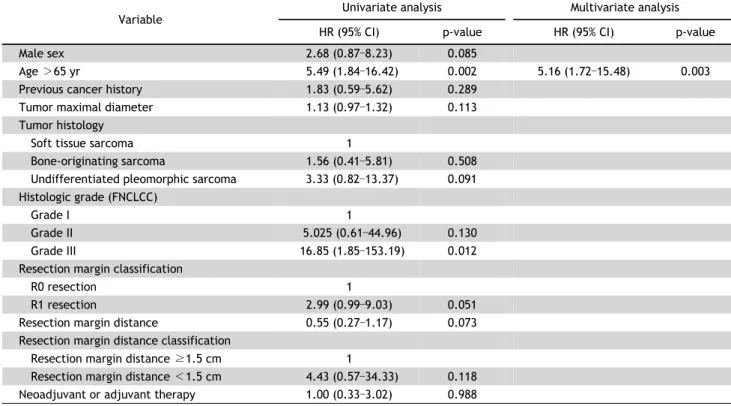
In the univariate analysis for OS (Table 3), male

(5)

Table 3. Univariate and multivariate analysis of overall survival

Variable Univariate analysis Multivariate analysis

HR (95% CI) p-value HR (95% CI) p-value

Male sex 2.68 (0.87–8.23) 0.085

Age >65 yr 5.49 (1.84–16.42) 0.002 5.16 (1.72–15.48) 0.003

Previous cancer history 1.83 (0.59–5.62) 0.289

Tumor maximal diameter 1.13 (0.97–1.32) 0.113

Tumor histology

Soft tissue sarcoma 1

Bone-originating sarcoma 1.56 (0.41–5.81) 0.508

Undifferentiated pleomorphic sarcoma 3.33 (0.82–13.37) 0.091 Histologic grade (FNCLCC)

Grade I 1

Grade II 5.025 (0.61–44.96) 0.130

Grade III 16.85 (1.85–153.19) 0.012

Resection margin classification

R0 resection 1

R1 resection 2.99 (0.99–9.03) 0.051

Resection margin distance 0.55 (0.27–1.17) 0.073

Resection margin distance classification

Resection margin distance ≥1.5 cm 1

Resection margin distance <1.5 cm 4.43 (0.57–34.33) 0.118 Neoadjuvant or adjuvant therapy 1.00 (0.33–3.02) 0.988

HR, hazard ratio; CI, confidence interval; FNCLCC, Fédération Nationale des Centres de Lutte Contre le Cancer.

sex, old age, tumor histology with undifferentiated pleomorphic sarcoma, histologic grade III, R1 re- section, and resection margin distance had p-values

<0.1 and were included in the multivariate analysis.

In the multivariate analysis (Table 3), old age was the only independent risk factor for death.

In the univariate analysis for RFS (Table 4), old age, previous history of cancer, maximal diameter of the tumor, tumor histology with undifferentiated pleomorphic sarcoma, histologic grade III, resection margin distance, and a resection margin distance

<1.5 cm had p-values <0.1. In the multivariate anal- ysis (Table 4), histologic grade III and a resection margin distance <1.5 cm were risk factors for recurrence.

Fig. 4 shows the RFS curve of patients according to the resection margin distance. The 10-year RFS of patients with a resection margin distance ≥1.5 cm was 90.9%, while that of patients with a resection margin distance <1.5 cm was 43.6%. In the log-rank test, the RFS rates differed significantly among the 3 groups (p=0.01).

Table 5 shows the recurrence patterns of both

groups. Only 1 patient with a resection margin dis- tance ≥1.5 cm experienced recurrence (local re- currence at the excision site). In contrast, 17 patients (58.6%) with a resection margin distance <1.5 cm experienced recurrence, of whom 11 (37.9%) showed local recurrence at the resection site, while 6 (20.6%) experienced distant metastasis in the lungs, bones, and lymph nodes. The median time of re- currence was 3.67 years after surgery in patients with a resection margin distance <1.5 cm.

Discussion

The aim of this study was to determine long-term OS and RFS and to identify risk factors for death and recurrence. The 5- and 10-year OS rates were 73%

and 61%, respectively, and the 10-year RFS rate was 57.1%; these rates are better than those in previous studies [1-6,8,9].

Prior to the risk factor analysis, we performed an

analysis of the ROC curve and the cutoff for the opti-

mal resection margin distance. The AUC of the ROC

curve for OS was 0.66, and the AUC of the ROC

(6)

Table 4. Univariate and multivariate analysis of recurrence-free survival

Variable Univariate analysis Multivariate analysis

HR (95% CI) p-value HR (95% CI) p-value

Male sex 0.48 (0.18–1.23) 0.121

Age >65 yr 4.44 (1.61–12.21) 0.002

Previous cancer history 2.55 (1.05–6.48) 0.041

Tumor maximal diameter 1.15 (1.00–1.32) 0.040

Tumor histology

Soft tissue sarcoma 1

Bone-originating sarcoma 1.08 (0.41–2.83) 0.868

Undifferentiated pleomorphic sarcoma 3.75 (1.25–11.22) 0.018 Histologic grade (FNCLCC)

Grade I 1 1

Grade II 3.13 (0.36–27.03) 0.298 2.48 (0.28–21.75) 0.410

Grade III 18.02 (2.16–149.92) 0.007 28.36 (2.76–290.87) 0.005

Resection margin classification

R0 resection 1

R1 resection 1.99 (0.71–5.61) 0.181

Resection margin distance 0.47 (0.22–0.98) 0.022

Resection margin distance classification

Resection margin distance ≥1.5 cm 1 1

Resection margin distance <1.5 cm 8.85 (1.17–66.77) 0.011 15.759 (1.78–139.46) 0.013 Neoadjuvant or adjuvant therapy 1.42 (0.56–3.61) 0.452

HR, hazard ratio; CI, confidence interval; FNCLCC, Fédération Nationale des Centres de Lutte Contre le Cancer.

Table 5. Recurrence pattern of all patients with known re- section margin distance (N=40)

Variable

Resection margin distance p-value

≥1.5 cm (n=11)

<1.5 cm (n=29)

No recurrence 10 (90.9) 13 (44.8) 0.011 Total recurrence 1 (9.1) 17 (58.6)

Local recurrence 1 (9.1) 11 (37.9)

Distant metastasis 0 6 (20.6)

Lung 0 3 (10.3)

Bone 0 2 (6.8)

Lymph node 0 1 (3.4)

Time to recurrence (yr) 1.33 3.67 (0.16–11.18) Values are presented as number (%) or median (range).

Fig. 4. Recurrence-free survival time according to resection mar- gin distance.

curve for RFS was 0.74. The cutoff value with the maximum Youden index was 1.5 cm. In many re- views, a wide surgical resection margin has been considered a prognostic factor for long-term survival [6,8]. Authors have described specific methods of achieving a wide resection margin for primary chest wall sarcoma [1-8]. Although the optimal resection

margin for good long-term survival was 4 cm accord- ing to the previous results of a study by King et al.

[6], we identified a 1.5-cm resection margin distance

to be the cutoff point for an optimal resection mar-

gin in this study. There might be 2 reasons for this

difference. First, our data about the distance between

the resection margin and the tumor were based on

(7)

pathologic data, not surgical records, because some data about resection margin distance were missing or incorrect in the surgical records. The resection margin distance in the pathologic review can be more accurate than that in surgical records. The sec- ond issue relates to sample size. The number of all patients with primary chest wall sarcoma and the number of patients with a resection margin distance

>4 cm (n=3) might have been too small for de- termining the optimal resection margin distance.

However, some previous reviews [1,2,6] also used a 2-cm resection margin as an indicator of better survival.

We studied the relationship between the maximal diameter of the tumor and the resection margin dis- tance, because in clinical practice, there might be a tendency for a shorter resection margin distance, es- pecially in patients with large tumors, because of proximity to vital structures. Using the Pearson cor- relation test (r=−0.371, p=0.107), we failed to prove a correlation between the maximal diameter of the tumor and the resection margin distance. However, in our data, all patients with a maximal diameter of the tumor more than 7.5 cm had a resection margin distance less than 1 cm. Although we were unable to prove the correlation due to the small number of pa- tients, there might be an inverse relationship be- tween the maximal diameter of the tumor and the resection margin distance, especially in larger tumors.

In risk factor analysis, old age was the only in- dependent risk factor for overall death. High histo- logic grade and resection margin distance less than 1.5 cm were 2 independent risk factors for re- currence, which is consistent with the results of pre- vious reviews [2,4,5,9].

An adequate resection margin distance is a well-known prognostic factor for recurrence after chest wall sarcoma resection [6]. Many centers have reported variable descriptions of wide resection of chest wall sarcoma, accompanied by variation in OS.

King et al. [6], who published the first report on the importance of a wide surgical resection margin for primary chest wall sarcoma, defined wide resection as a margin of 4 cm with several partial ribs above and below for rib tumors and entire bone resection for sternal or manubrial cancers [6]. However, they concluded that a 2-cm margin would be safe for low-grade sarcomas, such as chondrosarcoma. Walsh

et al. [2] and Athanassiadi et al. [8] reported similar descriptions of wide resection; however, Athanassiadi et al. [8] reported different methods for sternal tu- mors depending on the location of the sarcoma.

Perry et al. [4] and Jonsson et al. [7] described at least 1 uninvolved rib and intercostal space above and below the surgical resection of a primary chest wall sarcoma, and Wouters et al. [1] described a 1- to 2-cm margin of normal tissue as their principle of surgical resection for primary chest wall sarcoma.

In the present study, we analyzed long-term RFS according to the surgical resection margin distance based on pathology reports, not surgical records.

Many surgical records in our study with a planned resection margin distance of 4 cm revealed an in- adequate resection margin distance (<1.5 cm) in the gross pathological reports after surgery. This differ- ence may imply that the resection margin distance measured by the surgeon during the operation might be incorrect or inadequate because the resection margin distance may have been considered in only 1 of the 4 directions from the tumor. Because a suffi- cient resection margin distance is important for fa- vorable surgical outcomes, we suggest that the re- section margin distance be measured in all directions to ensure an adequate margin.

Surgeons may achieve insufficient resection mar- gins during chest wall sarcoma resection owing to in- sufficient adherence to surgical principles, low-grade chest wall sarcomas, or a tumor location near vital structures. If it is impossible to ensure a sufficient resection margin due to a tumor location near vital structures, a 1.5-cm resection margin distance could be justified considering our findings. Fig. 3 shows a 90.9% 10-year RFS of patients with a resection mar- gin distance ≥1.5 cm if the resection margin dis- tance is evaluated correctly. However, if possible, ev- ery effort should be made to ensure a resection mar- gin distance of 4 cm to ensure a good long-term dis- ease-free survival rate based on previous reviews [2,5,6,8].

This study has some limitations. First, this was a

retrospective case-control study. For ethical reasons,

however, it is impossible to conduct a randomized

controlled study of differences in the surgical re-

section margin. Second, values were missing for

some variables. Nine patients (21.1%) had no data

on the histologic grade. This may have limited the

(8)

interpretation of risk factor analysis because histo- logic grade was an independent risk factor for RFS.

However, most of the data, including survival and re- section margin, were completely collected for most patients.

In conclusion, the long-term OS and RFS after the surgical resection of primary chest wall sarcoma were clinically acceptable. Old age was the only in- dependent risk factor for death, while a resection margin distance <1.5 cm and histologic grade III were prognostic factors for recurrence. Surgeons should aim to achieve an adequate resection margin distance to ensure favorable long-term RFS.

Conflict of interest

No potential conflict of interest relevant to this ar- ticle was reported.

Acknowledgments

This study was supported by a Grant of the Samsung Vein Clinic Network (Daejeon, Anyang, Cheongju, Cheonan; Fund no. KTCS04-127).

ORCID

Ilkun Park: https://orcid.org/0000-0001-6005-640X Sumin Shin: https://orcid.org/0000-0002-8986-6622 Hong Kwan Kim: https://orcid.org/0000-0002-7815-3336 Yong Soo Choi: https://orcid.org/0000-0001-8492-7644 Jhingook Kim: https://orcid.org/0000-0002-3828-0453 Jae Ill Zo: https://orcid.org/0000-0002-0996-1612 Young Mog Shim: https://orcid.org/0000-0001-5924-9765 Jong Ho Cho: https://orcid.org/0000-0003-3362-4621

References

1. Wouters MW, van Geel AN, Nieuwenhuis L, et al. Outcome after surgical resections of recurrent chest wall sarcomas.

J Clin Oncol 2008;26:5113-8.

2. Walsh GL, Davis BM, Swisher SG, et al. A single-institu-

tional, multidisciplinary approach to primary sarcomas in- volving the chest wall requiring full-thickness resections.

J Thorac Cardiovasc Surg 2001;121:48-60.

3. Sabanathan S, Shah R, Mearns AJ. Surgical treatment of primary malignant chest wall tumours. Eur J Cardiothorac Surg 1997;11:1011-6.

4. Perry RR, Venzon D, Roth JA, Pass HI. Survival after surgi- cal resection for high-grade chest wall sarcomas. Ann Thorac Surg 1990;49:363-8.

5. Bagheri R, Haghi SZ, Kalantari MR, et al. Primary malig- nant chest wall tumors: analysis of 40 patients. J Cardiothorac Surg 2014;9:106.

6. King RM, Pairolero PC, Trastek VF, Piehler JM, Payne WS, Bernatz PE. Primary chest wall tumors: factors affecting survival. Ann Thorac Surg 1986;41:597-601.

7. Jonsson P, Gyllstedt E, Hambraeus G, Lillogil R, Rydholm A. Chest wall sarcoma: outcome in 22 patients after re- section requiring thoracic cage reconstruction. Sarcoma 1998;2:143-7.

8. Athanassiadi K, Kalavrouziotis G, Rondogianni D, Loutsidis A, Hatzimichalis A, Bellenis I. Primary chest wall tumors:

early and long-term results of surgical treatment. Eur J Cardiothorac Surg 2001;19:589-93.

9. Gross JL, Younes RN, Haddad FJ, Deheinzelin D, Pinto CA, Costa ML. Soft-tissue sarcomas of the chest wall: prog- nostic factors. Chest 2005;127:902-8.

10. Sohn ST, Chon SH, Shinn SH, et al. Review of primary chest wall tumors. Korean J Thorac Cardiovasc Surg 1998;31:

988-94.

11. Mah JS, Choi BW, Yu HS. Primary tumors of the chest wall.

Korean J Thorac Cardiovasc Surg 1974;7:61-5.

12. Kim SM, Park SD, Jeong JH, Cho SR, Lee SH. Clinical expe- rience of chest wall tumors: a review of twenty one cases.

Korean J Thorac Cardiovasc Surg 1987;20:723-9.

13. Lee MG, Oh TY, Chang WH. Clinical evaluation of chest wall tumors: review of 33 cases. Korean J Thorac Cardiovasc Surg 1995;28:778-83.

14. Park KH, Kim KB, Sung SW, Kim JH. Surgical management of chest wall tumors. Korean J Thorac Cardiovasc Surg 1991;24:547-54.

15. Paik HC, Kang JH, Choi SS, Chung KY. Clinical review of primary chest wall tumors. Korean J Thorac Cardiovasc Surg 2003;36:175-81.

16. Kim CG, Kuh JH, Kim KS. Clinical study of primary chest wall tumors. Korean J Thorac Cardiovasc Surg 1998;31:

155-61.

수치

Fig. 1. Overall survival time of 41 patients who underwent surgi- surgi-cal resection of primary chest wall sarcoma.
Fig. 3. ROC curve and cutoff analysis with the Youden index for determination of the optimal resection margin distance
Table 3. Univariate and multivariate analysis of overall survival
Fig. 4. Recurrence-free survival time according to resection mar- mar-gin distance.

참조

관련 문서

The magnetostatic energy of the domain wall in thin films can be minimized by forming Neel wall, and thus Neel walls are observed stable in various magnetic films for thickness up

The magnetostatic energy of the domain wall in thin films can be minimized by forming Neel wall, and thus Neel walls are observed stable in various magnetic films for thickness

Background The aim of this study was to compare the surgical outcomes of robotic single-site (RSS-H) and laparoendoscopic single-site total hysterectomy (LESS-H) and to

□ The least-upper-bound property (sometimes called completeness or supremum property) is a fundamental property of the real number system. The least-upper-bound

□ The least-upper-bound property (sometimes called completeness or supremum property) is a fundamental property of the real number system. The least-upper-bound

이것은 가 위로 유계가 아니라는 문제의 가정에 모순이다... 유리수의

수렴하는

하지만 여기서는 항번호가 자연수인 경우만 증명 하였다... 그러므로