For the differential diagnosis of a patient with lymph node enlargement, the possibility of an in- fectious disease caused by viral or bacterial in- fection, lymphadenitis caused by an autoimmune disease, a neoplastic lesion such as Hodgkin’s lym- phoma and non-Hodgkin’s lymphoma, and a rheu- matoid disease such as systemic lupus eryth- ematosus and rheumatoid arthritis may be considered.1 In addition, immunoglobulin G4 re- lated disease with lymphadenopathy should be con- sidered as a possible cause of lymph node enlargement.
IgG4-related disease, which is a disease causing fibrinous inflammatory histological changes as IgG4 positive plasma cells infiltrate into various target organs,2 has been studied since indurative pancreatitis accompanying serum IgG4 increase was first reported in 2001. The prevalence of IgG4-related diseases is high in middle-aged men, but is dependent on the organs that are the target of infiltration. It is known that there is no a sig- nificant difference between men and women in the prevalence of IgG4-related salivary gland inflammation.3 In addition to the pancreas, an
Case Report
IgG4-Related Disease with lymphadenopathy Presenting as a Cervical lymph node enlargement
Yeon Seok Choi1, SungMin Kim1, Jang Sihn Sohn2, JiYong Hwang1, TaeSoo Chang1, Do Yeon Cho1
1Department of Internal Medicine, College of Medicine, Konyang University, Daejeon, Korea
2Department of Pathology, College of Medicine, Konyang University, Daejeon, Korea
During the course of evaluation and management of neck masses, consideration for Immunoglobulin G4-related disease (IgG4-RD) should be given. IgG4-RD is relatively a new growing entity of immune-mediated origin, characterized by a mass-forming lesion, the infiltration of IgG4-positive plasma cells and occasionally elevated serum IgG4. The most common manifestations are parotid and lacrimal swelling, lymphadenopathy and autoimmune pancreatitis.
A previously healthy 72-year-old man was referred to our clinic with a 2-month history of left cervical lymph node enlargement without systemic manifestations . A cervical lymph node biopsy was planned because of elevated serum IgG4 levels. Pathological findings showed prominent infiltration of IgG4-postive plasma cells in the lymph node. After steroid therapy, a computed tomography scan revealed a decrease in the cervical lymph node size.
This case illustrates the importance of including IgG4-RD in the differential diagnosis of a cervical lymph node enlargement.
Key Words: Immunoglobulin G4, Lymphadeopathy
Corresponding Author: Do Yeon Cho, Department of Internal Medicine, Konyang University College of Medicine, 158 Gwanjeodong-ro, Seo-gu, Daejeon 35365, Korea
Tel: +82-10-9405-3076 Fax: +82-42-600-9435 E-mail: [email protected]
Received:
Revised:
Accepted:
Sep. 10, 2015 Sep. 21, 2015 Jan. 11, 2016
IgG4-related disease may be found in kidneys, sali- vary glands, lymph nodes, and retroperitoneum, and IgG4-related disease infiltration is reported to have been found in multiple organs in 60 to 90% of the diagnosed patients.4
An IgG4-related disease with lymphadenopathy generally accompanies infiltration into organs such as pancreas, kidneys, and salivary glands. Of the 114 cases of IgG4-related disease patients in which there was infiltration of multiple organs, 41 of the patients also had lymphadenopathy.5 However, IgG4-related disease with lymphadenopathy found in some patients showed one only symptom or sign of lymphadenopathy without an accompanied or- gan infiltration.6 Thus, for the diagnosis of a patient with the chief complaint of lymphadenopathy and no other specific symptoms, the possibility of IgG4-related disease with lymphadenopathy may need to be considered in addition to the possibility of an infectious disease by viral or bacterial in- fection, lymphadenitis by an autoimmune disease, or a neoplastic lesion such as Hodgkin’s lymphoma and non-Hodgkin’s lymphoma. We herein report a case in which a lymph node enlargement patient was diagnosed with IgG4-related disease with lymphadenopathy.
CASE
Patient: 72-year-old man
Chief complaint: Complained of left lymph node enlargement since two months before the visit
History: Hypertension, chronic obstructive lung disease
Present disease history: The patient stated that there had been a lymph node enlargement at the left cervical part since two months before the visit to our institution. The patient did not have a history of being bitten by an animal, consuming uncooked food, or any special travel. The patient did not complain of any particular symptoms such as fever by which tuberculosis or a neoplastic disease is suspected, or any weight change, fatigue, and night sweat.
Family history and social history: None of the patient’s family members were affected by an in- fectious disease within last three months. None of the patient’s direct family members had a history of a neoplastic disease. The patient was a non-smoker and was not taking any medicine.
Physical examination: The vital signs were blood pressure 116/70 mmHg, heart rate 98 /min, body temperature 36.5 ℃, and respiration rate 12 /min, which were all normal. The patient’s consciousness was normal, but the patient had the complexion of a chronic illness. A lump of about 2 ㎝ was pal- pated at the left cervical lymph node, which was relatively hard and moving. There was no op- pressive pain during the palpation. No lymph node was palpated in other parts of the body other than the cervical lymph node. The abdominal physical examination did not show any enlargement of liver or spleen. The chest examination did not show any abnormalities in the breath sound and heart sound.
Laboratory findings: The peripheral blood test results were leukocyte level 4,800 /㎣ (normal, 4,000 to 10,800 /㎣), segmented neutrophil 55.8%, lym- phocyte 24.4%, eosinocyte 10.1%, hemoglobin 9.7 g/dL (normal, 13 to 17 g/dL), platelet 84,000 /㎣
(normal, 130,000 to 400,000 /㎣), erythrocyte sed- imentation rate 46 ㎜/hr (normal, 0 to 9 ㎜/hr), and C-reactive protein < 0.1 mg/dl (normal, < 0.5 mg/dl).
The general chemistry test results were Na 129 mEql/L (normal, 137 to 145 mEql/L), K 4.36 mEql/L (normal, 3.7 to 5.0 mEql/L), Cl 104.5 mEql/L (normal, 99 to 109 mEql/L), total protein 10.47 g/dL (normal, 6.5 to 8.0 g/dL), albumin 2.13 g/dL (normal, 3.8 to 5.2 g/dL), AST 25 IU/L (normal, 10 to 36 IU/L), ALT 5 IU/L (normal, 7 to 38 IU/L), total bilir- ubin 0.44 mg/dL (normal, 0.2 to 1.3 mg/dL), blood urea nitrogen 18.5 md/dl (normal, 8 to 20 md/dl), creatinine 1.52 mg/dl (normal, 0.51 – 1.17 md/dl), LDH 213 IU/L (normal, 200 – 450 IU/L), CPK 21 U/L (normal, 0 to 170 U/L), and uric acid 5.59 mg/dl (normal, 2.6 – 7.2 mg/dl).
Special blood test findings: The autoimmune an- tibody test showed a positive antinuclear antibody reaction ( > 1:320), a negative anti-double stranded deoxyribonucleic acid antibody reaction ( < 1:5), a negative anti-myeloperoxidase antibody reaction (7.4), a negative anti-proteinase3 antibody reaction (53.8), and a negative anti-GBM antibody reaction ( < 0.2). Other findings were serum C3 27 mg/dl (normal, 90 – 180 mg/dl), C4 12 mg/dl (normal, 10 to 40 mg/dl), IgG level 4310 mg/dl (normal, 700 to 1600 mg/dl), and serum IgG4 level 340 mg/dl
or higher (normal, 3.92 to 86.40 mg/dl).
The protein electrophoresis test performed with the serum and the urine showed polyclonal gamm- opathy with B2-microglobulin level of 17.6 mg/L (normal, 0.7 to 1.8 mg/L).
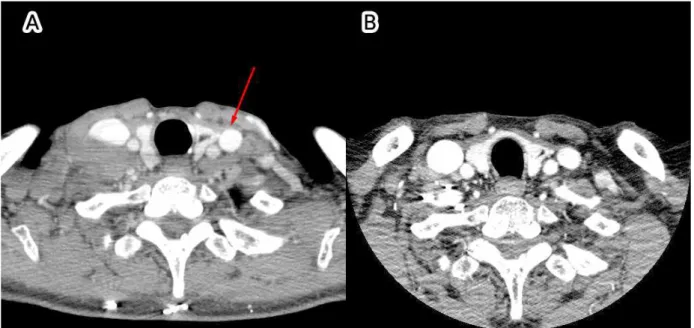
Imaging test findings: The cervical CT showed that multiple bilateral lymph node enlargements (1 to 2 ㎝) were found at both cervical lymph nodes (level I - V) (Fig. 1A). The chest CT showed multiple enlargements of bilateral supraclavicular lymph nodes, bilateral axillary lymph nodes, and media- stinal lymph nodes. The abdominal CT showed mul- tiple enlargements of bilateral inguinal lymph no- des and bilateral iliac lymph nodes. Enlargement of the liver and the spleen was not verified.
Biopsy: An incision biopsy was performed at the left cervical lymph node (1.3 ㎝). The biopsy showed lymphoplasmacytic infiltration. The IgG4 im- munohistochemistry showed an IgG4 positive plas- ma cell level of 100 / High-power field (HPF) or higher (Fig. 2, Fig. 3).
Treatment and catamnesis: The patient was ad- ministered with prednisolone 25 mg/day for one week after being diagnosed with an IgG4-related disease. Then, the patient was administered with prednisolone 20 mg/day for the following eight weeks, prednisolone 15 mg/day for the following eight weeks, and prednisolone 10 mg/day for the following eight weeks, as the steroid dosage was gradually reduced. The chest CT performed after the administration showed no change in the lymph node enlargement. The prednisolone admin- istration was increased again to 20 mg/day for five
weeks, and then the chest and cervical CT were performed to evaluate the reaction (Fig. 1B). In comparison with the previous CT result, a sig- nificant size reduction of the lymph node enlarge- ment was found. Prednisolone 10 mg/day is con- tinuously administered at present, and the patient does not show any particular side effect during the treatment.
DISCUSSION
IgG4-related disease, which is a disease caused by the infiltration of IgG4 positive plasma cells into various target organs, is characterized by the Fig. 2. Histological findings in Lt. cervical LN biopsy
specimen, H&E staining X200
Fig. 1A. Initial neck CT(Computed Tomography) showed multiple cervical lymph node enlargement,
Fig. 1B. Post-steroid treatment image (The size of the cervical lymph node decreased after 8 month steroid trial)
Fig. 3. Histological findings in Lt. cervical LN biopsy specimen, Interfollicular and perisinusoidal infiltration of small and large lymphocytes, admixed atrophic and hyperplastic germinal centers, large numbers of plasma cells showing IgG4 immunoreactivities (>100/HPF), Immunohistochemicalstaining X 200
infiltration into multiple organs including the pan- creas, the kidneys, and the salivary glands.2 The basic requirements of the diagnosis of an IgG4-related disease are the serum IgG4 level test and the biopsy of affected organs, and radiological tests may also be performed depending on the af- fected organs.2 As the name implies, many of the IgG4-related disease patients show an increase in their serum IgG4 level. According to a report, 86%
of 114 IgG4-related disease patients showed a se- rum IgG4 level higher than 135 mg/dl, the normal upper limit.5 Another study showed that the IgG4 level was increased as the number of affected organs was increased.7 However, even when the serum IgG4 level is within the normal range, an IgG4-related disease may be diagnosed with refer- ence to the ratio of IgG4 plasma cell/HPF. The IgG4 plasma cell/HPF ratio, which enables an IgG4-related disease to be diagnosed on the basis of the biopsy result, is dependent on the affected organs.3 Since the IgG4 plasma cell/HPF ratio, which enables the diagnoses of an IgG4-related disease, is dependent on the affected organs, some researchers employ the ratio of IgG4 plasma cell/IgG plasma cell as the reference for the diagnosis. If the ratio of IgG4 plasma cell/IgG plas- ma cell is higher than 40% in all the organs, an IgG4-related disease may be diagnosed.8
In the present case, an autoimmune antibody test and a serum complement test were performed to differentiate systemic lupus erythematosus and Sjogren syndrome, which may also accompany lymph node enlargement. The results were a pos-
itive antinuclear antibody reaction ( > 1:320) and a positive Anti-myeloperoxidase antibody re- action, serum C3 27 mg/dl, and C4 12 mg/dl.
However, the patient had neither the systemic symptoms that may accompany systemic lupus er- ythematosus such as rash, arthralgia, and canker, nor the symptoms of Sjogren syndrome such as ophthalmoxerosis and xerostomia. Therefore, for the differential diagnosis of a neoplastic lesion such as Hodgkin’s lymphoma and non-Hodgkin’s lym- phoma or an infectious disease by Epstein-Barr virus, a biopsy was performed at the left cervical lymph node. The biopsy results were IgG4 positive plasma cell level of 100 /HPF or higher and IgG4 plasma cell/IgG plasma cell ratio of 60% or higher, and thus an IgG4-related disease with lymphaden- opathy was diagnosed.
Since IgG4 is unable to fix a complement in a typical pathway to precipitate an antibody in con- trast to IgG1 and IgE,9 studies are still conducted on the correlation between the actual contribution of IgG4 to the pathogenesis of an IgG4-related dis- ease and the autoimmune antibodies such as anti- nuclear antibody and antineutrophil cytoplasmic antibody. A decrease of C3 and C4 has been reported in about 56 to 78% of the IgG4-related disease patients, as in the present case.9
The treatment of an IgG4-related disease is based on steroids. The initial treatment dosage is generally prednisolone 0.6 to 1.0 mg/kg/day.10 The reaction to the treatment is evaluated by referring to the improvement of patient’s symptoms, size change or functional improvement of the organs into which
IgG4 plasma cells are infiltrated, and the decrease of serum IgG4 level. Some patients show improve- ments in just a few weeks, but others show no re- action to the treatment.2 For patients showing no reaction to steroids, the fibrosis may be irreversible.
For patients having no reaction to steroids or the patients to whom a steroid cannot be administered, the use of an immunosuppressant such as rituximab as a secondary drug may be considered.11
Currently, the prognosis of IgG4-related disease has not been clearly identified. Some patients are completely healed without any special treatment, but it has been reported that relapse is common in many patients, as the disease turns into a type of chronic disease. If not treated after diagnosis, the IgG4-related disease may be accompanied by systemic symptoms such as aortic aneurysm and dissection and biliary obstruction, significantly in- creasing the mortality.12
In the case of a patient with lymph node enlarge- ment, as in the present case, the possibility of an infectious disease by viral or bacterial infection, an autoimmune disease, and a neoplastic lesion may be generally considered,1 but IgG4-related dis- ease with lymphadenopathy may also cause lymph node enlargement. IgG4-related disease with lym- phadenopathy often causes lymphadenopathy at the lymph glands close to a target organ. When this occurs to the lymph nodes of the head and neck, Mikulicz’s disease and Riedel's thyroiditis are commonly accompanied.13 However, since IgG4-related disease with lymphadenopathy may cause lymph node enlargement without affecting
an organ in some patients,6 consideration of IgG4-related disease with lymphadenopathy is nec- essary to diagnose a patient having the isolated symptom of lymph node enlargement without da- cryoadenitis or thyroiditis. Currently, the general treatment of an IgG4-related disease is based on steroids. If there is no reaction to the steroid-based treatment, the use of an immunosuppressant such as rituximab is considered as a secondary drug.11 In the present case, prednisolone was administered for six months by gradually decreasing the dosage, but no particular change was found in the reaction evaluation. At this point, the dosage of prednisolone was increased again, and a decrease in the lymph node enlargement was verified in the reaction evaluation. This indicates that an increased dosage of steroid may be attempted even though no change is found in the reaction evaluation following an initial steroid-based treatment. Further studies should be conducted to address this issue.
The present case report is about a patient who visited our institution with the chief complaint of cervical lymph node enlargement and was diag- nosed with IgG4-related disease with lymphaden- opathy (Type I–Multicentric Castleman dis- ease-like) through a histological examination. We report the case herein because the cervical CT showed a significant decrease in the lymph node enlargement after a continued steroid-based treatment.
REFERENCES
1. Habermann TM, Steensma DP. Lymphadenopathy.
Mayo Clin Proc 2000;75:723-32.
2. Kamisawa T, Zen Y, Pillai S, Stone JH. IgG4-related disease. Lancet 2015;385:1460-71.
3. Khosroshahi A, Stone JH. Treatment approaches to IgG4-related systemic disease. Curr Opin Rheumatol 2011;23:67-71.
4. Nizar AH, Toubi E. IgG4-related disease: case report and literature review. Auto Immun Highlights 2015;6:7–15.
5. Zen Y, Nakanuma Y. IgG4-related disease: a cross-sectional study of 114 cases. Am J Surg Pathol 2010;34:1812–9.
6. Umehara H, Okazaki K, Masaki Y, Kawano M, Yamamoto M, Saeki T, et al. A novel clinical entity, IgG4-related disease (IgG4RD): general concept and details. Mod Rheumatol 2012;22:1-14.
7. Stone JH, Zen Y, Deshpande V. IgG4-related disease. N Engl J Med 2012;366:539-51.
8. Ghably JG, Borthwick T, O’Neil TJ, Youngberg GA, Datta AA, Krishnaswamy G. IgG4-related disease: a primer on diagnosis and management.
Ann Allergy Asthma Immunol 2015;114:447-54.
9. Cornell LD. IgG4-related kidney disease. Semin Diagn Pathol 2012;29:245-50.
10. Shimosegawa T, Chari ST, Frulloni L, Kamisawa T, Kawa S, Mino-kenudson M, et al. International consensus diagnostic criteria for autoimmune pan- creatitis: guidelines of the International Association of Pancreatology. Pancreas 2011;40:352–8.
11. Khosroshahi A, Bloch DB, Deshpande V, Stone JH. Rituximab therapy leads to rapid decline of serum IgG4 levels and prompt clinical im- provement in IgG4-related systemic disease.
Arthritis Rheum 2010;62:1755–62.
12. Cheuk W, Chan JK. Lymphadenopathy of IgG4-related disease: an underdiagnosed and overdiagnosed entity. Semin Diagn Pathol 2012;29:226–34.
13. Kamisawa T, Nakajima H, Egawa N, Funata N, Tsuruta K, Okamoto A. IgG4-related sclerosing disease incorporating sclerosing pancreatitis, cholangitis, sialadenitis and retroperitoneal fib- rosis with lymphadenopathy. Pancreatology 2006;6:132–7.