ISSN: 2233-601X (Print) ISSN: 2093-6516 (Online)
Received: June 27, 2017, Revised: September 1, 2017, Accepted: September 1, 2017, Published online: February 5, 2018
Corresponding author: In Kyu Park, Department of Thoracic and Cardiovascular Surgery, Seoul National University Hospital, 101 Daehak-ro, Jongno-gu, Seoul 03080, Korea
(Tel) 82-2-2072-2342 (Fax) 82-2-764-3664 (E-mail) [email protected]
© The Korean Society for Thoracic and Cardiovascular Surgery. 2018. All right reserved.
This is an open access article distributed under the terms of the Creative Commons Attribution Non-Commercial License (http://creativecommons.org/
licenses/by-nc/4.0) which permits unrestricted non-commercial use, distribution, and reproduction in any medium, provided the original work is properly cited.
Outcomes of the Multimodal Treatment of Malignant Pleural Mesiothelioma: The Role of Surgery
Bub-Se Na, M.D., Ji Seong Kim, M.D., Kwanyong Hyun, M.D., In Kyu Park, M.D., Chang Hyun Kang, M.D., Young Tae Kim, M.D.
Department of Thoracic and Cardiovascular Surgery, Seoul National University Hospital, Seoul National University College of Medicine
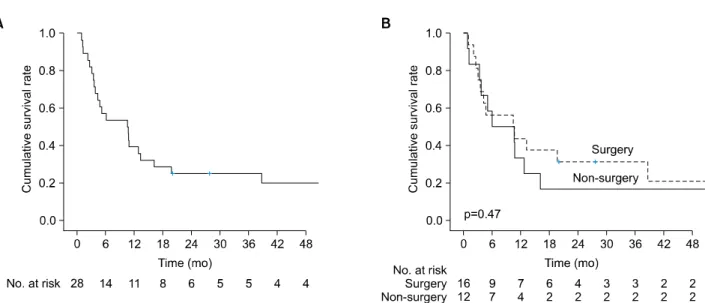
Background: The treatment of malignant pleural mesothelioma (MPM) is challenging, and multimodal treat- ment including surgery is recommended; however, the role of surgery is debated. The treatment outcomes of MPM in Korea have not been reported. We analyzed the outcomes of MPM in the context of multimodal treatment, including surgery. Methods: The records of 29 patients with pathologically proven MPM from April 1998 to July 2015 were retrospectively reviewed. The treatment outcomes of the surgery and non-surgery groups were compared. Results: The overall median survival time was 10.6 months, and the overall 3-year survival rate was 25%. No postoperative 30-day or in-hospital mortality occurred in the surgery group.
Postoperative complications included tachyarrhythmia (n=4), pulmonary thromboembolism (n=1), pneumonia (n=1), chylothorax (n=1), and wound complications (n=3). The treatment outcomes between the surgery and non-surgery groups were not significantly different (3-year survival rate: 31.3% vs. 16.7%, respectively;
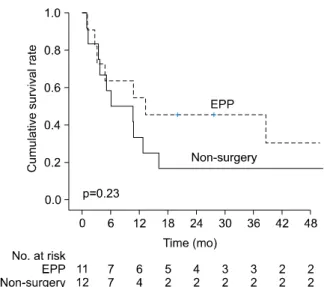
p=0.47). In a subgroup analysis, there was no significant difference in the treatment outcomes between the extrapleural pneumonectomy group and the non-surgery group (3-year survival rate: 45.5% vs. 16.7%, re- spectively; p=0.23). Conclusion: Multimodal treatment incorporating surgery did not show better outcomes than non-surgical treatment. A nationwide multicenter data registry and prospective randomized controlled studies are necessary to optimize the treatment of MPM.
Key words: 1. Mesothelioma 2. Surgery 3. Prognosis
Introduction
Malignant pleural mesothelioma (MPM) is a rare and aggressive malignancy. The crude incidence rate and crude prevalence rate in Korea were 0.3 per 100,000 and 0.5 per 100,000, respectively, in 2014 [1]. The incidence of MPM, however, is expected to increase until 2024, and the management of MPM is a concerning issue. MPM is challenging to treat and
should be managed by a multidisciplinary approach
[2]. The reported median survival time (MST) is less
than 2 years with multimodal treatment, which con-
sists of surgery, chemotherapy, and radiotherapy. The
aim of surgery in the treatment of MPM is to achieve
maximal cytoreduction through the macroscopic com-
plete resection of the tumor. Adjuvant chemotherapy
and radiotherapy are required to control the residual
microscopic disease. Several studies have showed
https://doi.org/10.5090/kjtcs.2018.51.1.35
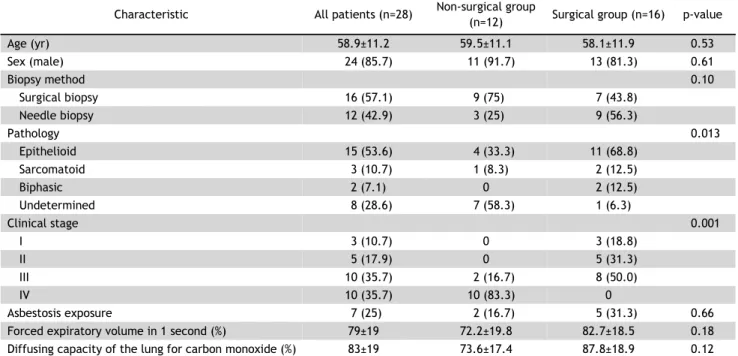
Table 1. Characteristics of the patients