서 론
1. 연구의 필요성
폐경은 여성에게 흔히 체중 및 체지방을 증가시킨다. 특히
복부로의 지방 재분포를 유발하여 여성의 심혈관 질환의 위 험을 증가시키는데 기여하는 것으로 알려져 있다. 전 세계적 으로 여성 사망원인 1위 질환은 심혈관계 질환으로 보고되고 있으며, 최근 우리나라에서도 여성의 심혈관계 질환으로 인한 사망률이 증가하고 있다. 특히 심혈관질환의 위험요소인 복부 비만 및 고밀도지단백(HDL) 콜레스테롤 이상, 총 콜레스테 롤 이상이 45세 이후 중년 여성에서 같은 연령의 남성에 비해 급격히 증가하는 것으로 보고되고 있어(Ministry of Health and Welfare and Korea Institute for Health and Social Affairs, 2005), 폐경기 이후 이러한 심혈관질환의 위험요소 를 어떻게 잘 관리하는가가 여성 건강에 큰 영향을 미칠 것으 로 생각되고 있다(Hyung & Kim, 2008). 전통적으로 여성은
63
Purpose: The purpose of this study is to assess the effects of raloxifene in prevention of cardiovascular disease in post- menopausal women. Methods: A systematic literature review was conducted. Data sources: The existing literature from 1986 to 2009 was searched electronically using the data base of Medline with the key words of hypertension, obesity, diabetes, cholesterol, lipid, myocardial infarction, coronary events with combination of raloxifene. Study selection: The criteria for inclusion in the review were 1) an randomized clinical trial (RCT), 2) postmenopausal women, 3) English or Korean language. Finally, 15 articles were included in the review. Data extraction: Findings from the studies were orga- nized according to the results of lipid profile changes by two authors. Results: Among 15 articles, 12 studies reported the beneficial effects of raloxifene on LDL cholesterol and 9 studies on total cholesterol in the postmenopausal women.
Conclusion: The consistent results on reduction of LDL cholesterol and total cholesterol in raloxifene using postmeno- pausal women were confirmed. However, the effect of raloxifene on other components of lipid profile and endothelial function were still remaining controversial.
Key Words : Raloxifene; Postmenopause; Women; Lipids 국문주요어:랄록시펜, 폐경기, 여성, 지질
Raloxifene and Lipid Profiles in Postmenopausal Women: A Systematic Review
Ji Soo Yoo
1, Ji hyoun An
2, DooRee Kim
2, Sang Hui Chu
31Professor, Department of Clinical Nursing Science, College of Nursing Researcher, Nursing Policy Research Institute,
Biobehavioral Research Center, Yonsei University; 2Teaching Assistant, Department of Clinical Nursing Science, College of Nursing, Yonsei University; 3Assistant Professor, Department of Clinical Nursing Science, College of Nursing Researcher, Nursing Policy Research Institute, Biobehavioral Research Center, Yonsei University, Seoul, Korea
폐경기 여성의 랄록시펜과 혈중 지질에 관한 체계적 문헌고찰
유지수1∙안지현2∙김두리2∙추상희3
1연세대학교 간호대학 임상간호과학과 교수∙간호정책연구소 연구원, 생행동연구센터; 2연세대학교 간호대학 임상간호과학과 조교;
3연세대학교 간호대학 임상간호과학과 조교수∙간호정책연구소 연구원, 생행동연구센터
Corresponding author :
Sang Hui Chu, Assistant Professor, Yonsei University College of Nursing, Nursing Policy and Research Institute, Biobehavioral Research Center, 250 Seongsan-ro, Seodaemun-gu, Seoul 120-752, Korea
Tel: 82-2-392-5440 Fax: 82-2-2228-3257 E-mail: [email protected]
*본 논문은 2006년 정부(교육인적자원부)의 재원으로 한국학술진흥재단의 지 원을 받아 수행된 연구임(KRF-2006-331-E00384).
투고일 : 2010년 3월 3일 심사의뢰일 : 2010년 3월 5일 게재확정일 : 2010년 4월 6일
여성호르몬인 에스트로젠 덕분에 심혈관질환에 있어서 남성 보다 유리한 것으로 알려져 왔다. 여성에서 주요한 에스트로 젠인 17b-estradiol (E2)의 이러한 심혈관 보호 작용은 다양 한 조직과 경로에서 에스트로젠 수용체(ER)를 조절함으로써 나타난다. 즉 혈관에서 강력하게 혈관확장 작용을 할 뿐만 아 니라 혈관 손상 후 평활근 세포 증식을 억제하고, 혈관내피 세포의 회복을 촉진한다. 심근세포에서는 비대 및 전기 생리 적인 활동을 조절하고, 허혈성 심장질환과 관계 있는 지질, 염증, 혈액 응고 상태를 수용체를 통하여 조절한다(Retitz- Zagroske, Wintermantel, & Schubert, 2007). 그러나 폐경 기 이후에는 여성도 에스트로젠 부족으로 이러한 심혈관 보 호 효과가 사라져 남성과 동등한 위험을 가지게 된다.
인간의 지방세포가 여성 호르몬인 에스트로젠 수용체를 발 현하고 있다는 것이 밝혀지고, 에스트로젠 호르몬 보충 요법 을 받은 폐경기 여성에서 복강 내 지방이 감소하고, 폐경 후 호르몬 보충요법이 제2형 당뇨병에 관한 위험률을 낮추었다 는 연구 결과 들이 발표되면서(Brussaard, Gevers, Frolich, Kluft, & Krans, 1997), 에스트로젠이 비만뿐만 아니라 당 뇨, 고혈압, 고지혈증 등을 포함하는 대사성 증후군 및 심혈 관계 질환의 예방 또는 보호에 효과적일 것으로 기대되어졌으 며 동물실험 연구에 의해 지지되어 왔다(Chu, Lee, Kowals- ki, Beck, & Schwertz, 2008). 그러나 폐경 후 여성 호르몬 보충 요법이 유방암 및 자궁내막암과 같은 여성암의 위험성 을 증가시킨다는 연구 결과 및 여성 호르몬을 심혈관질환의 1∙2차 예방을 위해서 장기적으로 사용해서는 안 된다는 결 과가 잇따라 발표되면서 기존 여성호르몬 요법에 제동을 걸게 되어 선택적 에스트로젠 수용체 조절 약물에 대한 관심이 증 가하게 되었다(Anderson et al., 2004; Grady et al., 2002).
선택적 에스트로젠 수용체 조절 약물(selective estrogen receptor modulators, SERMs)이란 에스트로젠과 구조적으 로 비슷하여 에스트로젠 수용체에 결합하나 조직에 따라 에 스트로젠 수용체 효현제(agonist) 또는 길항제(antagonist) 로 작용하는 약물을 의미한다. 이는 에스트로젠 수용체의 두 가지 아형인 ERs a와 ERs b의 발현, 수용체 친화성, 수용체 전사활성 능력과 관련이 있다.
랄록시펜(Raloxifene hydrochloride; Evista�; Eli Lilly and Company, Indianapolis, IN)은 타목시펜(tamoxifene) 과 더불어 가장 오래된 선택적 에스트로젠 수용체 조절 약물 (SERMs) 중의 하나로, 폐경기 여성에서 증가하는 골다공증 (랄록시펜) 또는 유방암(타목시펜)의 예방 및 치료에 사용되
지만 에스트로젠 호르몬 보충 요법의 위험성인 유방암 및 자 궁내막암을 증가시키지 않는 약물이다. 랄록시펜은 골격계와 심혈관계에서는 에스트로젠 효현제로 작용하여 뼈에서 뼈 흡 수를 억제함으로써 골다공증을 예방 또는 치료하는데 사용되 나, 임상 연구결과 총 콜레스테롤이나 LDL 콜레스테롤을 감 소시키는 것으로 알려져 있다. 최근 본 연구팀은 랄록시펜을 투여한 난소절제 흰 쥐에서 비만도 및 총 콜레스테롤이 개선 이 에스트로젠 투여군에 비해 우수한 것을 확인하고, 그 작용 기전에 관해 연구하고 있다(미발표 연구 결과). 랄록시펜을 사 용한 가장 대표적인 임상시험인 MORE (In the Multiple Outcomes of Raloxifene Evaluation) 연구 결과도 랄록시 펜이 폐경여성에서 심혈관 질환을 예방할 목적으로 사용할 수 있는 가능성을 제시한 바 있다. 그러나 이후 이 효과를 확인 할 목적으로 시행된 대규모 임상시험인 RUTH (The Ralox- ifene Use for The Heart trial) 연구 결과는 이를 전향적으 로 입증하지 못하였다. 이런 상반된 연구 결과로 인해 사람에 서 랄록시펜의 심혈관 보호효과에 대해서는 아직 뚜렷하게 밝혀진 것은 아니다. 따라서 본 연구에서는 체계적 문헌고찰 을 통하여 골다공증 약물인 랄록시펜이 폐경기 여성의 심혈 관 질환 위험요소인 혈중 지질에 미치는 효과를 알아보고자 하였다.
2. 연구 목적
본 연구는 폐경기 여성의 혈중 지질에 대한 랄록시펜의 효 과를 알아보고자 시도된 연구로 구체적인 목적은 다음과 같다.
1) 랄록시펜을 사용한 대규모 전향적 임상연구인 MORE 연구와 RUTH 연구를 비교 분석한다.
2) 폐경기 여성을 대상으로 한 무작위배정 전향적 임상연 구에서 랄록시펜이 혈중 지질에 미치는 효과를 분석한다.
연구 방법
1. 연구 설계
폐경기 여성에서 랄록시펜의 혈중 지질에 대한 효과를 탐색 하기 위해 문헌을 검색하고 체계적으로 문헌고찰한 연구이다.
2. 자료 수집 방법 및 자료 분석 방법
2008년 제시된 체계적 문헌고찰에 관한 가이드라인인 PRI- SMA (Preferred reporting items for systematic reviews and meta-analyses) 지침에 따라 자료를 수집하고 분석하
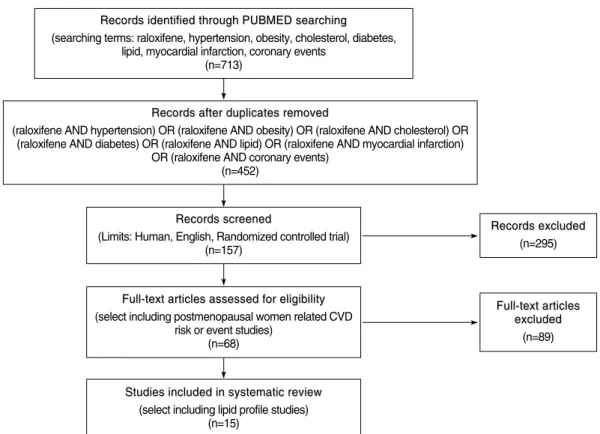
였다(Liberati et al., 2009). 해외 자료 검색은 미국국립의학 도서관(NLM, National Library of Medicine) Medline Data- base인 Pubmed를 사용하였으며, 사용한 검색어는 ralox- ifene과 hypertension, obesity, cholesterol, diabetes, lipid, myocardial infarction, coronary events를 배합하여 검색 하였다. 검색대상 논문은 데이터베이스가 포함한 자료의 시 작 시기인 1986년 8월부터 2009년 12월까지의 연구를 대상 으로 하였다. All field에서 제한을 두지 않고 검색하였을 때, 총 713편의 논문이 검색되었다. 이 중 중복되는 것을 제외하 니 452편이 검색되었다. 동물실험 155편과 논문의 언어가 영 어가 아닌 논문 54편을 제외하고, 무작위배정을 한 임상연구 만을 선정하였을 때 총 157편의 논문이 검색되었다. 이 중 폐 경기 여성이 포함된 심혈관 질환 관련 연구만을 선택하였을 때 68편이 검색되었다. 2명의 연구자가 각각 논문 원본을 확 보하여 읽은 후, 연구 결과에서 총 콜레스테롤, LDL 콜레스 테롤, HDL 콜레스테롤 및 중성지방을 모두 측정한 논문을 선택하였으며, 이 중 raloxifene과 지질 강하제인 statin을 함께 사용한 연구 2편을 제외하고, raloxifene 투여 결과 기 재 시 비교 가능한 통계치를 가지고 있지 않은 연구도 제외한 결과 최종 15편의 논문이 선정되었다(Figure 1). 선정된 15편
의 논문은 각 지질에 대한 효과를 기준으로 정리한 후 이 결 과를 연구팀이 분석하였다.
연구 결과
1. MORE 연구와 RUTH 연구의 비교
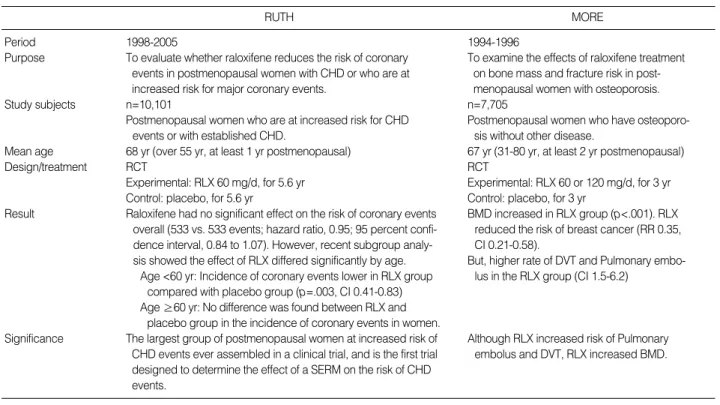
Table 1에 랄록시펜을 사용한 대표적인 대규모 임상연구인 MORE 연구와 RUTH 연구를 비교 분석하였다. 1994년부터 1996년까지 3년간 7,705명을 대상으로 이루어진 MORE 연 구의 경우 랄록시펜의 골다공증에 대한 효과를 확인하기 위 해 설계된 연구로 골다공증이 있는 폐경기 여성에서 골밀도 와 골절 위험을 분석하였다. 연구 결과 랄록시펜 투여군에서 위약군에 비해 요추 골밀도와 대퇴골 골밀도가 유의하게 증 가하였으며, 새로운 골절의 발생률도 기존 골절이 있었던 군 에서 30%, 없었던 군에서 50% 감소하였고, 유방암의 위험도 유의하게 감소하였다. 또한 랄록시펜 투여군에서 지질에 대 한 유익한 효과를 확인하는 계기가 되었다. 그러나 심부정맥 색전증과 폐색전증의 위험이 랄록시펜 투여군에서 유의하게 증가하는 것으로 나타났다(Ettinger et al., 1999). 1998년부 터 2005년까지 이루어진 RUTH 연구의 경우 이러한 MORE
Records excluded Records excluded
(n=295)
Full-text articles Full-text articles
excluded excluded (n=89)
Studies included in systematic review Studies included in systematic review
(select including lipid profile studies) (n=15)
Records identified through PUBMED searching Records identified through PUBMED searching (searching terms: raloxifene, hypertension, obesity, cholesterol, diabetes,
lipid, myocardial infarction, coronary events (n=713)
Records after duplicates removed Records after duplicates removed
(raloxifene AND hypertension) OR (raloxifene AND obesity) OR (raloxifene AND cholesterol) OR (raloxifene AND diabetes) OR (raloxifene AND lipid) OR (raloxifene AND myocardial infarction)
OR (raloxifene AND coronary events) (n=452)
Records screened Records screened
(Limits: Human, English, Randomized controlled trial) (n=157)
Full-text articles assessed for eligibility Full-text articles assessed for eligibility (select including postmenopausal women related CVD
risk or event studies) (n=68)
Figure 1. Flow diagram for study selection.
연구결과를 바탕으로 관상동맥질환 또는 그 위험요소를 가지 고 있는 10,101명의 폐경기 여성을 대상으로 랄록시펜의 관상 동맥질환 위험에 대한 효과를 확인하기 위해 전향적으로 설 계된 연구이다. 그러나 예상과 달리 전체적으로는 관상동맥 질환 발생에 아무런 영향을 미치지 않는 것으로 보고되었다.
최근 이차 분석 연구결과 60세 미만 그룹에서는 랄록시펜 투 여군이 위약군에 비해 관상동맥질환 발생률을 유의하게 감소 시켰으나, 60세 이상 그룹에서는 차이가 없는 것으로 나타났 다(Table 1).
2. 논문의 특징
선정된 총 15개의 논문은 모두 2001년부터 2008년에 출판 되었으며 이는 MORE 연구 및 RUTH 연구 결과의 영향으로 판단된다. Table 2에 제시된 논문의 특징을 분석한 결과, 피 험자는 최소 33명부터 5,133명까지 참여하였으며, 연구 대상 이 100명 미만인 논문이 7편으로 가장 많았고, 연구 대상이 100명 이상 1,000명 미만인 논문이 5편, 연구 대상이 1,000 명 이상인 논문이 3편이었다. 랄록시펜 투약 기간도 1개월에 서 36개월까지 다양하였다. 6개월 이하 진행된 연구가 8편으 로 가장 많았고, 12개월간 진행된 연구가 3편, 24개월간 진행 된 연구가 1편, 36개월간 진행된 연구가 3편 이었다. 13편의 논문에서 랄록시펜 60 mg을 투여하였으며 2개의 논문에서
랄록시펜 60 mg 투여군과 120 mg 또는 150 mg 투여군을 포함하였다. 논문 선정 시 발생할 수 있는 비뚤림(bias) 위험 성을 분석한 결과 선정된 총 15편의 논문 중 1편이 위약 대조 군이 없었으며, 2편이 이중 맹검이 아니라 피험자에게만 맹 검이 이루어졌다(Table 3).
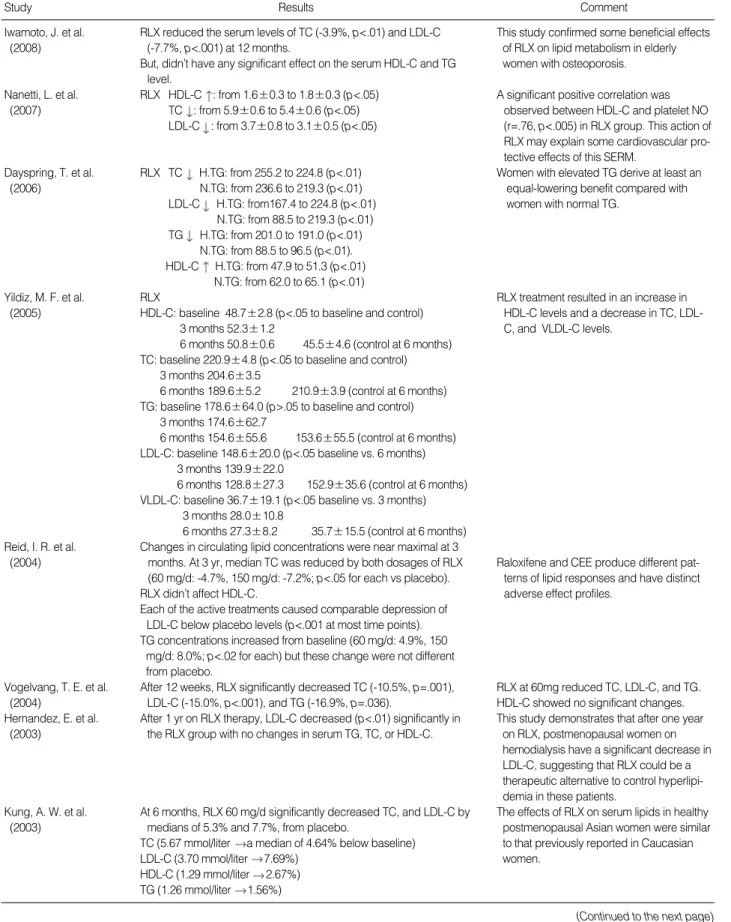
3. 폐경기 여성에서 랄록시펜의 지질에 대한 효과 이 중 12개의 논문에서 랄록시펜이 지질에 영향을 미치는 것으로 보고하였으며, 3개의 논문에서 랄록시펜이 지질에 영 향을 미치지 않는 것으로 보고하였다. 특히 지질에 대한 변화 가 보고된 12개의 논문 모두에서 유의한 LDL 콜레스테롤 감 소를 보고하였으며, 이 중 9개의 논문에서 유의한 총 콜레스 테롤 감소를 보고하였다. 또한 1,000명 이상의 폐경기 여성 을 대상으로 랄록시펜을 36개월간 장기 투여한 2개의 논문에 서도 총 콜레스테롤과 LDL 콜레스테롤이 유의하게 감소하였 다고 보고하였다. 그러나 중성지방 감소나 고밀도 콜레스테 롤 증가를 보고한 논문은 각 5건에 불과하였다(Table 4).
논 의
대표적인 여성 호르몬인 에스트로젠의 심혈관계 보호효과 는 오랫동안 특히 Nurses’study와 같은 대규모 후향적 역학 1998-2005
To evaluate whether raloxifene reduces the risk of coronary events in postmenopausal women with CHD or who are at increased risk for major coronary events.
n=10,101
Postmenopausal women who are at increased risk for CHD events or with established CHD.
68 yr (over 55 yr, at least 1 yr postmenopausal) RCT
Experimental: RLX 60 mg/d, for 5.6 yr Control: placebo, for 5.6 yr
Raloxifene had no significant effect on the risk of coronary events overall (533 vs. 533 events; hazard ratio, 0.95; 95 percent confi- dence interval, 0.84 to 1.07). However, recent subgroup analy- sis showed the effect of RLX differed significantly by age.
Age <60 yr: Incidence of coronary events lower in RLX group compared with placebo group (p=.003, CI 0.41-0.83) Age ≥60 yr: No difference was found between RLX and
placebo group in the incidence of coronary events in women.
The largest group of postmenopausal women at increased risk of CHD events ever assembled in a clinical trial, and is the first trial designed to determine the effect of a SERM on the risk of CHD events.
1994-1996
To examine the effects of raloxifene treatment on bone mass and fracture risk in post- menopausal women with osteoporosis.
n=7,705
Postmenopausal women who have osteoporo- sis without other disease.
67 yr (31-80 yr, at least 2 yr postmenopausal) RCT
Experimental: RLX 60 or 120 mg/d, for 3 yr Control: placebo, for 3 yr
BMD increased in RLX group (p<.001). RLX reduced the risk of breast cancer (RR 0.35, CI 0.21-0.58).
But, higher rate of DVT and Pulmonary embo- lus in the RLX group (CI 1.5-6.2)
Although RLX increased risk of Pulmonary embolus and DVT, RLX increased BMD.
Period Purpose
Study subjects
Mean age Design/treatment
Result
Significance
Table 1. Comparisons between The Raloxifene Use for The Heart trial (RUTH) and Multiple Outcomes of Raloxifene Evaluation (MORE)
RUTH MORE
연구 결과를 통해 지지받았다. 그러나 2002년 이러한 여성호 르몬의 심혈관계 보호효과를 증명하기 위한 전향적 임상연구
결과 여성호르몬의 사용이 오히려 심혈관계 위험성을 증가시 킨다는 연구결과가 제시됨에 따라 여성호르몬 사용에 대한 Iwamoto, J. et al. 122 69.4 Postmenopausal women with osteoporosis 12 Control: alendronate 5 mg/d
(2008) Experimental: RLX 60 mg/d
Nanetti, L. et al. 80 CG: 55±3 Healthy non-obese postmenopausal 12 Control: placebo
(2007) RLX: 56±4 women Experimental: RLX 60 mg/d
Dayspring, T. et al. 2,659 CG (High TG): 67.9 Normal or high TG (>150 mg/dL) levels 36 Control: Placebo (2006) RLX (High TG): 67.6 postmenopausal women with osteoporosis Experimental: combine
CG (Normal TG): 67.4 (TG sub group study of MORE trial) 60 mg and 120 mg/d RLX (Normal TG): 67.3
Yildiz, M. F. et al. 80 CG: 50.5±3.7 Healthy postmenopausal women 6 Control: placebo
(2005) RLX: 50.3±2.7 Experimental 1: RLX 60 mg/d
EVD: 49.7±3.0 Experimental 2: Estradiol valerate
SI: 49.5±3.0 2 mg/d+dienogest 2 mg/d
Experimental 3: Genistein 40 mg/d
Reid, I. R. et al. 619 53.0 Postmenopausal women with prior 36 Control: Placebo
(2004) hysterectomy Experimental 1: RLX 60 mg/d
Expeimental 2: RLX 150 mg/d Experimental 3: CEE 0.625 mg
Vogelvang, T. E. 118 55.5±3.3 Healthy nonhysterectomized 3 Control: placebo
et al. postmenopausal women Experimental: RLX 60 mg/d
(2004) Experimental: HMR 3339 2.5,
10, 50 mg/d
Hernandez, E. et al. 50 Postmenopausal women on chronic 12 Control: Placebo
(2003) hemodialysis with proven severe Experiment: RLX: 60 mg/d
osteopenia or osteoporosis
Kung, A. W. et al. 968 57 Healthy postmenopausal Asian women 6 Control: placebo
(2003) Experiment: RLX: 60 mg/d
Colacurci, N. et al. 60 CG: 56.5±3.7 Healthy postmenopausal women 4 Control: placebo
(2003) RLX:57.2±3.7 Experimental: RLX 60mg/d
Zheng, S. et al. 204 59.5±5.0 Healthy postmenopausal women 12 Control: Placebo
(2003) Experiment: RLX 60mg/d
Barrett-Connor, 5,133 C without DM: 66.5 Osteoporotic post-menopausal 36 Control: Placebo E. et al. RLX without DM: 66.4 women with and without type 2 DM Experiment: RLX 60 mg/d
(2002) C with DM: 69.1
RLX with DM: 67.6
Nickelen, G. et al. 1,008 56.1±4.9 Healthy postmenopausal women 6 Control: placebo
(2001) Experimental 1: RLX 60 mg/d
Experimental 2: ccHRT estradiol 2 mg+norethisterone acetate 1 mg
Engin-Ustun, Y. et al. 46 CG: 52.1±4.6 Healthy, postmenopausal women who 3 Control: Placebo (calcium) (2006) Intranasal E2: 50.2±3.6 had hysterectomy, with hypercholesterolemia Experimental1: Intranasal E2
RLX: 53.9±5.4 (fasting serum TC>200 and <350 mg/dL) (17b-estradiol)
Experimental2: RLX 60 mg/d
Dias, A. R. et al. 90 54±5 Healthy postmenopausal women 4 Control: placebo
(2005) Experimental 1: conjugated
equine estrogen (CEE) 0.625 mg Experimental 2: RLX 60 mg/d Griffiths, K. A. et al. 33 66±6 Postmenopausal women with clinically stable 2 Control: Placebo
(2003) and asymptomatic but had documented Experiment: RLX 60 mg/d
evidence of CAD Table 2. Summary of Study Characteristics
Study Number of
participants
Mean age
(yr) Inclusion criteria Length of
Tx (m) Treatment
Tx=Treatment.
많은 제한을 가지게 되며 선택적 에스트로젠 수용체 조절 약 물에 대해 관심이 기울어지게 되었다. 골다공증 예방 및 치료 제로 개발된 랄록시펜의 골다공증에 대한 효과를 검증하기 위한 대규모 연구인 MORE 연구에서 폐경기 여성의 지질에 대한 유익한 효과가 확인됨에 따라 폐경기 이후 위험도가 증 가하는 심혈관계 질환에 대한 예방 효과를 알아보기 위해 RUTH 연구가 진행되었다.
이미 RUTH 연구가 진행되기 이전에 세포주 및 동물실험 을 통해 랄록시펜의 심혈관 보호 작용에 대한 가능성이 꾸준 히 제시되어 왔다. 본 연구팀이 진행 중인 동물실험에서도 난 소절제술을 통한 인위적 폐경 모델에서 랄록시펜 투여군은 에스트로젠 투여군에 비해 유의한 체중 감소 및 혈중 콜레스 테롤 감소를 확인하였다. 이러한 랄록시펜의 비만에 대한 효 과는 총 콜레스테롤 및 LDL 콜레스테롤 감소에 기인하는 것 으로 알려져 있다(Walsh et al., 1998). 또한 랄록시펜은 에스 트로젠 보충 요법에서 보고된 중성지방 증가가 없으며, 혈중 염증 물질을 감소시키고, 혈관 내피세포에서 일산화질소합성 효소(nitric oxide synthase)를 활성시켜 관상동맥과 심근 세 포를 이완시키는 효과를 가지고 있어 폐경기 여성에서 관상 동맥질환의 발생을 감소시킬 것으로 기대되었다(Simoncini, Genazzani, & Liao, 2002).
그러나 랄록시펜이 관상동맥질환을 가지고 있거나 혹은 관 상동맥질환 위험이 높은 폐경기 여성에서 관상동맥 위험에 어떠한 영향도 미치지 않는다는 RUTH의 연구결과가 2006 년 발표되면서 이러한 심혈관 보호 효과를 효과적으로 증명
하지 못하였다. 이러한 결과에 대해서는 여성호르몬 보충 요 법과 마찬가지로 투여 시점 즉 폐경이후 너무 늦게 투약을 시 작하여 이미 에스트로젠 부족으로 인한 죽상경화와 같은 생 리적 변화가 진행된 이후라 약물의 효과가 잘 나타나지 않았 을 가능성이 제기 되고 있다. 또 RUTH 연구에서는 기대되었 던 지질에 대한 유익한 효과가 적었는데, 이는 RUTH 연구에 참가한 피험자 중 대조군의 68%, 실험군의 66%가 이미 지질 강하제인 스타틴계(statins) 약물을 복용하는 것과 관련이 있 다는 주장이 제기되고 있다(Collins et al., 2009).
랄록시펜의 이상반응으로 가장 흔하게 보고되고 있는 것은 안면 홍조로 이는 한국인을 대상으로 한 연구에서도 일관성 있게 보고되고 있다(Oh et al., 2006). 주목할 만한 이상반응 으로는 RUTH 연구에서 보고된 심부정맥 색전증 위험 증가 이다. 최근 Mosca 등(2009)은 RUTH 연구를 2차 분석 한 결 과 대조군과 랄록시펜 투여군 사이에 뇌졸중 발생률에는 차 이가 나지 않으나, 뇌졸중으로 인한 사망 위험(위험비, 1.49;
95% CI, 1.00-2.24) 및 심부정맥 색전증 위험(위험비, 1.44;
95% CI, 1.06-1.95)은 랄록시펜 투여군에서 유의하게 증가하 는 것으로 보고하였다. 특히 이러한 위험은 흡연상태와 연관 이 있다고 보고하였다.
그러나 이러한 신뢰성 있는 대규모 전향적 무작위배정 임 상시험이 주로 백인 여성을 대상으로 이루어졌으므로 한국폐 경기 여성에서도 랄록시펜이 같은 효과를 보일지에 대해서는 확신할 수 없다. Kung 등(2003)은 한국이 제외된 아시아 태 평양 지역 968명의 폐경 여성을 대상으로 6개월간 랄록시펜
Iwamoto, J. et al. (2008) Yes No Yes No No
Nanetti, L. et al. (2007) Yes No Yes Yes Yes
Dayspring, T. et al. (2006) Yes No Yes Yes Yes
Yildiz, M. F. et al. (2005) Yes No Yes No Yes
Reid, I. R. et al. (2004) Yes No Yes Yes Yes
Vogelvang, T. E. et al. (2004) Yes No Yes Yes Yes
Hernandez, E. et al. (2003) Yes No Yes No Yes
Kung, A. W. et al. (2003) Yes No Yes Yes Yes
Colacurci, N. et al. (2003) Yes No Yes Yes Yes
Zheng, S. et al. (2003) Yes No Yes Yes Yes
Barrett-Connor, E. et al. (2002) Yes No Yes Yes Yes
Nickelen, G. et al. (2001) Yes No Yes Yes Yes
Engin-Ustun, Y. et al. (2006) Yes No Yes Yes Yes
Dias, A. R. et al. (2005) Yes No Yes Yes Yes
Griffiths, K. A. et al. (2003) Yes No Yes Yes Yes
Table 3. Assessment of the Risk of Bias
Study Concealment of
randomisation
RCT stopped early
Patients blinded
Healthcare providers blinded
Placebo-con- trolled trial
RCT= Randomized clinical trial.
RLX reduced the serum levels of TC (-3.9%, p<.01) and LDL-C (-7.7%, p<.001) at 12 months.
But, didn’t have any significant effect on the serum HDL-C and TG level.
RLX HDL-C : from 1.6±0.3 to 1.8±0.3 (p<.05) TC : from 5.9±0.6 to 5.4±0.6 (p<.05) LDL-C : from 3.7±0.8 to 3.1±0.5 (p<.05)
RLX TC H.TG: from 255.2 to 224.8 (p<.01) N.TG: from 236.6 to 219.3 (p<.01) LDL-C H.TG: from167.4 to 224.8 (p<.01)
N.TG: from 88.5 to 219.3 (p<.01) TG H.TG: from 201.0 to 191.0 (p<.01)
N.TG: from 88.5 to 96.5 (p<.01).
HDL-C H.TG: from 47.9 to 51.3 (p<.01) N.TG: from 62.0 to 65.1 (p<.01) RLX
HDL-C: baseline 48.7±2.8 (p<.05 to baseline and control) 3 months 52.3±1.2
6 months 50.8±0.6 45.5±4.6 (control at 6 months) TC: baseline 220.9±4.8 (p<.05 to baseline and control)
3 months 204.6±3.5
6 months 189.6±5.2 210.9±3.9 (control at 6 months) TG: baseline 178.6±64.0 (p>.05 to baseline and control)
3 months 174.6±62.7
6 months 154.6±55.6 153.6±55.5 (control at 6 months) LDL-C: baseline 148.6±20.0 (p<.05 baseline vs. 6 months)
3 months 139.9±22.0
6 months 128.8±27.3 152.9±35.6 (control at 6 months) VLDL-C: baseline 36.7±19.1 (p<.05 baseline vs. 3 months)
3 months 28.0±10.8
6 months 27.3±8.2 35.7±15.5 (control at 6 months) Changes in circulating lipid concentrations were near maximal at 3
months. At 3 yr, median TC was reduced by both dosages of RLX (60 mg/d: -4.7%, 150 mg/d: -7.2%; p<.05 for each vs placebo).
RLX didn’t affect HDL-C.
Each of the active treatments caused comparable depression of LDL-C below placebo levels (p<.001 at most time points).
TG concentrations increased from baseline (60 mg/d: 4.9%, 150 mg/d: 8.0%; p<.02 for each) but these change were not different from placebo.
After 12 weeks, RLX significantly decreased TC (-10.5%, p=.001), LDL-C (-15.0%, p<.001), and TG (-16.9%, p=.036).
After 1 yr on RLX therapy, LDL-C decreased (p<.01) significantly in the RLX group with no changes in serum TG, TC, or HDL-C.
At 6 months, RLX 60 mg/d significantly decreased TC, and LDL-C by medians of 5.3% and 7.7%, from placebo.
TC (5.67 mmol/liter a median of 4.64% below baseline) LDL-C (3.70 mmol/liter 7.69%)
HDL-C (1.29 mmol/liter 2.67%) TG (1.26 mmol/liter 1.56%)
This study confirmed some beneficial effects of RLX on lipid metabolism in elderly women with osteoporosis.
A significant positive correlation was observed between HDL-C and platelet NO (r=.76, p<.005) in RLX group. This action of RLX may explain some cardiovascular pro- tective effects of this SERM.
Women with elevated TG derive at least an equal-lowering benefit compared with women with normal TG.
RLX treatment resulted in an increase in HDL-C levels and a decrease in TC, LDL- C, and VLDL-C levels.
Raloxifene and CEE produce different pat- terns of lipid responses and have distinct adverse effect profiles.
RLX at 60mg reduced TC, LDL-C, and TG.
HDL-C showed no significant changes.
This study demonstrates that after one year on RLX, postmenopausal women on hemodialysis have a significant decrease in LDL-C, suggesting that RLX could be a therapeutic alternative to control hyperlipi- demia in these patients.
The effects of RLX on serum lipids in healthy postmenopausal Asian women were similar to that previously reported in Caucasian women.
Iwamoto, J. et al.
(2008)
Nanetti, L. et al.
(2007)
Dayspring, T. et al.
(2006)
Yildiz, M. F. et al.
(2005)
Reid, I. R. et al.
(2004)
Vogelvang, T. E. et al.
(2004)
Hernandez, E. et al.
(2003)
Kung, A. W. et al.
(2003)
Table 4. Summary results
Study Results Comment
(Continued to the next page)
을 투여한 결과 기존 서양에서 이루어진 연구 결과와 비슷하 게 총 콜레스테롤, LDL 콜레스테롤, 중성지방의 감소 및 HDL 콜레스테롤 증가를 보고하였다. 204명의 중국 여성을 대상으 로 한 Zheng 등(2003)의 연구에서는 랄록시펜 투여군에서 총 콜레스테롤 및 LDL 콜레스테롤은 유의하게 감소하였으나,
중성지방이나 HDL 콜레스테롤에서는 유의한 차이가 나타나 지 않았다. 34명의 한국 폐경기 여성을 대상으로 한 Song 등 (2006)의 연구에서는 12개월의 랄록시펜 투여가 혈중 LDL콜 레스테롤을 22.6% 감소하였다고 보고한데 반해, 한국 폐경 여성 74명을 대상으로 한 Oh 등(2006)의 연구에서는 랄록시 Table 4. (Continued from the previous page) Summary results
Study Results Comment
RLX LDL-C : from 4.5±0.3 to 3.6±0.2, (p=.001) TG : from 1.5±0.4 to 1.5±0.1 (p=.05)
Thiobartituric acid-reactive substance, vascular cell adhesion molecule-1, intercellular adhesion molecule-1,and E-selectin.
TC and LDL-C levels, percentage decreases were 6.44% and 34.58% in the RLX-treated group.
Corresponding values on placebo-treated patients were a 1.44%
increase and a 19.07% decrease (RLX compared with placebo, both (p<.001).
No differences were found for HDL-C or TG levels between the two groups.
RLX did not significantly affect HbA1c, FPG, HDL-C or TG in women.
RLX produced statistically significant reductions in TC, LDL-C, and fibrinogen both in women with diabetes (all p≤.004) and without diabetes (all p<.001).
RLX significantly increased apo A-I (p<.001) and reduced apo B (p<.001) in women without diabetes.
In the RLX-treated group, body weight increased by a mean 0.31 kg (p<.001) in women without diabetes.
TC and LDL-C decreased statistically significantly from baseline to endpoint in both treatment arms (by 7.2% and 3.8% with raloxifene and by 13.0% and 8.9% with ccHRT, respectively, p<.001).
RLX produced a statistically significant increase in HDL-C by 4.2%, while ccHRT induced a decline by 9.5%.
TG were moderately suppressed with RLX by 3.6%.
Intranasal E2 group
TG : from 204.7±64.6 to 150.5±56.2 (p<.05) HDL-C : from 44.1±11.9 to 51.8±8.0 (p<.05)
No changes in lipid profile were observed in the RLX and placebo groups.
RLX Fibrinogen : from 382.9±69.3 to 333.4±48.2 CEE HDL-C : from 49.0±9.5 to 56.8±9.7 (p<.001)
TG : from 86.0±37.3 to 111.7±58.4 (p<.001) LDL-C : from 121.0±21.9 to 106.5±20.1 (p<.001) RLX HDL-C : from 46.0±9.1 to 47.8±9.1 mg/dL (p=.019).
Fibrinogen : from 354.7±100.3 to 302.0±65.8 (p=.009) Antithrombin III : from 102.4±12.5 to 98.5±12.3 (p=.039) There was no significant reduction LDL (from 111.5 to 110.2 mg/dL,
p=.06) and TG (from 21.7 to 20.0 mg/dL, p=.201).
There was no significant difference between the effect of RLX (0.26
±0.66% increase) and placebo (0.01±0.63% decrease) on flow mediated dilatation, the marker of endothelial function (p=.82).
No significant raloxifene-related effects were observed on derived aortic pressure, pulse pressure, augmentation index, TC, TG or LDL-C, HDL-C, markers of thrombosis, or vasoconstrictor, or vasodilator substances.
RLX is associated with a positive modulation of endothelial-dependent vasodilatation due to a reduction of risk factors for endothelial damage.
This study confirms that RLX exerts positive effects on on the overall serum lipid profile in postmenopausal women in China.
In osteoporotic postmenopausal women with or without type 2 diabetes, RLX 60mg/d did no affect glycemic control and had favorable effects on TC, LDL-C and fibrino- gen levels.
The smaller decreases in TC and LDL-C associated with RLX were accompanied by an increase in HDL-C and a decrease in fibrinogen.
RLX affects fibrinogen concentrations and the overall cholesterol profile more favor- ably than ccHRT; these differences may have important implications for the reduc- tion of cardiovascular disease.
Intranasal E2exerts significant effects on lipid profile in hypercholesterolemic post- menopausal women.
Both CEE and RLX exert significant effects on the lipid and coagulation profile. These effects may have a significant impact on the cardiovascular risk that needs to be confirmed in larger studies.
In postmenopusal women with treated CAD, selective estrogen receptor modulation with raloxifene does not improve a compre- hensive set of parameters examining vas- cular function and serum lipoprotein levels.
Colacurci, N. et al.
(2003)
Zheng, S. et al.
(2003)
Barrett-Connor, E. et al.
(2002)
Nickelen, G. et al.
(2001)
Engin-Ustun, Y. et al.
(2006)
Dias, A. R. et al.
(2005)
Griffiths, K. A. et al.
(2003)
펜 투여군과 에스트로겐 요법군에서 각각 기저치(baseline) 에 비해 지질대사에 유의한 변화를 보이지 않았다고 보고한 바 있다. 그러나 한국인을 대상으로 한 이 두 연구 모두 연구 대상이 적고 대조군이 제대로 설정되어 있지 않다는 제한점 을 가지고 있어 그 결과를 일반화시키기는 어렵다. 이처럼 폐 경기 한국여성을 대상으로 랄록시펜의 지질 및 심혈관 보호 효과 및 이상반응에 대한 대규모 전향적 임상시험이 없는 실 정이라 향후 랄록시펜을 투여할 때는 대상자가 얻을 수 있는 이익과 위험성 및 흡연상태를 신중하게 고려해야 할 것이다.
본 연구의 제한점은 심혈관 질환의 위험요소 중의 하나인 지질에 대한 효과만 분석하였으므로 이 결과를 랄록시펜의 심혈관질환 예방에 대한 효과로 확대하기는 어려우며, 한국 인을 대상으로 한 논문이 포함되지 않아 연구 결과를 한국 폐 경 여성에게 일반화시켜 적용하기 어렵다는 것이다. 또한 지 질에 대한 효과와 더불어 기대되는 비만도 개선을 나타낼 수 있는 지표를 확인하지 못하였다.
결론 및 제언
본 연구를 통해 폐경기 여성에서 랄록시펜의 총 콜레스테 롤 및 LDL 콜레스테롤에 대한 일관성 있는 감소 효과는 확인 하였으나, HDL 콜레스테롤 및 중성지방에 대한 효과는 확인 하지 못하였다. 또한 본 연구에서 확인하지 못한 지질 변화와 동반된 비만 및 혈관내피 기능에 대한 효과도 향후 분석해야 할 것이다.
골다공증의 예방 및 치료를 위해 사용되는 랄록시펜의 심 혈관질환의 예방에 대한 효과는 주된 투여 대상이 심혈관 질 환 위험성이 급격히 증가하는 폐경기 여성이라는 점과 일관 성 있는 총 콜레스테롤 및 LDL 콜레스테롤 감소 효과로 인해 관심이 지속적으로 제기되고 있지만 대규모 임상연구를 통해 아직 확인되지는 않았다. 그러나 연령 및 흡연 상태에 따라 랄록시펜 투여에 따른 관상동맥 질환과 관련된 이익 또는 뇌 졸중 및 심부정맥 색전증 위험성이 증가할 수 있음이 최근 실 시된 신뢰성 있는 대규모 전향적 임상시험 결과를 2차분석한 논문에서 제시되었다. 따라서 향후 골다공증을 예방 또는 치 료할 목적으로 랄록시펜을 투여하더라도 대상이 심혈관 질환 위험성이 급격히 증가하는 폐경기 여성이라면 특히 연령과 흡연여부를 고려하여 이러한 심혈관 질환 위험성을 조기에 평가할 수 있는 간호 중재를 고려해야 할 것이다.
참고문헌
Anderson, G. L., Limacher, M., Assaf, A. R., Bassford, T., Beresford, S. A., Black, H., et al. (2004). Effects of conjugated equine estrogen in postmenopausal women with hysterectomy: The Women’s Health Initiative randomized controlled trial. The Journal of the American Medical Association, 291, 1701-1712.
Barrett-Connor, E., Ensrud, K. E., Harper, K., Mason, T. M., Sashe- gyi, A., Krueger, K. A., et al. (2003). Post hoc analysis of data from the Multiple Outcomes of Raloxifene Evaluation (MORE) trial on the effects of three years of raloxifene treatment on glycemic control and cardiovascular disease risk factors in women with and without type 2 diabetes. Clinical Therapeutics, 25, 919-930.
Brussaard, H. E., Gevers, L. J., Frolich, M., Kluft, C., & Krans, H. M.
(1997). Short-term oestrogen replacement therapy improves insulin resistance, lipids and fibrinolysis in postmenopausal women with NIDDM. Diabetologia, 40, 843-849.
Chu, S. H., Lee, M. K., Kowalski, J., Beck, J., & Schwertz, D. (2008).
Effect of estrogen on ovariectomy-induced obesity in rats. Journal of Korean Biological Nursing Science, 10, 80-87.
Colacurci, N., Manzella, D., Fornaro, F., Carbonella, M., & Paolisso, G. (2003). Endothelial function and menopause: Effects of raloxifene administration. The Journal of Clinical Endocrinology & Metabolism, 88, 2135-2140.
Collins, P., Mosca, L., Geiger, M. J., Grady, D., Kornitzer, M., Ame- wou-Atisso, M. G., et al. (2009). Effets of the selective estrogen re- ceptor modulator raloxifene on coronary outcomes in the Raloxifene Use for the Heart trial: Results of subgroup analyses by age and other factors. Circulation, 119, 922-930.
Dias, A. R. Jr., Melo, R. N., Gebara, O. C., D’Amico, E. A., Nuss- bacher, A., Halbe, H. W., et al. (2005). Effects of conjugated equine estrogens or raloxifene on lipid profile, coagulation and fibrinolysis factors in postmenopausal women. Climacteric, 8, 63-70.
Duvernoy, C. S., Kulkarni, P. M., Dowsett, S. A., & Keech, C. A.
(2005). Vascular events in the Multiple Outcomes of Raloxifene Evaluation (MORE) trial: Incidence, patient characteristics, and effect of raloxifene. Menopause, 12, 444-452.
Engin-Ustun, Y., Ustun, Y., Meydanli, M. M., & Kafkasli, A. (2006).
Effects of intranasal 17beta-estradiol and raloxifene on lipid profile and fibrinogen in hypercholesterolemic postmenopausal women: A randomized, placebo-controlled clinical trial. Gynecological Endocrinol- ogy, 22, 676-679.
Ettinger, B., Black, D. M., Mitkma, B. H., Knickerbocker, R. K., Ni- ckelsen, T., Genant, H. K., et al. (1999). Reduction of vertebral frac- ture risk in postmenopausal women with osteoporosis treated with raloxifene: Results from a 3-year randomized clinical trial. The Jour- nal of the American Medical Association, 282, 637-645.
Grady, D., Herrington, D., Bittner, V., Blumenlhal, R., Davidson, M., Hlatky, M., et al. (2002). Cardiovascular disease outcomes during
6.8 years of hormones therapy: Heart and Estrogen/Progestin Replace- ment Study follow-up (HERS II). The Journal of the American Med- ical Association, 288, 49-57.
Griffiths, K. A., Sader, M. A., Skilton, M. R., Harmer, J. A., & Celer- majer, D. S. (2003). Effects of raloxifene on endothelium-dependent dilation, lipoproteins, and markers of vascular function in postmeno- pausal women with coronary artery disease. Journal of the American College of Cardiology, 42, 698-704.
Hernandez, E., Valera, R., Alonzo, E., Bajares-Lilue, M., Carlini, R., Capriles, F., et al. (2003). Effects of raloxifene on bone metabolism and serum lipids in postmenopausal women on chronic hemodialy- sis. Kidney International, 63, 2269-2274.
Hyung, H. K. & Kim, H. S. (2008). The effect of brisk walking exer- cise program on body composition, blood pressure, blood glucose and blood lipid for middle-aged women with obesity. Journal of Kore- an Biological Nursing Science, 10, 62-68.
Iwamoto, J., Sato, Y., Uzawa, M., Takeda, T., & Matsumoto, H. (2008).
Comparison of effects of alendronate and raloxifene on lumbar bone mineral density, bone turnover, and lipid metabolism in elderly wo- men with osteoporosis. Yonsei Medical Journal, 49, 119-128.
Kung, A. W., Chao, H. T., Huang, K. E., Need, A. G., Taechakraichana, N., Loh, F. H., et al. (2003). Efficacy and safety of raloxifene 60 mil- ligrams/day in postmeno-pausal Asian women. The Journal of Clini- cal Endocrinology & Metabolism, 88, 3130-3136.
Liberati, A., Altman, D. G., Tetzlaff, J., Mulrow, C., Gotzsche, P. C., Ioannidis, J. P. A., et al. (2009). The PRISMA statement for report- ing systematic reviews and meta-analyses of studies that evaluate healthcare interventions: Explanation and elaboration. The British Medical Journal, 339, b2700.
Ministry of Health and Welfare and Korea Institute for Health and Social Affairs. (2005). The Third Korea National Health and Nutri- tion Examination Survey. Unpublished Report.
Mosca, L., Grady, D., Barrett-Connor, E., Collins, P., Wenger, N., Abramson, B. L., et al. (2009). Effect of raloxifen on stroke and ve- nous thromboembolism according to subgroups in postmenopausal women at increased risk of coronary heart disease. Stroke, 40, 147- 155.
Nanetti, L., Camilletti, A., Francucci, C. M., Vignini, A., Raffaelli, F., Mazzanti, L., et al. (2008). Role of raloxifene on platelet metabolism and plasma lipids. European Journal of Clinical Investigation, 38, 117- 125.
Nickelsen, T., Creatsas, G., Rechberger, T., Depypere, H., Erenus,
M., Quail, D., et al. (2001). Differential effects of raloxifene and continuous combined hormone replacement therapy on biochemi- cal markers of cardiovascular risk: Results from the Euralox 1 study.
Climacteric, 4, 320-331.
Oh, E. K., Choi, H., Lee, C. M., Cho, Y. K., Kim, B. R., Ko, J. K., et al. (2006). A comparion of the effects of raloxifene and estrogen ther- apy on lipid profile and bone mineral density in postmenopausal wo- men. Journal of Korean Postmenopause, 12, 19-27.
Reid, I. R., Eastell, R., Fogelman, I., Adachi, J. D., Rosen, A., Netelen- bos, C., et al. (2004). A comparison of the effects of raloxifene and conjugated equine estrogen on bone and lipids in healthy postmeno- pausal women. Archives of Internal Medicine, 164, 871-879.
Regitz-Zagrosek, V., Wintermantel, T. M., & Schubert, C. (2007).
Estrogens and SERMs in coronary heart disease. Current Opinion in Pharmacology, 7, 130-139.
Simoncini, T., Genazzani, A. R., & Liao, J. K. (2002). Nongenomic mechanisms of endothelial nitric oxide synthase activation by the selective estrogen receptor modulator raloxifene. Circulation, 105, 1368-1373.
Song, E. K., Yeom, J. H., Shin, H. T., Kim, S. H., Shin, W. G., & Oh, J. M. (2006). Effectiveness of raloxifene on bone mineral density and serum lipid levels in post-menopausal women with low BMD after discontinuation of hormone replacement therapy. Journal of Clinical Pharmacy and Therapeutics, 31, 421-427.
Vogelvang, T. E., Mijatovic, V., Kenemans, P., Teerlink, T., & van der Mooren, M. J. (2004). HMR 3339, a novel selective estrogen recep- tor modulator, reduces total cholesterol, low-density lipoprotein choles- terol, and homocysteine in healthy postmenopausal women. Fertility and Sterility, 82, 1540-1549.
Walsh, B. W., Kuller, L. H., Wild , R. A., Paul, S., Farmer, M., Lawrence, J. B., et al. (1998). Effects of raloxifene on serum lipids and coagula- tion factors in healthy postmenopausal women. The Journal of the American Medical Association, 279, 1445-1451.
Yildiz, M. F., Kumru, S., Godekmerdan, A., & Kutlu, S. (2005). Effects of raloxifene, hormone therapy, and soy isoflavone on serum high- sensitive C-reactive protein in postmenopausal women. International Journal of Gynecology & Obstetrics, 90, 128-133.
Zeng, S., Wu, Y., Zhang, Z., Yang, X., Hui, Y., Zhang, Y., et al. (2003).
Effects of raloxifene hydrochloride on bone mineral density, bone metabolism and serum lipids in postmenopausal women: A random- ized clinical trial in Beijing. Chinese Medical Journal, 116, 1127-1133.