Background and Purpose Excessive daytime sleepiness (EDS) is a common complaint among patients with Parkinson’s disease (PD). Several factors have been associated with EDS in PD, especially neuropsychiatric symptoms. This study aimed to determine the relationships be- tween neuropsychiatric symptoms, sociodemographic and clinical parameters, and EDS in PD.
Methods This cross-sectional study analyzed 85 patients with PD. All patients underwent so- cioeconomic and clinical data evaluations followed by a psychiatric interview and a neurologi- cal examination, including the assessment of sleep features. Patients were divided into two groups according to the presence or absence of EDS, which was defined as a score higher than 10 on the Epworth Sleepiness Scale. Binary logistic regression was performed in order to describe the predictors of EDS.
Results We found that EDS affects 40% of PD patients and is associated with older age, rest- less legs syndrome, depressive and anxious symptoms, and worse sleep quality. In the multivari- ate analysis, older age, levodopa use, and worse sleep quality remained as significant predictors of EDS in PD.
Conclusions Nighttime sleep problems, older age, and levodopa use are significantly associat- ed with EDS in PD. A careful assessment and the management of sleep problems in PD patients might help to improve their quality of life.
Key Words Parkinson’s disease, nonmotor symptoms, excessive daytime sleepiness, depression, anxiety.
Clinical Predictors of Excessive Daytime Sleepiness in Patients with Parkinson’s Disease
INTRODUCTION
Sleep problems have received considerable attention from the scientific community, espe- cially in patients with Parkinson’s disease (PD). The prevalence of sleep complaints is very high in PD patients, reportedly ranging from 35.1% to 98%.1-4 These patients present with numerous sleep disorders such as insomnia, nocturia, rapid-eye-movement sleep behavior disorder, restless legs syndrome (RLS), circadian rhythm disorders, and excessive daytime sleepiness (EDS),5 which was the focus of the present study.
EDS is defined as the inability to sustain wakefulness during the usual awake periods of the day due to an uncontrollable need to sleep.6 Studies have found that 20–60% of individ- uals with PD exhibit EDS.4,5,7,8 This wide variation in the prevalence of EDS seems to reflect variations in diagnosis criteria, intrinsic characteristics of assessed samples, and study designs.
Nevertheless, previous studies have consistently found that the frequency of EDS is higher in patients with PD than in the general population.5,9
A myriad of factors has been implicated in EDS in PD, including a neurodegenerative pro- cess in specific brain regions implicated in regulating sleep and arousal.10,11 The impact of Bruno Terra Junhoa
Arthur Kummera,b Francisco Cardosoc Antonio Lucio Teixeiraa,d Natalia Pessoa Rochaa,d
a Laboratório Interdisciplinar de Investigação Médica (LIIM), Faculdade de Medicina,
Universidade Federal de Minas Gerais, Belo Horizonte, MG, Brazil
b Eli Lilly and Company do Brasil, São Paulo, SP, Brazil
c Unidade de Distúrbios do Movimento, Hospital das Clínicas,
Universidade Federal de Minas Gerais, Belo Horizonte, MG, Brazil
d Neuropsychiatry Program, Department of Psychiatry and Behavioral Sciences, McGovern Medical School, The University of Texas Health Science Center at Houston (UTHealth), Houston, TX, USA
pISSN 1738-6586 / eISSN 2005-5013 / J Clin Neurol 2018;14(4):530-536 / https://doi.org/10.3988/jcn.2018.14.4.530
Received March 19, 2018 Revised June 20, 2018 Accepted June 21, 2018 Correspondence Natalia Pessoa Rocha, PhD Neuropsychiatry Program, Department of Psychiatry and Behavioral Sciences, McGovern Medical School, The University of Texas Health Science Center at Houston (UTHealth), 1941 East Road, Houston, TX 77054, USA
Tel +1-713-486-2622 Fax +1-713-486-2553
E-mail [email protected]
cc This is an Open Access article distributed under the terms of the Creative Commons Attribution Non-Com- mercial License (https://creativecommons.org/licenses/by-nc/4.0) which permits unrestricted non-commercial use, distribution, and reproduction in any medium, provided the original work is properly cited.
JCN
Open Access ORIGINAL ARTICLEJunho BT et al.
JCN
nocturnal symptoms and other sleep disorders,12-14 the presence of psychiatric comorbidities (especially depression and anxiety),5,15,16 and the use of dopaminergic agonists have also been associated with EDS.7,17 There is some evidence in- dicating that sleepiness is mainly related to the pathology of PD rather than other concurrent factors. The application of polysomnography and daytime multiple sleep latency tests to 54 patients with PD preselected for sleepiness found that their EDS severity was not associated with dopamine-agonist treat- ment, age, disease duration, motor disability, total sleep time, periodic leg movement, apnea-hypopnea, or arousal indices, and so EDS was conceptualized as an integral feature of PD.8 This hypothesis was corroborated by a longitudinal study showing that the phosphorylated-tau/total-tau ratio in the ce- rebrospinal fluid is a strong predictor of EDS in PD. More- over, EDS evolves more rapidly over time in PD than in healthy individuals.7
EDS has been associated with most of the motor and non- motor symptoms in PD,5 including psychosis,18 falls,19 de- mentia,20 and fatigue.21 It is noteworthy that EDS is an impor- tant predictor of poor health-related quality of life22,23 and markedly increases the burden experienced by caregivers.24 Therefore, the present study was designed to evaluate clinical factors associated with EDS in a sizeable sample of Brazilian patients with PD.
METHODS
Study design and participants
This cross-sectional study involved 85 patients with PD re- cruited from the Movement Disorders Outpatient Clinic, Hospital das Clínicas, Universidade Federal de Minas Gerais (UFMG), Belo Horizonte, Brazil. Patients met the diagnostic criteria for PD according to the criteria of the United King- dom Parkinson’s Disease Society Brain Bank.25 Patients were included if they were able to answer all of the clinical rating scales used in this study. A previous diagnosis of dementia, delirium, or neurological comorbidities, and a history of un- dergoing neurosurgical procedure were considered exclusion criteria.
The ethics committee of UFMG approved the study proto- col (IRB No. ETIC 048/2006), and all participants provided written informed consent prior to study admission.
Clinical evaluation
All patients underwent a socioeconomic and clinical data evaluation followed by a psychiatric interview and a neuro- logical examination. The Unified Parkinson’s Disease Rating Scale (UPDRS)26 and the Modified Hoehn and Yahr Scale (MHYS)27 were used to assess the PD signs and symptoms
and the disease stage, respectively. Complications of therapy were assessed using UPDRS part IV.26
Sleep features were assessed using the Epworth Sleepiness Scale (ESS)28 and the Parkinson’s Disease Sleep Scale (PDSS).29,30 The ESS is a self-administered questionnaire designed to mea- sure the general level of daytime sleepiness, in which partici- pants rate on a 4-point scale (from 0 to 3) their likelihood of dozing off or falling asleep while engaging in eight different activities.28 The PDSS is a visual analogue scale that assesses 15 commonly reported symptoms associated with sleep dis- order in PD: overall quality of nighttime sleep (item 1), sleep onset and maintenance/insomnia (items 2 and 3), nocturnal restlessness (items 4 and 5), nocturnal psychosis (items 6 and 7), nocturia (items 8 and 9), nocturnal motor symptoms (items 10–13), sleep refreshment (item 14), and daytime dozing (item 15).29 The scores for each item range from 0 (symptom is se- vere and always experienced) to 10 (free of the symptom). The maximum cumulative score for the PDSS is 150, which would correspond to a patient without any sleep complaints.29 The PDSS items were grouped as proposed by Chaudhuri et al.29
All individuals underwent a cognitive evaluation, which included the Mini Mental State Examination (MMSE)31 and the Frontal Assessment Battery (FAB).32 The MMSE is wide- ly test for cognitive screening, and encompasses different do- mains such as orientation, registration, attention and calcu- lation, recall, and language.31 The FAB is a brief assessment tool for evaluating executive functioning. It comprises six subtests exploring frontal-lobe processes: conceptualization, mental flexibility, motor programming, sensitivity to interfer- ence, inhibitory control, and environmental autonomy. The score for each FAB subtest ranges from 0 (worst) to 3 (best), and the total FAB score is calculated as the sum of the subtest scores.32
The Beck Depression Inventory (BDI)33 and the Hamilton Rating Scale for Depression (HAM-D)34 were used to evalu- ate depressive symptoms. The BDI is a 21-item self-rating in- strument that measures depressive symptoms, with the score for each item ranging from 0 to 3 according to its severity.32 The HAM-D is a 17-item scale designed to be applied by a health-care professional.34 This instrument rates the severity of the following depression-related symptoms on either a 5- or 3-point scale: mood, feelings of guilt, suicide ideation, in- somnia, agitation or retardation, anxiety, weight loss, and so- matic symptoms.
Anxiety symptoms were assessed using the Hamilton Anxi- ety Rating Scale (HAM-A), which consists of 14 items scored from 0 (not present) to 4 (severe).35 The Schwab and England Activities of Daily Living (SEADL) scale was used to assess functioning.36 RLS was diagnosed based on the criteria of The International RLS Study Group.37
Daytime Sleepiness in Parkinson’s Disease
JCN
Data analysis
The patients were initially divided into two groups accord- ing to the presence or absence of EDS, with EDS defined as a score higher than 10 points on the ESS as proposed by Johns28 in 1991. Categorical data are presented as frequency and per- centage values, while continuous data are presented as mean±
standard-deviation and median values.
All continuous variables were tested for conformity with a Gaussian distribution using the Shapiro-Wilk test. The two groups (presence vs. absence of EDS) were compared using Student’s t test or the Mann-Whitney U test when variables did or did not conform to a normal distribution, respectively.
Associations between dichotomous variables were assessed with Fisher’s exact test.
Binary logistic regression using a backward elimination approach was performed to identify predictors of EDS. The following variables were included in the initial model: sex, age, education level, time since diagnosis, medications used (le- vodopa, antidepressant, and dopaminergic agonist), and scores for UPDRS total, MHYS, BDI, HAM-A, HAM-D, FAB, MMSE, and PDSS total. The goodness of fit of the logistic re- gression model was assessed using a receiver operating char- acteristics (ROC) curve.
Version 22 of SPSS (IBM Corp., Armonk, NY, USA) was used for all statistical tests, which were two-tailed and were performed using a significance cutoff of α=0.05.
RESULTS
Thirty-four of our PD patients (40%) presented with EDS.
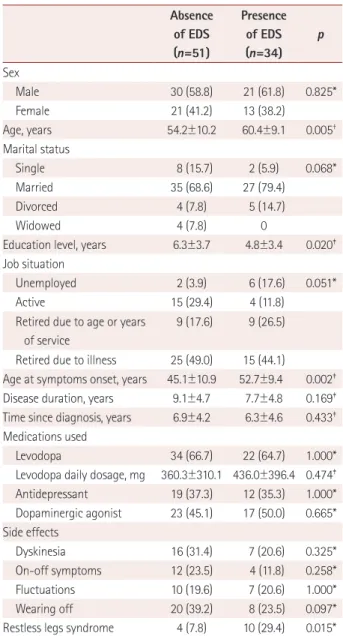
Table 1 summarizes the sociodemographic and clinical data of the patients enrolled in this study. Most of the participants were male, married, and retired due to illness. There was no statistically significant intergroup difference in sex (p=0.825), marital status (p=0.068), or job situation (p=0.051). PD pa- tients presenting with EDS were older than those without EDS (p=0.005). Both groups had a low education level, but it was significant lower in patients with EDS (p=0.020). Patients presenting with EDS were older at disease onset (p=0.002).
There were no intergroup differences in the medications used, mean dose of levodopa, or side-effects profile. RLS was more prevalent in patients with EDS than in those without EDS (29.4% vs. 7.8%, respectively; p=0.015).
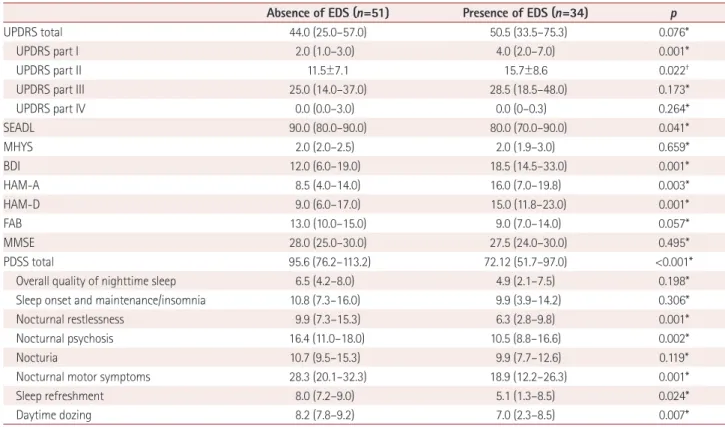
The scores on the clinical rating scales are presented in Ta- ble 2. The mean MHYS score did not differ between the two groups (p=0.659). Patients presenting with EDS had higher scores on UPDRS part I (p=0.001), UPDRS part II (p=0.022), BDI (p=0.001), HAM-A (p=0.003), and HAM-D (p=0.001) than patients without EDS. There were no significant inter- group differences in scores on the cognitive tests (FAB and
MMSE).
Patients with EDS reported worse sleep quality as assessed by the PDSS total score (p<0.001), especially for nocturnal restlessness (p=0.001), nocturnal psychosis (p=0.002), noctur- nal motor symptoms (p=0.001), sleep refreshment (p=0.024), and daytime dozing (p=0.007).
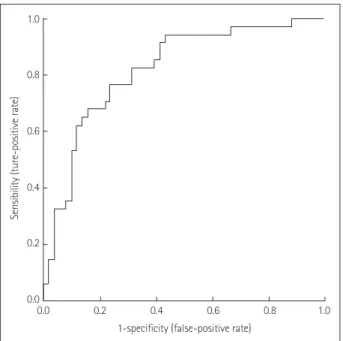
Backward stepwise regression revealed that older age, le- vodopa use, and lower score on the PDSS (i.e., worse sleep quality) were significant predictors of EDS. The results are presented in Table 3. The logistic regression model can be considered reliable since the predicted variability resulted in an area under the curve of 0.820 in the ROC analysis (Fig. 1).
Table 1. Sociodemographic and clinical data of patients with Parkin- son’s disease with and without EDS
Absence of EDS (n=51)
Presence of EDS (n=34)
p
Sex
Male 30 (58.8) 21 (61.8) 0.825*
Female 21 (41.2) 13 (38.2)
Age, years 54.2±10.2 60.4±9.1 0.005†
Marital status
Single 8 (15.7) 2 (5.9) 0.068*
Married 35 (68.6) 27 (79.4)
Divorced 4 (7.8) 5 (14.7)
Widowed 4 (7.8) 0
Education level, years 6.3±3.7 4.8±3.4 0.020‡ Job situation
Unemployed 2 (3.9) 6 (17.6) 0.051*
Active 15 (29.4) 4 (11.8)
Retired due to age or years of service
9 (17.6) 9 (26.5)
Retired due to illness 25 (49.0) 15 (44.1)
Age at symptoms onset, years 45.1±10.9 52.7±9.4 0.002‡ Disease duration, years 9.1±4.7 7.7±4.8 0.169‡ Time since diagnosis, years 6.9±4.2 6.3±4.6 0.433‡
Medications used
Levodopa 34 (66.7) 22 (64.7) 1.000*
Levodopa daily dosage, mg 360.3±310.1 436.0±396.4 0.474‡ Antidepressant 19 (37.3) 12 (35.3) 1.000*
Dopaminergic agonist 23 (45.1) 17 (50.0) 0.665*
Side effects
Dyskinesia 16 (31.4) 7 (20.6) 0.325*
On-off symptoms 12 (23.5) 4 (11.8) 0.258*
Fluctuations 10 (19.6) 7 (20.6) 1.000*
Wearing off 20 (39.2) 8 (23.5) 0.097*
Restless legs syndrome 4 (7.8) 10 (29.4) 0.015*
Data are mean±standard-deviation or n (%) values.
*Fisher’s exact test, †Student’s t test, ‡Mann-Whitney U test.
EDS: excessive daytime sleepiness.
Junho BT et al.
JCN
The obtained results were replicated when binary logistic re- gression was performed using forward selection, in that age, levodopa use, and PDSS total score were still significant pre- dictors of EDS.
DISCUSSION
To the best of our knowledge, this study has performed the most-comprehensive evaluation of EDS in a sample of Bra- zilian patients with PD. We confirmed that EDS is a common problem among patients with PD, with it affecting 40.0% of the evaluated subjects. The main predictors of EDS in PD
were advanced age, levodopa use, and worse sleep quality.
The aging process results in both qualitative and quantita- tive changes in sleep patterns.38,39 Typically there is a pro- nounced phase advance in the normal circadian sleep cycle, which results in a tendency to fall asleep and wake up earlier than usual, a longer sleep-onset latency, and a shorter total sleep duration.39-41 Moreover, the elderly population exhibits changes in neurophysiological parameters of polysomnog- raphy, such as significant reductions in slow-wave activity and the range of sleep spindles.39 Together these alterations lead to worse sleep quality and an increase in daytime sleepiness and naps. Accordingly, the prevalence of EDS is relatively Table 2. Comparison of scores on the clinical rating scales between Parkinson’s disease patients with and without EDS
Absence of EDS (n=51) Presence of EDS (n=34) p
UPDRS total 44.0 (25.0–57.0) 50.5 (33.5–75.3) 0.076*
UPDRS part I 2.0 (1.0–3.0) 4.0 (2.0–7.0) 0.001*
UPDRS part II 11.5±7.1 15.7±8.6 0.022†
UPDRS part III 25.0 (14.0–37.0) 28.5 (18.5–48.0) 0.173*
UPDRS part IV 0.0 (0.0–3.0) 0.0 (0–0.3) 0.264*
SEADL 90.0 (80.0–90.0) 80.0 (70.0–90.0) 0.041*
MHYS 2.0 (2.0–2.5) 2.0 (1.9–3.0) 0.659*
BDI 12.0 (6.0–19.0) 18.5 (14.5–33.0) 0.001*
HAM-A 8.5 (4.0–14.0) 16.0 (7.0–19.8) 0.003*
HAM-D 9.0 (6.0–17.0) 15.0 (11.8–23.0) 0.001*
FAB 13.0 (10.0–15.0) 9.0 (7.0–14.0) 0.057*
MMSE 28.0 (25.0–30.0) 27.5 (24.0–30.0) 0.495*
PDSS total 95.6 (76.2–113.2) 72.12 (51.7–97.0) <0.001*
Overall quality of nighttime sleep 6.5 (4.2–8.0) 4.9 (2.1–7.5) 0.198*
Sleep onset and maintenance/insomnia 10.8 (7.3–16.0) 9.9 (3.9–14.2) 0.306*
Nocturnal restlessness 9.9 (7.3–15.3) 6.3 (2.8–9.8) 0.001*
Nocturnal psychosis 16.4 (11.0–18.0) 10.5 (8.8–16.6) 0.002*
Nocturia 10.7 (9.5–15.3) 9.9 (7.7–12.6) 0.119*
Nocturnal motor symptoms 28.3 (20.1–32.3) 18.9 (12.2–26.3) 0.001*
Sleep refreshment 8.0 (7.2–9.0) 5.1 (1.3–8.5) 0.024*
Daytime dozing 8.2 (7.8–9.2) 7.0 (2.3–8.5) 0.007*
Data are mean±standard-deviation or median (interquartile) values.
*Mann-Whitney U test, †Student’s t test.
BDI: Beck Depression Inventory, EDS: excessive daytime sleepiness, FAB: Frontal Assessment Battery, HAM-A: Hamilton Anxiety Rating Scale, HAM-D:
Hamilton Rating Scale for Depression, MHYS: Modified Hoehn and Yahr Scale, MMSE: Mini Mental State Examination, PDSS: Parkinson’s Disease Sleep Scale, SEADL: Schwab and England Activities of Daily Living, UPDRS: Unified Parkinson’s Disease Rating Scale.
Table 3. Final binary logistic regression model (step 11) to predict excessive daytime sleepiness in Parkinson’s disease patients
Predictor variable B SE Wald df p Odds ratio 95% CI
Age* 0.126 0.041 9.661 1 0.002 1.135 1.048–1.229
Levodopa use* 1.818 0.724 6.312 1 0.012 6.160 1.491–25.439
UPDRS total 0.026 0.016 2.671 1 0.102 1.026 0.995–1.058
MMSE 0.199 0.107 3.438 1 0.064 1.220 0.989–1.506
PDSS total* -0.039 0.013 9.621 1 0.002 0.962 0.939–0.986
*Significant predictors.
CI: confidence interval, df: degrees of freedom, MMSE: Mini Mental State Examination, PDSS: Parkinson’s Disease Sleep Scale, SE: standard error, UPDRS:
Unified Parkinson’s Disease Rating Scale.
Daytime Sleepiness in Parkinson’s Disease
JCN
high in the elderly population, reportedly ranging from 13.6%
to 25.2%.42-45 The current study has revealed that neurodegen- erative diseases such as PD enhance these effects on sleep.
PD progression leads to worsening of motor symptoms7,46,47 and consequently a need for higher doses of dopaminergic drugs.7 It is worth remembering that besides acting as a proxy for dopamine in PD, dopaminergic drugs can induce sleepi- ness. We found that levodopa use was a strong predictor of EDS, which corroborates the findings of other studies.5,7,48,49 For example, de la Riva et al.49 found that 31% of patients treated with dopamine replacement therapy for at least 1 year developed EDS, in contrast to only 10% of untreated patients developing EDS. After following PD patients for 3 years, Ama- ra et al.7 found that the levodopa equivalent dose differed be- tween groups with and without EDS, especially during the second and third years of follow-up. The systematic review conducted by Chahine et al.5 showed that dopaminergic ago- nists induce EDS as a side effect, but the results with levodo- pa were unclear. It is noteworthy that, in contrast to previous findings of the use of dopaminergic agonists rather than le- vodopa being associated with EDS,5,7,17 we found that the use of levodopa (but not dopaminergic agonists) was a significant predictor of EDS in PD. This discrepancy between studies can be explained by differences in the characteristics of the includ- ed patients, such as their age, disease severity, and phenotype.
Medication management might also influence the results. For example, the timing and dosing of dopaminergic medication intake relative to sleep might vary between the studied popu- lations. Also, a higher levodopa equivalent dose has been as-
sociated with sleep disturbances, including EDS, especially when the medication is administered later in the day.5
EDS has also been considered a consequence of nighttime problems in PD.14 Corroborating this, we found a signifi- cant relationship between sleep quality (as evaluated by the PDSS) and EDS. In particular, nocturnal symptoms were more frequent among patients presenting with EDS than in those without EDS. An important aspect that must be taken into account when evaluating EDS in PD is the presence of RLS, since this is a sensorimotor disorder characterized by an urge to move associated with unpleasant sensations in the legs.50 This condition seems to be implicated in the development of EDS. We observed that RLS was more common among PD patients with EDS than those without EDS. It is partic- ularly interesting that EDS appeared more frequently in PD patients with RLS than in controls with RLS.51
Depressive and anxious symptoms are common manifes- tations in patients with PD.4 The coexistence of depression and anxiety is also commonly observed in PD, being report- ed in from 34.12% to 41% of patients with PD.4,52 Corrobo- rating previous findings, we observed that the scores on de- pressive and anxiety scales were worse for patients with EDS than for those without EDS. EDS may be understood either as a cause or as a consequence of anxious and depressive symptoms, and its treatment seems to be very important for im- proving the quality of sleep in these patients.5 However, EDS tends to be underrecognized and inadequately treated.5,53 It is worth emphasizing that although patients with EDS exhibit- ed higher scores on the scales evaluating depressive and anxi- ety symptoms (Table 2), these findings were not supported by the logistic regression analysis.
Daytime sleepiness may directly affect the functioning of PD patients and contribute to the burden experienced by caregivers. In a nationwide survey in France, Ghorayeb et al.54 found that an impaired ability to perform the activities of dai- ly living (ADL) was a risk factor for EDS. These data cor- roborate our findings that ADL impairment was more com- mon in PD patients with EDS than in those without EDS, as evaluated using the SEADL scale. Nevertheless, the results obtained in the univariate analysis were again not supported by the binary logistic regression, with the SEADL score not be- ing a significant predictor of EDS in our sample.
A major limitation of our study is its cross-sectional de- sign, which made it impossible to determine the causality of any relationships between EDS and other variables. In addi- tion, the lack of information about the physiological changes that occur during sleep (which could be obtained using ei- ther actigraphy or polysomnography) prevented the acquisi- tion of a better understanding of the factors associated with EDS. However, the sample size and conducting comprehen-
1.0
0.8
0.6
0.4
0.2
0.0
Sensibility (ture-positive rate)
0.0 0.2 0.4 0.6 0.8 1.0 1-specificity (false-positive rate)
Fig. 1. ROC curve for the binary logistic regression. The logistic re- gression model provided a good fit to the data, since the area under the ROC curve was 0.820. ROC: receiver operating characteristics.
Junho BT et al.
JCN
sive neuropsychiatric assessments can be regarded as strengths of our study. In addition, it should be noted that the use of mul- tivariate analysis strengthened the reliability of our results.
A univariate analysis alone might not be sufficient, especial- ly for complex data sets, because it does not account for co- variate effects. For example, although we found no signifi- cant difference in the frequency of levodopa use when we compared patients with and without EDS, levodopa use was a significant predictor of EDS when other variables (e.g., age) were considered in the analysis.
In conclusion, EDS in PD must be understood as a com- plex and multifactorial entity. Nighttime sleep problems, old- er age, and levodopa use are significant predictors of EDS in PD. A careful assessment and the management of sleep prob- lems in PD patients might help to improve their quality of life.
Conflicts of Interest
The authors have no financial conflicts of interest.
Acknowledgements
Authors would like to acknowledge the participation of volunteers in this study and are indebted to their caregivers for their magnificent support.
The Neuropsychiatry Program is funded by the Department of Psychia- try and Behavioral Sciences, UT Health Houston. NPR is a Huntington’s disease society of America (HDSA) fellowship recipient.
REFERENCES
1. Dhawan V, Healy DG, Pal S, Chaudhuri KR. Sleep-related problems of Parkinson’s disease. Age Ageing 2006;35:220-228.
2. Alatriste-Booth V, Rodríguez-Violante M, Camacho-Ordoñez A, Cer- vantes-Arriaga A. Prevalence and correlates of sleep disorders in Parkin- son’s disease: a polysomnographic study. Arq Neuropsiquiatr 2015;
73:241-245.
3. Suzuki K, Okuma Y, Uchiyama T, Miyamoto M, Sakakibara R, Shi- mo Y, et al. Impact of sleep-related symptoms on clinical motor sub- types and disability in Parkinson’s disease: a multicentre cross-sec- tional study. J Neurol Neurosurg Psychiatry 2017;88:953-959.
4. Junho BT, Kummer A, Cardoso FE, Teixeira AL, Rocha NP. Sleep quality is associated with the severity of clinical symptoms in Parkin- son’s disease. Acta Neurol Belg 2018;118:85-91.
5. Chahine LM, Amara AW, Videnovic A. A systematic review of the literature on disorders of sleep and wakefulness in Parkinson’s dis- ease from 2005 to 2015. Sleep Med Rev 2017;35:33-50.
6. American Academy of Sleep Medicine. International Classification of Sleep Disorders. Darien, IL: American Academy of Sleep Medicine, 2014.
7. Amara AW, Chahine LM, Caspell-Garcia C, Long JD, Coffey C, Högl B, et al. Longitudinal assessment of excessive daytime sleepiness in early Parkinson’s disease. J Neurol Neurosurg Psychiatry 2017;88:653- 8. Arnulf I, Konofal E, Merino-Andreu M, Houeto JL, Mesnage V, Wel-662.
ter ML, et al. Parkinson’s disease and sleepiness: an integral part of PD. Neurology 2002;58:1019-1024.
9. Simuni T, Caspell-Garcia C, Coffey C, Chahine LM, Lasch S, Oertel WH, et al. Correlates of excessive daytime sleepiness in de novo Par- kinson’s disease: a case control study. Mov Disord 2015;30:1371-1381.
10. Chondrogiorgi M, Tzarouchi LC, Zikou AK, Astrakas LG, Kosta P, Argyropoulou MI, et al. Multimodal imaging evaluation of excessive daytime sleepiness in Parkinson’s disease. Int J Neurosci 2016;126:422- 428.
11. Wen MC, Ng SY, Heng HS, Chao YX, Chan LL, Tan EK, et al. Neural substrates of excessive daytime sleepiness in early drug naïve Parkin- son’s disease: a resting state functional MRI study. Parkinsonism Relat Disord 2016;24:63-68.
12. Chung S, Bohnen NI, Albin RL, Frey KA, Müller ML, Chervin RD.
Insomnia and sleepiness in Parkinson disease: associations with symptoms and comorbidities. J Clin Sleep Med 2013;9:1131-1137.
13. Comella CL. Sleep disturbances and excessive daytime sleepiness in Parkinson disease: an overview. J Neural Transm Suppl 2006:349-355.
14. Verbaan D, van Rooden SM, Visser M, Marinus J, van Hilten JJ. Night- time sleep problems and daytime sleepiness in Parkinson’s disease.
Mov Disord 2008;23:35-41.
15. Havlikova E, van Dijk JP, Nagyova I, Rosenberger J, Middel B, Dubay- ova T, et al. The impact of sleep and mood disorders on quality of life in Parkinson’s disease patients. J Neurol 2011;258:2222-2229.
16. Zhu K, van Hilten JJ, Marinus J. Onset and evolution of anxiety in Parkinson’s disease. Eur J Neurol 2017;24:404-411.
17. Tholfsen LK, Larsen JP, Schulz J, Tysnes OB, Gjerstad MD. Develop- ment of excessive daytime sleepiness in early Parkinson disease. Neu- rology 2015;85:162-168.
18. Lenka A, George L, Arumugham SS, Hegde S, Reddy V, Kamble N, et al. Predictors of onset of psychosis in patients with Parkinson’s dis- ease: who gets it early? Parkinsonism Relat Disord 2017;44:91-94.
19. Spindler M, Gooneratne NS, Siderowf A, Duda JE, Cantor C, Dahod- wala N. Daytime sleepiness is associated with falls in Parkinson’s dis- ease. J Parkinsons Dis 2013;3:387-391.
20. Zhu K, van Hilten JJ, Marinus J. Predictors of dementia in Parkinson’s disease; findings from a 5-year prospective study using the SCOPA- COG. Parkinsonism Relat Disord 2014;20:980-985.
21. Kummer A, Scalzo P, Cardoso F, Teixeira AL. Evaluation of fatigue in Parkinson’s disease using the Brazilian version of Parkinson’s Fatigue Scale. Acta Neurol Scand 2011;123:130-136.
22. Avidan A, Hays RD, Diaz N, Bordelon Y, Thompson AW, Vassar SD, et al. Associations of sleep disturbance symptoms with health-related quality of life in Parkinson’s disease. J Neuropsychiatry Clin Neurosci 2013;25:319-326.
23. Gallagher DA, Lees AJ, Schrag A. What are the most important non- motor symptoms in patients with Parkinson’s disease and are we missing them? Mov Disord 2010;25:2493-2500.
24. Ozdilek B, Gunal DI. Motor and non-motor symptoms in Turkish patients with Parkinson’s disease affecting family caregiver burden and quality of life. J Neuropsychiatry Clin Neurosci 2012;24:478-483.
25. Hughes AJ, Daniel SE, Kilford L, Lees AJ. Accuracy of clinical diagno- sis of idiopathic Parkinson’s disease: a clinico-pathological study of 100 cases. J Neurol Neurosurg Psychiatry 1992;55:181-184.
26. Fahn S, Elton R. Unified Parkinson’s disease rating scale. In: Fahn S, Marsden CD, Jenner P, Teychenne P, editors. Recent Developments in Parkinson’s Disease. Florham Park, NJ: Macmillan Health Care Infor- mation, 1987;153-163.
27. Goetz CG, Poewe W, Rascol O, Sampaio C, Stebbins GT, Counsell C, et al. Movement Disorder Society Task Force report on the Hoehn and Yahr staging scale: status and recommendations. Mov Disord 2004;
19:1020-1028.
28. Johns MW. A new method for measuring daytime sleepiness: the Ep- worth sleepiness scale. Sleep 1991;14:540-545.
29. Chaudhuri KR, Pal S, DiMarco A, Whately-Smith C, Bridgman K, Mathew R, et al. The Parkinson’s disease sleep scale: a new instrument for assessing sleep and nocturnal disability in Parkinson’s disease. J Neurol Neurosurg Psychiatry 2002;73:629-635.
30. Chaudhuri KR, Martinez-Martin P. Clinical assessment of nocturnal disability in Parkinson’s disease: the Parkinson’s Disease Sleep Scale.
Neurology 2004;63(8 Suppl 3):S17-20.
31. Folstein MF, Robins LN, Helzer JE. The mini-mental state examina- tion. Arch Gen Psychiatry 1983;40:812.
32. Dubois B, Slachevsky A, Litvan I, Pillon B. The FAB: a frontal assess-
Daytime Sleepiness in Parkinson’s Disease
JCN
ment battery at bedside. Neurology 2000;55:1621-1626.
33. Beck AT, Ward CH, Mendelson M, Mock J, Erbaugh J. An inventory for measuring depression. Arch Gen Psychiatry 1961;4:561-571.
34. Hamilton M. A rating scale for depression. J Neurol Neurosurg Psychi- atry 1960;23:56-62.
35. Hamilton M. The assessment of anxiety states by rating. Br J Med Psy- chol 1959;32:50-55.
36. McRae C, Diem G, Vo A, O’Brien C, Seeberger L. Reliability of mea- surements of patient health status: a comparison of physician, patient, and caregiver ratings. Parkinsonism Relat Disord 2002;8:187-192.
37. Allen RP, Picchietti D, Hening WA, Trenkwalder C, Walters AS, Mont- plaisi J, et al. Restless legs syndrome: diagnostic criteria, special consid- erations, and epidemiology. A report from the restless legs syndrome diagnosis and epidemiology workshop at the National Institutes of Health. Sleep Med 2003;4:101-119.
38. Edwards BA, O’Driscoll DM, Ali A, Jordan AS, Trinder J, Malhotra A.
Aging and sleep: physiology and pathophysiology. Semin Respir Crit Care Med 2010;31:618-633.
39. Mander BA, Winer JR, Walker MP. Sleep and human aging. Neuron 2017;94:19-36.
40. Wolkove N, Elkholy O, Baltzan M, Palayew M. Sleep and aging: 1. sleep disorders commonly found in older people. CMAJ 2007;176:1299- 1304.
41. Schmidt C, Peigneux P, Cajochen C. Age-related changes in sleep and circadian rhythms: impact on cognitive performance and underlying neuroanatomical networks. Front Neurol 2012;3:118.
42. Vashum KP, McEvoy MA, Hancock SJ, Islam MR, Peel R, Attia JR, et al. Prevalence of and associations with excessive daytime sleepiness in an Australian older population. Asia Pac J Public Health 2015;27:
NP2275-NP2284.
43. Ohayon MM, Vecchierini MF. Daytime sleepiness and cognitive im- pairment in the elderly population. Arch Intern Med 2002;162:201- 44. Empana JP, Dauvilliers Y, Dartigues JF, Ritchie K, Gariepy J, Jouven X, 208.
et al. Excessive daytime sleepiness is an independent risk indicator for
cardiovascular mortality in community-dwelling elderly: the three city study. Stroke 2009;40:1219-1224.
45. Hays JC, Blazer DG, Foley DJ. Risk of napping: excessive daytime sleepiness and mortality in an older community population. J Am Geriatr Soc 1996;44:693-698.
46. Braak H, Del Tredici K, Rüb U, de Vos RA, Jansen Steur EN, Braak E.
Staging of brain pathology related to sporadic Parkinson’s disease.
Neurobiol Aging 2003;24:197-211.
47. Gama RL, Távora DG, Bomfim RC, Silva CE, de Bruin VM, de Bruin PF. Sleep disturbances and brain MRI morphometry in Parkinson’s disease, multiple system atrophy and progressive supranuclear palsy- a comparative study. Parkinsonism Relat Disord 2010;16:275-279.
48. Gjerstad MD, Alves G, Wentzel-Larsen T, Aarsland D, Larsen JP. Ex- cessive daytime sleepiness in Parkinson disease: is it the drugs or the disease? Neurology 2006;67:853-858.
49. de la Riva P, Smith K, Xie SX, Weintraub D. Course of psychiatric symptoms and global cognition in early Parkinson disease. Neurology 2014;83:1096-1103.
50. Wijemanne S, Ondo W. Restless Legs Syndrome: clinical features, di- agnosis and a practical approach to management. Pract Neurol 2017;
17:444-452.
51. Suzuki K, Okuma Y, Uchiyama T, Miyamoto M, Sakakibara R, Shimo Y, et al. Characterizing restless legs syndrome and leg motor restless- ness in patients with Parkinson’s disease: a multicenter case-controlled study. Parkinsonism Relat Disord 2017;44:18-22.
52. Yamanishi T, Tachibana H, Oguru M, Matsui K, Toda K, Okuda B, et al. Anxiety and depression in patients with Parkinson’s disease. In- tern Med 2013;52:539-545.
53. Shulman LM, Taback RL, Rabinstein AA, Weiner WJ. Non-recogni- tion of depression and other non-motor symptoms in Parkinson’s dis- ease. Parkinsonism Relat Disord 2002;8:193-197.
54. Ghorayeb I, Loundou A, Auquier P, Dauvilliers Y, Bioulac B, Tison F.
A nationwide survey of excessive daytime sleepiness in Parkinson’s disease in France. Mov Disord 2007;22:1567-1572.