ORIGINAL ARTICLE Print ISSN 1738-6586 / On-line ISSN 2005-5013 10.3988/jcn.2009.5.4.173 J Clin Neurol 2009;5:173-177
Validity and Reliability of the Greek Version
of the Multiple Sclerosis International Quality-of-Life Questionnaire
Nikos Triantafyllou, MDa; Aris Triantafillou, MDb; Georgios Tsivgoulis, MDc
aDepartment of Neurology, University of Athens, Athens, Greece
bDepartment of Neurology, University of Thessaloniki, Thessaloniki, Greece
cDepartment of Neurology, Democritus University of Thrace, Alexandroupolis, Greece
Received June 27, 2009 Revised November 3, 2009 Accepted November 3, 2009 Correspondence Nikos Triantafyllou, MD Neurology University of Athens, Eginition Hospital Vas. Sofias 74, 11528, Athens, Greece
Tel +30210-7289173 Fax +30210-7289271 E-mail [email protected]
Background and PurposeaaThere are no data regarding psychometrically validated, health- related quality-of-life instruments designed specifically for patients with multiple sclerosis (MS) in Greece. Recently, the MS International Quality-of-Life questionnaire (MusiQoL), a multidi- mensional, self-administered questionnaire, which is available in 14 languages (including Greek), has been validated using a large international sample. We investigated the validity and reliabi- lity of the Greek version of the MusiQoL.
MethodsaaConsecutive patients with different types and severities of MS were recruited from two tertiary-care centers in Greece. All patients completed the MusiQoL, the Short-Form-36 qu- ality-of-life questionnaire (SF-36), and a symptom checklist at baseline and 21±7 days (mean±
SD) later. Data regarding sociodemographic status, MS history, and functional outcome were also collected prospectively. Construct validity, internal consistency, reproducibility, and external con- sistency were tested.
ResultsaaA total of 92 patients was evaluated. The construct validity was confirmed in terms of satisfactory item-internal consistency correlations and scaling success (87.5-100%) of item- discriminant validity. The dimensions of the MusiQoL exhibited high internal consistency (Cron- bach’s alpha: 0.63-0.96), and reproducibility was satisfactory (intraclass correlation coeffici- ents: 0.69-0.99). External validity testing indicated that the MusiQoL correlated significantly with all SF-36 dimension scores (Spearman’s correlation: 0.43-0.76).
ConclusionsaaThe Greek version of the MusiQoL appears to be a valid and reliable instrument for measuring quality of life in Greek MS patients. J Clin Neurol 2009;5:173-177 Key Wordsaaepilepsy, quality of life, questionnaire, Greece.
Introduction
Multiple sclerosis (MS) is a chronic progressive disease with multiple neurological and psychological impairments that lead to disability and require ongoing care.1 The goal of evidence- based medicine in the treatment of conditions such as MS, which produce morbidity but have a minimal impact on mor- tality, is arguably to reduce the impact of the disease on pa- tients’ lives and to ensure that any interventions do in fact improve their quality of life. These goals can only be achieved with input from the patients themselves. There is clear evid- ence that MS has a significant negative impact on health-re- lated quality of life (HRQoL).2,3 The purpose of incorporating routine HRQoL data into clinical practice is to provide a com-
prehensive assessment of a patient’s health status from his or her perspective. However, the major challenge in developing an HRQoL questionnaire is to ensure that the subject’s per- ceptions are accurately taken into account.4
Whilst the measured HRQoL is considered an important outcome in population health assessments evaluating treat- ments and managing care,5 there are virtually no data regard- ing psychometrically validated HRQoL instruments designed specifically for patients with MS in Greece. Recently, the MS International Quality of Life questionnaire (MusiQoL), a multi-dimensional, self-administered questionnaire that is av- ailable in 14 languages (including Greek), has been validated using a large international sample.6 During this validation process, 1,992 patients were recruited from neurological de-
partments in 15 countries, including Greece. The validity and reliability of the Greek (translated) version of the MusiQoL were thus evaluated in this study using a sample of patients recruited from Greek tertiary-care centers.
Methods
Study population
The patients enrolled in the MusiQoL validation study com- prised a group of in- and outpatients who were being follow- ed up in an international multicenter study. The patients were recruited between January 2004 and February 2005 from neu- rological departments in 15 countries, including Greece. Two tertiary-care Greek university centers participated in this study (onein Athens, one in Thessaloniki). The details of this study have been presented elsewhere.1 MS was diagnosed according to Poser7 or MacDonald criteria.8 The study was conducted in accordance with the Helsinki Declaration of Human Rights and all included patients gave their informed consent to participate. The main inclusion criteria were 1) MS diagnosed at least 6 months previously, 2) age >18 years, 3) provision of signed informed consent, and 4) Greek being the native language. The main exclusion criteria were 1) a diag- nosis other than MS, 2) a history of dementia, 3) currently suf- fering from a severe relapse, 4) inability to fill in the ques- tionnaire unaided, and 5) withdrawal of consent.
Patient evaluation
All patients were evaluated at inclusion and then retested 21±7 days (mean±SD) later. The self-administered survey materials (completed by the patients) included the MusiQoL and the Short-Form 36 (SF-36),9 which is the most widely used general HRQoL scale in MS. The MusiQoL was com- pleted during both the baseline and follow-up assessments.
Two experienced MS neurologists10,11 collected sociode- mographic data and clinical history both related and unrelated to MS and its treatment. The neurologists also rated the fol- lowing: Poser classification (mandatory), McDonald Classi- fication (optional), the Expanded Disability Status Scale (ED- SS),12 the Kurtzke Functional Systems (KFS),13 the Ambul- ation Index for MS,14 the Folstein Mini-Mental State Exami- nation,15 and a Clinical Global Impression of Severity (CGI).16 The CGI questionnaire was coded as mild, moderate, or se- vere. At retest, patients completed the same questionnaire and one additional item assessing changes in their health status.
The neurologists collected data on current care and again rated the EDSS, KFS, and CGI. They also compared the pa- tient’s health status with that reported at inclusion (i.e., base- line), and ranked it as worsened, remained stable, or improv- ed. Finally, at retest all patients self-reported whether there
was any evolution (e.g., no evolution, improvement, or dete- rioration) in their clinical status.
Statistical analyses
Detailed statistical analyses testing the MusiQoL for internal structural validity, internal consistency, unidimensionality, re- producibility, and external validity have been described else- where.6 In brief, item-internal consistency (IIC) was assessed by correlating each item with its scale, which was corrected for overlap (correlation of ≥0.4 recommended for supporting IIC). Item-discriminant validity (IDV) was assessed by de- termining the extent to which items correlate more strongly with the dimensions they are hypothesized to represent than with the other dimensions. The internal consistency reliabi- lity of each potential dimension scale was assessed by Cron- bach’s alpha coefficient (alpha coefficient of at least 0.7 ex- pected for each scale). The unidimensionality of each dimen- sion was assessed using Rasch analyses. The scalability of each of the dimension scales was assessed by the pattern of item goodness-of-fit statistics (INFIT); INFIT values ranging between 0.7 and 1.2 ensure that all items of the scale tend to measure the same concept. Reproducibility was assessed as the test-retest reliability using intraclass correlation coeffici- ents between the two successive assessments. To explore ex- ternal validity, relationships were investigated between spe- cific potential dimensions of the MusiQoL (e.g., symptoms and psychological well-being) and other instruments such as the SF-36, and corresponding Spearman’s correlation coeffi- cients (r) were computed. Data analyses were performed us- ing SPSS 11.0, MAP-R, LISREL, and WINSTEP software.6
Results
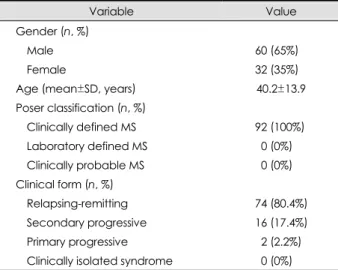
A total of 92 subjects was recruited from the two Greek ter- tiary-care centers. The baseline characteristics of the study population are presented in Table 1. All patients had clinical- ly defined MS according to Poser criteria, and almost 80%
of them had the relapsing-remitting clinical form. None of the patients had a clinically isolated syndrome according to the MS classification.
The MusiQoL comprised 31 items describing the follow- ing 9 dimensions:
1) Activities of daily living (ADL), comprising eight items and accounting for 81.9% of the variance.
2) Physical well-being (PWB), comprising four items and accounting for 9.1% of the variance.
3) Symptoms, comprising three items and accounting for 3.5% of the variance.
4) Relationships with friends, comprising four items and accounting for 2.4% of the variance.
5) Relationships with family, comprising three items and accounting for 1.6% of the variance.
6) Relationship with health-care system, comprising three items and accounting for 0.3% of the variance.
7) Sentimental and sexual life, comprising two items and accounting for 0.7% of the variance.
8) Coping, comprising two items and accounting for 0.5%
of the variance.
9) Rejection, comprising two items and accounting for 0%
of the variance.
The construct validity was confirmed in terms of satisfac- tory IIC (Table 2) correlations and the scaling success of IDV (Table 2). The IIC correlations ranged between 0.42 and 0.86 (with the exception of trait “being satisfied with your treatments”, for which the IIC correlation was 0.31) and IDV ranged from 87.5% to 100%. The Loevinger coefficient (H) analyses confirmed the unidimensionality of each dimension (H range: 0.41-0.88)(Table 3).
Dimensions of the MusiQoL showed high internal consist- ency, with Cronbach’s alpha coefficients ranging from 0.63
to 0.96 (Table 4). Reproducibility was defined with regard to stable patients between test and retest according to either the answer of the patient or the assessment made by the physi- cian using CGI. Overall, the reproducibility was satisfactory with intraclass correlation coefficients ranging from 0.69 to 0.99 and from 0.72 to 0.99 for patients’ answers and physici-
Table 1. Baseline characteristics of the study population (n=192)
Variable Value
Gender (n, %)
Male 60 (65%) Female 32 (35%) Age (mean±SD, years) 40.2±13.9 Poser classification (n, %)
Clinically defined MS 92 (100%) Laboratory defined MS 00 (0%) Clinically probable MS 00 (0%) Clinical form (n, %)
Relapsing-remitting 74 (80.4%)
Secondary progressive 16 (17.4%) Primary progressive 02 (2.2%) Clinically isolated syndrome 00 (0%) MS: multiple sclerosis.
Table 2. Dimension scale characteristics
Dimension (n of items) IIC (min–max) IDV (min–max) IDV (%) MV (%) Floor (%) Ceiling (%)
ADL (8) 0.62-0.86 -0.11-0.63 100.0 03.3 03.3 03.3
PWB (4) 0.62-0.73 -0.03-0.53 100.0 0 01.1 02.2
RFr (3) 0.55-0.72 -0.18-0.35 100.0 14.1 02.2 05.4
SPT (4) 0.42-0.67 -0.03-0.43 096.9 02.2 00.0 25.0
RF (3) 0.54-0.70 -0.08-0.34 100.0 04.3 01.1 28.3
RHCS (3) 0.31-0.45 -0.07-0.63 087.5 04.3 00.0 25.0
SSL (2) 0.84 -0.01-0.31 100.0 14.1 06.5 17.4
COP (2) 0.86 -0.17-0.54 100.0 07.6 15.2 08.7
REJ (2) 0.86 -0.17-0.65 100.0 19.6 04.3 31.5
ADL: activities of daily living, PWB: physical well-being, RFr: relationships with friends, SPT: symptoms, RF: relationships with family, RHCS:
relationship with health-care system, SSL: sentimental and sexual life, COP: coping, REJ: rejection, IIC: item-internal consistency, IDV:
item-discriminant validity, MV: percentage of missing values, Floor: floor effect, Ceiling: ceiling effect.
Table 3. Unidimensionality of each dimension
Dimension (n of items) H INFIT
ADL (8) 0.74 0.80-1.27
PWB (4) 0.66 0.79-1.16
RFr (3) 0.67 0.76-1.27
SPT (4) 0.50 0.74-1.36
RF (3) 0.52 0.72-1.24
RHCS (3) 0.41 0.84-1.16
SSL (2) 0.88 0.95-0.99
COP (2) 0.78 0.97-0.99
REJ (2) 0.83 0.97
INFIT: pattern of item of goodness-of-fit statistics, H: Loevinger coefficient, ADL: activities of daily living, PWB: physical well-be- ing, RFr: relationships with friends, SPT: symptoms, RF: relation- ships with family, RHCS: relationship with health-care system, SSL:
sentimental and sexual life, COP: coping, REJ: rejection.
Table 4. Internal consistency of each dimension
Dimension (n of items) Cronbach’s α
ADL (8) 0.95 PWB (4) 0.86 RFr (3) 0.83 SPT (4) 0.78 RF (3) 0.73 RHCS (3) 0.63 SSL (2) 0.92 COP (2) 0.86 REJ (2) 0.89 Cronbach’s α: Cronbach’s alpha coefficient.
ADL: activities of daily living, PWB: physical well-being, RFr: re- lationships with friends, SPT: symptoms, RF: relationships with fa- mily, RHCS: relationship with health-care system, SSL: sentimen- tal and sexual life, COP: coping, REJ: rejection.
ans’ assessments, respectively (Table 5). External validity testing indicated that the MusiQoL correlated significantly but moderately with all SF-36 dimension scores (Spearman’s correlation coefficient range: 0.43-0.76)(Table 6). Finally, ADL scores correlated strongly with SF-36 dimensions des- cribing physical domains [physical functioning (r=0.85) and vitality (r=0.69)]. PWB also correlated strongly with the SF- 36 mental-health dimension covering psychological issues (r=0.68).
Discussion
Our analyses demonstrated the construct validity, internal con- sistency, reproducibility, and external validity of the Greek
version of the MusiQoL. This study confirmed the process of validation of the MusiQoL version translated into the Greek language and underscores its potential utility as an outcome measure in the clinical-trial setting. None of the previously available HRQoL instruments has been formally translated or validated in Greek patients with MS.
Despite HRQoL questionnaires having become an import- ant outcome parameter in the population health assessment of neurological disorders, very few HRQoL instruments have undergone a formal process of validation in the Greek langu- age.17,18 To the best of our knowledge no HRQoL question- naire has been previously validated in MS patients in Greece.
Our results for the construct validity, internal consistency, and reproducibility of the MusiQoL were similar to those of in- ternational patient samples. They are also in line with previous differential item functioning analyses that have yielded satis- factory results across countries.6 The present findings, in com- bination with those of the initial validation report,6 thus indi- cate a major strength of the MusiQoL; that is, the simultane- ous process of validation in different countries around the world. Finally, they confirm that interviews with patients with MS contribute significantly to understanding patients with this condition,19,20 and underline the importance of translating and validating HRQoL instruments in a patient’s native language in order to take into account national and ethnical disparities related to quality-of-life evaluations.21,22
The following limitations of the present study need to be acknowledged:
1) The sample was relatively small (n=92) and not prede- termined. However, our analyses demonstrating the validity and reproducibility of the MusiQoL in this limited number of patients underscore the robustness of this instrument.
2) Since no patients with clinically isolated syndrome and
Table 5. Reproducibility of each dimension assessed by test-re- test intraclass correlation coefficients (ICCs) by both patients (st- ability defined as no change in general health according to the answer of the patients) and physicians (stability defined as no change in the Clinical Global Impression of Severity)
Dimension (n of items) Patient ICC Physician ICC
ADL (8) 0.99 0.98
PWB (4) 0.89 0.87
RFr (3) 0.91 0.89
SPT (4) 0.69 0.72
RF (3) 0.75 0.78
RHCS (3) 0.98 0.98
SSL (2) 0.94 0.96
COP (2) 0.92 0.93
REJ (2) 0.92 0.87
Index 0.99 0.99
Index: Ambulation Index for MS.
ADL: activities of daily living, PWB: physical well-being, RFr: re- lationships with friends, SPT: symptoms, RF: relationships with fa- mily, RHCS: relationship with health-care system, SSL: sentimen- tal and sexual life, COP: coping, REJ: rejection, MS: multiple sc- lerosis.
Table 6. Spearman’s correlations between MS International Quality-of-Life questionnaire (MusiQoL) and Short-Form 36 (SF-36) scores SF-36
MusiQoL
PF SF RP RE MH V BP GH
ADL (8) -0.85 0.74 0.77 0.61 0.46 0.69 0.32 0.48
PWB (4) -0.15 0.38 0.29 0.43 0.68 0.47 0.39 0.52
RFr (3) -0.02 0.14 0.07 0.07 0.27 0.21 0.07 0.19
SPT (4) -0.23 0.34 0.34 0.50 0.40 0.36 0.37 0.21
RF (3) -0.03 0.13 0.10 0.19 0.42 0.47 0.26 0.37
RHCS (3) -0.44 0.45 0.49 0.44 0.42 0.47 0.26 0.37
SSL (2) -0.24 0.40 0.33 0.34 0.38 0.34 0.15 0.33
COP (2) -0.01 0.31 0.24 0.35 0.56 0.31 0.17 0.31
REJ (2) -0.55 0.63 0.63 0.53 0.49 0.56 0.19 0.44
Index -0.43 0.69 0.66 0.73 0.76 0.70 0.17 0.49
Index: Ambulation Index for MS.
PF: physical functioning, SF: social functioning, RF: role, physical, RE: role, emotional, MH: mental health, V: vitality, BP: bodily pain, GH:
general health, ADL: activities of daily living, PWB: physical well-being, RFr: relationships with friends, SPT: symptoms, RF: relationships with family, RHCS: relationship with health-care system, SSL: sentimental and sexual life, COP: coping, REJ: rejection, MS: multiple sclerosis.
only two patients with primary progressive MS were includ- ed in the present cohort, the potential applicability of the Mu- siQoL in these specific subgroups cannot be inferred on the basis of the present results.
3) The present study performed a retrospective analysis of prospectively collected data. Further research is required to test the strengths and weaknesses of the Greek version of the MusiQoL in a prospective fashion using a larger and more balanced (in terms of clinical subtypes of MS) sample.
Indeed, our group plans to perform a prospective, independ- ent study involving additional academic centers from Greece to evaluate the acceptability and compatibility of the Greek version of the MusiQoL in the clinical-practice setting. Dur- ing that study we also plan to implement the MusiQoL in follow-up evaluations to explore and confirm its sensitivity to changes and to evaluate its potential applicability as a prog- nostic tool.
4) For the external validation of the MusiQoL we used the SF-36 questionnaire, which has not previously been validat- ed in Greek patients with MS.
5) Testing of the external validity of the MusiQoL scores showed significant but moderate correlations with those of the SF-36. Although the former results are encouraging, fur- ther external validation studies utilizing some of the other available HRQoL instruments in MS23,24 may be needed to explore the external validity of the MusiQoL in a more ro- bust fashion.
In conclusion, our findings indicate that the Greek version of the MusiQoL is a valid and reliable instrument with which to evaluate quality of life in Greek patients with MS. In the absence of any other validated HRQoL questionnaire in the Greek language, the MusiQoL appears to be a promising tool that can be readily applied as an outcome measure for evalu- ating treatment or managing care in Greek patients with MS.
REFERENCES
1. McCrone P, Heslin M, Knapp M, Bull P, Thompson A. Multiple scle- rosis in the UK: service use, costs, quality of life and disability. Phar- macoeconomics 2008;26:847-860.
2. Miller DM, Kinkel RP. Health-related quality of life assessment in multiple sclerosis. Rev Neurol Dis 2008;5:56-64.
3. Motl RW, Snook EM. Physical activity, self-efficacy, and quality of life in multiple sclerosis. Ann Behav Med 2008;35:111-115.
4. Whalley D, McKenna SP. Measuring quality of life in patients with depression or anxiety. Pharmacoeconomics 1995;8:305-315.
5. Solari A. Role of health-related quality of life measures in the routine care of people with multiple sclerosis. Health Qual Life Outcomes 2005;3:16.
6. Simeoni M, Auquier P, Fernandez O, Flachenecker P, Stecchi S, Con-
stantinescu C, et al. Validation of the Multiple Sclerosis International Quality of Life questionnaire. Mult Scler 2008;14:219-230.
7. Poser CM, Paty DW, Scheinberg L, McDonald WI, Davis FA, Ebers GC, et al. New diagnostic criteria for multiple sclerosis: guidelines for research protocols. Ann Neurol 1983;13:227-231.
8. McDonald WI, Compston A, Edan G, Goodkin D, Hartung HP, Lu- blin FD, et al. Recommended diagnostic criteria for multiple sclerosis:
guidelines from the International Panel on the diagnosis of multiple sclerosis. Ann Neurol 2001;50:121-127.
9. Ware JE Jr, Sherbourne CD. The MOS 36-item short-form health survey (SF-36). I. Conceptual framework and item selection. Med Care 1992;30:473-483.
10. Tsivgoulis G, Triantafyllou N, Papageorgiou C, Evangelopoulos ME, Kararizou E, Sfagos C, et al. Associations of the Expanded Disability Status Scale with anxiety and depression in multiple sclerosis out- patients. Acta Neurol Scand 2007;115:67-72.
11. Rentzos M, Cambouri C, Rombos A, Nikolaou C, Anagnostouli M, Tsoutsou A, et al. IL-15 is elevated in serum and cerebrospinal fluid of patients with multiple sclerosis. J Neurol Sci 2006;241:25-29.
12. Kurtzke JF. Rating neurologic impairment in multiple sclerosis: an expanded disability status scale (EDSS). Neurology 1983;33:1444- 1452.
13. Kurtzke JF. On the evaluation of disability in multiple sclerosis. Neu- rology 1961;11:686-694.
14. Hauser SL, Dawson DM, Lehrich JR, Beal MF, Kevy SV, Propper RD, et al. Intensive immunosuppression in progressive multiple scle- rosis. A randomized, three-arm study of high-dose intravenous cyclo- phosphamide, plasma exchange, and ACTH. N Engl J Med 1983;308:
173-180.
15. Folstein MF, Robins LN, Helzer JE. The Mini-Mental State Exami- nation. Arch Gen Psychiatry 1983;40:812.
16. Guy W. ECDEU Assessment manual for psychopharmacology, re- vised. Rockville, MD: U.S. Department of Health and Human Services, 1976;218-222.
17. Piperidou H, Terzoudi A, Vorvolakos T, Davis E, Heliopoulos I, Va- dikolias K, et al. The Greek version of the Quality of Life in Epilepsy Inventory (QOLIE-31). Qual Life Res 2006;15:833-839.
18. Piperidou C, Karlovasitou A, Triantafyllou N, Dimitrakoudi E, Ter- zoudi A, Mavraki E, et al. Association of demographic, clinical and treatment variables with quality of life of patients with epilepsy in Greece. Qual Life Res 2008;17:987-996.
19. Courts NF, Buchanan EM, Werstlein PO. Focus groups: the lived ex- perience of participants with multiple sclerosis. J Neurosci Nurs 2004;
36:42-47.
20. Somerset M, Peters TJ, Sharp DJ, Campbell R. Factors that contri- bute to quality of life outcomes prioritised by people with multiple sc- lerosis. Qual Life Res 2003;12:21-29.
21. Kaul P, Lytle BL, Spertus JA, DeLong ER, Peterson ED. Influence of racial disparities in procedure use on functional status outcomes among patients with coronary artery disease. Circulation 2005;111:
1284-1290.
22. Chavers LS, Gilbert GH, Shelton BJ. Racial and socioeconomic dis- parities in oral disadvantage, a measure of oral health-related quality of life: 24-month incidence. J Public Health Dent 2002;62:140-147.
23. Cella DF, Dineen K, Arnason B, Reder A, Webster KA, Karabatsos G, et al. Validation of the functional assessment of multiple sclerosis quality of life instrument. Neurology 1996;47:129-139.
24. Vickrey BG, Hays RD, Harooni R, Myers LW, Ellison GW. A health- related quality of life measure for multiple sclerosis. Qual Life Res 1995;4:187-206.