ABSTRACT
Purpose: Due to adverse events, dose reduction or withdrawal of adjuvant chemotherapy is required for some patients. To identify the predictive factors for tolerability to postoperative adjuvant S-1 monotherapy in gastric cancer (GC) patients, we evaluated the predictive values of blood indicators.
Materials and Methods: We analyzed 98 patients with pStage II/III GC who underwent postoperative adjuvant S-1 monotherapy. We retrospectively analyzed correlations between 14 parameters obtained from perioperative routine blood tests to assess their influence on the withdrawal of postoperative adjuvant S-1 monotherapy, within 6 months after discontinuation.
Results: Postoperative adjuvant chemotherapy was discontinued in 21 patients (21.4%) within 6 months. Univariable analysis revealed that high preoperative albumin-bilirubin (ALBI) scores had the highest odds ratio (OR) for predicting the failure of adjuvant S-1 chemotherapy (OR, 6.47; 95% confidence interval [CI], 2.08–20.1; cutoff value, –2.696).
The high ALBI group had a significantly shorter time to failure of postoperative adjuvant S-1monotherapy (hazard ratio, 3.48; 95% CI, 1.69–7.25; P=0.001). Multivariable analysis identified high preoperative ALBI score as an independent prognostic factor for tolerability (OR, 10.3; 95% CI, 2.33–45.8; P=0.002).
Conclusions: Preoperative ALBI shows promise as an indicator associated with the tolerability of adjuvant S-1 monotherapy in patients with pStage II/III GC.
Keywords: Gastric cancer; S-1; Adjuvant chemotherapy; Biomarker; Albumin-bilirubin score
INTRODUCTION
Gastric cancer (GC) is the second leading cause of cancer-related deaths worldwide [1].
Multimodality treatment is mandatory to improve treatment outcomes of patients with advanced GC, and postoperative adjuvant chemotherapy is the standard of care in East Asia.
Adjuvant chemotherapy with S-1 (an oral fluoropyrimidine) after curative gastrectomy has been a standard regimen based on the Adjuvant Chemotherapy Trial of TS-1 for GC [2]. It
Original Article
Received: Feb 2, 2019 Revised: Mar 14, 2019 Accepted: Apr 9, 2019 Correspondence to Mitsuro Kanda
Department of Gastroenterological Surgery (Surgery II), Nagoya University Graduate School of Medicine, 65 Tsurumai-cho, Showa-ku, Nagoya 466-8550, Japan.
E-mail: [email protected] Copyright © 2019. Korean Gastric Cancer Association
This is an Open Access article distributed under the terms of the Creative Commons Attribution Non-Commercial License (https://
creativecommons.org/licenses/by-nc/4.0) which permits unrestricted noncommercial use, distribution, and reproduction in any medium, provided the original work is properly cited.
ORCID iDs Takashi Miwa
https://orcid.org/0000-0003-2670-6733 Mitsuro Kanda
https://orcid.org/0000-0001-5464-3819 Chie Tanaka
https://orcid.org/0000-0002-7931-8753 Daisuke Kobayashi
https://orcid.org/0000-0002-6965-2707 Masamichi Hayashi
https://orcid.org/0000-0001-6875-2303 Suguru Yamada
https://orcid.org/0000-0001-9912-9119 Yasuhiro Kodera
https://orcid.org/0000-0002-6173-7474
Takashi Miwa , Mitsuro Kanda , Chie Tanaka , Daisuke Kobayashi , Masamichi Hayashi , Suguru Yamada , Goro Nakayama, Masahiko Koike, Yasuhiro Kodera
Department of Gastroenterological Surgery (Surgery II), Nagoya University Graduate School of Medicine, Nagoya, Japan
Albumin-Bilirubin Score Predicts Tolerability to Adjuvant S-1
Monotherapy after Curative
Gastrectomy
Author Contributions
Conceptualization: M.K.; Data curation: M.H.;
Formal analysis: S.Y.; Investigation: C.T.;
Methodology: G.N.; Project administration:
M.K.; Resources: D.K.; Software: T.M.;
Supervision: Y.K.; Visualization: T.M.; Writing - original draft: T.M.; Writing - review &
editing: T.M.
Conflict of Interest
No potential conflict of interest relevant to this article was reported.
has to be administered for 12 months, in contrast to adjuvant chemotherapy for other cancer types, which are delivered for 6 months [3,4].
Inadequately shortened duration or suboptimal dosages of adjuvant chemotherapy may adversely affect long term outcomes in patients with cancer [5]. However, dose reduction or even termination of drug administration is inevitable in some patients because of severe adverse events, especially in GC, in which consequences of the surgery could render patients vulnerable to toxicity. Predicting the likelihood of such adverse events could be useful in planning the treatment schedule and deciding the initial dose and may even encourage a shift to neoadjuvant therapy if an accurate prediction is made preoperatively. JCOG1104 was a phase III trial designed to investigate the non-inferiority of adjuvant S-1 chemotherapy for 6 months compared with that for 12 months in patients with stage II GC. This study failed to demonstrate the non-inferiority of adjuvant S-1 chemotherapy for 6 months, suggesting the importance of continuation of the treatment for more than 6 months [6]. This motivated us to identify the predictive factors for its withdrawal within 6 months. Aoyama et al.
reported that creatinine clearance (CCr) and body-weight loss were the risk factors for early termination of postoperative adjuvant S-1 chemotherapy [7,8]. Other risk factors could be identified by analyzing preoperative data.
The aim of the present study was to identify the risk factors for adverse events associated with the withdrawal of postoperative adjuvant S-1 monotherapy within 6 months, using laboratory data acquired preoperatively through cross-sectional and temporal analyses.
We identified preoperative albumin-bilirubin (ALBI) score to be the most predictive factor.
The ALBI score was initially developed to identify objective measures of liver dysfunction in patients with hepatocellular carcinoma (HCC) [9]. In this study, we demonstrate the clinical significance of ALBI score for predicting tolerability to adjuvant S-1 monotherapy in patients with advanced GC.
MATERIALS AND METHODS
Ethics
This study fully conforms to the ethical guidelines of the World Medical Association Declaration of Helsinki–Ethical Principles for Medical Research Involving Human Subjects (2013). Written informed consent for the use of clinical data was obtained from all patients as required by the Institutional Review Board (IRB) of our University (IRB No. 2018-0424).
Inclusion eligibility and treatment
Patients inclusion criteria were as follows: 1) underwent total or partial gastrectomy and systemic lymphadenectomy between January 2005 and July 2017 at our hospital, 2) had previously untreated stage II/III GC, and 3) received postoperative S-1 adjuvant monotherapy, excluding patients who experienced disease recurrence within 6 months and required another chemotherapy to treat recurrent lesions. Eventually, 98 patients were included in the analysis. These patients were started on S-1 adjuvant monotherapy within 6 weeks after surgery at a dose corresponding to the body surface area as follows: <1.25 m2 (40 mg twice daily), 1.25–1.50 m2 (50 mg twice daily), and ≥1.50 m2 (60 mg twice daily). S-1 was given for 4 weeks followed by 2 weeks' rest and the treatment was to be continued for 12 months unless rendered impossible due to severe adverse events, patient's refusal or recurrent disease.
Treatment-related adverse events were graded according to the criteria of the Common
Terminology Criteria for Adverse Events [10]. Changing the schedule to deliver S-1 for 2 weeks followed by 1 weeks' rest was recommended when patients experienced adverse effects of ≥grade 2 within the first 2 weeks of treatment, and the dose was reduced from 120 mg to 100 mg, 100 mg to 80 mg, or 80 mg to 50 mg in case of other circumstances at the discretion of the physicians. Postoperative follow-up, which was conducted according to the Japanese Gastric Cancer Treatment Guidelines, included physical examinations, laboratory tests, and diagnostic imaging. Patients underwent computed tomography at 6-month intervals and endoscopy at 12-month intervals until 5 years after surgery. Clinical recurrences required confirmation using imaging modalities [11].
Study parameters
Blood tests were routinely performed 2 days before surgery and on the day of postoperative adjuvant chemotherapy initiation. A total of 14 parameters were investigated as candidate predictive factors for early discontinuation of adjuvant S-1 monotherapy due to adverse effects. These parameters can be determined by preoperative routine blood test at any hospital and were potentially correlated to nutritional status and functions of the liver, kidney and bone marrow. The following data were retrospectively retrieved from the medical records: white blood cell count, neutrophil count, total lymphocyte count (TLC), platelet count (Plt), total protein, albumin (Alb), cholinesterase, total bilirubin (T-Bil), aspartate aminotransferase, alanine aminotransferase, indices as candidate predictors: CCr (Cockroft- Gault method), ALBI score [ALBI=log10 T-Bil (µmol/L)×0.66+Alb (g/L)×−0.0852], platelet- lymphocyte ratio (PLR) (PLR=TLC/Plt×100), Onodera's prognostic nutritional index (PNI) (PNI=10×Alb g/dL+0.005×TLC) [12,13].
Statistical analysis
The significance of the differences between the values of qualitative variables between groups was compared using the χ2 test. The cutoff values for predicting the failure of adjuvant S-1 monotherapy within 6 months were determined using receiver operating characteristic (ROC) curve analysis. Univariable and multivariable regression analyses to detect prognostic factors were performed using logistic regression analysis. The Kaplan–Meier method was used to assess overall, disease-free and time-to-treatment failure rates, and the differences between survival curves were analyzed using the log-rank test. The P<0.05 indicated a significant difference. These analyses were performed using R software (The R Foundation for Statistical Computing, Vienna, Austria) with EZR (Saitama Medical Center, Jichi Medical University, Saitama, Japan).
RESULTS
Patients' characteristics
The baseline characteristics of the patients are shown in Table 1. We analyzed 98 patients (male, 73.5%; median age, 67 years; total gastrectomy, 39.8%). Postoperative adjuvant S-1 monotherapy was withdrawn within 6 months from initiation of the treatment in 21 patients (21.4%), because of adverse events as follows; fatigue (n=5), diarrhea (n=4), anorexia (n=4), oral mucositis (n=2), leukopenia (n=1), dacryorrhea (n=1), and others (n=4), all adverse events were grade 3. These patients were considered as the main target population to identify risk factors for early discontinuation of adjuvant S-1 monotherapy, and hence were included in all analyses. The median duration of S-1 administration was 10.2 months and 1.6 months in the patient subgroup with S-withdrawal within 6 months.
Association of the compliance to the chemotherapy with the outcome Patients who withdrew from adjuvant chemotherapy within 6 months were inclined to have poor long-term survival (Fig. 1A).
Comparison of parameters affecting tolerability
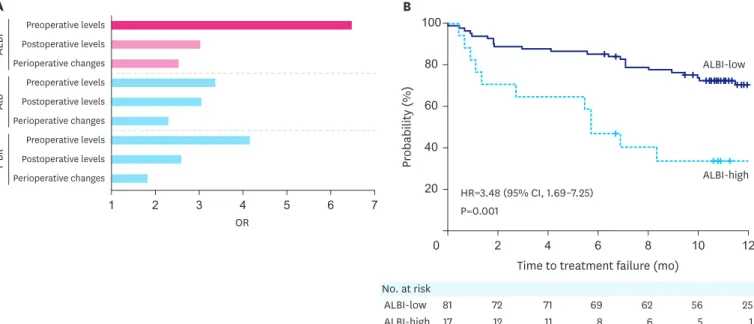
We analyzed 14 parameters at 3 time points as indicated in the materials and methods section. The highest odds ratio (OR) associated with predicting the failure of adjuvant S-1 monotherapy within 6 months was the preoperative ALBI score (OR, 6.47; 95% confidence interval [CI], 2.08–20.1) (Fig. 1B). The optimal cutoff value of ALBI to predict discontinuation of S-1 adjuvant was determined at −2.696 by the ROC analysis (Supplementary Fig. 1A). The ORs of the ALBI score, Alb, and T-Bil at each time point are shown in Fig. 2A.
Predictive significance of the preoperative ALBI score
The median preoperative ALBI score was –3.000 (range, –3.620, –1.529). We evaluated the clinical significance of the preoperative ALBI score by dividing the 98 patients into high ALBI (ALBI >–2.696, n=17) and low ALBI (ALBI ≤–2.696, n=81) groups according to the cutoff value determined through the ROC analysis. The relationships between the ALBI scores and various clinicopathological parameters are shown in Table 2. High ALBI scores were significantly associated with the age and the Union for International Cancer Control Table 1. Clinical characteristics of 98 patients
Variables No. of patients (n=98)
Age (yr) 67 (20–88)
Sex (male/female) 72/26
Preoperative BMI (kg/m2) 22.6±3.7
Diabetes mellitus
Absent 81
Present 17
Cardiopulmonary comorbidities
Absent 64
Present 34
Type of gastrectomy
Total 39
Partial 59
Tumor depth (UICC 8th)
pT1 5
pT2 11
pT3 37
pT4 45
UICC N factor
pN0 16
pN1 23
pN2 26
pN3 33
Pathological stage (UICC 8th)
IIA 15
IIB 24
IIIA 17
IIIB 23
IIIC 19
Follow-up (median, mo) 55.2 (2.2–137.3)
S-1 withdrawal (median, mo) 10.2
<6 21 (1.6)
≥6 77 (11.2)
Values are presented as mean±standard deviation, number (%) or number (range).
BMI = body mass index; UICC = Union for International Cancer Control.
stage. The high ALBI group was shown to suffer from significantly shorter time to failure of postoperative adjuvant S-1 monotherapy (hazard ratio [HR], 3.48; 95% CI, 1.69–7.25;
P=0.001) (Fig. 2B). Multivariable analysis identified preoperative high ALBI score and preoperative CCr<60 mL/min as independent predictive factors for tolerability of 6 months of postoperative adjuvant S-1 monotherapy (ALBI: OR, 10.3; 95% CI, 2.33–45.8; P=0.002 and CCr: OR, 7.28; 95% CI, 1.76–30.1; P=0.006) (Table 3). Disease-free survival (DFS) after OS time (mo)
Blood cell count WBC
Neu TLC Plt TP Alb ChE T-Bil AST ALT CCr ALBI PLR PNI Nutrition
Liver function
Index
A B
Survival rate (%) 60
0 10 30 50 60
100
80
40
20
20 40
OR
1 2 3 4 5 6 7
≥6 mo
<6 mo
No. at risk
≥6 mo
<6 mo 63
17 63
17 60
17 53
13 44
12 37 10
30 6 P=0.313
HR=1.71 (95% CI, 0.60–4.91)
Fig. 1. (A) OS of patients with pStage II/III gastric cancer with or without 6 months of S-1 postoperative adjuvant monotherapy. (B) Preoperative study parameters and ORs.
OS = overall survival; OR = odds ratio; HR = hazard ratio; CI = confidence interval; WBC = white blood cell; Neu = neutrophil count; TLC = total lymphocyte count; Plt = platelet count; TP = total protein; Alb = albumin; ChE = cholinesterase; T-Bil = total bilirubin; AST = aspartate aminotransferase; ALT = alanine aminotransferase; CCr = creatinine clearance; ALBI = albumin-bilirubin; PLR = platelet-lymphocyte ratio; PNI = prognostic nutritional index.
ALBI-low
ALBI-high
Time to treatment failure (mo)
ALBI
Preoperative levels Postoperative levels Perioperative changes Preoperative levels Postoperative levels Perioperative changes Preoperative levels Postoperative levels Perioperative changes
AlbT-Bil
B A
Probability (%)
60
0 2 6 10 12
100
80
40
20
4 8
OR
1 2 3 4 5 6 7
No. at risk ALBI-low ALBI-high
81 17
72 12
71 11
69 8
62 6
56 5
25 1 P=0.001
HR=3.48 (95% CI, 1.69–7.25)
Fig. 2. (A) ORs of ALBI scores and its variables before surgery and postoperative adjuvant chemotherapy initiation and perioperative changes. (B) Time-to-treatment failure of postoperative adjuvant S-1 monotherapy with high and low ALBI scores.
OR = odds ratio; ALBI = albumin-bilirubin; HR = hazard ratio; CI = confidence interval; Alb = albumin; T-Bil = total bilirubin.
curative gastrectomy was significantly shorter in the high ALBI group (HR, 4.33; 95% CI, 1.61–11.7; P=0.003) (Supplementary Fig. 1B). The recurrence rate in the high ALBI group was 50.0% (7 out of 14 patients) and that in the low ALBI group was 13.6% (9 out of 66 patients), within 5 years after curative gastrectomy.
DISCUSSION
The ALBI score is calculated from the serum Alb and bilirubin concentrations. Assessment of subjective variables such as ascites and encephalopathy are necessary for the conventional Child-Pugh grade to assess liver function. The ALBI score was developed initially to eliminate Table 2. Association between ALBI scores and clinicopathological parameters of 98 patients with gastric cancer
Variables Low ALBI High ALBI P-value
Age (yr) 0.010
<70 58 (72) 6 (35)
≥70 23 (28) 11 (65)
Sex 0.589
Male 59 (73) 13 (76)
Female 22 (27) 4 (24)
BMI (kg/m2) 1.000
<22 50 (62) 10 (59)
≥22 31 (38) 7 (41)
Diabetes mellitus 0.487
Absent 68 (84) 13 (76)
Present 13 (16) 4 (24)
Cardiopulmonary comorbidities 0.270
Absent 55 (68) 9 (53)
Present 26 (32) 8 (47)
Type of gastrectomy 0.589
Total 31 (38) 8 (47)
Partial 50 (62) 9 (53)
Tumor depth (UICC 8th) 0.624
pT1 5 (6) 0 (0)
pT2 9 (11) 2 (12)
pT3 32 (40) 5 (29)
pT4 35 (43) 10 (59)
Differentiation 0.098
Differentiated 33 (41) 3 (18)
Undifferentiated 48 (59) 14 (82)
Lymphatic involvement 1.000
Absent 4 (5) 1 (6)
Present 77 (95) 16 (94)
Vessel invasion 1.000
Absent 26 (32) 5 (29)
Present 55 (68) 12 (71)
Lymph node metastasis (UICC 8th) 0.329
pN0 13 (16) 4 (23)
pN1 20 (24) 3 (18)
pN2 24 (30) 2 (12)
pN3 24 (30) 8 (47)
Pathological stage (UICC 8th) 0.009
IIA 11 (13) 4 (23)
IIB 23 (28) 1 (6)
IIIA 16 (19) 1 (6)
IIIB 20 (24) 3 (18)
IIIC 11 (16) 8 (47)
Values are presented as number (%).
ALBI = albumin-bilirubin; BMI = body mass index; UICC = Union for International Cancer Control.
the need for subjective variables and to identify objective measures of liver dysfunction, which independently influence the survival of patients with HCC [9]. This score was also reported to be related to postoperative complications and liver failure [14]. In the present study, we analyzed 14 parameters obtained before surgery and before the initiation of postoperative adjuvant chemotherapy and evaluated the perioperative changes of these parameters.
The CCr was already recognized as a significant predictor of non-compliance to adjuvant S-1 monotherapy [7]. We found a closer correlation between the preoperative ALBI score and tolerability after 6 months of S-1 adjuvant monotherapy. The preoperative ALBI score had the highest OR for the incidence of withdrawal of postoperative adjuvant S-1monotherapy within 6 months. Furthermore, multivariable analysis identified preoperative high ALBI scores and preoperative CCr as 2 independent predictive factors in this aspect.
Alb and bilirubin concentrations to determine the ALBI score are easily measured using standard laboratory tests in most hospitals. Moreover, the ALBI score can serve as a prognostic factor for certain malignancies [9,13,15]. This study revealed that high ALBI scores are associated with shorter time to failure of postoperative adjuvant S-1 monotherapy and caused shorter DFS. Furthermore, the type of gastrectomy was not correlated with the ALBI score, and total gastrectomy was not an independent prognostic factor for discontinuation of S-1 monotherapy within 6 months. These results suggest irrespective of the gastrectomy type, the ALBI score acts as a prognostic factor. However, the reason that the ALBI score predicted patient compliance to adjuvant S-1 chemotherapy remains unclear. S-1 comprises tegafur, gimeracil, and oteracil potassium. Tegafur is a prodrug of the active metabolite fluorouracil (5-FU). Gimeracil inhibits the degradation of 5-FU by reversibly inhibiting dihydropyrimidine dehydrogenase (DPD). Oteracil mainly remains in the gut and reduces the production of 5-FU. 5-FU is metabolized by DPD, and lower 5-FU levels in the gut cause less gastrointestinal toxicity. The degradation of 5-FU occurs in all tissues, including tumor tissues, but mainly in the liver [16,17]. 5-FU is mainly bound to Table 3. Predictive factors for the discontinuation of S-1 monotherapy within 6 months
Variables Univariate Multivariable
OR 95% CI P-value OR 95% CI P-value
Age (≥70 yr) 3.33 1.23–9.02 0.018 2.35 0.81–6.86 0.118
Sex (male) 1.70 0.51–5.62 0.385 - - -
Preoperative BMI (<22, kg/m2) 2.22 0.82–6.02 0.118 - - -
Perioperative body weight loss (≥10%) 1.47 0.50–4.31 0.479 - - -
Preoperative CCr (<60 mL/min) 5.94 1.99–17.8 0.001 7.28 1.76–30.1 0.006
Diabetes mellitus 1.69 0.52–5.50 0.381 - - -
Cardiopulmonary comorbidities 1.21 0.44–3.28 0.712 - - -
Surgical approach (open) 2.11 0.44–10.1 0.350 - - -
Type of gastrectomy (total) 0.70 0.26–1.94 0.496 - - -
Intraoperative bleeding (≥200 mL) 1.43 0.50–4.10 0.507 - - -
Intraoperative transfusion 1.33 0.33–5.46 0.689 - - -
Operative time (≥240 min) 1.57 0.55–4.54 0.402 - - -
Splenectomy 1.19 0.38–3.74 0.764 - - -
Reconstruction method (Billroth I) 0.71 0.14–3.50 0.669 - - -
Tumor location (lower third) 1.44 0.53–3.95 0.474 - - -
Multifocal lesions 1.23 0.12–12.5 0.859 - - -
Tumor size (≥50 mm) 1.03 0.39–2.78 0.946 - - -
Tumor differentiation (undifferentiated) 3.02 0.93–9.38 0.661 - - -
Pathological stage (stage III) 1.10 0.41–2.95 0.857 - - -
Postoperative complication 1.66 0.62–4.46 0.318 - - -
Preoperative ALBI (high) 6.47 2.08–20.1 0.001 10.3 2.33–45.8 0.002
BMI = body mass index; CI = confidence interval; OR = odds ratio; CCr = creatinine clearance; ALBI = albumin-bilirubin.
Alb in the blood, and the free drug is pharmacologically active. Hypoalbuminemia leads to increased blood concentrations of the free drug, which induces profound toxicity [18]. The liver produces Alb, and hypoalbuminemia is defined as malnutrition and liver dysfunction, and hyperbilirubinemia indicates liver dysfunction as well. We hypothesize that, for these reasons, hypoalbuminemia and liver dysfunction are associated with the tolerability of chemotherapy in patients with other cancers [19,20].
High ALBI scores were significantly associated with advanced disease stages. Preoperative high ALBI scores were partially attributed to malnutrition caused by advanced disease [21,22]. Adjuvant chemotherapy is necessary to improve the prognosis of patients in advanced stages, although the high ALBI group had significantly shorter times-to-treatment failure of postoperative S-1 adjuvant monotherapy. To address this paradox, for patients with high preoperative ALBI, first, dose modification or measures against adverse effects can be considered before implementation of S-1 adjuvant to prevent early discontinuation of the S-1 adjuvant. Second, comprehensive perioperative nutrition improvement programs have been attempted to enhance nutritional status, of which postoperative preservation of body weight is a parameter [23]. Such attempts may increase the compliance to evidence-based adjuvant chemotherapy, ultimately leading to improvements in survival [8]. Lastly, intensive follow-up after initiation of S-1 adjuvant should be provided for patients with high preoperative ALBI for early detection of symptoms from adverse effects. For patients with low ALBI, decision has to be made to dose S-1 appropriately.
Interestingly, preoperative ALBI score was the most predicting value of the failure of postoperative adjuvant S-1 monotherapy. Postoperative ALBI can be influenced by hypoalbuminemia from surgical stress, hemodilution, acute inflammation, and elevated T-Bil due to blood transfusion and drug-induced liver dysfunction. These complications might weaken the correlation between postoperative ALBI and times-to-treatment failure of S-1. In contrast, preoperative ALBI reflects innate nutrition status and liver functions.
Therefore, preoperative ALBI score may reflect the tolerability of postoperative S-1 adjuvant monotherapy.
We acknowledge the limitations of our study. The evaluation of dose intensities, which were not available at this time, will possibly provide valuable insights into the understanding of the significance of the ALBI score and its relation to the tolerability of chemotherapy. Second, we did not evaluate adverse drug reactions. Various adverse effects were manifested, but we could not assess ALBI score linked to the adverse effect type. A rigid and comprehensive program performed by a multidisciplinary team to detect and promptly deal with adverse drug reactions, unachievable in the current study, may be able to improve the continuation of chemotherapy. Finally, we conducted a retrospective analysis of data acquired from a relatively small number of patients in single institution. Thus, our findings require validation by further large-scale prospective studies.
In conclusion, the preoperative ALBI score may serve as a significant prognostic biomarker associated with the tolerability of adjuvant S-1 monotherapy in patients with pStage II/III GC.
ACKNOWLEDGMENTS
We thank Edanz Group (www.edanzediting.com/ac) for editing a draft of this manuscript.
SUPPLEMENTARY MATERIAL
Supplementary Fig. 1
Receiver operating characteristic curve analysis of the association of ALBI score with 6 months continuation of S-1 monotherapy. (B) DFS after curative gastrectomy of patients with high and low ALBI scores.
Click here to view
REFERENCES
1. Jemal A, Bray F, Center MM, Ferlay J, Ward E, Forman D. Global cancer statistics. CA Cancer J Clin 2011;61:69-90.
PUBMED | CROSSREF
2. Sakuramoto S, Sasako M, Yamaguchi T, Kinoshita T, Fujii M, Nashimoto A, et al. Adjuvant chemotherapy for gastric cancer with S-1, an oral fluoropyrimidine. N Engl J Med 2007;357:1810-1820.
PUBMED | CROSSREF
3. André T, Tournigand C, Achille E, Tubiana-Mathieu N, Lledo G, Raoul Y, et al. Adjuvant treatment of colon cancer MOSAIC study's main results. Bull Cancer 2006;93 Suppl 1:S5-S9.
PUBMED
4. Early Breast Cancer Trialists' Collaborative Group (EBCTCG), Peto R, Davies C, Godwin J, Gray R, Pan HC, et al. Comparisons between different polychemotherapy regimens for early breast cancer: meta-analyses of long-term outcome among 100,000 women in 123 randomised trials. Lancet 2012;379:432-444.
PUBMED | CROSSREF
5. Sandra-Petrescu F, Herrle F, Burkholder I, Kienle P, Hofheinz RD. Influence of complete administration of adjuvant chemotherapy cycles on overall and disease-free survival in locally advanced rectal cancer: post hoc analysis of a randomized, multicenter, non-inferiority, phase 3 trial. BMC Cancer 2018;18:369.
PUBMED | CROSSREF
6. Yoshikawa T, Terashima M, Mizusawa J, Nunobe S, Nishida Y, Yamada T, et al. Four courses versus eight courses of adjuvant S-1 for patients with stage II gastric cancer (JCOG1104 [OPAS-1]): an open-label, phase 3, non-inferiority, randomised trial. Lancet Gastroenterol Hepatol 2019;4:208-216.
PUBMED | CROSSREF
7. Aoyama T, Yoshikawa T, Hayashi T, Kuwabara H, Mikayama Y, Ogata T, et al. Risk factors for 6-month continuation of S-1 adjuvant chemotherapy for gastric cancer. Gastric Cancer 2013;16:133-139.
PUBMED | CROSSREF
8. Aoyama T, Yoshikawa T, Shirai J, Hayashi T, Yamada T, Tsuchida K, et al. Body weight loss after surgery is an independent risk factor for continuation of S-1 adjuvant chemotherapy for gastric cancer. Ann Surg Oncol 2013;20:2000-2006.
PUBMED | CROSSREF
9. Johnson PJ, Berhane S, Kagebayashi C, Satomura S, Teng M, Reeves HL, et al. Assessment of liver function in patients with hepatocellular carcinoma: a new evidence-based approach-the ALBI grade. J Clin Oncol 2015;33:550-558.
PUBMED | CROSSREF
10. Bennett AV, Dueck AC, Mitchell SA, Mendoza TR, Reeve BB, Atkinson TM, et al. Mode equivalence and acceptability of tablet computer-, interactive voice response system-, and paper-based administration of the U.S. National Cancer Institute's Patient-Reported Outcomes version of the Common Terminology Criteria for Adverse Events (PRO-CTCAE). Health Qual Life Outcomes 2016;14:24.
PUBMED | CROSSREF
11. Japanese Gastric Cancer Association. Japanese gastric cancer treatment guidelines 2014 (ver. 4). Gastric Cancer 2017;20:1-19.
PUBMED | CROSSREF
12. Kanda M, Mizuno A, Tanaka C, Kobayashi D, Fujiwara M, Iwata N, et al. Nutritional predictors for postoperative short-term and long-term outcomes of patients with gastric cancer. Medicine (Baltimore) 2016;95:e3781.
PUBMED | CROSSREF
13. Kanda M, Tanaka C, Kobayashi D, Uda H, Inaoka K, Tanaka Y, et al. Preoperative albumin-bilirubin grade predicts recurrences after radical gastrectomy in patients with pT2-4 gastric cancer. World J Surg 2018;42:773-781.
PUBMED | CROSSREF
14. Andreatos N, Amini N, Gani F, Margonis GA, Sasaki K, Thompson VM, et al. Albumin-bilirubin score:
predicting short-term outcomes including bile leak and post-hepatectomy liver failure following hepatic resection. J Gastrointest Surg 2017;21:238-248.
PUBMED | CROSSREF
15. Ho SY, Liu PH, Hsu CY, Hsia CY, Su CW, Lee YH, et al. Comparison of twelve liver functional reserve models for outcome prediction in patients with hepatocellular carcinoma undergoing surgical resection.
Sci Rep 2018;8:4773.
PUBMED | CROSSREF
16. Ichikawa W. Prediction of clinical outcome of fluoropyrimidine-based chemotherapy for gastric cancer patients, in terms of the 5-fluorouracil metabolic pathway. Gastric Cancer 2006;9:145-155.
PUBMED | CROSSREF
17. Maring JG, Groen HJ, Wachters FM, Uges DR, de Vries EG. Genetic factors influencing pyrimidine- antagonist chemotherapy. Pharmacogenomics J 2005;5:226-243.
PUBMED | CROSSREF
18. Joel SP, Shah R, Clark PI, Slevin ML. Predicting etoposide toxicity: relationship to organ function and protein binding. J Clin Oncol 1996;14:257-267.
PUBMED | CROSSREF
19. Miura K, Konishi J, Miyake T, Makita M, Hojo A, Masaki Y, et al. A host-dependent prognostic model for elderly patients with diffuse large B-cell lymphoma. Oncologist 2017;22:554-560.
PUBMED | CROSSREF
20. Gong J, Cho M, Fakih M. Chemotherapy in patients with hepatobiliary cancers and abnormal hepatic function. J Gastrointest Oncol 2017;8:314-323.
PUBMED | CROSSREF
21. Kanda M, Kodera Y, Sakamoto J. Updated evidence on adjuvant treatments for gastric cancer. Expert Rev Gastroenterol Hepatol 2015;9:1549-1560.
PUBMED | CROSSREF
22. Kanda M, Murotani K, Kobayashi D, Tanaka C, Yamada S, Fujii T, et al. Postoperative adjuvant
chemotherapy with S-1 alters recurrence patterns and prognostic factors among patients with stage II/III gastric cancer: a propensity score matching analysis. Surgery 2015;158:1573-1580.
PUBMED | CROSSREF
23. Imamura H, Nishikawa K, Kishi K, Inoue K, Matsuyama J, Akamaru Y, et al. Effects of an oral elemental nutritional supplement on post-gastrectomy body weight loss in gastric cancer patients: a randomized controlled clinical trial. Ann Surg Oncol 2016;23:2928-2935.
PUBMED | CROSSREF