Clinical Characteristics of the Responders to Dipeptidyl
Peptidase-4 Inhibitors in Korean Subjects with Type 2 Diabetes
We investigated characteristics associated with the efficacy of dipeptidyl peptidase-4 inhibitors (DPP4i) in Korean patients with type 2 diabetes. We reviewed medical records of 477 patients who had taken sitagliptin or vildagliptin longer than 40 weeks. Response to DPP4i was evaluated with HbA1c change after therapy (∆HbA1c). The Student’s t-test between good responders (GR: ∆HbA1c > 1.0%) and poor responders (PR: ∆HbA1c <
0.5%), a correlation analysis among clinical parameters, and a linear multivariate regression analysis were performed. The mean age was 60 yr, duration of diabetes 11 yr and HbA1c was 8.1%. Baseline fasting plasma glucose (FPG), HbA1c, C-peptide, and creatinine were significantly higher in the GR compared to the PR. Duration of diabetes, FPG, HbA1c, C-peptide and creatinine were significantly correlated with ∆HbA1c. In the multivariate analysis, age (r2= 0.006), duration of diabetes (r2= 0.019), HbA1c (r2= 0.296), and creatinine levels (r2= 0.024) were independent predictors for the response to DPP4i. Body mass index and insulin resistance were not associated with the response to DPP4i. In conclusion, better response to DPP4i would be expected in Korean patients with type 2 diabetes who have higher baseline HbA1c and creatinine levels with shorter duration of diabetes.
Key Words: Dipeptidyl Peptidase IV Inhibitors; Diabetes Mellitus, Type 2; Hemoglobin A, Glycosylated; Clinical Efficacy
Tae Jung Oh, Hye Seung Jung, Jae Hyun Bae, Yeong Gi Kim, Kyeong Seon Park, Young Min Cho, Kyong Soo Park, and Seong Yeon Kim Department of Internal Medicine, Seoul National University College of Medicine, Seoul, Korea Received: 19 October 2012
Accepted: 1 April 2013 Address for Correspondence:
Hye Seung Jung, MD
Department of Internal Medicine, Seoul National University College of Medicine, 101 Daehak-ro, Jongno-gu, Seoul 110-744, Korea
Tel: +82.2-2072-0240, Fax: +82.2-762-9662 E-mail: [email protected]
This study was supported by a grant from the Innovative Research Institute for Cell Therapy (A062260) by the Ministry of Health and Welfare, Republic of Korea.
http://dx.doi.org/10.3346/jkms.2013.28.6.881 • J Korean Med Sci 2013; 28: 881-887 Endocrinology, Nutrition & Metabolism
INTRODUCTION
Dipeptidyl peptidase-4 inhibitors (DPP4i) are incretin enhanc- ers which inhibit the degradation of incretin hormones such as glucagon-like peptide-1 and glucose-dependent insulinotropic polypeptide. DPP4i treatment lets the incretin hormones stay active to stimulate insulin synthesis and secretion while inhibit- ing glucagon release from pancreatic islets. There are other me- chanisms of incretin action such as regulation of gastric empty- ing and appetite (1). The Food and Drug Administration approv- ed the first DPP4i in 2006. From then on a lot of clinical studies on it have been published. According to a meta-analysis of ran- domized controlled trials in adults with type 2 diabetes, at least 12 weeks of DPP4i treatment reduced HbA1c levels about 0.74%, which was noninferior to other hypoglycemic agents (2). Re- cently, DPP4i became one of second-line regimens after met- formin in the treatment of type 2 diabetes in the position state- ment suggested by the American Diabetes Association and the European Association for the Study of Diabetes (3).
As the previous studies with DPP4i showed different potency in glycemic controls depending on various patient characteris- tics (2, 4, 5), there seem to be more susceptible patients to DP-
P4i therapy. However, the factors predictive of the blood glu- cose lowering effect of DPP4i have not yet been determined clearly. One of the predictors may be racial disparity. Glucagon- like peptide-1 (GLP-1) responses to a mixed meal or oral glu- cose have been observed different between African Americans and European Americans (6, 7), which can affect the efficacy of DPP4i through GLP-1 response. Efficacy and safety of DPP4i have been demonstrated comparable in Asians to those in Cau- casians (8), but some researchers suggested more prominent HbA1c reduction with DPP4i in Japanese than in Caucasian (9).
There are a few reports on the clinical factors contributing to the efficacy of Sitagliptin, one of DPP4i, in Asian (10-14), but most of the studies are small-sized and retrospective ones, and some results are conflicting. Furthermore, there was no suffi- cient evaluation about insulin secretory capacity. According to the action mechanisms of DPP4i, insulin secretory capacity can be an important factor in the prediction of DPP4i efficacy. These studies generally suggested that subjects who had higher base- line HbA1c, lower body mass index (BMI) and shorter duration of diabetes would show a good response to DPP4i, which will be covered further in the discussion session below.
Therefore, in the current study, we investigated clinical fac-
tors including insulin secretion and resistance that were associ- ated with response to DPP4i in a large number of patients. Al- though this is a retrospective study, the results would provide us important perspective to decide which patients would have more beneficial effects with DPP4i.
MATERIALS AND METHODS Subjects
We reviewed electronic medical records of Seoul National Uni- versity Hospital from January 2008 to March 2011 to find pa- tients with type 2 diabetes who had taken sitagliptin or vilda- gliptin longer than 40 weeks continuously. We excluded pa- tients who had been under use of insulin, those who changed other oral anti-diabetic drugs (OAD) just before and during the period of DPP4i use, those who had history of malignancy, pan- creatitis, thyroid dysfunction or gastrointestinal surgery except appendectomy and those who were taking immune suppres- sant agents including glucocorticoids. As a result, we could en- roll 477 subjects in the final analysis.
Study design
Demographic characteristics, height, weight, duration of diabe- tes and comorbidities such as chronic diabetic complications, hypertension, dyslipidemia, concomitant medications, and history of operation were reviewed by four physicians. Labora- tory data were collected through electronic sorting, including fasting plasma glucose (FPG), postprandial plasma glucose, HbA1c, insulin, C-peptide, total cholesterol, LDL-cholesterol, HDL-cholesterol, triglyceride, aspartate aminotransferase, ala- nine aminotransferase, creatinine, and urine albumin/creati- nine ratio (ACR). Glomerular filtration rate was estimated using the equation from the Modification of Diet in Renal Disease (MDRD) study group (15). BMI was calculated as weight in kilo- grams divided by height in meters squared. Homeostasis model assessment (HOMA) was used in evaluating insulin resistance (HOMA-IR) and pancreatic β-cell function (HOMA-β) (16). In- sulin resistance was also evaluated by the quantitative insulin sensitivity check index (QUICKI) (17). Secretory unit of islet transplantation objects (SUITO) index, which could be applica- ble to the patients with type 2 diabetes (18), was also calculated to evaluate pancreatic β-cell function.
We assessed the response to DPP4i with the HbA1c change from baseline to after 40 weeks therapy (ΔHbA1c). Good respon- ders (GR) were defined as the subjects whose ΔHbA1c was grea- ter than 1.0% and poor responders (PR) as those whose ΔHbA1c was less than 0.5%. According to other clinical trials investigat- ing DPP4i efficacy in patients with similar baseline HbA1c to our subjects, HbA1c reduction by sitagliptin was about 0.7% (2, 19, 20). Considering the expected efficacy of DPP4i, arbitrary cutoff values of ΔHbA1c for the good and the poor responders
were selected as mentioned above. As a result, number of the GR was 170 and that of the PR was 168.
Statistical analysis
Continuous variables are presented as the mean ± standard deviation. Comparisons of continuous variables between the GR and the PR were performed using the Student’s t-test. Sex distribution, hypertension, dyslipidemia, microvascular com- plication and the use of OAD were analyzed by chi-square test.
Sex-adjusted partial correlation analysis with the whole enroll- ed subjects (n = 477) was performed for a univariate analysis.
There were notable data loss in fasting insulin and BMI, and a linear multivariate regression analysis was performed without BMI and the parameters using insulin levels. A level of P < 0.05 was considered statistically significant. All analyses were per- formed using the SPSS 17.0 (SPSS Inc., Chicago, IL, USA).
Ethics statement
The study was approved by the institutional review board of Seoul National University Hospital (IRB No. H-1104-040-358) and was conducted according to the Declaration of Helsinki.
Informed consent was waived by the board.
RESULTS
Comparisons between the patients with good response and poor response
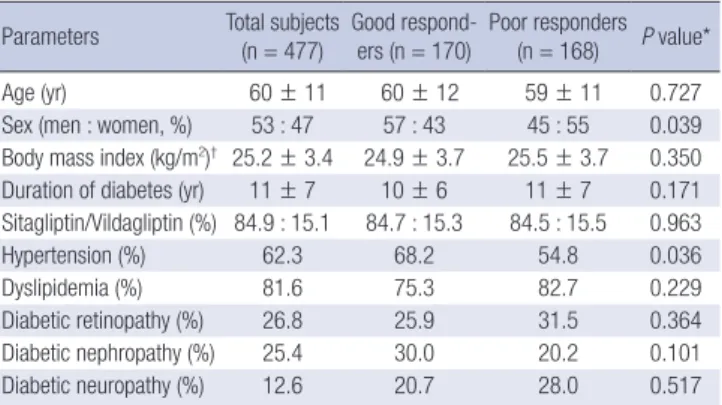
Characteristics of the subjects are demonstrated in Tables 1, 2.
Their mean age was 60 yr, BMI was 25.2 kg/m2 and duration of diabetes was 11 yr. Sitagliptin (100 mg/day in 63%, 50 mg/day in 37%) was prescribed to 84.9% of the subjects and vildagliptin (100 mg/day in 32%, 50 mg/day in 68%) to the others. Majority of the subjects was under inadequate glycemic control (base- line HbA1c 8.1 ± 0.9%), and HbA1c reduction after 40-weeks of DPP4i treatment was averaged 0.8 ± 1.1% (Table 2). Other labo-
Table 1. Comparisons of clinical characteristics between the good responders and the poor responders
Parameters Total subjects
(n = 477) Good respond-
ers (n = 170) Poor responders (n = 168) P value*
Age (yr) 60 ± 11 60 ± 12 59 ± 11 0.727
Sex (men : women, %) 53 : 47 57 : 43 45 : 55 0.039 Body mass index (kg/m2)† 25.2 ± 3.4 24.9 ± 3.7 25.5 ± 3.7 0.350 Duration of diabetes (yr) 11 ± 7 10 ± 6 11 ± 7 0.171 Sitagliptin/Vildagliptin (%) 84.9 : 15.1 84.7 : 15.3 84.5 : 15.5 0.963
Hypertension (%) 62.3 68.2 54.8 0.036
Dyslipidemia (%) 81.6 75.3 82.7 0.229
Diabetic retinopathy (%) 26.8 25.9 31.5 0.364
Diabetic nephropathy (%) 25.4 30.0 20.2 0.101
Diabetic neuropathy (%) 12.6 20.7 28.0 0.517
Data are presented as mean ± standard deviation or percent (%). *P values by Stu- dent’s t-test for continuous variables and by chi-square test for frequencies between the good responders and the poor responders; †n = 247 (total), 85 (GR), 87 (PR).
ratory data including insulin secretion, cholesterol levels and renal function are listed in the Table 2.
Comparisons of baseline characteristics between the GR and the PR demonstrated that there was no difference in age, dura- tion of diabetes, the method of DPP4i use and the rates of dia- betic complications. BMI data was available approximately half of the subjects, which were comparable between the two groups.
Sex distribution was slightly different between the GR and the PR: more proportion of men was observed in the GR than in the PR (57% vs 45%, P = 0.039, Table 1). The rate of hyperten- sion was higher in the GR, too (68.2% vs 54.8%, P = 0.036).
In the Table 2, glucose homeostasis and other laboratory data of the 2 groups are compared. Baseline HbA1c and FPG were significantly higher in the GR (8.5 ± 0.9%; 158 ± 41 mg/dL, re- spectively) than in the PR (7.7 ± 0.9%; 148 ± 35 mg/dL), but the difference in postprandial plasma glucose was insignificant. Af- ter 40-weeks of DPP4i treatment, HbA1c reduced by 1.9 ± 0.7%
in the GR, while it rather increased by 0.3 ± 0.6% in the PR, and the percentage reaching HbA1c less than 7% was significantly higher in the GR (67.6%) than in the PR (11.3%). FPG also re- duced by 31.5 ± 40.6 mg/dL in the GR, but increased by 15.7 ± 61.4 mg/dL in the PR. Fasting insulin levels and other indices of insulin secretory function and insulin resistance such as HOMA- β, SUITO index, HOMA-IR, and QUICKI were comparable be- tween the groups. However, fasting C-peptide levels were sig- nificantly higher in the GR. Fasting insulin levels and HOMA-β could fail of significant difference because of their small num-
ber of available data (65% of the subjects in the each group).
There were no differences in lipid profiles, aspartate amino- transferase and alanine aminotransferase. Creatinine levels were significantly higher in the GR compared to the PR, while estimated glomerular filtration rate (eGFR) which implied gen- der effects seemed to be comparable. ACR showed marginal increase in the GR (P = 0.080).
OAD which were concurrently prescribed with DPP4i were not different between the groups (Table 3). Majority of the sub- jects had taken combination therapy with metformin and sul- fonylurea.
Analysis of predictive parameters for the response to DPP4i
According to the sex-adjusted partial correlation analysis, dura- tion of diabetes (r = -0.112, P = 0.025), FPG (r = 0.145, P = 0.002), Table 2. Comparisons of laboratory data between the good responders and the poor responders
Tested items Total subjects (n = 477) Good responders (n = 170) Poor responders (n = 168) P value*
HbA1c (%) 8.1 ± 0.9 8.5 ± 0.9 7.7 ± 0.9 < 0.001
∆HbA1c (%) 0.8 ± 1.1 1.9 ± 0.7 -0.3 ± 0.6 < 0.001
Percentages achieving HbA1c < 7.0% (%) 42.6 67.6 11.3 < 0.001
Fasting plasma glucose (mg/dL) 151 ± 36 158 ± 41 148 ± 35 0.019
∆FPG (mg/dL) 10.9 ± 50.8 31.5 ± 40.6 -15.7 ± 61.4 < 0.001
Postprandial plasma glucose (mg/dL) 237 ± 67 246 ± 74 237 ± 67 0.285
Fasting insulin (µIU/mL)† 13.1 ± 8.8 14.0 ± 10.5 13.1 ± 9.0 0.476
Fasting C-peptide (ng/mL) 2.2 ± 1.4 2.5 ± 1.6 2.0 ± 1.2 0.002
HOMA-β† 80.7 ± 164.3 97.1 ± 241.8 73.5 ± 66.2 0.356
SUITO index 43.1 ± 42.3 45.3 ± 45.6 44.3 ± 48.5 0.299
HOMA-IR† 4.7 ± 3.0 5.1 ± 3.4 4.7 ± 3.3 0.382
QUICKI† 0.313 ± 0.024 0.310 ± 0.024 0.314 ± 0.024 0.225
Total cholesterol (mg/dL) 165.7 ± 34.5 167.2 ± 35.2 165.2 ± 34.7 0.601
Triglyceride (mg/dL) 165.9 ± 126.2 171.3 ± 111.0 154.9 ± 75.6 0.115
HDL-cholesterol (mg/dL) 47.4 ± 12.2 46.0 ± 10.6 48.4 ± 13.6 0.076
LDL-cholesterol (mg/dL) 95.5 ± 28.9 98.3 ± 30.0 95.8 ± 30.7 0.473
Aspartate aminotransferase (IU/L) 25.9 ± 13.6 25.6 ± 13.5 25.9 ± 14.4 0.873
Alanine aminotransferase (IU/L) 31.8 ± 23.2 31.9 ± 20.7 30.8 ± 22.8 0.356
Creatinine (mg/dL) 0.95 ± 0.21 1.00 ± 0.23 0.91 ± 0.19 < 0.001
eGFR (mL/min/1.73 m2) 80.4 ± 18.2 77.3 ± 17.9 80.6 ± 18.3 0.104
Urine albumin/creatinine ratio (mg/g) 69.9 ± 213.5 111.8 ± 292.8 59.7 ± 194.2 0.080
Data are presented as mean ± standard deviation or percent (%). *P values by Student’s t-test for continuous variables and by chi-square test for frequencies between the good responders and the poor responders; †n = 322 (total), 112 (GR), 111 (PR). eGFR, estimated glomerular filtration rate; FPG, fasting plasma glucose; HOMA-β, homeostasis model assessment of β-cell function; HOMA-IR, homeostasis model assessment of insulin resistance; QUICKI, quantitative insulin sensitivity check index; SUITO, secretory unit of islet transplant objects.
Table 3. Comparisons of oral anti-diabetics between the good responders and the poor responders
Medication Total subjects
(n = 477) Good responders
(n = 170) Poor responders (n = 168) P value*
DPP4i only 0.6 0 1.2
DPP4i + MET 37.7 32.9 36.3 0.568
DPP4i + SU 3.1 3.5 4.2 0.761
DPP4i + MET + SU 58.6 63.6 58.3 0.988
Data are presented as percent (%). *P values by chi-square test for frequencies be- tween the good responders and the poor responders. DPP4i, DPP-4 inhibitors; MET, metformin; SU, sulfonylurea.
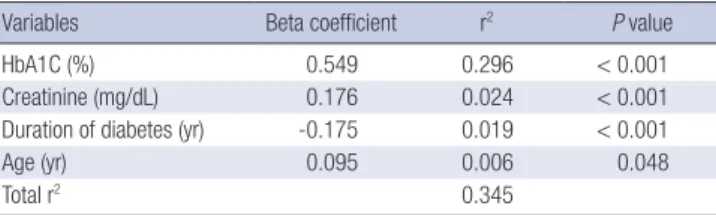
HbA1c (r = 0.528, P < 0.001), C-peptide (r = 0.127, P = 0.005), and creatinine concentrations (r = 0.116, P = 0.012) were asso- ciated with ΔHbA1c (Table 4). Using the ΔHbA1c as a depen- dent variable, with age, sex, duration of diabetes, HbA1c, C-pep- tide, creatinine, eGFR, and ACR as independent variables, a mul- tivariate linear regression analysis was performed. We found that age, duration of diabetes, baseline HbA1c, and creatinine levels were independent predictors for the response to DPP4i.
All four variables together explained 34.5% of the total variance in ΔHbA1c (Table 5).
DISCUSSION
Adding a second or third OAD in poorly-controlled old patients with multiple diabetic complications can be challenging, espe- cially when the patients are reluctant to insulin injection. DPP4i are a new therapeutic class for type 2 diabetes that can be used as a monotherapy or an add-on therapy, and may have some advantages over other OAD, particularly for certain high-risk groups: they allow effective glycemic control with low risk of hypoglycemia, neutral effect on body weight, and the conve- nience of once-daily oral dosing, which may help to improve patients’ adherence to therapy (1, 3, 4). However, the cost is rel- atively high, and it does not work in some patients at all, as we observed in this study. Therefore, we evaluated characteristics of those who showed good response to additive DPP4i, who had not been in adequate glycemic control with metformin and/or sulfonylurea. As far as we know, it is the largest study on the pre-
dictors for DPP4i efficacy ever published.
As reported before by previous researchers (10-12), baseline HbA1c was an important predictor for DPP4i efficacy just as other OAD (21). Baseline FPG levels were also observed higher in the GR than in the PR and correlated with ∆HbA1c in the univariate analysis, but it was not an independent predictor in the regression analysis. Postprandial plasma glucose showed no significant difference between the 2 groups nor significant correlation with DPP4i efficacy. Because of the retrospective design of this study, postprandial plasma glucose levels had not been measured by standardized method. Therefore, it is hard to conclude whether the postprandial plasma glucose levels cor- relate with the response to DPP4i treatment or not in this study.
Actually, DPP4i treatment had been reported to improve both fasting and postprandial glycemia (2).
Another independent predictor found in the regression anal- ysis was duration of diabetes. It was also suggested as a predic- tor in other studies, within the range of 6-11 yr (11-13). Because insulin secretory capacity is known to be decreased according to duration of type 2 diabetes (22), we could speculate that in- sulin secretory function can be another predictor to DPP4i effi- cacy. In addition, augmented insulin secretion is one of main mechanisms of DPP4i (1). We evaluated β-cell function using fasting C-peptide (23), HOMA-β (16), and SUITO index (18).
Among them, only fasting C-peptide was increased in the GR group compared to the PR (2.5 ± 1.6 vs 2.0 ± 1.2 ng/mL, Table 2), and were associated with ΔHbA1c (r = 0.127, Table 4). How- ever, it lost the statistical significance in the multivariate regres- sion analysis. Therefore, we cannot conclude that good β-cell function is a necessary condition for a good response to DPP4i.
There are 2 reports on the relationship between insulin secre- tion and the response to DPP4i. Lim et al. evaluated factors pre- dicting therapeutic efficacy of combination treatment with sita- gliptin and metformin (11). It was a prospective, randomized study in drug-naïve type 2 diabetic patients. They found that high baseline HbA1c and short duration of diabetes were inde- pendent parameters for the reduction of HbA1c. However, fast- ing C-peptide was not different between the highest and the lowest quartiles of HbA1c reduction in the study, while HOMA-β and insulinogenic index were significantly higher in the lowest quartile than in the highest one. Furthermore, insulinogenic in- Table 4. Sex-adjusted partial correlation analysis between the clinical characteristics
and the response to DPP-4 inhibitors
Variables Partial correlation coefficient P value
Age (yr) 0.020 0.668
Body mass index (kg/m2)* -0.067 0.294
Duration of diabetes (yr) -0.112 0.025
Fasting plasma glucose (mg/dL) 0.145 0.002
Postprandial plasma glucose (mg/dL) 0.034 0.504
HbA1 (%) 0.528 < 0.001
Fasting insulin (µIU/mL)† 0.017 0.756
Fasting C-peptide (ng/mL) 0.127 0.005
HOMA-IR† 0.070 0.223
HOMA-β† 0.037 0.543
QUICKI† -0.045 0.435
SUITO index 0.024 0.606
Total cholesterol (mg/dL) 0.026 0.570
Triglyceride (mg/dL) 0.054 0.244
HDL-cholesterol (mg/dL) -0.043 0.352
LDL-cholesterol (mg/dL) 0.032 0.509
Aspartate aminotransferase (IU/L) -0.033 0.475
Alanine aminotransferase (IU/L) 0.008 0.870
Creatinine (mg/dL) 0.116 0.012
eGFR (mL/min/1.73 m2) -0.045 0.333
Urine albumin/creatinine ratio (mg/g) 0.083 0.095
*n = 247 (total), 85 (GR), 87 (PR); †n = 322 (total), 112 (GR), 111 (PR).
Table 5. Multivariate linear regression analysis
Variables Beta coefficient r2 P value
HbA1C (%) 0.549 0.296 < 0.001
Creatinine (mg/dL) 0.176 0.024 < 0.001
Duration of diabetes (yr) -0.175 0.019 < 0.001
Age (yr) 0.095 0.006 0.048
Total r2 0.345
The dependent variable was ∆HbA1c (%). The independent variables were age, sex, duration of diabetes, HbA1c, C-peptide, creatinine, estimated glomerular filtration rate, and urine albumin/creatinine ratio.
dex became an independent negative factor for the response to combination therapy. They explained this phenomenon as glu- cotoxicity: that is, subjects who had higher HbA1c responded better to the combination therapy with sitagliptin and metfor- min, but they had been under severe glucotoxicity which im- paired insulin secretion transiently. They suggested that the low insulinogenic index in the early phase of type 2 diabetes might indicate reversible potential of pancreatic β-cell dysfunction.
Under this condition, they suggested that the use of metformin might have reversed the reduced expression of incretin recep- tor, which would augment the effects of combined sitagliptin.
The different study design such as initial combination with sita- gliptin and metformin, and the drug-naïve, early phase of type 2 diabetic patients makes it difficult to compare this study to our current one, but both did not support any idea that baseline insulin secretory function is an important predictor to the re- sponse to DPP4i. In another study, Kim et al. retrospectively evaluated if baseline insulin secretion as a predictive parameter for the therapeutic efficacy of sitagliptin (10). The subjects were mostly under metformin single therapy, baseline HbA1c was 8.5% and duration of diabetes was 7.7 yr. In that study, fasting C-peptide and HOMA-β were not related with efficacy of sita- gliptin in a logistic regression analysis. Therefore, we do not have evidences now about the impact of β-cell function on the DPP4i efficacy. Nonetheless, HOMA index and fasting C-peptide lev- els provide only an estimate of pancreatic β-cell function, which requires appropriate use and cautious interpretation.
High BMI has been found as an independent predictor for poor response to DPP4i in 2 Japanese studies (12, 13). We could not observe any significant relationship between BMI and DP- P4i efficacy in our study. Missing values and non-standardized method of measurement might have caused this discordant re- sult. Lim et al. did not report any relationships between them either, although there was a confounding factor of concurrent combination with metformin (11). If this association exists, the mechanisms why increased BMI is associated with a smaller degree of HbA1c reduction with sitagliptin have yet to be re- vealed. One possibility is through insulin resistance, because obesity is closely linked to insulin resistance. Insulin resistance was not dealt with by the 2 Japanese researches (12, 13). Our analysis using HOMA-IR and QUICKI did not suggest any rela- tions between insulin resistance and DPP4i efficacy (Tables 2, 4). Alternatively, GLP-1 levels in response to oral intake have been reduced in obese patients, which can attenuate the effica- cy of DPP4i as an inhibitor of GLP-1 degradation (24, 25). Fur- ther investigations to confirm whether BMI is related to the re- sponse to DPP4i and to elucidate the mechanisms would be re- quired.
The DPP4i we examined, sitagliptin and vildagliptin, are ex- creted mainly by urine (26, 27), and dose adjustments are need- ed in severe renal impairment (28). In addition, there is a report
that dipeptidyl peptidase-4 was exceptionally concentrated in rodent kidney glomeruli (29). We found that creatinine concen- trations were significantly higher in the GR compared to the PR (1.00 ± 0.23 vs 0.91 ± 0.19 mg/dL, P < 0.001, Table 2) although they were within normal range. And, the creatinine levels cor- related with HbA1c reduction both in the univariate and multi- variate analyses (Tables 4, 5). Therefore, trivial differences in glomerular damage or function could have affected the efficacy of DPP4i. However, eGFR estimated by the MDRD equation did not reflect it in the current study. In the study by Bando et al., eGFR was not an independent determinant of HbA1c reduc- tion in response to sitagliptin, either (12). The MDRD equation has poor accuracy when GFR is larger than 60 mL/min/1.73 m2 (30), where the eGFR of the subjects in both the studies lied.
According to another study dealing with creatinine levels by Lim et al. (11), response to initial combination of metformin and sitagliptin was not associated with creatinine levels, where we cannot discriminate the effects of metformin. Serum creati- nine concentrations are known to be dependent on age, sex, dietary protein and muscle mass, which suggests some con- founders other than glomerular function in the interpretation of creatinine levels.
We observed more patients with hypertension or higher ACR levels in the GR compared to the PR (68.2 vs 54.8%; 111.8 ± 292.8 vs 59.7 ± 194.2 mg/g, respectively, Tables 1, 2). We found more patients had both of hypertension and microalbuminuria in the GR compared to the PR (26.5 vs 17.4%, P = 0.049). It sug- gests that there might be some differences in anti-hypertensive agents, for example angiotensin converting enzyme inhibitors/
angiotensin receptor blockers between the groups, and possi- ble drug interaction affecting DPP4i efficacy. Further investiga- tions on this topic would be warranted.
This study has several limitations, because of its retrospec- tiveness. There are some missing values in several variables, lit- tle information on lifestyle and drug compliance, and confoun- ding effects by concurrent medications. Measurement methods of prandial glucose levels and BMI were not strictly standard- ized. More sophisticated method for evaluating insulin secre- tion should be applied. In addition, dosage of DPP4i was not standardized in this study. About 42 percent of total subjects re- ceived 50 mg/day, which is lower than usual dose (100 mg/day).
It was not because of their renal function impairment, but be- cause of the physicians’ own decision on optimal treatment.
When we excluded these subjects in the analyses, we could ob- serve similar results with weaker statistical significance, which might come from small numbers of subjects. Even though, fur- ther prospective study would be needed to confirm our results.
In summary, the present study suggested that high baseline HbA1c and creatinine levels with short duration of diabetes would allow physicians to predict a good response to DPP4i in elderly patients with inadequately controlled type 2 diabetes
under metformin with/without sulfonylurea.
DISCLOSURE
The authors have no conflicts of interest to disclose.
REFERENCES
1. Drucker DJ, Nauck MA. The incretin system: glucagon-like peptide-1 re- ceptor agonists and dipeptidyl peptidase-4 inhibitors in type 2 diabetes.
Lancet 2006; 368: 1696-705.
2. Amori RE, Lau J, Pittas AG. Efficacy and safety of incretin therapy in type 2 diabetes: systematic review and meta-analysis. JAMA 2007; 298: 194- 206.
3. Inzucchi SE, Bergenstal RM, Buse JB, Diamant M, Ferrannini E, Nauck M, Peters AL, Tsapas A, Wender R, Matthews DR. Management of hy- perglycemia in type 2 diabetes: a patient-centered approach: position statement of the American Diabetes Association (ADA) and the Europe- an Association for the Study of Diabetes (EASD). Diabetes Care 2012; 35:
1364-79.
4. Nauck MA, Meininger G, Sheng D, Terranella L, Stein PP; Sitagliptin Study 024 Group. Efficacy and safety of the dipeptidyl peptidase-4 in- hibitor, sitagliptin, compared with the sulfonylurea, glipizide, in patients with type 2 diabetes inadequately controlled on metformin alone: a ran- domized, double-blind, non-inferiority trial. Diabetes Obes Metab 2007;
9: 194-205.
5. Goldstein BJ, Feinglos MN, Lunceford JK, Johnson J, Williams-Herman DE; Sitagliptin 036 Study Group. Effect of initial combination therapy with sitagliptin, a dipeptidyl peptidase-4 inhibitor, and metformin on glycemic control in patients with type 2 diabetes. Diabetes Care 2007; 30:
1979-87.
6. Higgins PB, Férnández JR, Garvey WT, Granger WM, Gower BA. En- tero-insular axis and postprandial insulin differences in African Ameri- can and European American children. Am J Clin Nutr 2008; 88: 1277-83.
7. Velasquez-Mieyer PA, Cowan PA, Umpierrez GE, Lustig RH, Cashion AK, Burghen GA. Racial differences in glucagon-like peptide-1 (GLP-1) concentrations and insulin dynamics during oral glucose tolerance test in obese subjects. Int J Obes Relat Metab Disord 2003; 27: 1359-64.
8. Mu YM, Misra A, Adam JM, Chan SP, Chow FC, Cunanan EC, Deero- chanawong C, Jang HC, Khue NT, Sheu WH, et al. Managing diabetes in Asia: overcoming obstacles and the role of DPP-IV inhibitors. Diabe- tes Res Clin Pract 2012; 95: 179-88.
9. Kikuchi M, Abe N, Kato M, Terao S, Mimori N, Tachibana H. Vildagliptin dose-dependently improves glycemic control in Japanese patients with type 2 diabetes mellitus. Diabetes Res Clin Pract 2009; 83: 233-40.
10. Kim SA, Shim WH, Lee EH, Lee YM, Beom SH, Kim ES, Yoo JS, Nam JS, Cho MH, Park JS, et al. Predictive clinical parameters for the therapeutic efficacy of sitagliptin in korean type 2 diabetes mellitus. Diabetes Metab J 2011; 35: 159-65.
11. Lim S, An JH, Shin H, Khang AR, Lee Y, Ahn HY, Yoon JW, Kang SM, Choi SH, Cho YM, et al. Factors predicting therapeutic efficacy of combination treatment with sitagliptin and metformin in type 2 diabetic patients: the COSMETIC study. Clin Endocrinol (Oxf) 2012; 77: 215-23.
12. Bando Y, Kanehara H, Aoki K, Hisada A, Toya D, Tanaka N. Obesity may
attenuate the HbA1c-lowering effect of sitagliptin in Japanese type 2 dia- betic patients. J Diabetes Investig 2012; 3: 170-4.
13. Nomiyama T, Akehi Y, Takenoshita H, Nagaishi R, Terawaki Y, Nagasa- ko H, Kudo T, Kodera T, Kobayashi K, Urata H, et al. Contributing fac- tors related to efficacy of the dipeptidyl peptidase-4 inhibitor sitagliptin in Japanese patients with type 2 diabetes. Diabetes Res Clin Pract 2012;
95: e27-8.
14. Kim WJ, Park CY, Jeong EH, Seo JY, Seol JS, Park SE, Rhee EJ, Lee WY, Oh KW, Park SW, et al. Retrospective analysis on the efficacy, safety and treatment failure group of sitagliptin for mean 10-month duration. Dia- betes Metab J 2011; 35: 290-7.
15. Levey AS, Bosch JP, Lewis JB, Greene T, Rogers N, Roth D. A more accu- rate method to estimate glomerular filtration rate from serum creatinine:
a new prediction equation. Modification of Diet in Renal Disease Study Group. Ann Intern Med 1999; 130: 461-70.
16. Matthews DR, Hosker JP, Rudenski AS, Naylor BA, Treacher DF, Turner RC. Homeostasis model assessment: insulin resistance and beta-cell func- tion from fasting plasma glucose and insulin concentrations in man. Di- abetologia 1985; 28: 412-9.
17. Katz A, Nambi SS, Mather K, Baron AD, Follmann DA, Sullivan G, Quon MJ. Quantitative insulin sensitivity check index: a simple, accurate me- thod for assessing insulin sensitivity in humans. J Clin Endocrinol Metab 2000; 85: 2402-10.
18. Yamada Y, Fukuda K, Fujimoto S, Hosokawa M, Tsukiyama K, Nagashi- ma K, Fukushima M, Suzuki H, Toyoda K, Sassa M, et al. SUIT, secretory units of islets in transplantation: An index for therapeutic management of islet transplanted patients and its application to type 2 diabetes. Dia- betes Res Clin Pract 2006; 74: 222-6.
19. Charbonnel B, Karasik A, Liu J, Wu M, Meininger G; Sitagliptin Study 020 Group. Efficacy and safety of the dipeptidyl peptidase-4 inhibitor si- tagliptin added to ongoing metformin therapy in patients with type 2 di- abetes inadequately controlled with metformin alone. Diabetes Care 2006; 29: 2638-43.
20. Rosenstock J, Brazg R, Andryuk PJ, Lu K, Stein P; Sitagliptin Study 019 Group. Efficacy and safety of the dipeptidyl peptidase-4 inhibitor sita- gliptin added to ongoing pioglitazone therapy in patients with type 2 di- abetes: a 24-week, multicenter, randomized, double-blind, placebo-con- trolled, parallel-group study. Clin Ther 2006; 28: 1556-68.
21. Sherifali D, Nerenberg K, Pullenayegum E, Cheng JE, Gerstein HC. The effect of oral antidiabetic agents on A1C levels: a systematic review and meta-analysis. Diabetes Care 2010; 33: 1859-64.
22. U.K. prospective diabetes study 16. Overview of 6 years’ therapy of type II diabetes: a progressive disease: U.K. Prospective Diabetes Study Group.
Diabetes 1995; 44: 1249-58.
23. Faber OK, Binder C. C-peptide response to glucagon: a test for the resid- ual beta-cell function in diabetes mellitus. Diabetes 1977; 26: 605-10.
24. Muscelli E, Mari A, Casolaro A, Camastra S, Seghieri G, Gastaldelli A, Holst JJ, Ferrannini E. Separate impact of obesity and glucose tolerance on the incretin effect in normal subjects and type 2 diabetic patients. Di- abetes 2008; 57: 1340-8.
25. Ranganath LR, Beety JM, Morgan LM, Wright JW, Howland R, Marks V.
Attenuated GLP-1 secretion in obesity: cause or consequence? Gut 1996;
38: 916-9.
26. Herman GA, Stevens C, Van Dyck K, Bergman A, Yi B, De Smet M, Sny- der K, Hilliard D, Tanen M, Tanaka W, et al. Pharmacokinetics and phar-
macodynamics of sitagliptin, an inhibitor of dipeptidyl peptidase IV, in healthy subjects: results from two randomized, double-blind, placebo- controlled studies with single oral doses. Clin Pharmacol Ther 2005; 78:
675-88.
27. He YL, Sabo R, Campestrini J, Wang Y, Riviere GJ, Nielsen JC, Rosen- berg M, Ligueros-Saylan M, Howard D, Dole WP. The effect of age, gen- der, and body mass index on the pharmacokinetics and pharmacody- namics of vildagliptin in healthy volunteers. Br J Clin Pharmacol 2008;
65: 338-46.
28. Bergman AJ, Cote J, Yi B, Marbury T, Swan SK, Smith W, Gottesdiener
K, Wagner J, Herman GA. Effect of renal insufficiency on the pharmaco- kinetics of sitagliptin, a dipeptidyl peptidase-4 inhibitor. Diabetes Care 2007; 30: 1862-4.
29. Kettmann U, Humbel B, Holzhausen HJ. Ultrastructural localization of dipeptidylpeptidase IV in the glomerulum of the rat kidney. Acta Histo- chem 1992; 92: 225-7.
30. Julie Lin BMD. Azotemia and urinary abnormalities. In: Longo D, Fauci A, Kasper D, Hauser S, Loscalzo J, editors. Harrison’s Principles of Inter- nal Medicine. 18th ed. New York: McGraw-Hill, 2011.