ABSTRACT
Background: The purposes of this study were 1) to investigate the incidence of pneumonia during hospitalization in elderly hip fracture patients, 2) to evaluate the effect of pneumonia on 30 day to 1 year mortality and 3) to analyze the impact of age and gender on the mortality rate in the pneumonia patients using a nationwide cohort of Korea.
Methods: The Korean National Health Insurance Service (NHIS) database included approximately 5.5 million Korean enrollees > 60 years of age. A total of 588,147 participants were randomly selected for senior cohort using 10% simple random sampling. We identified senile (> 65 years old) patients who underwent hip fracture surgery from January 2005 to December 2014 and those who developed pneumonia during hospitalization from the NHIS- Senior cohort. The index date of hip fracture occurrence was defined as the date of admission to the acute care hospital. The last date of follow-up was defined as the date of death or 31 December 2015, whichever came first. A multivariable-adjusted Cox proportional hazards model was used to investigate the effects of pneumonia on all-cause mortality.
Results: During the enrollment period, a total of 14,736 patients, who were older than 65 years, underwent hip fracture surgeries. Among them, 1,629 patients (11.05%) developed pneumonia during the hospitalization. The pneumonia incidence was 16.39% (601/3,666) in men patients and 9.29% (1,028/10,042) in women patients. Compared to 13,107 non-pneumonia patients, adjusted relative risk (aRR) of death in pneumonia patients was 2.69 (95% confidence interval [CI], 2.14–3.38; P < 0.001) within postoperative 30-day, 3.40 (95% CI, 3.01–3.83; P < 0.001) within postoperative 90-day, 2.86 (95% CI, 2.61–3.15; P < 0.001) within postoperative 180-day and 2.31 (95% CI, 2.14–2.50; P < 0.001) within postoperative 1-year. According to patient's age, the aRR of death in pneumonia patients was 5.75 (95% CI, 2.89–11.43) in adults aged < 70 years, 5.14 (95%
CI, 4.08–6.46) in those aged 70–79 years, 3.29 (95% CI, 2.81–3.86) in those aged 80–89 years and 2.02 (95% CI, 1.52–2.69) in those aged ≥ 90 years. The aRR was 3.63 (95% CI, 3.01–4.38) in men pneumonia patients, and 3.27 (95% CI, 2.80–3.83) in women pneumonia patients.
Conclusion: The prevalence of pneumonia in elderly hip fracture patients was 11.05%. Men had higher incidence (16.39%) than women (9.29%). Compared to non-pneumonia patients, the pneumonia patients had higher 30-day to 1-year mortalities with aRR of 2.31 to 3.40. They had increased mortality in all age groups older than 65 years with aRR of 1.52 to 4.08. Both genders of pneumonia patients had higher risk of mortality (aRR, 3.63 in men and 3.27 in women) compared to non-pneumonia patients.
Original Article
Received: Sep 28, 2019 Accepted: Nov 15, 2019 Address for Correspondence:
Jun-Il Yoo, MD
Department of Orthopaedic Surgery, Gyeongsang National University Hospital, 79 Gangnam-ro, Jinju 52727, Republic of Korea.
E-mail: [email protected]
*Suk-Yong Jang and Yong-Han Cha contributed equally to this work.
© 2020 The Korean Academy of Medical Sciences.
This is an Open Access article distributed under the terms of the Creative Commons Attribution Non-Commercial License (https://
creativecommons.org/licenses/by-nc/4.0/) which permits unrestricted non-commercial use, distribution, and reproduction in any medium, provided the original work is properly cited.
ORCID iDs Suk-Yong Jang
https://orcid.org/0000-0003-0558-1505 Yonghan Cha
https://orcid.org/0000-0002-7616-6694 Jun-Il Yoo
https://orcid.org/0000-0002-3575-4123 Young-Tak Yu
https://orcid.org/0000-0001-7914-3327 Jung-Taek Kim
https://orcid.org/0000-0003-4243-5793 Chan-Ho Park
https://orcid.org/0000-0003-0409-8132 Wonsik Choy
https://orcid.org/0000-0001-9020-5832
Suk-Yong Jang ,1* Yonghan Cha ,2* Jun-Il Yoo ,3 Young-Tak Yu ,2 Jung-Taek Kim ,4 Chan-Ho Park ,5 and Wonsik Choy 2
1Department of Preventive Medicine, Eulji University College of Medicine, Daejeon, Korea
2Department of Orthopaedic Surgery, Eulji University Hospital, Daejeon, Korea
3Department of Orthopaedic Surgery, Gyeongsang National University Hospital, Jinju, Korea
4Department of Orthopaedic Surgery, Ajou University Medical Center, Suwon, Korea
5Department of Orthopaedic Surgery, Yeungnam University Medical Center, Daegu, Korea
Effect of Pneumonia on All-cause Mortality after Elderly Hip Fracture:
a Korean Nationwide Cohort Study
Musculoskeletal Disorders, Rehabilitation &
Sports Medicine
Disclosure
The authors have no potential conflicts of interest to disclose.
Author Contributions
Conceptualization: Yoo JI. Data curation:
Jang SY, Cha Y. Investigation: Jang SY, Cha Y.
Methodology: Jang SY, Cha Y. Validation: Jang SY, Cha Y. Writing - original draft: Choy W, Cha Y, Yu YT. Writing - review & editing: Park CH, Kim JT.
Keywords: Elderly; Hip Fracture; Pneumonia; National Health Insurance
INTRODUCTION
Hip fractures in the elderly are associated with high mortality and morbidity and are expected to increase in the future. These fractures are a socioeconomic burden to both individuals and the community.1-4
Postoperative pneumonia has been known as a common complication in elderly hip fracture patients.5,6 The incidence of postoperative pneumonia ranged from 5% to 10%.7-9 Men gender, prolonged operation, multi-organ failure, malnutrition, mechanical ventilation, old age, pre-existing pulmonary disease, low body mass index have been reported as risk factors for postoperative pneumonia.10 The postoperative pneumonia is a major cause of early mortality in these patients. Previous studies reported the short-term mortality of 14%–27.1%.5,11 However, there is a lack of studies on mid- to long-term effects of pneumonia on death of hip fracture patients. In addition, the differences in the effect of pneumonia according to the age and gender of patients on mortality are not known.
Therefore, we aimed 1) to investigate the incidence of pneumonia during hospitalization period in elderly hip fracture patients and 2) to evaluate the effect of pneumonia on mortality from 30 days to 1 year after the surgery and 3) to analyze the difference of mortality rate according to patient's age and gender using a nationwide cohort of Korea.
METHODS
Database
This retrospective review used data from the Health Insurance Service-Senior cohort (NHIS- Senior) of Korea. This database was constructed to represent the elderly living in Korea and included approximately 5.5 million enrollees, who were older than 60 years of age. From the NHIS-Senior database, a total of 588,147 participants were randomly selected using 10% simple random sampling. All individuals included in the NHIS-Senior were followed until December 31, 2015 unless death or disqualification for National Health Insurance such as emigration occurred. The NHIS is the only payer under the single-insurer system of nationwide health coverage in Korea. Virtually all Korean citizens are enrolled in NHIS, and they are categorized into insured employees, insured self-employed individuals, or medical aid beneficiaries.12,13 Data set included all inpatient and outpatient medical claims including codes of diagnoses and treatment procedure codes.
Identification of elderly hip fracture
The eligibility criteria for elderly hip fracture patients were: 1) first-time admission to an acute care hospital (index admission) with diagnostic codes of femoral neck fractures (International Classification of Diseases, 10th Revision [ICD-10] S720) or intertrochanteric fractures (ICD-10 S721)14,15; 2) at least a three year hip fracture-free period prior to the index hip surgery; 3) recipients of hip fracture surgeries including internal fixation (open reduction [femur], closed pinning [femur]), hemiarthroplasty (hip), and total arthroplasty (hip); and 4) age of 65 to 99 years at the time of a hip fracture surgery.15 To ensure a minimal 1-year follow-up period, patients with a hip fracture, which occurred within less than 1-year before
the end of the observation period (December 31, 2015) were excluded. Patients who had a hip fracture prior to December 31, 2004, were also excluded to make sure of hip fracture-free period longer than 3-year. The incidence date (index date) of hip fracture was defined as the date of admission to the acute care hospital that fulfilled the eligibility criteria. The last date of follow-up was defined as the date of death or December 31, 2015, whichever came first.
Identification of pneumonia patients
The diagnostic codes used to identify pneumonia patients were J10-J18 based on validation study of ICD-10.16 Pneumonia during the hospitalization was identified from the diagnostic code of pneumonia claimed during the first time admission period to an acute care hospital due to hip fracture and there is no diagnostic code within 30 days prior to index date.
All-cause mortality
In the NHIS-Senior, each subject's unique de-identified number was linked to mortality information from the Korean National Statistical Office.15 Thus, all deaths of subjects were identified and the time lapse from index date to date of death was used to define survival time.
Statistical analysis
Baseline characteristics were identified at the time of hip fracture (time zero). Survival time used in survival analyses was defined as the days from the index date to the date of death or December 31, 2015, whichever occurred first. If the hip fracture surgery was done and pneumonia occurred during the same admission episode, the date of pneumonia was set to the same date (time zero) as that of the hip fracture. The cumulative survival probabilities and survival curves were estimated and graphed by a Kaplan-Meier method using the product-limit formula. Comparison of survival was performed by using the log-rank test on the null hypothesis of a common survival curve. A multivariable-adjusted Cox proportional hazard model was used to investigate the effects of pneumonia on all-cause mortality. A generalized estimating equation model with a Poisson distribution and logarithmic link function was performed to estimate adjusted risk ratios (aRRs) and 95% confidence intervals (CIs) to assess the association between pneumonia and the cumulative mortality at different time frames (postoperative 30-, 90-, 180-day, and 1-year).
Included covariates were age group, gender, household income level, residential area, Charlson Comorbidity Score (CCS), fracture type, surgery type, anesthesia type, hospital stay, and year of the hip fracture occurrence. Number of comorbidities at each subject was assessed by diagnostic codes during the 3 years before the index date using the Quan ICD-10 coding algorithm of the CCS.17
The statistical analyses were conducted using SAS Enterprise Guide version 7.1 (SAS Institute, Cary, NC, USA). P values < 0.05 were considered statistically significant.
Ethics statement
The protocol of this study was approved by the Institutional Review Board of Eulji University Hospital (No. EMC 2019-02-011). Informed consent was waived due to the retrospective nature of the study.
RESULTS
From January 2002 to December 2015, 19,915 patients underwent surgeries for hip fracture.
Among them, 14,736 patients, who were older than 65 years at the time of surgery, were subjects
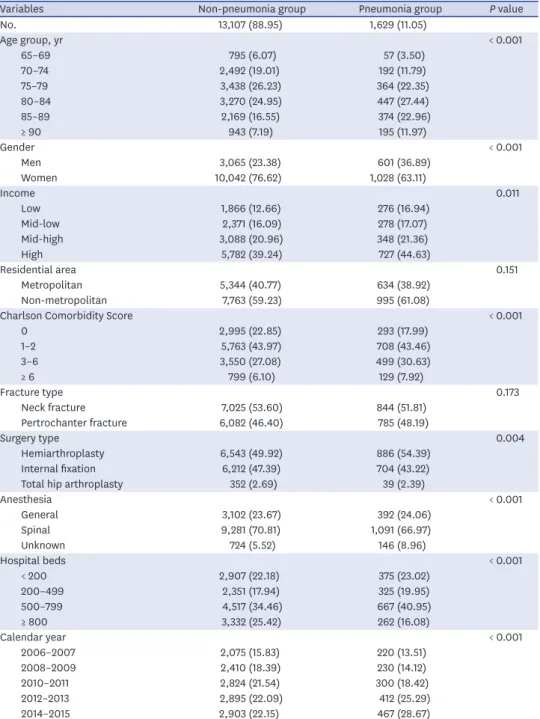
of this study (Fig. 1). Postoperative pneumonia developed in 1,629 patients (11.05%) during the hospitalization (pneumonia group) while it did not develop in the remaining 13,107 patients (88.95%) (non-pneumonia group) (Table 1). The pneumonia incidence was 16.39% (601/3,666 patients) in men patients and 9.29% (1,028/10,042 patients) in women patients. The 30-, 90-, 180-day, and 1-year cumulative mortalities were 3.25%, 11.17%, 14.61% and 18.11% in men pneumonia patients, and 3.56%, 12.22%, 17.37% and 21.98% in women pneumonia patients.
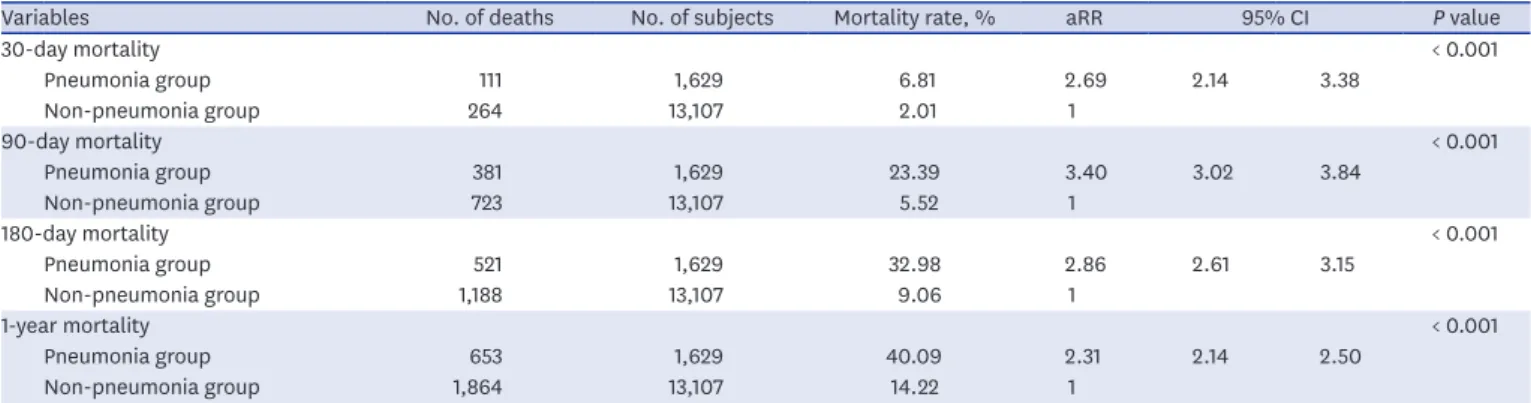
Compared to non-pneumonia patients, aRR of death in pneumonia patients was 2.69 (95%
CI, 2.14–3.38; P < 0.001) within postoperative 30-day. The aRR of pneumonia patients was 3.40 (95% CI, 3.01–3.83; P < 0.001) within postoperative 90-day, 2.86 (95% CI, 2.61–3.15;
P < 0.001) within postoperative 180-day and 2.31 (95% CI, 2.14–2.50; P < 0.001) within postoperative 1-year. The effect of pneumonia on all-cause mortality was highest within postoperative 90-day (Table 2 and Fig. 2).
588,147 persons in NHIS-Senior
19,915 patients admission due to hip fracture
Hip fracture cohort: total 14,736 patients
Excluded by
3-year hip fracture-free period and under 1-year follow-up: 4,022 patients Non-operation: 1,058 patients
Age < 66 years or > 99 years: 99 patients 1.
2.
3.
Non-pneumonia group : 13,107 patients
Pneumonia group : 1,629 patients Fig. 1. Flowchart of the study subjects.
0 400
1.0
0.6 0.8
0.4
Survival distribution function 0.2
Survival time, day
350 300 250 200 150 100 50 0
Non-pneumonia group
Pneumonia group
Fig. 2. Kaplan-Meier curve of elderly hip fracture patients according to the pneumonia. P value of log-rank test was < 0.001.
The aRR of death in the pneumonia group was 5.75 (95% CI, 2.89–11.43) in patients aged < 70 years, 5.14 (95% CI, 4.08–6.46) in those aged 70–79 years, 3.29 (95% CI, 2.81–3.86) in those aged 80–89 years and 2.02 (95% CI, 1.52–2.69) in those aged ≥ 90 years (Table 3).
The aRR of death was 3.63 (95% CI, 3.01–4.38) in men pneumonia patients, and 3.27 (95%
CI, 2.80–3.83) in women pneumonia patients (Table 4).
Table 1. Baseline characteristics of study participants
Variables Non-pneumonia group Pneumonia group P value
No. 13,107 (88.95) 1,629 (11.05)
Age group, yr < 0.001
65–69 795 (6.07) 57 (3.50)
70–74 2,492 (19.01) 192 (11.79)
75–79 3,438 (26.23) 364 (22.35)
80–84 3,270 (24.95) 447 (27.44)
85–89 2,169 (16.55) 374 (22.96)
≥ 90 943 (7.19) 195 (11.97)
Gender < 0.001
Men 3,065 (23.38) 601 (36.89)
Women 10,042 (76.62) 1,028 (63.11)
Income 0.011
Low 1,866 (12.66) 276 (16.94)
Mid-low 2,371 (16.09) 278 (17.07)
Mid-high 3,088 (20.96) 348 (21.36)
High 5,782 (39.24) 727 (44.63)
Residential area 0.151
Metropolitan 5,344 (40.77) 634 (38.92)
Non-metropolitan 7,763 (59.23) 995 (61.08)
Charlson Comorbidity Score < 0.001
0 2,995 (22.85) 293 (17.99)
1–2 5,763 (43.97) 708 (43.46)
3–6 3,550 (27.08) 499 (30.63)
≥ 6 799 (6.10) 129 (7.92)
Fracture type 0.173
Neck fracture 7,025 (53.60) 844 (51.81)
Pertrochanter fracture 6,082 (46.40) 785 (48.19)
Surgery type 0.004
Hemiarthroplasty 6,543 (49.92) 886 (54.39)
Internal fixation 6,212 (47.39) 704 (43.22)
Total hip arthroplasty 352 (2.69) 39 (2.39)
Anesthesia < 0.001
General 3,102 (23.67) 392 (24.06)
Spinal 9,281 (70.81) 1,091 (66.97)
Unknown 724 (5.52) 146 (8.96)
Hospital beds < 0.001
< 200 2,907 (22.18) 375 (23.02)
200–499 2,351 (17.94) 325 (19.95)
500–799 4,517 (34.46) 667 (40.95)
≥ 800 3,332 (25.42) 262 (16.08)
Calendar year < 0.001
2006–2007 2,075 (15.83) 220 (13.51)
2008–2009 2,410 (18.39) 230 (14.12)
2010–2011 2,824 (21.54) 300 (18.42)
2012–2013 2,895 (22.09) 412 (25.29)
2014–2015 2,903 (22.15) 467 (28.67)
Data are presented as number (%).
DISCUSSION
The principle findings of this study are that the prevalence of pneumonia in elderly patients with hip fracture was 11.05% and the aRR of postoperative pneumonia on all-cause mortality was 2.31 to 3.40 according to different time frames from postoperative 30 days to 1 year.
Lv et al.5 reviewed 1,429 Chinese patients who underwent hip fracture surgery and reported 4.9% incidence of postoperative pneumonia. Skull et al.18 also reported a 4.9% pneumonia incidence in a study of 153,613 Canadian patients with hip fracture complications. Recently, Roche et al.10 retrospectively reviewed 519 Korean hip fracture patients aged ≥ 60 years, and reported that postoperative pneumonia developed in 8.8%. In their study, old age, low body mass index, malnutrition, longer duration of surgery and delayed surgery were identified as risk factors of aspiration pneumonia.10 Quan et al.19 reported a comparative study of inpatient pulmonary rehabilitation program in 240 Chinese hip fracture patients.
The intervention group had a lower incidence of pneumonia (6 patients, 5.9%) compared to the control group (19 patients, 13.9%). The incidence of pneumonia in our patients was comparable with those of previous studies.
Sheehan et al.20 reported that men patients had higher incidence of postoperative pneumonia by 2.1 times than women patients after surgery for geriatric hip fracture.
Table 2. Effect of pneumonia on all-cause mortality of different time frame
Variables No. of deaths No. of subjects Mortality rate, % aRR 95% CI P value
30-day mortality < 0.001
Pneumonia group 111 1,629 6.81 2.69 2.14 3.38
Non-pneumonia group 264 13,107 2.01 1
90-day mortality < 0.001
Pneumonia group 381 1,629 23.39 3.40 3.02 3.84
Non-pneumonia group 723 13,107 5.52 1
180-day mortality < 0.001
Pneumonia group 521 1,629 32.98 2.86 2.61 3.15
Non-pneumonia group 1,188 13,107 9.06 1
1-year mortality < 0.001
Pneumonia group 653 1,629 40.09 2.31 2.14 2.50
Non-pneumonia group 1,864 13,107 14.22 1
aRR = adjusted risk ratio, CI = confidence interval.
Table 3. Effect of pneumonia on all-cause 90-day mortality according to the age group in elderly hip fracture patients
Age group, yr Non-pneumonia group
(reference) Pneumonia group
aRR 95% CI P value
< 70 1.00 5.75 2.89 11.43 < 0.001
70–79 1.00 5.14 4.08 6.46 < 0.001
80–89 1.00 3.29 2.81 3.86 < 0.001
≥ 90 1.00 2.02 1.52 2.69 < 0.001
aRR = adjusted risk ratio, CI = confidence interval.
P for interaction < 0.001.
Table 4. Effect of pneumonia on all-cause 90-day mortality according to the gender in elderly hip fracture patients
Gender Non-pneumonia group
(reference) Pneumonia group
aRR 95% CI P value
Men 1.00 3.63 3.01 4.38 < 0.001
Women 1.00 3.27 2.80 3.83 < 0.001
aRR = adjusted risk ratio, CI = confidence interval.
P for interaction = 0.600.
Smoking history and combined chronic obstructive pulmonary disease might explain the high risk of postoperative pneumonia in men patients.21 In our study, the incidence of pneumonia was higher in men patients than in women patients (16.39% vs. 9.29%).
Lawrence et al.22 and Smetana23 reported that men patients with postoperative pneumonia after hip fracture surgery had higher mortalities than women patients. Bohl et al.24 reported that the 30-day mortality rate in men patients after hip fracture surgery was 1.74 times higher than that of women. However, in our study, the risk of death by pneumonia was not different between the 2 genders (P for interaction > 0.05) after adjusting underlying comorbidities.
Although men patients seemingly have higher risk of developing pneumonia and higher mortality rate than women patients in previous studies, the higher risk in men patients was not due to gender difference but due to underlying comorbidities of men patients.
There are limitations in our study. First, our study was based on the national claim data.
Thus, we could not evaluate the effect of bone mineral density, body mass index, smoking history, alcohol abuse, the levels of vitamin D and calcium on the pneumonia development and mortality. Nevertheless, we attempted to overcome this limitation by adjusting CCS, socio-economic factors and residential area. Second, the national claim data did not include information about preoperative medical optimizations or postoperative care programs, which might have affected the rates of postoperative pneumonia and mortality.
In conclusion, the prevalence of postoperative pneumonia in elderly hip fracture patients was 11.05% and the pneumonia patients had higher 30-day to 1-year mortalities with aRR of 2.31 to 3.40 compared to non-pneumonia patients. They had increased mortality in all age group older than 65 years with aRR of 1.52 to 4.08. Both genders of pneumonia patients had higher risk of mortality (aRR, 3.63 in men and 3.27 in women) compared to non-pneumonia patients.
REFERENCES
1. Cha YH, Ha YC, Yoo JI, Min YS, Lee YK, Koo KH. Effect of causes of surgical delay on early and late mortality in patients with proximal hip fracture. Arch Orthop Trauma Surg 2017;137(5):625-30.
PUBMED | CROSSREF
2. Abrahamsen B, van Staa T, Ariely R, Olson M, Cooper C. Excess mortality following hip fracture: a systematic epidemiological review. Osteoporos Int 2009;20(10):1633-50.
PUBMED | CROSSREF
3. Cha YH, Lee YK, Koo KH, Wi C, Lee KH. Difference in mortality rate by type of anticoagulant in elderly patients with cardiovascular disease after hip fractures. Clin Orthop Surg 2019;11(1):15-20.
PUBMED | CROSSREF
4. Lee YK, Kim JW, Lee MH, Moon KH, Koo KH. Trend in the Age-Adjusted Incidence Of Hip Fractures In South Korea: systematic review. Clin Orthop Surg 2017;9(4):420-3.
PUBMED | CROSSREF
5. Lv H, Yin P, Long A, Gao Y, Zhao Z, Li J, et al. Clinical characteristics and risk factors of postoperative pneumonia after hip fracture surgery: a prospective cohort study. Osteoporos Int 2016;27(10):3001-9.
PUBMED | CROSSREF
6. Pedersen SJ, Borgbjerg FM, Schousboe B, Pedersen BD, Jørgensen HL, Duus BR, et al. A comprehensive hip fracture program reduces complication rates and mortality. J Am Geriatr Soc 2008;56(10):1831-8.
PUBMED | CROSSREF
7. Lo IL, Siu CW, Tse HF, Lau TW, Leung F, Wong M. Pre-operative pulmonary assessment for patients with hip fracture. Osteoporos Int 2010;21(Suppl 4):S579-86.
PUBMED | CROSSREF
8. Folbert EC, Hegeman JH, Gierveld R, van Netten JJ, Velde DV, Ten Duis HJ, et al. Complications during hospitalization and risk factors in elderly patients with hip fracture following integrated orthogeriatric
treatment. Arch Orthop Trauma Surg 2017;137(4):507-15.
PUBMED | CROSSREF
9. Flikweert ER, Wendt KW, Diercks RL, Izaks GJ, Landsheer D, Stevens M, et al. Complications after hip fracture surgery: are they preventable? Eur J Trauma Emerg Surg 2018;44(4):573-80.
PUBMED | CROSSREF
10. Roche JJ, Wenn RT, Sahota O, Moran CG. Effect of comorbidities and postoperative complications on mortality after hip fracture in elderly people: prospective observational cohort study. BMJ 2005;331(7529):1374.
PUBMED | CROSSREF
11. Brown CA, Boling J, Manson M, Owens T, Zura R. Relation between prefracture characteristics and perioperative complications in the elderly adult patient with hip fracture. South Med J 2012;105(6):306-10.
PUBMED | CROSSREF
12. Byun SE, Shon HC, Kim JW, Kim HK, Sim Y. Risk factors and prognostic implications of aspiration pneumonia in older hip fracture patients: a multicenter retrospective analysis. Geriatr Gerontol Int 2019;19(2):119-23.
PUBMED
13. Esperatti M, Ferrer M, Giunta V, Ranzani OT, Saucedo LM, Li Bassi G, et al. Validation of predictors of adverse outcomes in hospital-acquired pneumonia in the ICU. Crit Care Med 2013;41(9):2151-61.
PUBMED | CROSSREF
14. Seong SC, Kim YY, Park SK, Khang YH, Kim HC, Park JH, et al. Cohort profile: the National Health Insurance Service-National Health Screening Cohort (NHIS-HEALS) in Korea. BMJ Open 2017;7(9):e016640.
PUBMED | CROSSREF
15. Lee J, Lee JS, Park SH, Shin SA, Kim K. Cohort profile: the National Health Insurance Service-National Sample Cohort (NHIS-NSC), South Korea. Int J Epidemiol 2017;46(2):e15.
PUBMED
16. Park C, Jang S, Jang S, Ha YC, Lee YK, Yoon HK, et al. Identification and validation of osteoporotic hip fracture using the national health insurance database. J Korean Hip Soc 2010;22(4):305-11.
CROSSREF
17. Lee YK, Ha YC, Choi HJ, Jang S, Park C, Lim YT, et al. Bisphosphonate use and subsequent hip fracture in South Korea. Osteoporos Int 2013;24(11):2887-92.
PUBMED | CROSSREF
18. Skull SA, Andrews RM, Byrnes GB, Campbell DA, Nolan TM, Brown GV, et al. ICD-10 codes are a valid tool for identification of pneumonia in hospitalized patients aged > or = 65 years. Epidemiol Infect 2008;136(2):232-40.
PUBMED | CROSSREF
19. Quan H, Sundararajan V, Halfon P, Fong A, Burnand B, Luthi JC, et al. Coding algorithms for defining comorbidities in ICD-9-CM and ICD-10 administrative data. Med Care 2005;43(11):1130-9.
PUBMED | CROSSREF
20. Sheehan KJ, Sobolev B, Guy P, Tang M, Kuramoto L, Belmont P, et al. Feasibility of administrative data for studying complications after hip fracture surgery. BMJ Open 2017;7(4):e015368.
PUBMED | CROSSREF
21. Chang SC, Lai JI, Lu MC, Lin KH, Wang WS, Lo SS, et al. Reduction in the incidence of pneumonia in elderly patients after hip fracture surgery: An inpatient pulmonary rehabilitation program. Medicine (Baltimore) 2018;97(33):e11845.
PUBMED | CROSSREF
22. Lawrence VA, Cornell JE, Smetana GW; American College of Physicians. Strategies to reduce postoperative pulmonary complications after noncardiothoracic surgery: systematic review for the American College of Physicians. Ann Intern Med 2006;144(8):596-608.
PUBMED | CROSSREF
23. Smetana GW. Preoperative pulmonary evaluation: identifying and reducing risks for pulmonary complications. Cleve Clin J Med 2006;73 Suppl 1:S36-41.
PUBMED | CROSSREF
24. Bohl DD, Sershon RA, Saltzman BM, Darrith B, Della Valle CJ. Incidence, risk factors, and clinical implications of pneumonia after surgery for geriatric hip fracture. J Arthroplasty 2018;33(5):1552-1556.e1.
PUBMED | CROSSREF