291 J. Sensor Sci. & Tech. Vol. 23, No. 5, 2014 Journal of Sensor Science and Technology
Vol. 23, No. 5 (2014) pp. 291-294 http://dx.doi.org/10.5369/JSST.2014.23.5.291 pISSN 1225-5475/eISSN 2093-7563
Chemiresistive Sensor Based on One-Dimensional WO 3 Nanostructures as Non-Invasive Disease Monitors
Hi Gyu Moon
1,2, Soo Deok Han
1, Chulki Kim
3, Hyung-Ho Park
2, and Seok-Jin Yoon
1,+Abstract
In this study, a chemiresistive sensor based on one-dimensional WO
3nanostructures is presented for application in non-invasive med- ical diagnostics. WO
3nanostructures were used as an active gas sensing layer and were deposited onto a SiO
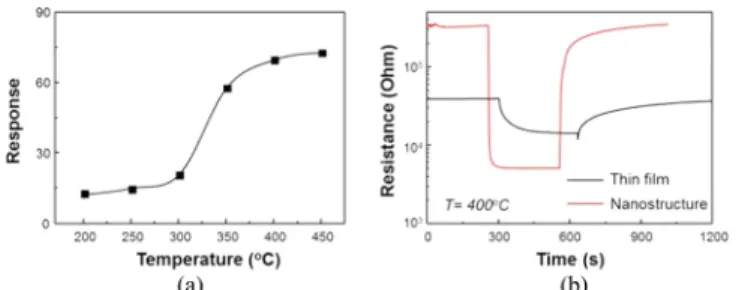
2/Si substrate using Pt inter- digitated electrodes (IDEs). The IDE spacing was 5 µm and deposition was performed using RF sputter with glancing angle deposition mode. Pt IDEs fabricated by photolithography and dry etching. In comparison with thin film sensor, sensing performance of nano- structure sensor showed an enhanced response of more than 20 times when exposed to 50 ppm acetone at 400°C. Such a remarkable faster response can pave the way for a new generation of exhaled breath analyzers based on chemiresistive sensors which are less expen- sive, more reliable, and less complicated to be manufactured. Moreover, presented sensor technology has the potential of being used as a personalized medical diagnostics tool in the near future.
Keywords: Metal oxide gas sensors, Chemiresistive sensor, Exhaled breath analyzer, One-dimensional WO
3nanostructures, Tungsten oxide (WO
3)
1. INTRODUCTION
Exhaled human breath contains several bio-markers that can be used as tools for diagnosing metabolic disorders such as lung cancer, kidney diseases, asthma, and diabetes [1-4]. Among these disorders, diabetes mellitus can be particularly dangerous since it causes chronic high blood sugar for a prolonged period and leads to inefficient wound healing among other complications [4]. Thus, diabetes should be quickly diagnosed as it requires daily management.
In general, exhaled breath contains as many as 300 different gaseous compounds including inorganic molecules such as NO, NH
3or CO and volatile organic compounds (VOCs) such as acetone, ethane, and isoprene with concentrations ranging from
ppb to ppm. Among these compounds, acetone exhalation is caused by fatty acid oxidation and ketoacidosis in diabetic patients due to lack of insulin [5]. Although a few VOCs are successfully detectable by table-top equipment by techniques such as gas chromatography-mass spectrometry (GC-MS) and proton transfer reaction-mass spectrometry (PTR-MS) [6,7], these techniques are not suitable for domestic use, which requires equipment with features such as portability, small form factor, low cost, real-time analysis, and large samples of collected exhaled breath.
Chemiresistive sensors based on semiconductor materials offer an alternative to the abovementioned techniques since they offer long-term stability and high sensitivity owing to high electron concentration. Moreover, metal oxide thin films exhibit simple structures, simplicity of operation, low cost, and can be easily applied to semiconductor manufacturing. Chemiresistive sensors therefore offer great potential for detecting chemical compounds.
However, metal oxides (Fe
2O
3, In
2O
3, WO
3, and TiO
2) thin film gas sensors poor sensitivity and selectivity [8]. To achieve sub ppb detection, metal oxide gas sensor needs the configuration of nanostructures such as nanowire, nanobelts, and nanorods for higher sensitivity and selectivity.
Herein, we synthesized the chemiresistive sensor based on one- dimensional WO
3nanostructures by glancing angle deposition (GAD) using RF sputter. These nanostructure sensors have extremely fast response to acetone at elevated temperature.
Consequently, highly sensitive properties of nanostructure WO
31
Future Convergence Research Division, Korea Institute of Science and Technology, Seoul 136-791, Republic of Korea
2
Materials Science and Engineering, Yonsei University, Seoul 120-749, Republic of Korea
3
Sensor System Research Center, Korea Institute of Science and Technology, Seoul 136-791, Republic of Korea
+