RESEARCH ARTICLE
Received: May 13, 2020, Revised: June 4, 2020, Accepted: June 8, 2020 eISSN 2233-7679
†Correspondence to: Ji-Hyun Min, https://orcid.org/0000-0001-5177-7600
Department of Dental Hygiene, College of Medical and Health Sciences, Cheongju University, 298, Daesung-ro, Cheongwon-gu, Cheongju 28503, Korea Tel: +82-43-229-8375, Fax: +82-43-229-8969, E-mail: [email protected]
Copyright © The Korean Society of Dental Hygiene Science.
Clinical Dental Hygienists’ Awareness of the Medical Technicians Act and Clinical Performance in Korea
Song-I Back
1and Ji-Hyun Min
2,†1
Kimjiyong Dental Clinic, Cheongju 28325,
2
Department of Dental Hygiene, College of Medical and Health Sciences, Cheongju University, Cheongju 28503, Korea
Background: In Korea, laws for many medical technicians were revised in the Enforcement Decree of the Medical Technicians Act
(MTA), which was announced on December 2018, whereas those related to dental hygienists remained unchanged. This study aimed to determine the awareness and opinions of dental hygienists regarding MTA.
Methods: Dental hygienist were recruited as participants via convenient sampling in Seoul, Gyeonggi-do, and Chungcheong-do;
data from 291 self-reported questionnaire responses were used for the final analysis. We investigated the participants’ general characteristics, awareness, and request for the amendment of the MTA. The compliance with the work scope specified in the MTA and level of demand for revision of the MTA were analyzed by independent t-test and one-way analysis of variance. For all statistical analyses, the significance level was set at 0.05.
Results: For the 2018 MTA revision, 99 (34.02%) knew that dental treatment assistance and surgery assistance were excluded,
whereas 192 (65.98%) did not know. The item “The current medical technician law must be revised” was scored 4.13±0.80 out of 5 points, and significant differences were identified according to the education level, career, and position (p<0.05). The item
“It is necessary to institutionalize the expanded work scope beyond the work scope of dental hygienists specified in the MTA” was scored 4.02±1.04 out of 5 points, and significant differences were identified according to age (p<0.05).
Conclusion: The participants wanted the MTA to be revised to reflect the real-world work performed by dental hygienists in the
dental clinical field. The legal system must ensure the legal protection of the work area of the dental hygienist as an oral health professional, and recognize the legal work scope of the dental hygienist.
Key Words: Awareness, Clinical performance, Dental hygienist, Medical technicians act
Introduction
The dental hygienist is an oral health professional who prevents and treats oral diseases with dentists after passing the national exam conducted by the Korea Health Personnel Licensing Examination Institute and then obtaining a license from the Minister of Health and Welfare
1). Previously, before dental assistants were produced through regular education courses, nurses trained to assist doctors who performed dental services. Korean dental hygienists were first defined by law in 1973, which was revised in
October 1995 and again in May 2012. Currently, dental hygienists are defined in the Medical Technicians Act of Korea (enforced December 20, 2018, MTA) as a type of medical technician. The legal scope of work of dental hygienists was first defined as “work on the prevention and hygiene of dental and oral diseases” in accordance with the MTA and its implementing ordinances of 1973.
In 1996, “the removal of calculus scaling, the application
of fluoride, and radiography for intraoral diagnosis” was
specifically introduced. In 2015, the tasks of “temporary
filling, temporary attachment installation, attachment
removal, dental impression, orthodontic wire installation, and removal” were specified
2). Stipulations for other medical technician occupational groups were revised in accordance with the implementing ordinances of the MTA, announced on December 18, 2018; meanwhile, the laws related to dental hygienists were maintained.
According to Article 2 of the implementing ordinances of MTA, the scope of work for dental hygienists is defined as follows: orthodontic wire installation and removal, application of fluoride, radiography for intraoral diagnosis, temporary filling, installation and removal of temporary attachments, removal of deposits (e.g., dental calculus), dental impression, and other tasks related to the prevention of dental and oral diseases and hygiene management.
However, the scope of the work performed by dental hygienists under the management and guidance of dentists in dental clinics is broader than that described in the implementing ordinances of the MTA. As such, the law does not properly reflect reality. Indeed, dental treatment assistance, which is mainly performed by dental hygienists in the clinical field, has been claimed to be illegal because
“dental care aid and surgical aid” tasks are not explicitly indicated in MTA
3). To date, the law recognizes dental hygienists, nurses and nursing assistants, and dental medical personnel, including dental technicians and radiologists. To address the conflict in the field of dental work among professionals, the Korean Dental Hygienists Association has posted on the Blue House petition website, implemented a ribbon campaign to inform and call for the revision of the legal scope of work of dental hygienists, and conducted a signature campaign to have the medical law amended to recognize dental hygienists as medical personnel.
As the paradigm of dental treatment changes from treatment to oral health promotion, the role of the dental hygienists should expand to improve dental care more qualitatively and bolster productivity
4). However, there is a gap between the legally prescribed and actually performed work of the dental hygienist
5), and owing to social needs, dental treatment assistance and cooperation occupy a significant portion of the work of the dental hygienist.
Consequently, legal controversies over the delegated dental treatment and dental treatment assistance are
constantly intensifying and conflicts with other occupations are growing. Dental hygienists, along with dentists, are professionals who face patients directly in clinical practice
1), and should strive to promote the public’s oral health with professionalism and a sense of mission.
However, if the professionalism of the dental hygienist is not recognized owing to the barriers of the law, then the satisfaction with the dental hygienists’ work will be lowered and dental hygiene activities will contract. Such a scenario makes it difficult to provide high-quality dental services, which in turn adversely affects the public’s oral health. Interest in the legal scope of the work of dental hygienists has been increasing, and research on the awareness of MTA
6-8)has been conducted among dental hygienists. However, after the announcement of the current maintenance of the implementing ordinances of the 2018 MTA, few studies have examined the perceptions of dental hygienists regarding their actual and legal scope of work. Therefore, this study aimed to determine the awareness of MTA, work suitability, and clinical performance of dental hygienists. We intended to call for a legal system that can legally protect the dental hygienist’s work area and realize a practical legal work scope that can be used as a basic resource.
Materials and Methods
1. Participants
We recruited through convenience sampling 231 dental hygienists working at primary dental hospitals in Seoul, Gyeonggi Province, and Chungcheong Province and 60 dental hygienists working at secondary and tertiary dental hospitals to participate in the self-administered survey.
The investigation was conducted from June to July 2019.
We only included dental hygienists who agreed to
participate in the study and submitted their consent via
mobile message after listening to the explanation of the
meaning and purpose of the study in advance. We
explained that participation could be canceled at any time
in the course of participation in the study, that the
collected data would not be used for purposes other than
the study objectives, and that confidentiality was guaranteed
by all participants being treated as anonymous.
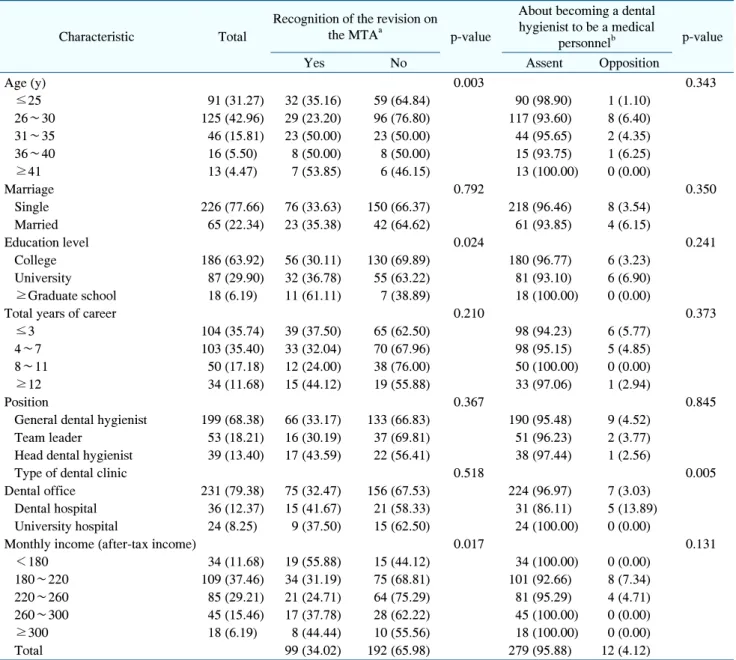
Table 1. Difference of Recognition of the Medical Technicians Act according to General Characteristics
Characteristic Total
Recognition of the revision on
the MTA
ap-value
About becoming a dental hygienist to be a medical
personnel
bp-value
Yes No Assent Opposition
Age (y) 0.003 0.343
≤25 91 (31.27) 32 (35.16) 59 (64.84) 90 (98.90) 1 (1.10)
26∼30 125 (42.96) 29 (23.20) 96 (76.80) 117 (93.60) 8 (6.40)
31∼35 46 (15.81) 23 (50.00) 23 (50.00) 44 (95.65) 2 (4.35)
36∼40 16 (5.50) 8 (50.00) 8 (50.00) 15 (93.75) 1 (6.25)
≥41 13 (4.47) 7 (53.85) 6 (46.15) 13 (100.00) 0 (0.00)
Marriage 0.792 0.350
Single 226 (77.66) 76 (33.63) 150 (66.37) 218 (96.46) 8 (3.54)
Married 65 (22.34) 23 (35.38) 42 (64.62) 61 (93.85) 4 (6.15)
Education level 0.024 0.241
College 186 (63.92) 56 (30.11) 130 (69.89) 180 (96.77) 6 (3.23)
University 87 (29.90) 32 (36.78) 55 (63.22) 81 (93.10) 6 (6.90)
≥Graduate school 18 (6.19) 11 (61.11) 7 (38.89) 18 (100.00) 0 (0.00)
Total years of career 0.210 0.373
≤3 104 (35.74) 39 (37.50) 65 (62.50) 98 (94.23) 6 (5.77)
4∼7 103 (35.40) 33 (32.04) 70 (67.96) 98 (95.15) 5 (4.85)
8∼11 50 (17.18) 12 (24.00) 38 (76.00) 50 (100.00) 0 (0.00)
≥12 34 (11.68) 15 (44.12) 19 (55.88) 33 (97.06) 1 (2.94)
Position 0.367 0.845
General dental hygienist 199 (68.38) 66 (33.17) 133 (66.83) 190 (95.48) 9 (4.52) Team leader 53 (18.21) 16 (30.19) 37 (69.81) 51 (96.23) 2 (3.77) Head dental hygienist 39 (13.40) 17 (43.59) 22 (56.41) 38 (97.44) 1 (2.56)
Type of dental clinic 0.518 0.005
Dental office 231 (79.38) 75 (32.47) 156 (67.53) 224 (96.97) 7 (3.03)
Dental hospital 36 (12.37) 15 (41.67) 21 (58.33) 31 (86.11) 5 (13.89) University hospital 24 (8.25) 9 (37.50) 15 (62.50) 24 (100.00) 0 (0.00)
Monthly income (after-tax income) 0.017 0.131
<180 34 (11.68) 19 (55.88) 15 (44.12) 34 (100.00) 0 (0.00)
180∼220 109 (37.46) 34 (31.19) 75 (68.81) 101 (92.66) 8 (7.34)
220∼260 85 (29.21) 21 (24.71) 64 (75.29) 81 (95.29) 4 (4.71)
260∼300 45 (15.46) 17 (37.78) 28 (62.22) 45 (100.00) 0 (0.00)
≥300 18 (6.19) 8 (44.44) 10 (55.56) 18 (100.00) 0 (0.00)
Total 99 (34.02) 192 (65.98) 279 (95.88) 12 (4.12)
Values are presented as number (%).
a
Whether or not to aware of the exclusion of 'dental treatment assistance and surgical assistance' in the revision of the Medical Technicians Act in 2018.
b
Whether or not to agree that the dental hygienist become a medical personnel as the medical law is revised in the future.
p-values were obtained from chi-square test.
The necessary number of participants was calculated as 200 people when the significance level was set at 0.05, power at 0.80, and effect size at 0.25 in the G*power 3.1 program to perform one-way analysis of variance. A total of 320 people were surveyed. Data from 291 were used for the final analysis; data from 29 people who did not respond were excluded.
2. Study variables
1) General characteristics of participants
The general characteristics of the participants, such as
age, marital status, educational background, clinical career,
work position, type of medical institution, and monthly
income (after-tax income) were investigated.
Table 2. The Recognition of the Medical Technicians Act
Classification n (%)
1. Only those who were aware of the revision of the Medical Articles Act were asked.:
Are you satisfied with 'Maintaining the current status' of the revised Medical Technicians Act?
99 (100)
Satisfaction 24 (24.24)
dissatisfaction 75 (75.76)
2. Only those who were not aware of the revision of the Medical Articles Act were asked.:
If you aren't aware of the revision of Medical Technicians Act, why?
192 (100)
No interest 30 (15.63)
Lack of publicity 101 (52.60)
Lack of awareness 61 (31.77)
2) Recognition and opinions of Medical Technicians Act
The study tools were based on the thesis of Kim
9)and survey questions in Choi et al.
8), modified to suit the purpose of the present research. The recognition of and opinions on MTA were investigated by formulating four questions on the degree of recognition of MTA, five questions on the level of demand for the revision of the MTA, and six questions on the suitability of the work scope of dental hygienists specified in the MTA. Two questions on the level of demand for the revision of the MTA and three questions on the suitability of work scope specified in the MTA were rated using a five-point Likert scale in which “Strongly Disagree” was scored point and
“Strongly Agree,” five points.
3) Duties actually performed and duties recognized as specified in the law
Among the tasks of dental hygienists presented in the study of Lee et al.
2), we selected the contents with frequent problems from overlapping tasks among different occupations.
In addition to the nine legal duties of dental hygienists under the MTA, 11 duties that were expected of dental hygienists to perform frequently in dental hospitals and clinics were selected. Thus, 20 questions were composed.
Duties actually performed and duties recognized as the legal scope of the work were calculated in percentages.
3. Data analysis
To identify the general characteristics, and recognition of and opinions on the MTA of the participants, we conducted technical statistical analyses of frequency, percentage, average, and standard deviation. Whether the MTA was recognized or not according to the general characteristics was tested with chi-square, and the compliance with the work scope specified in the MTA and level of demand for the revision of the MTA were analyzed by independent t-test and one-way analysis of variance. For all statistical analyses, the significance level of the test was based on 0.05. The data collected were analyzed using the IBM SPSS Statistics 24.0 K Program for Windows (IBM Corp., Armonk, NY, USA).
Results
1. Recognition of Medical Technicians Act
Table 1 shows the results of the general characteristics
of the participants regarding their recognition of the
revision of the MTA and their consent to being recognized
as medical personnel. For the 2018 MTA revision, 99
(34.02%) knew that dental treatment assistance and
surgery assistance were excluded, whereas 192 (65.98%)
did not know. On whether or not the participants were
aware of the revision of the MTA, significant differences
were identified depending on age, education level, and
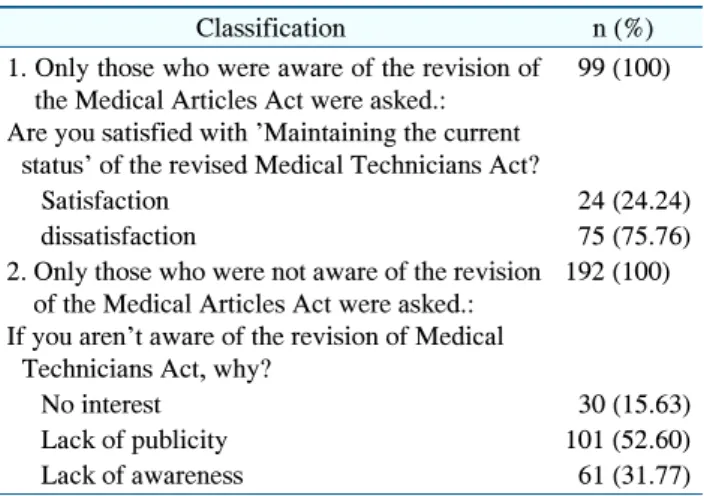
monthly income. Of the 99 people who were aware of the
revision of the MTA, only 24.24% were satisfied with the
revision, and the remaining 75.76% said they were
dissatisfied. The 192 people who did not recognize the
revision of the MTA stated their reason as follows: lack of
publicity (52.60%), lack of awareness (31.77%), and no
interest (15.63%) (Table 2). Significant differences were
found in these responses according to age, educational
background, and monthly income (after-tax income) type
(Table 1). A large majority of the participants (279,
95.88%) answered that they would approve that the dental
hygienist be recognized as medical personnel through a
revision of the medical law in the future, whereas 12
(4.12%) expressed disapproval. Significant differences
were found in these responses depending on the type of
dental clinic (p=0.005, Table 1).
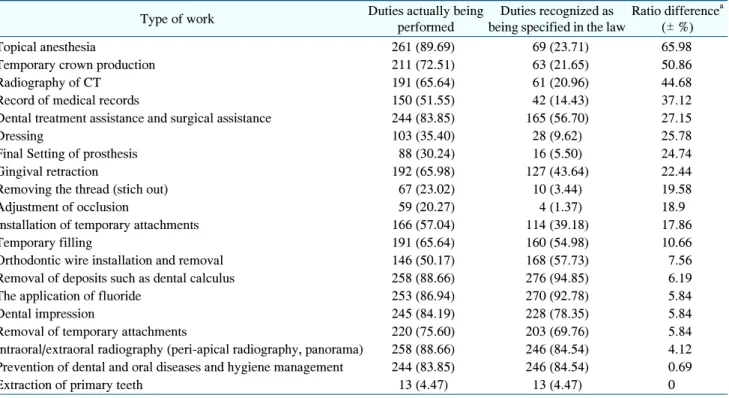
Table 3. The Order of Duties Actually Being Performed and the Order of Duties Recognized as Being Specified in the Law
Type of work Duties actually being
performed
Duties recognized as being specified in the law
Ratio difference
a(± %)
Topical anesthesia 261 (89.69) 69 (23.71) 65.98
Temporary crown production 211 (72.51) 63 (21.65) 50.86
Radiography of CT 191 (65.64) 61 (20.96) 44.68
Record of medical records 150 (51.55) 42 (14.43) 37.12
Dental treatment assistance and surgical assistance 244 (83.85) 165 (56.70) 27.15
Dressing 103 (35.40) 28 (9.62) 25.78
Final Setting of prosthesis 88 (30.24) 16 (5.50) 24.74
Gingival retraction 192 (65.98) 127 (43.64) 22.44
Removing the thread (stich out) 67 (23.02) 10 (3.44) 19.58
Adjustment of occlusion 59 (20.27) 4 (1.37) 18.9
Installation of temporary attachments 166 (57.04) 114 (39.18) 17.86
Temporary filling 191 (65.64) 160 (54.98) 10.66
Orthodontic wire installation and removal 146 (50.17) 168 (57.73) 7.56
Removal of deposits such as dental calculus 258 (88.66) 276 (94.85) 6.19
The application of fluoride 253 (86.94) 270 (92.78) 5.84
Dental impression 245 (84.19) 228 (78.35) 5.84
Removal of temporary attachments 220 (75.60) 203 (69.76) 5.84
Intraoral/extraoral radiography (peri-apical radiography, panorama) 258 (88.66) 246 (84.54) 4.12 Prevention of dental and oral diseases and hygiene management 244 (83.85) 246 (84.54) 0.69
Extraction of primary teeth 13 (4.47) 13 (4.47) 0
Values are presented as number (%).
CT: computed tomography.
a
Ratio difference in ratio between duties actually being performed and duties recognized as being specified in the law.
2. Duties actually performed and duties recognized as specified in the law
Twenty kinds of duties were selected, and the participants were asked to select all the duties they were actually performing in the clinic. They were also asked to identify the nine duties recognized as being specified in the law.
The results indicated that topical anesthesia showed the greatest difference of 65.98% between duties actually performed and duties recognized as specified in the law.
The majority (89.69%) of the participants were applying topical anesthesia, which was the most common task.
Meanwhile, only 23.71% of the participants perceived topical anesthesia as among the duties recognized as specified in the law. Temporary crown production and radiography showed large gaps between duties actually performed and duties recognized as specified in the law.
Meanwhile, we observed no difference between the number of participants who chose extraction of primary teeth as among the duties actually being performed and
those who chose it as among the duties recognized as specified in the law (Table 3).
3. Suitability of legal work scope of dental hygienists and demand for revision of the Act
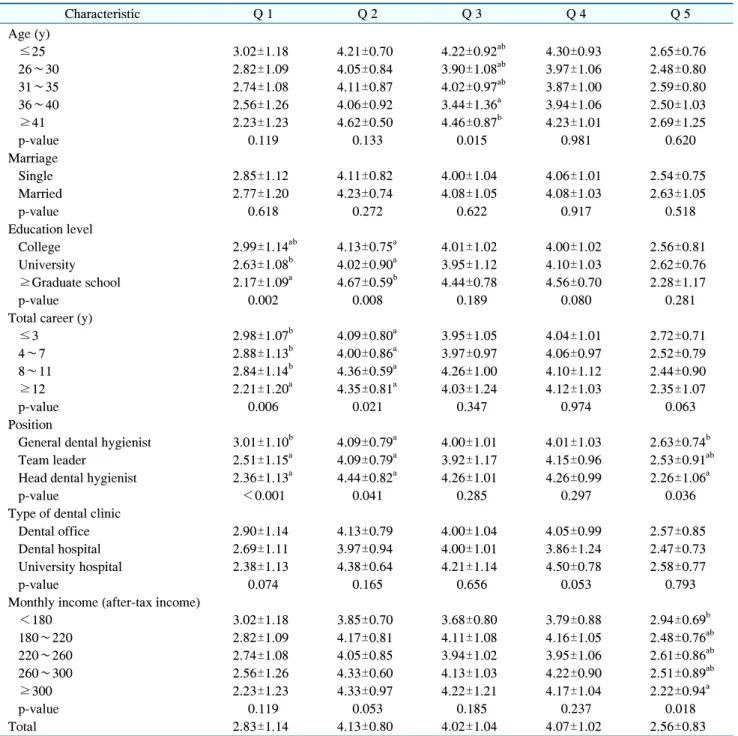
Table 4 shows the results of the verification of the suitability of the work scope of dental hygienists specified in the MTA and the level of demand for the revision of the MTA by general characteristics. The survey was rated on a five-point scale from 5 (strongly agree) to 1 (strongly disagree). The items “The current MTA should be revised,”
“It is necessary to institutionalize the expanded work
scope beyond the work scope of dental hygienists specified
in the MTA,” and “The work scope of dental hygienists in
the MTA should include medical assistance and surgical
assistance,” showed similar results of being rated four
points. “The work scope of dental hygienists specified in
the MTA includes the actual clinical practice” was rated
2.83±1.14 points. “Overall, I am satisfied with the system
Table 4. The Awareness of Suitability of the Work Scope of Dental Hygienists Specified in the Medical Technicians Act and Level of Demand for Revision of the Medical Technicians Act by General Characteristics
Characteristic Q 1 Q 2 Q 3 Q 4 Q 5
Age (y)
≤25 3.02±1.18 4.21±0.70 4.22±0.92
ab4.30±0.93 2.65±0.76
26∼30 2.82±1.09 4.05±0.84 3.90±1.08
ab3.97±1.06 2.48±0.80
31∼35 2.74±1.08 4.11±0.87 4.02±0.97
ab3.87±1.00 2.59±0.80
36∼40 2.56±1.26 4.06±0.92 3.44±1.36
a3.94±1.06 2.50±1.03
≥41 2.23±1.23 4.62±0.50 4.46±0.87
b4.23±1.01 2.69±1.25
p-value 0.119 0.133 0.015 0.981 0.620
Marriage
Single 2.85±1.12 4.11±0.82 4.00±1.04 4.06±1.01 2.54±0.75
Married 2.77±1.20 4.23±0.74 4.08±1.05 4.08±1.03 2.63±1.05
p-value 0.618 0.272 0.622 0.917 0.518
Education level
College 2.99±1.14
ab4.13±0.75
a4.01±1.02 4.00±1.02 2.56±0.81
University 2.63±1.08
b4.02±0.90
a3.95±1.12 4.10±1.03 2.62±0.76
≥Graduate school 2.17±1.09
a4.67±0.59
b4.44±0.78 4.56±0.70 2.28±1.17
p-value 0.002 0.008 0.189 0.080 0.281
Total career (y)
≤3 2.98±1.07
b4.09±0.80
a3.95±1.05 4.04±1.01 2.72±0.71
4∼7 2.88±1.13
b4.00±0.86
a3.97±0.97 4.06±0.97 2.52±0.79
8∼11 2.84±1.14
b4.36±0.59
a4.26±1.00 4.10±1.12 2.44±0.90
≥12 2.21±1.20
a4.35±0.81
a4.03±1.24 4.12±1.03 2.35±1.07
p-value 0.006 0.021 0.347 0.974 0.063
Position
General dental hygienist 3.01±1.10
b4.09±0.79
a4.00±1.01 4.01±1.03 2.63±0.74
bTeam leader 2.51±1.15
a4.09±0.79
a3.92±1.17 4.15±0.96 2.53±0.91
abHead dental hygienist 2.36±1.13
a4.44±0.82
a4.26±1.01 4.26±0.99 2.26±1.06
ap-value <0.001 0.041 0.285 0.297 0.036
Type of dental clinic
Dental office 2.90±1.14 4.13±0.79 4.00±1.04 4.05±0.99 2.57±0.85
Dental hospital 2.69±1.11 3.97±0.94 4.00±1.01 3.86±1.24 2.47±0.73
University hospital 2.38±1.13 4.38±0.64 4.21±1.14 4.50±0.78 2.58±0.77
p-value 0.074 0.165 0.656 0.053 0.793
Monthly income (after-tax income)
<180 3.02±1.18 3.85±0.70 3.68±0.80 3.79±0.88 2.94±0.69
b180∼220 2.82±1.09 4.17±0.81 4.11±1.08 4.16±1.05 2.48±0.76
ab220∼260 2.74±1.08 4.05±0.85 3.94±1.02 3.95±1.06 2.61±0.86
ab260∼300 2.56±1.26 4.33±0.60 4.13±1.03 4.22±0.90 2.51±0.89
ab≥300 2.23±1.23 4.33±0.97 4.22±1.21 4.17±1.04 2.22±0.94
ap-value 0.119 0.053 0.185 0.237 0.018
Total 2.83±1.14 4.13±0.80 4.02±1.04 4.07±1.02 2.56±0.83
All values were shown as mean±standard deviation that obtained from the result of answer values (five-point scale: strongly agree=5, agree=4, neutral=3, disagree=2, strongly disagree=1).
Q 1. The work scope of the dental hygienists specified in the Medical Technicians Act includes the actual clinical practice.
Q 2. Currently the Medical Technicians Act needs to be revised.
Q 3. It is necessary to institutionalize the expanded work scope beyond the work scope of dental hygienists specified in the Medical Technicians Act.
Q 4. The work scope of dental hygienists in Medical Technicians Act should include ‘dental treatment assistance and surgical assistance’.
Q 5. Overall, I am satisfied with the system related to dental hygienists in Medical Technicians Act.
a,b
Different superscript letters denote significant differences between groups by Scheffe post hoc test (p<0.05).
p-values were obtained from independent t-test or one-way ANOVA test.
Table 6. Main Duties of Dental Hygienists and Future Prospects
Main duty Q 1 Q 2 Q 3
1st 5th 1st 5th 1st 5th
Dental treatment assistance 173 (59.45) 14 (4.81) 99 (34.02) 17 (5.84) 82 (28.18) 17 (5.84) Clinic administration and management 48 (16.49) 149 (51.20) 7 (2.41) 226 (77.66) 9 (3.09) 231 (79.38) Oral hygiene status observation and preliminary
dental examination
46 (15.81) 41 (14.09) 73 (25.09) 22 (7.56) 93 (31.96) 11 (3.78)
Preventive dental treatment 17 (5.84) 30 (10.31) 79 (27.15) 7 (2.41) 74 (25.43) 9 (3.09) Oral health education 7 (2.41) 57 (19.59) 33 (11.34) 19 (6.53) 33 (11.34) 23 (7.90) Values are presented as number (%).
Q 1. What do you do the most?
Q 2. What is the first priority of work to be considered if Article 3 (Scope and Limits) of the Medical Technician Act was revised.
Q 3. When the dental hygienist becomes a medical personnel with the revision of the medical law, what capabilities should the dental hygienist develop to expand the role of the dental hygienist?
Table 5. Opinions Related to the Scope of Work of Dental Hygienists under the Medical Technician Act