The Assessment of the Postural Control Ability of the Volleyball Players With Functional Ankle Instability Using Balance Master System
Ho-sung Kim, Ph.D., P.T.
Dept. of Physical Therapy, Inega Oriental Hospital Chang-sik Ahn, M.D., P.T.
Jong-duk Choi, Ph.D., P.T.
Dept. of Physical Therapy, College of Health Science, Eulji University
Abstract
1)The present study was aimed at investigating the postural control ability of volleyball players with functional ankle instability. The subjects were 26 male volleyball players were divided into 2 groups (13 subjects with functional ankle instability and 13 subjects with ankle stability) who could evaluate questionnaire. All the male participants were tested by a Balance Master System. This study were to measure of static balance ability, dynamic balance ability, motor function the difference between functional ankle instability group and control group. Ankle instability group and stable group in postural sway (°/sec) on firm surface with eye closed in modified clinical test sensory interaction on balance, and left unilateral stance with eye opened and closed were significantly different (p<.05). The ankle instability group and stable group in limit of stability were significantly different (p<.05). The ankle instability group and stable group in left/right rhythmic weight shift were significantly different (p<.05). The ankle instability group and stable group in turn time (sec) & turn sway (°) during step/quick turn and end sway (°/sec) in tandem walk were significantly different (p<.05). This study showed that volleyball play- ers with functional ankle in stability were effected postural control ability by static balance & dynamic balance ability. Further study is needed to measure various athletic with functional ankle instability for clinical application.
Key Words: Balance Master System; Dynamic balance; Functional ankle instability; Static balance.
Introduction
Fifteen to forty-five percent of all sport-related ankle injuries, especially volleyball, soccer and bas- ketball occur when players turn on one leg making a sudden pause (Ekstrand and Tropp, 1990), change direction, and when landing after jumping (Barker et al, 1997; Garrick and Requa, 1989). More than 50%
of patients who experienced ankle sprain complain of chronic ankle instability, including chronic pain and reinjury (Karlsson and Lansinger, 1992). Thirty-one to forty-two percent of lateral ankle sprain patients have these kinds of chronic ankle instability which can be divided into mechanical and functional in-
stabilities (Elis and Rosenbaum, 2001; Hubbard et al, 2007). Symptoms of functional ankle instability in- clude ankle joint weakness, a decrease in the sense of balance after intensive exercise and repetitive an- kle sprain, which cause athletes serious problems (Gross, 1987; Lentell et al, 1995). According to Lephart et al (1998), proprioception accompanied by the feedback mechanism of the neuromuscular sys- tem is an important factor in maintaining the func- tional stability of an ankle injury. According to Hertel et al (2006), patients with chronic ankle sprains have a high possibility of reinjury during sports activities because their postural balance con- trol and proprioception is lowered.
Corresponding author: Chang-sik [email protected]
Lee (2006) contends that in the case of functional ankle instability, ankle strength and balance ability are lowered as well, according to a study of func- tional performances of the lower extremities in male gymnasts. Also, according to Santos and Liu (2008), the balance control ability and the evertor strength of football players with functional ankle instability is significantly decreased. Therefore athletes with func- tional ankle instability should carry out proprioceptive exercises required by the rehabilitation program (Ergen and Ulkar, 2008; Lephart et al, 1998). Na et al (1999) also reported that ankle disc training might help patients with functional ankle instability improve their proprioception. This kind of functional ankle in- stability is frequent, especially in volleyball players.
According to Park (1999), volleyball players injure their ankle joints because of repetitive jumping and landing. Sudden movement can create heavy (pressure) loading on the ankle joint. McGuine et al (2000) states that when volleyball players have an ankle injury, it can cause functional ankle instability, which can lead to reinjury of the ankle and a de- crease in performance.
According to Docherty et al (2006), players with functional ankle instability could experience repeti- tive instability and the ankle may give way when they have sprained ankle inversion due to a deficit in postural control. However, the postural sway is in- creased when they have ankle instability, it is un- certain whether it is caused by the sense of joint position reported by Bernier and Perrin (1998).
According to de Noronha et al (2007) if the ankle sprain continues for a month, the loss of proprio- ception doesn't affect functional ankle instability.
Having chronic ankle instability has a big influence on static and dynamic balance ability. Brown and Mynark (2007) reported that the static and dynamic stability of those players with chronic ankle in- stability was lowered when standing on one leg.
However, as Ross et al (2005) states, only the static balance was lowered while the dynamic bal- ance remained unchanged. Ji et al (2004) suggested
that functional ankle instability may cause weakness of the ankle muscle and balance ability decreases, but it has no influence on functional ability. Indeed, there are numerous opinions about the balance abil- ities of volleyball players with functional ankle instability. Players are required to have agility, pos- tural sway and appropriate weight bearing in order to make functional movements such as quick turns, landing and jumping. Also necessary is an accurate evaluation of excursion, movement velocity and the reaction time of dynamic balance.
However as mentioned above, there are several precursor studies conducted on postural balance abil- ity and functional ability which have a huge influ- ence on the performance of volleyball players, how- ever conclusions are still forthcoming. This study used the Balance Master System, which is the most objective and superior among all the methods used to evaluate balance ability, and to find out the dif- ference between volleyball players who have func- tional ankle instability and those who don't in terms of postural balance control during static and dynamic movement. It is also to present basic information for effective rehabilitation therapy hereafter.
Methods Subjects
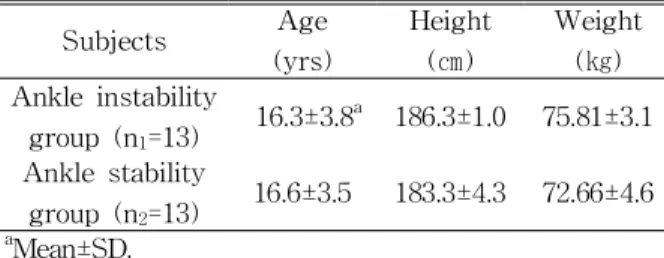
This study was aimed at 13 adolescent male vol- leyball players who have ankle stability and 13 of those who have ankle instability who have all been diagnosed with functional ankle instability through the completion of a questionnaire, physical examina- tion, interview-driven medical examination, and by re- ferring to their past histories. For those who have functional ankle instability however, the experiment was limited to only their left ankles. The subjects were all informed about the aim and the methods of this study and they all agreed to participate in the experiment. The experiment pertaining to ankle in- stability was aimed at patients who complained of in-
Subjects Age (yrs)
Height (㎝)
Weight (㎏) Ankle instability
group (n1=13) 16.3±3.8a 186.3±1.0 75.81±3.1 Ankle stability
group (n2=13) 16.6±3.5 183.3±4.3 72.66±4.6
aMean±SD.
Table 1. Characteristics of the subjects (N=26) stability and recurring ankle sprains, and those whose injuries were sustained a minimum of 3 months ear- lier, and whose full weight bearing was possible at the time of the examination were also chosen.
Functional ankle instability has been clarified through a questionnaire, which was based on data from the precursor studies (Ji et al, 2004; Hubbard and Kaminski, 2002). If a person shows more than 3 of these symptoms-ankle has been sprained more than 2 times, difficulties experienced while running on an uneven surface or cutting and jumping during play, ankle gives way, a high degree of pain, and instability. Those who had lower extremity fractures, edema or had surgery at the time of the experiment were excluded (Table 1).
Instruments 2) 3)
To measure the balance ability in this study, the Balance Master System1)which is judged to be highly ob- jective was used (Lim et al, 2006; McGuine et al, 2000).
To measure height and weight, a HM-2022) was used.
Procedures
Sensory limitation assessment of static balance ability, motor limitation assessment of dynamic bal- ance ability and functional limitation assessment of motor functions were divided into 3 sections and the experiment was performed on each section.
Sensory Limitation Assessment of Static Balance Ability.
Modified Clinical Test Sensory Interaction on Balance (Modified CTSIB)
To test for problems in the sensory system in a standing position, the subject stood on the force platform for 10 seconds and was measured 3 times.
Center of gravity (COG) changes on the force plat- form was recorded on the monitor and the mean COG sway velocity of the COG was measured when eyes opened and closed based on the height and width of the sway.
Unilateral Stance
To measure coordination, the subject stood on the force platform of the Balance Master on one leg, both hands placed on the elbow joints of the oppo- site sides, stayed in that position for 10 seconds and was measured 3 times. COG changes on the force platform were recorded on the monitor and the mean COG sway velocity of the COG was measured when eyes opened and closed, based on the height and width of the sway.
Motor Limitation Assessment With Dynamic Balance Ability
Limit of Stability
To measure directional control of the COG, 8 ob- jects were marked clockwise on the monitor and the subject's COG was shown in the center of the monitor. The subject was to move the 8 objects by moving his own COG during which time each object was measured every 10 seconds. The methods used for reaction time, movement velocity, movement ex- cursion and directional control of each object in ev- ery direction was measured as follows. The reaction time shows the time from the starting sign displayed on the monitor until the subject makes their first 1) Balance MasterⓇ System, NeuroCom Inc., U.S.A.
2) HM-202, Fanics, Korea.
Ankle stability group Ankle instability group
Firm Eye open .23±.50a .24±.51
Eye closed .25±.96 .29±.43*
Form Eye open .44±.12 .45±.11
Eye closed 1.54±.31 1.59±.45
aMean±SD.
*p<.05.
Table 2. Comparisons of postural sway of mean COG under modified CTSIB between groups (Unit: °/sec) movement, and this was measured in seconds. The
movement velocity shows the time for the COG to reach the object, and this was measured in angular velocity per second. The movement excursion shows the end point & excursion and maximal excursion of the movement path for the COG from the center of the object, and this was measured as a percentage.
The directional control shows the degree of sway for the COG from the center of the object, which was advanced in a straight line, and the value was measured 3 times as a percentage and the mean value was estimated.
Rhythmic Weight Shift
To evaluate the velocity control of left/right, front/back rhythmic movement, the on-axis velocity of each section and directional control was measured.
During this evaluation, 3-second transitions for slow velocity, 2-second transitions for medium velocity and 1-second transitions for fast velocity were measured. The on-axis velocity was to move the weight towards directional movement, it was meas- ured in angular velocity per second. The value for the degree of sway of the subject in directional con- trol movement, which was advanced in a straight line, was measured 3 times as a percentage and es- timated the mean value.
Functional Limitation Assessment of Motor Functions
A 180 degree step/quick turn during a tandem walk and gait was evaluated. For the tandem walk, the subject tandem walks on the center line dis- played on the force platform, and the degree of end
sway was measured. When making a step/quick turn during gaiting, a turn sway (in degrees) of the COG which was calculated by angle and turn time (in seconds), were measured 3 times for both left and right and the mean value was estimated.
Statistical Analysis
All data acquired through this study was to pro- duce the mean SD by using the Window SPSS/PC 12.0 statistical program and the Independent samples t-test was conducted to determine changes in static balance ability, dynamic balance ability and motor function between the ankle stability group and the ankle instability group. Statistical standards to be at- tended to all possible variables are set at .05.
Results
Sensory Limitation Assessment About Static Balance Ability
Modified Clinical Test Sensory Interaction on Balance (Modified CTSIB)
When tested on a firm surface with eyed closed, the ankle instability group showed a value of .29±.43°/sec and the ankle stability group showed a value of .25±.96°/sec, and there was a significant difference in terms of postural sway. However, when tested on a foam surface, the postural sway of the ankle instability group was slightly more increased than the ankle stability group, but it was not sig- nificant statistically (Table 2).
Ankle stability group Ankle instability group
Left Eye open .67±.16a .76±.15*
Eye closed .72±.11 .76±.18*
Right Eye open 1.54±.52 1.57±.40
Eye closed 1.60±.38 1.60±.39
aMean±SD.
*p<.05.
Table 3. Comparisons of postural sway of mean COG under unilateral stance between groups (Unit: °/sec)
Ankle stability group Ankle instability group Reaction time (sec)
Forward .76±.25a .56±.11
Backward .59±.18 .56±.11
Right .69±.19 .54±.96
Left .67±.17 .58±.08*
Movement velocity (°/sec)
Forward 3.68±1.18 2.80±.69*
Backward 4.03±.68 3.38±1.26*
Right 5.73±1.81 4.56±1.63
Left 5.80±1.87 4.78±1.35*
End-point excursion (%)
Forward 69.76±12.35 4.15±14.59
Backward 70.76±8.87 67.23±12.69
Right 87.46±11.35 83.69±11.89
Left 95.07±12.23 97.38±11.98
Maximal excursion (%)
Forward 82.38±8.09 76.30±12.79
Backward 83.15±10.22 82.00±7.00
Right 100.23±9.06 101.69±6.90
Left 104.61±9.88 101.23±9.15*
Directional control (%)
Forward 85.92±4.90 83.53±4.40
Backward 82.46±8.81 81.30±4.85
Right 84.38±4.69 84.15±3.33
Left 83.15±8.38 77.38±4.44*
aMean±SD.
*p<.05.
Table 4. Comparisons of 5 balance parameter under limit of stability between groups
Unilateral Stance
On the right, one can see a not very significant difference in sway velocity of the center of gravity between the ankle stability group and the ankle in- stability group, however, on the left can be seen a value of .67±.16°/sec for the ankle stability group and .76±.15 for the ankle instability group with eyes open, which indicates a statistically significant differ- ence (p<.05) (Table 3).
Motor Limitation Assessment with Dynamic Balance Ability
Limit of Stability
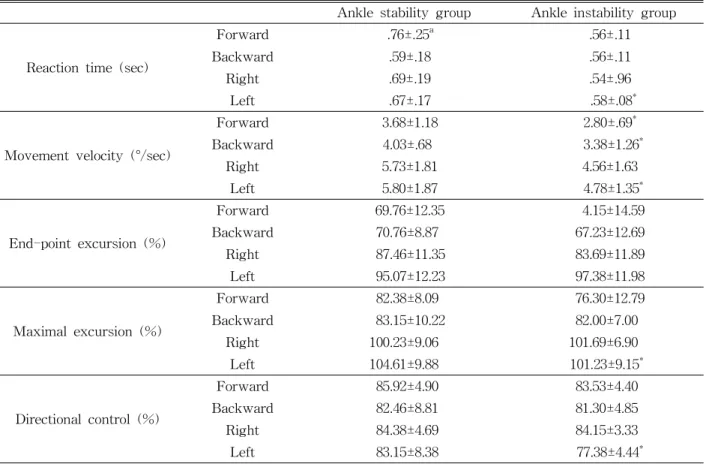
The limit of stability was to compare the dynamic balance ability of directional control, movement ex- cursions, end-point, maximum, movement velocity and reaction time for both the ankle instability group and the ankle stability group, and the ankle in-
Ankle stability group Ankle instability group
Slow Medium Fast Slow Medium Fast
Left/
Right
On-axis velocity
(°/sec) 2.06±.27a 3.00±.36 5.88±.64 1.35±.29 2.43±.34* 5.12±.90* Directional control
(%) 81.53±5.01 86.15±3.89 86.76±7.08 81.00±7.03 83.38±6.75* 81.84±5.03* Front
/Back
On-axis velocity
(°/sec) 2.96±.40 4.45±.42 8.90±1.19 2.50±.31 4.33±.50 8.38±1.86 Directional control
(%) 79.61±6.71 85.46±4.87 86.46±6.61 78.53±7.46 82.61±4.99 86.30±4.38
aMean±SD.
*p<.05.
Table 5. Comparisons of 2 balance parameter under rhythmic weight shift between groups stability group showed more unstable changes than
the ankle stability group. The reaction time showed a significant difference on the right and left, the move- ment velocity showed a significant difference in the front, back and left, maximal excursions showed a significant difference on the right and left, however the end-point excursions did not show any significant difference. The directional control showed a significant difference on the left statistically (p<.05) (Table 4).
Rhythmic Weight Shift
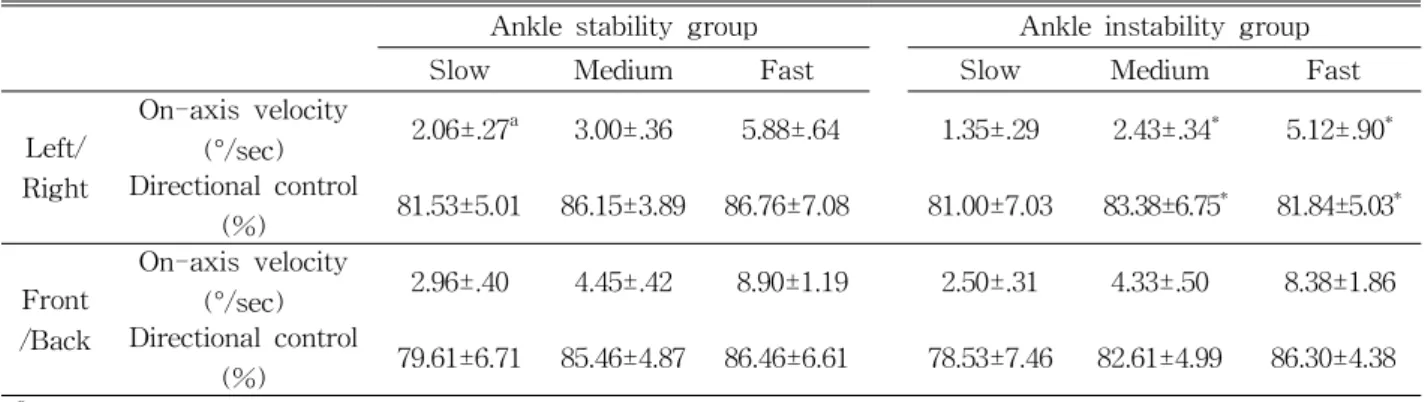
Rhythmic weight shift was conducted to compare the ankle stability group and the ankle instability group with regards to their directional control and on-axis velocity of the right, left, front and back side in terms of movement velocity. There was a significant differ- ence statistically in fast directional control, medium di- rectional control, fast on-axis velocity and medium on-axis (p<.05). However, the on-axis velocity and di- rectional control of the COG in terms of slow move- ment velocity did not show any significant difference statistically. On the front and the back direction, on-axis velocity and directional control of the COG de- creased in the group with ankle instability, but there were no significant changes statistically (Table 5).
Functional Limitation Assessment of Motor Functions
The turn time of the ankle instability group and the ankle stability group was compared in step/quick
turn during a gaiting test, and on the left the ankle instability showed a value of .50±.23 sec and the an- kle stability group showed a value of .43±.27 sec, and there was a significant difference statistically.
During step/quick turn, turn the sway of the center of gravity of the ankle instability group was 12.05±4.48˚, and the ankle stability group was 10.88±4.10˚ and there was a significant difference statistically. Also, during the tandem walk, the end sway of the center of gravity of the ankle instability group was 3.13±.79°/sec while the ankle stability group was 2.88±.75°/sec, and there was a significant difference statistically (p<.05) (Table 6).
Discussion
A reciprocal action of all motion in harmony with sense of sight, the vestibular organ and other phys- ical sensation is said to be a balance of the body which can be divided into static balance and dynam- ic balance (Mergner and Rosemeier, 1998). The fac- tors which affect balance control are vision, proprio- ception, the inner ear, the function of the vestibular organ, the function of the cerebellum, length discrep- ancy of both legs on the surface, the strength of both legs, etc (Horak et al, 1990). To evaluate this kind of balance control ability quantitatively, the Computerized Balance Evaluation & Training System (COBETS), and the Balance Error Scoring System
Ankle stability group Ankle instability group Step/Quick turn
Turn time (sec) Right side .49±.25a .49±.28
Left side .43±.27 .50±.23*
Turn sway (°) Right side 11.51±2.67 11.03±4.19
Left side 10.88±4.10 12.05±4.48*
Tandem walk End Sway (°/sec) 2.88±.75 3.13±.79*
aMean±SD.
*p<.05.
Table 6. Comparisons of 2 balance parameter under step/quick turn and tandem walk between groups
(BESS) are used (Docherty et al, 2006). Testerman and Vander (1999) used the Biodex stability system to measure the proprioception objectively.
The Balance Master System (computerized dynamic posturography), which was used in this study, is a device in which a right/left balance training through visual feedback with one's COG can be objectively evaluated in a quantitative way (Dodd et al, 2003;
Lim et al, 2006). To evaluate the sensory limitation of the static balance ability of volleyball players, this study used a unilateral test and modified Clinical Test Sensory Interaction on Balance: modified CTSIB.
During the modified CTSIB, when it was con- ducted on a firm surface, the postural sway was significantly increased in the ankle instability group.
This accords with the study by Lephard et al (1998) that the somatic sensory organ takes an important part during static posture balance control, and pos- tural sway occurred when the somatic sensory sys- tem and visual input was destroyed. This is why the ankle instability group showed more severe postural sway because it is unlikely to receive visual input with their eyes closed. Also visual information has a bigger influence on the static posture balance than condition of the surface. During the unilateral stance test, the sway velocity of the COG of the left ankle increased significantly with eyes opened and closed.
This proves that the left ankle is less stable func- tionally and thus that it caused the increase in the ankle sway. It also accords with the study (McGuine et al, 2000) that basketball players with ankle sprains received higher postural sway scores on the balance ability test on one leg, and the study conducted by
Wang et a, (2006) that ankle sprains are more likely to occur in high school basketball players because of numerous changes of postural sway during the uni- lateral stance test, according to the analysis of high school basketball players' ankle injury risk factors.
Conversely, according to Ross et al (2005), mean sway does not show any significant difference between the two groups standing on one leg to measure func- tional ankle instability. This is because the ways to measure balance ability are different. This study shows that the somatosensory and visual information of the volleyball players with functional ankle instability has a big influence on their static postural balance. Therefore static balance ability can be improved by proprioceptive training and visual biofeedback training.
Dynamic Postural Balance Ability is the process of reorganization of the sensorimotor system by taking parts in tasks, environment, movement and various states of interactions (Davids et al, 2003). The vol- leyball players' dynamic postural balance ability was compared in the test determining limit of stability, and there was a significant difference in the left di- rection on reaction time, maximal excursion and di- rectional control, and the same applied to movement velocity to the front, back and left directions. This shows that the ankle instability group has less dy- namic balance ability. Also the rhythmic weight shift test shows a great decrease in slow, medium on-ax- is velocity and medium, fast directional control, which shows that the ankle instability group has a less dynamic balance ability.
Based on reports by Nakagawa and Hoffman (2004), This study demonstrates that because volley-
ball is a sport involving fast movement of the COG, the directional control, movement excursion and movement velocity have lowered. It seems that be- cause it changes in the sensorimotor system, which caused a retardation in the time to stabilization when the volleyball players with functional ankle instability jump and land on a single leg.
According to Wikstrom et al (2007), on the rhyth- mic weight shift of players with ankle instability, the directional control and on-axis velocity are decreased inside and outside, not in the front and back direc- tion, and it can be an index guide in preventing the players from falling down. Brown and Mynark (2007) suggested that the motion of the ankle joint is lim- ited to the left and right direction during landing and to the anterior and posterior direction during jumping for those who have ankle instability. Thus from the available evidence, it is suggested that the left and right direction has a bigger influence on movement velocity and directional control than the front and back direction for the players with ankle instability.
This indicates that volleyball players with functional ankle instability are more subject to restriction dur- ing landing than jumping.
For the functional limitation assessment test on motor functions, turn sway of the COG was sig- nificantly increased in the ankle instability group as compared to the ankle stability group on the tandem walk and making 180 degree steps/quick turns dur- ing a gait. This shows that volleyball requires quick directional control when running and walking so the stability of functional balance control could be low- ered in the case of ankle stability.
Therefore, functional training, including shuttle runs, eight figure run, zigzag run is recommended for those players with functional ankle instability to improve their turn velocity and turn time. This study, which analysed the static balance ability and dynamic balance ability of volleyball players with functional ankle instability quantitatively and ob- jectively, is worthy as draft data that can be applied to the training of volleyball players.
Conclusion
In conclusion, this study shows that visual in- formation and the somatic sensory system has a big influence on the static balance ability of volleyball play- ers with functional ankle instability, and dynamic bal- ance ability also affects the reaction time, movement velocity and directional control in left and right directions. It is considered that further studies need to be conducted on the balance ability differences to be objectified and standardized, which are aimed at various kinds of sports players with functional ankle instability.
References
Barker HB, Beynnon BD, Renstrom AFH. Ankle in- jury risk factors in sports. Sports Med.
1997;23(2):69–74.
Bernier JN, Perrin DH. Effect of Coordination training on proprioception of the functionally unstable ankle.
J Orthop Sports Phys Ther. 1998;27(4):264-275.
Brown CN, Mynark R. Balance deficits in recrea- tional athletes with chronic ankle instability. J Athl Train. 2007;42(3):367-373.
de Noronha M, Refshauge KM, Kilbreath SL, et al. Loss of proprioception or motor control is not related to functional ankle instability: An observational study.
Aust J Physiother. 2007;53(3):193-198.
Davids K, Glazier P, Araujo D, et al. Movement systems as dynamical systems: The functional role of variability and its implications for sports medicine. Sports Med. 2003;33(4):245-260.
Docherty CL, Valovich McLeod TC, Shultz SJ. Postural control deficits in participants with functional ankle in stability as measured by the balance error scor- ing system. Clin J Sport Med. 2006; 16(3):203-208.
Dodd K, Hill K, Hass R, et al. Retest reliability of dynamic balance during standing in older people after surgical treatment of hip fracture.
Physiother Res Int. 2003;8(2):93-100.
Ekstrand JH, Tropp H. The incidence of ankle
This article was received October 27, 2008, and was accepted November 5, 2008.
sprains in soccer. Foot Ankle. 1990;11:41-44.
Eils E, Rosenbaum D. A multi-station proprioceptive exercise program in patients with ankle instability.
Med Sci Sports Exerc. 2001;33(12):1991-1998.
Ergen E, Ulkar B. Proprioception and ankle injuries in soccer. Clin Sports Med. 2008;27(1):195-217.
Garrick JG, Requa RK. The epidemiology of foot and ankle injuries in sports. Clin Podiatr Med Surg.
1989;6(3):629-637.
Gross M. Effects of recurrent lateral ankle sprains on active and passive judgement of joint position. Phys Ther. 1987;67(10):1505-1509.
Hertel J, Braham RA, Hale SA, et al. Simplifying the star excursion balance test: Analyses of subjects with and without chronic ankle instability. J Orthop Sports Phys Ther. 2006;36(3):131-137.
Horak FB, Nashner LM, Diener HC. Postural strat- egies associated with somatosensory and ves- tibular loss. Exp Brain Res. 1990;82(1):167-177.
Hubbard TJ, Kramer LC, Denegar CR, et al.
Correlations among multiple measures of functional and mechanical instability in subjects with chronic ankle instability. J Athl Train. 2007;42(3):361-366.
Hubbard TJ, Kaminski TW. Kinesthesia is not af- fected by functional ankle instability status. J Athl Train. 2002;37(4):481-486.
Ji SW, Kim HS, Kwon KW, et al. The ankle strength, balance and functional ability of the adolescent volleyball players with functional an- kle instability. The Korea Journal of Physical Education. 2004;43(1):567-577.
Karlsson J, Lansinger O. Lateral instability of the ankle joint. Clin Orthop. 1992;276:253-261.
Lentell G, Baas B, Lopez D, et al. The contributions of proprioceptive deficits, muscle function, and ana- tomic laxity to functional instability of the ankle.
J Orthop Sports Phys Ther. 1995;21(4):206-215.
Lephart SM, Pincivero DM, Rozzi SL. Proprioception of the ankle and knee. Sports Med. 1998;25(3):149-155.
Lee JP. The effects of functional ankle instability on ankle characteristics and functional performance of lower extremity in male gymnasts. Exercise
Science. 2006;15(2):147-154.
Lim KB, Lee HJ, Joo SJ, et al. Postural control measures of golfers using Balance Master System. Korean Journal of Sports Medicine. 2006;24(2):152-157.
McGuine TA, Greene JJ, Best T, et al. Balance as a predictor of ankle injuries in high school basket- ball players. Clin J Sport Med. 2000;10(4):239-244.
Mergner T, Rosemeier T. Interaction of vestibular, somatosensory and visual signals for postural control and motion perception under terrestrial and microgravity conditions-A conceptual model.
Brain Res Brain Res Rev. 1998;28(1-2):118-135.
Nakagawa I, Hoffman M. Performance in static, dy- namic, and clinical tests of postural control in individuals with recurrent ankle sprains. J Sport Rehabil. 2004;13(3):255-268.
Na YM, Mun JH, Sung YJ, et al. The effects of ankle disk training in functional ankle instability. Korean Journal of Sports Medicine. 1999;17(2):406-412.
Park MH. A Study on the injuries of the volleyball players. Seoul, Hanyang university, 1999;43-44.
Ross SE, Guskiewicz KM, Yu B. Single-leg jump-landing stabilization times in subjects with functionally unstable ankles. J Athl Train.
2005;40(4):298-304.
Santos MJ, Liu W. Possible factors related to func- tional ankle instability. J Orthop Sports Phys Ther. 2008;38(3):150-157.
Testerman C, Vander GR. Evaluation of ankle in- stability using the Biodex Stability System. Foot Ankle Int. 1999;20(5):317-321.
Wang HK, Chen CH, Shiang TY, et al. Risk factor analysis of high school basketball–player ankle in- juries: A prospective controlled cohort study evalu- ating postural sway, ankle strength, and flexibility.
Arch Phys Med Rehabil. 2006;87(6):821-825.
Wikstrom EA, Tillman MD, Chmielewski TL, et al.
Dynamic postural stability deficits in subjects with self-reported ankle instability. Med Sci Sports Exerc. 2007;39(3):397-402.