• 검색 결과가 없습니다.

Correlation between Weight Bearing Ratio and Functional Level for Development of Pressure Sensor Biofeedback in Stroke Patient

N/A
N/A
Protected

Academic year: 2021

Share "Correlation between Weight Bearing Ratio and Functional Level for Development of Pressure Sensor Biofeedback in Stroke Patient"

Copied!
10
0
0

로드 중.... (전체 텍스트 보기)

전체 글

(1)

Research Article Open Access

Correlation between Weight Bearing Ratio and Functional Level for Development of Pressure Sensor Biofeedback in Stroke Patient

Young Moon, PT, BSc, Mi-Sun Kim, PT, MSc, Jong-Duk Choi, PT, PhD 1†

Department of Physical Therapy, The Graduate School, Daejeon University

1 Department of Physical Therapy, College of Natural Science, Daejeon University

Received: July 24, 2014 / Revised: August 29, 2014 / Accepted: August 20, 2014

ⓒ 2014 J Korean Soc Phys Med

1)

| Abstract |

PURPOSE: This study aimed to determine the correlation of weight bearing ability at the affected side with balance and gait abilities for the development of pressure biofeedback based equipment to stroke patients.

METHODS: This study included 35 patients with stroke patient. The tests were conducted to determine the weight bearing ratio while pushing a step forward the affected side, static balance ability using the total length of COP(Center of pressure), sway velocity of COP, COP velocity at the X and Y axis. Functional reaching test (FRT), berg balance scale (BBS) were used to assess the dynamic balance ability and timed up and go test (TUG), 10m walk test (10mWT) were used assess the gait ability respectively. In order to determine the correlation between measured variables, bivariate correlation analysis was conducted.

RESULTS: A significant correlation of the weight bearing ratio were shown with COP total length and velocity(r=-.34), Y-axis velocity(r=-.39), FRT(r=.42), BBS(r=.54), TUG

†Corresponding Author : [email protected]

This is an Open Access article distributed under the terms of the Creative Commons Attribution Non-Commercial License (http://creativecommons.org/licenses/by-nc/3.0) which permits unrestricted non-commercial use, distribution, and reproduction in any medium, provided the original work is properly cited.

(r=-.39), and 10m walking test (r=-.42).

CONCLUSION: This study result showed that as patients with stroke had more weight bearing ratio at the affected side, not only their static and dynamic balance abilities increased more but also functional gait ability improved more. These results mean that, to improve stroke patients’ static, dynamic balance ability and gait ability, weight bearing training with the affected side foot placed one step forward necessary for gaits are important.

Key Words: Balance, Gait ability, Stroke, Weight bearing

Ⅰ. Introduction

After onset, stroke which is a representative cerebrovascular impairment causes not only sensory disorder, perception disorder, language disorder, and emotional disturbance but also upper and lower extremity dysfunction, gait disturbance, and disabilities in activities of daily living (ADL) due to hemiplegia and increases related individual and social costs(Chon et al., 1998).

When standing, many stroke patients show an imbalance

of weight bearing that loads less than 50% of their total

weight on their affected side lower extremity(Kim, 1995)

and such stroke patients reach 79∼87% of all stroke

(2)

patients(Sackley, 1990). This asymmetry of weight bearing affects the recovery of the patients’ gait ability(Kim, 1995) because functional weight shifting between the lower extremities on the both sides is essential for the ability to maintain and control balanced standing postures necessary to reduce the asymmetry between the left and right sides of the body and recover gait ability(Wall and Turnbull, 1986; Bobath, 1990). Stroke patients perform functional movements also loading more weight on the less-affected side lower extremity. Dettmann et al. (1987) stated that the cause of abnormal gaits of hemiplegia patients due to stroke was that they could not shift their center of mass(CoM) to the affected side lower extremity.

In previous studies, diverse intervention methods have been implemented to improve stroke patients’ affected side lower extremity’s weight bearing ability and many studies reported improvement in weight bearing ability as well as in balance, gait abilities(Kim, 2011; Kim, 2009; McCain et al., 2008).

The decline in performance capability after stroke onset hinders postural and selective motor control(Sackley et al., 1992), and disrupts weight bearing control and gait ability (Kim and Eng 2003; Keenan et al., 1984). Therefore, balance training is important to reduce stroke patients’ risk of falling risk and increase their physical activity ability(Catherine et al., 2009). Yavuzer et al.(2006) reported that balance training affected stroke patients’ gait toward the improvement of their affected side weight shifting and postural control ability.

The re-gain of gait ability after stroke is an important element directly related to the patients’ independence (Taylor-Piliae et al., 2012) and their gait functions should be recovered at least to the extent that functional activities are possible. For ideal gaits, the effectiveness that can minimize fatigue and the stability that can prevent falling are require(Neumann, 2004). However, stroke patients’

gaits show states in which they are hard, slow, and not well coordinated and also show low gait velocity, reduced

stance phase time, reduced weight bearing, and increased swing phase time(Geiger et al., 2001; Ikai et al., 2003).

Kim and Eng(2003) reported that stroke patients’ reduced weight bearing on their affected side lower extremity affected their gaits.

Although many studies reported the enhancement of weight bearing ability and the improvement of balance and gait abilities, most of the studies focused on the improvement of abilities through interventions and studies on correlations are insufficient. In addition, most of studies on correlations are on the correlations between stroke patients’ gait and their balance (Keenan et al., 1984;

Bohannon, 1989) and studies on direct correlations between affected side weight bearing ratios and their balance/gaits are insufficient. Furthermore, most studies measured affected side weight bearing ratios in general bipedal standing position with patients’ two feet placed parallel to each other and measurements of affected side weight bearing ratios in affected side stance phases which are the periods of weight bearing by the affected side during gait cycles that are emphasized for actual improvement of gait ability are quite insufficient.

Therefore, the purpose of the present study was to measure stroke patients’ affected side weight bearing ratios, static balance ability, dynamic balance ability, and functional gait ability to examine the correlations between them.

Ⅱ. Methods

1. Participants

The present study was conducted with 182 stroke

patients in D rehabilitation hospital in Daejeon. The

inclusion criteria for the subjects were as follows; patients

with hemiplegia due to stroke that could walk at least 10m

independently without using any gait assisted-aid, had no

other neurologic problem than stroke, had no orthopedic

(3)

problem in their lower extremities and spine, and showed at least 24 points in the mini-mental state examination- Korean version (MMSE-K). Among 76 patients that satisfied the inclusion criteria, 35 patients that agreed to participate in the study finally participated in the study.

The subjects of the present study voluntarily wanted to participate in the experiment and signed on an agreement to the experiment. The present study was deliberated by the Daejeon University Institutional Life Ethics committee before being conducted (No. 1040647-201403-HR-024-03).

2. Materials and methods

1) Assessment of the weight bearing ability of the affected side

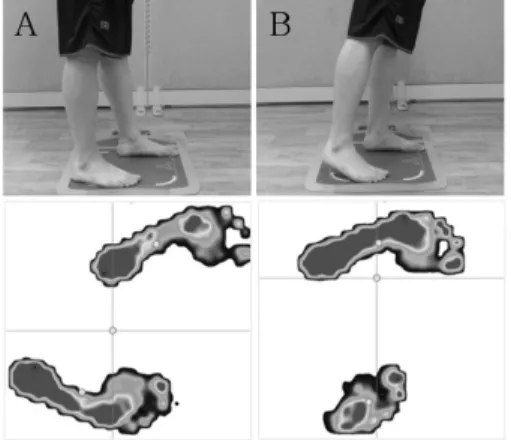
A gait evaluation system named Gaitview (Alfoots, Seoul, Korea) was used to assess affected side weight bearing ability in positions similar to mid-stance phases during gait cycles. The measurement was conducted when

the participant took a forward step with the affected side foot with a step width similar to the step width during gaits similarly to mid-stance phases during gait cycles. The participant’s affected side weight bearing ability was measured in two positions; a comfortable standing position with the affected side foot placed forward by one step and a standing position with weight shifted as much as possible to the affected side foot placed forward by one step. In this case, the affected side weight bearing ability was measured using the difference between the weight bearing ratio(%) in the comfortable standing position with the affected side foot placed forward by one step and that in the standing position with weight shifted as much as possible to the affected side foot placed forward by one step. In all cases of the measurement, the participant was instructed to maintain the position as soon as the start was notified and the weight bearing ability was measured for 5 sec (Fig 1). The measurement was conducted three times and the average value was used as a measured value.

   

 

   

   

for   

× 

Fig 1. Evaluation of weight bearing ratio on affected side. (A) Standing position on affected side forward step. (B) Weight bearing on affected side.

2) Static balance ability assessment

A Gaitview was used to assess the subjects’ static balance ability. The subject stood upright on the foothold of the equipment looking straight ahead. The subject was instructed to maintain the standing position for 30 seconds with the eyes open and the subject’s COP total length, COP sway velocity, COP X axis velocity, and COP Y axis velocity were measured. The measurement was conducted three times and the average value was used as a measured value.

3) Dynamic balance ability assessment

Functional reach test (FRT) and Berg balance scale

(BBS) were used to assess the participants’ dynamic

balance ability.

(4)

(1) Functional reach test (FRT)

FRT were conducted to assess the participants’ dynamic balance ability. In a standing position with his/her feet apart at the shoulder width, the subject bent the shoulder joint by 90°, extended the elbows, and clenched his/her fists. After measuring the distance from the center of the shoulder joint to the hand in the start position, the subject was instructed to stretch out the arm forward while maximally bending within the extent not to fall forward and the distance in this case was measured. The value obtained by deducting the specific value obtained in the initial start position from the later measured value was used. FRTs have high reliability and validity as their validity is r=.71, intra-rater reliability is r=.89, and inter-rater reliability is r=.98(Duncan et al., 1990). The measurement was conducted three times and the average value was used as a measured value.

(2) Berg balance scale (BBS)

The BBS was used to assess the participants’ dynamic balance ability. The BBS is a method of measuring stroke patients’ or elders’ balance ability that assesses the ability to perform 14 tasks comprising tasks ranging from low level ones such as balance in sitting positions to high level ones such as one leg standing and placing alternate foot on stool (Wee et al., 2003) with a full score of 56 points.

Higher scores mean better balance ability. This scale has high reliability and validity in assessing balance ability as its intra-rater reliability and inter-rater reliability are r=.99 and r=.98 (Berg et al., 1992). The measurement was conducted three times and the average value was used as a measured value.

4) Functional gait ability assessment

(1) Timed up and go test (TUG)

TUG were conducted to assess the participants’

functional gait ability. The time taken for the subject to

stand up from an upright sitting position on an armchair according to a verbal command ‘Start’, walk to a point 3m away on the front, come back, and sit on the chair again was measured in seconds. this test has high reliability as its intra-rater reliability is r=.99 and inter-rater reliability is r=.98(Podsiadlo and Richardson, 1991). The measurement was conducted three times and the average value was used as a measured value.

(2) 10m walking test (10mWT)

The 10mWT was conducted to assess the participants’

functional gait ability. The participant walked a total of 14m at comfortable walking speed and the walking time for the 10m section excluding the first 2m and the last 2m was measured in seconds considering acceleration and deceleration. This test has high reliability as its intra-rater reliability is r=.95, and inter-rater reliability is r=.95(Hunt et al. 1981). The measurement was conducted three times and the average value was used as a measured value.

3. Statistical analyses

The collected data were statistically processed using the SPSS window ver. 18.0 program. The means and SDs of the participants’ characteristics were calculated using descriptive statistics. Pearson’s correlation coefficients were used to analyze the correlations between affected side weight bearing ratios and static, dynamic balance ability, functional gait ability. The level of significance was fixed at .05.

Ⅲ. Results

1. Participants characteristics

The present study was conducted with a total of 35

stroke patients. With regard to the subjects’ general

characteristics, the subjects consisted of 24 males and 14

females, their age was 60.14±9.54 year, their weight was

(5)

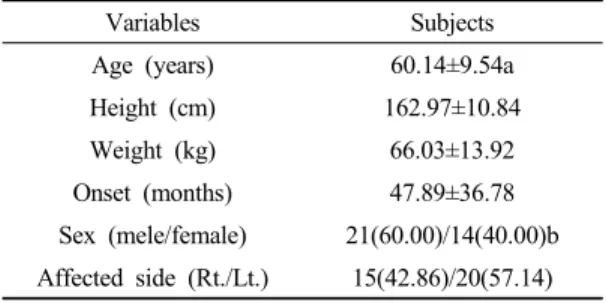
66.03±13.92kg, and their height was 162.97±10.84cm.

Time after onset of stroke of the subjects was 47.89±36.78 months. With regard to their affected side, the subjects consisted of 15 right hemiplegia patients and 20 left hemiplegia patients(Table 1).

Variables Subjects

Age (years) 60.14±9.54a

Height (cm) 162.97±10.84

Weight (kg) 66.03±13.92

Onset (months) 47.89±36.78 Sex (mele/female) 21(60.00)/14(40.00)b Affected side (Rt./Lt.) 15(42.86)/20(57.14)

a mean±S.D.

b The number of persons (%)

Table 1. General and Medical Characteristics of Subjects.

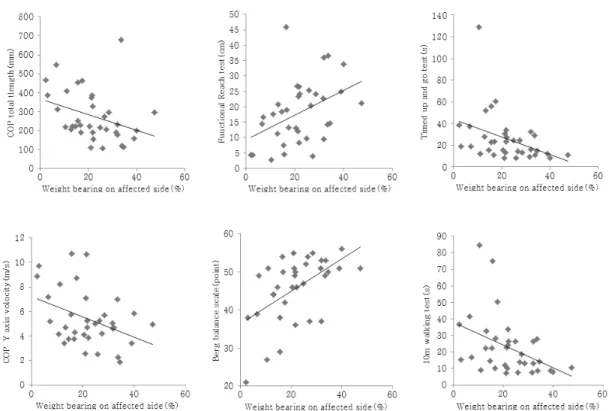
2. Correlation between affected side weight bearing ratios and static balance ability Affected side weight bearing ratios and the COP total length/sway velocity as static balance ability showed significant negative correlations(r=-.34, p<.05). Affected side weight bearing ratios and Y axis velocity showed statistically significant negative correlations(r=-.39, p<.05) but affected side weight bearing ratios and X axis velocity did not show any statistically significant correlation(Table 2).

3. Correlation between affected side weight bearing ratios and dynamic balance ability According to the results of measurement between affected side weight bearing ratios and dynamic balance ability, both FRT(r=.42, p<.05) and BBS(r=.54, p<.05) showed significant positive correlations(Table 2).

4. Correlation between affected side weight bearing ratios and functional gait ability Both TUG(r=-.39, p<.05) and 10mWT(r=-.42, p<.05) that are two variables for assessment of the correlations between affected side weight bearing ratios and functional

gait ability showed statistically significant negative correlations(Table 2).

Weight bearing on affected side ratio p

COP total length -.34 .49*

COP sway velocity -.34 .49*

COP X axis velocity -.25 .15

COP Y axis velocity -.39 .02*

FRT .42 .01*

BBS .54 .00*

TUG -.39 .02*

10mWT -.42 .01*

*p<0.05

COP : Center of pressure FRT : Functional reach test BBS : Berg balance scale TUG : Timed up and go test 10mWT : 10m walk test

Table 2. Correlations between weight bearing on affected side ratio, static balance, dynamic balance and functional gait ability

Ⅳ. Discussion

Stroke patients show asymmetric weight bearing between the affected side and less-affected side and have the dysfunction of declined balance and gait abilities.

Therefore, the improvement of affected side weight bearing

ability should essentially precede the improvement of

balance ability and gait ability. In previous studies, the

improvement of balance ability and gait ability was shown

through the improvement of affected side weight bearing

ability(Eng and Chu, 2002; Hwang, 2014; Pollock et al.,

2011; Robinson et al., 2011). However, in many previous

studies(Geiger et al., 2001; Kim, 2012; Son et al., 2012),

the assessment of affected side weight bearing ability has

been conducted in parallel and symmetrical upright

standing positions and cases of the assessment of weight

bearing ability during gaits in which patients’ base of

(6)

Fig 2. Correlation graph between weight bearing on affected side ratio and static(COP total length, COP Y axis velocity), dynamic(FRT, BBS) balance and functional gait ability(TUG, 10mWT)

support and weight distribution vary are quite insufficient.

Therefore, in the present study, stroke patients’ affected side weight bearing ratios were measured in positions similar to gaits to examine the correlations between affected side weight bearing ratios and balance ability/gait ability.

In the present study, the affected side weight bearing ability was assessed using the difference between the weight bearing ratio (%) in the comfortable standing position with the affected side foot placed forward by one step and that in the standing position with weight shifted as much as possible to the affected side foot placed forward by one step.

Affected side weight bearing ratios and COP total length, COP sway velocity showed significant negative correlations with r=-.34. This means that weight bearing ability in positions with the affected side foot placed forward by one step similar to gaits is related to balance ability in

symmetrical upright standing positions. In addition,

affected side weight bearing ratios showed significant

negative correlations with Y axis velocity that indicates

anterior-posterior postural sway(r=-.39). This means that

subjects with higher affected side weight bearing ratios

have better ability to control anterior-posterior postural

sway in standing positions. Harburn et al.(1995) advised

that hemiplegia patients experienced reduction in endurance

necessary for weight bearing due to the affected side lower

extremity’s abnormal muscle recruitment and had

difficulties in maintaining static standing positions due to

increased static postural sway. In a study conducted by

Lee et al.(2010), it was reported that, through motor

imagery and gait training, stroke patients showed

improvement of static balance ability and further

improvement of anterior-posterior postural sway velocity

compared to medial-lateral postural sway velocity. Another

(7)

study indicated that balance in static standing positions was the ability to shift weight to the affected side, a prerequisite for functional movement, and important for activities of daily living such as sit to stand, gait, and stair up and down(Eng and Chu, 2002). Although many previous studies reported that medial-lateral balance ability was related to stroke patients’ functional balance and gait ability, the present study showed that anterior-posterior balance ability was also significantly correlated with functional balance and gait ability.

In the present study, when the correlations between affected side weight bearing ratios and dynamic balance ability were assessed, significant positive correlations were shown as FRT was r=.419 and BBS was r=.538. Some previous studies assessed stroke patients’ balance ability and reported that it was significantly correlated with ADL and gait ability (Desrosiers et al., 2002; Robinson et al., 2011; Pollock et al., 2011). However, Tyson et al.(2006) argued that the measurement of balance impairment that measures the degree of medial-lateral weight bearing was not much related to the measurement of balance disability that measures static, dynamic balance abilities. In a study conducted by Walker et al.(2000), the researchers stated that although visual feedback balance training was effective in helping stroke patients to have symmetrical standing postures, it was doubtful whether the training improved functional balance ability. However, Eng and Chu(2002) advised that, in the case of stroke patients, weight bearing ability was correlated with functional performance capability and that stroke patients’ ability for anterior- posterior, medial-lateral movements of weight in static standing postures was their ability for anterior-posterior, medial- lateral movements of affected side weight bearing, and that it could be directly connected to gaits. Since the FRT tests conducted in the present study were used as a way to measure active anterior-posterior weight shifting ability in static standing postures, the results of the present study are consistent with the results of previous studies(Eng and

Chu, 2002). In addition, a previous study conducted by Kim(2012) indicated that BBS and affected side weight bearing ratios were significantly correlated with each other with r=.34 consistently with the results of the present study.

In addition, TUG and 10mWT that assessed affected side weight bearing ratios and functional gait ability showed significant negative correlation with r=-.39 and r=-.42 respectively. Hwang (2014) reported that patients with higher affected side weight bearing ratios had better TUG functions and Geiger et al.(2001) reported that when affected side weight bearing training was implemented using balance ability measuring equipment, TUG scores were improved. Although a previous study (Kim, 2012) reported that affected side weight bearing ratios were not statistically significantly correlated with 10m gait velocity, the present study showed statistically significant correlations between affected side weight bearing ratio and 10mWT.

A study conducted by Son et al.(2012) reported that when 10m gait velocity was measured after weight shifting training with the joint mobilization technique applied to the affected side ankle, the 10m gait velocity showed significant increases. This means that the improvement of gait velocity that is clinically used as a scale for measuring the levels of independent gait ability necessary for ADL is associated with the enhancement of affected side weight bearing ratios (Keenan et al., 1984). These results of previous studies are thought to be grounds that support the results of the present study indicating the correlations between affected side weight bearing ratios and static, dynamic balance ability, functional gait ability.

Since the stroke patients’ affected side weight bearing

ratios used in the present study was obtained by analyzing

the data measured while the subjects were consciously

implementing weight bearing by the affected side, the

present study has a limitation that unconscious affected

side weight bearing ratios appearing in actual gaits could

not be reflected. In addition, since the present study was

conducted with subjects that could walk without any gait

(8)

assisted-aid or help, future studies should be conducted with more diverse subjects along with the assessment of weight bearing ratios appearing during actual gaits to derive study results regarding the correlations between stroke patients’ affected side weight bearing and functional balance ability/gait ability.

Ⅴ. Conclusion

The present study was intended to examine the correlations between variables obtained by measuring weight bearing ratios, static/dynamic balance ability, and functional gait ability in states where the affected side foot had taken one forward step similarly to affected side stance phases in stroke patients’ gait cycles. Affected side weight bearing ratios showed statistically significant correlation not only with static balance ability but also with other variables such as FRT, BBS, TUG, and 10mWT. These results mean that the improvement of affected side weight bearing ratios can indicate the improvement of functional performance capabilities related to patients’ balance and gait.

Therefore, these results mean that, to improve stroke patients’ static, dynamic balance ability and gait ability, not only alternative weight bearing training between the affected side and the non-affected side but also weight bearing training with the affected side foot placed one step forward necessary for gaits are important. Stroke patients’

functions are expected to be improved further through the development of pressure bio feedback based equipment for the improvement of stroke patients’ weight bearing ratios and functional levels so that these training methods can be effectively applied.

This work (Grants No. C0142214) was supported by Business for Cooperative R&D between Industry, Academy, and Research Institute funded Korea Small and Medium Business Administration in 2013.

References

Berg KO, Wood-Dauphinee SL, Williams JI, et al. Measuring balance in the elderly: validation of an instrument.

Can J Public Health. 1992;83:7-11.

Bobath B, Adult hemiplegia: evaluation and treatment(3rd ed).

London. Hionemann. 1990.

Bohannon RW. Selected determinants of ambulatory capacity in patients with hemiplegia. Clin Rehabil. 1989;

3(1):47-53.

Catherine D, Chris R, Michelle S, et al. Exercise intervention to prevent falls and enhance mobility in community dwellers after stroke: a protocol for a randomized controlled trial. BMC Neurol. 2009;22(9):38-43.

Chon JS, Chun SI, Park SH, et al. Recent Epidemiologic Trends of Stroke. J of Korean Acad of Rehab Med. 1998;

22(6):1159-65.

Desrosiers J, Noreau L, Rochette A, et al. Predictors of handicap situations following post-stroke rehabilitation. Disabil Rehabil. 2002;24(15):774-85.

Dettmann MA, Linder MT, Aepic SB. Relationship among walking performance, postural stability, and functional assessments of the hemiplegic patient. Am J Phys Med. 1987;66(2):77-90.

Duncan PW, Weiner DK, Chandler J, et al. Functional reach:

a new clinical measure of balance. J Gerontol.

1990;45(6):192-7.

Eng JJ, Chu KS. Reliability and comparison of weight-bearing

ability during standing tasks for individuals sith

chronic stroke. Arch Phys Meds Rehabil. 2002;

(9)

83(8):1138-44.

Geiger RA, Allen JB, O’Keefe J, et al. Balance and mobility following stroke : Effects of physical therapy interventions with and without biofeedback / forceplate training. Phys Ther, 2001;81(4):995-1005.

Harburn KL, Hill KM, Kramer JF, et al. Clinical applicability and test-retest reliability of an external pertubation test of balance in stroke subjects. Arch Phys Med Rehabil. 1995;76(4):317-23.

Hunt SM, McKenna SP, Williams J. Reliability of a population survey tool for measuring perceived health problems:

A study of patients with osteoarthrosis. J Epidermiol Community Health. 1981;35(4):297-300.

Hwang JH. The relation between weight bearing ratio and balance and functional ambulation in stroke patient.

Catholic University of Daegu. Dissertation of Master’s Degree. 2014.

Ikai T, Kamikub T, Takenhara I, et al. Dynamic postural control in patients with hemiparesis. Am J Phys Med Rehabil, 2003;82(6):463-9.

Keenan MA, Perry J, Jordan C. Factors affecting balance and ambulation following stroke. Clin Orthop Relat Res.

1984;182:165-71.

Kim CM, Eng JJ. Symmetry in vertical ground reaction force is accompanied by symmetry in temporal but not distance variables of gait in person with stroke. Gait Posture. 2003;18(1):23-8.

Kim JH. A study on the correlation between static, dynamic standing balance symmetry and walking function in stroke. J Kor Soc Phys Ter. 2012;24(2):73-81.

Kim JM. A study on the effects of weight-transfer training upon the gait pattern of hemiplegic patients through visual and auditory feedback. The Graduate School of Health Yonsei University. Dissertation of Master’s Degree. 1995.

Kim KC. The effects of weight transfer training using visual feedback program on balance and gait in patient with stroke. The Graduate School of Rehabilitation Health

Science Young-In University. Dissertation of Master’s Degree. 2009.

Kim WH. Effect of Task-Oriented Approach on Weight-Bearing Distribution and Muscular Activities of the Paretic Leg During Sit-to-Stand Movement in Chronic Stroke Patients. Phys Ther Korea. 2011;18(2):18-26.

Lee GC, Lee SM. Effects of Motor Imagery Training on Balance Ability in Poststroke. Journal of Special Education

& Rehabilitation Science. 2010;49(1):113-31.

McCain KJ. Pollo FE, Baum BS, et al. Locomotor treadmill training with partial body-Weight Support before overground gait in adults with acute stroke: A pilot study. Arch Phys Med Rehabil, 2008;89(4):684-91.

Neumann DA. Kinesiology of the musculoskeletal system.

Korea: Jung-Dan Media. 2004.

Podsiadlo D, Richardson S. The timed “Up & Go”: a test of basic functional mobility for frail elderly persons.

J Am Geriatr Soc. 1991;39(2):142-8.

Pollock C, Eng J, Garland S. Clinical measurement of walking balance in people post stroke: a systematic review.

Clin Rehabil. 2011;25(8):693-708.

Robinson CA, Shumway-Cook A, Ciol MA, et al. Participation in community walking following stroke: subjective versus objective measures and the impact of personal factors. Phys Ther. 2011;91(12):1865-76.

Sackley CM, Baguley BI, Gent S, et al. The use of balance performance monitor and weight-transference in the treatment of weight-bearing problems after stroke.

Physiother. 1992;78(12):907-13.

Sackley CM, The relationships between weight-bearing asymmetry after stroke, motor function and activities of daily living. Physiother Theory Pract, 1990;

6(4):179-85.

Son HY, Choi JD. The Effect of Weight Shift Training With Joint Mobilization on Balance and Gait Velocity of Hemiplegic Patients. J Korean Soc Phys Ther. 2012;

19(1):10-19.

Taylor-Piliae RE, Latt LD, Hepworth JT, et al. Predictors

(10)

of gait velocity among community-dwelling stroke survivors. Gait Posture, 2012;35(3):395-9.

Tyson SF, Hanley M, Chillala J, et al. Balance disability after stroke. Phys Ther. 2006;86:30-8.

Walker C, Brouwer BJ, Culham EG. Use of visual feedback in retraining balance following acute stroke. Phys Ther. 2000;80(9):886-95.

Wall JC, Turnbull GI, Gait asymmetries in residual hemiplegia.

Arch Phys Med Rehabil. 1986;67(8):550-3.

Wee JY, Wong H, Palepu A. Validation of the Berg Balance Scale as a predictor of length of stay and discharge destination in stroke rehabilitation. Arch Phys Med Rehabil. 2003;84(5):731-5.

Yavuzer G, Eser F, Karakus D, et al. The effects of balance

training on gait late after stroke: a randomized

controlled trial. Clin Rehabil, 2006;20(11):960-9.

수치

Fig 1. Evaluation of weight bearing ratio on  affected side. (A) Standing position on affected side forward step
Table 2. Correlations between weight bearing on affected side ratio, static balance, dynamic balance and functional gait ability
Fig 2. Correlation graph between weight bearing on affected side ratio and static(COP total length,  COP Y axis velocity), dynamic(FRT, BBS) balance and functional gait ability(TUG, 10mWT)

참조

관련 문서

In addition, a correlation analysis was conducted to examine the relationship between generality 5 factors (neuroticism, extroversion, openness, agreeableness,

Purpose: The present study was conducted to understand nursing students’ self-esteem, problem-solving ability, professionalism, and career identity, and to

Objectives: The present study was conducted to determine the relationship between degree of work performance and job satisfaction in NICU nurses.. Methods: The subjects of

Sixth, there was no significant correlation between lower extremity muscle thickness, static stability, and dynamic stability of excellent athletes in college

Purpose: This study was aimed to compare the functional outcomes of the continuous and discontinuous fractures, retrospectively, in multiple thoracolumbar

The present study used the guinea pig CPI model to investigate the effect of hypoxia on the development of mature neurons and to evaluate the relationship

Third, for the change in balance ability according to core training and plyometric training, the core group showed a significant difference in travel area

The aim of this study was to evaluate the sealing ability in Type II root canal obturation by comparing the presence of voids between single cone technique using Endoseal MTA