pISSN 2288-6575 • eISSN 2288-6796 http://dx.doi.org/10.4174/astr.2015.89.4.190 Annals of Surgical Treatment and Research
Robotic versus conventional laparoscopic surgery for rectal cancer: systematic review and meta-analysis
Seon Heui Lee, Sungwon Lim1, Jin Hee Kim2, Kil Yeon Lee3
Department of Nursing Science, College of Nursing, Gachon University, Incheon, 1National Evidence-based Healthcare
Collaborating Agency, Seoul, 2Department of Nursing, College of Medicine, Chosun University, Gwangju, 3Department of Surgery, Kyung Hee University School of Medicine, Seoul, Korea
INTRODUCTION
Laparoscopic colorectal surgery has been proven to be as safe and effective as open surgery and offers various advantages [1]. Conventional laparoscopic surgery (CLS) provides good magnification and illumination for colorectal surgeons, which improve visualization of pelvic structures [2]. CLS for patients with colorectal diseases results in better shortterm morbidity than that from open surgery [3]. Although CLS has
revolutionized surgical management of colorectal cancers over the past two decades, it has several technical limitations, particularly when excising rectal cancer, including a limited range of instrument motion in the narrow pelvic cavity, related loss of dexterity, and an inadequate visual field associated with an unstable camera view [1,4]. Robotic systems have been widely adopted for urological, gynecological, and rectal surgery.
In particular, a robotic system is favorable for deep and narrow spaces, such as the pelvis or mediastinum [5,6].
Purpose: Robotic surgery (RS) overcomes the limitations of previous conventional laparoscopic surgery (CLS). Although meta-analyses have been published recently, our study evaluated the latest comparative surgical, urologic, and sexual results for rectal cancer and compares RS with CLS in patients with rectal cancer only.
Methods: We searched three foreign databases (Ovid-MEDLINE, Ovid-Embase, and Cochrane Library) and five Korean databases (KoreaMed, KMbase, KISS, RISS, and KisTi) during July 2013. The Cochrane Risk of Bias and the Methodological Index for Non-Randomized were utilized to evaluate quality of study. Dichotomous variables were pooled using the risk ratio (RR), and continuous variables were pooled using the mean difference (MD). All meta-analyses were conducted with Review Manager, V. 5.3.
Results: Seventeen studies involving 2,224 patients were included. RS was associated with a lower rate of intraoperative conversion than that of CLS (RR, 0.28; 95% confidence interval [CI], 0.15–0.54). Time to first flatus was short (MD, –0.13;
95% CI, –0.25 to –0.01). Operating time was longer for RS than that for CLS (MD, 49.97; 95% CI, 20.43–79.52, I2 = 97%).
International Prostate Symptom Score scores at 3 months better RS than CLS (MD, –2.90; 95% CI, –5.31 to –0.48, I2 = 0%).
International Index of Erectile Function scores showed better improvement at 3 months (MD, –2.82; 95% CI, –4.78 to –0.87, I2 = 37%) and 6 months (MD, –2.15; 95% CI, –4.08 to –0.22, I2 = 0%).
Conclusion: RS appears to be an effective alternative to CLS with a lower conversion rate to open surgery, a shorter time to first flatus and better recovery in voiding and sexual function. RS could enhance postoperative recovery in patients with rectal cancer.
[Ann Surg Treat Res 2015;89(4):190-201]
Key Words: Robotic surgical procedures, Rectal neoplasms
Reviewed January February March April May June July August September October November December
Received March 5, 2015, Revised June 13, 2015, Accepted July 4, 2015 Corresponding Author: Kil Yeon Lee
Department of Surgery, Kyung Hee University Medical Center, Kyung Hee University School of Medicine, 23 Kyungheedae-ro, Dongdaemun-gu, Seoul 02447, Korea
Tel: +82-2-958-8241, Fax: +82-2-966-9366 E-mail: [email protected]
Copyright ⓒ 2015, the Korean Surgical Society
cc Annals of Surgical Treatment and Research is an Open Access Journal. All articles are distributed under the terms of the Creative Commons Attribution Non- Commercial License (http://creativecommons.org/licenses/by-nc/4.0/) which permits unrestricted non-commercial use, distribution, and reproduction in any medium, provided the original work is properly cited.
Since the first robotassisted colectomy was performed in 2001 [7], a number of studies have been published on the use of robotic systems in colorectal surgery. In particular, robotic surgery (RS) overcomes the limitations of previous CLS, including a motion filter for tremorfree surgery, high definition threedimensional imaging, an easily controlled camera on a stable platform, and increased space for the operating instruments [8]. Currently, Baik et al. [9] reported the feasibility and safety of robotassisted tumorspecific mesorectal excision of rectal cancer in terms of oncologic outcomes. Also, Bae et al.
[10] reported robotic pelvic lymph node dissection for rectal cancer was feasible and safe. A few systematic reviews and metaanalyses comparing outcomes between RS and CLS have been conducted [1114]. However, there is some limitations of the studies because they analyzed safety and efficacy but included noncomparative studies or mixed colonic and rectal cancers.
Therefore, we evaluated the safety and efficacy of RS by performing a systematic review and metaanalysis focusing on rectal cancer studies that compared RS and CLS.
METHODS
Search strategy and study selection
We searched three foreign databases (OvidMEDLINE, Ovid
Embase, and Cochrane Library) and five Korean databases (KoreaMed, KMbase, KISS, RISS, and KisTi) on July 23, 2013. We searched pertinent MeSH or EMTREE terms (rectal neoplasms, rectal cancer, and rectal carcinoma or adenocarcinoma or tumor), intervention terms (robotics, computerassisted surgery, telerobot, remote operation, remote surgery, and Da Vinci) and their combinations. No language was restricted, and no filters were applied. The references from published reviews were also assessed to seek additional publications. A total of 1,664 records were ultimately identified through the search. After removing duplicates, 1,302 studies were imported for the first title and abstract screening.
A total of 54 articles were obtained to conduct the fulltext review, and 23 articles were identified to be potentially relevant.
We excluded 9 of 23 publications because 4 may have had overlapping cohorts, and 5 studies did not report appropriate results. We considered sample size, publication year, study design, and the number of outcomes of interest to choose high
quality data with a low risk of bias for the publications with possible overlap. Finally, we add 3 articles by hand searching.
Total seventeen publications were ultimately selected for the metaanalysis (Fig. 1).
Inclusion and exclusion criteria
Two authors (S.L. and J.H.K.) independently reviewed all abstracts. We retrieved fulltext copies of all studies that
potentially met the inclusion criteria based on a review of the abstract. If both authors agreed that a study did not meet the eligibility criteria, we excluded the study. If we disagreed, we resolved the conflict by discussion and consensus or by consulting a third review team member. The inclusion criteria were: (1) compared outcomes of RS and CLS in patients with rectal cancer and (2) if multiple studies were reported for the same patient population, either the one of higher quality or the most recent study was used. Studies fulfilling the following criteria were excluded: (1) the outcomes and parameters of patients with rectal cancer were not reported clearly; (2) it was impossible to extract appropriate data from the published results; (3) the studies were not original articles and included gray literature, such as letters, editorials, and expert opinions or reviews without original data; and (4) abstracts, theses, case
reports, and studies lacking a control group.
Data extraction and quality assessment
Each author extracted the data independently from each study and compared them, resolving disagreement by discussion: (1) first author and year of publication; (2) study design; (3) country in which the study was performed; (4) number of subjects operated on with each technique; (5) study population demographic and clinical characteristics; (6) clinical outcomes, conversion rates, time to oral diet, time to bowel function recovery, estimated blood loss (EBL), bowel obstruction, complications (anastomotic leakage, urinary retention, intrapelvic abscess, or intrapelvic bleeding); (7) oncologic outcomes (number of lymph nodes extracted); and (8) urological and sexual function (e.g., International Prostate Symptom Score [IPSS] and International Index of Erectile Function [IIEF]).
Two authors (S.L. and J.H.K.) assessed all of the studies included for methodological quality according to the Risk of Bias for Randomized Controlled Trials (RCTs) [15] and the Methodological Index for Nonrandomized Studies (MINORS) for nonrandomized comparative studies [16]. The information is summarized in Table 1 and Fig. 2.
Statistical analysis
Dichotomous variables were pooled using the risk ratio (RR), and continuous variables were pooled using the mean difference (MD). RR and MD were calculated and reported with 95% confidence intervals (CIs). Statistical heterogeneity among the studies was analyzed using the chisquare and Qtests [17]. A fixed effects model was used for studies with low or moderate statistical heterogeneity (I2 < 25, 25%–50%), and a random effects model was used for studies with high statistical heterogeneity (I2 > 50%). Metaanalyses of dichotomous variables were performed using the MantelHaenszel (MH) method, and continuous variables were analysed using the
Table 1. Characteristics and quality assessment of the eligible studies SourceYearCountryStudy typeStudy size (n)Sex, M:FAge (yr)BMI (kg/m2 )CRTTumor size (cm)
Robotic teca) Quality hniqueRSCLSRSCLSCLSRSCLSRSCLSRSCLSRSTotal 62.0 ± 9.0-R-TME----24.0 ± 2.522.8 ± 1.81857.3 ± 6.3Baik et al. [25]14:41836RCTKorea200814:4 25.4 ± 6.4472---R-LAR69 ± 10.024 ± 6.2RCT68 ± 10.011:18372966Italy2009Patriti et al. [24]12:25 - 24.626.5 R-TME--- 69 (33–83) 62 (42–77)2517:818:72550PCSItaly2010hi et al. Bianc14 (18.5–31.2)(18.1–35.0) [23]
Popescu et al. [22]
2010RomaniaRCS122388423:1551:3353 ± 11.360 ± 12.3------R-TME10 Baek et al. [21]2011USAPCS82414125:1625:1663.5 (48–87)63.7 (42–88)25.7 (17.1–34.0) 26.7 (16.8–40.3)3318--R-TME13 Park et al. [29]2011KoreaRCS140528828:2470:5357.3 ± 12.365.1 ± 10.323.7 ± 2.423.6 ± 3.31210--R-proc tec- tomy R-TME
13 Patel et al. [30]2011USARCS60303019:1119:1153.9 ± 11.056.3 ± 12.228.2 ± 4.227.0 ± 4.344---12 Baek et al. [28]2012KoreaRCS304154150105:49109:4159.1 ± 12.262.3 ± 10.923.4 ± 3.123.1 ± 3.03512--
R-TME R-ISR R-LAR R-APR
11 Kim et al. [33]2012KoreaPCS69303918:1220:1954.13 ± 8.556.85 ± 11.124.36 ± 2.424.01 ± 2.21915--R-TME21 Shin [20]2012KoreaRCS291712----------R-proc tec- tomy10
D’Annibale et al. [19]
2013ItalyRCS100505030:2030:2066.0 ± 12.165.7 ± 11.6--3428--R-TME12
Erguner et al. [31]
2013TurkeyRCS642737---- 28.3 (19.3–30.8) 26.75 (19–40)48 4 (0–15)3.6 (0–9)R- LAR10 Kang et al. [18]2013KoreaRCS330165165104:6197:6861.2 ± 11.460.4 ± 11.823.1 ± 2.823.2 ± 3.124233.4 ± 1.83.3 ± 2.2R-proc tec- tomy14 Park et al. [2]2013KoreaRCS80404028:1225:1557.3 ± 12.163.6 ± 10.623.9 ± 2.424.3 ± 3.132202.8 ± 1.93.2 ± 1.9R-ISP11 Fernandez et al. [26]2013USARCS72135913:057:267.9 ± 2.164.9 ± 1.2--1032--
R-APR R-LAR
12 Kuo et al. [32]2014TaiwanRCS64362821:1517:11 55.9 (30–89)54.9 (25-88)23.7823.322828--R-ISR12 Cho et al. [27]2015KoreaRCS556278278182:96184:9457.4 ± 11.658.3 ± 10.423.5 ± 2.923.7 ±3.391792.9 ± 1.93.1 ± 2.1R-TME16 Values are presented as mean ± standard deviation or median (range) unless otherwise indicated. RS, robotic surgery; CLS, conventional laparoscopic surgery; BMI, body mass index; CRT, chemoradiotherapy; RCT, randomized controlled clinical trial; PCS, prospective cohort study; RCS, retrospective cohort study; R-TME, robotic rectal anterior resection with total mesorectal excision; R-ISP, robot-assisted intersphinteric resection; R-LAR, robotic low anterior resection; R-APR, robotic abdominoperitoneal resection. a) Quality assessment was done using the Methodological Index for Non-randomized (MINORS).
inverse variance method. We conducted all metaanalyses with Review Manager, V. 5.3 (RevMan, Copenhagen, Denmark: The Nordic Cochrane Centre, The Cochrane Collaboration, 2014) and used the twotailed test of significance (P < 0.05).
Ethical consideration
This study was reviewed and approved by the Institutional Review Board at the National EvidenceBased Healthcare Collaborating Agency (NECA): (approval number: NECA IRB 13
013)
RESULTS
Study characteristics
Table 1 shows the characteristics of the 17 studies and their patients. The 17 studies included 2,224 patients: 1,043 in the RS group and 1,181 in the CLS group. Two studies were RCTs, four were prospective cohort studies, and eleven were retrospective cohort studies. Of the 17 studies, 8 were conducted in Korea, 3 were conducted in Italy, 3 in the USA, 1 in Turkey, 1 in Taiwan, and 1 in Romania. All studies were published during the last 7 years (2008–2015). The risk of bias in the RCT studies was high (Fig. 2). The quality of the cohort studies, except Kim (2012), was poor (Table 1).
Conversion rates
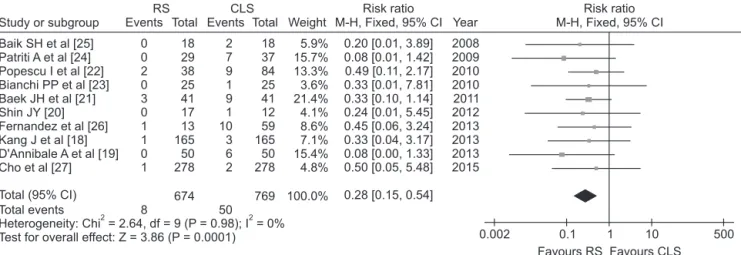
Ten studies [1827] reported a conversion rate to open
surgery. In all, 8 patients (1.19%) undergoing RS and 50 (6.50%) undergoing CLS required conversion to open surgery (RR, 0.28;
95% CI, 0.15–0.54), with no heterogeneity among studies (P = 0.98, I2 = 0%) (Table 2, Fig. 3).
Time to oral diet
Time to liquid diet was reported in six studies [2,18,22,27
29] comparing RS and CLS. The pooled estimates using a fixed
1,302 Articles after duplicates removed
54 Potentially appropriate articles to be included in this study
14 All articles included in this study
17 All articles included in this study
1,248 Excluded by title and abstract review
40 Full-text articles excluded Reasons
6 Not original articles
2 Not focused on patients with rectal cancer 4 No comparison between RS and CLS 2 No reported clinical outcomes 20 Gray literature
6 Overlapping patients cohorts
3 Hand search Records identified through electronic DB
250 Ovid-MEDLINE 743 Ovid-Embase 48 Cochrane library 623 Domestic DB (KoreaMed et al.)
1,664 Total
Fig. 1. Flow diagram of the study selection process. RS, robotic surgery; CLS, conventional lapa- roscopic surgery.
Baik et al. (2008) Patriti et al. (2009)
Randomsequencegeneration(selectionbias) Allocationconcealment(selectionbias) Blindingofparticipantsandpersonnel(performancebias) Blindingofoutcomeassessment(detectionbias) Incompleteoutcomedata(attritionbias) Selectivereporting(reportingbias) Otherbias
Fig. 2. The risk of bias for eligible randomized controlled trials.
Table 2. Clinical and oncological outcomes Outcome No. of stud
yStudy size (n)HeterogeneityEffect measure
Statistical method Analysis model
Pooled effect RSCLSP-valueI2 (%)RR (95% CI)P-value Clinical outcomes Conversion rates106747690.9800RRM-HFE0.28 (0.15 to 0.54)<0.001 Time to oral diet67278050.16036MDIVFE–0.18 (–0.36 to 0.00)0.050 Time to recovery of bowel function87628500.7100MDIVFE–0.13 (–0.25 to –0.01)0.030 Estimated blood loss87517960.00171MDIVRE–9.03 (–33.11 to 15.05)0.460 Operating time10821844<0.00197MDIVRE49.97 (20.43 to 79.52)<0.001 Duration of hospitalization108219170.00661MDIVRE–0.53 (–1.26 to 0.21)0.160 Complication Anastomotic leakage 108199250.9500RRM-HFE0.87 (0.65 to 1.17)0.360 Urinary retention52993890.7700RRM-HFE0.87 (0.47 to 1.61)0.650 Intrapelvic bleeding66806760.7100RRM-HFE1.23 (0.51 to 2.94)0.640 Intrapelvic abscess55666020.9500RRM-HFE1.21 (0.57 to 2.60)0.620 Wound infection76257170.9500RRM-HFE0.76 (0.32 to 1.81)0.540 Oncological outcomes No. of lymph nodes extracted86477320.06048MDIVFE0.20 (–0.54 to 0.94)0.600 Urological function IPSS (3 mo after surgery)244540.5900MDIVFE–2.90 (–5.31 to –0.48)0.020 IPSS (6 mo after surgery)244540.4900MDIVFE–0.45 (–2.58 to 1.68)0.680 IPSS (12 mo after surgery)260690.4900MDIVFE–0.90 (–1.93 to 0.14)0.090 Sexual functiona) IIEF (3 mo after surgery)232320.21037MDIVFE–2.82 (–4.78 to –0.87)0.005 IIEF (6 mo after surgery)232290.9300MDIVFE–2.15 (–4.08 to –0.22)0.030 RS, robotic surgery; CLS, conventional laparoscopic surgery; CI, confidence interval; RR, risk ratio; MD, mean difference; M-H, Mantel-Haenszel; IV, inverse variance; FE, fixed effects; RE, random effects; IPSS, International Prostate Symptom Score; IIEF, International Index of Erectile Function. a) Change from baseline after surgery.
effects model showed no significant difference between RS and CLS (MD, −0.18 days; 95% CI, −0.36 to 0.00), with moderate heterogeneity (P = 0.16, I2 = 36%) (Table 2).
Time to bowel function recovery
Eight studies [2,18,20,22,25,2729] analyzed time to first flatus. The pooled estimates using a fixed effects model showed a significant difference between RS and CLS (MD, −0.13 days, 95% CI, −0.25 to −0.01), with no heterogeneity among studies (P
= 0.71, I2 = 0%) (Table 2, Fig. 4).
Estimated blood loss
EBL was reported in eight studies [2,18,20,22,24,27,28,30]
comparing RS and CLS. The pooled estimates using a random effects model showed no significant difference between RS and CLS (MD, −9.03 mL; 95% CI, −33.11 to 15.05), with heterogeneity (P = 0.001, I2 = 71%) (Table 2).
Operating time
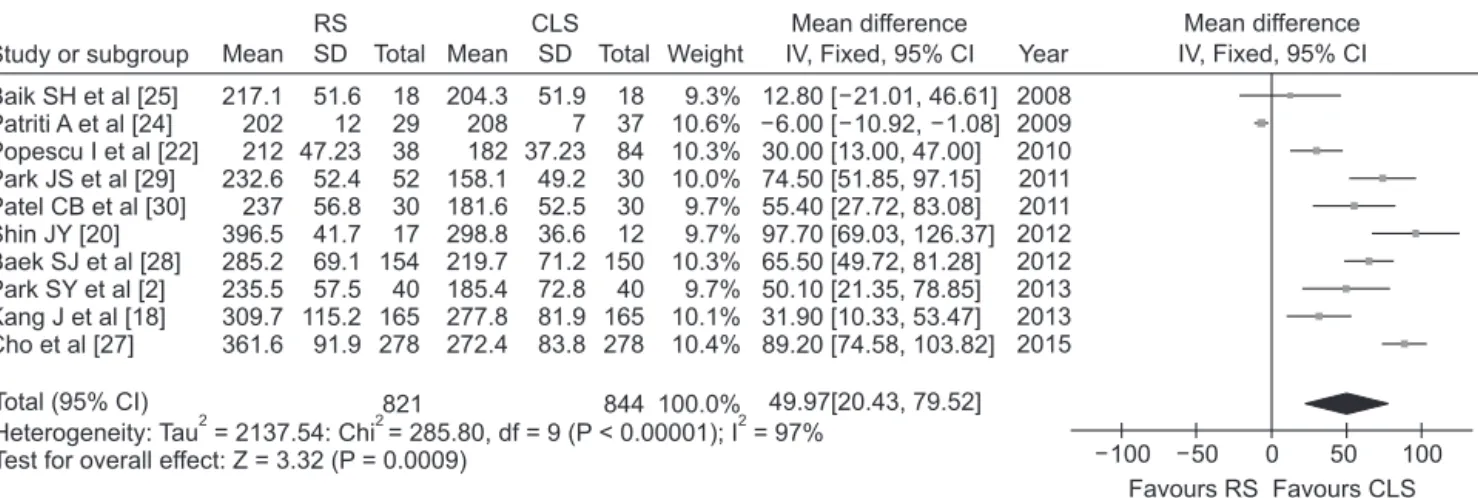
Operating time was reported in ten studies [2,18,20,22,24,25,
2730] comparing RS and CLS. The pooled estimates using a random effects model showed significantly longer operating time for RS than that for CLS (MD, 49.97 minutes; 95% CI, 20.43–79.52). However, this result had high heterogeneity (P <
0.001, I2 = 97%) (Table 2, Fig. 5).
Duration of hospitalization
Hospitalization duration was reported in ten studies [2,18,20,22,24,25,2730] comparing RS and CLS. The pooled estimates using a random effects model showed no significant difference between RS and CLS (MD, −0.53 days; 95% CI, −1.26 to 0.21), with heterogeneity (P = 0.006, I2 = 61%) (Table 2).
Complications
Anastomotic leakage
Anastomotic leakage was reported in ten studies [2,18,19,22
24,2628,31] comparing RS and CLS. No significant difference in bowel anastomotic leaks was observed between RS and CLS (RR, 0.87; 95% CI, 0.65–1.17), with no heterogeneity (P = 0.95, I2 = 0%) (Table 2).
Study or subgroup Events Total RS
Events Total CLS
Weight
Risk ratio
M-H, Fixed, 95% CI Year
Risk ratio M-H, Fixed, 95% CI Baik SH et al [25]
Patriti A et al [24]
Popescu I et al [22]
Bianchi PP et al [23]
Baek JH et al [21]
Shin JY [20]
Fernandez et al [26]
Kang J et al [18]
D'Annibale A et al [19]
Cho et al [27]
0 0 2 0 3 0 1 1 0 1
18 29 38 25 41 17 13 165 50 278
2 7 9 1 9 1 10 3 6 2
18 37 84 25 41 12 59 165 50 278
0.20 [0.01, 3.89]
0.08 [0.01, 1.42]
0.49 [0.11, 2.17]
0.33 [0.01, 7.81]
0.33 [0.10, 1.14]
0.24 [0.01, 5.45]
0.45 [0.06, 3.24]
0.33 [0.04, 3.17]
0.08 [0.00, 1.33]
0.50 [0.05, 5.48]
2008 2009 2010 2010 2011 2012 2013 2013 2013 2015 Total (95% CI)
Total events
Heterogeneity: Chi = 2.64, df = 9 (P = 0.98); I = 0%
Test for overall effect: Z = 3.86 (P = 0.0001)
2 2
674 769
5.9%
15.7%
13.3%
3.6%
21.4%
4.1%
8.6%
7.1%
15.4%
4.8%
100.0% 0.28 [0.15, 0.54]
8 50
0.002 0.1 1 10 500
Favours RS Favours CLS
Fig. 3. Forest plot and meta-analysis of conversion to open surgery. RS, robotic surgery; CLS, conventional laparoscopic surgery; M-H, Mantel-Haenszel; CI, confidence interval; df, degree of freedom.
Study or subgroup
RS CLS
Weight
Mean difference IV, Fixed, 95% CI Year Baik SH et al
Popescu I et al Park JS et al Shin JY Baek SJ et al Kang J et al Park SY et al Cho et al
[25]
[22]
[29]
[20]
[28]
[18]
[2]
[27]
1.8 3.02 3.2 3 2.1 2.2 2.4 2.8
0.4 1.2 1.8 1 1 1.1 1.6 1.4
18 38 52 17 154 165 40 278
3.5%
6.5%
4.8%
2.3%
29.0%
22.7%
3.4%
27.8%
0.60 [ 1.23, 0.03]
0.05 [ 0.52, 0.42]
0.20 [ 0.34, 0.74]
0.40 [ 1.18, 0.38]
0.10 [ 0.32, 0.12]
0.20 [ 0.45, 0.05]
0.10 [ 0.74, 0.54]
0.10 [ 0.32, 0.12]
2008 2010 2011 2012 2012 2013 2013 2015 0.13 [ 0.25, 0.01]
Total (95% CI)
Heterogeneity: Chi = 4.60, df = 7 (P = 0.71); I = 0%2 2 Test for overall effect: Z = 2.15 (P = 0.03)
762 850 100.0%
0.5 0 0.5 1
Favours RS Favours CLS 2.4
3.07 3 3.4 2.2 2.4 2.5 2.9
Mean SD Total Mean SD Total 1.3 1.25 1.1 1.1 1 1.2 1.3 1.3
18 84 88 12 165 165 40 278
Mean difference IV, Fixed, 95% CI
1
Fig. 4. Forest plot and meta-analysis of time to first flatus. RS, robotic surgery; CLS, conventional laparoscopic surgery; SD, standard deviation; CI, confidence interval; df, degree of freedom.
Urinary retention
Urinary retention was reported in five studies [2,18,24,26,29]
comparing RS and CLS. The pooled estimates using a fixed effects model showed no significant difference between RS and CLS (RR, 0.87; 95% CI, 0.47–1.61), with no heterogeneity (P = 0.77, I2 = 0%) (Table 2).
Intrapelvic bleeding
Intrapelvic bleeding was reported in six studies [18,24,25, 27,28,32] comparing RS and CLS. The pooled estimates using a fixed effects model showed no significant difference between RS and CLS (RR, 1.23; 95% CI, 0.51–2.94), with no heterogeneity (P
= 0.71, I2 = 0%) (Table 2).
Intrapelvic abscess
Intrapelvic abscess was reported in five studies [18,21,27, 29,30] comparing RS and CLS. The pooled estimates using a fixed effects model showed no significant difference between RS and CLS (RR, 1.21; 95% CI, 0.57–2.60), with no heterogeneity (P
= 0.95, I2 = 0%) (Table 2).
Wound infection
Wound infection was reported in seven studies [2,18,22,23,27, 29,31] comparing RS and CLS. The pooled estimates using a
fixed effects model showed no significant difference between RS and CLS (RR, 0.76; 95% CI, 0.32–1.81), with no heterogeneity (P = 0.95, I2 = 0%) (Table 2).
Number of lymph nodes extracted
Eight studies [1820,22,24,25,27,29] reported the numbers of lymph nodes extracted. No significant differences were observed in the total numbers of lymph nodes extracted bet
ween patients undergoing RS and CLS (MD, 0.20; 95% CI, −0.54 to 0.94), with no heterogeneity (P = 0.06, I2 = 48%) (Table 2).
Urological function (IPSS)
Urological function was reported in three studies [2,19,33]
comparing RS and CLS. The outcome was evaluated using IPSS with high scores corresponding with greater dysfunction. At three months followup, the pooled estimates using a fixed effects model showed significant difference of IPSS scores bet
ween RS and CLS (MD, −2.90; 95% CI, −5.31 to −0.48), with no heterogeneity (P = 0.59, I2 = 0%) (Table 2, Fig. 6). At six month three months followup, the pooled estimates showed a no significant difference of IPSS scores between RS and CLS (MD, −0.45; 95% CI, −2.58 to 1.68), with no heterogeneity (P = 0.49, I2 = 0%) (Table 2). Lastly, at the 12 months, there was no significant difference of IPSS score between RS and CLS (MD,
Study or subgroup Weight
Mean difference IV, Fixed, 95% CI Year Baik SH et al
Patriti A et al Park JS et al Patel CB et al Shin JY Baek SJ et al Park SY et al Kang J et al Cho et al Popescu I et al
[25]
[24]
[22]
[29]
[30]
[20]
[28]
[2]
[18]
[27]
9.3%
10.6%
10.3%
10.0%
9.7%
9.7%
10.3%
9.7%
10.1%
10.4%
2008 2009 2010 2011 2011 2012 2012 2013 2013 2015 12.80 [ 21.01, 46.61]
[ 10.92, 1.08]
6.00
30.00 [13.00, 47.00]
74.50 [51.85, 97.15]
55.40 [27.72, 83.08]
97.70 [69.03, 126.37]
65.50 [49.72, 81.28]
50.10 [21.35, 78.85]
31.90 [10.33, 53.47]
89.20 [74.58, 103.82]
49.97[20.43, 79.52]
Total (95% CI)
Heterogeneity: Tau = 2137.54: Chi = 285.80, df = 9 (P < 0.00001); I = 97%2 2 2 Test for overall effect: Z = 3.32 (P = 0.0009)
821 844 100.0%
50 0 50 100
Favours RS Favours CLS RS
217.1 202 212 232.6 237 396.5 285.2 235.5 309.7 361.6
51.6 12 47.23 52.4 56.8 41.7 69.1 57.5 115.2 91.9
18 29 38 52 30 17 154 40 165 278 Mean SD Total
CLS
204.3 208 182 158.1 181.6 298.8 219.7 185.4 277.8 272.4
Mean SD Total 51.9
7 37.23 49.2 52.5 36.6 71.2 72.8 81.9 83.8
18 37 84 30 30 12 150 40 165 278
Mean difference IV, Fixed, 95% CI
100
Fig. 5. Forest plot and meta-analysis of operation time. RS, robotic surgery; CLS, conventional laparoscopic surgery; SD, standard deviation; CI, confidence interval; df, degree of freedom.
Study or subgroup Weight
Mean difference
IV, Fixed, 95% CI Year Kim JY et al [33]
Park SY et al [2]
69.1%
30.9%
3.34 [ 6.24, 0.44]
[ 6.24, 2.44]
1.90
2012 2013 2.90 [ 5.31, 0.48]
Total (95% CI)
Heterogeneity: Chi = 0.29, df = 1 (P = 0.59); I = 0%2 2 Test for overall effect: Z = 2.35 (P = 0.02)
44 54 100.0%
10 0 10 20
Favours RS Favours CLS RS
8.36 3.6
5.5 4.5
30 14 Mean SD Total
CLS
11.7 5.5
Mean SD Total 6.79
7.2 39 15
Mean difference IV, Fixed, 95% CI
20
Fig. 6. Forest plot and meta-analysis of International Prostate Symptom Score 3 months after surgery. RS, robotic surgery; CLS, conventional laparoscopic surgery; SD, standard deviation; CI, confidence interval; df, degree of freedom.
−0.87; 95% CI, −1.93 to 0.19), with no heterogeneity (P = 0.52, I2
= 0%) (Table 2).
Sexual function (IIEF)
Sexual function was reported in two studies [2,33] comparing RS and CLS. The outcome was evaluated using IIEF with high scores related to better sexual function. In this study, only erectile function was analyzed because Park et al. [2] reported assessment of male erectile function. At three months follow
up, the pooled estimates using a fixed effects model showed significant difference of IIEF scores between RS and CLS (MD,
−2.82; 95% CI, −4.78 to −0.87), with little heterogeneity (P
= 0.21, I2 = 37%) (Table 2, Fig. 7). At six month three months followup, the pooled estimates showed a significant difference of IIEF scores between RS and CLS (MD, −2.15; 95% CI, −4.08 to
−0.22), with no heterogeneity (P = 0.93, I2 = 0%) (Table 2, Fig. 8).
Publication bias
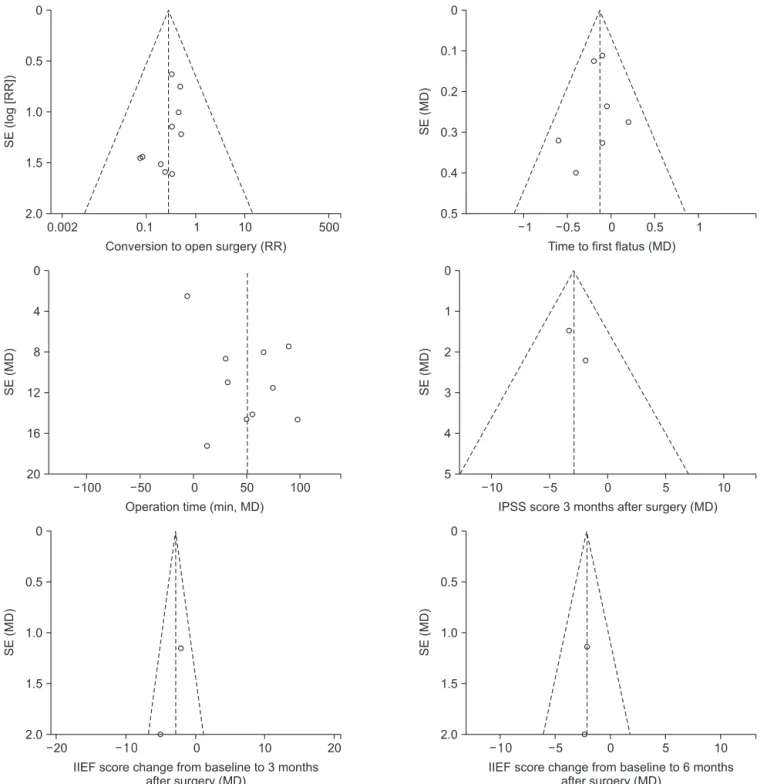
A funnel plot analysis of the studies was performed in a metaanalysis reporting on overall postoperative complications after RS compared to those after CLS. None of the studies lay outside the 95% CI, and no evidence of publication bias or heterogeneity was detected among the studies except for operation time (Fig. 9).
DISCUSSION
There is currently moderate quality evidence that CLS for
total mesorectal excision (TME) has similar effects as those of open TME on longterm survival outcomes for treating rectal cancer [34]. Nevertheless, CLS remains a difficult procedure to perform due to inherent limitations, including the use of straight rigid instruments within a small working area, limited freedom, the fulcrum effect, and poor ergonomics [1,35]. In addition, CLS has been slow to gain popularity for treating rectal cancer, as a result of the technical difficulties associated with extensively dissecting the pelvis [36]. The da Vinci Surgical System (Intuitive Surgical, Sunnyvale, CA, USA) has been popularized for performing RS because it offers technical features that help overcome such difficulties. Adopting RS has facilitated the application of minimally invasive surgery to complex surgical operations in colorectal oncology. RS for rectal cancer is a technically feasible, safe procedure and can be performed with low morbidity and a low conversion rate, even for cases with advanced rectal cancer requiring complicated, robotassisted, lateral lymph node dissection [37].
We conducted a systematic review and metaanalysis of comparative studies published during 2008–2015 to compare safety and effectiveness between RS and CLS in patients with rectal cancer. Although metaanalyses have been published recently [11,12,38,39], our study includes the most publications and reflects the latest comparative surgical results for rectal cancer. We also performed this metaanalysis to compare RS with CLS in patients with malignant diseases of the rectum only. Our results show two benefits of RS over CLS, and showed favorable urological and sexual function in RS group.
Study or subgroup Weight
Mean difference
IV, Fixed, 95% CI Year Kim JY et al [33]
Park SY et al [2]
25.0%
75.0%
2012 2013 5.00 [ 8.91, 1.09]
[ 4.36, 0.16]
2.10
2.82 [ 4.78, 0.87]
Total (95% CI)
Heterogeneity: Chi = 1.58, df = 1 (P = 0.21); I = 37%2 2 Test for overall effect: Z = 2.83 (P = 0.005)
32 32 100.0%
10 0 5 10
Favours RS Favours CLS RS
8 3.8
5.8 3
18 14 Mean SD Total
CLS
13 5.9
Mean SD Total 6 3.2
17 15
Mean difference IV, Fixed, 95% CI
5
Fig. 7. Forest plot and meta-analysis of International Index of Erectile Function score change from baseline to 3 months after surgery. RS, robotic surgery; CLS, conventional laparoscopic surgery; SD, standard deviation; CI, confidence interval; df, degree of freedom.
Study or subgroup Weight
Mean difference
IV, Fixed, 95% CI Year Kim JY et al [33]
Park SY et al [2]
24.5%
75.5%
2.30 [ 6.20, 1.60]
[ 4.32, 0.12]
2.10
2012 2013 2.15 [ 4.08, 0.22]
Total (95% CI)
Heterogeneity: Chi = 0.01, df = 1 (P = 0.93); I = 0%2 2 Test for overall effect: Z = 2.18 (P = 0.03)
32 29 100.0%
10 0 5 10
Favours RS Favours CLS RS
4.5 2.4
5 2.8
18 14 Mean SD Total
CLS
6.8 4.5
Mean SD Total 6 3.3
14 15
Mean difference IV, Fixed, 95% CI
5
Fig. 8. Forest plot and meta-analysis of International Index of Erectile Function score change from baseline to 6 months after surgery. RS, robotic surgery; CLS, conventional laparoscopic surgery; SD, standard deviation; CI, confidence interval; df, degree of freedom.
We found that the RS conversion rate for rectal cancer was significantly lower than that for CLS, indicating that RS provides better management of complex procedures and allowing more patients to benefit from minimally invasive surgery [39]. The reasons for conversion to open surgery included obesity with heavy mesentery, inability to identify important vascular structures, vascular injury, adhesions, and narrow pelvis;
technical difficulties included stapler misfiring, inappropriate
robotic arm placement, and robot malfunction [40]. The lower RS conversion rate may have been due to superior exposure and visualization of the operating field in the pelvis, thanks to the ability of the fixed fourth arm to grip and maneuver organs and the ability of the surgeon to move the threedimensional camera as required [23]. Because conversion rate is related to a technical difficulty, surgical experience, and an intraoperative complication, it is good marker of the effectiveness of a robotic
SE()MD
0
0.5
1.0
1.5
2.0
5
IIEF score change from baseline to 6 months after surgery (MD)
0 5 10
SE(log[RR])
0
0.5
1.0
1.5
2.0
0.002 0.1
Conversion to open surgery (RR)
1 10 500
SE(MD)
0
0.2
0.3
0.4
0.5
1
Time to first flatus (MD)
0 0.5 1
0.1
0.5
SE(MD)
0
4
8
12
16
20
100 50
Operation time (min, MD)
0 50 100
SE(MD)
0
2
3
4
5 10
IPSS score 3 months after surgery (MD)
0 5 10
1
5
SE()MD
0
0.5
1.0
1.5
2.0 20
IIEF score change from baseline to 3 months after surgery (MD)
0 10 20
Fig. 9. Funnel plot of the studies used in the meta-analysis. IPSS, International Prostate Symptom Score; IIEF, International Index of Erectile Function; SE, standard error; MD, mean difference; RR, risk ratio.
procedure [39]. The conversion rate for laparoscopic rectal cancer surgery is usually high, as 82 of 242 patients (34%) with rectal cancer were converted into open surgery in the MRC CLASICC trial [1]. The most common reasons were excess tumor fixation or uncertain tumor clearance, obesity, anatomical uncertainties, and tumor inaccessibility. Conversion to open surgery increases cost [41], and the patient no longer benefits from a laparoscopic approach. Conversion results in increased blood loss, prolonged postoperative hospital stay, and higher rates of intraoperative and postoperative complications.
Moreover, conversion leads to higher postoperative mortality [42] and leads to poorer survival than those of laparoscopic or open rectal surgery [43]. Therefore, the lower conversion rate is clinically significant both in the shortterm and longterm.
Another major advantage of RS was the marginally significant reduction in time to first flatus. The pooled data of our study show that time to first flatus was 0.13 days shorter following RS than that after LAS. The minimally invasive characteristics and technological advantages of a robotic system may have influenced this result. Baik et al. [25] explained that the da Vinci Surgical System robotic arms are used for retraction and dissection during the TME procedure, which reduces unnece
ssary procedures and minimizes iatrogenic tissue injury during retraction. These differences may have been the reason for the shorter time to first flatus in RS patients, but a more advanced study is needed before such a conclusion can be drawn.
However, there is little clinical significance in these small differences.
Our metaanalysis demonstrated no difference in the number of retrieved lymph nodes. TME is widely accepted as the gold standard for RS and is one of the most important factors for reducing local recurrence and to assess the oncological adequacy of resection, Further studies should compare several secondary endpoints, such as margin clearance and mesorectal fascia integrity [44].
Our study showed favorable urological and sexual function in RS group. Specifically, IPSS scores 3 months after RS were better than those of the CLS and IIEF scores change from baseline to 6 months after RS were better than CLS. Damage to hypogastric nerves or sacral splanchnic nerves affect the patient’s urological and sexual functions [45,46]. Also, when the CLS is used, it is more difficult to achieve autonomic nerve preservation than RS due to insufficient tension on the dissected planes [47,48].
Threedimensional view conducted by the robotic system allowed the surgeon to better preserve the pelvic autonomic nerves. Besides, the use of the articulated monopolar cautery hook allowed the surgeon to obtain better control of energy delivery, avoiding inopportune cauterization of the nervous bundle [19]. However, our results included a relatively small number of patients compared in both groups that the results need to be interpreted carefully.
This study had several important limitations. First, most studies in our review reported an insufficient followup period so many of the data were unsuitable to evaluate oncological outcomes, such as recurrence, metastasis, and mortality.
Second, we could not determine whether the surgeon’s learning curve affected the end result, as the studies included did not report comparisons between initial and subsequent RS experience.
In conclusion, RS provides an enhanced benefit to patients with rectal cancer in terms of postoperative recovery and the quality of the surgery. However, the quality of the evidence assembled does not support strong conclusions about most of the parameters of interest. In addition, RS is associated with a high cost and longer operating times. Therefore, findings supporting the safety and efficacy of RS need to be inter
preted with caution because of the lack of RCTs. Only RCTs with a longterm followup could clearly determine whether the technological advantages of a robotic surgical system translate into favorable surgical and oncological outcomes.
Further studies are required to evaluate the functional results and oncological outcomes associated with RS, such as the multicenter RCT of robotassisted vs. laparoscopic resection for rectal cancer (ROLARR trial) [49].
CONFLICTS OF INTEREST
No potential conflict of interest relevant to this article was reported.
ACKNOWLEDGEMENTS
This study was funded by the National Evidencebased Healthcare Collaborating Agency in the Republic of Korea (NC13007).
REFERENCES
1. Guillou PJ, Quirke P, Thorpe H, Walker J, Jayne DG, Smith AM, et al. Short
term endpoints of conventional versus
laparoscopicassisted surgery in patients with colorectal cancer (MRC CLASICC trial): multicentre, randomised controlled
trial. Lancet 2005;365:171826.
2. Park SY, Choi GS, Park JS, Kim HJ, Ryuk JP. Shortterm clinical outcome of robot
assisted intersphincteric resection for low rectal cancer: a retrospective comparison with conventional laparoscopy. Surg Endosc 2013;27:4855.
3. Arezzo A, Passera R, Scozzari G, Verra M, Morino M. Laparoscopy for rectal cancer reduces shortterm mortality and morbidity: results of a systematic review and metaanalysis. Surg Endosc 2013;27:1485502.
4. Sammour T, Kahokehr A, Srinivasa S, Bissett IP, Hill AG. Laparoscopic colorectal surgery is associated with a higher intraoperative complication rate than open surgery. Ann Surg 2011;253:3543.
5. Patel VR, Thaly R, Shah K. Robotic radical prostatectomy: outcomes of 500 cases.
BJU Int 2007;99:110912.
6. Veljovich DS, Paley PJ, Drescher CW, Everett EN, Shah C, Peters WA 3rd. Robotic surgery in gynecologic oncology: program initiation and outcomes after the first year with comparison with laparotomy for endometrial cancer staging. Am J Obstet Gynecol 2008;198:679.e19.
7. Weber PA, Merola S, Wasielewski A, Ballantyne GH. Teleroboticassisted lapar
oscopic right and sigmoid colectomies for benign disease. Dis Colon Rectum 2002;
45:168994.
8. Corcione F, Esposito C, Cuccurullo D, Settembre A, Miranda N, Amato F, et al.
Advantages and limits of robotassisted laparoscopic surgery: preliminary experience. Surg Endosc 2005;19:1179.
9. Baik SH, Kim NK, Lim DR, Hur H, Min BS, Lee KY. Oncologic outcomes and perioperative clinicopathologic results after robotassisted tumorspecific meso
rectal excision for rectal cancer. Ann Surg Oncol 2013;20:262532.
10. Bae SU, Saklani AP, Hur H, Min BS, Baik SH, Lee KY, et al. Robotic and laparoscopic pelvic lymph node dissection for rectal cancer: shortterm outcomes of 21 con
secutive series. Ann Surg Treat Res 2014;
86:7682.
11. Memon S, Heriot AG, Murphy DG, Bressel M, Lynch AC. Robotic versus laparoscopic proctectomy for rectal cancer: a meta
analysis. Ann Surg Oncol 2012;19:2095
101.
12. Trastulli S, Farinella E, Cirocchi R, Cavaliere D, Avenia N, Sciannameo F, et al. Robotic resection compared with lapar oscopic rectal resection for cancer: system atic review and metaanalysis of shortterm outcome. Colorectal Dis 2012;14:e13456.
13. Xiong B, Ma L, Huang W, Zhao Q, Cheng Y, Liu J. Robotic versus laparoscopic total mesorectal excision for rectal can
cer: a metaanalysis of eight studies. J Gastrointest Surg 2015;19:51626.
14. Broholm M, Pommergaard HC, Gogenur I.
Possible benefits of robotassisted rec tal cancer surgery regarding urological and sexual dysfunction: a systematic review and metaanalysis. Colorectal Dis 2015;
17:37581.
15. Higgins JP, Green S, editors. Cochrane handbook for systematic reviews of interventions. Hoboken (NJ): Wiley
Blackwell; 2008.
16. Slim K, Nini E, Forestier D, Kwiatkowski F, Panis Y, Chipponi J. Methodological index for nonrandomized studies (minors):
development and validation of a new instrument. ANZ J Surg 2003;73:7126.
17. Higgins JP, Thompson SG. Quantifying heterogeneity in a metaanalysis. Stat Med 2002;21:153958.
18. Kang J, Yoon KJ, Min BS, Hur H, Baik SH, Kim NK, et al. The impact of robotic surgery for mid and low rectal cancer: a casematched analysis of a 3arm com
parison: open, laparoscopic, and robotic surgery. Ann Surg 2013;257:95101.
19. D'Annibale A, Pernazza G, Monsellato I, Pende V, Lucandri G, Mazzocchi P, et al.
Total mesorectal excision: a comparison of oncological and functional outcomes between robotic and laparoscopic sur
gery for rectal cancer. Surg Endosc 2013;
27:188795.
20. Shin JY. Comparison of shortterm sur
gical outcomes between a robotic colec
tomy and a laparoscopic colectomy during early experience. J Korean Soc Coloproctol 2012;28:1926.
21. Baek JH, Pastor C, Pigazzi A. Robotic and laparoscopic total mesorectal excision for rectal cancer: a casematched study. Surg
Endosc 2011;25:5215.
22. Popescu I, Vasilescu C, Tomulescu V, Vasile S, Sgarbura O. The minimally invasive approach, laparoscopic and robotic, in rectal resection for cancer: a single center experience. Acta Chir Iugosl 2010;57:2935.
23. Bianchi PP, Ceriani C, Locatelli A, Spinoglio G, Zampino MG, Sonzogni A, et al.
Robotic versus laparoscopic total meso
rectal excision for rectal cancer: a com
parative analysis of oncological safety and shortterm outcomes. Surg Endosc 2010;
24:288894.
24. Patriti A, Ceccarelli G, Bartoli A, Spaziani A, Biancafarina A, Casciola L. Short and mediumterm outcome of robotassisted and traditional laparoscopic rectal resec
tion. JSLS 2009;13:17683.
25. Baik SH, Ko YT, Kang CM, Lee WJ, Kim NK, Sohn SK, et al. Robotic tumorspecific mesorectal excision of rectal cancer:
shortterm outcome of a pilot randomized trial. Surg Endosc 2008;22:16018.
26. Fernandez R, Anaya DA, Li LT, Orcutt ST, Balentine CJ, Awad SA, et al. Laparoscopic versus robotic rectal resection for rectal cancer in a veteran population. Am J Surg 2013;206:50917.
27. Cho MS, Baek SJ, Hur H, Min BS, Baik SH, Lee KY, et al. Short and longterm outcomes of robotic versus laparoscopic total mesorectal excision for rectal cancer:
a casematched retrospective study. Medi
cine (Baltimore) 2015;94:e522.
28. Baek SJ, Kim SH, Cho JS, Shin JW, Kim J.
Robotic versus conventional laparoscopic surgery for rectal cancer: a cost analysis from a single institute in Korea. World J Surg 2012;36:27229.
29. Park JS, Choi GS, Lim KH, Jang YS, Jun SH. S052: a comparison of robotassisted, laparoscopic, and open surgery in the treatment of rectal cancer. Surg Endosc 2011;25:2408.
30. Patel CB, Ragupathi M, RamosValadez DI, Haas EM. A threearm (laparoscopic, handassisted, and robotic) matched
case analysis of intraoperative and post
operative outcomes in minimally invasive colorectal surgery. Dis Colon Rectum 2011;54:14450.