* Corresponding author : Beom-Young Son, National Institute of Crop Science, RDA, Suwon 441-857, Korea. Tel: +82-31-290-6758, Fax:
+82-31-290-6742 E-mail: [email protected]
사료용 옥수수 신품종 ‘양안옥’의 생육특성 및 수량성
손범영
1*․백성범
1․김정태
1․이진석
1․구자환
1․김선림
1․정건호
1․권영업
1․지희정
2․허창석
3․박종열
41
국립식량과학원, 수원 441-857,
2국립축산과학원 수원 441-706,
3경북농업기술원, 대구 702-010,
4
강원도농업기술원, 홍천 250-823
Growth Characteristics and Productivity of Single Cross Maize New Hybrid for Silage and Grain, ‘Yanganok’
Beom Young Son
1*, Seong Bum Baek
1, Jung Tae Kim
1, Jin Seok Lee
1, Ja Hwan Ku
1, Sun Lim Kim
1, Gun Ho Jung
1, Young Up Kwon
1, Hee Jung Ji
2, Chang Suk Huh
3and Jong Yeol Park
41
National Institute of Crop Science, RDA, Suwon 441-857, Korea,
2National Livestock Research Institute, RDA, Suwon, 441-706, Korea,
3Gyeongbuk Agricultural Research and Extension Services, Daegu 702-010, Korea,
4Hongcheon Maize
Experiment Station, Gangwon Agricultural Research and Extension Services, Hongcheon 250-823, Korea
ABSTRACT
Yanganok, a new single cross variety, was developed by the maize breeding team at the National Institute of Crop Science (NICS), RDA in 2012. This hybrid, which has a high yield of grain was produced by crossing two inbred lines, KS164 and KS163. KS164 is the seed parent and KS163 is the pollen parent of Yanganok. It is a yellow-orange intermediate maize hybrid (Zea mays L.). After a preliminary yield trial and advanced yield trial of Yanganok (Suwon180) in Suwon for 2 years, a regional yield trial was carried out for its growth characteristics, and yields were determined at 4 different locations from 2009 to 2012, with the exception of 2010. It was named ‘Yanganok’. The silking date of Yanganok is 2 days earlier than that of the check hybrid, Kwangpyeongok. Plant height of Yanganok is similar to Kwangpyeongok, but its ear height ratio is higher than that of Kwangpyeongok. It has resistance to lodging. Stay-green features of Yanganok are similar to those of Kwangpyeongok. The ear ratio of Yanganok is similar to Kwangpyeongok. It has moderate resistance to southern leaf blight (Bipolaris maydis) and strong resistance to northern leaf blight (Exserohilum turcicum). It has moderate resistance to black streaked dwarf virus (BSDV), ear lot and corn borer. The dry matter yield of Yanganok, 17.45 ton/ha, was similar to that of Kwangpyeongok. The total digestible nutrients (TDN) yield of Yanganok, 11.96 ton/ha, was similar to that of Kwangpyeongok. The grain yield of Yanganok, 8.32 ton/ha was similar to that of Jangdaok. Seed production of Yanganok went well due to a good match during crossing between the seed parent, KS164, and the pollen parent, KS163, in Yeongwol, and F1 seed yield was 1.79 ton/ha. Yanganok would be a suitable cultivar to all plain areas in the Korean peninsula.
(Key words : Maize, Crossing, Dry matter, TDN, Grain, Yield, Seed production)
Ⅰ. 서 론
최근 미국을 비롯한 세계 주요 곡창지대의 기상여건 악 화로 옥수수 (Zea mays L.) 생산량이 크게 감소하여 국제곡 물 가격이 치솟게 되었다. 주로 농후사료로 사용되고 있는 곡실용 옥수수의 국제가격 상승이 사료비 상승의 주원인으 로 작용하고 있어, 농촌진흥청에서는 축산경영인들에게 생 산비 절감을 위하여 사일리지용 옥수수 등 사료작물을 자
체 생산할 것을 적극 권장하고 있다.
옥수수는 재배하기 쉽고 수량이 많아 오래 전부터 식량
작물로 재배해 왔으나 1990년대 이후 식생활이 윤택해지면
서, 고기, 우유, 햄, 소시지 등 축산물의 수요가 급격히 증
가함에 따라 옥수수가 식용보다는 사료용으로서의 중요성
이 훨씬 높아졌다. 우유의 생산량을 증대시키거나 양질의
쇠고기를 생산하기 위해서는 육성기간 중에 양질의 조사료
를 충분히 급여하여야 한다.
사일리지용 옥수수는 단위 면적당 수확량이 다른 사료작 물보다 많고 기호성도 높다 (Son et al., 2006b). 옥수수는 단위면적당 건물생산성이 높고 가소화영양소총량 (Total Digestible Nutrients, TDN)이 높기 때문에 경지 면적이 적 은 우리나라에서는 어느 작물보다 수량과 품질이 우수한 옥수수 재배가 적합하다고 할 수 있다 (김동암, 1986). 국내 에서 재배되는 사일리지 사료용 옥수수는 2011년 총 종자 공급량 285톤 중 P3394 등 수입종이 70% 이상이며, 광평 옥 (Moon et al., 2001) 등 국내 육성 품종은 81톤이 보급되 어 28% 정도 차지하고 있다. 80년대 이후 국내에서 육성 된 수원19호 (Kim et al., 1978)를 사일리지용 옥수수로 재 배해 왔던 축산농가들은 수확시기에 잘 쓰러지고 이삭아래 부분이 빨리 마를 뿐 아니라 수확량이 적고 품질이 좋지 않아 국산 옥수수 재배를 기피하고 대부분 수입산 사료용 옥수수를 재배해 왔다.
그러나 최근 국내에서 육성된 사료용 옥수수 품종인 광 평옥, 강다옥 등은 기존 수입 사료용 옥수수에 비해 쓰러 짐에 강하고 건물수량이 많을 뿐만 아니라 사료가치가 높 아 (Moon et al., 2001; Son et al., 2006a; Son et al., 2009) 축산농가의 반응이 좋아지면서 국내 육성 품종의 재배면적 이 늘어나고 있다. 본 연구는 국내 옥수수 안정생산 기반 을 확립하기 위해 사료 품질이 우수하고 수량이 많은 신품 종을 육성하고자 실시하였다.
Ⅱ. 재료 및 방법
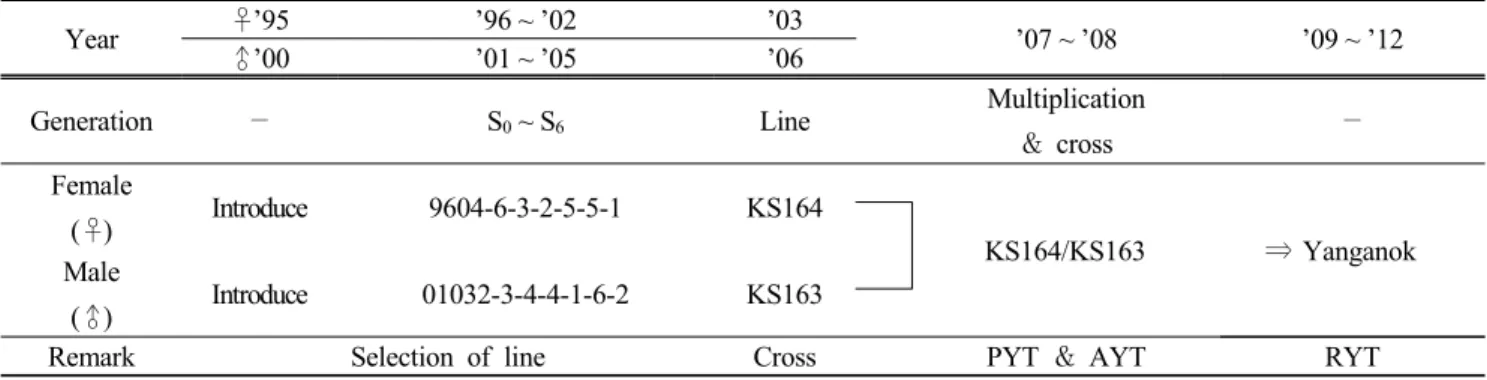
본 연구는 내도복 다수성 사료용 옥수수 신품종 육성을 위해 2009~2012년까지 2010년을 제외한 3년간 수원, 천 안, 홍천, 대구 등 4개 지역에서 수행하였다. 본 연구에 사용한 옥수수의 품종, 양안옥의 교잡 모본인 KS164는 1995년에 수집한 교잡종을 6세대에 걸쳐 자식 (selfing)시 켜 계통으로 육성한 것이며 부본인 KS163은 2000년에 수 집한 교잡종을 6세대에 걸쳐 자식 (selfing)시켜 계통으로 육성한 것이다. 양안옥은 2003년에 육성된 자식계통 KS164를 종자친 (모본)으로 하고 2006년에 육성된 자식계 통 KS163을 화분친(부본)으로 하여 교잡된 단교잡종이다.
양안옥은 2007~2008년 2년 동안 생산력검정시험을 거쳐 2009~2012년 2010년을 제외한 3년 동안 4지역에서 지역 적응시험을 실시하였다. 그 결과 그 우수성이 인정되어 2012 농작물 직무육성 신품종으로 결정되었고 ‘양안옥’으 로 명명하였다 (Fig. 1).
1. 고유특성조사
수염색은 안토시아닌의 색소 표현정도에 따라 구분하였 으며, 종피색은 립의 등 부위색의 표현정도에 따라 구분하 였다. 출사일수는 파종부터 출사기까지의 일수를 조사하였 다. 간장은 지면에서 웅수목까지의 길이를 측정하였고 착 수고는 지면으로부터 최상단 암이삭이 달린 마디까지의 높 이를 측정하였다. 도복과 후기녹체성의 조사범위는 1~9로 우수한 것을 1, 불량한 것을 9로 표시하였다. 깨씨무늬병 (Bipolaris maydis), 그을음무늬병 (Exserohilum turcicum)의 조사범위는 0∼9로 저항성은 0, 불량한 것을 9로 표시하였 다. 검은줄오갈병 (BSDV), 이삭썩음병, 조명나방 (Ostrina
furnacalis)은 자연발생조건에서 조사하였다. 생초 및 건물수량조사는 구당 4열 가운데 2줄을 수확하여 암이삭과 경 엽으로 분리하여 생초수량을 조사하였으며 구당 2주를 취 하여 경엽과 암이삭을 분리하여 60℃의 열풍건조기에서 72 시간 건조 후 칭량하여 건물률을 산출하고 생초수량에 건 물률을 곱하여 건물수량을 계산하였다. 건물률은 생초수량 에 대한 건물수량 비율로 계산하였다. 가소화영양소총량 (TDN) 수량은 Pioneer Hi-bred사가 제시한 TDN (Total Digestible Nutrients) = (경엽건물수량 × 0.582) + (암이삭 건물 수량 × 0.85)의 공식으로 계산하였다 (Holland et al., 1990).
2. 지역적응성 시험
시험품종은 양안옥이고 대비품종으로는 사일리지용 옥수 수로 2000년 육성된 광평옥 (Moon et al., 2001), 종실용 옥 수수는 2003년에 육성된 장다옥 (Son et al., 2004)으로 하 였다. 시비량은 사일리지용 옥수수 시험에서 N-P
2O
5-K
2O = 200-150-150 kg/ha, 종실용 옥수수 시험에서 N-P
2O
5-K
2O = 174-30-69 kg/ha로 하였고, 퇴비는 두 시험 모두 ha당 15 톤 시용하였다. 사일리지용 옥수수는 재식밀도 60×25 cm (66,000 본/ha), 종실용 옥수수는 재식밀도 60×30 cm (55,000 본/ha)로 수원에서 4월 20일, 천안에서 4월 22일, 홍천에서 4월 29일, 대구에서 4월 20일에 각각 2립씩 파종하였다.
3~4엽기에 1주에 1개체만 남기고 솎아 주었다. 시험구는 난괴법 4반복으로 배치하였으며, 파종 후 본엽 7~8엽기에 사일리지용 시험은 질소 (N) 100 kg를, 종실용 시험은 질소 (N) 87 kg를 추비로 주었다. 통계처리는 SAS프로그램 (V.
9.1)의 PROC ANOVA procedure를 이용하여 최소유의차검
정법 (Least Significant Difference Test, LSDT)를 통해 평균
값을 5% 유의수준에서 비교하였다.
Year ♀’95 ’96 ~ ’02 ’03
’07 ~ ’08 ’09 ~ ’12
♂’00 ’01 ~ ’05 ’06
Generation - S
0~ S
6Line Multiplication
& cross -
Female
(♀) Introduce 9604-6-3-2-5-5-1 KS164
KS164/KS163 ⇒ Yanganok Male
(♂) Introduce 01032-3-4-4-1-6-2 KS163
Remark Selection of line Cross PYT & AYT RYT
Fig. 1. Breeding procedure of Yanganok
PYT (preliminary yield trial), AYT (advanced yield trial), RYT (regional yield trial)
Table 1. Color of silk, seed coat and type of grain of Yanganok
Hybrid Color of silk Color of seed coat Type of grain Yanganok
Kwangpyeongok
Light purple Light green
Yellow-orange Yellow
Intermediate Dent Table 2. Agronomic characteristics of Yanganok
Hybrid Days to silking
(days) Plant height
(cm) Ratio
1)(%) Lodging
(1~9) Ear ratio
2)(%) Stay-green
3)(1〜9) Yanganok
Kwangpyeongok
80a 82a
244a 262a
57a 50b
1.3a 1.7a
46a 47a
3.6a 3.7a
Values within a column followed by the same letter are not significantly different at the 0.05 level.Ratio1) : Ear height ratio = ear height/plant height × 100 Ear ratio(%)2) = Ear DM/total DM × 100
Stay-green3) (1: excellent, 9: poor)
Table 3. Resistance to disease of Yanganok
Hybrid
Disease resistance
Corn borer (0~9)
B. maydis(0~9)
E. turcicum(0~9) BSDV
1)Ear rot
Yanganok Kwangpyeongok
MR (3.0) MR (4.3)
R (1.7) R (1.8)
MR MR
MR MR
MR (6.5) MR (6.1)
BSDV1) (black streaked dwarf virus)R : Resistance, MR : Moderate Resistance
Ⅲ. 결과 및 고찰 1. 고유특성
양안옥의 수염색은 담자색인 반면 광평옥은 담녹색이고, 종피색은 황오렌지색이며 입질은 중간종이다 (Table 1). 양 안옥의 출사일수는 광평옥보다 2일 빠르고 간장은 광평옥 과 유의한 차이는 없었지만 착수고율은 광평옥보다 높다.
도복은 광평옥과 비슷한 정도로 강하다. 후기녹체성은 광
평옥과 유의한 차이는 없었고 이삭비율도 광평옥과 유의한 차이는 없었다 (Table 2). 양안옥의 깨씨무늬병 (Bipolaris
maydis)은 광평옥과 비슷한 중강의 저항성을 보이며, 그을음무늬병 (Exserohilum turcicum)도 광평옥과 같이 강한 편 이다. 검은줄오갈병 (BSDV), 이삭썩음병 및 조명나방도 광 평옥과 같이 중 정도의 저항성을 보인다 (Table 3).
2. 수량성
Table 4. Dry matter yield of Yanganok in preliminary and advanced yield trial (NICS, '07~'08)
Hybrid Dry matter yield (ton/ha) Index
’07 ’08 Mean (%)
Yanganok Kwangpyeongok
21.25 20.29
23.06 22.49
22.16a 21.39a
104 100
Values within a column followed by the same letter are not significantly different at the 0.05 level.Table 5. Dry matter yield of Yanganok in regional yield trial from 2009 to 2012
Location Yanganok (ton/ha) Kwangpyeongok (ton/ha)
’09 ’11 ’12 Mean Index ’09 ’11 ’12 Mean Index
Suwon Cheonan Hongcheon Daegu
24.31 23.18 18.24 16.36
15.07 13.19 16.08 13.55
18.60 10.87 19.79 20.16
19.33a 15.75a 18.04a 16.69a
99 97 98 101
23.25 24.65 17.26 17.51
15.33 13.57 18.88 12.70
20.17 10.37 19.24 19.18
19.58a 16.20a 18.46a 16.46a
100 100 100 100 Meanz 20.52 14.47 17.36 17.45A 99 20.67 15.12 17.24 17.68A 100
Values within a row followed by the same letter are not significantly different at the 0.05 level.Table 6. TDN yield of Yanganok in regional yield trial from 2009 to 2012
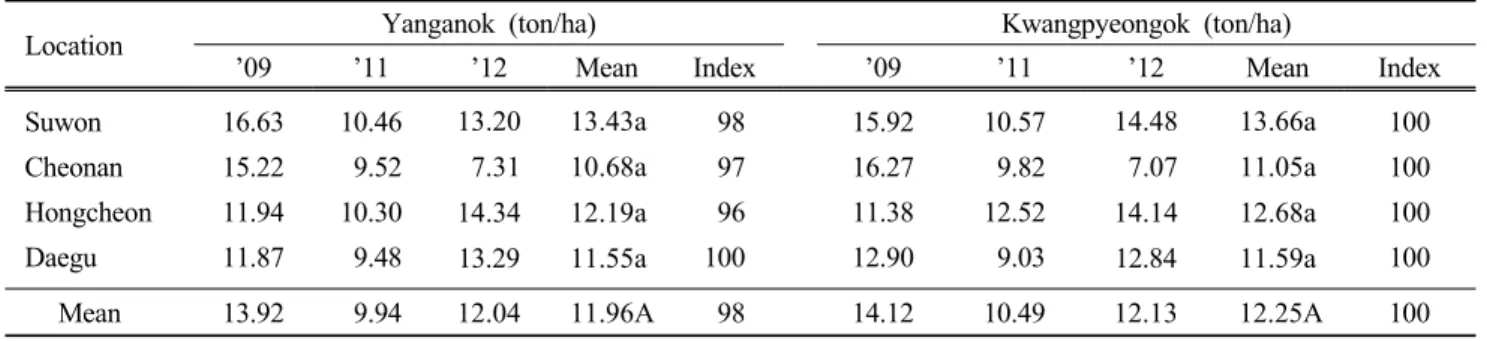
Location Yanganok (ton/ha) Kwangpyeongok (ton/ha)
’09 ’11 ’12 Mean Index ’09 ’11 ’12 Mean Index
Suwon Cheonan Hongcheon Daegu
16.63 15.22 11.94 11.87
10.46 9.52 10.30 9.48
13.20 7.31 14.34 13.29
13.43a 10.68a 12.19a 11.55a
98 97 96 100
15.92 16.27 11.38 12.90
10.57 9.82 12.52 9.03
14.48 7.07 14.14 12.84
13.66a 11.05a 12.68a 11.59a
100 100 100 100 Mean 13.92 9.94 12.04 11.96A 98 14.12 10.49 12.13 12.25A 100
Values within a row followed by the same letter are not significantly different at the 0.05 level.사료용 옥수수 양안옥 (수원180호)의 생산력검정시험을 2007~2008년 수원에서 실시하였다. 건물수량 (22.16 톤/ha) 이 광평옥에 비해 4% 많았다 (Table 4). 사료용 옥수수 양 안옥의 지역적응시험을 2009~2012년까지 3년간 수원, 천 안, 홍천, 대구 등 4지역에서 수행하였다. 양안옥의 건물수 량 (17.45 톤/ha)은 광평옥과 유의한 차이는 없었다. 각 지 역의 양안옥과 광평옥의 건물수량도 유의한 차이는 없었다.
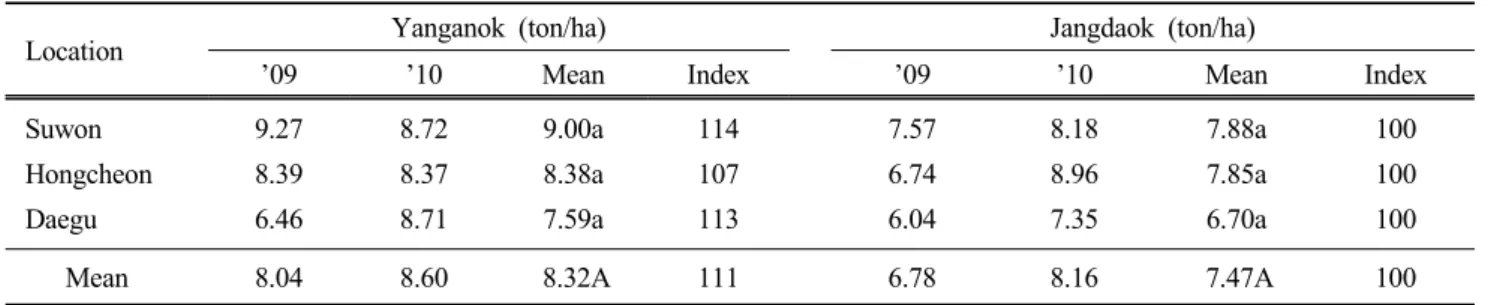
양안옥의 TDN수량 (11.96 톤/ha)은 광평옥과 유의한 차이 는 없었다 (Table 6). 양안옥의 종실수량 (8.32 톤/ha)은 장다 옥과 유의한 차이는 없었다 (Table 7).
이상의 결과를 종합해 볼 때 신품종 양안옥은 광평옥과 더불어 재배 안정성이 높고 생산성이 우수하여 광범한 지 역적응성을 나타내는 사료용 옥수수로서 양질의 조사료 생 산에 적합한 품종으로 생각된다. 양안옥은 1대 단교잡종 옥수수로 해마다 교잡하여 종자를 채종해야 한다. 채종할
때 채종지역의 기상, 토양 등에 따라 지역 간 모본과 부본 의 개화기 차이가 나타나므로 현지 채종지역인 강원도 영 월에서 2012년 모․부본 재식비율을 2 : 1과 4∶1로 동시 파종하여 채종 안정성을 검토하였다. 양안옥은 모본의 출 사기와 부본의 화분 비산기간이 일치하였으며 임실률은 2 : 1에서 96%, 4 : 1에서 98%로 높은 것으로 나타났다. 2 : 1과 4∶1 재식비율에서 채종수량은 ha당 1.79 톤으로 모두 같았다 (Table 8).
양안옥은 전국에서 재배가 가능하지만 검은줄오갈병에
대한 저항성이 중 정도이므로 남부평야지 등 검은줄오갈병
이 많이 발생되는 지역 (Lee et al., 1987; Lee et al., 1988)
에서는 재배를 피하고, 4월 중․하순경 토양수분이 충분할
때 파종하여 검은줄오갈병 매개체인 애멸구 발생 시기를
피하여야 한다. 양안옥은 1대 교잡종이므로 매년 생산된
종자를 이용해야 한다.
Table 7. Grain yield of Yanganok in regional yield trial from 2009 to 2010
Location Yanganok (ton/ha) Jangdaok (ton/ha)
’09 ’10 Mean Index ’09 ’10 Mean Index
Suwon Hongcheon Daegu
9.27 8.39 6.46
8.72 8.37 8.71
9.00a 8.38a 7.59a
114 107 113
7.57 6.74 6.04
8.18 8.96 7.35
7.88a 7.85a 6.70a
100 100 100
Mean 8.04 8.60 8.32A 111 6.78 8.16 7.47A 100
Values within a row followed by the same letter are not significantly different at the 0.05 level.
Table 8. Seed production trial of Yanganok at Yeongwol in 2012 Planting rate
(♀:♂) Inbred Silking date Pollen dispersal
period Ear length
(cm) Fertile kernels
(%) F
1seed yield (ton/ha) 2 : 1 KS164 (♀)
KS163 (♂)
July 27
-
- July 26~Aug. 1
14
-
96
-
1.79
-
4 : 1 KS164 (♀) KS163 (♂)
July 27
-
- July 26~Aug. 1
14
-
98
-
1.79
-
Ⅳ. 요 약
양안옥은 다수성 사료용 옥수수 품종 개발을 목표로 2012년에 농촌진흥청 국립식량과학원에서 자식계통 KS164 과 KS163을 교잡하여 육성한 다수성 단교잡종이다. 양안옥 의 종피색은 황오렌지색이며 입질은 중간종이다. 양안옥은 2007~2008년 동안 생산력검정시험을 거쳐, 2009~2012년까 지 3년간 4지역에서 지역적응시험을 실시하였다. 그 결과 우수성이 인정되어 2012 농작물 직무육성 신품종으로 결정 되었고 양안옥으로 명명하였다. 양안옥의 출사일수는 대비 품종인 광평옥보다 2일 빠르다. 간장은 광평옥과 유의한 차이는 없으나 착수고율은 광평옥보다 높고 도복은 광평옥 과 비슷한 정도로 강하며 후기녹체성과 이삭비율도 광평옥 과 유의한 차이는 없다. 양안옥의 깨씨무늬병은 광평옥과 비슷한 중강의 저항성을 보이며, 그을음무늬병도 광평옥과 같이 강한 편이다. 검은줄오갈병, 이삭썩음병 및 조명나방 도 광평옥과 같이 중 정도의 저항성을 보인다. 양안옥의 건물수량은 17.45 톤/ha이며, TDN수량은 11.96 톤/ha로 광평 옥과 유의한 차이는 없었다. 양안옥의 종실수량은 8.32 톤 /ha로 장다옥과 유의한 차이는 없었다. 4∶1 (모본 : 부본) 재식비율로 동시 파종하여 채종 시험한 결과 모본의 출사 기와 부본의 화분비산기간이 일치하며 채종수량은 1.79 톤 /ha이었다. 양안옥은 전국적으로 재배가 가능하다.
Ⅴ. 인 용 문 헌
Holland, C., Kezar, W., Kautz, W.P., Lazowski, E.J., Mahanna, W.C.
and Reinhart, R. 1990. The Pioneer forage manual : A nutritional guide. Pioneer Hi-Bred Int., Des Moines, IA.
Kim, S.K., Han, Y.S., Park, K.Y., Park, S.U., Moon, H.G., Choi, H.O. and Brewbaker, J.L. 1978. Disease, insect, and lodging resistance super high yielding maize hybrid, “Suweon 19”. Rural Development Administration Journal Agriculture Science. 20 (Crop):149-156.
Lee, S.S. and Lee, J.M. 1987. Productivity of silage corn hybrids in rice black-streaked dwarf virus prevalent region. Journal of the Korean Society of Grassland and Forage Science. 7:140-145.
Lee, S.S., Park, K.Y., Park, S.U. and Lee, S.S. 1988. Population of Laodelphax striatellus, percentage of rice black-streaked dwarf virus (RBSDV) viruliferous vector and RBSDV infection of maize in different locations. Korean Journal of Crop Science.
33:74-80.
Moon, H.G., Son, B.Y., Cha, S.W., Jung, T.W., Lee, Y.H., Seo, J.H., Min, H.K., Choi, K.J., Huh, C.S. and Kim, S.D. 2001. A new single cross hybrid for silage “Kwangpyeongok”. Korean Journal of Breeding Science. 33:350-351.
Son, B.Y., Moon, H.G., Jung, T.W., Park, N.K., Kim, S.K., Cha, S.W., Rye, Y.H., Sung, B.R., Huh, C.S. and Ryu, S.H. 2004. A new single cross maize hybrid cultivar, “Jangdaok” for grain and silage. Korean Journal of Breeding Science. 36:185-186.
Son, B.Y., Moon, H.G., Jung, T.W., Kim, S.J., Sung, B.R., Huh, C.S. and Ryu, S.H. 2006a. A new corn hybrid cultivar,
“Gangdaok” for silage. Korean Journal of Breeding Science.
38:149-150.
Son, B.Y., Moon, H.G., Jung, T.W., Kim, S.J. and Kim, J.D. 2006b.
Comparison of agronomic characteristics, yield and feed value of different corn hybrids for silage. Korean Journal of Crop
Science. 51:233-238.
Son, B.Y., Kim, J.T., Song, S.Y., Baek, S.B., Kim, C.K. and Kim, J.D. 2009. Comparison of yield and forage quality of silage corns of different planting dates. Journal of the Korean Society of Grassland and Forage Science. 29:179-186.
김동암. 1986. 초지학총론. 선진문화사. 서울. pp. 167-198.
(Received May 1, 2013/Accepted May 15, 2013)