전남대학교 (Chonnam National University, Gwangju 500-757, Korea)
* BK21 Research Team for the Control of Animal Hazards using Biotechnology, College of Agriculture & Life Science, Chonnam National University, Gwangju 500-757, Korea
Corresponding author : Tae-hwan Kim, Department of Animal Science, Institute of Agriculture Science and Technology, College of Agriculture & Life Science, Chonnam Chonnam National University, Gwangju 500-757, Korea. Tel: +82-62-530-2126, Fax: +82-62-530-2129, E-mail:
[email protected]
Mycorrhizal Colonization Effects on Some Physiological Parameters Related to Drought Stress in White Clover
Sang-Hyun Park, Qian Zhang and Tae-Hwan Kim
화이트 클로버에서 마이코라이자 접종이 가뭄 스트레스와 관련된 생리학적 요인에 미치는 영향
박상현 ⋅장 천⋅김태환
요 약
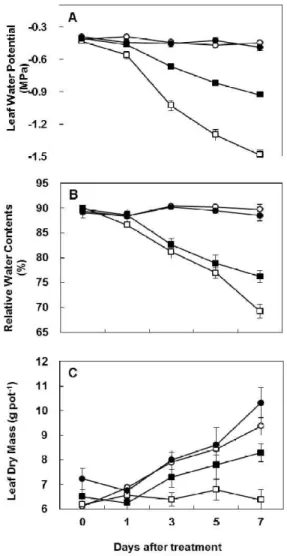
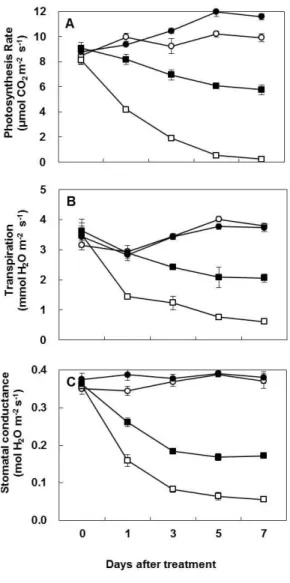
화이트 클로버에서 마이코라이자 접종이 가뭄스트레스와 관련된 생리학적 요인들을 조사하기 위하 여, 마이코라이자 접종 (AM) 또는 비접종구에서 정상관수 (WW) 또는 가뭄 스트레스 처리 (DS)하여 7 일동안 주기적으로 잎 수분포텐셜, 상대수분함량, 건물중, 광합성효율, 증산, 기공전도성, 프롤린 및 암모니아 함량을 각각 측정하였다. 모든 조사항목에서 정상적인 관수조건 (대조구)에서는 전 시험기간 중 변화가 매우 적었으며, 마이코라이자 접종에 의한 변화도 매우 낮았다. 반면, 가뭄 스트레스 조건 하에서 마이코라이자 비접종구에서는 처리 후 지속적으로 감소하여 처리 7일차에서 잎 수분포텐셜, 상대수분함량, 광합성효율, 증산 및 기공 전도성이 처리일 기준 68.6%, 22.7%, 97.7%, 83.9%, 84.9%로 각각 감소하였으나, 마이코라이자 접종에 의해 각각 그 감소비율이 각각 46.8%, 13.4%, 50.3%, 44.8%, 54.7%로 경감되었다. 암모니아 및 프롤린함량은 가뭄 스트레스 처리 7일후에 마이코라이자 비접종식 물에서는 31.8% 및 162%로 각각 증가하였으나, 마이코라이자 접종식물에서는 각각 20.9% 및 76.9%
로 그 증가비율이 상대적으로 낮았다. 이러한 결과들은 화이트 클로버에서 마이코라이자 접종이 가뭄 처리에 의해 유도되는 스트레스 관련 생리적 요인을 유의적으로 경감시킬 수 있음을 잘 보여준다.
(Key words : Trifolium repens, Drought, Arbuscular mycorrhiza, Leaf water potential, Photosynthetic parameters, Ammonia, Proline)
Ⅰ. INTRODUCTION
White clover is most important forage legume in the temperate climate zone (Kessler and
Nösberger, 1994). It is well known that white
clover is very sensitive to drought because it
has shallow root. In a prolonged period of dry
weather, especially in spring in Korea, growth
of white clover can be inhibited and finally withered (Kim et al., 2004). Drought stress is considered one of the most important abiotic factors limiting growth and development of plant (Kramer and Boyer, 1997). In drought condition, photosynthesis abilityin mesophyll (Chaves, 1991) and/or water transport availability (Lee et al., 2005) has often been repressed. The increase in some metabolic compounds such as proline and ammonia has been reported (Kim et al., 2004).
Arbuscularmycorrhizal (AM) fungi are known to enhance the ability of plants to cope with abiotic and/or biotic stress situations (Ruiz- Lozano, 2003). Many factors can be involved in AM plant tolerance to water limitation, such as size or architecture of the root system and the efficiency of water and nutrient uptake (Khalvati et al., 2005). One proposed mechanism of the improved drought tolerance primarily focuses upon the impact of AM colonization on water absorption rates, which further involves in alterations of gas exchange parameters and leaf hydration (Augé, 2001; Khalvati et al., 2005).
AM colonization improves the osmotic adjustment originating from non-structural carbohydrate, K
+, Ca
2+and Mg
2+, resulting in the enhancement of drought tolerance (Wu and Xia, 2006). It has been widely reported that AM symbiosis positively contributes to plant growth and nutrition (Augé, 2001), and that it involves in stress tolerance against salinity and heavy metal toxicity (Hildebrandt et al., 2007; Sharifi et al., 2007).
In this study, we hypothesized that AM colonization positively affects some physiological parameters responding to drought stress, so that in turn can approve favorable role of AM symbiosis in drought tolerance. To test this, we
analyzed some physiological parameters such as leaf water potential (Ψ
PL), relative water content (RWC), leaf dry mass, photosynthesis rate, transpiration, stomatal conductance, proline and ammonia in non-AM and AM plants under well- watered or drought-stressed conditions.
Ⅱ. MATERIALS AND METHODS 1. Plant culture
Seeds of white clover (Trifoliumrepens L.) were surface-sterilized by a consecutive washing with Tween 20 and 80% ethanol (Kim et al., 1991). Three uniform seedlings (15 days old) per pot were transplanted to 3 L pots containing a sterilized mixture of quartz sand and soil. The experimental soil had a pH of 7.6, 1.9% organic matter, 0.09% total N, 37 μg P g
-1(NaHCO
3- extractable P) and 351 μg K g
-1. For mycorrhizal treatment, five grams of
Glomusintraradicsinoculum, containing hyphae, spores, mycorrhizal root fragments, and soil was placed directly below the seedling through plastic tube. Each pot was watered daily to full capacity with 200 ml of complete nutrient solution (Kim et al., 1991) in order to prevent mineral nutrient deficiencies. The seedlings were cultivated in a greenhouse with a day/night mean temperature of 27/18°C, and a relative humidity of 65/80%.
Natural light was supplemented by metal halide
lamps, which generated approximately 400 μmol
photons m
-2s
-1at the canopy height for 16 h
per day. At full vegetative stage (about 12
weeks after sowing), water-deficit stress was
imposed by decreasing the volume of water
supply per day. A daily irrigation of 200 ml per
pot was applied for the well-watered (control) plants while reduced irrigation (20 ml) was applied for the water-stressed treatment.
2. Measurements and tissue sampling
Leaf water potential (Ψ
PL) was immediately evaluated as the petiole xylem-pressure potential determined using a pressure chamber (PMS Instrument Co., Corvallis, OR) and relative water content (RWC) was determined according to the procedure described previously (Kim et al., 2004). The measurement of leaf-water status parameters was done on the first or second fully expanded green leaf by removing from stolon apex. The results of leaf-water parameter are given as pooled mean of three separate pots with three replicates in each. Photosynthesis rate, stomatal conductance and transpiration were measured in the growth chamber using a portable photosynthesis measurement system (LI-6400, LI- COR, Inc., Lincoln, NE). It is measured on the youngest fully expanded leaf, 4 h after the beginning of the photoperiod under greenhouse condition as described previously. The first sampling (day 0) was made just before water- stress treatment. The samples were harvested at 1, 3, 5 and 7 days after treatment. Harvested plants were separated into leaves and roots. All plant samples were immediately frozen with liquid nitrogen and stored at −80℃. After freeze-drying, the samples were weighed for dry mass determination, ground and stored in vacuum desiccators for further analysis.
3. Chemical analysis
For ammonia determination, fresh tissue (2 g) was immediately homogenized with 10 mL of 10% (w/v) trichloroacetic acid (TCA) and then centrifuged at 10,000 g for 10 min at 4°C. After microdiffusion of the acid soluble supernatant fraction containing the combined pool of NH
3- NH
4+
as NH
4+
, in Conway dishes, colorimetric determination of NH
4+