https://doi.org/10.7848/ksgpc.2019.37.1.9
옥상 색상에 따른 쿨루프 성능평가를 위한 여름철 옥상 표면 및 실내온도 비교 분석 : 무인항공기에 장착된 열적외선 카메라를 이용하여
Comparison of Rooftop Surface Temperature and Indoor Temperature for the Evaluation of Cool Roof Performance according to the Rooftop Colors in Summer: Using Thermal Infrared Camera Mounted on UAV
이기림1) · 성지훈2) · 한유경3) · 이원희4)
Lee, Ki Rim · Seong, Ji Hoon · Han, You Kyung · Lee, Won Hee
Abstract
The intensity and the number of days of high temperature occurrence are also high and record heat occurred.
In addition, the global warming phenomenon is intensifying globally, and especially in South Korea, the urban heat island phenomenon is also occurring due to rapid urbanization due to rapid industrial development. As the temperature of the city rises, it causes problems such as the comfort of the residential living and the cooling load.
In this study, the cool roof performance is evaluated according to the roof color to reduce these problems. Unlike previous studies, UAV(Unmanned Aerial Vehicle) thermal infrared camera was used to obtain the surface temperature (white, grey, green, blue, brown, black) according to the rooftop color by remote sensing technique.
As a result, the surface temperature of white color was 11~20℃ lower than other colors. Also air conditioning temperature of white color was 1.5~4.4℃ lower than other colors and the digital thermometer of white color was about 1.5~3.5℃ lower than other colors. It was confirmed that the white cool roof performance is the best, and the UAV and the thermal infrared camera can confirm the cool roof performa
Keyword: UAV, Cool Roof, Thermal Infrared Images, Surface Temperature, Indoor Temperature 초 록
전 세계적으로 지구온난화현상이 심화되고 있으며, 특히 우리나라의 경우 급격한 산업 발전 등으로 인해 도시화
가 진행되면서 도시열섬현상까지 발생되고 있다. 이렇게 도시의 온도가 상승하게 되면 주거 생활의 쾌적성 및 냉방
부하와 같은 문제 등을 야기한다. 본 연구에서는 이러한 문제를 줄이기 위해 지붕 색상에 따른 쿨루프 성능 평가를
진행하였으며 , 기존의 평지붕 축소 모형, 손잡이 형태의 열화상 카메라 또는 레이저 온도계를 이용하지 않고, 실제
건물과 UAV에 열적외선 카메라를 장착하여 원격탐사 기법으로 옥상 색상 (흰색, 회색, 초록색, 청색, 갈색, 검은색)
에 따른 표면 온도를 취득하였다. 그 결과 흰색을 적용한 표면 온도가 다른 색상보다 11도에서 20도 낮게 나타났으
며 , 에어컨의 실내 온도와 디지털 온도계의 실내 온도 또한 흰색의 색상이 다른 색상보다 약 1.5도에서 4.4도, 약 1.5
도에서 3.5도 낮게 측정되었다. 이를 통해 흰색이 쿨루프 성능이 가장 좋음을 확인할 수 있었으며, UAV와 열적외선
카메라를 통해 기존 다른 연구에서 사용했던 방법보다 신속하고, 편리하게 쿨루프 성능 평가가 가능함을 확인할
수 있었다.
핵심어 : 무인항공기, 쿨루프, 열적외선 영상, 표면온도, 실내온도
Original article
Received 2018. 11. 16, Revised 2018. 12. 12, Accepted 2019. 02. 18
1) Department of Geospatial Information, Kyungpook National University (E-mail: [email protected]) 2) Department of Geospatial Information, Kyungpook National University (E-mail: [email protected]) 3) Member, School of Geospatial Information, Kyungpook National University (E-mail: [email protected])
4) Corresponding Author, Member, School of Convergence & Fusion System Engineering, Kyungpook National University (E-mail: [email protected])
1. 서 론
2018년 올해 우리나라 7월과 8월 기후는 평균기온이 평년 보다 높았으며, 7월의 경우 1973년 이후 두 번째로 높은 기온 을 기록하는 등 이상고온 발생 강도 및 일수 또한 기록적인 폭 염을 보였다(KMA, 2018). 또한, 전 세계적으로 지구온난화현 상이 발생함에 따라 기온 상승이 심화되고 있으며, 특히 우리 나라의 경우 급격한 산업 발전으로 인해 도시화가 진행되면서 도시열섬현상 또한 발생되고 있다. 도시열섬현상의 주원인은 아스팔트 도로와 콘크리트 인공구조물로 인해 발생되며, 이러 한 구조물은 도시의 온도를 높여 주거 생활, 냉방 부하와 같은 문제 등을 야기하여 도시민들의 생활환경에 악영향을 미치고 있다(Ahn et al ., 2012; Lee and Hong, 2007). 도시열섬현상을 줄이고 쾌적한 실내 환경을 위해 건물 옥상 표면의 열을 낮추 는 방법으로 쿨루프(cool roof) 및 옥상녹화(green roof), 살 수 처리 등에 대한 연구가 많이 진행되고 있다(Choi and Lee, 2006; Song et al .,, 2016; Imran et al ., 2018; Seifhashemi et al ., 2018). 위와 같이 옥상 표면에 대한 열을 낮추는 방법 중 색상 차이에서 나타나는 열의 흡수를 이용하여 반사가 잘 되는 흰 색 또는 밝은 색 페인트를 옥상에 칠해 지붕의 열기 축적을 감소시키고, 기존 건물에 설치가 힘든 옥상녹화에 비해 쉽게 적용시킬 수 있는 쿨루프에 대한 연구가 많이 진행되고 있다.
또한, 쿨루프는 지붕의 온도를 낮춰주는 옥상녹화와 살수 장 치에 비해 설치 및 유지 보수 관리에서 경제적인 효과가 있다 (Kim and Um, 2012; Chung et al ., 2015).
쿨루프에 대한 국내 연구로는 Ryu and Um (2013)은 원격 열화상 카메라를 이용하여 겨울철 건물 지붕 색상별 표면 온 도 변화를 분석하고, 쿨루프로 인한 난방 부하를 예측할 수 있는 근거를 제시하였으며, Ryu and Um (2013)은 축소모형 의 평지붕 건물을 제작하여 지붕 색상에 따른 계절별 표면 온 도를 비교·평가하여 쿨루프에 대한 성능을 평가하였다. 또한, Kim et al . (2016)은 옥상녹화를 설치하지 못하는 노후 건축 물에 대해 지붕 색상을 달리하여 열 환경 개선 효과 및 쿨루프 적용 가능성을 분석하였으며, Park et al . (2016)은 강남구 보 건소를 연구 대상지로 정하고 한 가지 색상의 쿨루프만을 설 치하여 쿨루프가 설치된 지역과 비 설치된 지역의 표면 온도 와 실내 온도를 비교·분석하였다.
쿨루프에 대한 국외 연구로는 Romeo and Zinzi (2013)은 건물의 한쪽 면에 흰색 페인트 칠하기 전 후에 대한 실내 및 실 외 온도, 상대습도, 태양복사에너지를 측정하여 모니터링을 통한 비교를 진행하였으며, Roman et al . (2016)은 도시열섬
현상의 완화를 위해 건물 지붕의 재료 변화를 통한 쿨루프 적 용 방안을 연구하였다. Yoon et al . (2018)은 소형 평지붕 건축 물을 제작하여 PCM (Phase Change Material)의 여부와 마감 색상에 따라 온도를 비교하여 쿨루프 시스템의 단점을 보완 하는 연구를 진행하였다.
위와 같이 선행연구에서는 평지붕 축소 모형을 사용하거 나 일부 내부 면적이 다른 건물 옥상 색상에 대한 쿨루프 성 능을 비교하였으며, 손잡이 형태의 열화상 카메라 또는 레이 저 온도계를 이용하여 직접 건물 표면의 온도를 측정하였다.
축소 모형 및 면적이 다른 환경의 경우 실제 환경과 다를 수 있기 때문에 본 연구에서는 축소 모형이 아닌 내부 면적이 똑 같은 실제 건물 옥상에 페인트칠을 하여 쿨루프 성능을 평가 하고자 하였다. 또한, 기존 논문에서는 손잡이 형태의 열화 상 카메라를 이용하여 직접 온도를 측정하거나 높은 건물에 서 낮은 건물에 대해 원격으로 열을 측정하였지만 본 연구에 서는 UAV (Unmanned Aerial Vehicle)에 탑재된 열적외선 카 메라를 이용하여 원격탐사 기법으로 옥상 표면 온도를 측정 하고자 한다.
2. 연구방법 및 데이터 취득
2.1 연구방법 및 연구장비
본 연구에서는 DJI 사에서 제작한 회전익 UAV인 인스파 이어 1과 Flir 사의 드론용 열적외선 카메라 Zenmuse XT630 을 사용하여 원격탐사 시스템을 통해 색상에 따른 쿨루프 성 능 평가를 하고자 한다. XT630의 경우 물체가 방출하는 적 외선의 방출량 차이를 온도 값으로 나타내어주며, 이를 영상 화하여 보여주는 시스템이다. 또한, UAV의 경우 진동으로 인 해 각의 변화가 있을 수 있으나 XT630의 경우 진동각 범위가
± 0.03℃로써 정밀하며, 온도 정확도 또한 ±5%의 높은 정확 도를 가지고 있다. 쿨루프 성능 평가를 위한 색상으로는 쿨루 프 연구에서 가장 효과적인 흰색, 시멘트 색상과 유사한 회색, 기존의 옥상 색상인 초록색, 원룸 또는 공장에서 많이 사용 하는 청색, 흙색과 비슷한 갈색과 햇빛의 흡수를 가장 많이 하는 검은색을 적용하여 총 6가지 색상을 적용하였다. 적용 된 색상을 통해 일주일에 맑은 날을 지정하여 2-3일 열적외선 카메라가 탑재된 UAV를 통해 표면 온도를 측정하였으며, 실 내 온도는 각 방마다 설치한 디지털 온도계와 에어컨에 부착 되어 있는 온도계를 이용하여 각각의 온도 값을 측정하였다.
연구 방법은 다음 Fig. 1과 같으며, 연구에 사용된 장비는 다
음 Tables 1 and 2와 같다.
Selection of research target area
Color selection and rooftop surface painting colors
Comparison of surface temperature and indoor temperature according to roof colors
Indoor temperature data acquisition Acquisition of surface temperature data using
thermal infrared camera mounted on UAV
Table 1. Specifications of UAV and thermal infrared camera
UAV Thermal infrared camera
(Inspire 1) (Zenmuse XT630_13mm, Radiometric (30Hz))
Weight 2935g Resolution 640 × 512
Flight altitude Max: 4500m Pixel size 17 μm
Flight time Max: 18min FOV 45°× 37°
Speed Max: 22m/s Focal length 13mm
Maximum wind resistance 10m/s Scene range -25℃~ +135℃(High gain) -40℃~ +550℃(Low gain)
Air conditioning
thermometer Digital thermometer
(AWR-WE10) (Xiaomi precision thermometer) Temperature
display unit 0.1℃ Temperature
display unit 0.1℃
Temperature
accuracy - Temperature
accuracy ±0.3℃
Table 2. Specifications of air conditioning thermometer and digital thermometer
2.2. 연구대상지 선정
연구 대상지는 경상북도 상주시에 위치하고 있는 경북대학교
상주캠퍼스 9호관 왼쪽 건물로 지정하였다. 9호관 왼쪽 건물을
지정한 이유는 Fig. 2의 도면과 같이 4층 실내 면적이 동일하게
나눠져 있고, 그림에서 원으로 표시된 방의 경우 현재 사용하지
않아 동일한 조건에서 실험 진행이 가능하기 때문이다. 또한 9
호 관의 경우 상주 인원이 적고, 옥상에는 실외기를 제외한 실
험을 위한 기자재가 없어 표면 온도에 영향을 주는 요소가 적어
9호 관을 지정하였다. Fig. 3은 UAV (Unmanned Aerial Vehicle)
에 장착된 RGB 카메라로 제작된 상주캠퍼스 1/500 축척의 정사
영상 지도 및 9호 관에 색상을 적용한 모습을 나타내며, Fig. 4는
실내 온도를 측정 장소인 9호관 4층 방의 일부 모습을 나타낸다.
Fig. 2. Study site drawing (Left of building No. 9)
Fig. 3. Study site : Building No. 9 painting with different colors of Kyungpook National University
– Sangju Campus –
Fig. 4. 4th floor of building No. 9 for temperature measurement
2.3. 데이터 취득 및 처리
무인항공기 Inspire 1과 Flir 사의 무인항공기 전용 열적외 선 카메라, 영상의 촬영 디스플레이를 위한 DJI GO 애플리케 이션을 이용하여 9호 관의 색상별 표면 온도를 취득하였다. 취 득 날짜는 장마철이 지난 후 7월 넷째 주부터 8월 말까지 바람 과 구름이 적고, 맑은 날을 선정하여 일주일 2-3일씩, 10시부 터 18시까지 태양의 고도 간격을 고려하여 2시간 간격으로 촬 영을 진행하였으며, 색상별 표면 온도가 한 장의 영상에 보일 수 있도록 약 50m 높이에서 데이터를 취득하였다.
또한 , 실내 온도 또한 동시에 측정하였으며, 온도계와 천장 에어컨에 있는 온도 센서 값을 이용하여 각각의 온도 데이터 를 취득하였으며, 에어컨의 온도 센서 값을 같이 측정한 이유 는 여름철 냉방 시 냉방기가 측정된 온도에 따라 냉방의 세기 및 전력 소모 등의 냉방부하에 대한 후속 연구의 실용성을 증 대시키기 위해 동시에 측정을 진행하였다.
UAV에 장착된 열적외선 카메라를 이용하여 취득된 영상 은 Flir 사의 Flir Tools+ 소프트웨어를 사용하여 표면 온도를 취득하였으며 , Flir Tools+ 소프트웨어는 한 지점의 온도, 원·
사각형 ·직선의 관심 영역 RoI: Region of Interest 안에서의 최
대 , 최소, 평균 온도를 계산하여 제공해준다. 본 연구에서는
Flir Tools+ 소프트웨어를 이용하여 영상의 한 가운데 지점의
표면 방사 값을 온도로 처리된 값을 취득하였다. Table 3은 열
적외선 카메라로 취득된 영상을 Flir Tools+에 표시된 영상 중
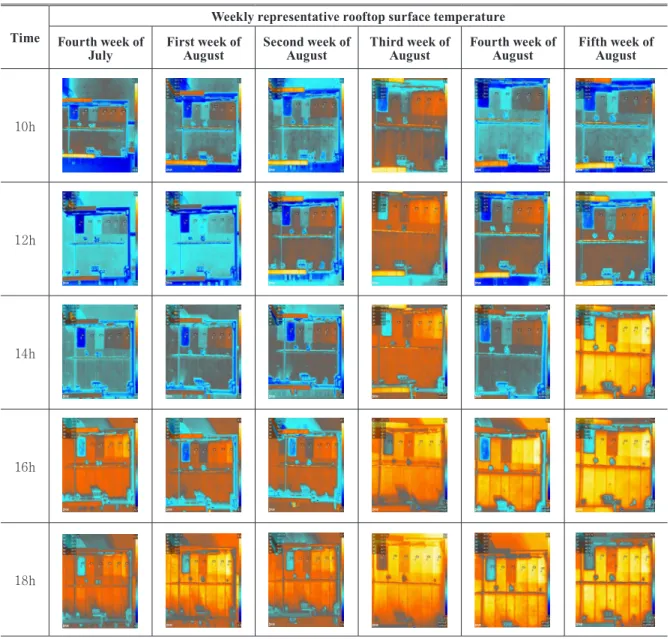
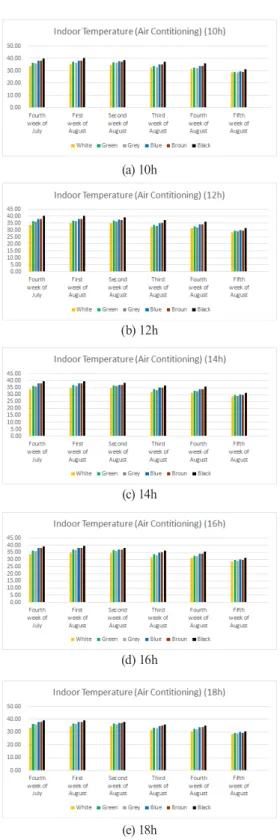
일부를 정리한 표이며, Figs. 5, 6 and 7은 UAV로 취득된 열적
외선 영상 표면 온도 및 에어컨 센서로 취득된 실내 온도, 온
도계로 취득된 실내 온도에 대해 주별로 정리한 표를 나타낸
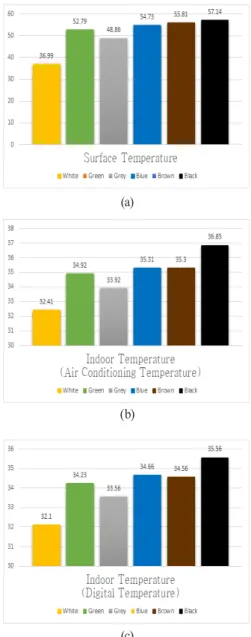
다 . 또한 Fig. 8은 각각의 표면 온도 및 실내 온도의 색상별 전
체 평균온도를 나타낸다.
Time
Weekly representative rooftop surface temperature Fourth week of
July First week of
August Second week of
August Third week of
August Fourth week of
August Fifth week of August
10h
12h
14h
16h
18h
Table 3. Rooftop surface temperature images acquired by UAV-based thermal infrared camera
according to weekly different time
(a) 10h (a) 10h
(b) 12h (b) 12h
(c) 14h (c) 14h
(d) 16h (d) 16h
(e) 18h (e) 18h
Fig. 5. Rooftop surface average temperature acquired by UAV-based thermal infrared camera
according to weekly different time (℃)
Fig. 6. Indoor average temperature acquired by the thermometer of the air-conditioning sensor
according to weekly different time (℃)
(a) 10h
(b) 12h
(c) 14h
(d) 16h
(e) 18h
Fig. 7. Indoor average temperature acquired by a thermometer according to the weekly different time (℃)
(a)
(b)
(c)
Fig. 8. Overall average surface and indoor temperature
by colors (℃)
3. 표면 온도 및 실내 온도 비교 및 결과
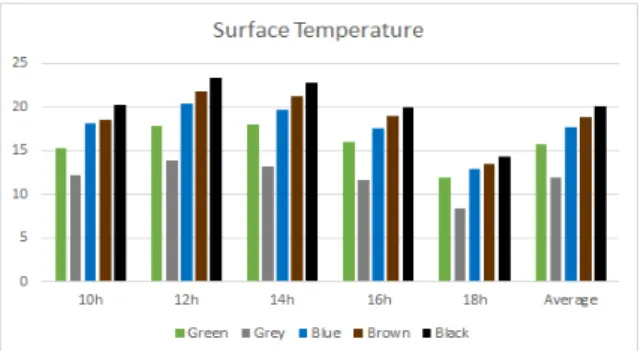
본 연구에서는 총 6주간 취득된 표면 온도 및 실내 온도를 각각의 색상별 전체 평균과 색상 및 시간대 별로 평균 내어 기 존의 쿨루프 연구에서 가장 효과가 있었던 흰색과 나머지 색 들의 차를 비교하였다. 다음 Figs. 9, 10 and 11은 색상별 전체 평균온도를 나타낸다.
Fig. 8을 보면 기존 논문에서와 마찬가지로 흰색의 색상이 쿨루프 성능이 가장 우수한 것을 확인할 수 있었으며, 표면 온도의 경우 흰색이 다른 색상보다 약 11도에서 20도의 낮게 나타났으며, 에어컨의 실내 온도는 또한 흰색이 약 1.5도에서 4.4도, 디지털 온도계는 약 1.5도에서 3.5도 낮게 측정되었다.
표면 온도의 경우 빛을 많이 흡수하는 색상인 검은색과 빛 을 많이 반사하는 흰색과의 차가 햇빛을 가장 많이 받는 12시 에는 23.41도로 가장 크게 나타났으며, 기존의 옥상 색상으 로 많이 사용되는 초록색과 파란색과의 차 또한 12시를 기 준으로 했을 때 17.88도, 20.43도로 높게 나타났다(Fig. 9). 평 균을 통해 봤을 때 온도의 차는 검은색>갈색>파란색>초록 색>회색 순서대로 나타났으며, 표면 온도의 경우 태양 고도 가 가장 높은 12시 이후로는 온도가 급격히 차이나는 것을 확인하였다.
에어컨 온도계와 디지털 온도계로 취득된 실내 온도 또한 표면 온도와 마찬가지로 검은색이 가장 큰 온도차를 보였으 며, 기존의 옥상 색상인 초록색과 파란색 또한 에어컨 온도계 를 기준으로 2.76도, 3.08도 차이를 보였으며, 디지털 온도계 의 경우 2.64, 2.73의 온도 차이를 보였다(Figs. 10 and 11). 실 내 온도 또한 평균을 통해 봤을 때 온도의 차는 에어컨 온도 계와 디지털 온도계 모두 검은색>파란색>갈색>초록색>회색 순서대로 나타났으며, 표면 온도의 경우 갈색이 파란색보다 높 게 나타났지만 실내 온도에서는 근소한 차이로 파란색이 갈색 보다 온도가 높게 측정되었다.
또한, Figs. 5, 6 and 7을 보면 일사량이 많은 7월과 8월 중 순까지는 쿨루프 색상으로 인한 표면 온도 및 실내 온도의 온 도차가 크게 나타났지만 더위가 지나 일사량이 줄어드는 8월 말부터는 쿨루프 색상 간 표면 온도의 경우 약간의 차이가 나 타나지만 실내 온도의 경우 온도 차가 크지 않은 것을 확인 할 수 있었다.
Fig. 9. Difference between white and other colors on surface temperature
Fig. 10. Difference between white and other colors on Indoor temperature (Air conditioning thermometer)
Fig. 11. Difference between white and other colors on Indoor temperature (Digital thermometer)
4. 결 론
본 연구에서는 기존 연구에서와 달리 실제 건물과 UAV에 장착된 열적외선 카메라를 이용하여 원격탐사 기법을 통해 쿨 루프 색상에 따른 성능 평가를 진행하였으며, 그 결과 다음과 같은 결론을 얻을 수 있었다.
첫째, 표면 온도의 경우 흰색이 다른 색상과의 차가 약 11.9
도에서 20.1도의 차이가 나타났으며, 에어컨의 실내 온도는 약
1.5도에서 4.4도, 디지털 온도계는 약 1.5도에서 3.5도 차이를 보여 흰색이 쿨루프 성능이 가장 뛰어남을 확인할 수 있었다.
둘째 , 색상 및 시간대 별 평균을 통한 흰색과 다른 색의 온 도 차는 검은색>갈색>파란색>초록색>회색 순서대로 나타났 으며 , 실내 온도의 온도 차는 에어컨 온도계와 디지털 온도계 모두 검은색>파란색>갈색>초록색>회색 순서대로 나타났으 며 , 기존의 방수 페인트 색상으로 많이 쓰이는 초록색과 파란 색의 경우 표면 온도와 실내 온도 모두 높은 온도를 나타났다.
셋째 , 기존의 표면 온도 또는 디지털 온도계를 통해 실내 온 도를 측정하였지만 본 연구에서는 에어컨 자체의 온도계를 통 해 온도 값을 취득하였다. 냉방에 있어 에어컨 센서가 느끼는 온도에 따라 냉방의 작동이 크게 달라지기 때문에 향후 쿨루 프에 따른 냉방부하 연구 자료에 도움이 될 것으로 사료된다.
마지막으로 본 연구에서는 한 건물에 대해 쿨루프 색상에 성능 평가를 진행하였지만 향후 연구에서는 다양한 건물, 다 양한 옥상 재질, 다양한 지붕 모양, 다양한 시기에 대한 쿨루 프 성능 평가에 대한 연구와 일조시간과 기온변화 등에 따라 변화되는 옥상면의 온도 변화 면적 분석이 필요할 것으로 사 료된다 . 또한, 흰색의 쿨루프가 건물 내부의 온도를 줄여줄 순 있지만 빛 반사로 인한 도시열섬현상에 영향을 미칠 수 있기 때문에 향후 연구에서는 이러한 도시열섬현상과의 상관관계 또한 같이 분석할 예정이다.
감사의 글
이 논문은 2018년도 정부(교육부)의 재원으로 한국연구 재단 기초연구사업의 지원을 받아 수행된 연구임(No. NRF- 2017R1D1A1B03030611)
References