JKSCI
Deep learning based Person Re-identification with RGB-D sensors
1)
Min-Kim*, Dong-Hyun Park*
*Student, Dept. of Industrial & Management Engineering, Inha University, Incheon, Korea
*Professor, Dept. of Industrial & Management Engineering, Inha University, Incheon, Korea
[Abstract]
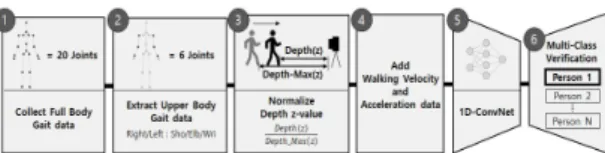
In this paper, we propose a deep learning-based person re-identification method using a three-dimensional RGB-Depth Xtion2 camera considering joint coordinates and dynamic features(velocity, acceleration). The main idea of the proposed identification methodology is to easily extract gait data such as joint coordinates, dynamic features with an RGB-D camera and automatically identify gait patterns through a self-designed one-dimensional convolutional neural network classifier(1D-ConvNet).
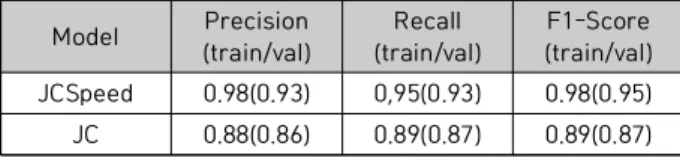
The accuracy was measured based on the F1 Score, and the influence was measured by comparing the accuracy with the classifier model (JC) that did not consider dynamic characteristics. As a result, our proposed classifier model in the case of considering the dynamic characteristics(JCSpeed) showed about 8% higher F1-Score than JC.
▸Key words: person re-identification, surveillance system, deep learning, human action recognition, multi class identification
[요 약]
본 연구에서는 3차원 RGB-D Xtion2 카메라를 이용하여 보행자의 골격좌표를 추출한 결과를 바 탕으로 동적인 특성(속도, 가속도)을 함께 고려하여 딥러닝 모델을 통해 사람을 인식하는 방법을 제안한다 . 본 논문의 핵심목표는 RGB-D 카메라로 손쉽게 좌표를 추출하고 새롭게 생성한 동적인 특성을 기반으로 자체 고안한 1차원 합성곱 신경망 분류기 모델(1D-ConvNet)을 통해 자동으로 보 행 패턴을 파악하는 것이다. 1D-ConvNet의 인식 정확도와 동적인 특성이 정확도에 미치는 영향을 알아보기 위한 실험을 수행하였다 . 정확도는 F1 Score를 기준으로 측정하였고, 동적인 특성을 고 려한 분류기 모델(JCSpeed)과 고려하지 않은 분류기 모델(JC)의 정확도 비교를 통해 영향력을 측 정하였다. 그 결과 동적인 특성을 고려한 경우의 분류기 모델이 그렇지 않은 경우보다 F1 Score가 약 8% 높게 나타났다.
▸주제어: 사람 재인식, 감시 시스템, 딥러닝, 합성곱신경망, 사람 행동 인식, 다중 분류 인식
∙First Author: Min-Kim, Corresponding Author: Dong-Hyun Park
*Min-Kim ([email protected]), Dept. of Industrial & Management Engineering, Inha University *Dong-Hyun Park ([email protected]), Dept. of Industrial & Management Engineering, Inha University
∙Received: 2021. 01. 13, Revised: 2021. 02. 18, Accepted: 2021. 02. 19.
Copyright ⓒ 2021 The Korea Society of Computer and Information http://www.ksci.re.kr pISSN:1598-849X | eISSN:2383-9945