텍스처 분석 기반 칼라 텍스처 이미지 워터마킹 알고리즘
1)강명수*, 트룩 뉘엔*, 딘 뉘엔*, 김철홍**, 김종면*
A Color-Texture Image Watermarking Algorithm Based on Texture Analysis
Myeongsu Kang*, Truc Kim Thi Nguyen*, Dinh Van Nguyen, Cheol-Hong Kim**, Jong-Myon Kim*
요 약
텍스처 이미지가 다양한 산업 애플리케이션 분야에 널리 사용됨에 따라, 이러한 이미지들의 저작권 보호는 중요 한 이슈가 되어왔다. 이러한 이유로, 본 논문은 이미지에 내재한 텍스처 특성을 이용한 칼라 텍스처 이미지 워터마 킹 알고리즘을 제안한다. 제안한 알고리즘은 퍼지 클러스터링을 위한 입력으로써 그레이 레벨 동시발생 행렬의 에 너지와 동질성 특징을 사용하여 워터마크를 삽입하기 위한 적당한 블록들을 선택한다. 워터마크를 삽입하기 위해 먼저 선택된 블록들에 이산 웨이블릿 변환을 수행하고, 이산 웨이블릿 변환의 서버밴드들의 하나를 선택한다. 그런 후에 이 워터마크를 중간 대역의 이산 코사인 변환 계수에 삽입한다. 또한, 본 논문은 워터마크 삽입 후 비인지성과 다양한 형태의 워커마킹 공격에 대해 강인성이 뛰어난 이득 계수들과 이산 웨이블릿 변환의 서버밴드들의 효과를 탐색한다. 모의실험 결과, 제안한 알고리즘은 이득 계수가 42이고 HH 밴드에 워터마크를 삽입하였을 때 높은 PSNR 값 (47.66 dB to 48.04 dB) 및 낮은 M-SVD 값 (8.84 to 15.6)을 얻었다. 또한 제안한 알고리즘은 노 이즈 첨가, 필터링, 잘라내기 및 JPEG 압축과 같은 다양한 이미지 처리 공격에서도 높은 상관 값 (0.7193 to 1) 을 보였다.
▸Keywords : 텍스처 이미지 워터마킹, 그레이 레벨 동시발생 행렬, 퍼지 클러스터링, 이산 웨이블릿 변환, 이산 코사인 변환
∙제1저자 : 강명수 ∙교신저자 : 김종면
∙투고일 : 2012. 11. 15, 심사일 : 2012. 12. 4, 게재확정일 : 2012. 12. 11.
* 울산대학교 전기공학부(School of Electrical Engineering, University of Ulsan)
** 전남대학교 전자컴퓨터공학부(School of Electronic and Computer Engineering, Chonnam National Uiversity)
※ This work was supported by a grant from the NIPA (National IT industry Promotion Agency) in 2012, (Fostering Global IT Human Resource Project), by Business for Cooperative R&D between Industry, Academy, and Research Institute funded Korea Small and Medium Business Administration in 2012 (Grants No. C0031322), by the Leading Industry Development for Economic Region (LeadER) grant funded the MKE(The Ministry of Knowledge Economy) in 2012, and work supported by NRF, No.
2012-0004962.
Abstract
As texture images have become prevalent throughout a variety of industrial applications, copyright protection of these images has become important issues. For this reason, this paper proposes a color-texture image watermarking algorithm utilizing texture properties inherent in the image. The proposed algorithm selects suitable blocks to embed a watermark using the energy and homogeneity properties of the grey level co-occurrence matrices as inputs for the fuzzy c-means clustering algorithm. To embed the watermark, we first perform a discrete wavelet transform (DWT) on the selected blocks and choose one of DWT subbands. Then, we embed the watermark into discrete cosine transformed blocks with a gain factor. In this study, we also explore the effects of the DWT subbands and gain factors with respect to the imperceptibility and robustness against various watermarking attacks. Experimental results show that the proposed algorithm achieves higher peak signal-to-noise ratio values (47.66 dB to 48.04 dB) and lower M-SVD values (8.84 to 15.6) when we embedded a watermark into the HH band with a gain factor of 42, which means the proposed algorithm is good enough in terms of imperceptibility. In addition, the proposed algorithm guarantees robustness against various image processing attacks, such as noise addition, filtering, cropping, and JPEG compression yielding higher normalized correlation values (0.7193 to 1).
▸Keywords : Texture image watermarking, Grey level co-occurrence matrices, Fuzzy c-means clustering, Discrete wavelet transform, Discrete cosine transform
I. Introduction
The rapid development of the Internet and networked multimedia systems has triggered an explosion of usage of digital media through the Internet. Consequently, copyright protection, information security, and authentication of digital content have become urgent problems and have evoked the concern of researchers. Digital watermarking has been proposed as an effective solution to these problems. In particular, digital image watermarking is defined as a technology that embeds information in digital images in order to protect and track the copyright and to prevent illegal copying [1]. Most of watermarking schemes embed data either in the spatial domain or in the frequency domain. Spatial domain algorithms embed
a watermark image by modifying the original image directly, while frequency domain algorithms embed the image by changing the frequency coefficients.
Spatial-based algorithms are relatively easy to manipulate and are highly reliable but are only weakly resistant to various attacks. Thus, transform-based watermarking methods have become a main focus of research because they are robust and compatible with image compression methods [2].
The transform domain watermarking schemes generally use a discrete cosine transformation (DCT), a discrete Fourier transformation (DFT), a discrete wavelet transformation (DWT), or a combination of these transforms to increase the robustness. Furthermore, numerous properties of the human visual system (HVS) have been exploited to enhance the fidelity of watermark techniques for color images [3].
industry and personal applications [4,5]. A texture is attractive not only because it is an important component in image analysis for solving a wide range of applied recognition, segmentation, and synthesis problems, but also because it provides a key to understanding basic mechanisms that underlie human visual perception [6]. Therefore, protecting the copyright of texture images is necessary, and we propose a blind texture image watermarking algorithm that utilizes multiple techniques, including a grey level co-occurrence matrix (GLCM), fuzzy c-means clustering (FCM), DWT, and DCT.
The remainder of this paper is organized as follows: Section 2 describes the background information including the GLCM, and Section 3 introduces the watermark embedding and extracting procedures of our proposed algorithm. Section 4 evaluates the proposed algorithm with respect to imperceptibility and robustness against various watermarking attacks. Finally, Section 5 summarizes our conclusions.
II. Grey Level Co-occurrence Matrix
The grey level co-occurrence matrix (GLCM) was originally proposed by Haralick and has been widely used for texture analysis [7]. The GLCM is a square matrix that quantifies the occurrence of different combinations of grey pixel levels in an image. It simultaneously considers the spatial relationships between groups of adjacent pixels, called the reference and neighbor pixels, in any one of the eight directions (north, south, east, west, and the four diagonals). In addition, Haralick proposed fourteen measures of texture features that can be computed from the co-occurrence matrices; each measure specifies certain characteristics such as coarseness, contrast, homogeneity, and complexity of the texture.
The HVS is least sensitive to noise in dark and
distortions in regions characterized by high activity and low saliency [3]. Thus, the HVS has difficulty detecting a watermark embedded in complex regions.
As a result, our proposed algorithm utilizes the energy and homogeneity properties of GLCMs to evaluate the complexity of regions and then chooses a suitable position to hide a watermark on the basis of these parameters. These properties are defined as follows:
′
(1)
where P(i, j) represents the probability of a given outcome and is defined as the number of times this outcome occurs, divided by the total number of possible outcomes, where i is the row number and j is the column number [7].
III. Proposed Algorithm
1. Watermark Embedding
Three different types of original images are used in this study in which each 512x512 in size with a grey level ‘ITC’ text size of 32x32 for the watermark.
In order to embed a watermark, we first convert an original cover image from RGB to CIE LAB color space. For color image watermarking, it is obviously important to possess a uniform color space in order to guarantee the perceptual transparency of the color-embedded image, and the CIE LAB color space is the most suitable for this characteristic. Likewise, the HVS is less sensitive to lightness variations than hue variations [3], so the proposed algorithm utilizes the lightness component (L component in the CIE LAB color space) to embed a watermark instead of chrominance components (A and B components in the CIE LAB color space). Next, we
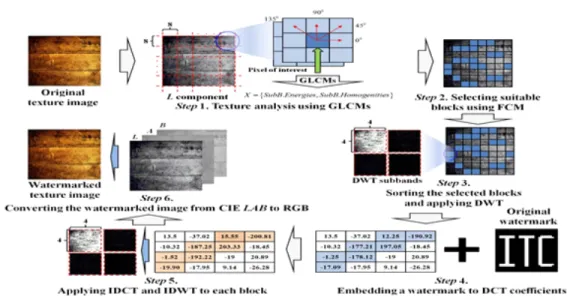
그림 1. 제안한 알고리즘의 워터마커 삽입 과정
Fig. 1. Watermark embedding process of the proposed algorithm
divide the L component into several 8x8 blocks and calculate the properties of the GLCMs for all of the blocks. For a lower visibility of the embedded watermark, this paper uses FCM to classify the blocks into two categories: one category is suitable for embedding a watermark and the other is not. For this process, it is necessary to build the data set X={SubB.Energies, SubB.Homogeneties} as an input for the FCM, where SubB.Energies and SubB.Homogeneities are the energy and homogeneity properties of the GLCMs for the 8x8 blocks, respectively. We then use cluster centroids to select suitable blocks. Since larger values of the energy and homogeneity properties of GLCMs produce larger scalar centroid values, the membership values corresponding to less than 0.5 are considered suitable for watermark embedding. Figure 1 presents the watermark embedding process;
additionally, the steps for embedding a watermark are described below.
Step 1: Convert the original cover image from RGB to CIE LAB color space and extract the lightness component (L component). Then, divide the lightness component into 8x8 blocks and compute a GLCM for each block in four directions
(0o, 45o, 90o, and 135o). Finally, calculate the energy and homogeneity properties of the GLCMs.
Step 2: Apply FCM using the energy and homogeneity properties of the GLCMs as inputs for the FCM, and select suitable blocks to embed a watermark. To apply FCM to the proposed algorithm, we selected the degree of fuzzification and the termination threshold as 2 and 0.001, respectively, since Bezdek et al. experimentally determined the optimal interval for the degree of fuzzification and termination threshold to range from 1.1 to 5 and from 0.01 to 0.0001, respectively [8].
Step 3: Sort the membership values in ascending order and select the first 1,024 blocks corresponding to the membership values that are lower than 0.5.
Then, decompose the selected blocks by applying one-level DWT [9-11]:
[LL, LH, HL, HH] = dwt2(selected blocks,
‘db1’)
Step 4: Apply DCT to each DWT subband (e.g., LL, LH, HL, and HH) and modify the DCT coefficients at mid-frequency, as shown in Fig.1. To embed a watermark, generate two uncorrelated
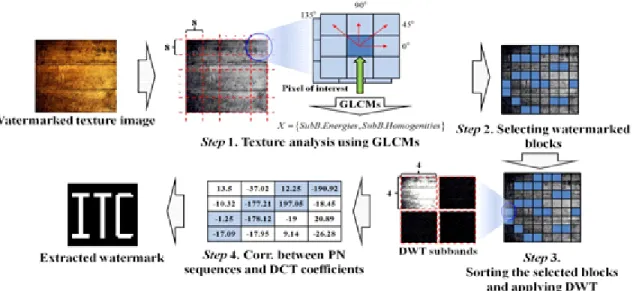
그림 2. 제안한 알고리즘의 워터마커 추출 과정
Fig. 2. Watermark extracting process of the proposed algorithm will be utilized to embed a watermark value of 255
(PN255) and the other will be used to embed a watermark value of 0 (PN0). The number of elements in each of the two pseudo random sequences must be equal to the number of mid-frequency elements in the DCT-transformed block (Note: the number of elements in each pseudo random sequence is seven in this study). Then, embed the two pseudo random sequences with a gain factor in the DCT-transformed 4x4 block via the following embedding rule:
(2)
where X and X' are the mid-frequency DCT coefficients and modified mid-frequency DCT coefficients, respectively, and is a gain factor.
Finally, replace the original DCT coefficients with the modified DCT coefficients.
Step 5: Apply inverse DCT (IDCT) and one-level inverse DWT (IDWT) to obtain the watermarked image.
Step 6: Convert the watermarked image from CIE
2. Watermark Extracting
Figure 2 shows the watermark extracting process which is described in detail in the following steps.
Note that, since the proposed algorithm is a blind watermarking, the original cover image is not necessary.
Step 1: Convert the watermarked image from RGB to CIE LAB color space and extract the lightness component (L component). Then, divide the lightness component into 8x8 blocks and compute a GLCM for each block in four directions (0o, 45o, 90o, and 135o). Finally, calculate the energy and homogeneity properties of the GLCMs.
Step 2: Apply FCM using the energy and homogeneity properties of the GLCMs as inputs for the FCM, and find the watermarked blocks.
Step 3: Sort the membership values in ascending order and select the first 1,024 blocks corresponding to the membership values that are lower than 0.5.
Then, decompose the selected blocks by applying the one-level DWT technique.
Step 4: To extract a watermark, first apply DCT to each DWT subband and calculate the correlation
between the mid-frequency coefficients and the two generated pseudo random sequences (PN255 and PN0). If the correlation with the PN255 is higher than the correlation with PN0, the extracted watermark value is considered to be 255; otherwise, the value of the extracted watermark is considered to be 0.
IV. Performance Evaluation
1. Quality and Robustness Evaluation
In this study, the quality of the watermarked image is computed using the peak signal-to-noise ratio (PSNR) and M-SVD, which are calculated as follows:
log
·
(3)
where M x N is the size of the cover image, I(i, j) are the intensity values of the original image, and I*(i, j) are the intensity values of the watermarked image.
Furthermore, the M-SVD can numerically express the quality of the distorted images. It is a bivariate measure that computes the distance between the singular values of the host image block and the singular values of the distorted image block (or watermarked image block) such that
(4)
where si are the singular values of the original block, si* are the singular values of the distorted block, and n x n is the block size. Finally, the numerical measure can be expressed as follows:
×
∑
×
(5)
where k x k is the image size and Dmid represents the midpoint of the sorted Di values.
Lower M-SVD values indicate that the watermarked image has been distorted less by the watermark insertion.
Likewise, we evaluate the robustness of the proposed algorithm against various attacks such as noise addition (Gaussian noise, salt and pepper noise), Gaussian low-pass filtering, cropping, and JPEG compression. We use the normalized correlation (NC) to evaluate the robustness of the proposed algorithm as follows:
∑
∑
∑
∑
×
(5)
where M x N is the watermark image size, I(i, j) are the intensity values of the original watermark, and I*(i, j) are the intensity values of the extracted watermark image. If the calculated NC is 1, the original and extracted watermarks are exactly the same.
2. Experimental Result
There is no general consensus regarding which DWT subband is the most suitable for watermark embedding. In addition, it is necessary to manually set the gain factor to embed the watermark.
Consequently, we need to explore the effects of DWT subbands and gain factors with respect to imperceptibility and robustness against various watermarking attacks. Figure 3 presents target texture images for this study.
그림 4. 워터마된 이미지와 추출된 워터마크 Fig 4. Watermarked images and extracted watermarks
Attacks Conventional approach Proposed approach
Fig. 3(a) Fig. 3(b) Fig. 3(c) Fig. 3(a) Fig. 3(b) Fig. 3(c) NO
PSNR (dB) 34.06 34.81 34.11 47.66 47.93 48.06
M-SVD 17.83 34.04 19.39 15.6 14.69 8.84
NC 1 1 1 1 1 1
SP NC 0.9948 1 0.9227 0.9974 0.9974 0.9974
GN NC 1 1 0.9278 0.9974 0.9974 0.9923
GF NC 0.9897 0.9794 0.6031 1 1 1
Crop NC 0.7680 0.6443 0.4485 0.7202 0.6887 0.7193
JPEG NC 1 1 0.9485 0.9974 1 0.9818
NO: No attack, GN: Gaussian Noise, SP: Salt and Pepper Noise, GF: Gaussian Filtering, Crop: Cropping, JPEG: JPEG Compression
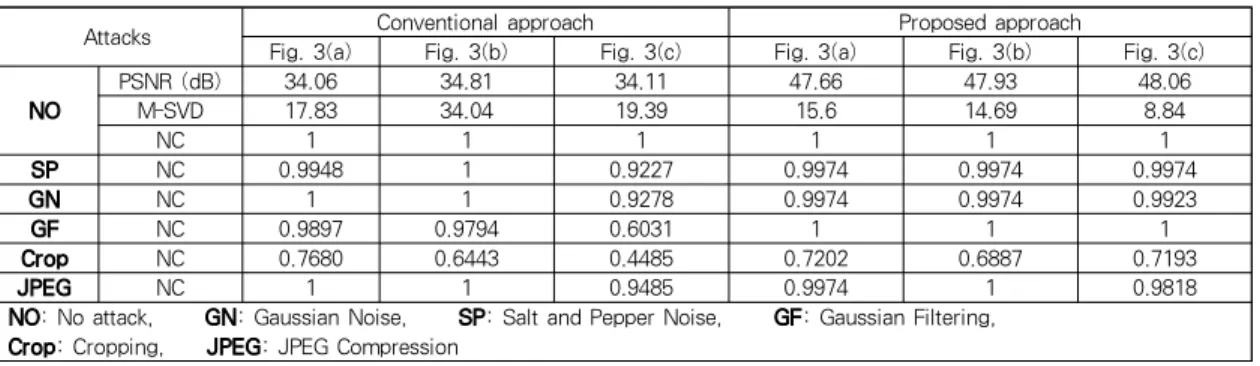
표 1. 다양한 공격에 대한 제안한 알고리즘과 기존 알고리즘의 평가 결과
Table 1. Evaluation results of the proposed and conventional algorithms against several attacks 그림 3. 텍스처 이미지
FIg. 3. Texture images
Our experimental results using Figure 3(a) produce PSNRs ranging from 43.35 dB to 43.33 dB for LL, from 50.01 dB to 48.07 dB for LH, from 44.81 dB to 44.55 dB for HL, and from 49.08 dB to 47.35 dB for HH. Furthermore, M-SVD values using the same Figure 3(a) range from 50.76 to 52.90 for LL, from 9.51 to 13.47 for LH, from 23.84 to 27.05 for HL, and from 12.30 to 16.41 for HH. Regarding
the highest NC value when we embed a watermark into the HH band with a gain factor of 42. More details of the simulation results are available at http://eucs.ulsan.ac.kr/KSCI2012/TIWM.
Accordingly, these experimental results indicate that HH is the most suitable DWT band, with a gain factor of 42. Using this experimental setup, we evaluate the proposed algorithm for other texture images. Figure 4 illustrates the watermarked images and the extracted watermarks. In addition, we compare the NC values of the proposed algorithm and those of the conventional algorithm [2] against various image processing attacks. Table 1 presents the NC values of between the original and the extracted watermarks via the proposed and
conventional watermarking algorithms after various watermark attacks. The proposed watermarking outperforms the conventional algorithm with respect to NC values.
IV. Conclusions
This paper proposed a color-texture image watermarking algorithm that utilizes the texture properties of GLCMs. The proposed algorithm selected suitable blocks in which to embed a watermark by using the energy and homogeneity properties of the GLCMs as inputs for the FCM clustering algorithm. To embed the watermark, we first performed one-level DWT on the selected blocks and chose one of the DWT subbands. Then, we embedded a watermark into DCT coefficients with a gain factor. In this study, we explored several DWT subbands and gain factors with respect to imperceptibility and robustness against various watermark attacks. Our experimental results showed that the proposed algorithm achieved higher values of PSNR, lower values of M-SVD after embedding a watermark in the HH1 band with a gain factor of 42. Moreover, the proposed algorithm yielded higher values of NC for all of the watermark attacks.
References
[1] N. Wang, Y. Wang, and X. Li, “A Novel Robust Watermarking Algorithm Based on DWT and DCT,” International Conference on Computational Intelligence and Security, vol. 1, pp. 437-441. 2009.
[2] F. Kong and Y. Peng, “Color Image Watermarking Algorithm Based on HIS Color Space,” 2nd International Conference on Industrial and Information Systems, vol. 2, pp.
464-467, 2010.
[3] T. Troung and J.-M. Kim, “An Enhanced Spatial
uzzy C-Means Algorithm for Image Segmentation,” Journal of The Korea Society of Computer and Information, vol. 17, no. 2, pp.
49-57, 2012.
[4] O. O. Basset, B. B. Buquet, S. S. Abouelkaram, P. Delachartre, and J. J. Culioli, “Application of Texture Image Analysis for the Classification of Bovine Meat,” Food Chemistry, vol. 69, no. 4, pp. 437-445, 2000.
[5] S.-M. Kang and J.-M. Kim, “Survey for Early Detection Techniques of Smoke and Flame using Camera Images”, Journal of The Korea Society of Computer and Information, vol. 16, no. 4, pp.
43-52, 2011.
[6] Texture Analysis and Synthesis Using a Generic Markov-Gibbs Image Model, available at http://www.cs.auckland.ac.nz/~georgy/research /texture/thesis-html/node4.html.
[7] The GLCM Tutorial, available at http://www.fp.ucalgary.ca/mhallbey/tutorial.ht m.
[8] J. C. Bezdek, J. Keller, R. Krisnapuram, and N.
R. Pal, Fuzzy Models and Algorithms for Pattern Recognition and Image Processing. Springer, 1st edition, 2005.
[9] P. U. Lande, S. N. Talbar, and G. N. Shinde, “A Fuzzy Logic Approach to Encrypted Watermarking for Still Images In Wavelet Domain of FPGA,” Int’l J. Sig. Proc., Image Proc., and Patt. Recog., vol. 3, no. 2, pp. 1-10, 2010.
[10] H. A. Abdallah and M. M. Hadhoud, “Blind Wavelet-Based Image Watermarking,” Int’l J.
Sig. Proc, Image Proc., and Patt. Recog., vol. 4, no. 1, pp. 15-28, 2011.
[11] S. Kishk, H. E. M. Ahmed, and H. Helmy,
“Integral Images Compression Using Discrete Wavelets and PCA,” Int’l J. Sig. Proc., Image Proc., and Patt. Recog., vol. 4, no. 2, pp.
65-78, 2011.
강 명 수
2008 : 울산대학교 컴퓨터공학과 학사 2010 : 울산대학교 컴퓨터공학과
공학석사 2010 - 현재 : 울산대학교
컴퓨터공학과 박사과정 관심분야 : 임베디드 시스템,
음향신호처리, 고장진단 Email: [email protected] Truc Kim Thi Nguyen 2008 : Electrical Engineering,
Danang University of Technology, Vietnam, 공학사.
2011 : 울산대학교 컴퓨터정보통신공학부 석사과정 입학.
관심분야 : 영상처리, 워터마킹 Email: [email protected] Dinh Van Nguyen
2009 : Electrical Engineering, Hanoi University of Science and Technology, Vietnam, 공학사
2011 : 울산대학교 컴퓨터정보통신공학부 석사과정 입학.
관심분야 : 음향처리, 고장예측, 워터마킹
Email: [email protected] 김 철 홍
1998 : 서울대학교 컴퓨터공학사.
2000 : 서울대학교 컴퓨터공학부 석사.
2006 : 서울대학교
전기컴퓨터공학부 박사 2005-2007년 :삼성전자 반도체총괄
책임연구원 2007-현재 : 전남대학교
전자컴퓨터공학부 교수 관심분야 : 임베디드시스템, 컴퓨터구조,
SoC설계, 저전력 설계 Email: [email protected]
1995 : 명지대학교 전기공학사 2000 : University of Florida ECE
석사
2005 : Georgia Institute of Technology ECE 박사 2005-2007 : 삼성종합기술원
전문연구원 2007-현재 : 울산대학교
전기공학부 조교수 관심분야 : 프로세서 설계,
임베디드 SoC, 컴퓨터구조, 병렬처리 Email: [email protected]