Selection of rs2rs2titi Soybean Genotype with Yellow Seed Coat
Sang Woo Choi, Jun Hyun Park and Jong Il Chung*
Department of Agronomy, Gyeongsang National University, Jinju 52828, Korea
Received September 16, 2018 /Revised November 2, 2018 /Accepted November 3, 2018
Soybean [Glycine max (L.) Merr.] seed is an important dietary source of protein, oil, carbohydrates, iso- flavones, and other nutrients for humans and animals. But, antinutritional factors in the raw mature soybean are exist. Kunitz trypsin inhibitor (KTI) protein and stachyose are main antinutritional factors in soybean seed. The genetic removal of the antinutritional factors will improve the nutritional value of soybean seed. The objective of this research was to breed a new yellow soybean strains (rs2rs2titi genotype) with the traits of lacking of KTI protein and low content of stachyose. Breeding population was developed from the cross of “Jinyangkong” and 15G1 parents. Presence or absence of KTI protein was detected based on Western Blot technique. Content of stachyose in mature seed was detected by HPLC. Total four new strains (603-1, 603-2, 625, and 694) with KTI protein free and low content of stachyose were selected. Four strains (603-1, 603-2, 625, and 694) have yellow seed coat and hilum.
Plant height of 603-1 strain was 65 cm and 100-seed weight was 29.2 g. Plant height of 603-2 strain was 66 cm and 100-seed weight was 26.2 g. Plant height of 625 strain was 64 cm and 100-seed weight was 27.1 g. Content of stachyose for four new strains was 3.0~3.50 g/kg. Four strains selected in this research will be used to improve new yellow soybean cultivar with KTI protein free, and low content of stachyose.
Key words : Breeding lines, kunitz trypsin inhibitor, stachyose, yellow soybean
*Corresponding author
*Tel : +82-55-772-1872, Fax : +82-55-772-1872
*E-mail : [email protected]
This is an Open-Access article distributed under the terms of the Creative Commons Attribution Non-Commercial License (http://creativecommons.org/licenses/by-nc/3.0) which permits unrestricted non-commercial use, distribution, and reproduction in any medium, provided the original work is properly cited.
Journal of Life Science 2018 Vol. 28. No. 11. 1285~1289 DOI : https://doi.org/10.5352/JLS.2018.28.11.1285
서 론
콩[Glycine max (L.) Merr. 2n=40]의 원산지는 한국과 남만 주 및 중국으로 알려져 있고, 오래전부터 양질의 단백질과 지 질의 공급원으로 이용되어져 오고 있으며 우리나라에서는 우 수한 식물성 단백질 공급원으로 예로부터 된장, 간장, 두부, 콩나물 등 다양한 식품으로 이용되어져 왔다. 성숙한 콩 종실 에는 단백질 40%, 지방 20%, 탄수화물 35%, 미네랄 5% 정도가 함유되어져 있으며[8], 사포닌, 피토스테롤, 피트산, 루테인, 아 이소플라본 및 안토시아닌 등 여러 가지 기능성 물질들이 다 량 함유되어져 있어 영양학적 가치가 높아지고 있다. 하지만 콩에는 품질이나 기능성 및 가공적성을 떨어트리는 성분들이 다수 존재한다.
콩 종실의 탄수화물에는 식이섬유가 25%, 올리고당이 10%
정도이며, 올리고당은 2~10개의 단당이 결합되어 있는 상태이 고 대표적인 올리고당으로는 sucrose, raffinose, stachyose 등 이 존재하고 있다. Raffinose와 stachyose는 대두에서 각각 1%와 4% 정도 함유되어져 있다[4]. Raffinose와 stachyose는
sucrose에 galactose가 α-1, 6결합으로 1개 또는 2개 결합되어 있는 형태로 장내에는 α-galactosidase 효소가 결핍되어 있어 sucrose와 galactose로 분해시키지 못하기 때문에 난소화성인 것으로 밝혀져 있다[16]. 난소화성당은 분해되지 않은 상태로 대장에 도달하게 되고, 대장 내의 혐기성 미생물에 의해 분해 되면서 가스가 발생하면서 장을 불편하게 하고 체외로 배출시 켜 불쾌감을 주는 것으로 알려져 있다[11, 12]. Suarez 등[16]은 일반적인 콩보다 raffinose와 stachyose의 함량이 떨어진 콩 생산물을 섭취하였을 경우 인체에서 가스발생이 감소하였음 을 보고하였다. 성숙 콩 종실에 raffinose 및 stachyose의 함량 이 낮은 유전자원이 밝혀져 있으며[7], Dierking와 Bilyeu [1]
는 유전자원 PI200508로부터 RS2라는 raffinose synthase의 새 로운 allele를 발견하였으며 rs2 gene은 raffinose 함량을 낮게 한다고 하였다. Stachyose의 함량이 낮은 유전자형은 포장 실 험결과 수량 등 대부분의 농업적 형질에서 일반콩과 차이가 없었다는 보고가 있다[6]. Hou 등[3]은 유전자형, 성숙군, 원산 지에 따른 raffinose 및 stachyose의 함량 변이를 보고하였고, Kumar 등[9]은 재배환경에 따른 함량의 변이를 보고한 바 있 다. Maughan 등[13]은 raffinose 및 stachyose를 포함한 su- crose의 함량에 영향을 미치는 양적형질 유전자좌를 탐색한 연구결과를 보고하였다.
KTI (Kunitz Trypsin Inhibitor) 단백질은 181개의 아미노산
으로 구성된 소화 억제 단백질로써 분자량은 21.5 Kda이며,
콩에 존재하는 대표적인 비영양학적 성분으로 분류된다고 하
였다[10]. Friedman 등[2]은 KTI 단백질은 콩 종자에 나타나는
Table 1. Flower color, seed coat color, hilum color, and genotype for Rs2 (rs2) and Ti (ti) alleles of two parents used in this experiment
Parents Trait/genotype
Flower color Seed coat color Hilum color Ti (ti) Rs2 (rs2)
“Jinyangkong”
15G1
Purple Purple
Yellow Yellow
Yellow Yellow
TiTi titi
rs2rs2 Rs2Rs2 Fig. 1. Scheme for selection of lacking of Kunitz Trypsin Inhibi-
tor (KTI) protein and low content of stachyose (rs2rs2titi genotype).
트립신의 활동을 약 80%정도 억제하여 콩단백질을 흡수하는 데 있어서 낮은 소화율을 유발시킨다고 하였다. 콩 단백질에 는 12가지의 eletrophoretic form이 존재하며 이러한 형태에는
Tia, Ti
b[15], Ti
c[5], Ti
d[20], Ti
e[17], Ti-null type [14], Ti
f[18], Ti
bi5[19]가 알려져 있다. KTI 단백질은 Molecular linkage map A2 (chromosome 8번)에 위치하는 Ti 유전자에 의해 조 절되는데 recessive allele (ti)일 경우 KTI 단백질이 유전적으 로 결핍되어진 형태이며[14], KTI 단백질이 결핍되어진 유전 자원으로는 PI157440, PI196168 등이 있다. 따라서 본 연구는 성숙 콩 종실에서 품질, 기능성 및 가공 적성을 저하시키는 KTI 단백질이 없으면서 난소화성 올리고당인 Stachyose 함량 이 낮은 rs2rs2titi 노란 콩 유전자형을 선발하여 품종화 및 중 간모본으로 활용하기 위하여 진행되었다.
재료 및 방법
육종집단
콩의 품질, 가공 적성 및 기능성을 저하시키는 Kunitz Trypsin Inhibitor (KTI) 단백질이 없으면서 stachyose의 함량 이 낮은 rs2rs2titi 유전자형을 가진 계통을 선발하기 위하여 2개의 모본을 이용하여 육종집단을 만들었다. 이용된 2개의 모본에 대한 형질은 Table 1과 같다.
“Jinyangkong” 모본은 성숙 종실에서 KTI 단백질이 존재 하고(TiTi genotype) stachyose의 함량이 낮으며(rs2rs2 geno- type), 15G1 모본은 KTI 단백질 없으며(titi genotype) Rs2Rs2 genotype을 가져 stachyose의 함량이 일반콩과 유사한 편이 다. 양 모본의 화색은 자주색이고 종피색 및 제색은 모두 노란색 이다. 온실에 두 모본을 파종하여 “Jinyangkong x 15G1의 조합 으로 교배를 통하여 F
1종자를 얻었다. 얻어진 F
1종자를 F
1식물 체로 양성하면서 잡종성을 확인 한 후 성숙기에 F
2종자를 얻었 다. 각각의 F
2종자를 이용하여 KTI 단백질이 없는 종자를 선발 하여 포장에서 F
2개체로 전개시켰다. 각각의 F
2개체를 수확 한 후 random으로 종자를 골라 stachyose의 성분 함량을 측정 하였다. 저함량 계통을 선발하여 포장에서 F
3계통으로 전개시 켜 초형, 성숙기, 종자상태등 농업적 형질을 점검하여 양호한 계통을 선발하여 포장에서 F
4계통으로 유지시켜 농업적 형질 을 점검하였다. 교배부터 선발까지의 단계는 Fig. 1과 같다.
Kunitz Trypsin Inhibitor (KTI) 단백질 분석
KTI 단백질의 유무는 SDS-PAGE 및 Western blot 방법을
이용하였다. 각각의 F
2종자로부터 배를 제외한 성숙 자엽을 절취하여 단백질을 추출하였다. 추출한 단백질 시료의 농도를 정량한 후 12% SDS-PAGE를 이용하여 전기영동을 하였다.
Gel에서 분리된 단백질을 PVDF membrane에 옮긴 후 2시간 동안 blocking buffer (20 mM Tris (pH 7.5), 150 mM NaCl, 0.1% Tween 20, 5% nonfat dried milk)에 담갔다. 이후 KTI antibody와 Lectin antibody를 1시간 동안 반응시킨 후 TTBS buffer (20 mM), Tris (pH 7.5), 150 mM NaCl, 0.1% Tween 20에 5분씩 3번 씻고, 2차 antibody와 1시간 동안 반응시켰다.
그런 후 다시 TTBS buffer에 5분씩 3번 씻은 후 ECL kit를 사용하여 X-ray film에서 KTI 단백질 존재여부를 확인하였다.
Stachyose의 함량 분석
성숙 종자에서 KTI 단백질이 없는 F
2개체를 수확 한 후
random으로 종자를 골라 stachyose의 함량을 HPLC 방법으
로 측정하였다. 선발된 종자들의 종피를 제거한 후 미세하게
분말로 갈아서 각 시료 당 수분을 동일하게 제거한 후 500
mg을 취하여 acetone 10 ml를 가하여 약 2시간 동안 열을 가하
면서 지방을 제거하였다. 필터를 통해 acetone을 제거하고 남
은 powder에 증류수 10 ml을 가하여 60℃ 온탕기에 2시간
동안 둔 후 추출물 1 ml을 취하였다. 1 ml에 단백질 및 기타
유기 colloid 등을 침전시키기 12,000 rpm에서 10분 동안 원심
분리 후 상층액을 0.2 µl membrane 필터에 필터하고 난 후
냉장고에 저장하면서 HPLC를 통해 분석하였다. HPLC 분석
Table 2. Planting date, harvesting date, plant height, seed weight, seed coat color and hilum color for four new strains Strains Planting date
(month.day)
Harvesting date (month.day)
Plant height (cm)1
Seed weight
(g/100 seed)1 Seed coat color Hilum color 603-1
603-2 625 694
5.26 5.26 5.26 5.26
10.20 10.20 10.20 10.20
65a 66a 64a 65a
29.2b 26.1a 27.1a 26.8a
Yellow Yellow Yellow Yellow
Yellow Yellow Yellow Yellow
1Means with the same letters are not significantly different at 5% significant level by Duncan’s multiple range test.
Fig. 3. Identification of Kunitz Trypsin Inhibitor(KTI) protein free for four F5 seed strains selected in this experiment.
P1: Jinyangkong, P2: 15G1. +, -: presence and absence KTI protein, respectively.
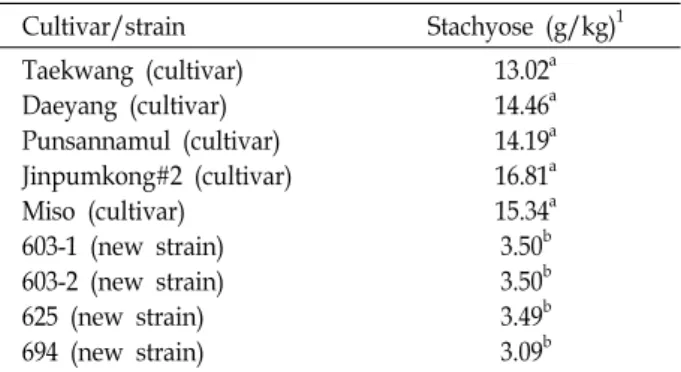
Table 3. Content of stachyose for five cultivars and four new strains selected in this experiment
Cultivar/strain Stachyose (g/kg)1
Taekwang (cultivar) Daeyang (cultivar) Punsannamul (cultivar) Jinpumkong#2 (cultivar) Miso (cultivar)
603-1 (new strain) 603-2 (new strain) 625 (new strain) 694 (new strain)
13.02a 14.46a 14.19a 16.81a 15.34a 3.50b 3.50b 3.49b 3.09b
1Means with the same letters are not significantly different at 5% significant level by Duncan’s multiple range test.
Fig. 2. Segregation of Kunitz trypsin inhibitor (KTI) protein in the parents and F2 seeds. Arrow is the KTI protein band.
P1: Jinyangkong, P2: 15G1. +, -: presence and absence of KTI protein, respectively.
컬럼은 Supelcogel 610-H Column (30 cm × 7.8 mm, 9 µm, Supelco, USA)을 사용하였으며, 이동상은 2차 증류수에서 0.1% H
3PO
4, 유속은 0.5 ml/min, 온도는 30℃로 유지시켰다.
Reflective index detector (RID) 검출기를 사용했으며 sta- chyose 의 각 standard를 10, 8, 6, 4, 2, 0 mg/ml로 calibration 후 각각의 sample 당 stachyose 의 함량 분석을 실시하였다.
Rs2Rs2 유전자형을 가진 장려품종들의 stachyose 함량 비교를
위해 태광콩, 대양콩, 풍산나물콩, 진품콩2호, 미소를 이용하 였다.
선발계통의 농업적 형질평가
성숙 종자에서 KTI 단백질이 없으며 stachyose의 함량이 낮은 rs2rs2titi 유전자형을 가진 F
4계통을 2017년 5월에 26일 포장에 파종하여 농업적 형질을 평가하였다. 수확기, 경장, 100립중, 종피색 및 제색을 관찰하였다. 조사된 양적형질 및 stachyose 함량에 대한 data는 SAS 프로그램을 이용하여 분산 분석과 덩컨의 다중검증을 실시하였다
결과 및 고찰
콩의 품질 및 기능성을 저하시키는 Kunitz Trypsin Inhibi- tor (KTI) 단백질이 없으며 stachyose의 함량이 낮은 rs2rs2titi 유전자형을 선발하기 위하여 얻어진 F
2개개의 종자를 이용하 여 KTI 단백질이 부재한 종자를 선발하였다(Fig. 2). KTI 단백 질이 부재한 종자를 계통으로 전개하면서 stachyose의 함량이 낮은 rs2rs2titi 유전자형을 가진 4개의 계통을 선발하였다. 선 발된 F
4plant 계통에 대한 포장으로부터 얻어진 농업적 형질 은 Table 2와 같다.
선발된 4개의 계통 수확일은 10월 20일이었고 초장은
64~66 cm, 백립중은 26.1~29.2 g으로 대립이었으며 종피색과 제색은 모두 노란색이었다. 선발 계통들은 포장에서 발아 및 재배에서의 특이한 문제점은 관찰되지 않았다. 이는 raffinose 와 stachyose의 함량이 차이 나는 계통에 대한 포장 실험결과 수량 등 대부분의 농업적 형질에서 차이가 없었다는 이전의 연구 결과와 일치하였다[6]. 선발된 4개의 계통(603-1, 603-2, 625, 694)에 대한 F
5random 종자를 이용하여 단백질 추출 후 Western Blot으로 KTI 단백질의 유무를 확인한 결과는 Fig.
3과 같다.
P1은 Jinyangkong 모본으로 성숙 콩 종실에서 KTI 단백질
이 있는 TiTi 유전자형이며 P2는 15G1 모본으로 KTI 단백질이
없는 titi 유전자형(Table 1)이고, 선발된 4개의 계통은 모두
P2 모본과 같이 KTI 단백질이 없는 titi 유전자형이었다. KTI
단백질의 부재는 single 유전자에 의해 지배되므로 F
2seed에
서 KTI 단백질이 없는 titi 유전자형 종자가 선발되어 고정된
상태임을 나타내었다[14]. 선발된 4개의 계통(603-1, 603-2, 625,
694)에 대한 F
5random 종자를 이용하여 HPLC 방법으로 sta- chyose의 함량을 측정한 결과는 Table 3과 같다.
대조품종으로 이용된 RS2RS2 유전자형을 가진 품종들의 stachyose 함량은 13.02~16.81 g/kg으로 선발계통의 3.09~3.50 g/kg보다 매우 높았다. 2개의 선발계통(603-1, 603-2)에 대한 stachyose의 함량은 3.50 g/kg이었고 625 계통은 3.49 g/kg, 694 계통은 가장 낮은 3.09 g/kg로 나타났다. 이로써 선발계통 의 stachyose 함량은 장려품종보다 매우 낮았으며 유전적으로 고정된 rs2rs2 유전자형임을 나타내었다. 따라서, 본 연구를 통하여 육성된 4개의 계통은 콩 종실에서 품질, 기능성 및 가 공 적성을 저하시키는 KTI 단백질이 없으면서 난소화성 올리 고당인 Stachyose 함량이 낮은 rs2rs2titi 노란 콩 육종을 위한 중간모본으로 활용될 수 있을 것으로 사료된다.
감사의 글
이 논문은 2015년도 정부(교육부)의 재원으로 한국연구재 단의 지원을 받아 수행된 기초연구사업(NRF-2015R1D1A1A 01059053) 결과입니다.
References
1. Dierking, E. C. and Bilyeu, K. D. 2008. Association of a soy- bean raffinose synthase gene with low raffinose and sta- chyose seed phenotype. Plant Genome 1, 135-145.
2. Friedman, M., Brandon, D. L., Bates, A. H. and Hymowitz, T. 1991. Comparison of a commercial soybean cultivar and an isoline lacking the Kunitz trypsin inhibitor: composition, nutritional value, and effects of heating. J. Agric. Food Chem.
39, 327-335.
3. Hou, A., Chen, P., Alloatti, J., Li, D., Mozzoni, L., Zhang, B. and Shi, A. 2009. Genetic variability of seed sugar content in worldwide soybean germplasm collections. Crop Sci. 49, 903-912.
4. Hymowitz, T., Collins, F. I., Panezner, J. and Walker, W.
M. 1972. Relationship between the content of oil, protein, and sugar in soybean seed. Agron. J. 64, 613-616.
5. Hymowitz, T. 1973. Electrophoretic analysis of SBTI-A2 in the USDA soybean germplasm collection. Crop Sci. 13, 420- 421.
6. Jason, D. N., Fehr, W. R. and Schnebly, S. R. 2005. Agronomic and seed characteristics of soybean with reduced raffinose and stachyose. Crop Sci. 45, 589-592.
7. Kerr, P. S. and Sebastian, S. A. 2000. Soybean products with improved carbohydrate composition and soybean plants.
U.S. Patent 6147193. Date issued: 14 November. 64, 613-616.
8. Krober, O. A. and Cartter, J. L. 1962. Quantitative inter- relations of protein and nonprotein constituents of soy- beans. Crop Sci. 2, 171-172.
9. Kumar, V., Rani, A., Goyal, L., Dixit, A. K., Manjaya, J. G.
and Swamy, M. 2010. Sucrose and raffinose family oligo- saccharides (RFOs) in soybean seeds as influenced by geno- type and growing location. J. Agric. Food Chem. 58, 5081- 5085.
10. Kunitz, M. 1947. Isolation of a crystalline protein compound of trypsin and soybean trypsin inhibitor. J. Gen. Physiol. 30, 311-320.
11. Levitt, D. 1999. Gas production in humans ingesting soybean flour derived from beans naturally low in oligosaccharides.
Am. J. Clin. Nutr. 69, 135-139.
12. Murphy, E. L., Horsley, H. and Burr, H. K. 1972. Fractiona- tion of dry bean extracts which increase carbon dioxide egestion in human flatus. J. Agr. Food. Chem. 20, 813-817.
13. Maughan, P. J., Saghai Maroof, M. A. and Buss, G. R. 2000.
Identification of quantitative trait loci controlling sucrose content in soybean (Glycine max). Mol. Breed. 6, 105-111.
14. Orf, J. H. and Hymowitz, T. 1979. Inheritance of the absence of the Kunitz trypsin inhibitor in seed protein of soybeans.
Crop Sci. 19, 107-109.
15. Singh, L. C, Wilson, M. and Hadley, H. H. 1969. Genetic differences in soybean trypsin inhibitor separated by disc electrophoresis. Crop Sci. 9, 489-491.
16. Suarez, F. L., Furne, J. K., Springfield, J. R. and Levitt, M.
D. 1997. Insights into human colonic physiology obtained from study of flatus composition. Am. J. Physiol. 272, 1028- 1033.
17. Wang, K. J., Kaizuma, N., Takahata, Y. and Hatakeyama, S. 1996. Detection of two new variants of soybean Kunitz trypsin inhibitor through electrophoresis. Breed. Sci. 46, 39- 44.
18. Wang, K. J., Yamashita, T., Watanabe, M. and Takahata, Y.
2004. Genetic characterization of a novel Tib-derived variant of soybean Kunitz trypsin inhibitor detected in wild soy- bean (Glycine soja). Genome 47, 9-14.
19. Wang, K. J. and Li, X. H. 2005. Tif type of soybean Kunitz trypsin inhibitor exists in wild soybean of northern China.
In:Proceedings of the 8th national soybean research conference of China, p, 167-168.
20. Zhao, S. W. and Wang, H. 1992. A new electrophoretic var- iant of SBTi-A2 in soybean seed protein. Soybean Genet.
Newsl. 19, 22-24.
초록:
rs2rs2titi유전자형을 가진 노란 콩 계통 선발
최상우․박준현․정종일*
(경상대학교 농학과)