Streptozotocin-유발 당뇨쥐에 대한 클로렐라 열수 추출물의 혈당 강하 효과
김정욱․차재영1․허진선․진현진2․조영수*
동아대학교 생명공학과, 1대선주조(주) 기술연구소, 2(주)클만사
Received October 13, 2008 /Accepted November 17, 2008
Hypoglycemic Effect of Chlorella sp. CMS-1 Hot Water Extract on Streptozotocin-Induced Diabetic Rats. Jung-Wook Kim, Jae-Young Cha1, Jin-Sun Heo, Hyun-Jin Jin2 and Young-Su Cho*. Department of Biotechnology, Dong-A University, 1Alcoholic Beverage Research Institute, Daesun Distilling Co. Ltd. and
2Chlmansa Co. Ltd. - The effect of Chlorella hot water extract (CE) on hyperglycemia in streptozoto- cin-induced diabetic rats has not been studied. Therefore, hypoglycemic effect of CE in type I strepto- zotocin-induced diabetic rats was studied. Rats were fed a semisynthetic diet supplemented with ei- ther 3% (the STZ+CE3) and 6% (the STZ+CE6) CE or no supplement the Normal and the STZ-Control rats for 4 weeks. The concentrations of fasting and non-fasting blood glucose were higher in the STZ-Control rats than in the Normal rats, but this rise was lowered in the STZ+CE3 and the STZ+CE6 rats. Serum insulin concentrations were decreased with STZ injection, however, the decreased levels were almost restored to the Normal level with CE supplementation. The increased serum fructosamine levels associated with hyperglycemia were decreased with the CE treatment. The morphology of pan- creatic islets in the Normal rat was round and maintained a typical arrangement. The STZ-Control pancreatic beta-cells were found to have significant swelling and severely morphological damaged, however, pancreatic tissue damage by STZ in the CE-supplemented diet group was ameliorated. This study shows that Chlorella hot water extract had a hypoglycemic effect on the STZ-diabetic rats via either increased insulin secretion during recovery or the prevention of STZ-induced pancreatic damage.
Key words : Chlorella sp. CMS-1, diabetes, hypoglycemia, pancreatic islets, streptozotocin
*Corresponding author
*Tel:+82-51-200-7586, Fax:+82-51-200-7505
*E-mail : [email protected]
서 론
전통적인 채식위주의 식사에서 최근 생활수준의 향상과 식 생활의 서구화로 인해 우리나라 사람들의 평균수명이 늘어나 고 있는 반면 질병의 양상도 당뇨병, 심근경색, 암 등 서구형 질병이 급격히 증가하고 있는 추세에 따라 오늘날 사회적 문 제로 제기되고 있다[2]. 대사성 순환기 질환 중에서 당뇨병은 우리나라 인구의 약 10% 정도를 차지할 정도로 유병률이 대단 히 높으며, 특히 당뇨병 환자와 병으로 진단되기 직전 단계인 내당능장애 인구까지 포함하면 현재 국내 50대 남자의 25.1%
가 당뇨병 위험 그룹에 속하는 것으로 나타나 국가적으로 심 각한 건강장애 질환으로 간주되고 있다[2]. 당뇨병은 여러 생 리적 대사조절 기능의 이상으로 고혈당과 뇨당 등의 특징적인 증상이 장기간 지속되면서 고혈압, 동맥경화, 당뇨성 망막증, 신증, 말초 신경증, 고지혈증 등의 합병증을 유발시켜 인체에 치명적인 영향을 미치는 것으로 잘 알려져 있다[8,13,17]. 또한 당뇨병 상태에서는 유리기 생성계의 증가로 과산화지질이 증 가되며 산화적 스트레스로 인한 직간접적인 조직세포에의 손 상은 세포의 기능저하와 노화촉진 및 각종 퇴행성질환을 유발
시키는 것으로 알려져 있다[8,13,17].
특히, 우리나라의 경우 탄수화물 섭취가 높은 식단에서는 당뇨병 유병률도 높게 나타나므로 당뇨병 예방 및 당뇨 환자 의 혈당 개선에 적합한 새로운 항당뇨 물질의 탐색과 제품개 발은 한국인의 건강증진을 위해서는 반드시 필요하다. 이러 한 천연물 유래 경구 혈당강하 효과를 가지는 것으로 닥나 무, 누에, 클로렐라, 버섯 등과 이들을 이용한 발효제품 등이 알려져 있다[4,5,7,18].
이러한 천연물 유래의 항당뇨 효능을 가지는 물질 탐색의 일환으로 기능성 생물소재로 각광받고 있는 미세조류의 한 종류인 클로렐라(Chlorella)는 인체에 필요한 영양소를 골고 루 균형 있게 가지고 있으면서도 식이섬유소, 클로로필, 카로 티노이드 등 생리활성물질도 많이 함유하고 있어 혈당강하 효과가 기대된다[3,20,34].
클로렐라는 담수 녹조 단세포 생물로 크기는 2~10 μm 정 도로 단백질, 필수 아미노산, 펩타이드, 미네랄, 비타민 및 식 이섬유소 등 인체 필수 영양소를 균형 있게 함유한 완전식품 또는 미래식품으로 인식되어져 오고 있다[3,20,34]. 클로렐라 는 간 기능 개선 작용[35], 면역기능 향상[12], 항산화 작용 [22,31,36], 혈압강하 작용[24], 혈당강하 작용[7,30] 및 콜레스 테롤 저하 작용[26,32]과 같은 생리활성 작용을 다양하게 가 지고 있기 때문에 기능성식품, 식품첨가물, 화장품 제조 등
다양하게 이용되고 있다. 또한 클로렐라 열수 추출물에도 동 식물 성장촉진, 면역력 증강[14,29], 간 기능 개선작용 및 지 질 저하 작용[16], 항암 작용[21], 항산화 작용[25] 및 항균작 용[15]이 보고되고 있으나, 클로렐라 열수 추출물에 의한 당 뇨에 대한 구체적인 효능은 알려져 있지 않고 있다. 따라서 클로렐라 열수 추출물의 항당뇨 효능을 연구하기 위하여 제1 형 당뇨 동물모델인 streptozotocin (STZ)-유발 당뇨쥐를 이 용하여 검토하였다.
재료 및 방법
실험 재료
옥외 배양장에서 생육속도가 빠른 클로렐라 균주를 순수 분리하여 최적 배지 조성과 배양 조건에서 대량 배양 한 후 M/F 농축기(Membrain Filter System, PHILOSEP RCM 60, PHILOSE Co., Ltd., Korea) 및 PHILOSEP RCM 60 내에 장 착된 membrane filter를 통과시키면서 농축하였다. 클로렐라 농축액을 고압 멸균기(Autoclave)로 121oC에서 30분간 열처 리한 후 규조토를 혼합하여 Filter Press (Korea Filter Co., Ltd., Korea)로 여과하였다. 여과된 추출물에 클로렐라 세포 파쇄물의 잔존여부를 확인한 후, 완전히 여과된 상태의 최종 클로렐라 열수 추출물을 진주 바이오 21센터에서 100 kg 용 량의 동결건조기(Freeze Dryer, IlShin-Lab, Busan, Korea)를 이용하여 열수추출물 건조 분말을 얻어 실험 재료로 사용하 였다.
실험 동물, 사육 조건 및 식이 조성
실험 동물은 4주령 Sprague-Dawley계 수컷쥐를 효창사이 언스(Daegu, Korea)로부터 구입하여 동물 사육실 온도 22±
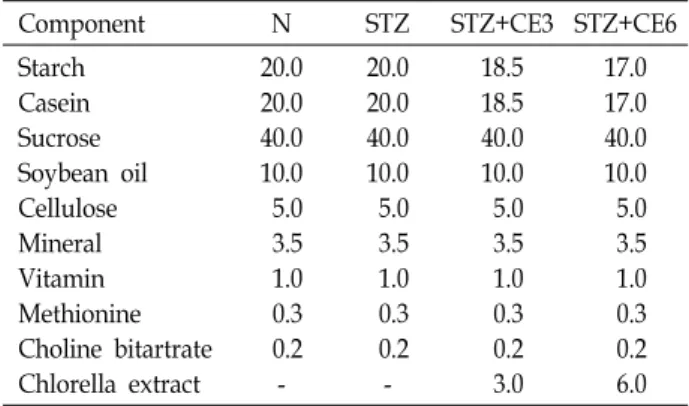
2oC, 습도 50±5%, 명암주기 12시간(명주기: 07:00~19:00)이 조절되는 동물 사육실에서 사육하였다. 당뇨 유발은 6주령까 지 환경에 충분히 순화시킨 후 16시간 절식시키고 streptozo- tocin (STZ)을 0.01 M citric acid 반응액(pH 4.5)에 60 mg/kg B.W 농도로 용해하여 1회 복강 주사하여 당뇨를 유발시켰 다. STZ 복강 주사 후 24시간째 꼬리 정맥에서 채혈하여 혈 당 측정계(SureStep PlusTM, LIFESCAN, Johnson & Johnson, USA)로 측정하여 비공복 혈당이 300 mg/dl 이상인 것만 당 뇨쥐로 판정하고 각군의 평균 혈당이 비슷하도록 하여 6마리 씩 실험군으로 각각 나누었다. 실험군은 일반 조제식이 투여 정상 N군 및 STZ-당뇨군, 클로렐라 추출물 분말 3% 및 6%
첨가 식이 투여 STZ+CE3군 및 STZ+CE6군으로 나누어 4주 간 실험하였다(Table 1). 실험식이 중 클로렐라 첨가 농도 수 준은 간 독성 실험에서 5% 및 10% 투여[35], 고지혈증 유발 쥐에서 Chlorella pyrenoidosa 분말 1.8% 및 7.2% 투여[7], STZ- 당뇨쥐에 Chlorella pyrenoidosa 분말 7.3% 투여[26] 및 고콜레 스테롤 실험쥐에 Chlorella pyrenoidosa 분말 10% 투여 농도를
Table 1. Compositions of experimental diet (%)
Component N STZ STZ+CE3 STZ+CE6
Starch Casein Sucrose Soybean oil Cellulose Mineral Vitamin Methionine Choline bitartrate Chlorella extract
20.0 20.0 40.0 10.0 5.0 3.5 1.0 0.3 0.2 -
20.0 20.0 40.0 10.0 5.0 3.5 1.0 0.3 0.2 -
18.5 18.5 40.0 10.0 5.0 3.5 1.0 0.3 0.2 3.0
17.0 17.0 40.0 10.0 5.0 3.5 1.0 0.3 0.2 6.0 N: Normal
STZ: Streptozotocin Control
STZ+CE3: Streptozotocin + Chlorella Hot Water Extract 3%
STZ+CE6: Streptozotocin + Chlorella Hot Water Extract 6%
고려하였다[33]. 실험 식이를 투여한 6주령부터 매주 1회씩 일정한 시간에 체중을 측정하였고, 식이 및 음료 섭취량은 매일 측정하여 급여량과 잔여량의 차이로 계산하였다.
분석 시료의 조제
실험 식이 투여 4주 후 최종일에 실험 동물을 12시간 이상 절식시킨 후 디에틸 에테르로 가볍게 마취시켜 복부 대동맥 으로부터 채혈하였다. 얻어진 혈액은 약 30분간 실온에서 방 치시킨 후 3,000 rpm에서 15분간 윈심분리 하여 혈청을 얻어 혈청생화학 분석에 사용하였다. 췌장은 적출 한 후 냉각된 0.9% 생리식염수로 충분히 세척하고 물기를 제거한 다음 지 방 등을 깨끗하게 정리하여 무게를 측정하고, 조직 검사에 제공하였다.
혈청 생화학적 분석
인슐린 농도는 실험 최종일의 혈청에서 TIA법(면역현탁 침전법)에 따라 측정하였고, 최근 몇 주일 동안의 혈당 조절 능력을 반영해주는 검사 지표인 fructosamine 농도는 혈액 분석전문 기관인 Neodin의학연구소(Seoul, Korea)에 의뢰하 여 측정하였다.
혈당 농도 측정
실험동물의 혈당은 비공복 시(non-fasting blood glucose) 및 공복 시(fasting blood glucose)로 나누어서 측정하였다.
비공복시 혈당은 실험시작과 실험식이 투여 후 1주 간격으로 꼬리로부터 전혈을 이용하여 혈당 측정계로 측정하였다. 공 복 시 혈당 측정은 실험 식이를 마지막 투여한 후 12시간 이 상 절식시킨 상태에서 해부 시 얻은 혈액으로 측정하였다.
경구 당내성 검사(Oral glucose tolerance test, OGTT) 실험식이 투여 3주째에 12시간 이상 절식시킨 후 꼬리정
맥에서 채혈하여 공복시 혈당을 측정한 후 glucose (1 g/kg B.W.) 용액을 경구투여기로 투여하고 30, 60, 90, 120 및 150 분에 꼬리정맥에서 채혈하여 혈당 측정계(SureStep PlusTM, LIFESCAN, Johnson & Johnson, USA)를 이용하여 혈당을 측정하였다.
뇨당 측정
실험식이 투여 최종 전일에 케이지부터 수집된 뇨로부터 뇨당 농도를 Hexokinase/G6P-DH assay법에 의해 조제된 시판 kit (Boehringer Mannheim, Germany)로 측정하였다.
췌장 조직의 면역 조직학적 관찰
췌장 조직을 적출하여 4%의 paraformaldehyde를 사용하 여 24시간 동안 고정시켰다. 고정된 췌장 조직으로부터 12 μm 두께의 조직절편을 작성하고, 이들 절편을 free-fat slide에 부 착시켰다. 이들을 33oC 조직 신전기에서 2시간 동안 조직을 말린 후 이들 슬라이드 표본을 Harris hematoxlyin에 2분간 염색한 후 흐르는 수돗물에 수세하였다. 1% HCl에 1초간 침 적 시켰다가 재빨리 꺼내 흐르는 물에 수세한 후, 암모니아 수로 30초간 중화시킨 후 다시 흐르는 물에 5분간 수세하였 다. 탈수과정으로 95% alcohol에 2회에 걸쳐 2분씩 반응시킨 후, 100% alcohol에 2회에 걸쳐 2분씩 반응시켰다[27]. 투명 과정으로 Xylene 2단계를 2분씩 거친 후, 통상적인 방법에 따라 영구 표본을 제작하여 광학현미경으로 검경한 후 사진 을 촬영하였다.
통계 처리
실험으로부터 얻어진 결과치는 one-way ANOVA에 의한 평균치와 표준오차(mean±S.E.)로 표시하고, 각 실험 군간의 유의성은 p<0.05 수준에서 Duncan's multiple range test로 검정하였다[11].
결과 및 고찰
체중, 식이 및 물 섭취량 변화
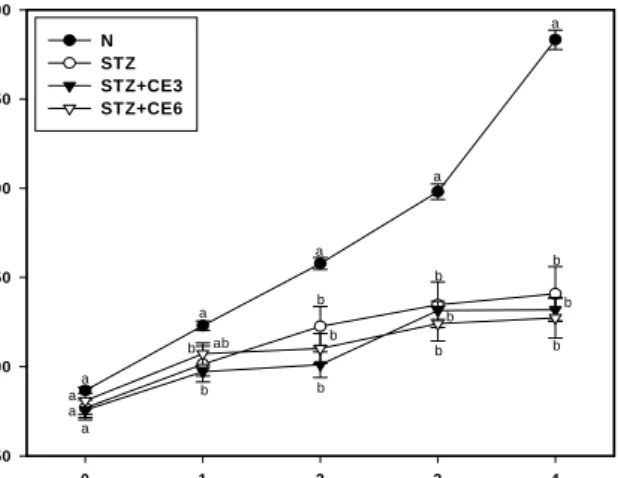
일반 식이를 투여한 정상 N군에서는 경시적으로 체중이 증가하였으나, STZ-Control군에서는 체중 증가가 정상 N군 에 비해 둔화되는 것으로 나타났다(Fig. 1). 이러한 결과는 특 히 STZ-유발 당뇨 실험 모델쥐에서 단시간에 나타나는 전형 적인 현상으로 당질 대사의 이상에 의한 것이 주요원인으로 지적되고 있다[19,28].
정상 N군에 비해 STZ-Control군에서 식이섭취량이 유의 적으로 증가하였다(Fig. 2). 그러나 STZ-Control군에 비해 클 로렐라 투여군인 STZ+CE3군에서는 정상 N군과 차이가 없 었으나, STZ+CE6군에서는 정상 N군보다 5% 수준에서 유의 적으로 증가하고 STZ-Control군과 비슷한 경향을 보였다.
Time (Week)
0 1 2 3 4
Body weight (g)
150 200 250 300 350 400
N STZ STZ+CE3 STZ+CE6
a
a
a
a
a
b
b
b
b ab
a a a
b
b
b
b b
b b
Fig. 1. Changes of body weight in the STZ-induced diabetic rats. Values are means±SE of 6 rats per group.
Between the groups, values with different letters are significantly different at p<0.05 by Duncan's multiple range test. N: Normal, STZ: Streptozotocin control, STZ+CE3: Streptozotocin + Chlorella hot water extract 3%, STZ+CE6: Streptozotocin + Chlorella hot water ex- tract 6%
Food intake
N STZ STZ+CE3 STZ+CE6
g/day
0 5 10 15 20 25 30 35
a a
b b
Fig. 2. Food intake in the STZ-induced diabetic rats. Values are means±SE of 6 rats per group. Between the groups, val- ues with different letters are significantly different at
p<0.05 by Duncan's multiple range test. N: Normal, STZ:
Streptozotocin control, STZ+CE3: Streptozotocin + Chlorella hot water extract 3%, STZ+CE6: Streptozotocin + Chlorella hot water extract 6%
실험적으로 STZ에 의해 유발된 당뇨쥐에서는 정상쥐에 비해 수분섭취량이 4~7배 이상 증가한다고 보고 되어있다 [19,28]. 본 실험에서도 수분섭취량은 정상 N군에 비해 STZ-Control군에서 유의적으로 증가하였고(Fig. 3), 이러한 증가는 클로렐라 투여군인 STZ+CE3군 및 STZ+CE6군에서 각각 감소하는 경향을 보였다. 특히 클로렐라 투여 농도 의 존적으로 수분섭취량이 적은 것으로 나타나 당뇨 특징인 다
Water intake
N STZ STZ+CE3 STZ+CE6
ml/day
0 20 40 60 80 100 120 140 160
a
b
ab
ab
Fig. 3. Water consumption in the STZ-induced diabetic rats.
Values are means±SE of 6 rats per group. Between the groups, values with different letters are significantly different at p<0.05 by Duncan's multiple range test. N:
Normal, STZ: Streptozotocin control, STZ+CE3: Strep- tozotocin + Chlorella hot water extract 3%, STZ+CE6:
Streptozotocin + Chlorella hot water extract 6%
뇨증상을 고려해 볼 때 당뇨개선 효과를 나타낸 것으로 사료 되어 진다.
비공복 시 혈당량(Non-fasting blood glucose) 변화
비공복 시 혈당치를 1주 간격으로 매주 측정한 결과 초기 혈당치에서는 당뇨군 간에 큰 차이가 없었으나, 시간이 경과 함에 따라 STZ-Control군에서는 경시적으로 혈당치 증가가 확인되었다(Fig 4). 그러나 클로렐라 투여군인 STZ+CE3군 및 STZ+CE6군에서는 2주째부터 혈당치가 감소하기 시작하 여 STZ-Control군과 큰 차이를 보이기 시작하였다. 비공복 시 당뇨 대조군 보다 클로렐라 투여군에서 혈당치가 많이 낮 아지는 것은 당질 소화 과정에서 소화효소의 저해에 의한 흡 수 저하로 사료되며, 특히 식물성 화합물은 소장에서 당질 분해 효소인 α-amylase, sucrase 및 α-glucosidase의 활성을 저해시킴으로서 혈당치를 저하시키는 것으로 보고되고 있다 [1]. 그러나 클로렐라 7.3%를 11주간 투여한 STZ-유발 당뇨 쥐에서는 혈당치 농도 감소효과가 없다고 하여 본 실험 결과 와 다른 경향을 보였다[31]. 클로렐라는 alloxan으로 유발시 킨 당뇨쥐에서도 항당뇨 효과가 있다고 하였다[30].
공복 시 혈당량(Fasting blood glucose) 변화
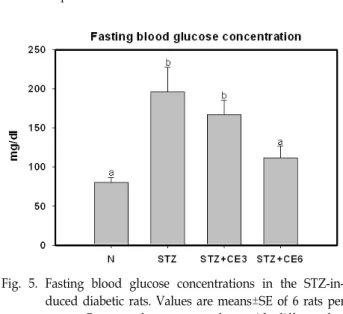
클로렐라 식이를 4주간 섭취시킨 후 12시간 이상 절식시 킨 상태에서 공복 시 혈당치를 측정한 결과, 정상 N군은 100 mg/dl 이하로 정상적인 혈당치 수준을 보였다(Fig. 5). 정상 N군에 비해 STZ-Control군에서는 혈당치가 현저히 증가하 였다. 이러한 혈당치의 증가는 클로렐라 투여군인 STZ+CE3 군 및 STZ+CE6군에서 각각 감소경향을 보였고, 클로렐라 투 여 농도 의존적으로 감소하였다.
Fig. 4. Changes of non-fasting blood glucose concentrations in the STZ-induced diabetic rats. Values are means±SE of 6 rats per group. Between the groups, values with dif- ferent letters are significantly different at p<0.05 by Duncan's multiple range test. NS: Not significant, N:
Normal, STZ: Streptozotocin control, STZ+CE3: Strepto- zotocin + Chlorella hot water extract 3%, STZ+CE6:
Streptozotocin + Chlorella hot water extract 6%
Fig. 5. Fasting blood glucose concentrations in the STZ-in- duced diabetic rats. Values are means±SE of 6 rats per group. Between the groups, values with different let- ters are significantly different at p<0.05 by Duncan's multiple range test. N: Normal, STZ: Streptozotocin control, STZ+CE3: Streptozotocin + Chlorella hot wa- ter extract 3%, STZ+CE6: Streptozotocin + Chlorella hot water extract 6%
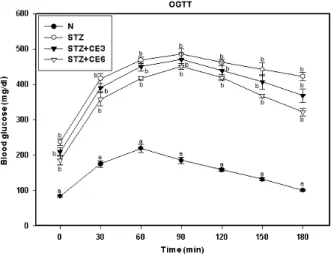
경구당 내성 검사(Oral glucose tolerance test, OGTT) 클로렐라 추출물이 당뇨쥐의 내당능에 미치는 영향을 검 토하기 위하여 실험식이 투여 3주째에 12시간 이상 절식시킨 공복상태에서 포도당(1 g/kg body weight) 용액을 경구투여 한 후 경시적으로 꼬리정맥으로부터 채혈하여 혈당치를 측 정한 결과는 Fig 6과 같다. 정상 N군에서는 포도당 투여 후 60분에 가장 높은 혈당치를 보였으나, 당뇨 실험군에서는 모
Fig. 6. Blood glucose response to the oral glucose tolerance test (OGTT) in the STZ-induced diabetic rats. Values are means±SE of 6 rats per group. Between the groups, values with different letters are significantly different at p<0.05 by Duncan's multiple range test. N:
Normal, STZ: Streptozotocin control, STZ+CE3: Strep- tozotocin + Chlorella hot water extract 3%, STZ+CE6:
Streptozotocin + Chlorella hot water extract 6%
두 90분대에 가장 높은 혈당치를 보였다가 차츰 낮아지는 경 향을 나타내었다. STZ-Control군에 비해 클로렐라 투여군인 STZ+CE3 및 STZ+CE6군에서 혈당치의 증가가 약간 낮은 것 으로 나타났으나 통계상의 현저한 차이는 없었다. 한편 STZ- 유발 당뇨 마우스에 클로렐라 100 mg/kg B.W.을 경구투여 한 후 포도당을 0.5 mg/kg B.W.으로 복강 주사하여 경시적 으로 검토한 결과 대조군으로 투여한 물 투여군보가 150분까 지 낮은 혈당치를 유지한 것으로 밝혀져 본 실험 결과와 유 사한 결과를 보였다[6].
인슐린 농도 변화
클로렐라 열수 추출물에는 클로렐라 세포에 함유된 양질 의 풍부한 단백질, 미네랄, 비타민이 함유되어 있으므로 영양 학적으로 우수할 뿐만 아니라 인슐린 대사과정 조절과 혈당 강하 인자로서 작용할 가능성이 있는 아미노산, 미네랄, 식이 섬유소, 클로로필 등이 많이 들어 있다[6,20,34].
인슐린 농도는 정상 N군에 비해 STZ-Control군에서 5%
수준에서 유의적으로 낮아지는 것으로 나타났으나(Fig. 7), 이러한 감소는 클로렐라 투여군에서 농도 의존적으로 증가 하였는데, 특히 STZ+CE6군에서는 정상군 수준까지 인슐린 농도가 증가 하여 혈당치의 변화와 비례한 것으로 나타났다.
따라서 클로렐라 추출물 투여에 의해서 인슐린 합성의 증가 로 혈중 인슐린 농도가 높아짐으로써 혈당이 조절된 것으로 사료되어 클로렐라 추출물에 인슐린 증강 작용이 있을 것으 로 여겨진다. STZ-유발 마우스에서 클로렐라 100 mg/kg B.W.을 경구투여 한 후 인슐린을 복강 주사하여 경시적으로
Fig. 7. Concentrations of serum insulin in the STZ-induced di- abetic rats. Values are means±SE of 6 rats per group.
Between the groups, values with different letters are significantly different at p<0.05 by Duncan's multiple range test. N: Normal, STZ: Streptozotocin control, STZ+CE3: Streptozotocin + Chlorella hot water extract 3%, STZ+CE6: Streptozotocin + Chlorella hot water ex- tract 6%
혈당치의 변화를 검토한 결과 클로렐라를 투여 60분 정도에 서 거의 정상군까지 낮아지다가 차츰 증가하는 것으로 나타 나 인슐린의 작용을 활성화 시킬 가능성 높은 것으로 사료되 어 진다[6]. 이와 같이 클로렐라에는 췌장에서 인슐린 합성 능력을 향상시키는 작용과 인슐린의 작용을 활성화시키는 작용이 동시에 있음으로서 혈당치를 조절하는 것으로 여겨 져 당뇨병 환자에 있어서도 혈당강하 효과를 발휘하는 것으 로 생각되어진다. 한편, 클로렐라에는 단백질 유래의 다양한 아미노산 및 미네랄 물질이 많이 함유되어 있어서 인체 내 췌장 세포에서 인슐린 생산과 분비를 촉진시키고 각 조직에 서 인슐린을 활성화하여 당대사를 원활히 시켜 혈당을 조절 해줄 가능성이 있을 것으로 본다[6]. 따라서 실험적 STZ-유 발 당뇨쥐에서 췌장의 췌도 베타-세포의 독성을 완화시키는 작용으로 인해 췌장의 조직을 회복시키고 인슐린 분비량을 증가시킴으로써 혈당을 떨어트려 당뇨를 개선시킬 가능성이 있어 당뇨조절 건강기능식품 개발에 활용할 가치가 있을 것 으로 사료 된다.
Fructosamine 농도 변화
후락토사민은 당뇨병 환자의 혈당조절 지표가 되는 검사 항목으로 최근 1~3주의 혈당 조절정도를 반영하는 지표로 사용되고 있으며, 후락토사민은 혈청 단백이 포도당과 결합 한 것으로 혈청단백의 반감기가 약 17일이므로 후락토사민 치는 과거 17일간의 혈당 조절 능력을 반영하는 것이다. 후 락토사민은 정상치가 205~285 μmol/l이며 식사나 다른 여 러 외부 조건에 의해 일시적으로 큰 변동이 없기 때문에 당 뇨병의 장기적인 치료의 조절 지표로 아주 유용하게 이용 되
Fig. 8. Concentrations of serum fructosamine in the STZ rats. Values are means±SE of 6 rats per group.
Between the groups, values with different letters are significantly different at p<0.05 by Duncan's multiple range test. N: Normal, STZ: Streptozotocin control, STZ+CE3: Streptozotocin + Chlorella hot water extract 3%, STZ+CE6: Streptozotocin + Chlorella hot water extract 6%
고 있다[9,10]. 본 실험에서 후락토사민 농도는 정상 N군에 가장 낮은 농도를 나타내었고, STZ-Control군에서 높은 농도 를 나타내었다(Fig. 8). 그러나 이러한 STZ-Control군에서 증 가한 후락토사민 농도는 클로렐라 추출물에 의해 감소하는 경향을 보였으며, 이러한 감소 효과는 농도 의존적으로 감소 하여 혈당치의 변화와 잘 일치하는 것으로 나타났다.
뇨 당(Urinary glucose) 농도 변화
뇨 당은 실험 3주째 사육 케이지로부터 뇨를 회수하여 측 정한 결과 정상N군에 비해 STZ-Control군에서 현저히 증가 하여 당뇨 증상을 잘 나타내었다(Fig. 9). 그러나 STZ- Control군에서 증가된 뇨당은 클로렐라 추출물 투여로 감소 하였으며, 특히 6% 투여군인 STZ+CE6군에서 5% 수준에서 유의적으로 감소하였다.
췌장조직 베타세포 면역학적 관찰
Streprozotocin-유발 당뇨쥐는 췌장의 췌도 세포(Langer- hans islets) 안에 60~70%를 차지 베타세포에 독성을 발휘 하여 파괴시킴으로써 인슐린 생성과 분비가 적어져 결국 혈 중 인슐린 농도가 낮아지면서 혈당조절 실패로 고 혈당을 유지하게 되는 전형적인 제1형 당뇨 실험 동물 모델이다 [23,27].
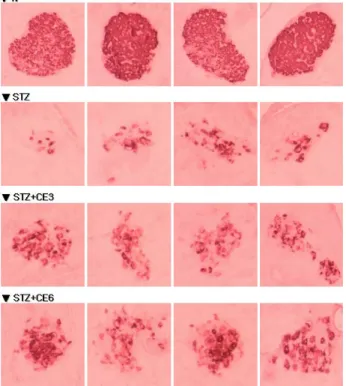
정상 N군의 췌장의 췌도세포가 정상적으로 분포하고 있 고 베타세포도 전반적으로 많이 관찰되고 또한 둥근 형태를 잘 유지하고 있다(Fig. 10). STZ-Control군에서는 STZ의 독 성으로 인해 인슐린을 분비하는 베타세포가 심하게 파괴되 어 극소수 존재하게 됨으로서 면역 반응성 또한 매우 미약하
Fig. 9. Concentrations of urinary glucose concentration in the STZ rats Values are means±SE of 6 rats per group.
Between the groups, values with different letters are significantly different at p<0.05 by Duncan's multiple range test. N: Normal, STZ: Streptozotocin control, STZ+CE3: Streptozotocin + Chlorella hot water extract 3%, STZ+CE6: Streptozotocin + Chlorella hot water ex- tract 6%
Fig. 10. Histopathological comparison of pancreas sections (200×
magnification) from the STZ-induced diabetic rats. N:
Normal, STZ: Streptozotocin control, STZ+CE3:
Streptozotocin + Chlorella hot water extractt 3%, STZ+
CE6: Streptozotocin + Chlorella hot water extract 6%
였다. 이와 같이 STZ로 고혈당이 유발된 당뇨쥐에서는 베타 세포가 파괴되어 인슐린 생성 및 분비가 극히 저조하여 그 결과 혈당량이 증가한 것으로 보인다. 그러나 클로렐라 추출
물 투여군에서는 농도 의존적으로 췌도세포 내 베타세포 수 가 많아지면서 당뇨 대조군보다는 췌도세포의 정상적인 형 태를 유지하고 있어 클로렐라 추출물이 STZ에 의해 파괴된 베타세포를 회복시키는 효능이 강한 것으로 보여 진다. 따라 서 클로렐라 추출물은 STZ-유발 제1형 당뇨를 개선시키는 작용이 강한 것으로 사료되어 진다.
요 약
클로렐라의 생리활성작용 중 인슐린작용 활성 및 항당뇨 효능이 보고된 바 있으나 클로렐라 열수 추출물(Chlorella hot water extract, CE)에 의한 혈당치 조절에 관한 연구는 보고된 바 없다. 따라서 본 실험에서는 실험적인 당뇨유발 물질 streptozotocin (STZ)을 성장기 SD계 수컷 흰쥐에 단회 복강 주사하여 당뇨를 유발시킨 CE 무첨가 STZ-Control군, CE 3% 첨가 STZ+CE3군 및 CE 6% 첨가 STZ+CE6군, 그리 고 정상군(Normal군)으로 실험 설계하여 4주간 식이와 함 께 물을 자유 급여하였다. 공복 및 비공복시 혈당치는 정상 군보다 당뇨 대조군에서 현저히 증가하여 당뇨 유발이 확인 되었고, 이러한 혈당치 증가는 클로렐라 열수 추출물 분말 3% 첨가 STZ+CE3군 및 6% 첨가 STZ+CE6군에서 각각 감 소하였다. 혈중 인슐린 농도는 당뇨 대조군에서 낮게 나타 났으나 클로렐라 열수 추출물 분말 첨가식이 투여군들에서 인슐린 농도 감소현상이 상쇄되었다. 또한 정상군보다 STZ- 당뇨 대조군에서 Fructosamine 및 뇨당이 증가하였으나, 클 로렐라 추출물 투여 STZ+CE3군 및 STZ+CE6군에서 감소하 는 경향을 나타내었고, 특히 이러한 효과는 클로렐라 열수 추출물 첨가농도 의존적이었다. 클로렐라 추출물 투여군에 서 혈당치 감소의 기작을 검토하기 위하여 인슐린 합성과 분비에 관여하는 췌장의 췌도 베타세포의 면역반응에 의한 조직검사에서 정상군의 정상적인 둥근 모양의 형태를 잘 유 지하고 있었으나, STZ-당뇨 대조군에서는 베타세포가 심하 게 파괴되어 극소수 존재함으로서 면역 반응성이 매우 미약 하였다. 그러나 클로렐라 열수 추출물 투여군에서 농도 의 존적으로 베타세포가 많아지면서 정상군과 비슷한 췌도 세 포의 형태를 유지하고 있었다. 클로렐라 열수 추출물은 STZ 에 의해 파괴된 베타세포를 회복시키는 효능이 강한 것으로 보여 진다. 이러한 결과는 클로렐라 열수 추출물에 의해 인 슐린을 생산해 내는 췌도 베타세포가 회복됨에 따라 인슐린 증강 작용으로 혈당치 강하 효과가 실험 동물을 통하여 확 인되었다.
감사의 글
본 연구는 2007년도 (재)부산테크노파크에서 시행한 산학 공동기술혁신사업의 연구 결과이며 이에 감사드립니다.
References
1. Andrade-Cetto, A., J. Becerra-Jiménez and R. Cárdenas- Vázquez. 2008. Alfa-glucosidase-inhibiting activity of some Mexican plants used in the treatment of type 2 diabetes.
J. Ethnopharmacol. 116, 27-32.
2. Annual report on the cause of death statistics. 2005.
National Statistical Office, Republic of Korea.
3. Borowitzka, M. A. 1988. Vitamins and fine chemicals from micro-algae. In Borowitzka, M. A. and L. J. Borowitzka (eds), Micro-algal Biotechnology, Cambridge University Press, New York. pp. 153.
4. Cha, J. Y., Y. T. Kim, H. S. Kim and Y. S. Cho. 2008.
Antihyperglycemic effect of stem-bark powder from paper mulberry (Broussonetia kazinoki Sieb.) on type 2 diabetic Otsuka Long-Evans Tokushima Fatty (OLETF) rats. J.
Medicinal Food 11, 499-505.
5. Cha, J. Y, B. S. Jun, C. H. Lee, G. S. Yu, J. C. Moon and Y. S. Cho. 2005. Hypoglycemic and antioxidative effects of fermented chaga mushroom (Inonotus obliquus) on strepto- zotocin-induced diabetic rats. J. Life Sci. 15, 809-818.
6. Cherng, J. Y. and M. F. Shih. 2005. Preventing dyslipidemia by Chlorella pyrenoidosa in rats and hamsters after chronic high fat diet treatment. Life Sci. 76, 3001-3013.
7. Cherng, J. Y. and M. S. Shih. 2006. Improving glycogenesis in Streptozocin (STZ) diabetic mice after administration of green algae Chlorella. Life Sci. 78, 1181-1186.
8. Cosio, F. G., Y. Kudva and M. Velde, T. S. Larson, S. C.
Textor, M. D. Griffin and M. D. Stegall. 2005. New onset hyperglycemia and diabetes are associated with increased cardiovascular risk after kidney transplantation, Kidney Int.
67, 2415-2421.
9. De Michele, G., M. Correale, O. De Michele, V. Guerra, R.
Mazzarelli and G. Misciagna. 2008. Evaluation of serum bio- markers in nutritional disorders: Glycated apolipoprotein B, fasting serum glucose, fructosamine, stable and labile gly- cated hemoglobin in diabetic and non-diabetic subjects.
Immunopharmacol. Immunotoxicol. 15, 1-12.
10. Di Mauro, M., D. Lazzarini, P. Fumelli, F. Carle and A.
Kosmidis. 2007. Bioelectrical impedance analysis and dia- betes mellitus: which correlation among fructosamine, gly- cosylated haemoglobin and exchangeable potassium.
Minerva Med. 98, 633-638.
11. Duncan, D. B. 1959. Multiple range and multiple F tests.
Biometrics 1, 1-42.
12. Guzman, S., A. Gato, M. Lamela, M. Freire-Garabal and J.
M. Calleja. 2003. Anti-inflammatory and immunomodula- tory activities of polysaccharide from Chlorella stigmatophora and Phaeodactylum tricornutum. Phytother. Res. 17, 665-670.
13. Hanley, A. J., S. B. Harris, M. Mamakeesick, K. Goodwin, E. Fiddler, R. A. Hegele, J. D. Spence, A. A. House, Ed Brown, B. Schoales, J. R. McLaughlin, R. Klein and B.
Zinman. 2005. Complications of type 2 diabetes among abo- riginal Canadians: prevalence and associated risk factors.
Diabetes Care 28, 2054-2057.
14. Hasegawa, T., Y. Kimura, K. Hiromatsu, N. Kobayashi, A.
Yamada, M. Makino, M. Okuda, T. Sano, K. Nomoto and Y. Yoshikai. 1997. Effects of hot water extract of Chlorella
vulgaris on cytokine expression patterns in mice with mur-
ine acquired immunodeficiency syndrome after infection with Listeria monocytogenes. Immunopharmacology 35, 273-282.15. Hasegawa, T., M. Okuda, K. Nomoto and Y. Yoshikai. 1994.
Augmentation of the resistance against Listeria mono-
cytogenes by oral administration of a hot water extract of Chlorella vulgaris in mice. Immunopharmacol. Immunotoxicol.
16, 191-202.
16. Hidaka, S., Y. Okamoto and M. A. Arita. 2004. Hot water extract of Chlorella pyrenoidosa reduces body weight and se- rum lipids in ovariectomized rats. Phytother. Res. 18, 164-168.
17. Jay, D., H. Hitomi and K. K. Griendling. 2006. Oxidative stress and diabetic cardiovascular complications. Free Radic.
Biol. Med. 40, 183-192.
18. Jeon, B. S., J. W. Park, B. K. Kim, H. K. Kim, T. S. Jung, J. R. Hahm, D. R. Kim, Y. S. Cho and J. Y. Cha. Fermented mushroom milk supplemented dietary fiber prevents the onset of obesity and hypertriglyceridemia in Otsuka Long-Evans Tokushima Fatty (OLETF) rats. Diabetes Obesity
Metabol. 7, 709-715.
19. Jeong, J. J., Y. T. Kim, W. S. Seo, H. Y. Yang, Y. S. Lee and J. Y. Cha. 2006. Hypoglycemic and hepatoprotective ef- fects of betaine on streptozotocin-induced diabetic rats. J.
Life Sci. 16, 767-772.
20. Kay, P. A. 1991. Microalgae as food and supplement. Crit.
Rev. Food Sci. Nutr. 30, 555-573.
21. Konishi, F., K. Tanaka, K. Himeno, K. Tagniguchi and K.
Nomoto. 1985. Antitumor effect induced by a hot water ex- tract of Chlorella vulgaris (CE): resistance to Meth-A tumor growth mediated by CE-induced polymorphonuclear leukocyres. Cancer Immunol. Immunother. 19, 73-78.
22. Lee, H. S., C. Y. Choi, C. Cho and Y. Song. 2003. Attenuating effect of Chlorella supplementation on oxidative stress and NFkappaB activation in peritoneal macrophages and liver of C57BL/6 mice fed on an atherogenic diet. Biosci.
Biotechnol. Biochem. 67, 2083-2090.
23. Lee, S. H. and I. S. Park. 2000. Effects of soybean diet on the β cells in the streptozotocin treated rats for induction of diabetes. Diabetes Res. Clin. Practice 47, 1-13.
24. Merchant, R. E., C. A. Andre and D. A. Sica. 2002.
Nutritional supplementation with Chlorella pyrenoidosa for mild to moderate hypertension. J. Med. Food 5, 141-152.
25. Miranda, M. S., S. Sato and J. Mancini-Filho. 2001.
Antioxidant activity of the microalage Chlorella vulgaris cul-
tured on special conditions. Boll. Chem. Farm. 140, 165-168.
26. Okudo, M., T. Hasegawa, M. Sonoda, T. Okabe and M.
Tanaka. 1975. The effects of Chlorella on the level of choles- terol in serum and liver. Jap. J. Nutr. 33, 3-8.
27. Park, I. S., Y. Z. Che, Bendayan, S. W. Kang and B. H. Min.
1999. Up-regulation of clusterin (sulfated glycoprotein-2) in pancreatic islet cells upon streptozotocin injection to rats.
J. Endorinol. 162, 57-65.
28. Preton, A. M., J. Tome, J. J. Morales, L. Milan, A. A. Cuevas, J. Medina and J. A. Santiago. 1991. Diabetic parameters 58 weeks after injection with streptozotocin in rats fed basal diet supplemented with fiber, mineral and vitamins. Nutr.
Res. 11, 895-906.
29. Queiroz, M. L., C. Bincoletto, M. C. Valadares, D. C. Dantas and L. M. Santos. 2002. Effects of Chlorella vulgaris extract on cytokines production in Listeria monocytogenes infected mice, Immunopharmacol. Immunotoxicol. 24, 483-496.
30. Rodriguez-Lopez, M. and C. Lopez-Quijada. 1971. Plasma glucose and plasma insulin in normal and alloxanized rats treated with Chlorella. Life Sci. 10, 557-608.
31. Shibata, S., Y. Natori, T. Nishihara, K. Tomisaka, K.
Matsumoto, H. Sansawa and V. C. Nguyen. 2003.
Antioxidant and anti-cataract effects of Chlorella on rats with streptozotocin-induced diabetes, J. Nutr. Sci. Vitaminol. 49, 334-339.
32. Shibata, S., K. Oda, N. Onodera-Masuoka, S. Matsubara, H.
Kikuchi-Hayakawa, F. Ishikawa, A. Iwabuchi and H.
Sansawa. 2001. Hypocholesterolemic effect of indigestible fraction of Chlorella vulgaris in cholesterol-fed rats. J. Nutr.
Sci. Vitaminol. 47, 373-377.
33. Shibata, S., K. Hayakawa, Y. Egashira and H. Sanada. 2007.
Hypocholesterolemic mechanism of Chlorella: Chlorella and its indigestible fraction enhance hepatic cholesterol catabo- lism through up-regulation of cholesterol 7alpha-hydrox- ylase in rats. Biosci. Biotechnol. Biochem. 71, 916-925.
34. Schubert, L. E. 1988. The use of Spirulina (Cyanophycaea) and Chlorella (Chlorophyceae) as food resource for animals and humans. In Round, F. E. and D. J. Chapman (eds.), pp. 237, Progressing physiological research, Biopress Ltd.
35. Shim, J. Y., H. S. Shin, J. G. Han, H. S. Park, B. L. Lim, K. W. Chung and A. S. Om. 2008. Protective effects of
Chlorella vulgaris on liver toxicity in cadmium-administered
rats. J. Med. Food 11, 479-485.36. Tanaka, K., A. Yamada, K. Nada, Y. Shoyama, C. Kubo and K. Nomoto. 1997. Oral administration of a unicellular green algae, Chlorella vulgaris, prevents stress-induced ulcer. Plant