논토양 종류가 메탄배출에 미치는 영향
서영진*·박준홍·김찬용·김종수·조두현·최성용·박소득·정현철1·이덕배1·김광섭2·박 만2
경상북도농업기술원, 1국립농업과학원, 2경북대학교
Effects of Soil Types on Methane Gas Emission in Paddy During Rice Cultivation
Young-Jin Seo*, Jun-Hong Park, Chan-Yong Kim, Jong-Su Kim, Doo-Hyun Cho, Seong-Yong Choi, So-Deuk Park, Hyun-Cheol Jung
1, Deog-Bae Lee
1, Kwang-Seop Kim
2, and Man Park
2Institute of Gyeongsangbukdo Agricultural Research and Extention Services, Daegu, 702-708, Korea
1
National Institute of Agricultural Science and Technology, RDA, Suwon, 441-707, Korea
2
College of Agriculture and life science, kyungpook National University, Daegu, 702-701, Korea
Anaerobic decomposition of organic materials in flooded rice fields produces methane (CH
4) gas, which escapes to the atmosphere primarily by transport through organs of the rice plants such as arenchyma etc., Although the annual amount of methane emitted from a given area is influenced by cultivation periods of rice and organic/inorganic amendments etc., soil type also affects methane emission from paddy soil during a rice cultivation. A field experiment was conducted to evaluate effects of soil type on CH
4emission in two paddy soils. One is a red-yellow soil classified as a Hwadong series (fine, mixed, mesic family of Aquic Hapludalfs), and the other is a gley soil classified as a Shinheung series (fine loamy, mixed, nonacid, mesic family of Aeric Fluvaquentic Endoaquepts). During a flooded periods, redox potentials of red-yellow soil were significantly higher than gley soil. CH
4emission in red-yellow soil (0.21 kg ha
-1day
-1) was lower than that in gley soil (5.25 kg ha
-1day
-1). In the condition of different soil types, CH
4emissions were mainly influenced by the content of total free metal oxides in paddy soil. The results strongly imply that iron- or manganese-oxides of well ordered crystalline forms in soil such as goethite and hematite influenced on a CH
4emission, which is crucial role as a CH
4oxidizers in paddy soil during a rice cultivation.
Key words: Methane, Rice, Greenhouse gas emission, Red yellow soil, Gley soil
접수 : 2011. 11. 17 수리 : 2011. 12. 8
*연락저자 : Phone: +82533200269 E-mail: [email protected]
서 언
농업부문에서 배출되는 온실가스는 크게 메탄 (CH4)과 아산화질소 (N2O)로 구분되며 (IPCC, 1995; Rodhe, 1990) CH4은 이산화탄소에 이어 2번째로 지구온난화 효과가 높은 온실가스이다 (Karl et al., 2003). 특히 메탄배출의 70% 정 도가 인간의 활동에 의한 것으로 알려져 있는데 전세계에서 년간 25~100 Tg의 메탄이 논토양에서 배출되는 것으로 보 고되고 있으며 (IPCC, 1995), 우리나라에서는 2006년도에 약 6,717천 CO2톤에 해당하는 메탄이 벼 재배동안 배출되는 것으로 조사되었다 (NIAST, 2009a).
논토양이 관개수 또는 강우에 의해 담수상태가 되면 환 원조건이 형성되고 O2, NO3-
, Mn (IV), Fe (III), SO42-
와 같 은 전자수용체가 이용이 되어 고갈이 되면 토양중 탄소물
질이 환원되어 메탄이 생성되는 것으로 알려져 있다. 논토 양으로 부터 대기중으로 메탄의 방출은 확산 (molecular diffusion), 거품 (ebullition as gas bubble), 벼를 통한 배 출 (rice mediated transport) 등의 여러 가지 경로가 있으나 벼의 통도조직을 통한 배출이 전체의 90% 이상을 차지하는 것으로 보고되어 있고 벼 품종 및 재배기간에 따라 메탄배 출에 큰 영향을 미치는 것으로 알려져 있다 (Butterbach- Bahl et al., 1997; Cicerone and Shetter, 1981; Hosono and Nouchi, 1997; Iversen and Jorgensen, 1985). 또한 무기질 비료와 유기물 첨가, 물관리 방법, 토양온도, 그리고 토양미 생물 뿐 만 아니라 메탄의 생성, 산화와 배출 등에 영향을 주는 토양의 물리화학적 특성도 매우 중요한 요인으로 평가 되고 있다 (Bachelet et al., 1995; Bodelier et al., 2000;
Cao et al., 1998; Huang et al., 1998; Knox et al., 2000;
Matthews et al., 2000; Minami, 1995; Schutz et al., 1990;
Van Bodegom et al., 2002; Wassmann et al., 2000; Yan et al., 2003; Yang and Chang, 1999).
Table 1. Physico-chemical properties of paddy soils used in experiment.
Soil type pH OM Avail. P2O5
Exch. Cation
Avail. SiO2 Soil texture
K Ca Mg
(1:5) g kg-1 mg kg-1 --- cmolc kg-1 --- mg kg-1
Red-yellow soil 5.7 23.0 56 0.27 6.20 1.76 175 SiCL
Gley soil 7.0 41 1,129 2.16 9.99 3.27 1.78 SiL
논토양의 이화학적 특성은 토양의 생성요인에 따라 차이 가 나게 된다. 우리나라에서는 주로 하천이나 강을 따라 형 성된 하성평탄지, 선상지, 곡간지 등에 분포하여 토층의 발 달이 적은 미숙토로 정의되고 있는 충적토 (Alluvial soil)와 평탄저지, 곡간저지대에서 지하수위의 영향을 장기간 받아 반문이 적은 토양의 색이 회색계인 회색토 (Gley soil) 그리 고 저구릉지, 산록, 홍적대지에 분포하며 토색이 붉은 적황 색토 (Red yellow soil)가 논토양의 대부분을 차지하고 있다 (NIAST, 1992). 특히 적황색토는 적철광 (Fe2O3), Limonite (2Fe2O3・H2O)에서 기인한 유리철 함량이 높은 토양인 반면, 전국에 90만 ha 이상 분포하는 회색토는 지하수위가 높아 장기간 환원상태로 인한 2가철 함량이 높은 특성을 나타내 고 있다. 적황색토는 주로 분포하는 단구지토양은 전국에 약 10만 ha 정도가 분포하며, 특히 영남지역에서 전국의 약 36%가 분포되어 있다 (Jung, 1986).
따라서 토양특성이 상이한 적황색토와 회색토에서 토양 중 철, 망간 함량과 존재형태에 따른 메탄 배출양상을 조사 하고자 본 연구를 수행하였다.
재료 및 방법
시험포장 및 공시토양 본 시험은 대구광역시 북구 칠 곡중앙대로길 136길 47번지에 위치하고 있는 경상북도농업 기술원 포장 (북위 : 35°57′02″, 경도 : 128°33′52″, 해발고도 50 m)에서 시험을 수행하였다. 시험토양의 조사지점의 토양 분류는 농업과학기술원의 토양통 설명서 (NIAST, 2000a)를 이용하여 분류를 하였다. 적황색토 (Red-yellow soil)는 홍 적대지에 분포된 식질계 적황색토인 화동통 (fine, mixed, mesic family of Aquic Hapludalfs)에 해당되며 본 시험 이전 까지 작물을 재배하지 않은 나지상태의 토양이었고, 회색토 (Gley soil)는 하성평탄지에 분포된 신흥통 (fine loamy, mixed, nonacid, mesic family of Aeric Fluvaquentic Endoaquepts) 으로 배수가 약간 불량한 논토양으로 현재까지 벼를 계속 재배하고 있는 논토양이었다. pH는 적황색토 5.7, 회색토 6.5로 적정수준인 5.5~6.5의 범위였고 유기물은 적황색토 23.0 g kg-1, 회색토 22.7 g kg-1로 비슷한 함량을 나타내었 으며 적황색토의 표토의 토성은 점토함량이 311 g kg-1의 미 사질식양토이었고, 회색토는 점토함량이 156 g kg-1인 미사 질양토였다 (Table 1).
재배방법 및 시비조건 벼는 칠보벼 (Oryzae sativa L.
cv. Chilbobyeo)를 공시하여 45일간 육묘한 후 주당 4~5본 씩 재식거리 30×14 cm로 6월 1일에 손으로 이앙하였으며, 삼 요소의 성분별 시비량은 질소 90 kg ha-1, 인산 45 kg ha-1, 칼리 57 kg ha-1을 시용하였다. 이앙 7일전에 논에 물을 대 어 경운 후 써레질을 실시하였으며 재배기간 동안 중간 물 떼기를 하지 않고 상시담수 상태를 유지하였으며, 이앙 118 일경에 낙수를 실시하였다.
토양화학성, 메탄농도 및 통계분석 시험전 토양의 분석은 농업과학기술원의 토양 및 식물체 분석법 (NIAST, 2000b)에 준하여 실시하였으며, 토양 pH는 초자전극법, 유 기물함량은 Tyurin법, 유효인산은 Lancaster법으로 분석하 였고, 치환성 양이온 함량은 1M NH4OAc 용액 (pH 7.0)으로 추출하여 원자흡광분석기 (Analyst 800, Perkin Elmer, USA) 로 분석하였으며, 토성은 비중계법으로 측정하였다. 산화환 원전위는 Rowell (1994)의 방법에 따라 분석하였으며 백금 전극을 이용하여 측정하였다. 논토양으로 부터 발생되는 메 탄가스 채취와 분석은 Ko et al. (2011)의 방법에 준하여 실 시하였다. 메탄가스 시료채취는 polyacrylic plastic 재질의 밀폐식 chamber (60 cm × 60 cm × 100 cm)를 이용하였으 며 메탄가스는 오전 10시경 부터 30분간 포집하였으며 삼방 밸브가 장착된 60 ml polypropylene 주사기로 채취하여, 시 료채취 당일에 불꽃이온화검출기 (Flame Ionization Detector, FID)가 장착된 가스크로마토그래프 (Agilent GC6890, USA) 를 사용하여 분석하였다. CH4 분석을 위해 Porapak Q column (Stainless steel, 1/8"×2 m) 칼럼을 사용하였으며 column oven 온도는 40℃, injector 온도는 50 ℃, detector 온도는 250℃로 분석하였다. 토양중 함유된 total Fe와 Mn함량은 Giesler et al. (2000)의 방법에 따라 토양에 진한 질산을 가 하여 마이크로웨이브 분해장치로 분해한 후 유도결합플라 즈마분석기 (Optima 3200 RL, Perkin Elmer, USA)를 이용하 여 분석하였다. 유리태 산화물 (total free oxides)는 Citrate- bicarbonate-dithionite법으로 분석하였고 (Bech et al., 1997), 0.5 M HCl로 추출하여 활성태 산화물 (Active oxide) 함량을 구하였다 (Thompson et al., 2006). 시험구는 완전임의배치 법 3반복으로 하였으며, 처리평균간 유의성검증을 위해서 T-test를 실시하였다.
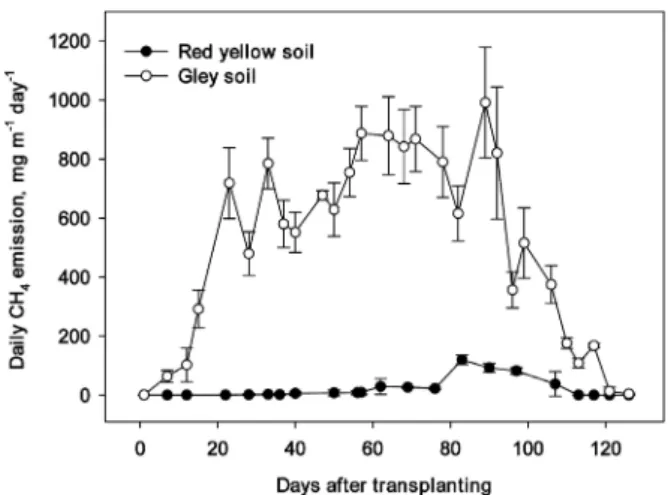
Fig. 1. Seasonal pattern of daily CH
4emission from paddy soils. Data points represent the mean value and standard deviation (n=3).
Fig. 2. Seasonal pattern of surface soil redox potential at 10 cm depth during the rice growth season. Data points represent the mean value and standard deviation (n=3).
Fig. 3. Effect of soil type on CH
4emissions during the rice growth seasons.
결과 및 고찰
메탄 배출량 및 산화환원전위 적황색토와 회색토에 서 벼 재배시 생육시기별 메탄배출 양상은 큰 차이를 나타 내었다 (Fig. 1). 회색토에서는 이앙 10일 이후 부터 메탄배 출이 급격히 증가하여 이앙 20일 이후에는 조사시점의 기상 요인에 따른 메탄배출량 편차는 있었지만 700~900 mg m-1 day-1의 메탄 배출량을 나타낸 반면, 적황색토에서는 이앙 후 80일 경까지는 100 mg m-1 day-1 미만의 메탄 배출량을 나타내었다. 재배기간중 논토양의 산화환원전위는 회색토에 서 이앙 후 약 7일경 -133 mV로 낮아진 후 이앙 20일 경부 터 50일경 까지는 -200 mV 이하의 환원상태를 유지하였으 나, 적황색토에서는 이앙 30일경 까지 -100 mV 보다 높은 산화환원전위를 나타내었고 그 후 부터는 -30 ~ -100 mV 를 나내었다 (Fig. 2).
Figure 3의 내용과 같이 적황색토의 경우 벼 재배기간중 메탄배출량은 0.21 kg ha-1 day-1인 반면 회색토에서의 메 탄배출량은 5.25 kg ha-1 day-1로 유의한 배출량 차이를 보 였다 (P<0.0001). 이와 같은 메탄배출 양상과 산화환원전위 변동에 대한 결과는 본 연구와 동일한 적황색토로 분류된 곳에서 실시한 연구결과와는 매우 상이한 결과를 나타내고 있는데, 이앙재배시에는 276~402 kg ha-1 day-1로 본 연 구결과보다 약 27배 이상 높은 메탄 배출량이 나타났다 (NIAST, 2009b). 또한, Kim (2009)은 본 연구와 동일한 적 황색토인 화동통에서 상시담수 조건하에 실험한 결과 산화 환원전위는 -129~-366 mV로 중간낙수 처리구에 비해 낮 게 형성되었으며 메탄의 배출양상은 생육초기에는 이후 처 리간 다소 차이는 있지만 혐기상태에서 유기물 분해특성에 따라 메탄의 배출양상이 영향을 받으며, 수온, 토양온도와는 상관성이 다소 낮은 것으로 보고하였다. Lee et al. (2005) 은 산화환원전위를 조절하여 벼를 재배할 경우 -200 mV에 서 -300 mV로 낮추었을 때 메탄의 생성이 10배 정도 증가 하며, 볏짚을 시용하지 않았거나 포장용수량에 해당하는 토 양수분 함량을 조절한 처리에서는 산화환원전위가 상대적 으로 높았고 메탄배출량은 낮다고 보고하였다. 따라서 메탄 의 배출량은 토양의 산화환원전위 변화와 매우 높은 관련성 을 나타내며 토양중 메탄이 생성되기 위해서는 -200 mV 이 하로 되어야 하며, 메탄생성을 위한 토양의 산화환원전위는 -150 mV라는 연구결과를 종합하면 토양의 산화환원전위가 메탄배출을 조절하는 주요 인자로 사료된다. Kim (2009)의 연구결과와 상이한 메탄배출 양상은 메탄배출에 기질이 되 는 토양중 유기물의 조성도 관련성이 있는 것으로 사료된 다. 안정동위원소 (stable isotope) 분석으로 매년 새롭게 투 입된 유기물은 탄소화합물로 쉽게 분해되어 토양의 조건에 따라 CO2 또는 CH4로 배출된다는 결과 (Trumbore, 1995)와 논토양에서 토양유기물 증가는 벼 뿌리의 바이오매스 유입 에 의해 큰 영향을 받는다는 보고 (Lee et al., 2009)로 미루
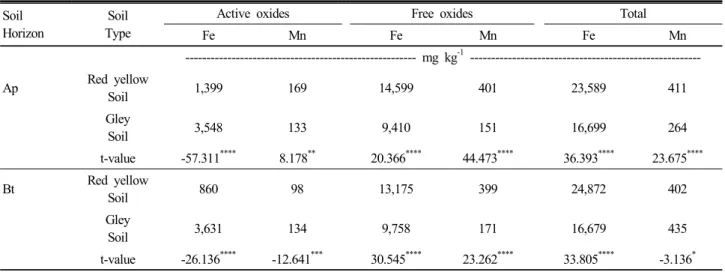
Table 2. Contents of active metal oxides, total free metal oxides and total metal used selective dissolution procedures in paddy soil before flooding.
Soil Horizon
Soil Type
Active oxides Free oxides Total
Fe Mn Fe Mn Fe Mn
--- mg kg-1 ---
Ap Red yellow
Soil 1,399 169 14,599 401 23,589 411
Gley
Soil 3,548 133 9,410 151 16,699 264
t-value -57.311**** 8.178** 20.366**** 44.473**** 36.393**** 23.675****
Bt Red yellow
Soil 860 98 13,175 399 24,872 402
Gley
Soil 3,631 134 9,758 171 16,679 435
t-value -26.136**** -12.641*** 30.545**** 23.262**** 33.805**** -3.136*
†*, **, ***, **** are significantly different at p<0.05, p<0.01, p<0.001, p<0.0001 by t-test.
어 본 연구에 공시된 적황색토는 그동안 벼 재배가 이루어 지지 않은 논토양이기 때문에 토양중 유기물은 분해가 다소 느린 유기물이 주를 이룰 것으로 추정된다. 따라서 벼 뿌리 의 유입에 따른 년차간 메탄배출량 변화에 대한 조사가 이 루어져야 할 것으로 사료된다.
토양중 철, 망간함량 적황색토와 회색토의 토양 층위별 철, 망간함량을 조사한 결과는 Table 2와 같다. 토양중 철, 망 간의 형태는 산화환원전위와 pH에 영향을 받으며, 산화조건 에서는 Fe-, Mn-oxides로 존재한다. Geothite, Hematite와 같은 산화물 들은 산화조건에서 well-ordered crystalline form으로 존재하고 Ferrihydrite는 산환환원전위의 변화가 있는 곳에서 주로 존재하며, 입자의 크기가 10 nm 이하로서 short range crystalline order를 가지며 layer sillicate, armorphous sillicate 등에 존재하는 것으로 알려져 있다 (Loeppert and Inskeep, 1996). 쉽게 환원될 수 있는 oxide (labile) 함량을 조사하기 위하여 Active oxide를 분석한 결 과, 표토의 Active Fe은 적황색토 1,399 mg kg-1에 비해 회 색토에서 3,548 mg kg-1로 유의하게 높았으며 (P<0.0001), 심토에서도 적황색토 860 mg kg-1에 비해 회색토에서 3,631 mg kg-1로 유의하게 높았다 (P<0.0001). Active Mn은 표토 에서는 적황색토에서 169 mg kg-1으로 회색토의 133 mg kg-1 보다 다소 높았으나 (P<0.01) 심토에서는 적황색토 98 mg kg-1에 비해 회색토는 134 mg kg-1으로 높은 경향을 나타내 었다 (P<0.001). Geothite, Hematite 등의 상대적인 안정성이 높은 oxide를 나타내는 Free oxide 함량을 조사한 결과, 표 토의 Free Fe는 적황색토 14,599 mg kg-1로 회색토에 9,410 mg kg-1에 비해 유의하게 높았고, 심토에서도 같은 경향을 나타내었다. 또한, Free Mn 함량도 적황색토에서 표토와 심 토 공히 높은 함량을 나타내었다. 회색토의 경우 지대가 다
소 낮은 곳에 위치하기 때문에 B층의 경우 지하수위의 영향 으로 3가 철이 환원되어 2가철로 존재하며, 비담수기간에는 다시 3가철로 존재하게 된다. 그러므로 회색토에서는 Table 2의 결과와 같이 쉽게 환원될 수 있는 형태인 Ferrihydrite 의 형태로 존재할 가능성이 매우 높다. 따라서 적황색토는 비교적 안정된 형태의 산화물 함량이 높고, 존재량도 상태 적으로 많으므로 토양이 담수될 경우 전자수용체의 역할을 하는 산화물의 역할이 회색토에 비해 큰 편으로 사료된다.
따라서 적황색토에 함유된 Free metal oxide의 함량이 벼 재 배기간중 메탄배출에 큰 영향을 미치는 것으로 사료된다.
요 약
논토양 종류가 메탄배출에 미치는 영향을 구명하기 위하 여 적황색토인 화동통과 회색토인 신흥통을 공시하여 벼 재 배기간중 메탄배출량, 산화환원전위 및 토양중 산화물 함량 을 분석하였다. 적황색토에서 메탄배출이 회색토에 비해 유 의하게 낮았으며, 산화환원전위는 상대적으로 높았다. 적황 색토는 회색토에 비해 쉽게 환원될 수 있는 Active oxide 함 량은 낮은 반면, 상대적으로 안정성이 높은 Free oxide의 함 량이 높았다. 따라서 논토양 종류별 메탄배출은 벼 재배기 간중 산화환원전위와 토양중 Geothite, Hematite 등과 같은 메탄산화제의 함량에 영향을 받는 것으로 나타났다.
사 사
본 논문은 농촌진흥청 공동연구사업 (과제번호: PJ0067 84022011)의 지원에 의해 이루어진 것임.
인 용 문 헌
Bachelet, D., J. Kern, and M. Tolg. 1995. Balancing the rice carbon burget of irrigated rice in China using spacially distributed data. Ecol. Model. 79:167-177.
Bech, J., J. Rustullet, J. Garrigo, F.J. Tobias, and R. Martinez.
1997. The iron content of some red Mediterranean soils from northeast Spain and its pedogenic significance. Catena.
28:211-229.
Bodelier, P.L., P. Roslev., T. Henckel, and P. Frenzel. 2000.
Stimulation by ammonium based fertilizers of methane oxidation in soil around rice roots. Nature. 403:421-424.
Butterbach-Bahl, K., H. Papen, and H. Rennenberg. 1997.
Impact of gas transport through rice cultivars on methane emission from rice paddy fields. Plant cell Environ. 20:
1175-1183.
Cao, M.K., K. Gregson, and S. Marshall. 1998. Global methane emission from wetlands and its sensitivity to climate change.
Atmos. Environ. 32:3293-3299.
Cicerone, R.J. and J.D. Shetter. 1981. Source of atmospheric methane measurements in rice paddies and a discussion.
J. Geophys. Res. Oceans Atmos. 86:7203-7209.
Giesler, R., H. Ilvesniemi, L. Nyberg, P. van Hees, M.
Starr, K. Bishop, T. Kareinen, and U.S. Lundstrom. 2000.
Distribution and mobilization of Al, Fe, and Si in three podzolic soil profiles in relation to the humus layer. Geoderma.
94:249-263.
Hosono, T. and I. Nouchi. 1997. The dependence of methane transport in rice plants on the root zone temperature. Plant Soil 191:233-240.
Huang, Y., R.L. Sass, and F.M. Fisher. 1998. Model estimates of methane emission from irrigated rice cultivation of China.
Global Change Biol. 4:809-821.
IPCC. 1995. Climate change, 1994 : Radiation forcing of climate change and an evaluation of the the IPCC IS92 emission secinario. Cambridge University Press, Cambridge, england.
New York. P. 399.
Jung, Y.T. 1986. Characteristics and genesis of terraces soils in Yeongnam area. V : Soil genesis and classification.
Korean J. Soil Sci. Fert. 19(4):275-282.
Karl, T.R. and E.T. Kevin. 2003. Modern global climate change.
Science 302:1719-1723.
Kim, G.Y. 2009. Emission and evaluation of greenhouse gas (CO2, CH4, N2O) in paddy and upland field. p. 25-29.
Ph.D. Thesis. Chungbuk National University. Cheongju, Korea.
Knox, J.W., R.B. Mattews, and R. Wassmann. 2000. Using a crop/soil simulation model and GIS techniques to assess methane emissions from rice fields in Asia. III. Databases.
Nutr. Cycl. Agroecosyst. 58:179-199.
Ko, J.Y., J.S. Lee, K.S. Woo, S.B. Song, J.R Kang, M.C.
Seo, D.Y. Kwak, B.G. Oh, and M.H. Nam. 2011. Effects of
soil organic matter contents, paddy types and agricultural climatic zone on CH4 emissions from rice paddy field. Korean J. Soil Sci. Fert. 44(5):887-894.
Lee, G.B., J.G. Kim, C.W. Park, Y.K. Shin, D.B. Lee, and J.D.
Kim. 2005. Effects of irrigation water depth on greenhouse gas emission in paddy field. Korean J. Soil Sci. Fer. 38(3):
150-156.
Lee, S.B., C.H. Lee, K.Y. Jung, K.D. Park, D.K. Lee, and P.J. Kim. 2009. Changes of soil organic carbon and its fractions in trlation to soil physical properties in a long- term fertilizerd paddy. Soil Till. Res. 104:227-232.
Loeppert, R.H. and W.P. Inskeep. 1996. Iron. p. 639-664. In D.L. Sparks et al.(ed.). Method of soil analysis., part 3.
Chemical methods. Soil Science Society of America. Madison, WI, USA.
Mattews, R.B., R. Wassmann, and J. Arah. 2000. Using a crop/soil simulation model and GIS techniques to assess methane emissions from rice fields in Asia. I. Model development. Nutr. Cycl. Agroecosyst. 58:141-159.
Minami, K. 1995. The effect of nitrogen fertilizer use and pther practices on methane emission from flooded rice.
Fertilizer Res. 40:71-84.
NIAST. 1992. Introduction of Korean soil. National Institute of Agricultural Science and Technology, Suwon, Korea (In Korean).
NIAST. 2000a. Taxonomical classification of Korean soil.
National Institute of Agricultural Science and Technology, Suwon, Korea.
NIAST. 2000b. Method of analysis soil and plant. National Institute of Agricultural Science and Technology, Suwon, Korea (In Korean).
NIAST. 2009a. Estimating greenhouse gas emissions and removals in croplands. p. 11-15. National Institute of Agricultural Science and Technology, Suwon, Korea (In Korean).
NIAST. 2009b. Technique of rice cultivation for reducing a greenhouse gas emissions. p. 29-30. National Institute of Agricultural Science and Technology, Suwon, Korea (In Korean).
Rodhe, H. 1990. A comparison of the contribution of various gases to the greenhouse effect. Science. 247:1217-1219.
Rowell, D.L. 1994. Air in soils-Supply and demand. p.
125-129. Soil Science : Method and applications. Longman Scientific and Technical, Larlow, Essex, England.
Schutz, H., W. Seiler, and R. Conrad. 1990. Influence of soil temperature on methane emission from paddy fields.
Biochemistry. 11:77-95.
Thompson, A., O.A. Chadwick, D.G. Rancourt, and J.
Chorover. 2006. Iron oxide crystallinity increases during soil redox oscillations. Geochimica et Cosmochimicha Acta.
70:1710-1727.
Trumbore, S.E. 1995. Use of isotopes and tracers in the study
of emission and consumption of trace gases in terrestrial environments. p. 291-326. In Matson, P.A. and R.C. Harriss.
(ed.). Biogenic trace gases : Measuring emission from soil and water. Blackwell science Ltd. Osney Mead, Oxford, UK.
Van Bodegom, P., J. Goudriaan, and P. Leffelaar. 2001. A mechanistic model on methane oxidation in a rice rhizosphere.
Biochemistry. 55:145-177.
Wassmann, R., H.U. Neue, R.S. Lantin, L.V. Buendia, and H. Rennenberg. 2003. Characterization of methane emissions
from rice fields in Asia. I. Comparison among field sites in five countries. Nutr. Cycl. Agroecosyst. 58:1-12.
Yan, X.Y., T. Ohara, and H. Akimoto. 2003. Development of region specific emission factors and estimation of methane emission from rice fields in East, Southeast and South Asian countries. Global Change Biol. 9:237-254.
Yang, S.S. and H.L. Chang. 1999. Diurnal variation of methane emission from paddy fields at different growth stages of rice cultivation in Taiwan. Agric. Ecosyst. Environ.
76:75-84.