지속가능한 친환경 한우 사양 전략 수립을 위한 일당증체량과 도체 특성에 관한 상관성*
1)
박명선
**․전은정
**․한재규
**․김정용
**․원미영
***Correlation of Effective Average Daily Gain and Carcass Traits for Sustainable Hanwoo Steers Feeding Strategy
Park, Myungsun․Jeon, Eunjeong․Han, Jaekyu․Kim, Joung-Yong․Won, Mi-Young
The present study investigated the effect of average daily gain (ADG) on carcass traits of Hanwoo steers. A total of 233 heads of Hanwoo steer slaughtered from 2017 to 2020 were employed in the analysis. Their body weight profiles during feedlot and carcass traits were used. The entire feedlot period is split into two periods. ADG during the first period (ADG1) was then defined as an independent variable in statistical analysis. In the meantime, it was examined that how the cutoff month for the period split altered the significance of the effect of ADG1 on carcass traits. Subsequently, steers were assigned to two groups (High vs. Low) based on the median of total ADG1, and we compared the carcass traits of each group using a linear mixed model. ADG1 during 10 to 23 months showed a significant effect on all carcass traits except the marbling score. ADG1 significan- tly influenced carcass weight and eye muscle area of Hanwoo steers. And it was found that greater ADG1 could get greater carcass weight and eye muscle area (p<0.001). The result of this study provides preliminary information for the target month in the calculation of ADG1 mostly influencing carcass performance, and feeding strategy of Hanwoo steer in terms of sustainability.
Key words : average daily gain, carcass traits, Hanwoo steers
***
본 연구의 데이터 분석에 도움을 주신 조상범 박사님께 감사의 마음을 전합니다. 또한 본 결과물은
농림축산식품부의 재원으로 농림식품기술기획평가원의 농생명산업기술개발의 사업의 지원을 받아 연구되었습니다(315017-5).
***
전북대학교 축산학과 박사과정
***
Corresponding author, 전북대학교 동물자원과학과 연구교수([email protected])
Ⅰ. 서 론
경제성과 생산성의 향상은 농가 소득 향상뿐만 아니라 지속가능한 친환경 축산을 위한 접근 방법이다. 경제성과 생산성이 낮다는 것은 섭취된 영양소와 비교해서 생산성이 떨어 진다는 것이다. 즉 영양소 이용 효율이 낮아 섭취한 영양소가 체내에 축적되기보다는 분 중으로 배출된다는 것이다. 결국 생산성은 낮아지고 환경오염은 악화될 것이다.
한우 생산성은 도체 등급과 육질 등급으로 결정된다. 도체중(carcass weight, CWT), 등심 단면적(eye muscle area, EMA), 등지방두께(backfat thickness, BFT) 그리고 근내지방도 (marbling score, MSC)에 의해 도체 판매가격이 결정되고, 판매가격은 한우 농가 수익을 결 정하게 된다(Lee et al., 2008; NIAS, 2017). 생산성을 높이기 위해서는 우수한 도체 및 육질 성적을 획득해야 한다.
도체 성적 향상을 위해 다양한 영양학적 접근이 시도되고 있다. 비육기간 동안 영양소 섭취량을 늘려 일당 증체량을 증가시키는 방법이 제시된 바 있다. 그리고 단백질 섭취량에 따라서 비육우 일당 증체량이 변화할 수 있다(Martin et al., 1979; Byers and Moxon, 1980;
Perry et al., 1983; Rossi et al., 2000; Ponnampalam et al., 2003). 그러면 평균 7개월에서 30 개월 동안 비육하는 한우 거세우에 있어 과연 어느 기간의 일당 증체량이 도체 성적에 큰 영향을 미칠 것인가? 만약 전체 비육 기간 동안 어느 기간에 조단백질 섭취량을 증가 시키 면 우수한 도체 성적을 얻을 수 있을까? 비육기간별 성장 특징과 각 기간별 일당증체량 (average daily gain, ADG)이 도체 성적에 미치는 효과에 대한 정보는 단백질 섭취량을 집중 적으로 늘려야 하는 구간 정보를 제공할 수 있다. 이러한 정보가 부족하다면 상대적으로 도체 성적에 미치는 영향이 낮은 구간에도 많은 단백질이 투입될 수 있다. 과도한 단백질 섭취는 결국 질소 배출량 증가로 이어지고, 다시 환경오염의 문제를 초래할 수 있다(Abbasi et al., 2018). 즉 비육 기간별 일당 증체량이 도체 성적에 미치는 영향에 대한 정보는 지속 가능한 친환경 축산 및 사양관리에 있어 중요한 자료로 활용될 수 있을 것이다.
본 연구는 한우 거세우 비육 기간별 일당 증체량이 도체 특성에 미치는 영향을 알아보았 다. 전체 비육기간을 두 개의 기간으로 분리하고, 첫 번째 기간의 평균 일당증체량이 도체 특성에 미치는 영향을 알아보았다. 비육 기간의 분리 기준과 평균 일당 증체량과 도체 특 성의 상관성 등을 조사하였다.
Ⅱ. 재료 및 방법
1. 데이터2017년부터 2020년도에 도축된 한우 거세우 233두의 체중변화와 도체 성적 자료를 분석 에 사용하였다. 도체 성적으로는 CWT, EMA, BFT 및 MSC를 사용하였다.
2. 평균 일당 증체량 계산 기준 설정
한우 거세우의 평균 ADG와 도체 성적의 상관성 분석을 위해 10개월령에서 도축 시까지 의 기간을 두 구간으로 구분하였다. 그리고 전반기 기간의 평균 일당 증체량(ADG1, eq. 1) 과 도체 성적 특징 간의 상관성을 분석하였다. 기간 구분 개월령을 변수(i)로 하고 ADG1과 도체성적의 선형회귀 분석을 실시하였다(eq. 2). 그리고 변수 i를 독립변수로 그리고 분석 결과로 얻어진 결정계수와 확률값을 종속변수로 데이터 시각화를 진행하였다(eq. 3). 마지 막으로 가장 높은 결정계수값 혹은 유의적인 확률값이 얻어진 변수 i를 기간 구분 개월령 으로 결정하였다.
×
eq (1)
× eq (2)
× eq (3)
ADG1, average daily gain for first period; BW, body weight; i, cutoff month;
a, initial month for ADG calculation; j, animal.no; CT, carcass traits; Y, statistics for linear regression (e.g, R2 or probability); β, coefficients; ε, error.
3. 통계 분석
ADG1이 도체 성적에 미치는 효과는 선형혼합모형(linear mixed model)을 이용하여 분석 하였다. 고정효과로는 ADG1을 사용하였고 임의효과로는 도축 개월령을 설정하였다. ADG1은 전체 중앙값을 기준으로 두 집단(High, Low)으로 분류하여 분석에 사용하였다. 데이터 정 리, 시각화 및 분석은 R (version 4.0.3)과 Python (version 3.9.1)을 사용하였다(R core Team, 2013).
Ⅲ. 결 과
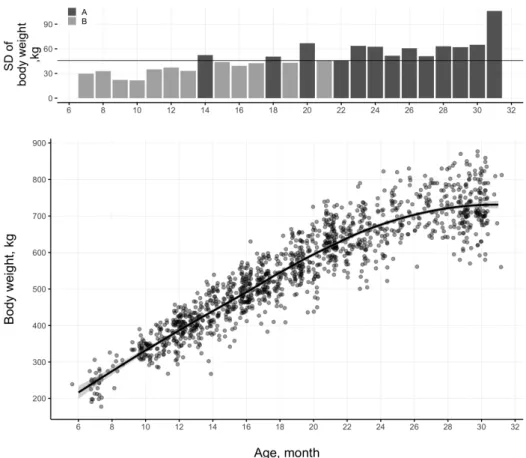
1. 데이터 특성분석에 사용된 한우 거세우의 체중 변화는 Fig. 1에서 보는 것과 같다. 추세선 분석결과 24개월령 이후에 체중 증가가 완만해지는 것을 알 수 있었다. 개월령별 개체 체중의 차이 는 22개월령 이후에 커지는 것으로 나타났다. 도체 특성 데이터의 기술 통계량은 Table 1에 서 보는 것과 같다. 변이계수(coefficient of variation, CV) 값이 가장 큰 도체 특성은 BFT로 나타났으며, 다음으로는 MSC의 차이가 큰 것으로 나타났다.
Fig. 1. Growth curves for the Hanwoo steers in this study.
The bar plot shows the standard deviation of body weights and a solid line in horizontal indicates the median of standard deviation for all ages. A, higher than the median of standard deviation for body weight; B, lower than the median of standard deviation for body weight.
Table 1. Descriptive statistics for the data
Traits N Mean SD CV Min. 1
stQu. Median 3
rdQu. Max.
CWT, kg 233 432.06 42.23 9.77 323.00 405.00 427.00 454.00 557.00 EMA, cm
2233 90.91 11.29 12.42 65.00 84.00 92.00 97.00 128.00 BFT, mm 233 13.75 4.81 34.98 4.00 11.00 13.00 17.00 34.00
MSC 233 5.95 1.74 29.24 2.00 5.00 6.00 7.00 9.00
CWT, carcass weight; EMA, Eye muscle area; BFT, backfat thickness; MSC, marbling score; SD, standard deviation; CV, coefficient of variation; Min, minimum; 1st Qu, the first quartile; 3rd Qu, the third quartile; Max, maximum.
2. 일당증체량의 기간 구분 개월령이 도체 성적에 미치는 효과
한우 거세우 10개월령에서 도축 개월령까지를 두 단계로 구분하고, 전 단계의 평균 일당 증체량(ADG1)이 도체 성적에 미치는 효과를 조사하였다. ADG1이 도체 성적에 유의적인 영향
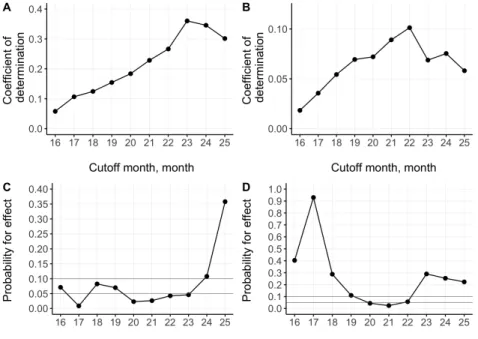
Fig. 2. Effect of the cutoff month for the end month in the calculation of average daily gain (ADG1) on the correlation between average daily gain and carcass traits.
A, changes of determination coefficient for ADG and carcass weight by cutoff month. B, changes of determination coefficient for ADG and eye muscle area by cutoff month. C, alteration of probability for the linear effect of ADG on back-fat thickness by cutoff month. D, alteration of probability for the linear effect of ADG on marbling score by cutoff month.
을 미치는 기간 구분 개월령(cutoff month, CM)을 조사하였다(Fig. 2). CWT에 미치는 ADG1 의 효과는 CM 범위 16~25 모든 구간에서 유의적인 선형효과(linear effect, eq(2), p<0.05)가 관찰되었다(data not shown). 이에 CM 변화에 따른 결정 계수(R2)를 조사한 결과 23개월령 에서 가장 높은 결정 계수값이 관찰되었다(Fig. 2A). ADG1이 EMA에 미치는 유의적인 선 형효과(p<0.05)도 CWT와 마찬가지로 모든 CM 구간에서 관찰되었다(data not shown). 그리 고 가장 높은 결정 계수값은 22개월령에서 관찰되었다(Fig. 2B). BFT에 대한 ADG1의 선형 효과는 개월령에 따라서 서로 다른 유의성이 관찰되었다. 경향성(0.05<p<0.1)을 기준으로 CM 24부터 유의적 혹은 경향적 효과가 없는 것으로 관찰되었다(Fig. 2C). MSC의 경우, CM 22~24구간에서만 ADG1의 유의적인 혹은 경향적 선형효과(p<0.1)가 관찰되었다(Fig. 2D).
3. ADG123과 한우 도체 성적의 관계 분석
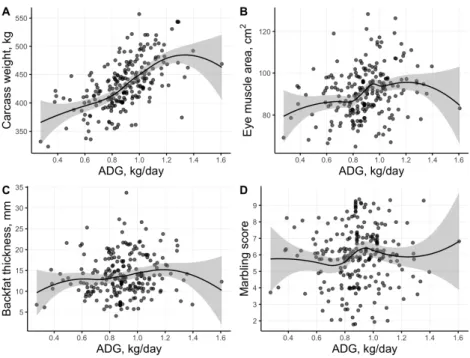
도체 성적과 ADG1의 유의적인 관계를 나타내는 CM으로 23을 설정하였고, ADG123과 각 도체성적의 관계를 분석하였다(Fig. 3). CWT, EMA, BFT 그리고 MSC 중에서 ADG123과 가장 선형적 관계가 높은 것으로 CWT가 관찰되었다(Fig. 3A). 특히 ADG123 0.6~1.1 사이에 서 선형적 관계가 높게 나타났다.
Fig. 3. Effects of ADG123 on carcass traits of Hanwoo steer.
Solid lines on the plot are a trend line estimated by the local regression model and the grey area around the trend line indicates standard error. ADG, average daily gain.
4. 도체 성적들의 상관성
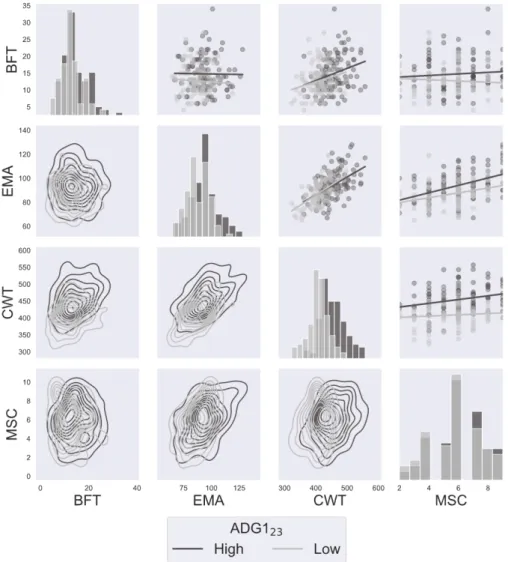
측정된 ADG123은 전체 중앙값을 기준으로 high ADG123 (H-ADG1, 중앙값 이상), low ADG123 (L-ADG1, 중앙값 이하)으로 구분하였다. 도체 성적들 간의 상관성은 Fig. 4에서 보는 것과 같다. CWT와 EMA간의 선형적 상관성이 관찰되었다(panel R2C3). H-ADG1 그룹 의 CWT와 EMA가 L-ADG1에 비해 높게 분포하였다(panel R3C2). CWT가 증가함에 따라 BFT도 증가하는 것을 알 수 있었다(panel R1C3). CWT 범위에 관계없이 ADG123 그룹 간에
Fig. 4. Correlation between carcass traits with two groups of ADG123 (high vs. low).
The left upper panel was coded as R1C1 (row 1 and column 1, the histogram for BFT), and the right lower panel indicating histogram of MSC is coded as R4C4 in text. CWT, carcass weight. EMA, Eye muscle area. BFT, backfat thickness. MSC, marbling score.
유사한 BFT의 분포가 관찰되었다(panel R3C1). MSC와 CWT 간의 낮은 상관성이 관찰되었 고(panel R3C4), 모든 CWT 구간에서 ADG1 수준별로 유사한 MSC 분포가 관찰되었다(panel R4C3).
5. ADG123 수준이 도체 특성에 미치는 효과
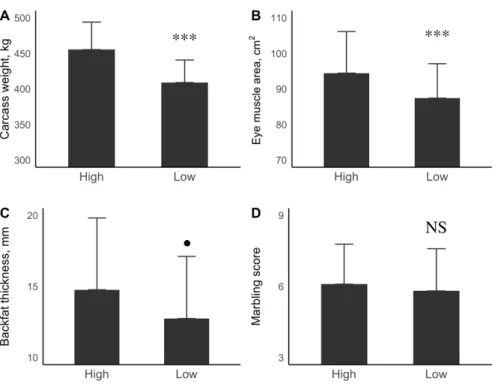
ADG123이 도체 특성에 미치는 효과를 분석하였다(Fig. 5). CWT (Fig. 5A)와 EMA (Fig.
5B)의 경우, ADG123의 유의적인 효과가 관찰되었다(p<0.001). ADG123이 증가하면 BFT도 증가하는 경향이 관찰되었다(p<0.1) (Fig. 5C). MSC에 대한 ADG123의 유의적인 효과는 관 찰되지 않았다(Fig. 5D).
Fig. 5. Effect of ADG123 levels (High and Low) on carcass traits.
For significance, ***, and NS indicates p<0.001, 0.05<p<0.1, and not significant (p>0.1), respectively.
Ⅳ. 고 찰
일반적으로 한우 거세우의 ADG는 가축이 성장함에 따라 급격하게 증가하고 성장이 완료되는 시점에서 감소한다. ADG는 생후 18개월령까지 0.8~1.0 kg/d이고 그 이후에는
0.6~0.7 kg/d로 감소한다(NIAS, 2007). ADG는 사료 영양소와 밀접한 관계를 갖고 있다. 또 한 일당증체량에 따라 도체 특성도 변화할 수 있다. 따라서 섭취량이 동일하다는 가정에서 사료 영양소의 농도는 일당증체량과 도체 특성에 영향을 미칠 수 있다. Jeong 등(2010)은 조단백질(crude protein, CP) 수준이 12.0%에서 14.0%로 증가함에 따라 ADG가 0.72 kg/d에 서 0.80 kg/d으로 증가하였고, EMA는 89.7 cm2에서 91.2 cm2로 증가, BFT는 8.6 mm에서 8.1 mm로 감소, 그리고 MSC는 4.6에서 5.5로 증가한 것으로 보고하였다. Kwon 등 (2009)의 연 구에서는 7~12개월령 CP 수준이 14.8%일 때 평균 ADG는 0.86 kg/d로 나타났고, 13~17개월 령 CP 수준이 13.2%일 때 ADG가 0.84 kg/d로 관찰되었다. 18~29개월령 CP 수준이 11.0%일 때 ADG가 0.69 kg/d로 나타났다. 그리고 평균 도체 특성은 CWT 424.5 kg, EMA 87.0 cm2, BFT 13.1 mm 및 MSC 6.1으로 나타났다. Park 등(2010)의 연구에서는 6~11개월령까지의 CP 수준이 16.4%일 때 ADG는 0.85 kg/d, 12~16개월령 CP 수준이 15.0%일 때 ADG는 0.86 kg/d 으로 나타났다. 17~21개월령 CP 수준이 14.1%일 때 ADG는 0.83 kg/d, 22~28개월령에는 0.66 kg/d으로 나타났다. 그리고 평균 도체 특성은 CWT 414.8 kg, EMA 92.6 cm2, BFT 13.2 mm 및 MSC 6.1으로 나타났다.
Chang 등(2007)은 NDF (neutral detergent fiber) 수준이 32.8%에서 39.6%로 증가함에 따라 19~23개월령의 ADG가 0.81 kg/d에서 0.84 kg/d로 증가하였고, 24~28개월령의 ADG가 0.34 kg/d에서 0.36 kg/d로 증가했다고 보고하였다. 도체 특성의 경우 CWT가 405.4 kg에서 412.2 kg로 증가하였으며, EMA 또한 84.6 cm2에서 92.5 cm2로 증가했다고 보고하였다. BFT의 경 우 10.5 mm로 동일하게 나타났고 MSC는 5.0에서 5.5로 증가했다고 하였다. Kim 등(2012) 은 사료 내 NDF 수준이 39.0%에서 53.42%로 증가함에 따라 13~18개월령의 ADG가 0.58 kg/d에서 0.61 kg/d로 증가했다고 보고하였다. 또한 19~24개월령과 25~30개월령의 NDF 수준이 증가하면 ADG가 증가하는 것으로 나타났다. 도체특성 결과에서는 CWT는 397.3 kg 에서 427.1 kg으로 증가하였고, EMA는 89.8 cm2에서 92.6 cm2로 증가했다고 하였다. BFT는 10.8 mm에서 13.4 mm로 증가하였으며, MSC는 5.81로 변화가 없는 것으로 보고하였다.
Jang 등(2016)의 연구에서는 11~18개월령 TDN (total digestible nutrient) 수준이 71.0%에서 73.1%로 증가함에 따라 ADG는 1.01 kg/d에서 1.05 kg/d로 증가했고 19~30개월령 TDN 수준 이 74.0%에서 76.2%로 증가함에 따라 ADG는 0.73 kg/d에서 0.62 kg/d으로 감소했다. CWT 는 420.8 kg에서 438.9 kg로 증가하였으며, EMA는 81.6 cm2에서 83.7 cm2로 증가했다. BFT 는 14.6 mm에서 12.6 mm로, MSC는 4.8에서 4.6으로 감소하였다. Choi 등(2016)은 22~31 개월령 TDN 수준을 74.0%에서 75.7%로 증가시킨 결과 ADG가 0.79 kg/d에서 0.84 kg/d로 증가했다고 보고하였다. 그리고 CWT는 442.0 kg에서 454.6 kg으로 EMA는 91.2 cm2에서 92.4 cm2로 변화하였다. BFT는 14.2 mm에서 15.1 mm으로 증가했고, MSC는 5.3에서 5.1로 감소했다고 보고하였다.
일당증체량과 도체 특성은 서로 상관관계를 가지고 있다. Park 등(2012)은 한우 거세우의
6~12개월령 ADG가 증가함에 따라서 CWT, EMA 및 MSC가 증가하는 것으로 보고하였다.
본 연구에서도 10~23개월령 ADG가 CWT와 EMA에 대해 유의적인 상관관계를 가지는 것 으로 나타났다.
Jang 등(2016)의 연구에서는 11~18개월령의 ADG가 1.01 kg/d에서 1.05 kg/d로 증가하고 19~30개월령 ADG가 0.73 kg/d에서 0.62 kg/d로 감소할 경우, CWT는 420.8 kg에서 438.9 kg 으로 증가, EMA는 81.6 cm2에서 83.7 cm2로 증가, BFT와 MSC는 각각 14.6 mm에서 12.6 mm, 4.8에서 4.6으로 감소한다고 보고하였다. Kim 등(2012)의 연구에서는 13~18개월령 ADG가 0.83 kg/d에서 0.93 kg/d으로 증가하고, 19~24개월령과 25~30개월령의 ADG가 각각 0.72 kg/d에서 0.82 kg/d, 0.67 kg/d에서 0.69 kg/d로 증가할 경우, CWT가 397.3 kg에서 427.1 kg으로 증가하였고 EMA와 BFT는 각각 89.8 cm2에서 92.6 cm2, 10.8 mm에서 13.4 mm로 증 가하였으며, MSC는 5.81로 동일하게 나타났다. 즉, 11~18개월령의 ADG가 증가하고 19~30 개월령의 ADG가 감소할 경우 CWT와 EMA가 증가한 반면, BFT가 감소하는 특성이 있는 것으로 나타났다. 하지만 13~18개월령과 19~24개월령 및 25~30개월령의 ADG가 증가할 경우 CWT와 EMA뿐만 아니라 BFT 또한 증가하는 것으로 나타났다.
본 연구에서는 한우 거세우의 평균 ADG를 측정하는 기준을 기간 구분 개월령으로 설정 하였다. 즉 도축전 몇 개월령까지의 ADG가 도체 특성에 영향을 미치는가를 알아보았다.
그 결과 평균 일당 증체량 산출 기준이 24개월령 이후가 된다면 평균 ADG가 도체 특성에 미치는 효과는 낮아지는 것으로 나타났다. 두 번째로 10~23개월령 사이의 평균 ADG를 증가시키면 CWT와 EMA가 증가할 확률이 높은 것으로 나타났다.
한우 거세우 23개월령 이전의 ADG가 도체 성적에 큰 영향을 미치고 있음을 확인하였다.
해당 기간의 ADG를 증가시키는 방법으로 조단백질 섭취량 증가와 적절한 NDF 공급이 필 요하다고 하였다(Chang et al., 2007; Jeong et al., 2010). 영양소 섭취 수준뿐만 아니라 비타 민 섭취 수준도 ADG에 영향을 미친다. 특히 에너지와 단백질 대사에 관여하는 비타민 B군 의 섭취가 ADG 증가와 밀접한 관련이 있다(NAIS, 2017). Leclerc 등(2015)의 연구에서는 반추위 바이패스 비타민B 복합제의 급여는 동일한 에너지와 단백질 섭취 조건에서 비육우 의 ADG를 약 10% 이상 증가시키는 것으로 나타났다.
Ⅴ. 적 요
일련의 분석결과 10~23개월령 한우 거세우의 일당 증체량이 도체 성적에 미치는 영향이 크다는 것을 알 수 있었다. 본 연구 결과는 한우 생산성 향상과 영양 및 사양관리 전략 수 립에 기초 자료로 활용될 수 있을 것이다.
[Submitted, January. 22, 2021; Revised, February. 4, 2021; Accepted, February. 9, 2021]
References
1. Abbasi, I. H. R., F. Abbasi, M. E. Abd El-Hack, M. A. Abdel-Latif, R. N. Soomro, K.
Hayat, A. E. M. Mohamed, M. B. Bodinga, J. Yao, and Y. Cao. 2018. Critical analysis of excessive utilization of crude protein in ruminants ration: impact on environmental ecosystem and opportunities of supplementation of limiting amino acids— a review. Environ.
Sci. Pollut. Res. 25(1): 181-190.
2. Byers, F. M. and A. L. Moxon. 1980. Protein and selenium levels for growing and finishing beef cattle. J. Anim. Sci. 50(6): 1136-1144.
3. Chang, S. S., Y. K. Oh, K. H. Kim, S. K. Hong, E. G. Kwon, Y. M. Cho, W. M. Cho, J. S. Eun, S. C. Lee, S. H. Choi, and M. K. Song. 2007. Effects of dietary barley on the growth performance and carcass characteristics in Hanwoo steers. J. Anim. Sci. and Technol.
49(6): 801-818.
4. Choi, C. B., H. Kwon, S. I. Kim, U. M. Yang, J. H. Lee, and E. K. Park. 2016. Effects of rice bran, flax seed, and sunflower seed on growth performance, carcass characteristics, fatty acid composition, free amino acid and peptide contents, and sensory evaluations of native Korean cattle (Hanwoo). Asian-Aust. J. Anim. Sci. 29(2): 195-203.
5. Jang, S. S., S. H. Yang, E. M. Lee, D. H. Kang, B. H. Park, H. J. Kim, E. G. Kwon, and K. Y. Chung. 2016. Change of performance, serum metabolite, and carcass characteristics on high energy diet of Hanwoo steers. Korean J. Agr. Sci. 43(5): 810-817.
6. Jeong, J., N. I. Seong, I. K. Hwang, S. B. Lee, M. S. Yu, I. S. Nam, and M. I. Lee. 2010.
Effects of level of CP and TDN in the concentrate supplement on growth performances and carcass characteristics in Hanwoo Steers during final fattening period. J. Anim. Sci. and Technol. 52(4): 305-312.
7. Kim, G. L., J. K. Kim, W. Z. Qin, J. Jeong, S. S. Jang, Y. S. Sohn, C. W. Choi, and M.
K. Song. 2012. Effect of feeding whole crop barley silage-or whole crop rye silage based- TMR and duration of TMR feeding on growth, feed cost and meat characteristics of Hanwoo steers. J. Anim. Sci. and Technol. 54(2): 111-124.
8. Kwon, E. G., B. K. Park, H. C. Kim, Y. M. Cho, T. I. Kim, S. S. Chang, Y. K. Oh, N.
K. Kim, J. H. Kim, Y. J. Kim, E. J. Kim, S. K. Im, and N. J. Choi. 2009. Effects of fattening period on growth performance, carcass characteristics and lipogenic gene expression
in Hanwoo steers. Asian-Aust. J. Anim. Sci. 22(12): 1654-1660.
9. Leclerc, H., D. A. Espinosa, E. Evans, R. Z. Gaytan, and J. de Dios Garza Flores. 2015.
Effect of rumen protected B vitamins supplementation during the receiving periods on the productive performance of beef cattle. J. Anim. Sci. 98(2): 426.
10. Lee, J. M., K. H. Hah, J. H. Kim, S. H. Cho, P. N. Seong, M. O. Jung, Y. M. Cho, B.
Y. Park, D. H. Kim, and C. N. Ahn. 2008. Study on the carcass yield grade traits and prediction of retail product weight in Hanwoo beef. Korean J. Food sci. Ani. Resour. 28(5):
604-609.
11. Martin, T. G., T. W. Perry, M. T. Mohler, and F. H. Owens. 1979. Comparison of four levels of protein supplementation with and without oral diethylstilbestrol on daily gain, feed conversion and carcass traits of bulls. J. Anim. Sci. 48(5): 1026-1032.
12. NIAS (National Institute of Animal Science). 2007. Annual Research Report.
13. NIAS (National Institute of Animal Science). 2017. The materials related animal genetic improvement.
14. Park, B. K., N. J. Choi, S. M. Lee, H. C. Kim, B. S. Jeon, M. J. Kim, Y. K. Oh, S. K.
Im, S. K. Hong, J. S. Chang, I. H. Hwang, Y. J. Kim, and E. G. Kwon. 2010. Effects of dietary multi-nutritional targeted supplementation according to different growth stages on performance and carcass characteristics of Hanwoo steers. Asian-Aust. J. Anim. Sci. 24(2):
222-229.
15. Park, B., T. Choi, J. G. Choi, Y. H. Choy, K. H. Cho, S. S. Lee, S. Kim, O. S. Kwon, S.
H. Na, Y. L. Choi, and C. Cho. 2012. Estimation of genetic parameters for average daily gain and Carcass Traits of Hanwoo. J. Anim. Sci. and Technol. 54(5): 317-321.
16. Perry, T. W., D. R. Shields, W. J. Dunn, and M. T. Mohler. 1983. Protein levels and monensin for growing and finishing steers. J. Anim. Sci. 57(5): 1067-1076.
17. Ponnampalam, E. N., B. J. Hosking, and A. R. Egan. 2003. Rate of carcass components gain, carcass characteristics, and muscle longissimus tenderness in lambs fed dietary protein sources with a low quality roughage diet. Meat Sci. 63(2): 143-149.
18. R. Core Team. 2013. R: A language and environment for statistical computing. Vienna, Austria. R Foundation for Statistical Computing. Retrived from http://www.R-project.org.
19. Rossi, J. E., S. C. Loerch, and F. L. Fluharty. 2000. Effects of crude protein concentration on diets feedlot steers fed to achieve stepwise increases in rate of gain. J. Anim. Sci.
78(12): 3036-3044.